
CHAPTER II Solving Business Problems with Information Systems
CHAPTER II Solving Business Problems with Information Systems
Solving Business Problems with Information Systems n Contents of presentation n n A systems approach to problem solving Developing Information System Solutions
A systems approach to problem solving n The scientific Method n The systems approach is based on a widely accepted problem - solving methodology known as the scientific method. n The scientific method consists the following steps: n Recognize phenomena in the real world n Formulate a hypothesis about the causes or effects of the phenomena. n Test the hypothesis through experimentation n Evaluate the results of the experiments n Draw conclusions about the hypothesis
A systems approach to problem solving…Cont’d n The systems Approach n The systems approach is a modification of the scientific method. n n n It stresses a systematic process of problem solving. Problems and opportunities are viewed in a systems context. Studying a problem and formulating a solution becomes an organized system of interrelated activities, such as:

The Systems Approach n Define a problem or opportunity in a systems context n n n Separate a problem or opportunity from its symptoms identify systems in the organization and environment and their interrelationships. determine the components, objectives, standards, and constraints of appropriate systems. n Gather data describing the problem or opportunity n use methods such as interviews, questionnaires, personal observation, examination of documents, and modeling to gather data relating to a problem or opportunity.
The Systems Approach…Cont’d n Identify alternative solutions n Propose a variety of alternative solutions based on experience, advice, intuition, creativity, simulation, etc. n Evaluate each alternative solution n Evaluate alternative solutions using criteria that reveal their advantages and disadvantages. n Select the best solution n Select the alternative solution that best meets the evaluation criteria. n Implement the selected solution n implement the selected solution according to an implementation plan. n Evaluate the success of the implemented solution n monitor and evaluate how well the implemented solution is meeting its system objectives.
The Systems Approach…Cont’d n Points to note: n n n the steps in the systems approach can overlap each other. the steps are grouped into three broad stages of problem solving. n Understanding a problem or opportunity n Developing a Solution n Implementing a Solution we discuss each step of the systems approach in more detail in the following pages.
The Systems Approach…Cont’d n Understanding a problem or opportunity n Defining problems and opportunities n n separating problems or opportunities from symptoms Identifying systems in the organization and environment Determining objectives, standards, and constraints Gathering Data and Information
Understanding a problem or opportunity Defining problems and opportunities I. separating problems or opportunities from symptoms 1) Symptoms must be separated from problems. Symptoms are merely signals of an underlying cause or problem. n § § n A problem: A basic condition that is causing undesirable results. An opportunity: is a basic condition that presents the potential for desirable results. e. g. the fact that "sales are declining" is a symptom, not a properly defined problem.
Understanding a problem or opportunity…Cont’d 2) Identifying systems in the organization and environment n one of the most important aspects of the systems approach is viewing a problem or opportunity in a systems context. n When you use a systems context, you try to find systems, subsystems, and components of systems in the situation you are studying. This ensures that important factors and their interrelationships are considered. n Thus, to understand a problem or opportunity, you must understand both the organizational systems and environmental systems in which the problem or opportunity arises.
Understanding a problem or opportunity…Cont’d n A business as an organizational system n A business faced with a problem or opportunity should be viewed as an organizational system operating in a business environment. n The concept of a business as a system helps us isolate and better understand how a problem or opportunity may be related to the basic system components of a business. n It also emphasizes the vital feedback role played by information systems in helping managers control the performance of their organizations.
Understanding a problem or opportunity…Cont’d n Organizational subsystems n n A business is typically subdivided into various organizational subsystems. For example, most businesses are organized into departments, divisions, and other types of business units. Firms may also be subdivided into subsystems such as project teams, product groups, task forces, etc. whatever the case, you must try to identify these subsystems, the boundaries of each subsystem, and their relationships to each other. Process called decomposition. Then, you should try to isolate those subsystems most affected by the problem or opportunity you are studying.
Understanding a problem or opportunity…Cont’d n Relationships between systems n Once you have identified the subsystems in an organizational system, you can analyze the relationships and connections between them. n Such analysis is frequently aided by a black box approach, where you concentrate on defining the boundaries, interfaces, inputs, and outputs of a system but do not attempt to study the technical details of transformation processes. In other words, a system's processing component remains in an undefined black box while you study the components that define that system's interactions with other systems.
Understanding a problem or opportunity…Cont’d n Evaluating selected systems n The specific systems (or subsystems) in which a problem or opportunity arises should be viewed as systems of input, processing, output, feedback, and control components. To really understand a problem and solve it you should try to determine if basic system functions are being properly performed. n That is how you can really use a systems context in your evaluation.
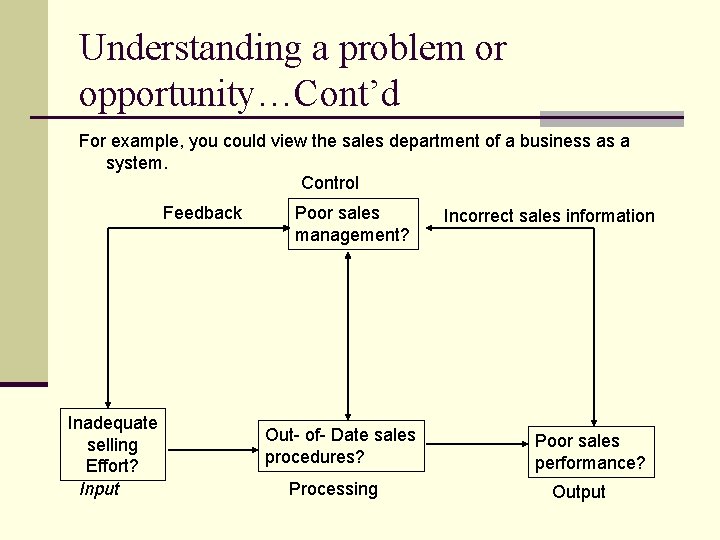
Understanding a problem or opportunity…Cont’d For example, you could view the sales department of a business as a system. Control Feedback Inadequate selling Effort? Input Poor sales management? Out- of- Date sales procedures? Processing Incorrect sales information Poor sales performance? Output
Understanding a problem or opportunity…Cont’d n Environmental systems n A business is a subsystem of society and is surrounded by the other systems of the business environment. n It is an open, adaptive system, exchanging inputs and outputs with its environment and adjusting to the demands of various environmental systems. n A business tries to maintain proper interrelationships with the economic, political and social stakeholders in its environment. n Therefore, the stakeholders that interact with a business should be identified. This helps determine their effect on a problem or its solution.
Understanding a problem or opportunity…Cont’d 3) Determining objectives, standards, and constraints n Objectives n n n When using the systems approach, you should determine the objectives of the organizational systems and subsystems you wish to study. We should determine how these objectives fit into the overall strategic plan of the business. Objectives should not be stated in vague terms. They should be specific.
Understanding a problem or opportunity…Cont’d – Standards • It is also important to identify the standards used to measure progress toward the objectives of a system. • Standards are a vital component of the effective control of any system. Feedback about actual performance is compared by managers to standards of performance to measure the degree of attainment of business unit's objectives. • Budgets and forecasts are typically used as standards. Knowing the standards should help determine the extent of perceived problems or opportunities in the system we are studying. • Standards are usually more specific and quantitative than objectives.
Understanding a problem or opportunity…Cont’d – Constraints • are restrictions on the form and content of a solution. • Constraints can be internal or external to the business organization. • External constraints are typically required by law or industry agreement. • Internal constraints may arise due to scarcity of organizational resources or to conflicting information needs of departments and personnel within an organization
Understanding a problem or opportunity…Cont’d Gathering Data and Information In order to properly understand a problem or opportunity you must gather data and information about it. In business situations, this may involve one or more of the following: n Interviewing with employees, customers, and managers. n Questionnaires to appropriate individuals in the organization. n Personal observation of business operations and systems. n Examination of documents, reports, procedures manuals, and other documentation. n Inspecting accounting and management reports to collect operating statistics, cost data, and performance results. n development, manipulation, and observation of a model of the business operations or systems affected by the problem or opportunity II.
The Systems Approach…Cont’d n Developing a Solution This is the second stage of the systems approach to problem solving. It consists of three steps: Designing alternative solutions n Evaluating Alternative solutions n Selecting the best solution n
Developing a Solution Designing alternative solutions 1) n n n There are usually several different ways to solve any problem or pursue any opportunity. Jumping immediately from problem definition to a single solution is not a good idea. n It limits your options and robs you of the chance to consider the advantages and disadvantages of several alternatives. n You also lose the chance to combine the best points of several alternatives. Having too many alternatives can obscure the best solution. However, a screening process in the next step of the systems approach should help reduce the number of alternatives.
Developing a Solution…Cont’d n Where do alternative solutions come from? n n n Experience The advice of others- including consultants and expert systems. Your intuition, ingenuity and creativity Simulation - through decision support software packages used to develop and manipulate models of a business operation. These should include what you think is an ideal solution. Then, more realistic alternatives that recognize the limited financial, personnel and other resources should be developed. Also, don't forget that "doing nothing" about a problem or opportunity is a legitimate solution with its own advantages and disadvantages.
Developing a Solution…Cont’d Evaluating Alternative solutions 2) n n Once alternative solutions have been developed, they must be evaluated so that the best solution can be identified. The goal of evaluation is to determine how well each alternative solution helps the firm and its selected subsystems meet their objectives.
Evaluating Alternative Solutions…Cont’d n Evaluation Criteria n First, we should develop evaluation criteria, then determine how well each alternative solution meets these criteria n The criteria we develop should reflect the objectives and the constraints defined in the first stage of the solution process.
Evaluating Alternative Solutions…Cont’d n Cost/ benefit analysis n n Every legitimate solution will have some advantages or benefits and some disadvantages or costs. These advantages and disadvantages are identified when each alternative solution is evaluated. This process is called cost/ benefit analysis If costs and benefits can be quantified, they are called tangible; if not, they are called intangible.
Evaluating Alternative Solutions…Cont’d n Tangible costs- e. g. costs of hardware and software, employee salaries, etc. n Intangible costs- are difficult to quantify, such as the loss of customer goodwill or employee morale caused by errors and disruptions arising from the installation of a new system. n Tangible benefits- are favorable results, such as the n decrease in payroll costs caused by a reduction in personnel n decrease in inventory carrying costs caused by a reduction in inventory n Increase in sales or profits n Decrease in information processing costs n Decrease in operating work. n Intangible benefits- harder to estimate. Better customer service or faster and more accurate information for management, improved management decision making, improved image.
Evaluating Alternative Solutions…Cont’d Selecting the best solution 3) n n Once all alternative solutions have been evaluated, the process of selecting the best solution can begin. Alternative solutions can be compared to each other because they have been evaluated using the same criteria. For example, alternatives can be screened and ranked, based on individual criteria or overall scores.
Selecting the best solution…Cont’d n Note: n It is possible that we will decide not to select the topranked alternative. n A low-ranked solution could be chosen for a variety of other reasons. n Or, all proposed alternatives could be rejected. In this case, new alternative solutions must be identified and evaluated. However, don't forget that the legitimate alternative of "doing nothing" could be selected as the best option.
The Systems Approach…Cont’d Implementing a solution n I. Implement the selected solution n Once a solution has been selected, it must be implemented. n An implementation plan may have to be developed. Typically, an implementation plan specifies the activities, resources, and timing needed for proper implementation. n For example, the following items might be specified: § § § Types and sources of hardware and software Construction of physical facilities Hiring and training of personnel Start-up and operating procedures Implementation timetables.
Implementing a solution…Cont’d Evaluate the success of the implemented solution II. n n The results of implementing a solution should be monitored and evaluated. This is called a post implementation review process. The focus of this step is to determine if the implemented solution has indeed helped the firm and selected business units meet their system objectives. If not, the systems approach assumes you will cycle back to a previous step and make another attempt to find a workable solution.
Developing Information System Solutions n The Systems Development Cycle n Developing information system solutions to business problems is a major responsibility of managerial end users. n They are responsible for proposing or developing new or improved information systems for their organizations.
The Systems Development Cycle…Cont’d n Developing information system solutions to business problems is typically a multi step process or cycle. n This is frequently called the systems development cycle or systems development life cycle (SDLC). n The traditional information systems development cycle includes five steps: n Investigation n analysis n design n implementation n maintenance
The Systems Development Cycle…Cont’d n Let's take a look at each step of this development process. 1) Systems Investigation n This stage includes the following three steps. n n i) Information systems planning Survey the organization to screen and select potential systems development projects, including those generated by formal information systems planning. (Determine whether a business problem or opportunity exists) There are typically many opportunities to use information systems to support organization end users and its business operations, management decision making, and strategic objectives.
The Systems Development Cycle…Cont’d ii) Feasibility studies n n n Conduct a feasibility study to determine whether a new or improved information system is needed. A feasibility study is a preliminary study to investigate the information needs of prospective end users and the objectives, constraints, basic resource requirements, costs, benefits, and feasibility of a proposed project. The findings of this study are usually formalized in a written report. It includes preliminary specifications and a developmental plan for the proposed system.
The Systems Development Cycle…Cont’d n The feasibility of a proposed system can be evaluated in terms of four major categories: n Organizational feasibility- how well the proposed system supports the strategic plan of the organization. n Economic feasibility- whether expected cost savings, increased revenue, increased profits, reductions in required investment, and other benefits exceed the costs of developing and operating a proposed system. n Technical feasibility- whether reliable hardware and software capable of meeting the needs of a proposed system can be acquired or developed by the business in the required time. n Operational feasibility- the willingness and ability of the management, employees, customers, suppliers, and so on to operate, use, and support a proposed system.
The Systems Development Cycle…Cont’d Feasibility report III. n n This report is submitted to the management of the firm for its approval before development work can begin. If management approves the recommendations of the feasibility study, the systems analysis stage can begin. The goal of feasibility studies is to evaluate alternative systems and to propose the most feasible and desirable systems for development.
The Systems Development Cycle…Cont’d 2) Systems Analysis n Many of the system analysis activities are an extension of those used in conducting a feasibility study. n However, systems analysis is not a preliminary study. It is an in-depth study of end user information requirements that is needed before the design of a new information system can be completed.
The Systems Development Cycle…Cont’d n Systems analysis traditionally involves a detailed study of: The information needs of the organization and its end users. /organizational analysis/ n The activities, resources, and products of any present information systems. (Analysis of the present system) n The information system capabilities required to meet the information needs of users. / Functional requirements analysis/ n
The Systems Development Cycle…Cont’d 3) Systems Design n n systems analysis describes what a system should do to meet the information needs of users. systems design specifies how the system will accomplish this objective. systems design consists of design activities, which produce system specifications satisfying the system requirements developed in the systems analysis stage. These specifications are used as the basis for software development, hardware acquisition, system testing, and other activities of the implementation stage.
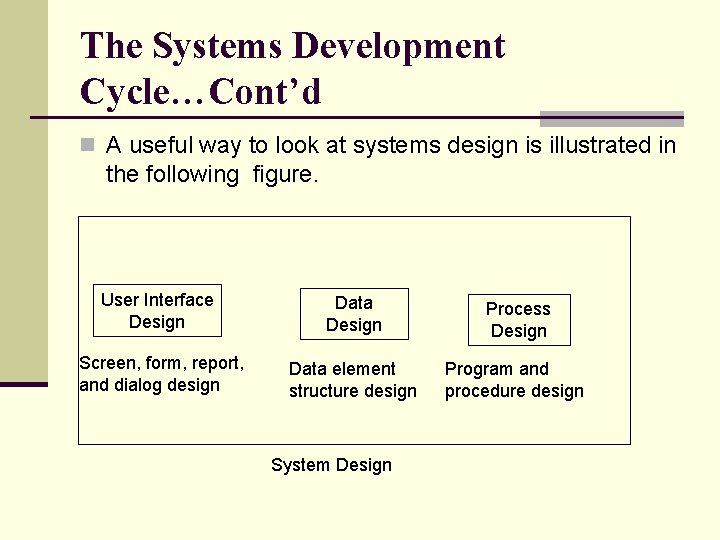
The Systems Development Cycle…Cont’d n A useful way to look at systems design is illustrated in the following figure. User Interface Design Data Design Process Design Screen, form, report, and dialog design Data element structure design Program and procedure design System Design
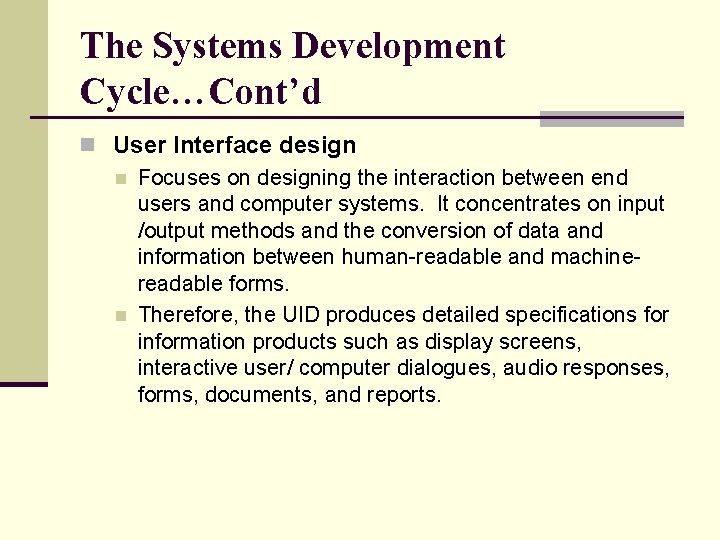
The Systems Development Cycle…Cont’d n User Interface design n Focuses on designing the interaction between end users and computer systems. It concentrates on input /output methods and the conversion of data and information between human-readable and machinereadable forms. n Therefore, the UID produces detailed specifications for information products such as display screens, interactive user/ computer dialogues, audio responses, forms, documents, and reports.
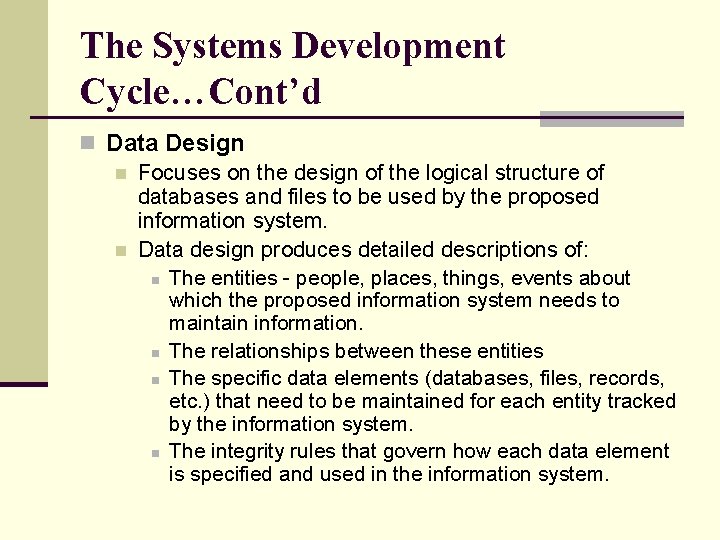
The Systems Development Cycle…Cont’d n Data Design n Focuses on the design of the logical structure of databases and files to be used by the proposed information system. n Data design produces detailed descriptions of: n The entities - people, places, things, events about which the proposed information system needs to maintain information. n The relationships between these entities n The specific data elements (databases, files, records, etc. ) that need to be maintained for each entity tracked by the information system. n The integrity rules that govern how each data element is specified and used in the information system.
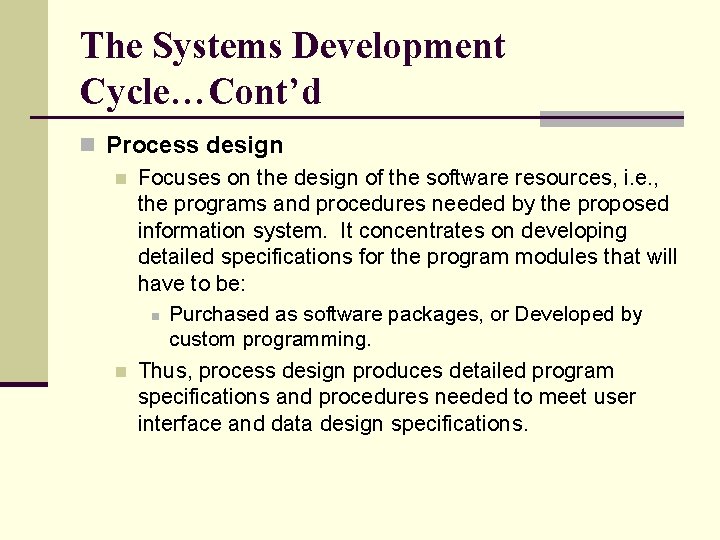
The Systems Development Cycle…Cont’d n Process design n Focuses on the design of the software resources, i. e. , the programs and procedures needed by the proposed information system. It concentrates on developing detailed specifications for the program modules that will have to be: n Purchased as software packages, or Developed by custom programming. n Thus, process design produces detailed program specifications and procedures needed to meet user interface and data design specifications.
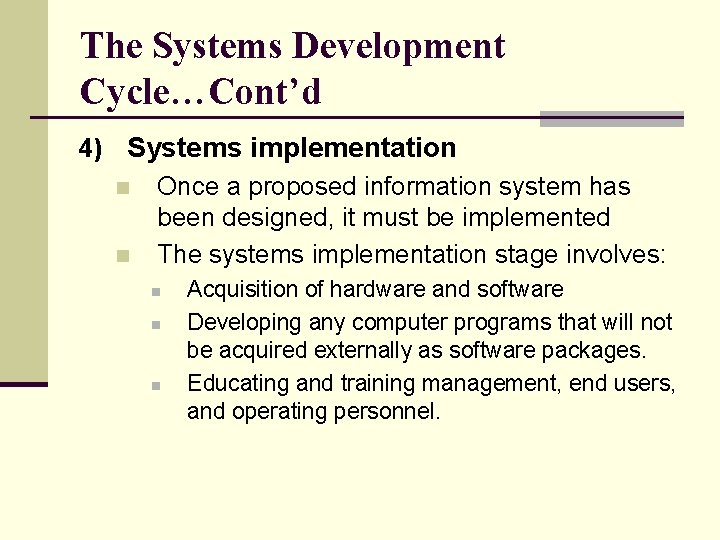
The Systems Development Cycle…Cont’d 4) Systems implementation n Once a proposed information system has been designed, it must be implemented n The systems implementation stage involves: n n n Acquisition of hardware and software Developing any computer programs that will not be acquired externally as software packages. Educating and training management, end users, and operating personnel.
The Systems Development Cycle…Cont’d n Testing and making necessary corrections to the programs, procedures, and hardware used by a new system. n Documentation- record and communicate the detailed system specifications including procedures for end users and operating personnel, and examples of input/ output displays and reports. n Conversion- Convert from the use of a present system to the operation of a new or improved system. This may involve n Operating both new and old systems in parallel for a trial period n Operation of a pilot system on a trial basis at one location n Phasing in the new system one location at a time, or n an immediate cutover to the new system.
The Systems Development Cycle…Cont’d 5) Systems Maintenance n n n involves a post implementation review process to monitor, evaluate, and modify the system as needed. errors in the development or use of a system are corrected by the maintenance activity. systems maintenance also includes making modifications to a system due to changes within the business or the business environment. n For example, Change in tax laws - requires change to tax computations in payroll systems and taxaccounting systems of a business organization.
Developing Information System Solutions…Cont’d n Computer- Aided systems Development n n Major changes are occurring in the traditional process of information systems just described. This is because the SDLC is inflexible, time-consuming, and expensive. A computer -aided systems engineering (CASE) process has emerged due to the availability of fourth-generation languages (4 GL) and a variety of software packages for system development. CASE involves using software packages, called CASE tools, to perform many of the activities of systems development, including software development or programming. Thus, CASE allows systems analysts and end users to use microcomputers and 4 GL and CASE tools to help accomplish activities of the systems development process.
Computer- Aided systems Development…Cont’d n Note: - Categories of programming languages n Machine Languages- use binary coded instructions (First Generation) n n In the early stages of computer development, all program instructions had to be written using binary codes unique to each computer. Assembler languages- use symbolic coded instructions (Second generation) next level of programming languages n n n were used to reduce the difficulties in writing machine language programs. require language translator program called assemblers also called symbolic languages.
Computer- Aided systems Development…Cont’d n High- level languages- use English like statements and arithmetic notation (Third Generation) n n n instructions of high- level languages are called statements, and closely resemble human language or the standard notation of mathematics. For Example, FORTRAN X= Y+Z require translator programs called compilers or interpreters.
Computer- Aided systems Development…Cont’d n Fourth-generation languages - Use natural and non-procedural statements. the term 4 GL is used to describe a variety of programming languages that are more nonprocedural and conversational than prior languages. n are nonprocedural means - they encourage users and programmers to specify the results they want, while the computer determines the sequence of instructions that will accomplish those results. n For example, Sum the following two numbers. n
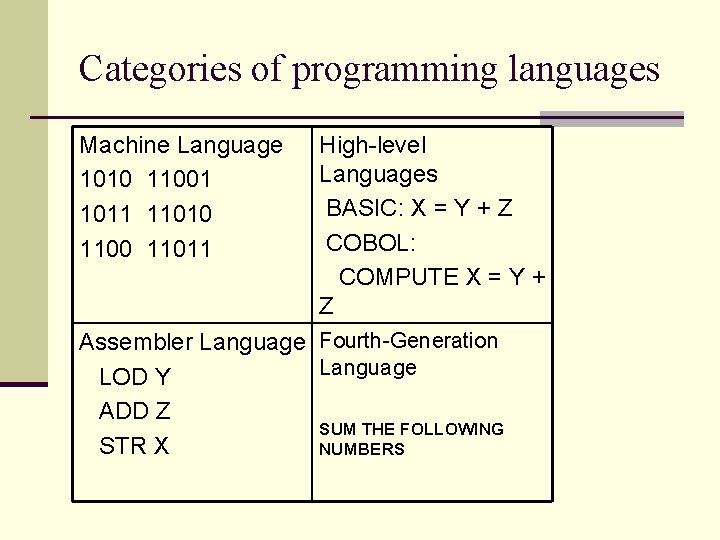
Categories of programming languages Machine Language 1010 11001 1011 11010 11011 High-level Languages BASIC: X = Y + Z COBOL: COMPUTE X = Y + Z Assembler Language Fourth-Generation Language LOD Y ADD Z SUM THE FOLLOWING STR X NUMBERS
Prototyping n A Prototype n A prototype information system is a tentative working model of an information system which includes tentative versions of user input and output, databases and files, control methods, and processing routines. n Prototyping n prototyping is the rapid development and testing of working models, or prototypes, of new information system applications in an interactive, iterative process involving both system analysts and end users.
Prototyping…Cont’d n A prototype of an information system needed by an end user is developed quickly using a variety of application development packages (such as 4 GL, CASE). n The prototype system is then repeatedly refined until it is acceptable to an end user. (used, evaluated, and modified repeatedly until end users find it acceptable). n The final version of the system is then turned over to the end user for operational use.
- Slides: 54