
Chapter I What is Wellbeing A Capability perspective
Chapter I What is Well-being? A Capability perspective AY 2016 -17
Structure § Session 1. Happiness, Income and Capabilities § Session 2. Implications for development indicators and policy
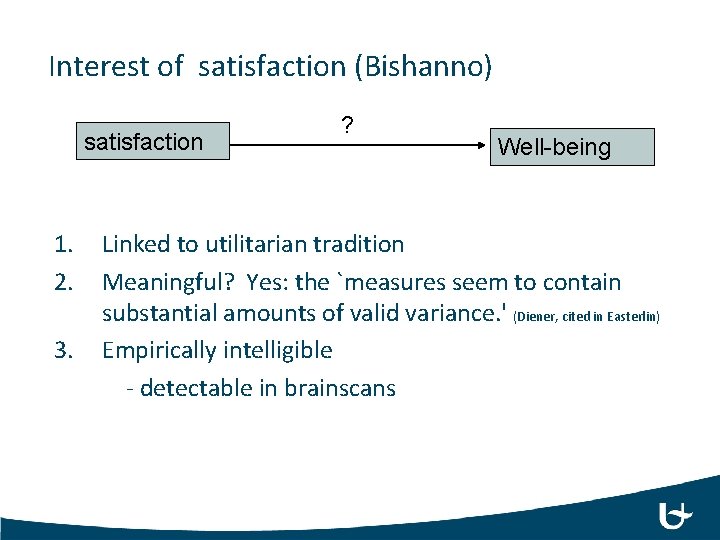
Interest of satisfaction (Bishanno) satisfaction 1. 2. 3. ? Well-being Linked to utilitarian tradition Meaningful? Yes: the `measures seem to contain substantial amounts of valid variance. ' (Diener, cited in Easterlin) Empirically intelligible - detectable in brainscans

Dectable in brainscans Downloaded from sciencealert. com
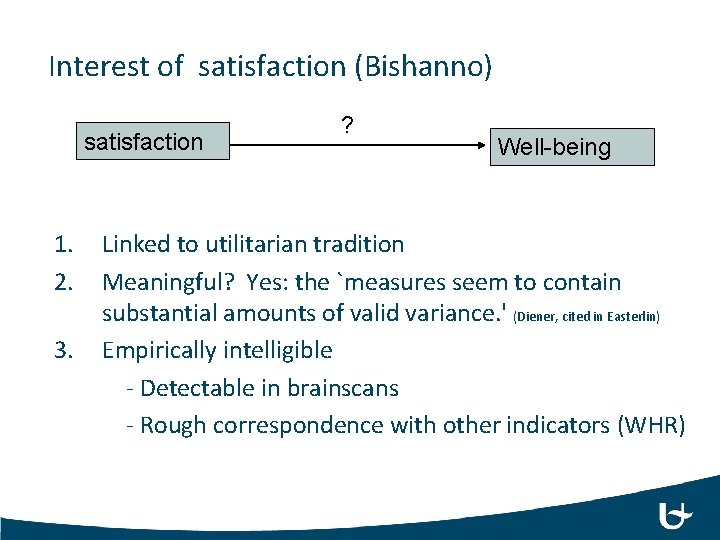
Interest of satisfaction (Bishanno) satisfaction 1. 2. 3. ? Well-being Linked to utilitarian tradition Meaningful? Yes: the `measures seem to contain substantial amounts of valid variance. ' (Diener, cited in Easterlin) Empirically intelligible - Detectable in brainscans - Rough correspondence with other indicators (WHR)
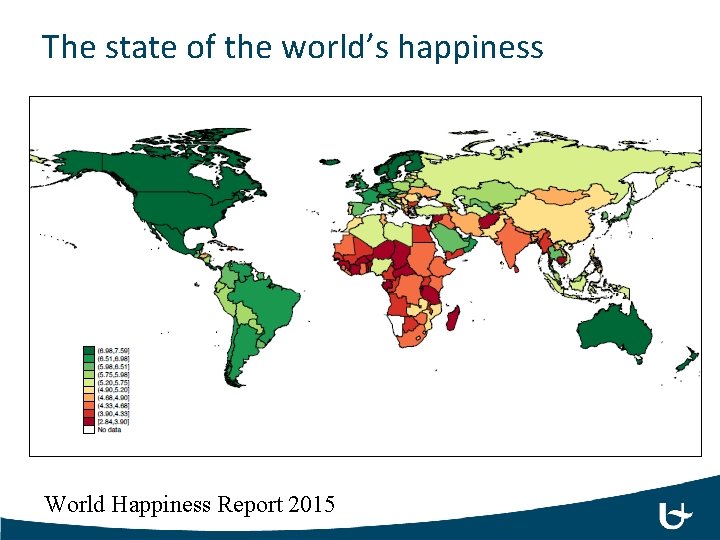
The state of the world’s happiness World Happiness Report 2015
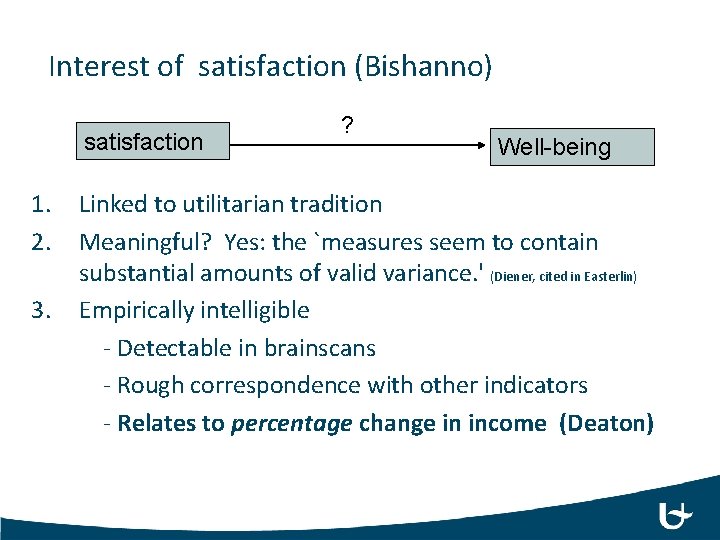
Interest of satisfaction (Bishanno) satisfaction 1. 2. 3. ? Well-being Linked to utilitarian tradition Meaningful? Yes: the `measures seem to contain substantial amounts of valid variance. ' (Diener, cited in Easterlin) Empirically intelligible - Detectable in brainscans - Rough correspondence with other indicators - Relates to percentage change in income (Deaton)



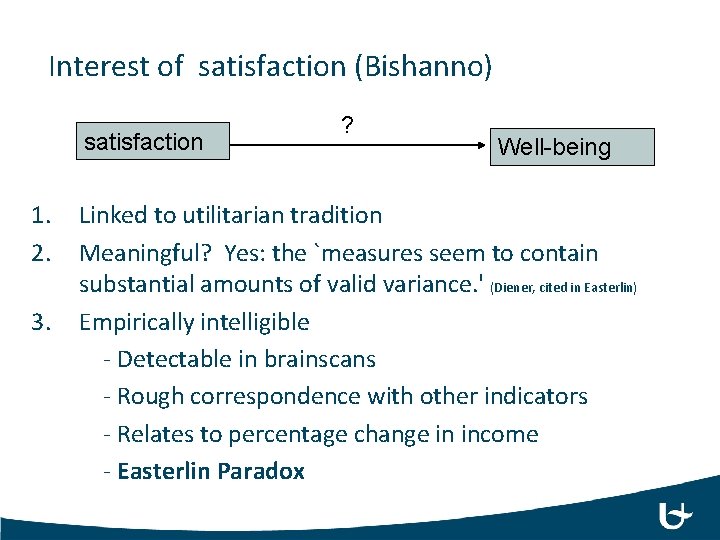
Interest of satisfaction (Bishanno) satisfaction 1. 2. 3. ? Well-being Linked to utilitarian tradition Meaningful? Yes: the `measures seem to contain substantial amounts of valid variance. ' (Diener, cited in Easterlin) Empirically intelligible - Detectable in brainscans - Rough correspondence with other indicators - Relates to percentage change in income - Easterlin Paradox

Source: Easterlin 2001, p. 469

Easterlin’s paradox? • What? § On one hand, “at a point in time, those with more income are, on average, happier than those with less” § On the other, “over the life cycle, the average happiness of a cohort remains constant despite substantial income growth” • Explanation? § Satisfaction changes with income (among other factors) satisfaction = f (income, aspirations, … ) § “aspirations change over the life cycle roughly in proportion to income” aspirations = g (income)
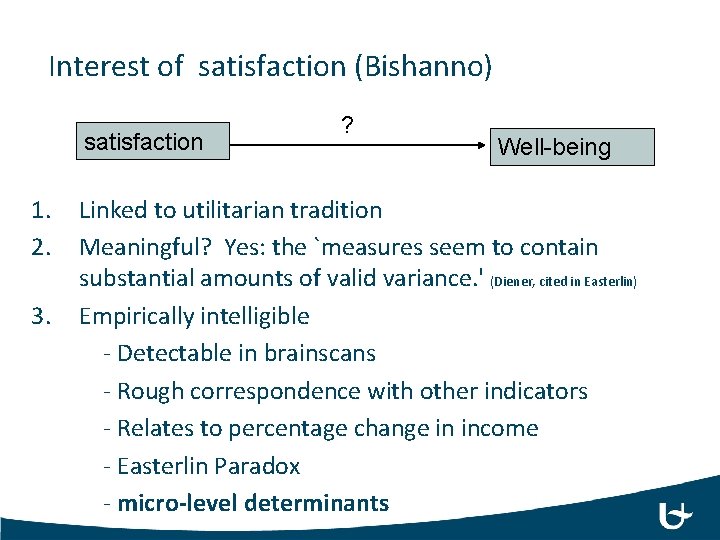
Interest of satisfaction (Bishanno) satisfaction 1. 2. 3. ? Well-being Linked to utilitarian tradition Meaningful? Yes: the `measures seem to contain substantial amounts of valid variance. ' (Diener, cited in Easterlin) Empirically intelligible - Detectable in brainscans - Rough correspondence with other indicators - Relates to percentage change in income - Easterlin Paradox - micro-level determinants

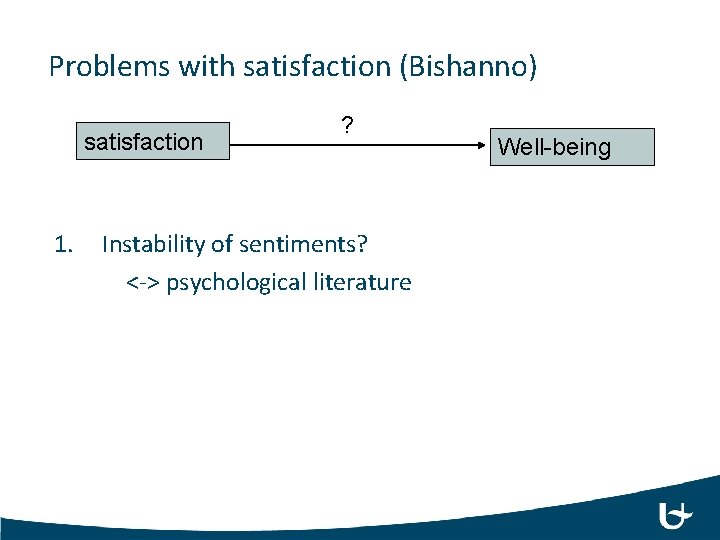
Problems with satisfaction (Bishanno) satisfaction 1. ? Instability of sentiments? <-> psychological literature Well-being
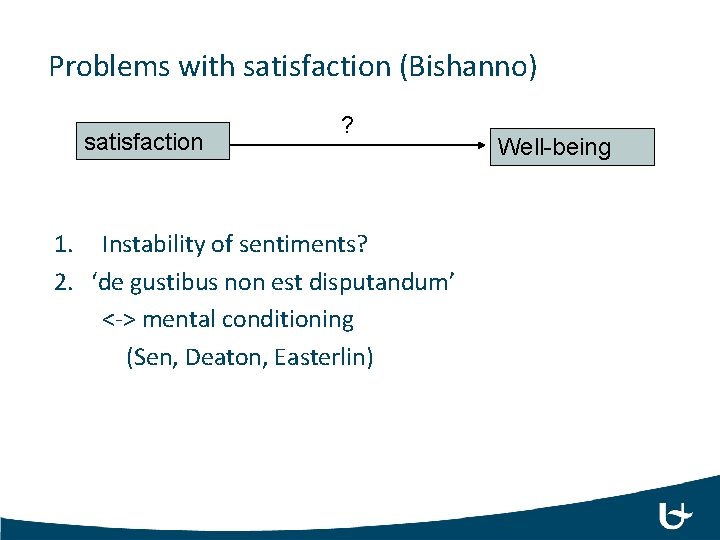
Problems with satisfaction (Bishanno) satisfaction ? 1. Instability of sentiments? 2. ‘de gustibus non est disputandum’ <-> mental conditioning (Sen, Deaton, Easterlin) Well-being

“We believe that every American and in every community has a right to pursue happiness… ” Jeb Bush Danger of “spiritualizing” development?
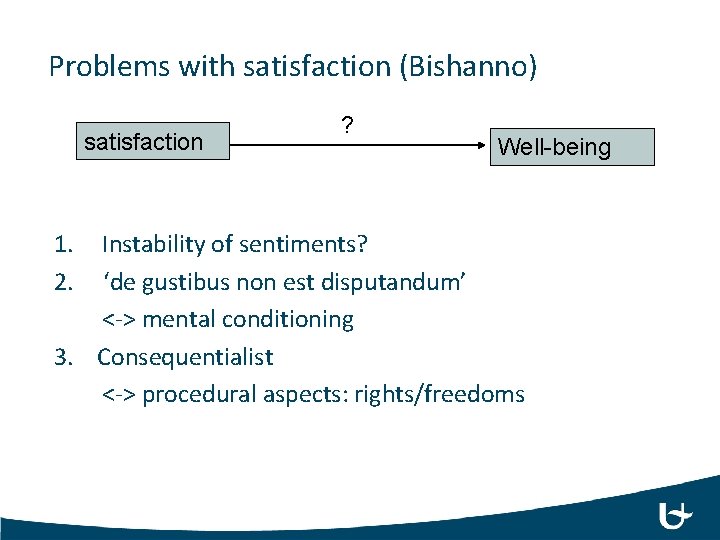
Problems with satisfaction (Bishanno) satisfaction 1. 2. ? Well-being Instability of sentiments? ‘de gustibus non est disputandum’ <-> mental conditioning 3. Consequentialist <-> procedural aspects: rights/freedoms
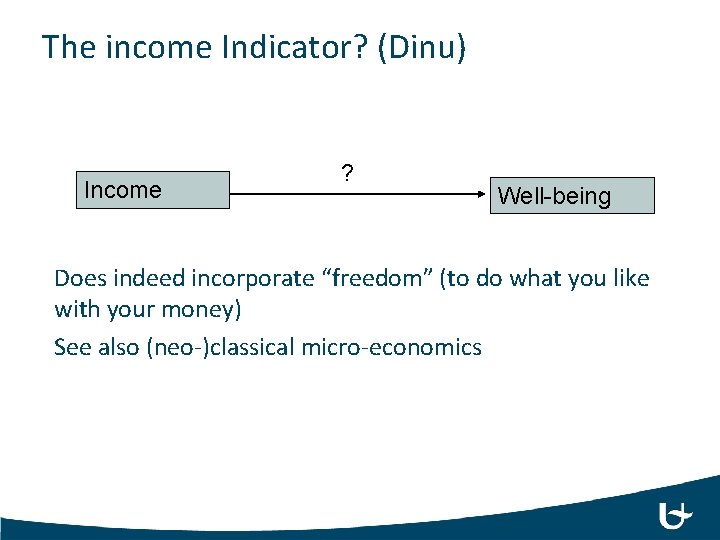
The income Indicator? (Dinu) Income ? Well-being Does indeed incorporate “freedom” (to do what you like with your money) See also (neo-)classical micro-economics
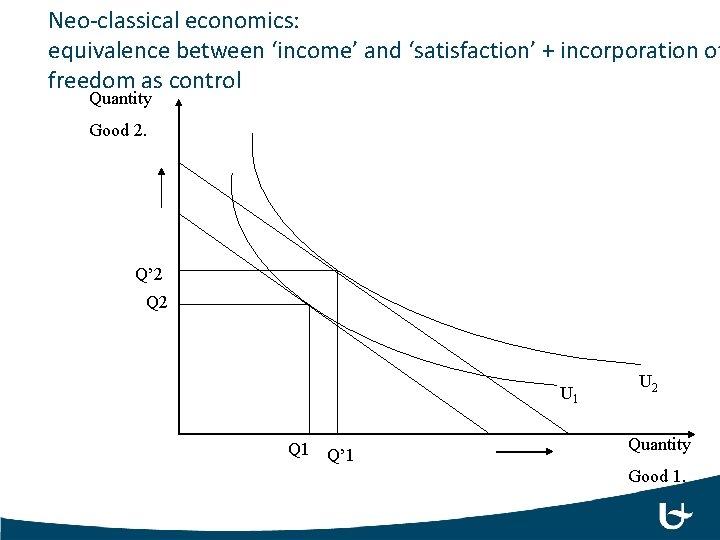
Neo-classical economics: equivalence between ‘income’ and ‘satisfaction’ + incorporation of freedom as control Quantity Good 2. Q’ 2 Q 2 U 1 Q’ 1 U 2 Quantity Good 1.
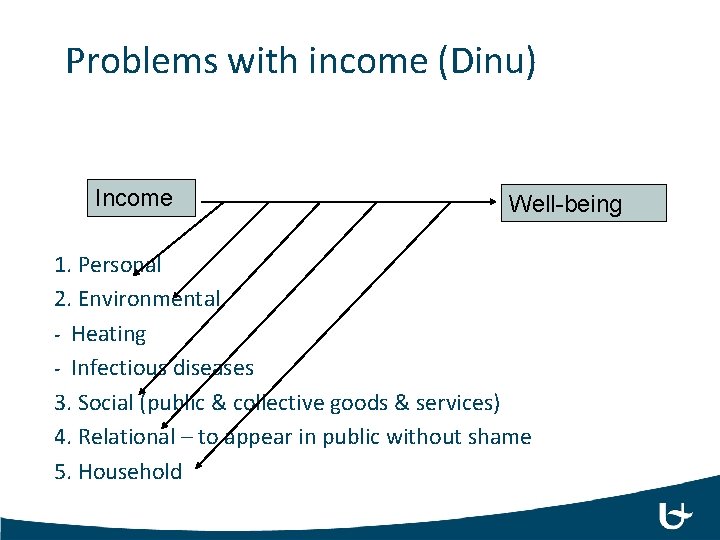
Problems with income (Dinu) Income Well-being 1. Personal 2. Environmental - Heating - Infectious diseases 3. Social (public & collective goods & services) 4. Relational – to appear in public without shame 5. Household
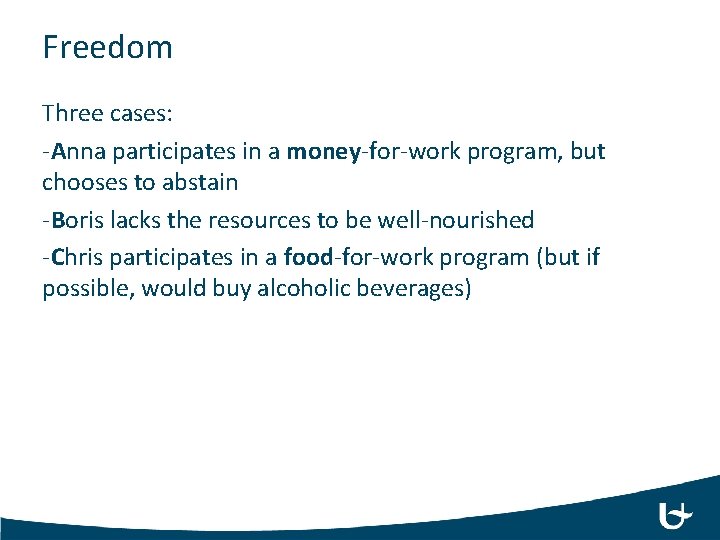
Freedom Three cases: -Anna participates in a money-for-work program, but chooses to abstain -Boris lacks the resources to be well-nourished -Chris participates in a food-for-work program (but if possible, would buy alcoholic beverages)

Freedom (2) In terms of freedom as control, A > B=C Importance of different kinds/levels of “agency” (participation, democracy, empowerment, …) In terms of effective freedom, A=B < C !! Sen: The two kinds of freedom are important e. g. debate on slavery
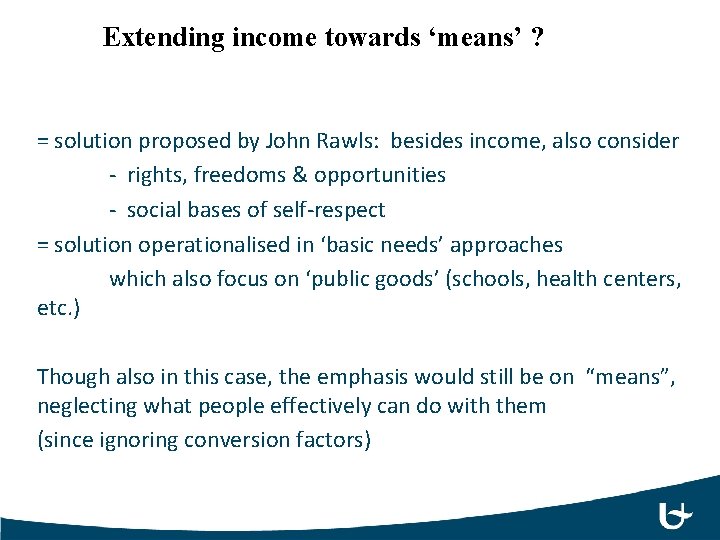
Extending income towards ‘means’ ? Extending ‘income’ towards ‘means’ ? = solution proposed by John Rawls: besides income, also consider - rights, freedoms & opportunities - social bases of self-respect = solution operationalised in ‘basic needs’ approaches which also focus on ‘public goods’ (schools, health centers, etc. ) Though also in this case, the emphasis would still be on “means”, neglecting what people effectively can do with them (since ignoring conversion factors)

Choice for Rogini ! Definition of Development: “Ultimately, the process of economic development has to be concerned with what people can or cannot do, e. g. whether they can live a long and healthy life, be well nourished, are capable to read, write and communicate, participate in literary and scientific debates, etc. ” (Sen 1984: 497) Development as freedom, understood as “people’s capability to choose the lives they have reason to value” (1999: 63)
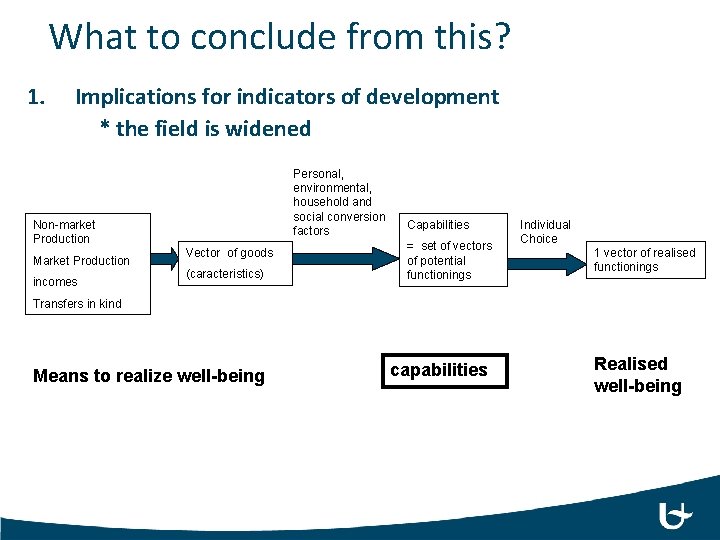
What to conclude from this? 1. Implications for indicators of development * the field is widened Personal, environmental, household and social conversion factors Non-market Production Market Production incomes Vector of goods (caracteristics) Capabilities = set of vectors of potential functionings Individual Choice 1 vector of realised functionings Transfers in kind Means to realize well-being capabilities Realised well-being
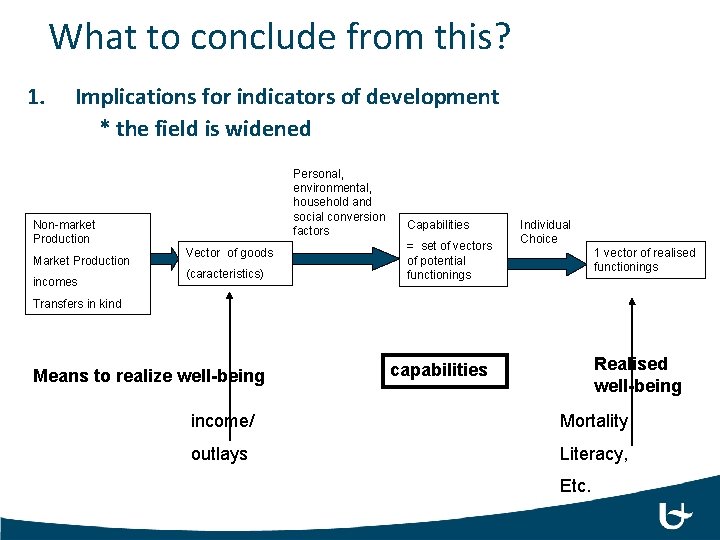
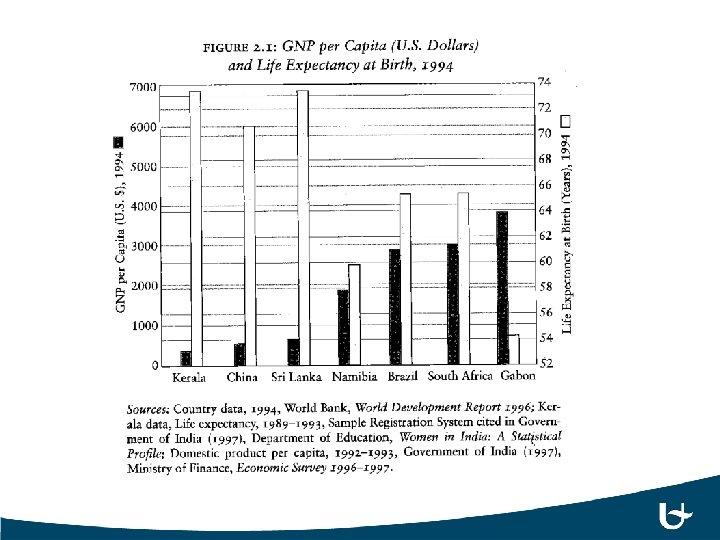
What to conclude from this? 1. Implications for indicators of development * the field is widened Personal, environmental, household and social conversion factors Non-market Production Market Production incomes Vector of goods (caracteristics) Capabilities = set of vectors of potential functionings Individual Choice 1 vector of realised functionings Transfers in kind Means to realize well-being Realised well-being capabilities income/ Mortality outlays Literacy, Etc.
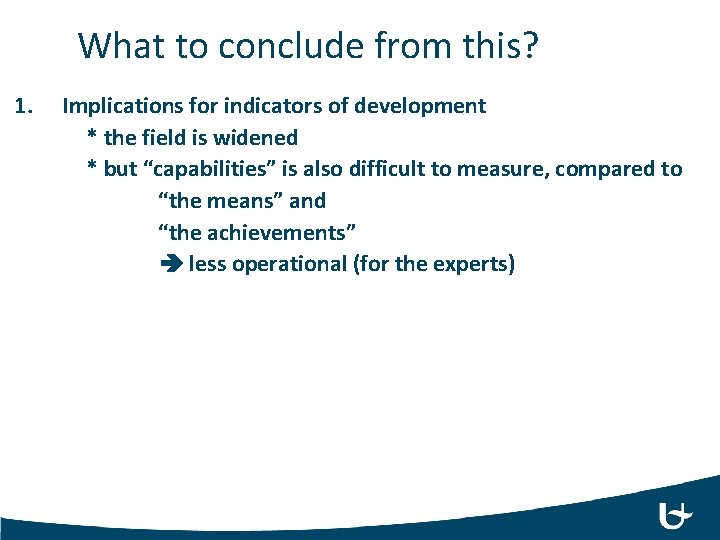
What to conclude from this? 1. Implications for indicators of development * the field is widened * but “capabilities” is also difficult to measure, compared to “the means” and “the achievements” less operational (for the experts)
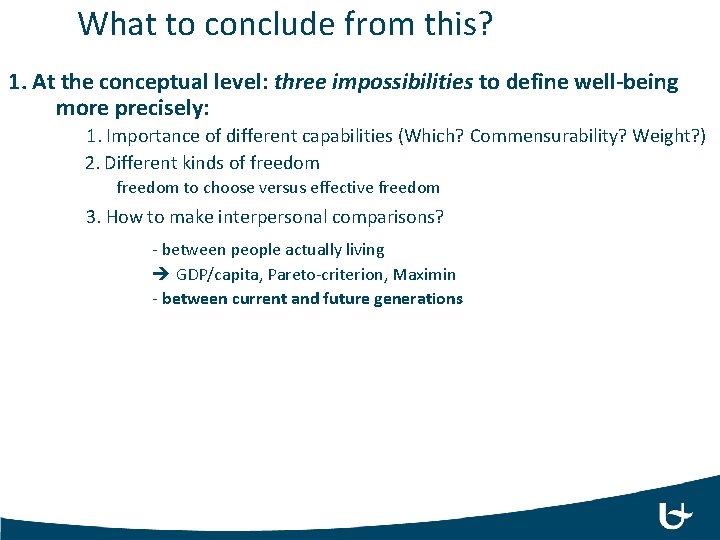
What to conclude from this? 1. Implications for indicators of development 2. The inevitability of social choice in defining development three impossibilities to define well-being more precisely: 1. Importance of different capabilities (Which? Commensurability? Weight? ) 2. Different kinds of freedom to choose versus effective freedom 3. How to make interpersonal comparisons? - between people actually living
Equity considerations Problems with GDP/cap: Compare 3 policies, all 3 increasing GDP/N with 1$, but in case of policy E, income of top 5% would increase with 20$ in case of policy S , everyone’s income would increase with 1$ in case of policy T, 40$ to top 5%, 20$ paid by bottom 5% the indicator cannot make that difference
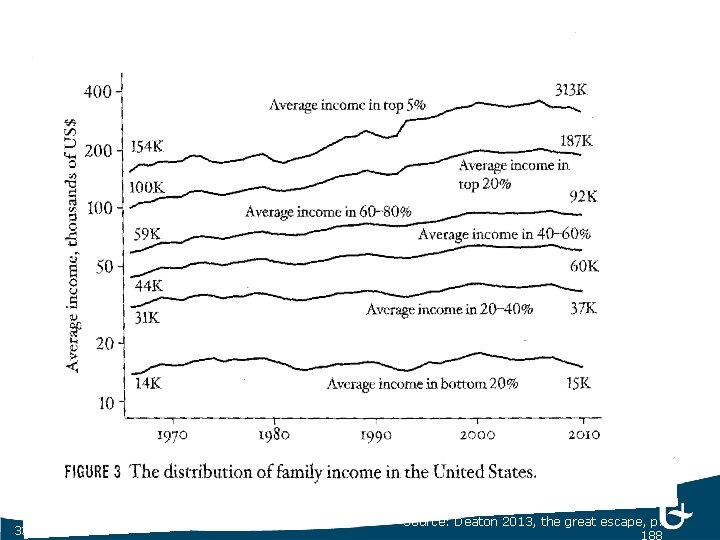
33 Source: Deaton 2013, the great escape, p.
Considerations of distribution of well-being Problems with GDP/cap Compare 3 policies, all 3 increasing GDP/N with 1$, but in case of policy E, income of top 5% would increase with 20$ in case of policy S , everyone’s income would increase with 1$ in case of policy T, 40$ to top 5%, 20$ paid by bottom 5% • • • The indicator of GDP/cap cannot make that difference Pareto-criterion: excludes T, indifferent between E & S but would E or S exist? Rawlsian Maximin: preference for S.
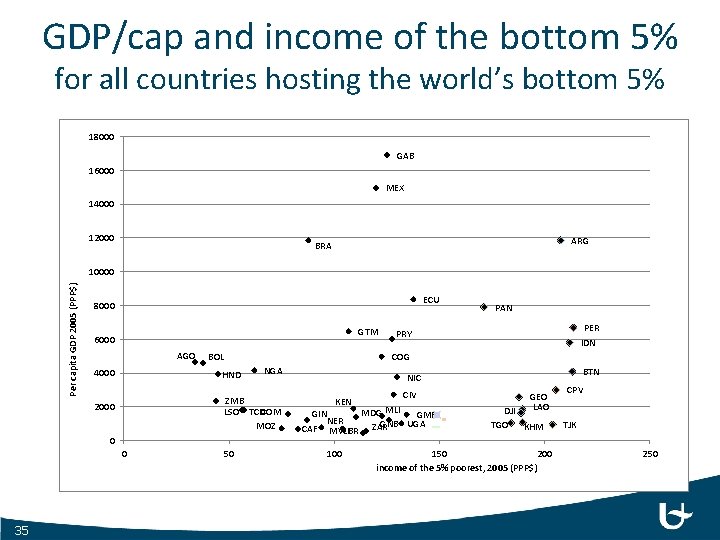
GDP/cap and income of the bottom 5% for all countries hosting the world’s bottom 5% 18000 GAB 16000 MEX 14000 12000 ARG BRA Per capita GDP 2005 (PPP$) 10000 ECU 8000 GTM 6000 AGO 4000 BOL HND 0 0 35 50 PER IDN PRY COG NGA ZMB LSO TCDCOM MOZ 2000 PAN BTN NIC KEN CIV MDG MLI GIN GMB NER GNB UGA ZAR CAF MWI LBR 100 GEO LAO DJI TGO KHM 150 200 income of the 5% poorest, 2005 (PPP$) CPV TJK 250
What to conclude from this? 1. At the conceptual level: three impossibilities to define well-being more precisely: 1. Importance of different capabilities (Which? Commensurability? Weight? ) 2. Different kinds of freedom to choose versus effective freedom 3. How to make interpersonal comparisons? - between people actually living GDP/capita, Pareto-criterion, Maximin - between current and future generations
Thinking within the box? Source: living planet report 2016
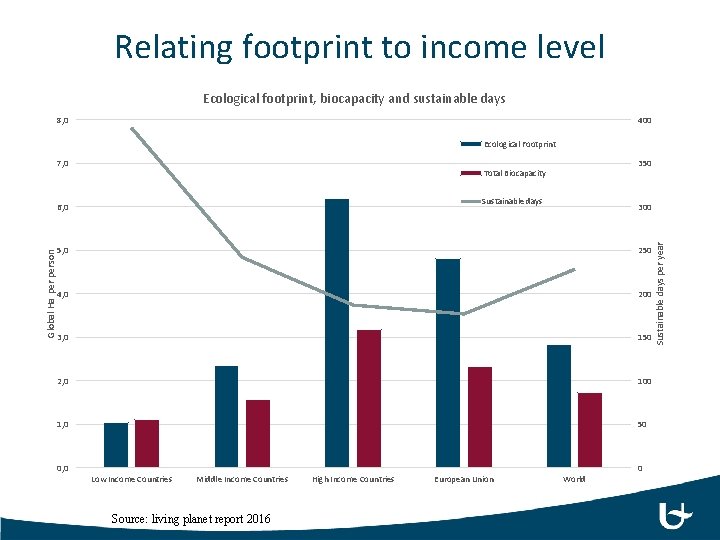
Relating footprint to income level Ecological footprint, biocapacity and sustainable days 8, 0 400 Ecological Footprint Sustainable days 6, 0 Global Ha person 350 Total Biocapacity 300 5, 0 250 4, 0 200 3, 0 150 2, 0 100 1, 0 50 0, 0 Low Income Countries Middle Income Countries Source: living planet report 2016 High Income Countries European Union World 0 Sustainable days per year 7, 0
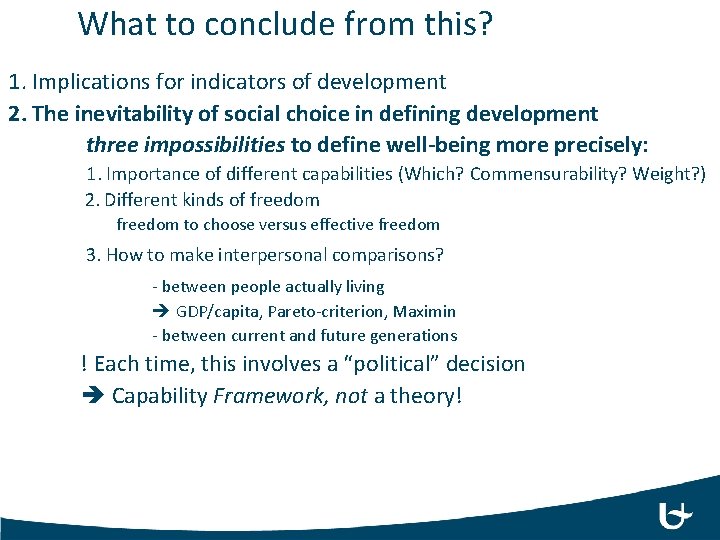
What to conclude from this? 1. Implications for indicators of development 2. The inevitability of social choice in defining development three impossibilities to define well-being more precisely: 1. Importance of different capabilities (Which? Commensurability? Weight? ) 2. Different kinds of freedom to choose versus effective freedom 3. How to make interpersonal comparisons? - between people actually living GDP/capita, Pareto-criterion, Maximin - between current and future generations ! Each time, this involves a “political” decision Capability Framework, not a theory!
What to conclude from this? 1. Implications for indicators of development 2. The inevitability of social choice in defining development 3. For evaluation of development policy: * supplementary approach
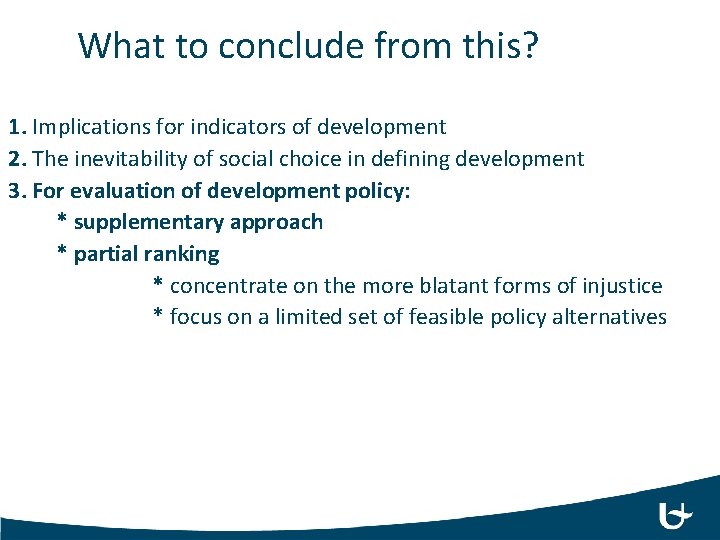
What to conclude from this? 1. Implications for indicators of development 2. The inevitability of social choice in defining development 3. For evaluation of development policy: * supplementary approach * partial ranking * concentrate on the more blatant forms of injustice * focus on a limited set of feasible policy alternatives
- Slides: 42