
Chapter Fourteen Observing Skills Formative Observation Qualitative Quantitative
Chapter Fourteen: Observing Skills Formative Observation Qualitative & Quantitative Observations Cautions
Observation Skills: �Exercise: Turn to page 236. �What did you observe? �What is happening? �What is an ‘interpretation trap? ’

Observation: What is Happening?
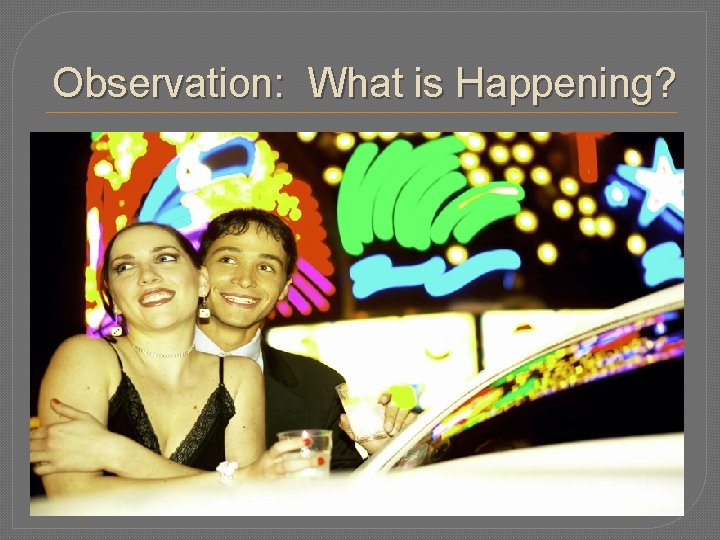
Observation: What is Happening?

Observation: What is Happening?
Observation Skills: �Observation: First describe, then interpret. �What does it mean to describe? �What does it mean to interpret?
Observer Skills: �Observation: Observer brings bias. �Give an example of observer bias. �Why is this such an important skill in supervision? �Observation: Don't assume, ask. �Observation: Goal - to improve instruction. �Examples from Practice.
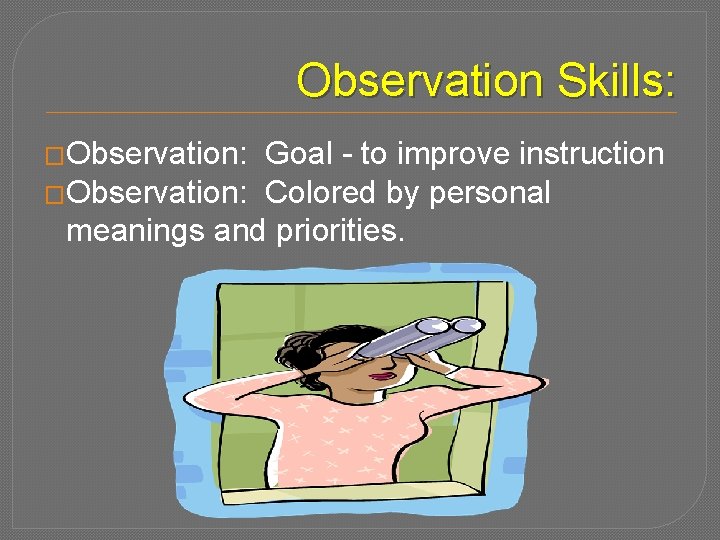
Observation Skills: �Observation: Goal - to improve instruction �Observation: Colored by personal meanings and priorities.
Observation Skills: �Observation: What are you there to observe? Why?
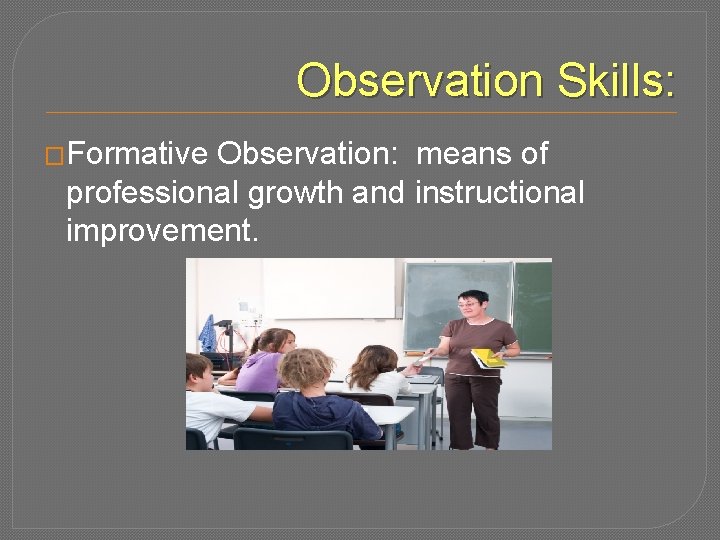
Observation Skills: �Formative Observation: means of professional growth and instructional improvement.
Observation Skills: �Examples of formative observations: �Five minutes walk through. �Teacher directed observation. �Specific skills observation. �See example on p. 239. �What other examples have you used in your practice?
Observation Skills. �Formative Observation Instrument: Used to describe what is occurring in a classroom (consistent w/ with teacher and supervisor agreed to focus on and later discuss). �On-task time sweep (p. 240). Performance Indicators (p. 241).
Observation Skills: �Quantitative Observations: describing an event using numbers, meaning derived using statistical operations. �Other examples?
Observation Skills: �Category Frequency Instrument: Observation of specific behaviors at specific intervals of time. Ex: Off-task. �Performance Indicator Instruments: records whether or not specific actions were observed -- checklist. �Examples: pp. 242, � 243, 244.
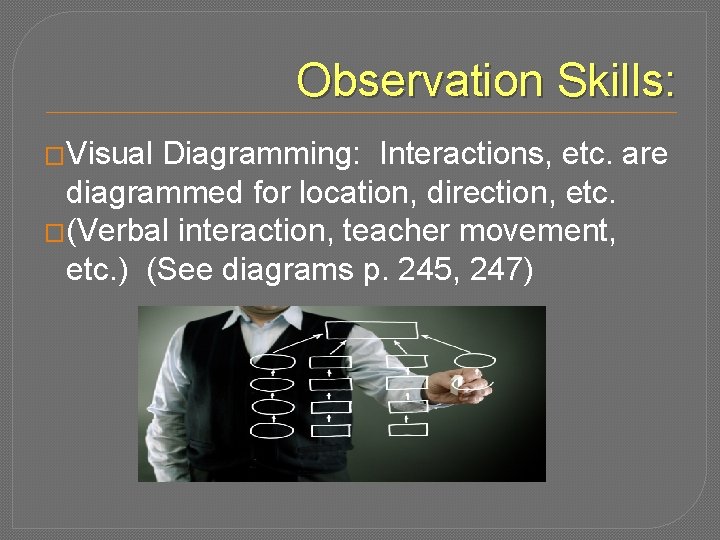
Observation Skills: �Visual Diagramming: Interactions, etc. are diagrammed for location, direction, etc. �(Verbal interaction, teacher movement, etc. ) (See diagrams p. 245, 247)
Observation Skills: �Qualitative Observations: not knowing exactly what is to be recorded. General focus. Records events as they occur. Makes meaning of them at a later time. �Examples?
Observational Skills �Narrative observation. �Looking for meanings and trends, not statistical measures. �Verbatim and Selected Verbatim, p. 248, 249.
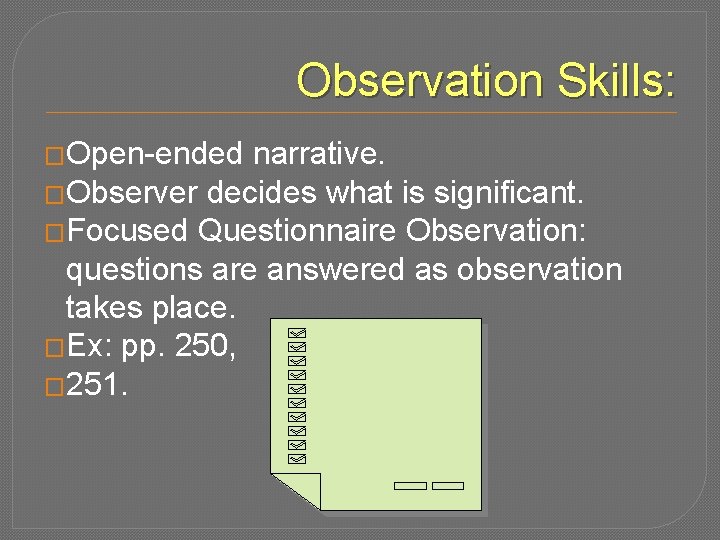
Observation Skills: �Open-ended narrative. �Observer decides what is significant. �Focused Questionnaire Observation: questions are answered as observation takes place. �Ex: pp. 250, � 251.
Educational Criticism/ Appreciative Inquiry �Elliott Eisner (1985). �Detached observation + participant observation + description + interpretation. �Observe classroom as a critic or connoisseur. �David Cooperider (1988). �Appreciative Inquiry. �What is good?
Observation Skills: �Tailored Observations: �Data gathered for specified behaviors: �Ex: How often teacher calls on student. �Whether student's response is correct. �How often positive feedback is provided, etc. �Example: p. 253.
Observation Skills: �Tailored Behavior Response. �Invited Behavior Feedback. �Ex: p. 254.
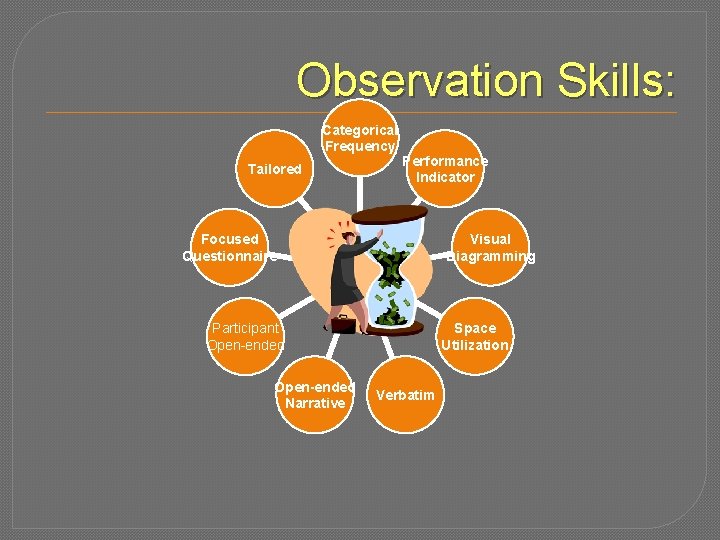
Observation Skills: Categorical Frequency Tailored Focused Questionnaire Performance Indicator Observation Methods Space Utilization Participant Open-ended Narrative Visual Diagramming Verbatim
Observation Skills: �Cautions: �Quantum Physics: A phenomenon cannot be measured w/out the measurement process affecting the outcome. (Greene, 2004)
Observational Skills: �Other cautions? �Real life examples? �Short Discussion: move into small groups. �Open Document in Blackboard: Evaluation Instruments. You can also share those from your district. �What works? What doesn’t work? �What questions do you have?
Observational Skills: �Reflection: Timed reflection. (6 minutes) �Any ‘ah-a’s’ about observation? �Cautions? �How, specifically, will you observe professionals in your organization? �Questions? Concerns?
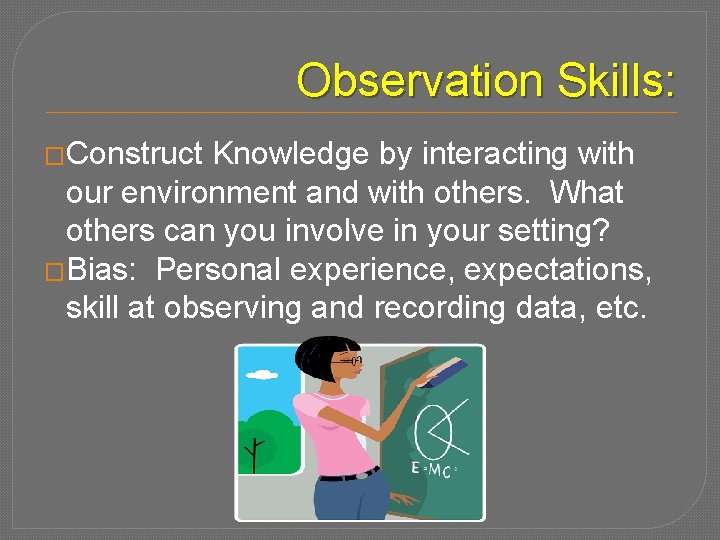
Observation Skills: �Construct Knowledge by interacting with our environment and with others. What others can you involve in your setting? �Bias: Personal experience, expectations, skill at observing and recording data, etc.
Informal: Observation as Coach �Teacher Directed. �Informal Process. �Focused on improvement of instruction. �Collegial relationship. �Two-way Communication.
Formal: Observation as Supervisor �Professional relationship. �Follow suggested district procedures. �Be kind. Be human. �Opportunity for professional growth. �Do-overs.
Legal: Supervision for Job Retention �Work closely with district. �Understand the legalities involved. �Carry out your responsibilities accurately and to the letter. �Make sure the paperwork is in order. �It can get ugly. �Be humane and respectful.
Small Group Discussion: �Instructional models. �What have you developed? �Why have you developed your models? �Questions? �Insights? �Why do we need many models for supervision? �Observational issues?
- Slides: 30