
Chapter Four Tips for Argument Analysis Copyright 2012
- Slides: 15
Chapter Four Tips for Argument Analysis Copyright © 2012 Pearson Education, Inc. All rights reserved.
Correct Argument Analysis • The primary aim of argument analysis is to endorse a certain claim or reject it. • In order to achieve this goal, two principles must be followed: – Faithfulness: Requires you to phrase the argument so that it captures the arguer’s intentions. – Charity: Requires you to phrase the argument so that is comes out as strong as possible. Copyright © 2012 Pearson Education, Inc. All rights reserved.
Conflicts between Faithfulness and Charity • Prioritize Faithfulness. – If the principle of faithfulness suggests construing an argument one way, but the principle of charity suggests construing it in another way, you should follow the principle of faithfulness. • Remember, you can’t simply change what the arguer had in mind in order to make the argument as strong as possible. – The price of doing that is you end up analyzing an argument altogether different than the one actually proposed. Copyright © 2012 Pearson Education, Inc. All rights reserved.
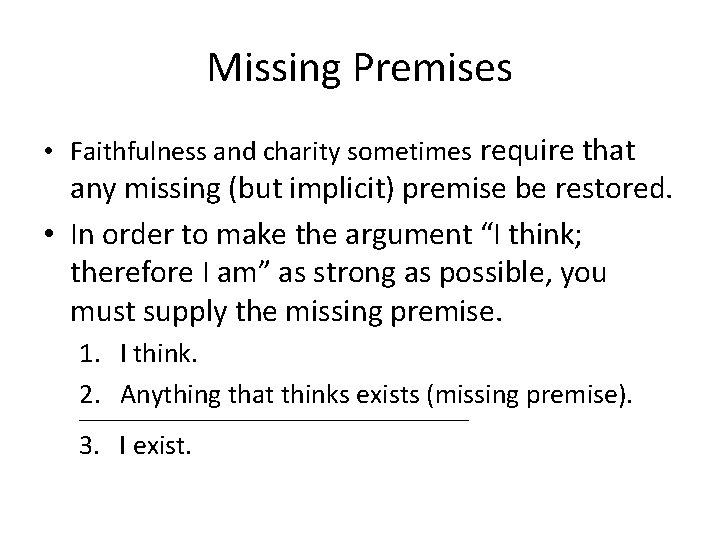
Missing Premises • Faithfulness and charity sometimes require that any missing (but implicit) premise be restored. • In order to make the argument “I think; therefore I am” as strong as possible, you must supply the missing premise. 1. I think. 2. Anything that thinks exists (missing premise). _________________________________________________ 3. I exist. Copyright © 2012 Pearson Education, Inc. All rights reserved.
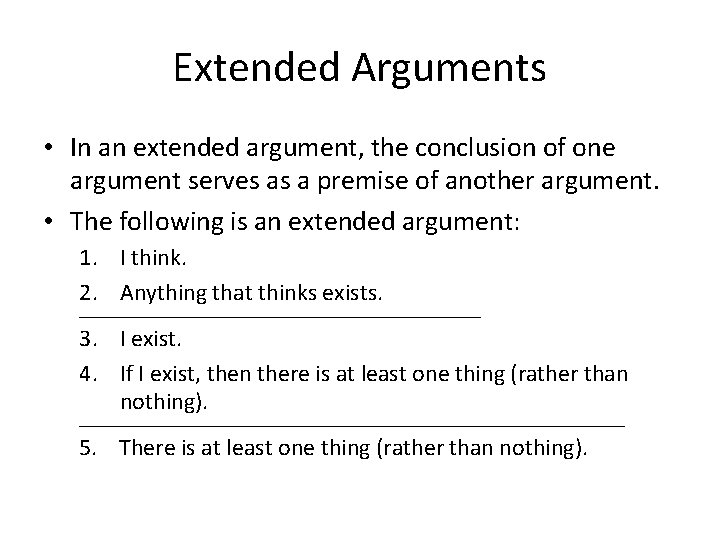
Extended Arguments • In an extended argument, the conclusion of one argument serves as a premise of another argument. • The following is an extended argument: 1. I think. 2. Anything that thinks exists. ___________________________________________________ 3. I exist. 4. If I exist, then there is at least one thing (rather than nothing). _____________________________________________________________________ 5. There is at least one thing (rather than nothing). Copyright © 2012 Pearson Education, Inc. All rights reserved.
Considerations for Extended Arguments • When you are presented with an extended argument, bear in mind that: § You may, in fact, be presented with two arguments linked together. § The conclusion of the first may be a premise of the second, intended to support some further conclusion. . . and so on. § Any conclusion that itself fails to be supported by the premises of an extended argument cannot succeed in supporting further conclusions of that argument. Copyright © 2012 Pearson Education, Inc. All rights reserved.
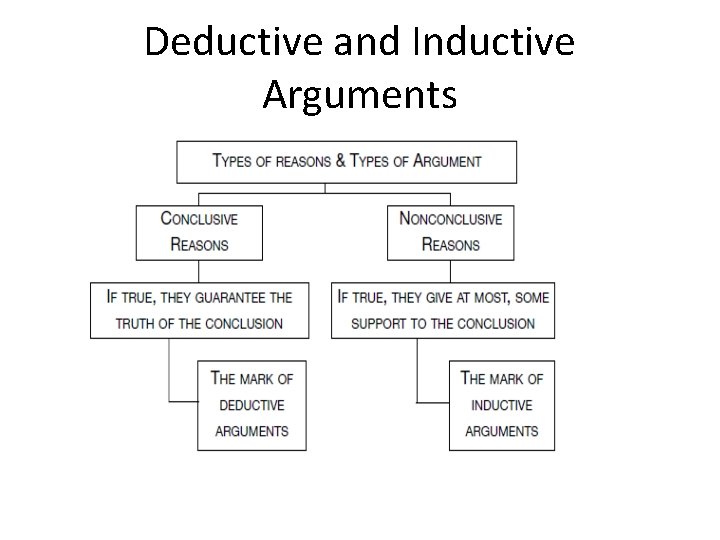
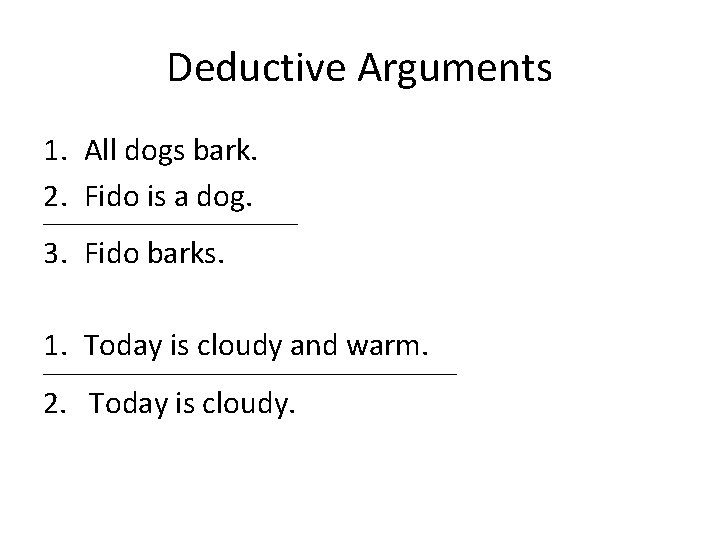
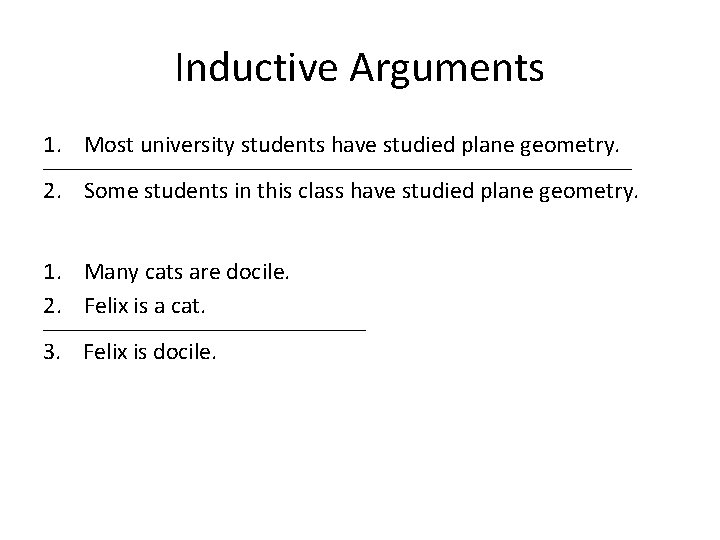
Types of Arguments • All arguments are either deductive or inductive. • A deductive argument is one in which the conclusion follows necessarily from the premises. • An inductive argument is one in which the premises provide nonconclusive support for the conclusion. Copyright © 2012 Pearson Education, Inc. All rights reserved.
Deductive and Inductive Arguments Copyright © 2012 Pearson Education, Inc. All rights reserved.
Deductive Arguments 1. All dogs bark. 2. Fido is a dog. ________________________________ 3. Fido barks. 1. Today is cloudy and warm. ____________________________________________________ 2. Today is cloudy. Copyright © 2012 Pearson Education, Inc. All rights reserved.
Inductive Arguments 1. Most university students have studied plane geometry. __________________________________________________________________________ 2. Some students in this class have studied plane geometry. 1. Many cats are docile. 2. Felix is a cat. _________________________________________ 3. Felix is docile. Copyright © 2012 Pearson Education, Inc. All rights reserved.
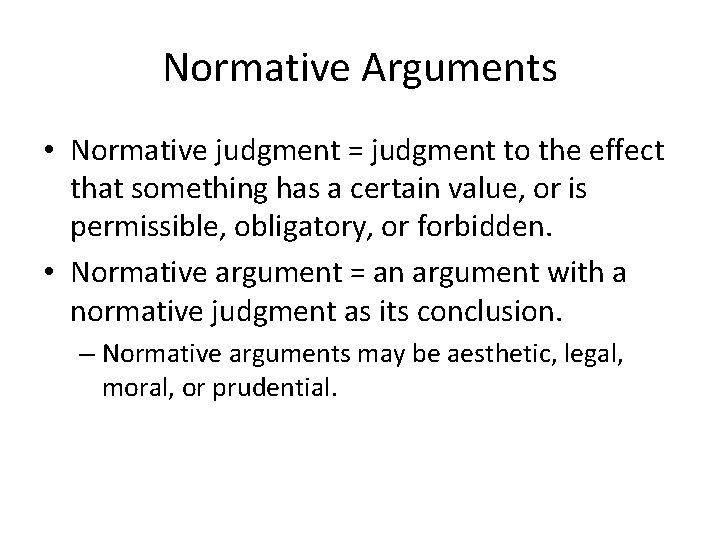
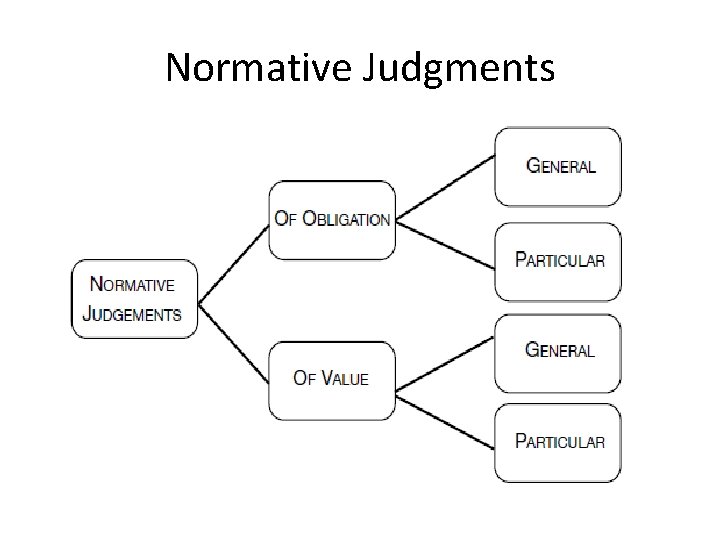
Normative Arguments • Normative judgment = judgment to the effect that something has a certain value, or is permissible, obligatory, or forbidden. • Normative argument = an argument with a normative judgment as its conclusion. – Normative arguments may be aesthetic, legal, moral, or prudential. Copyright © 2012 Pearson Education, Inc. All rights reserved.
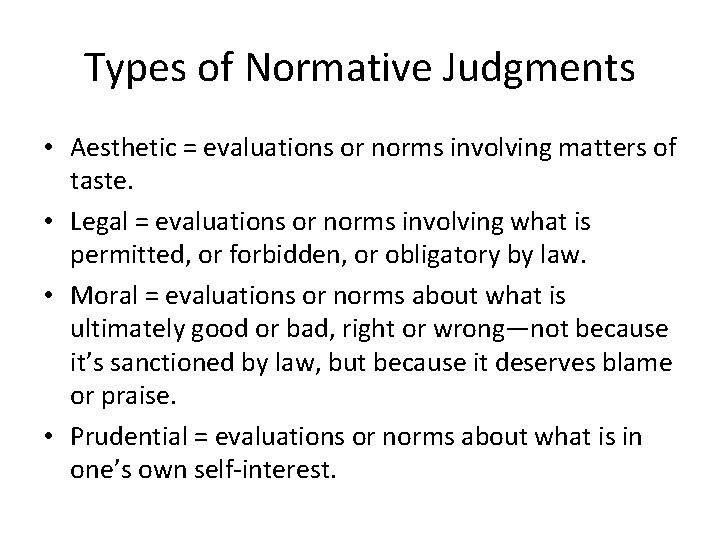
Types of Normative Judgments • Aesthetic = evaluations or norms involving matters of taste. • Legal = evaluations or norms involving what is permitted, or forbidden, or obligatory by law. • Moral = evaluations or norms about what is ultimately good or bad, right or wrong—not because it’s sanctioned by law, but because it deserves blame or praise. • Prudential = evaluations or norms about what is in one’s own self-interest. Copyright © 2012 Pearson Education, Inc. All rights reserved.
Normative Judgments Copyright © 2012 Pearson Education, Inc. All rights reserved.
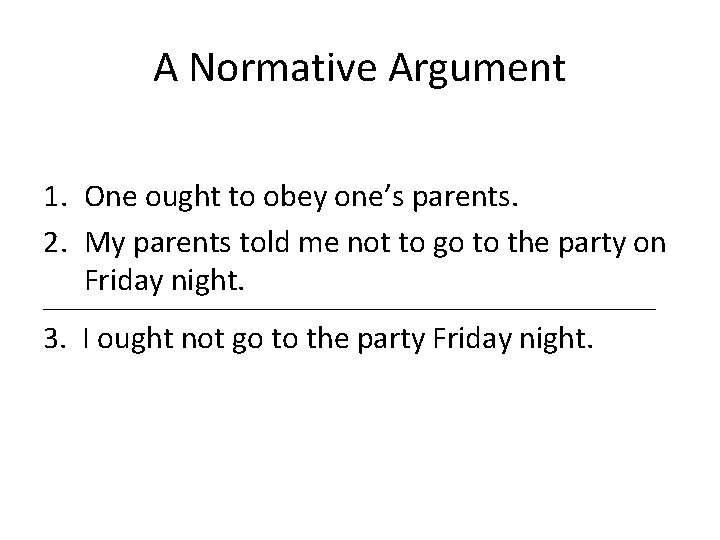
A Normative Argument 1. One ought to obey one’s parents. 2. My parents told me not to go to the party on Friday night. _____________________________________________________________________________ 3. I ought not go to the party Friday night. Copyright © 2012 Pearson Education, Inc. All rights reserved.
Normative Arguments with Missing Premises • Normative arguments often leave out general normative reasons. • Such reasons must be made explicit in argument analysis. • A careful logical thinker will ensure that all of an argument’s premises are in place, since that is the only way to make a fair assessment of the argument’s conclusiveness. Copyright © 2012 Pearson Education, Inc. All rights reserved.