
Chapter FOUR Structure and Function of Cells I


- Slides: 38
Chapter FOUR Structure and Function of Cells I. Introduction (Cell theory, Cell size, Microscopy) II. Prokaryotic Cellular Structure III. Eukaryotic Cell Structure & Function of Organelles – Nucleus – Ribosomes – Endomembrane System: Rg & Sm ER, Golgi apparatus, vesicles (lysosomes & peroxisomes) – Vacuoles – Energy Related Organelles: chloroplasts & mitochondria – Cytoskeleton: actin filaments, intermediate filaments, microtubles (centrioles, cilia & flagella) IV. Comparison of Prokaryotic Cell vs Eukaryotic Cell V. Comparison of Animal vs. Plant cell
I. Introduction (Cell theory, Cell size, Microscopy) • Cell Theory – Hooke - (1660 s) coined the term “cell” to describe life’s basic unit – Schleiden - (1838) studied plant cells – Schwann - (1839) studied animal cells – Virchow - (1858) cells capable of self-reproduction • Three Tenets of CELL THEORY: (pg. 61) 1. Cell is basic (structural/functional) unit of life 2. All living things are made up of cells 3. New cells arise only from pre-existing cells
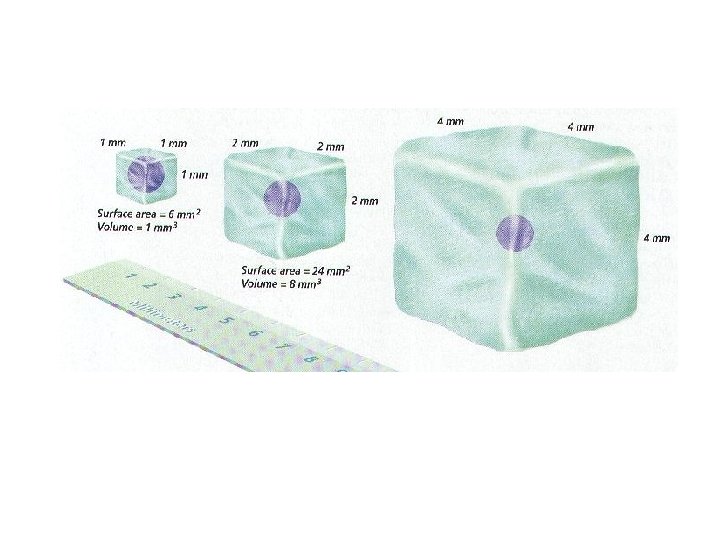
• Size of cells must remain SMALL in order to efficiently function (pg. 62) • A LARGE surface area: volume ratio allows the cell to function properly/efficiently – Small cells have more plasma membrane : cytoplasm ratio – As a cell increases in size the SURFACE AREA to VOLUME ratio decreases 1) Nucleus can only control “so much” volume (cytoplasm) 2) Plasma membrane can only regulate “so much” material into/out off cell – CONCEPT: In the smaller cell, cellular communication & control is more efficient. – EXCEPTION: Cells that specialize in absorption need to have a large surface area.
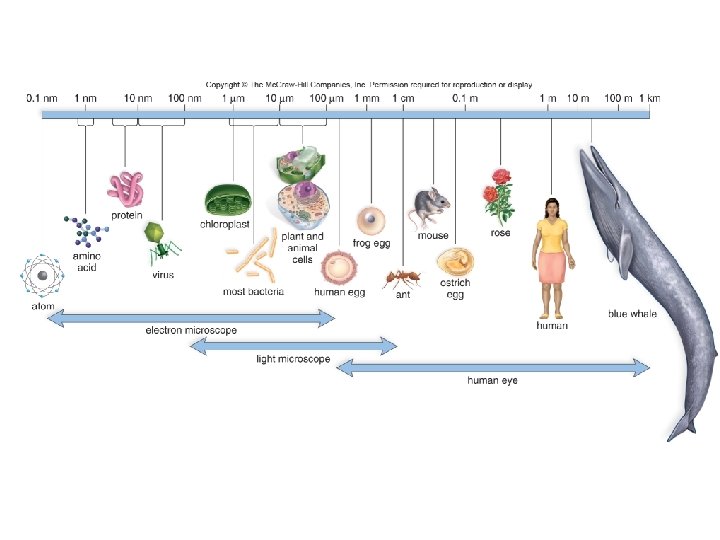
• Microscopy (pg. 63 -64) – Cell sizes vary; Most are very small; Size measured in µms (1µm = 1 millionth of a meter) – Terms: • Magnification – increases size • resolving power - clarity of image • Different types of microscopy: – Compound light – not powerful enough to resolve many cellular structures – SEM – Scanning Electron Microscope – bounces electrons off surfaces – creates a 3 -D image – TEM – Transmission Electron Microscope – transmits electrons through the material – view internal structures
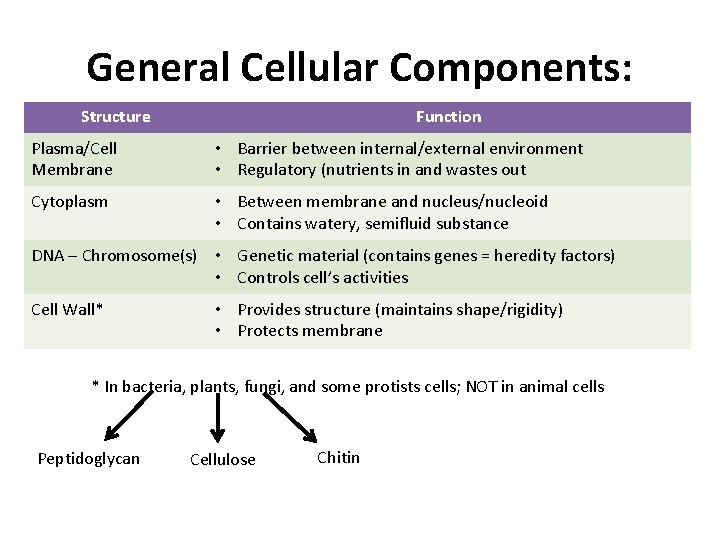
General Cellular Components: Structure Function Plasma/Cell Membrane • Barrier between internal/external environment • Regulatory (nutrients in and wastes out Cytoplasm • Between membrane and nucleus/nucleoid • Contains watery, semifluid substance DNA – Chromosome(s) • Genetic material (contains genes = heredity factors) • Controls cell’s activities Cell Wall* • Provides structure (maintains shape/rigidity) • Protects membrane * In bacteria, plants, fungi, and some protists cells; NOT in animal cells Peptidoglycan Cellulose Chitin
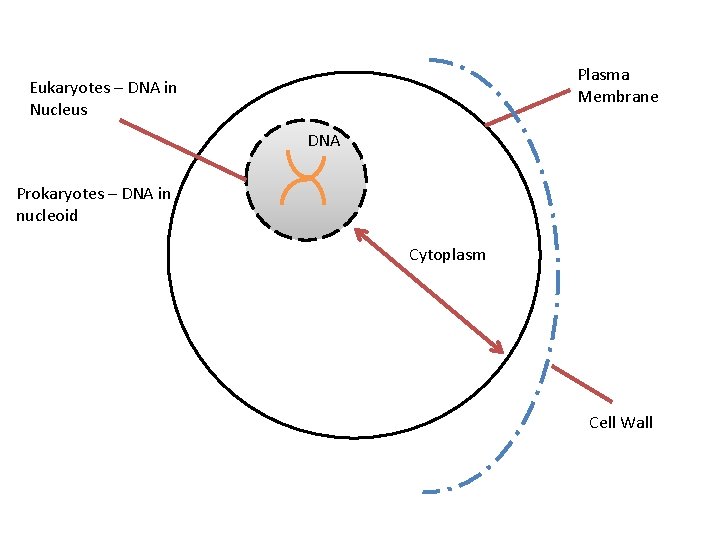
Plasma Membrane Eukaryotes – DNA in Nucleus DNA Prokaryotes – DNA in nucleoid Cytoplasm Cell Wall
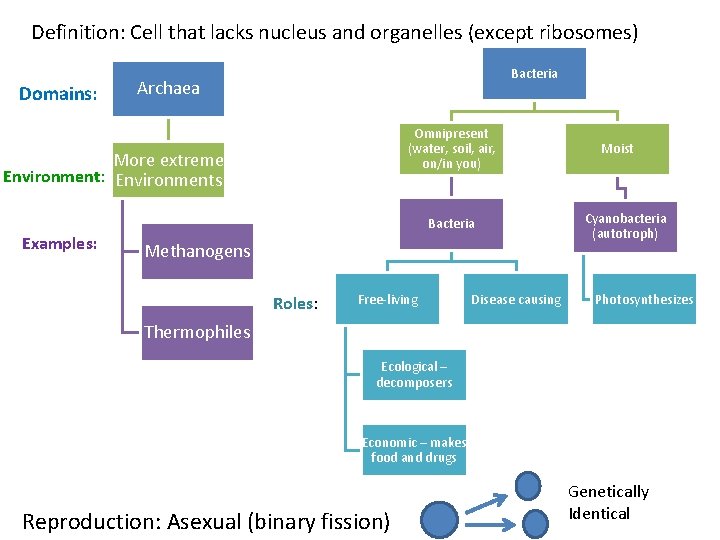
Definition: Cell that lacks nucleus and organelles (except ribosomes) Domains: Bacteria Archaea Omnipresent (water, soil, air, on/in you) More extreme Environment: Environments Bacteria Examples: Methanogens Roles: Free-living Disease causing Moist Cyanobacteria (autotroph) Photosynthesizes Thermophiles Ecological – decomposers Economic – makes food and drugs Reproduction: Asexual (binary fission) Genetically Identical
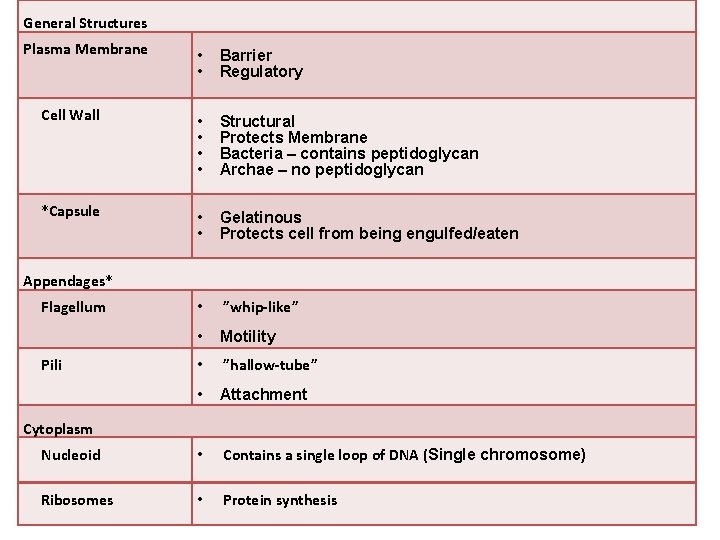
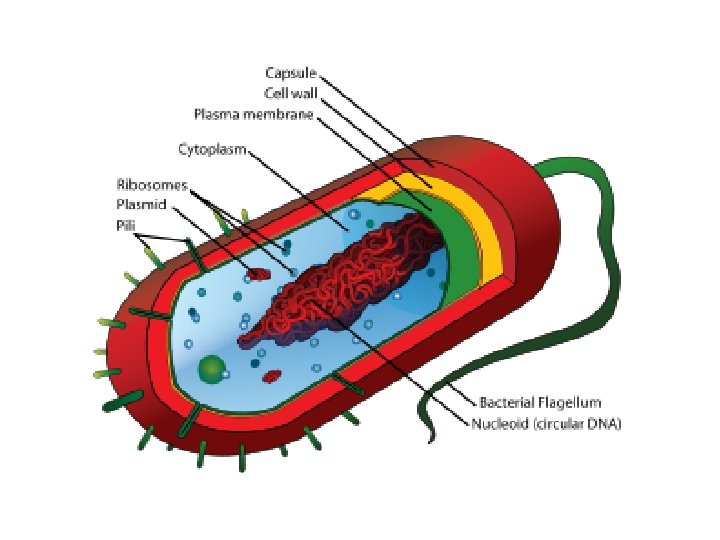
General Structures • • Barrier Regulatory • • Structural Protects Membrane Bacteria – contains peptidoglycan Archae – no peptidoglycan • • Gelatinous Protects cell from being engulfed/eaten • ”whip-like” • Motility • ”hallow-tube” • Attachment Nucleoid • Contains a single loop of DNA (Single chromosome) Ribosomes • Protein synthesis Plasma Membrane Cell Wall *Capsule Appendages* Flagellum Pili Cytoplasm
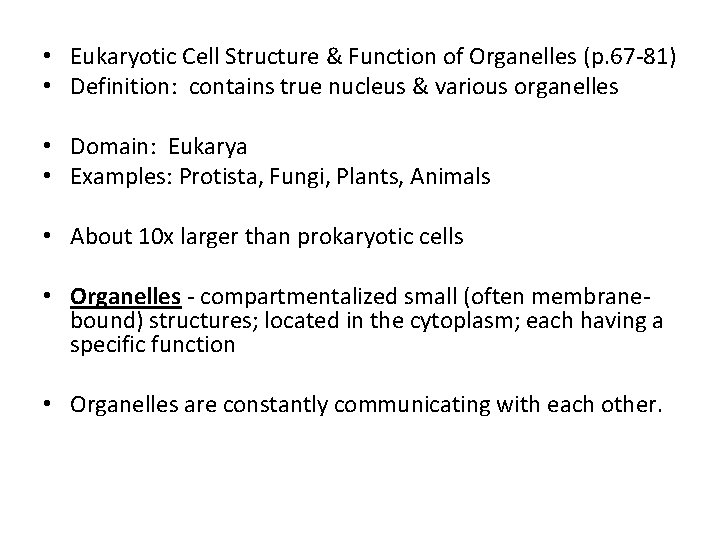
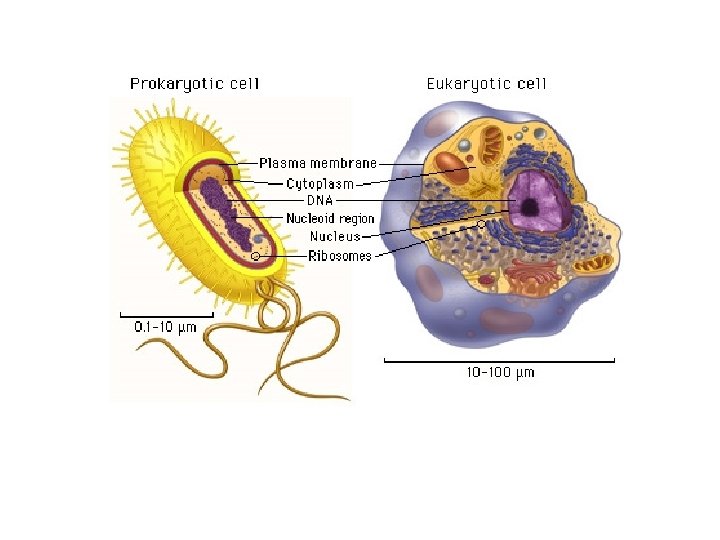
• Eukaryotic Cell Structure & Function of Organelles (p. 67 -81) • Definition: contains true nucleus & various organelles • Domain: Eukarya • Examples: Protista, Fungi, Plants, Animals • About 10 x larger than prokaryotic cells • Organelles - compartmentalized small (often membranebound) structures; located in the cytoplasm; each having a specific function • Organelles are constantly communicating with each other.
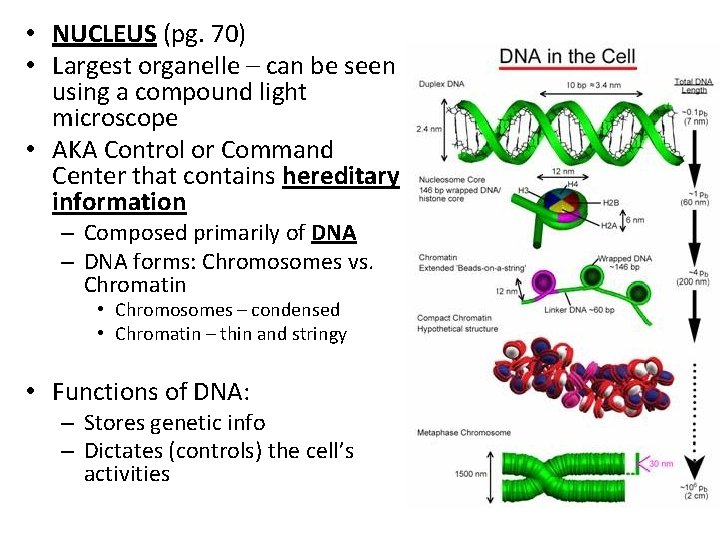
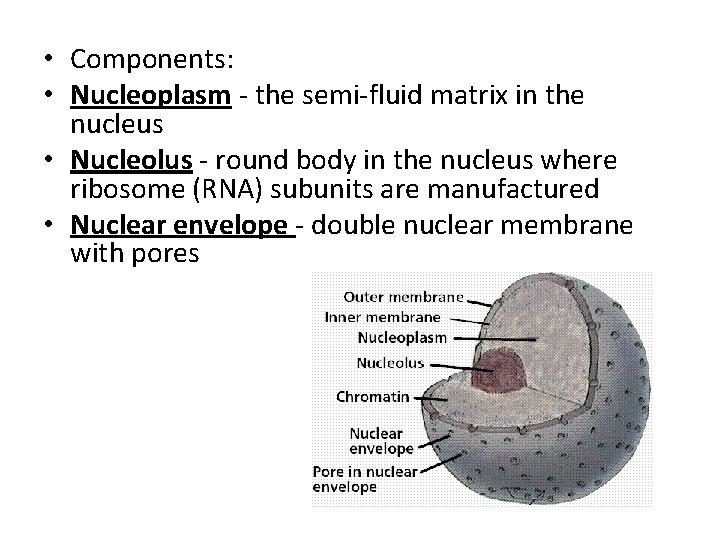
• NUCLEUS (pg. 70) • Largest organelle – can be seen using a compound light microscope • AKA Control or Command Center that contains hereditary information – Composed primarily of DNA – DNA forms: Chromosomes vs. Chromatin • Chromosomes – condensed • Chromatin – thin and stringy • Functions of DNA: – Stores genetic info – Dictates (controls) the cell’s activities
• Components: • Nucleoplasm - the semi-fluid matrix in the nucleus • Nucleolus - round body in the nucleus where ribosome (RNA) subunits are manufactured • Nuclear envelope - double nuclear membrane with pores
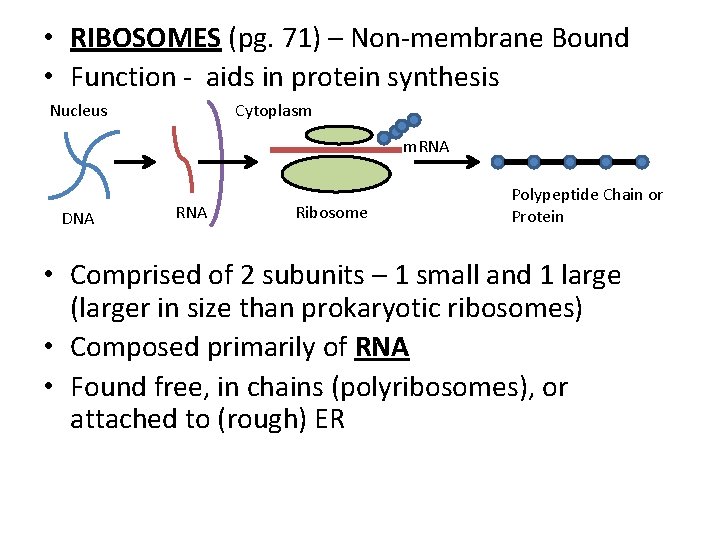
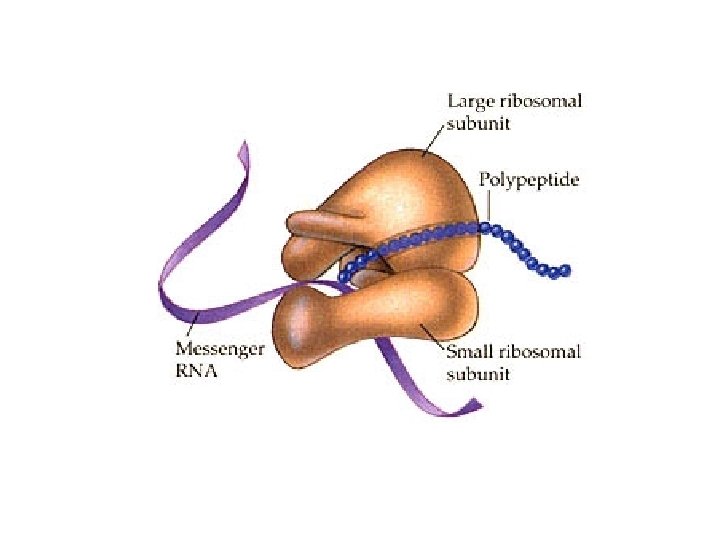
• RIBOSOMES (pg. 71) – Non-membrane Bound • Function - aids in protein synthesis Nucleus Cytoplasm m. RNA DNA Ribosome Polypeptide Chain or Protein • Comprised of 2 subunits – 1 small and 1 large (larger in size than prokaryotic ribosomes) • Composed primarily of RNA • Found free, in chains (polyribosomes), or attached to (rough) ER
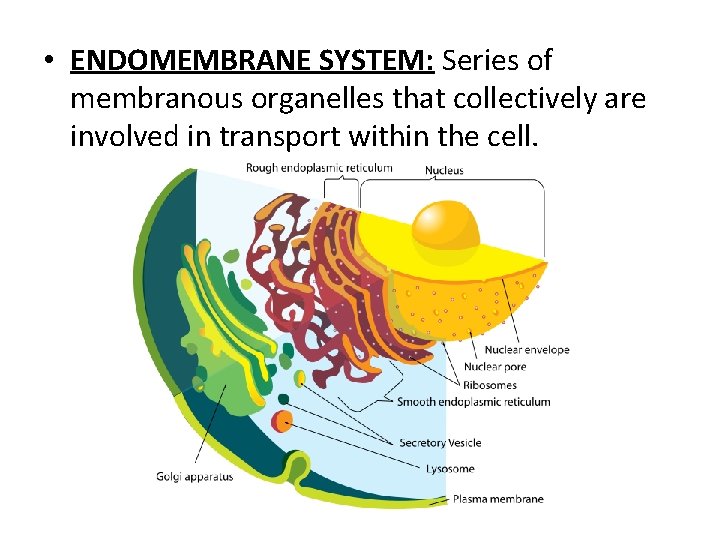
• ENDOMEMBRANE SYSTEM: Series of membranous organelles that collectively are involved in transport within the cell.
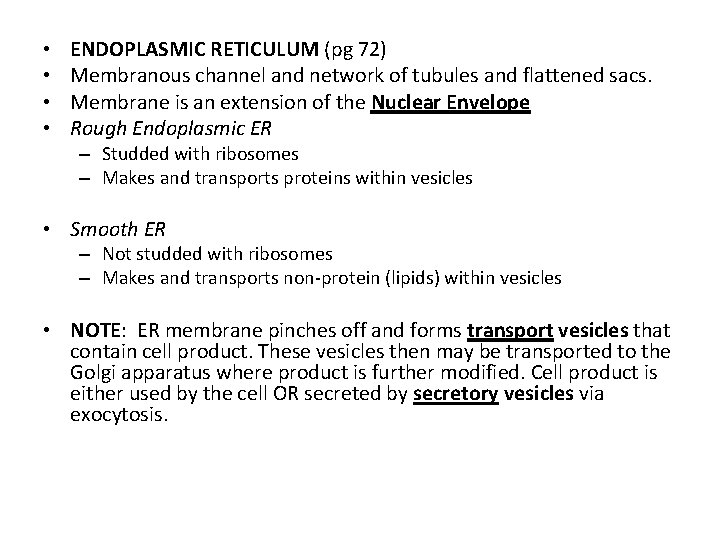
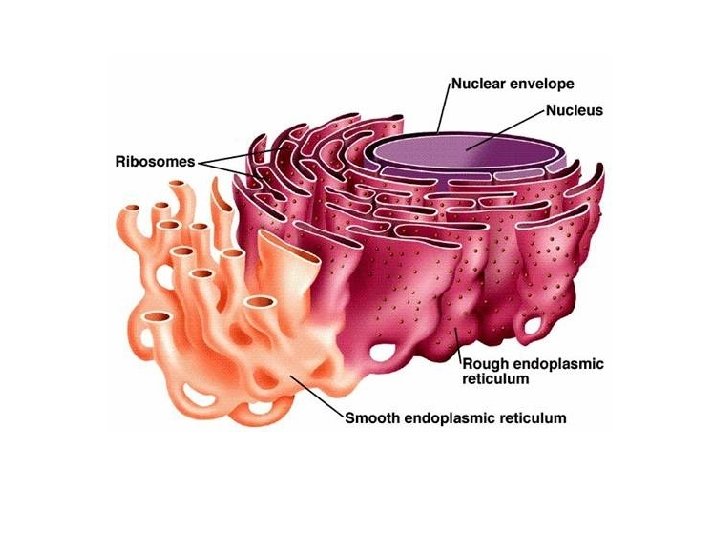
• • ENDOPLASMIC RETICULUM (pg 72) Membranous channel and network of tubules and flattened sacs. Membrane is an extension of the Nuclear Envelope Rough Endoplasmic ER – Studded with ribosomes – Makes and transports proteins within vesicles • Smooth ER – Not studded with ribosomes – Makes and transports non-protein (lipids) within vesicles • NOTE: ER membrane pinches off and forms transport vesicles that contain cell product. These vesicles then may be transported to the Golgi apparatus where product is further modified. Cell product is either used by the cell OR secreted by secretory vesicles via exocytosis.
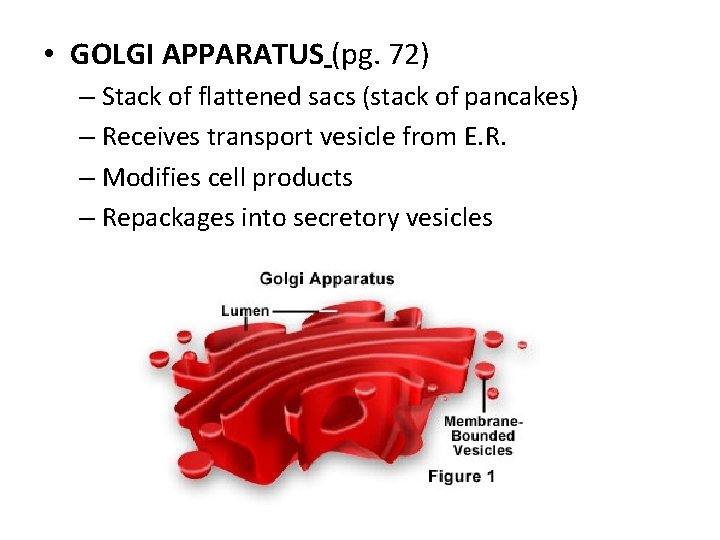
• GOLGI APPARATUS (pg. 72) – Stack of flattened sacs (stack of pancakes) – Receives transport vesicle from E. R. – Modifies cell products – Repackages into secretory vesicles
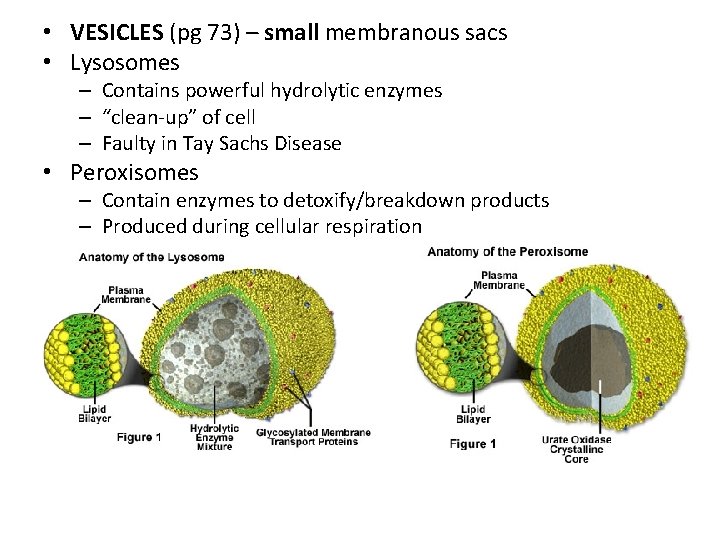
• VESICLES (pg 73) – small membranous sacs • Lysosomes – Contains powerful hydrolytic enzymes – “clean-up” of cell – Faulty in Tay Sachs Disease • Peroxisomes – Contain enzymes to detoxify/breakdown products – Produced during cellular respiration
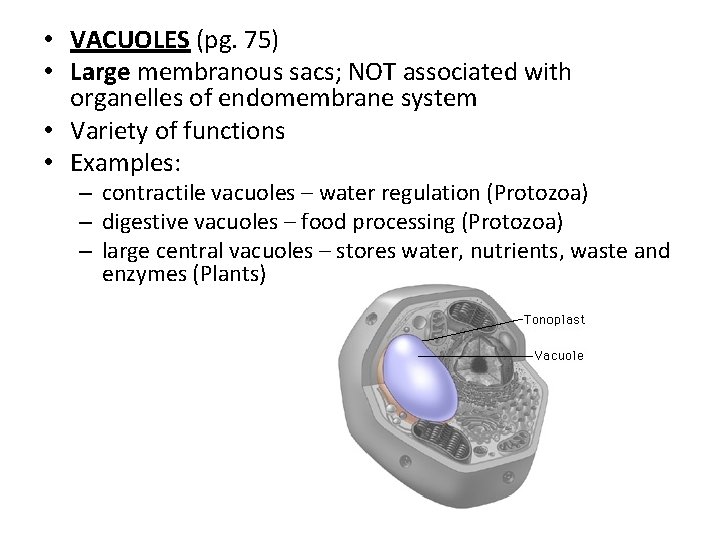
• VACUOLES (pg. 75) • Large membranous sacs; NOT associated with organelles of endomembrane system • Variety of functions • Examples: – contractile vacuoles – water regulation (Protozoa) – digestive vacuoles – food processing (Protozoa) – large central vacuoles – stores water, nutrients, waste and enzymes (Plants)
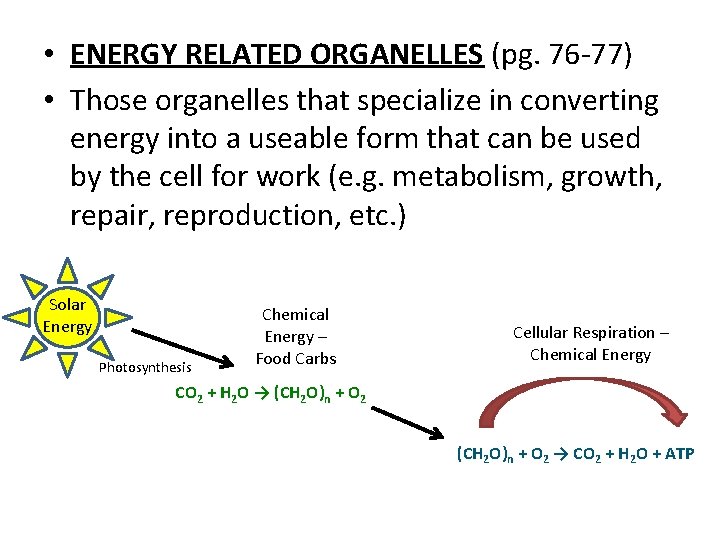
• ENERGY RELATED ORGANELLES (pg. 76 -77) • Those organelles that specialize in converting energy into a useable form that can be used by the cell for work (e. g. metabolism, growth, repair, reproduction, etc. ) Solar Energy Photosynthesis Chemical Energy – Food Carbs Cellular Respiration – Chemical Energy CO 2 + H 2 O → (CH 2 O)n + O 2 → CO 2 + H 2 O + ATP
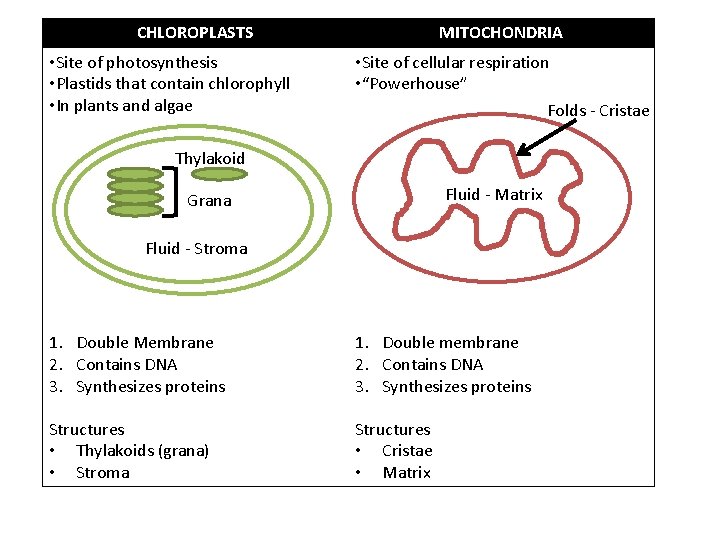
CHLOROPLASTS • Site of photosynthesis • Plastids that contain chlorophyll • In plants and algae MITOCHONDRIA • Site of cellular respiration • “Powerhouse” Folds - Cristae Thylakoid Fluid - Matrix Grana Fluid - Stroma 1. Double Membrane 2. Contains DNA 3. Synthesizes proteins 1. Double membrane 2. Contains DNA 3. Synthesizes proteins Structures • Thylakoids (grana) • Stroma Structures • Cristae • Matrix
• Theory of Endosymbiosis – Symbiosis is a close relationship between organisms of different species that live together. – This theory proposes that some of today’s eukaryotic organelles evolved by symbiosis. – Meaning that free living cells came together. The smaller prokaryotic cells were engulfed by the larger cell and offered the host cell certain advantages. – Some organelles contain DNA: • Mitochondria • Chloroplast
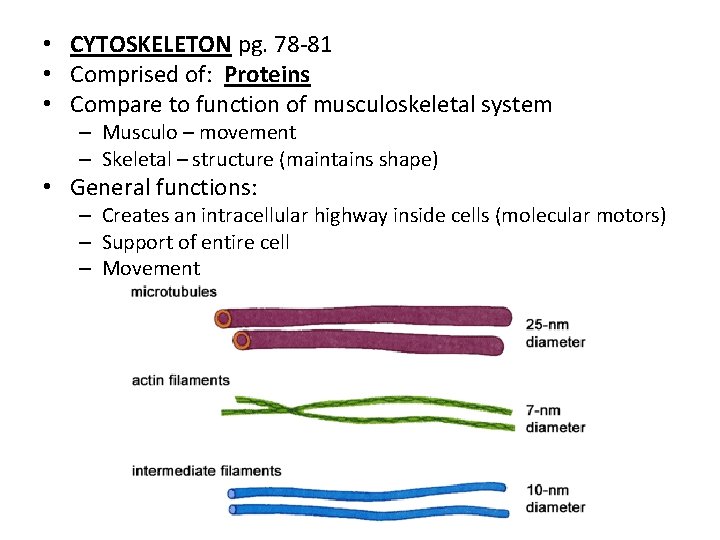
• CYTOSKELETON pg. 78 -81 • Comprised of: Proteins • Compare to function of musculoskeletal system – Musculo – movement – Skeletal – structure (maintains shape) • General functions: – Creates an intracellular highway inside cells (molecular motors) – Support of entire cell – Movement
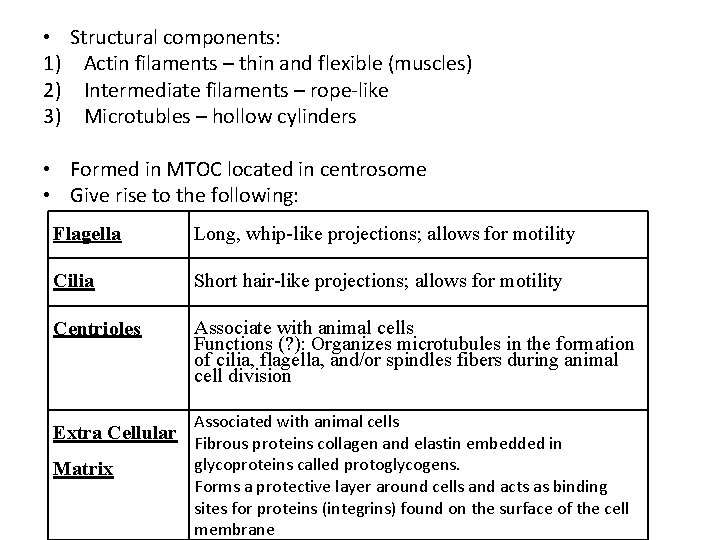
• 1) 2) 3) Structural components: Actin filaments – thin and flexible (muscles) Intermediate filaments – rope-like Microtubles – hollow cylinders • Formed in MTOC located in centrosome • Give rise to the following: Flagella Long, whip-like projections; allows for motility Cilia Short hair-like projections; allows for motility Centrioles Associate with animal cells Functions (? ): Organizes microtubules in the formation of cilia, flagella, and/or spindles fibers during animal cell division Associated with animal cells Extra Cellular Fibrous proteins collagen and elastin embedded in glycoproteins called protoglycogens. Matrix Forms a protective layer around cells and acts as binding sites for proteins (integrins) found on the surface of the cell membrane
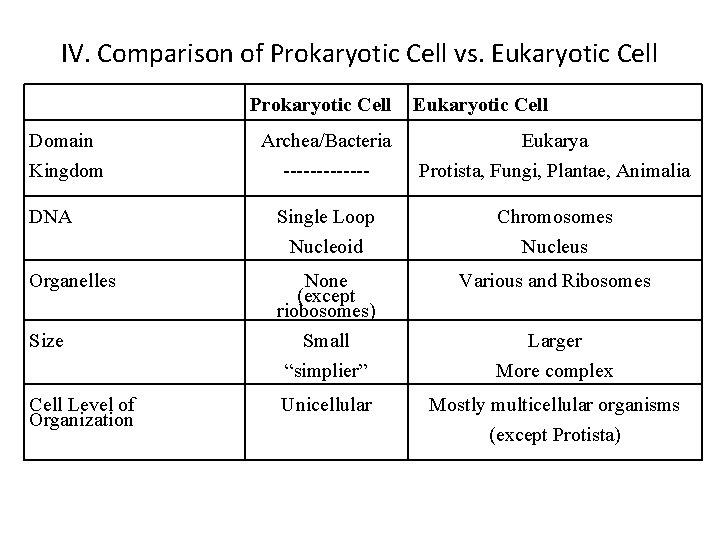
IV. Comparison of Prokaryotic Cell vs. Eukaryotic Cell Prokaryotic Cell Domain Kingdom Eukaryotic Cell Archea/Bacteria ------- Eukarya Protista, Fungi, Plantae, Animalia DNA Single Loop Nucleoid Chromosomes Nucleus Organelles None (except riobosomes) Various and Ribosomes Size Small “simplier” Larger More complex Cell Level of Organization Unicellular Mostly multicellular organisms (except Protista)
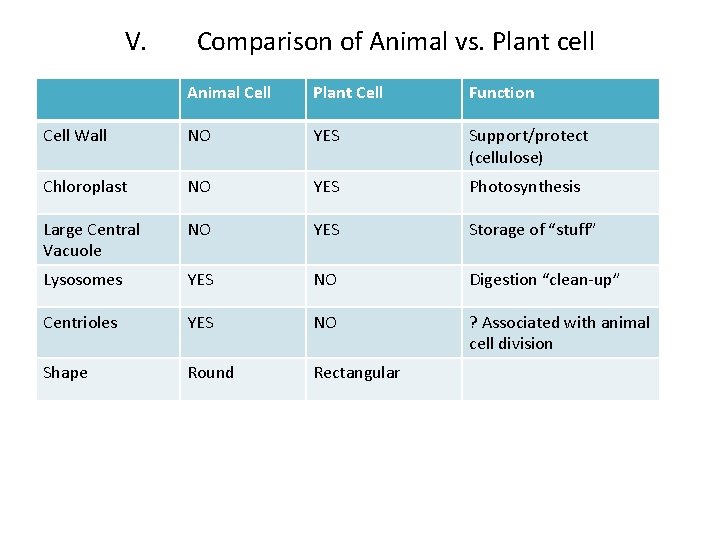
V. Comparison of Animal vs. Plant cell Animal Cell Plant Cell Function Cell Wall NO YES Support/protect (cellulose) Chloroplast NO YES Photosynthesis Large Central Vacuole NO YES Storage of “stuff” Lysosomes YES NO Digestion “clean-up” Centrioles YES NO ? Associated with animal cell division Shape Round Rectangular
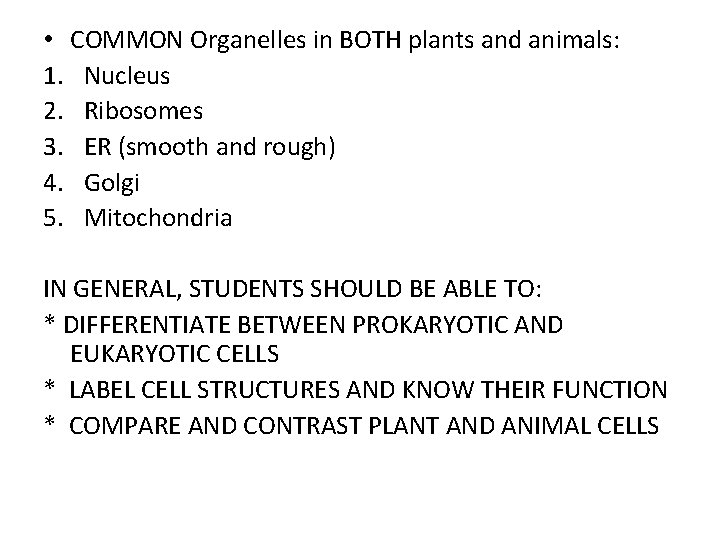
• COMMON Organelles in BOTH plants and animals: 1. Nucleus 2. Ribosomes 3. ER (smooth and rough) 4. Golgi 5. Mitochondria IN GENERAL, STUDENTS SHOULD BE ABLE TO: * DIFFERENTIATE BETWEEN PROKARYOTIC AND EUKARYOTIC CELLS * LABEL CELL STRUCTURES AND KNOW THEIR FUNCTION * COMPARE AND CONTRAST PLANT AND ANIMAL CELLS
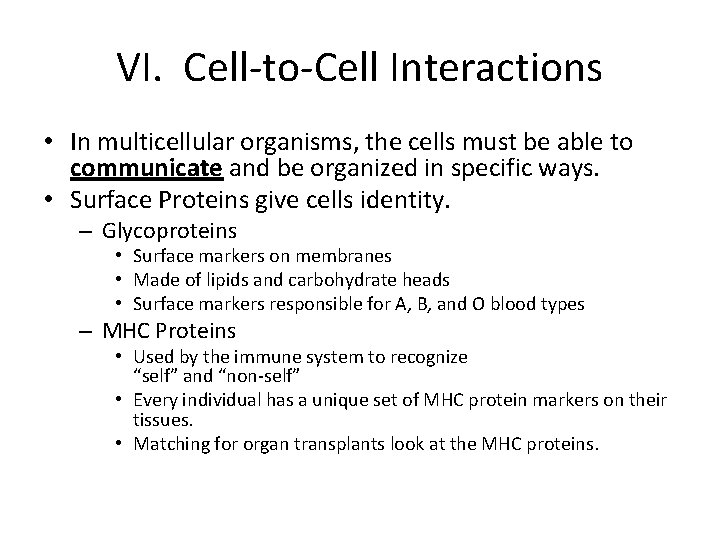
VI. Cell-to-Cell Interactions • In multicellular organisms, the cells must be able to communicate and be organized in specific ways. • Surface Proteins give cells identity. – Glycoproteins • Surface markers on membranes • Made of lipids and carbohydrate heads • Surface markers responsible for A, B, and O blood types – MHC Proteins • Used by the immune system to recognize “self” and “non-self” • Every individual has a unique set of MHC protein markers on their tissues. • Matching for organ transplants look at the MHC proteins.
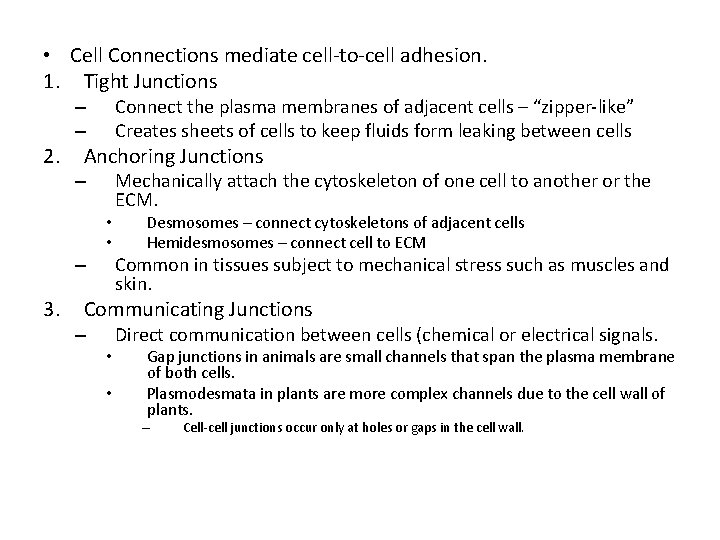
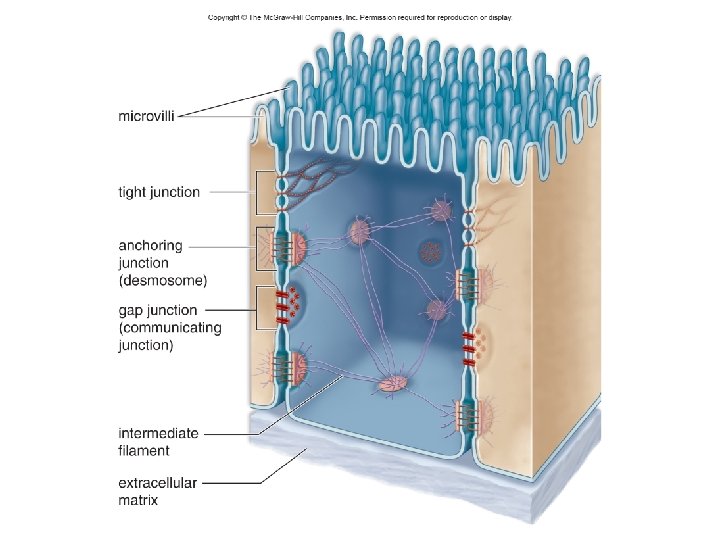
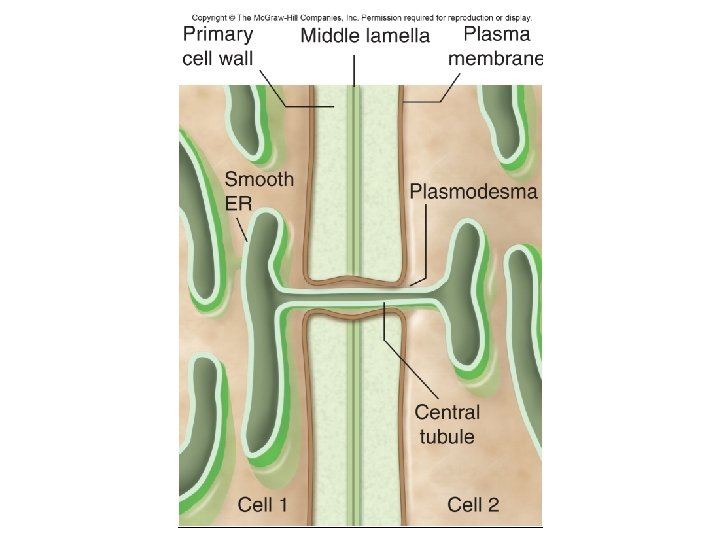
• Cell Connections mediate cell-to-cell adhesion. 1. Tight Junctions Connect the plasma membranes of adjacent cells – “zipper-like” Creates sheets of cells to keep fluids form leaking between cells – – 2. Anchoring Junctions – • • Desmosomes – connect cytoskeletons of adjacent cells Hemidesmosomes – connect cell to ECM Common in tissues subject to mechanical stress such as muscles and skin. – 3. Mechanically attach the cytoskeleton of one cell to another or the ECM. Communicating Junctions – • • Direct communication between cells (chemical or electrical signals. Gap junctions in animals are small channels that span the plasma membrane of both cells. Plasmodesmata in plants are more complex channels due to the cell wall of plants. – Cell-cell junctions occur only at holes or gaps in the cell wall.
• At the bottom of your notes write down these organelles! 1. Mitochondria 2. Ribosomes 3. Nucleus 4. Endoplasmic Reticulum 5. Golgi Apparatus 6. Protein 7. Cell Membrane 8. Lysosomes 9. Nucleolus • Match the parts of the city (underlined) with the parts of the cell.
Cell City Analogy In a far away city called Grant City, the main export and production product is the steel widget. Everyone in the town has something to do with steel widget making and the entire town is designed to build and export widgets. The town hall has the instructions for widget making, widgets come in all shapes and sizes and any citizen of Grant can get the instructions and begin making their own widgets. Widgets are generally produced in small shops around the city, these small shops can be built by the carpenter's union (whose headquarters are in town hall). After the widget is constructed, they are placed on special carts which can deliver the widget anywhere in the city. In order for a widget to be exported, the carts take the widget to the postal office, where the widgets are packaged and labeled for export. Sometimes widgets don't turn out right, and the "rejects" are sent to the scrap yard where they are broken down for parts or destroyed altogether. The town powers the widget shops and carts from a hydraulic dam that is in the city. The entire city is enclosed by a large wooden fence, only the postal trucks (and citizens with proper passports) are allowed outside the city.