
Chapter Four Part I SOLUTION STOICHIOMETRY AP Chemistry
- Slides: 12
Chapter Four: Part I: SOLUTION STOICHIOMETRY AP Chemistry Ms. Paskowski
Water, the Common Solvent • One of the most important substances on earth • Can dissolve many different substances • A polar molecule 4. 1
Dissolution of a Solid in a Liquid 4. 1
Nature of Aqueous Solutions • Solute – substance being dissolved • Solvent – liquid water • Electrolyte – substance that when dissolved in water produces a solution that can conduct electricity 4. 2
Electrolytes • Strong Electrolytes – conduct current very efficiently (bulb shines brightly) • Weak Electrolytes – conduct only a small current (bulb glows dimly) • Nonelectrolytes – no current flows (bulb remains unlit) 4. 2
Electrolyte Behavior 4. 2
Chemical Reactions of Solutions • We must know: • Nature of the reaction • Amounts of chemicals present in the solutions 4. 3
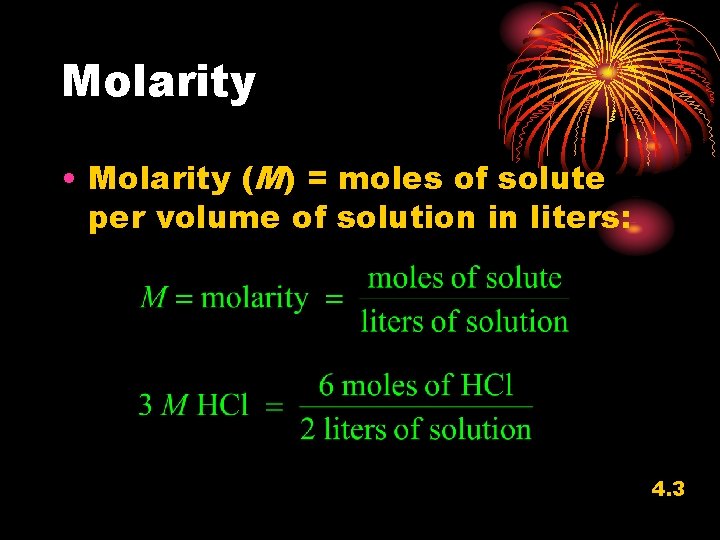
Molarity • Molarity (M) = moles of solute per volume of solution in liters: 4. 3
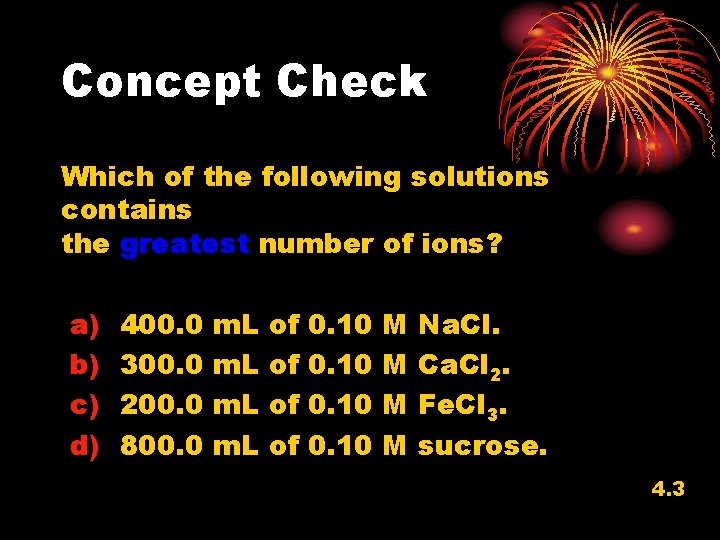
Concept Check Which of the following solutions contains the greatest number of ions? a) b) c) d) 400. 0 300. 0 200. 0 800. 0 m. L of of 0. 10 M M Na. Cl. Ca. Cl 2. Fe. Cl 3. sucrose. 4. 3
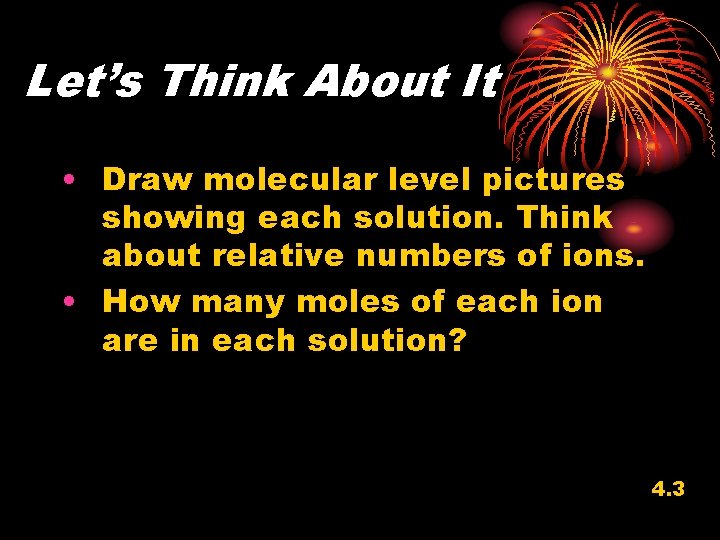
Let’s Think About It • Draw molecular level pictures showing each solution. Think about relative numbers of ions. • How many moles of each ion are in each solution? 4. 3
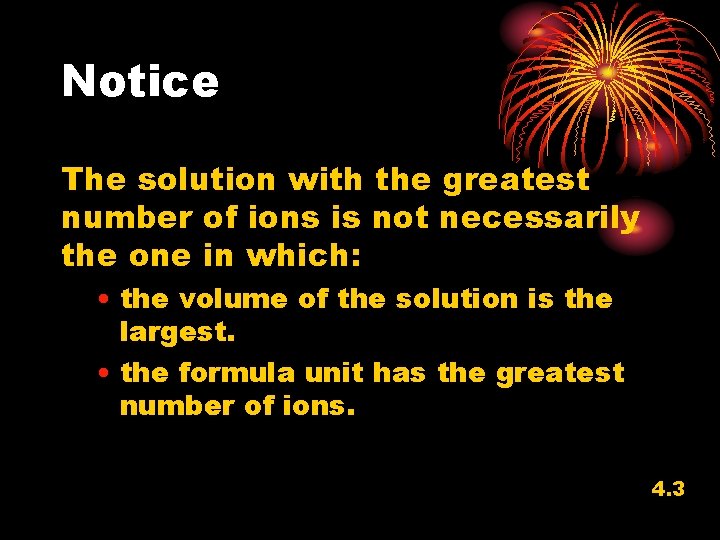
Notice The solution with the greatest number of ions is not necessarily the one in which: • the volume of the solution is the largest. • the formula unit has the greatest number of ions. 4. 3
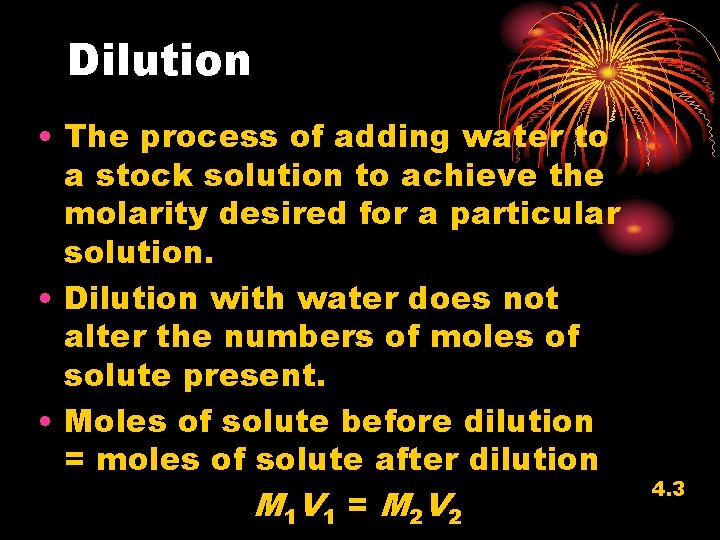
Dilution • The process of adding water to a stock solution to achieve the molarity desired for a particular solution. • Dilution with water does not alter the numbers of moles of solute present. • Moles of solute before dilution = moles of solute after dilution M 1 V 1 = M 2 V 2 4. 3