
Chapter Four LowInvolvement Consumer Decision Making Session Preview
- Slides: 14
Chapter Four Low-Involvement Consumer Decision Making
Session Preview • • Meaning of involvement Strategic implications Utilitarian versus hedonic involvement Enduring versus situational involvement • Involvement with media • Social implications of involvement Copyright © Houghton Mifflin Company. All rights reserved. 2
Meaning of Involvement • Involvement = motivation to process information and evaluate brand alternatives • Involvement is greater if product – – – Is tied to self-image Is expensive Has symbolic meaning Has an important functional role Purchase results in high perceived risk • • Performance Financial Social Psychological Copyright © Houghton Mifflin Company. All rights reserved. 3
Why Is Involvement a Key Dimension in Consumer Decision Making? • Increases level of information search • Increases number of alternatives considered • Strengthens product/brand attitudes • Increases perceived risk in choice Copyright © Houghton Mifflin Company. All rights reserved. 4
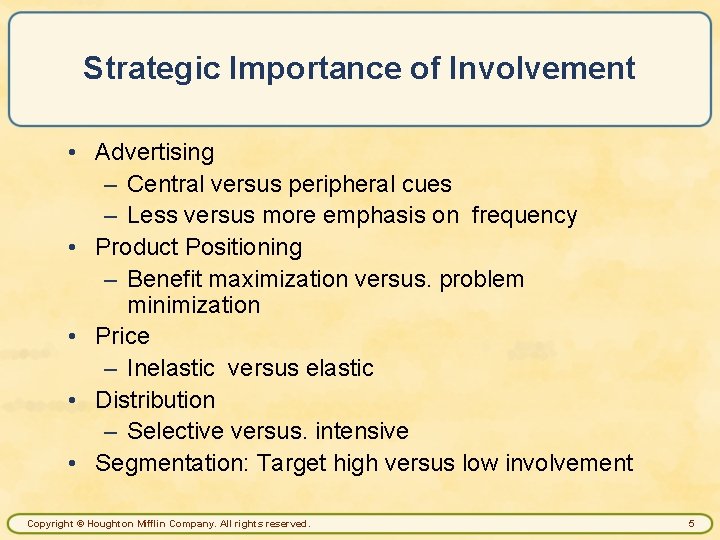
Strategic Importance of Involvement • Advertising – Central versus peripheral cues – Less versus more emphasis on frequency • Product Positioning – Benefit maximization versus. problem minimization • Price – Inelastic versus elastic • Distribution – Selective versus. intensive • Segmentation: Target high versus low involvement Copyright © Houghton Mifflin Company. All rights reserved. 5
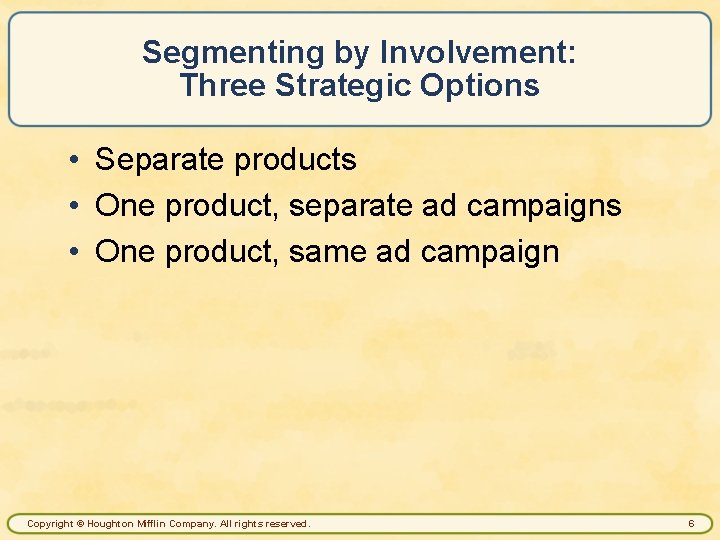
Segmenting by Involvement: Three Strategic Options • Separate products • One product, separate ad campaigns • One product, same ad campaign Copyright © Houghton Mifflin Company. All rights reserved. 6
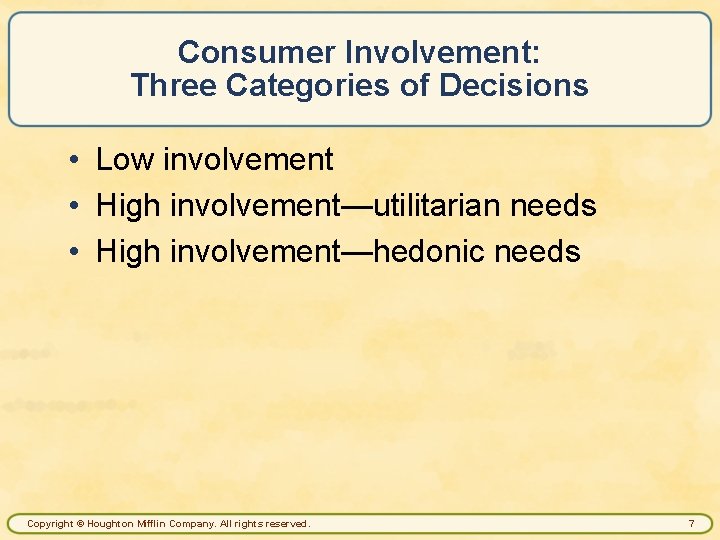
Consumer Involvement: Three Categories of Decisions • Low involvement • High involvement—utilitarian needs • High involvement—hedonic needs Copyright © Houghton Mifflin Company. All rights reserved. 7
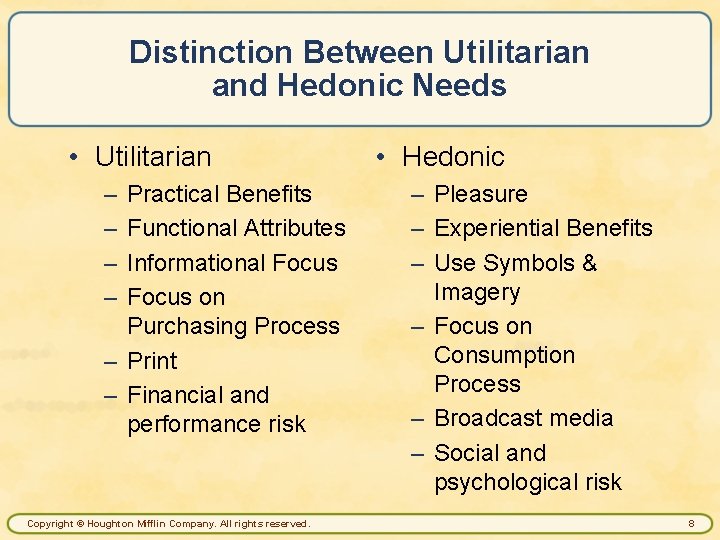
Distinction Between Utilitarian and Hedonic Needs • Utilitarian – – Practical Benefits Functional Attributes Informational Focus on Purchasing Process – Print – Financial and performance risk Copyright © Houghton Mifflin Company. All rights reserved. • Hedonic – Pleasure – Experiential Benefits – Use Symbols & Imagery – Focus on Consumption Process – Broadcast media – Social and psychological risk 8
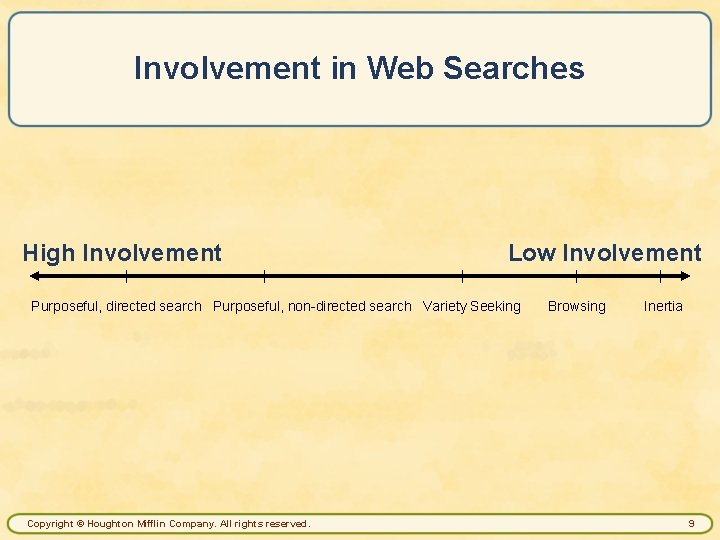
Involvement in Web Searches High Involvement Low Involvement Purposeful, directed search Purposeful, non-directed search Variety Seeking Copyright © Houghton Mifflin Company. All rights reserved. Browsing Inertia 9
Distinction Between Enduring and Situational Involvement • Enduring Involvement – Consumers have continuous interest in product on day-to-day basis • Situational Involvement – Consumers process and evaluate information only when they have to make a decision Would it benefit marketers to convert consumers from situational to enduring involvement? Copyright © Houghton Mifflin Company. All rights reserved. 10
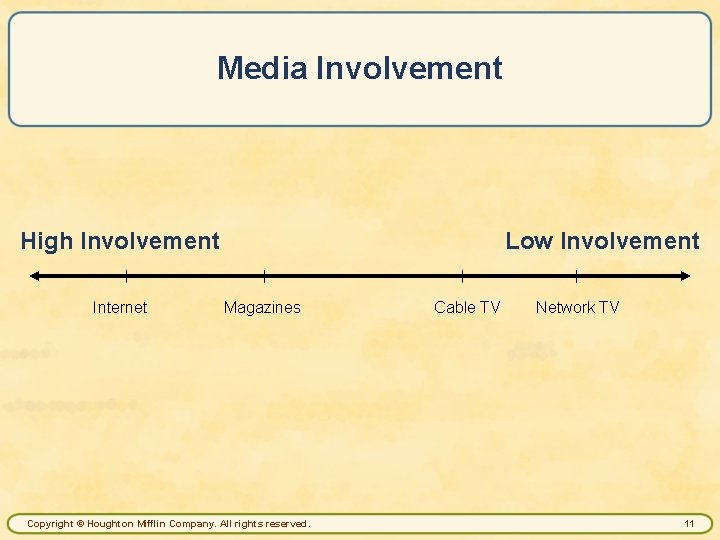
Media Involvement High Involvement Internet Low Involvement Magazines Copyright © Houghton Mifflin Company. All rights reserved. Cable TV Network TV 11
Procter & Gamble Opening Case • The case makes two apparently contradictory statements: • Internet commerce works best when merchandise is easy to label and doesn’t vary meaningfully within each category. • The Internet is an “experience-oriented destination” and as a result, “provides the opportunity to take the brand’s emotional value to new levels. ” (primarily through interactivity and customization. ) Are these statements contradictory? How can marketers get the brand to new emotional level if doesn’t vary significantly? Copyright © Houghton Mifflin Company. All rights reserved. 12
More P&G Questions • What is P&G trying to accomplish by establishing low involvement products on the Internet? • How can P&G increase involvement with its brands through its Web sites? • What are the strategic implications for brand building on the Web for low involvement products? • What are the pros and cons of selling P&G products online? Copyright © Houghton Mifflin Company. All rights reserved. 13
How Do Online Strategies for Brand Building Differ from Offline Strategies? • Offline strategies rely on advertising in more passive media. • Online strategies have facility for providing more (1) personalization and (2) community through interactive facilities. • Online strategies are more likely to be informationally oriented. • Offline strategies create an experiential focus through symbolism and imagery –e. g. , Harley Davidson. • Online strategies create an experiential focus through interactive communications and personalization. Copyright © Houghton Mifflin Company. All rights reserved. 14