
Chapter Four Implementation of Community Nutrition Education Programs
- Slides: 72
Chapter Four Implementation of Community Nutrition Education Programs 1
INTRODUCTION Nutrition education is an instructional method that promotes healthy behaviors by imparting information that individuals can use to make informed decisions about food, dietary habits, and health The successful nutrition message has a favorable impact on the target audience and gets them to: ØExamine their belief system ØEvaluate the consequences of a certain behavior ØChange their behavior 2
Introduction Personal Experience: The Hidden Curriculum we learn about food and food practices from birth, simply from personal experience. Social concepts We also learn what our community thinks, believes, and does, from families, peers, colleagues, eating places, and shops. Commercial influences are also a kind of “education”. 3 22 -Jan-22
INTRODUCTION I) Academic Nutrition Education Professional nutrition education for doctors, nutritionists, and health workers, on the other hand, has a scientific knowledge base, dealing with nutrient functions, food groups, how the diet should be constituted, and what happens if it is inadequate. 4 22 -Jan-22
INTRODUCTION ii) Functional Nutrition Education Is needs-based and action oriented: it deals with what people need to know and do in order to improve their diet and become healthier. It aims to tackle urgent issues and to affect how people behave and think, to “change the script of daily life”. Examples are public campaigns, counseling by 5 health workers, national dietary guidelines, and 22 -Jan-22 school projects on healthy eating
A framework for planning nutrition education programs Scope of nutrition education Ø A central assumption of this framework is the question of whether nutrition education should be mainly concerned with ü population sub-groups at risk or already suffering from malnutrition, or üwhether planners can and should be working more actively to prevent malnutrition and promote the 6 knowledge, skills, and supports which will enhance 22 -Jan-22 and
A framework for planning nutrition education programs Also raises the question of whether nutrition education only be concerned with communication activities. Nature of the food supply is not concern for nutrition education. üNE ="any system of communication that teaches people to make better use of available food resources". 7 üdoes not tell the nutrition educator what to do 22 -Jan-22 if
A framework for planning nutrition education programs scope of NE… Ø Gussow and Eide (1985) propose that the role for a nutrition educator should be: ü "one who helps people of whatever social, economic or political circumstances to meet their need for nutritious food". ü This definition implies strategies which go beyond communication activities and encourages planners to 8 consider a variety of strategies to address the factors 22 -Jan-22
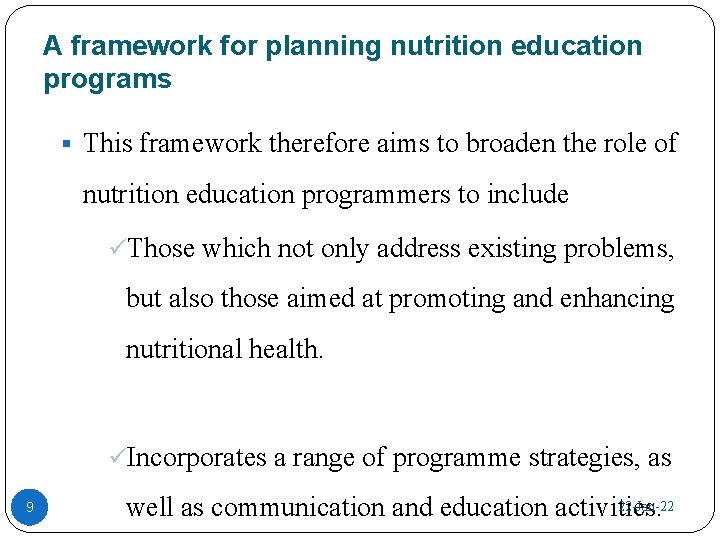
A framework for planning nutrition education programs § This framework therefore aims to broaden the role of nutrition education programmers to include üThose which not only address existing problems, but also those aimed at promoting and enhancing nutritional health. üIncorporates a range of programme strategies, as 9 22 -Jan-22 well as communication and education activities.
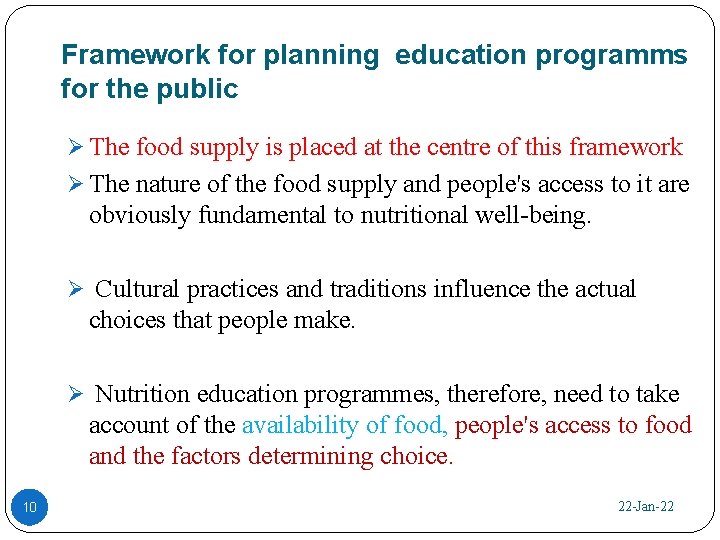
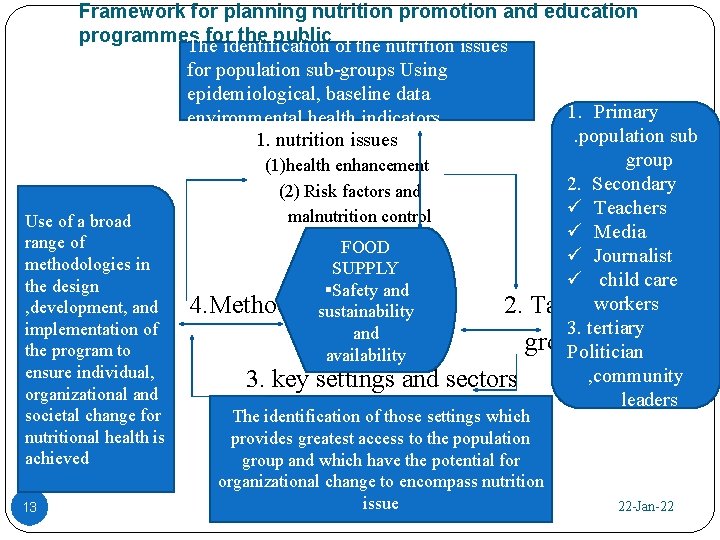
Framework for planning education programms for the public Ø The food supply is placed at the centre of this framework Ø The nature of the food supply and people's access to it are obviously fundamental to nutritional well-being. Ø Cultural practices and traditions influence the actual choices that people make. Ø Nutrition education programmes, therefore, need to take account of the availability of food, people's access to food and the factors determining choice. 10 22 -Jan-22
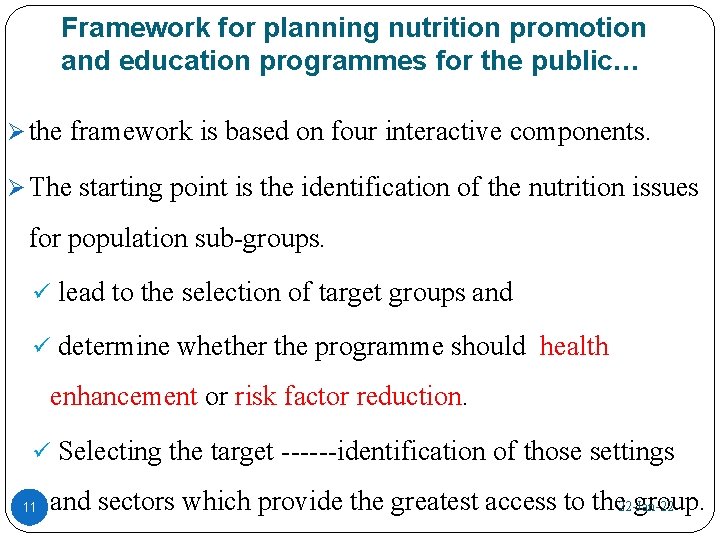
Framework for planning nutrition promotion and education programmes for the public… Ø the framework is based on four interactive components. Ø The starting point is the identification of the nutrition issues for population sub-groups. ü lead to the selection of target groups and ü determine whether the programme should health enhancement or risk factor reduction. ü Selecting the target ------identification of those settings 11 and sectors which provide the greatest access to the 22 -Jan-22 group.
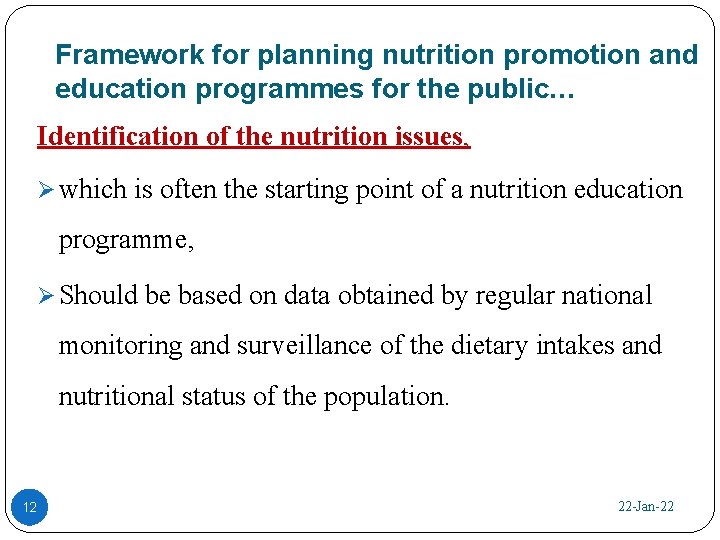
Framework for planning nutrition promotion and education programmes for the public… Identification of the nutrition issues, Ø which is often the starting point of a nutrition education programme, Ø Should be based on data obtained by regular national monitoring and surveillance of the dietary intakes and nutritional status of the population. 12 22 -Jan-22
Framework for planning nutrition promotion and education programmes for the public The identification of the nutrition issues for population sub-groups Using epidemiological, baseline data 1. Primary environmental health indicators. . population sub 1. nutrition issues group (1)health enhancement 2. Secondary (2) Risk factors and ü Teachers malnutrition control Use of a broad ü Media range of FOOD ü Journalist methodologies in SUPPLY o ü child care the design §Safety and 4. Method sustainability 2. Targetworkers , development, and 3. tertiary implementation of and group the program to Politician availability ensure individual, , community 3. key settings and sectors organizational and leaders societal change for nutritional health is achieved 13 The identification of those settings which provides greatest access to the population group and which have the potential for organizational change to encompass nutrition issue 22 -Jan-22
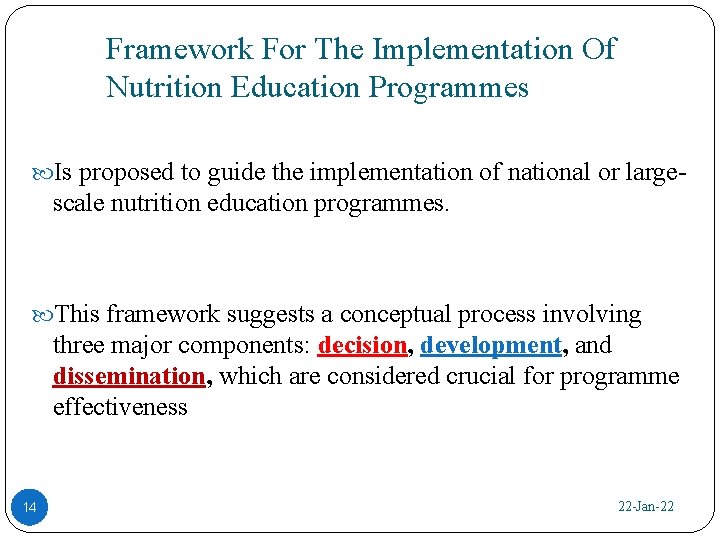
Framework For The Implementation Of Nutrition Education Programmes Is proposed to guide the implementation of national or large- scale nutrition education programmes. This framework suggests a conceptual process involving three major components: decision, development, and dissemination, which are considered crucial for programme effectiveness 14 22 -Jan-22
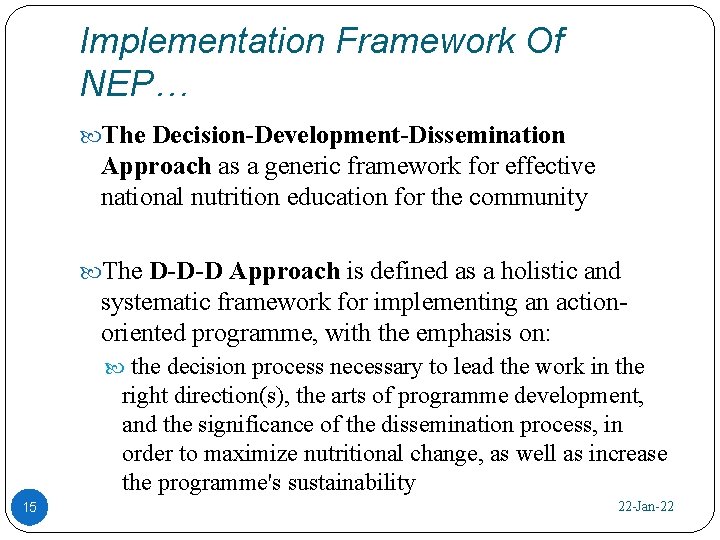
Implementation Framework Of NEP… The Decision-Development-Dissemination Approach as a generic framework for effective national nutrition education for the community The D-D-D Approach is defined as a holistic and systematic framework for implementing an actionoriented programme, with the emphasis on: the decision process necessary to lead the work in the right direction(s), the arts of programme development, and the significance of the dissemination process, in order to maximize nutritional change, as well as increase the programme's sustainability 15 22 -Jan-22
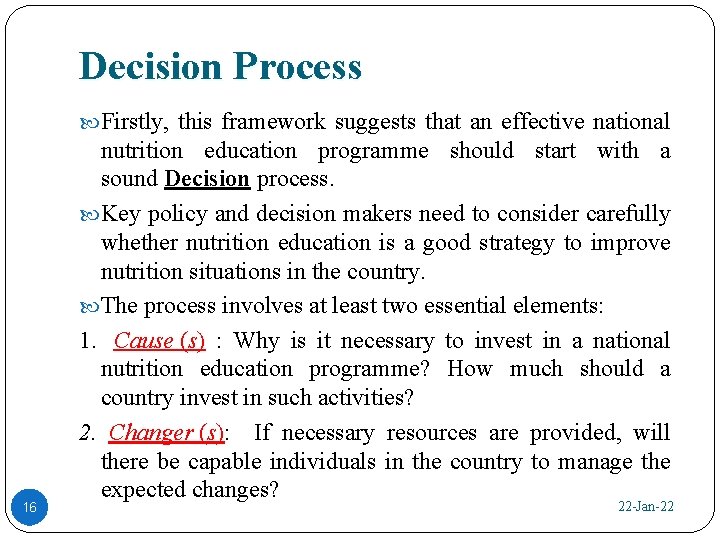
Decision Process Firstly, this framework suggests that an effective national 16 nutrition education programme should start with a sound Decision process. Key policy and decision makers need to consider carefully whether nutrition education is a good strategy to improve nutrition situations in the country. The process involves at least two essential elements: 1. Cause (s) : Why is it necessary to invest in a national nutrition education programme? How much should a country invest in such activities? 2. Changer (s): If necessary resources are provided, will there be capable individuals in the country to manage the expected changes? 22 -Jan-22
Decision Process…. . Cont’d National policy and decision makers decision and commitment should be shown in the budgets and the level of involvement in the programmes. they should examine whether the root of nutritional problems in the country is determined by nutritional behaviors. 17 22 -Jan-22
Decision Process…. . Cont’d National policy and decision makers need to perceive that the cause (s) of implementing a national nutrition education programme is relevant to their country so that they really find it critical to support such a programme. Programme administrators and individuals who see the benefits of such intervention for the country - they may be important nutrition scientists, key administrators at the ministry of public health or other related ministries are called "change initiators" 18 22 -Jan-22
Decision Process…. . Cont’d Knowledge of the process of behavioral change, together with concrete evidence of how beneficial effective nutrition education programmes should be used convincingly so that policy and decision makers perceive nutrition education as a relevant strategy for national nutrition development, and are willing to commit themselves, as well as reasonable resources, to nutrition education activities. They must understand that adequate investment in the right strategy at the right time will definitely result in the effectiveness of their nutrition interventions. 19 22 -Jan-22
Decision Process…. . Cont’d Change initiators, therefore, have a major role to play at this initial stage. Their influence, if efficient, will give a national nutrition education programme a good beginning. There also another type of changers. They are called change agents. They can be individuals at any level from the national to the community level. In general, they adopt the idea of the proposed change and are willing to influence others to change as well. 20 22 -Jan-22
Decision Process…. . Cont’d One important reason why many nutrition education programmes fail, is the fact that governments often assign inappropriate people to manage the programmes. Nutrition education, on the surface, looks so simple that anyone can do it and people often say they can. This work, in fact, needs quality change agents with adequate capacity to engage in the behavior change process. Therefore, it is crucial for national policy and decision makers to make a good decision about who should be key change agents for their national nutrition education programmes. 21 22 -Jan-22
Decision Process…. . Cont’d Characteristics necessary for a group of change agents who will be actively involved in the implementation of a nutrition education programme. Their ability to understand the target population is 22 crucial; They should have talent and creativity to guide the design, development and dissemination of innovative and useful messages; Change agents should have the capability to think strategically; They must be willing to use technology (especially communication technology which includes both mass media, small media, folk media and person-to-person) appropriately and creatively 22 -Jan-22
Development Process Once the right decisions have been made to implement the programmes, developing them to the appropriate level of commitment and support is necessary. This process highlights three essential elements. Assessment. Analysis. Creative action. 23 22 -Jan-22
The Development process Assessment. The need for contextual knowledge and information in order to plan and implement a programme well. Since changing behavior requires an understanding of people's perceptions and then a responsiveness to those perceptions, it usually requires an assessment of contextual situations. 24 22 -Jan-22
Development Process…CONT’D Analysis. It is suggested that critical analysis of the food supply, nutrition issues, target groups, and key settings, as related to nutrition education are crucial to a successful programme. Creative action. Actions leading to nutritional behavior change in the population need to be creative. These actions should direct the audiences to move forward in the change process. 25 22 -Jan-22
Development Process…CONT’D A major action for a national nutrition education programme is usually communication/education process itself. the Communication/education actions for the target audiences of a national nutrition education programme should be seen as a comprehensive intervention 26 22 -Jan-22
Development Process…CONT’D It is recommended that an effective programme should plan to manage at least two communication/education actions: (i) Communication/education actions for changers (change initiators and agents) themselves, To maintain the level of knowledge, skills, and motivation needed to implement a programme, To facilitate team-work. (ii) Communication/education audiences at different levels. 27 actions for target 22 -Jan-22
Development Process…CONT’D A national nutrition education programme should play an important role in increasing the capacity of the household to use existing food resources, and Sometimes it is necessary to encourage people to produce better food for the family (store, process, and prepare 28 22 -Jan-22
Phase 3: The Dissemination Process This process is significant for promoting and 29 securing sustainable change. It consists of two major interactive elements: (i) management/control and (ii) monitoring/evaluation. These elements are essential for nutrition education because the task is action-oriented in nature. An effective CNE programme not only needs good planning or excellent design, but also a system that will ensure everything is implemented successfully as planned. 22 -Jan-22
The Dissemination Process … The management/control of a national nutrition education programme is likely to be successful if it has, at least, three characteristics: Supportive staff, Good collaborators, and The flexibility of the management/control itself. Leadership style and an interactive working 30 environment are most important to gain the support of programme staff 22 -Jan-22
The Dissemination Process… Four criteria for selection are suggested: Individuals who themselves are interested in 31 contributing to societal change; They have previous success(es) in similar activities; They are interested in social recognition; and They have already established themselves in their work. Interested individuals who fall into all or most of these categories would be likely to be good collaborators in a national nutrition education 22 -Jan-22 programme.
The Dissemination Process… ü A good nutrition education programme also needs a comprehensive evaluation strategy, one which combines both appropriate quantitative and qualitative evaluation methods ü Equally important is how to work with interdisciplinary evaluators and how the issue of professionalism is dealt with in order to ensure fruitful evaluation results 32 22 -Jan-22
Summury This generic framework is aimed at assisting programme administrators in implementing an effective national or large-scale nutrition education programme. The Decision-Development-Dissemination Approach is proposed as a generic framework to promote good nutrition for the public 33 22 -Jan-22
Principles of nutrition education… The comprehensive approach outlined for preventing malnutrition and improving nutritional status involves four key components: policy & advocacy, capacity building, community involvement, and behavior change communication/nutrition education. People's concepts and beliefs about feeding, health and 34 growth are rooted in their traditions. ü Language & conceptual framework for nutrition education needs to have meaning in each cultural context.
Applying Educational Principles to Program Design The effect of an intervention on the target population’s knowledge and behavior depends on the intervention’s application of 6 basic educational principles. 1. Consonance - the fit between program and its objectives 2. Relevance - the degree to which the intervention is geared to clients 3. Individualization - allows clients to have personal 35 questions answered or instructions paced according to
Applying Educational Principles … cont’d 4. Feedback - helps clients learn by providing a measuring stick to determine how much progress they are making 5. Reinforcement - designed to reward the desired behavior 6. Facilitation - measures taken to accomplish desired actions or eliminate obstacles 36
Learning across the Life Span People of any age learn best if: ØThey have the prerequisite knowledge ØContent is broken into small pieces. ØThey have an opportunity to practice what they have learned ØThe content seems relevant 37
Adult Learners Adult education - the process whereby adults learn and achieve changes in knowledge, attitudes, values, and skills For adults, learning is an intentional, purposeful activity Adult learners approach learning differently than children do because they have different motivations for learning 38
Adult Learners… Characteristics of adult learners include the following: Ø They learn best when subject matter is directly tied to their own realm of experience Ø Their learning is facilitated when they can make connections between their past experiences and their current concerns Ø They are motivated to learn by the relevance of the topic to their lives Ø They retain new information best when they are actively involved in problem-solving exercises and hands-on 39 learning
Recommendations for adult learners ØMake learning problem-centered ØMake information concrete & define all abstract terms ØMake learning collaborative between the educator and the learner ØEncourage participatory approaches to learning ØAsk open-ended questions to draw out what adults already know about the topic 40
Recommendations for adult learners ØSeize the “teachable moments” which are life transitions ØIncrease the adult learners’ sense of self-worth by validating their experiences ØEstablish a positive learning environment ØRecognize individual and cultural differences because they affect learning styles 41
Adult Learners… cont’d Target groups should be researched by: ØReviewing the literature ØConducting formative research ØAsking representatives from the audience to help you with the planning and development of the program 42
Behaviorally Focused Nutrition Education Programs for Children Behaviorally focused nutrition education addresses 3 domains of learning: ØCognitive - presents children with the “how” of eating more healthfully (Knowledge) ØAffective - addresses factors that motivate children to change the way they eat (Attitudes) ØBehavioral - helps children build new eating 43 skills and behaviors( psychomotor )
Behaviorally Focused Nutrition Education Programs for Children… cont’d Strategies recommended to promote healthful eating among students in the lower elementary school grades: ØInvolve parents in nutrition education through homework or take-home videos ØProvide role models for healthful eating ØUse incentives to reinforce healthful eating ØIdentify easy-to-prepare, tasty, and healthful snacks such as fruits and vegetable Ø Increase students’ confidence in their ability to make healthful 44 eating choices
Developing a Nutrition Education Plan Nutrition education plan outlines the strategy for disseminating the intervention’s key messages to the target population Key nutrition messages may be designed to change consumers health related behavior 45
Developing a Nutrition Education Plan…cont’d Nutrition education plan is a written document that 46 includes the following: ØNeeds of the target population ØGoals and objectives for intervention activities ØProgram format ØLesson plans ØNutrition messages to be imparted to the target population ØMarketing plan ØAny partnerships that will support program development or delivery ØEvaluation instruments
Developing a Nutrition Education Plan…cont’d A nutrition education plan is developed for each intervention target group At the systemic level, the nutritional education plan might properly be called a strategy 47
Developing Lesson Plans The first step in developing a lesson plan is to know your target audience, the setting, and the content Consider these principles when developing lesson 48 plans: ØFocus on the learner and their interests, needs, and motivations ØRelate learning to real-life situations and give examples that relate directly to the learners’ lives and experiences ØActively involve the learners in the learning
Structuring Your Knowledge The first component of lesson writing is to identify the major concept you are communicating. Three questions to ask yourself before creating a lesson plan include: ØWhat am I trying to teach? ØWhat are the key concepts? ØWhat methods of inquiry are used – what teaching method will I use? 49
50
Writing Instructional Objectives Instructional objectives should: ØConcentrate on the learner and not the teacher ØClearly communicate a specific instructional intent ØBe stated in terms of the end-product and not in terms of the process of learning ØDescribe one type of learning outcome per objective that is specific in describing the learners’ performance 51
Components of a Lesson Plan Common format used to structure lesson plans: Ø Lesson title Ø Target audience Ø Duration Ø General objectives or the goal for the class Ø Specific objectives that identify the expected learning outcomes using measurable statements Ø Procedures Ø Learning experiences or activities Ø Method of evaluation v. Describes how the instructor will evaluate whether or not the expected outcomes have been achieved Ø Materials needed 52
Components of a Lesson Plan… cont’d Procedures section includes: ØIntroduction - describes how the instructor will introduce the class ØBody of the lesson - contains the background and the lesson organization scheme ØClosure - a summary of the lesson 53
Designing Nutrition and Health Messages Studies of consumer behavior suggest several ways of designing nutrition messages to grab consumers’ attention. . . 54
Designing Nutrition and Health Messages… cont’d Present information in a novel or unusual fashion Use language that says to the consumer “Listen to this. It’s important” Use language that is immediate Design messages that use verbs in the present tense and demonstratives such as this, these and here Avoid using qualifiers such as perhaps, may, and maybe that express uncertainty Use straightforward statements rather than tentative statements 55
Implementing the Program After the program has been designed and tested, it is ready for implementation The goal at this phase is to deliver the program as faithfully as possible Keep a record of any unexpected problems so that a strategy for preventing them can be developed for future programs 56
Enhancing Program Participation The higher the level of participation in a program the 57 better Ways to improve participation rates include: ØUnderstand the target populations’ needs and interests ØUse evaluation research to improve the program design ØRemove barriers to participation ØFind ways to help participants see the immediate benefits of participating ØSchedule the activity at a convenient time ØUse incentives for participating ØBuild ownership of the program among participants
Conducting Summative Evaluation Summative evaluation provides information about 58 the effectiveness of the program and it is conducted at the end of the program. Summative evaluation seeks to obtain data about the participants’ reactions to all aspects of the program: ØTopics covered ØInstructors or presenters ØInstructional materials ØProgram activities ØPhysical arrangements for the program ØAdvertising and promotion ØRegistration procedures
4. 2 Behaviour Change Communication (BCC) Communication is a central aspect of directed behavior change, and communication has been a major strategy to impact such change. BCC can be broadly defined as a process of understanding people's situations and influences, developing messages that respond to the concerns within those situations, and using communication processes and media to persuade people to increase their knowledge and change the behaviors and practices that place them at risk. 59
4. 2 BCC…cont’d Communications strategies have evolved to focus 60 more on the receiver—rather than the sender—as the center of communications, and the new terminology BCC reflects this shift. Unlike the didactic programs, which are set to “sell” a particular message or idea, BCC recognizes individuals within the intended audience as active, rather than passive, receivers of information and messages, who act on messages only if they are seen as advantageous or useful. BCC appreciates that the audience may need new skills and social support to make and maintain behavior change.
4. 2 BCC…cont’d Communications for behavioral change CBC may be directed to several nutrition-related objectives; e. g. , improved feeding or caring practices, or compliance with supplementation regimens, among others. It may be employed as a complementary strategy alongside, for example, supplementary feeding or growth monitoring (as growth promotion). There is a need, however, to redirect some CBC toward 61 women, particularly with regard to eating practices. These are important for the health of the women themselves and for that of their children, particularly in rural areas where women endure the dual burden of moderate to high levels of physical work and frequent pregnancies without noticeable increases in energy and nutrient intakes.
4. 2 BCC…cont’d Human behaviors, including those related to health have complex, multifactorial and interrelated determinants that cannot be addressed by BCC alone, and need social, economic and systemic changes. 62
Process of designing BCC interventions Before deciding on the BCC messages and channels, it is essential to carry out a process of understanding the health behaviors of the community, and their overall sociocultural and economic realities. While behaviors of individuals, groups and 63 communities are important determinants of their health, factors that influence behaviors frequently lie outside the individual's control and are influenced by economic, social, and political factors operating at the district and national levels.
Process of designing BCC interventions… cont’d It is important to understand these determinants at the level of the individual woman, her household, the community and the systemic levels, as they would influence the design of the intervention programme to address the problem. After understanding the determinants of the specific behavior that we are attempting to change through health communication, it is important to identify the intended audience – e. g. : not restricted to the mother, but the people who influence her behaviors. 64
Process of designing BCC interventions… cont’d Identification and segmentation of audience for a particular behavior change necessitates sensitivity to the varying needs of different sections of the community and the different needs of groups even within the larger identified audience. Here, an in-depth understanding of the determinants of behaviors can help identify who is the primary audience, and who are the significant influencers of these behaviors. ü E. g. : in most health behaviors related to child health and nutrition, the intended audience may include the mother, the father, and the grandmother of the child. 65
Process of designing BCC interventions… cont’d Audience characteristics are very important in designing BCC messages. Age of the audience, literacy levels, socioeconomic status, geographical location, and other such demographic profiles need to be considered. The next step in designing the BCC intervention is to identify the key message points and formulate the message brief. ü This exercise is closely dictated by not just the behavior identified to be changed and the objectives of the programme, but also by the understanding about the determinants of the concerned behaviors and the needs and characteristics of the identified audience. 66
Process of designing BCC interventions… cont’d Identifying the range of available tools should be part of every formative BCC assessment. It is important to know which tools can most effectively reach particular intended populations. A tool or channel is of BCC is the way a message is disseminated. Messages can be delivered through mass media. Television or radio spots, films and newspapers are the most commonly used mass media channels used for BCC in health. 67
Process of designing BCC interventions… cont’d In largely resource poor settings, in rural contexts 68 where access to mass media is limited and rates of literacy are low, BCC messages can be communicated in-person, by health workers, peer educators, or other trained personnel. Ø Health workers can help reach specific groups, model desired behaviors, stimulate community discussions and provide referrals to health services. Ø In rural communities, where various forms of folk media such as songs and stories in local dialects, dances and theatre are popular means of entertainment, BCC can be delivered through such tools. Musical or dramatic performances & community events can deliver messages and influence behaviors in a culturally relevant and acceptable manner.
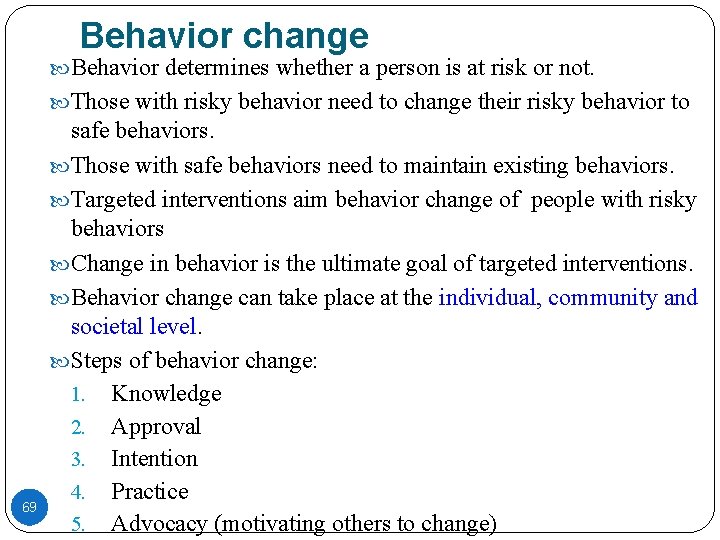
Behavior change Behavior determines whether a person is at risk or not. Those with risky behavior need to change their risky behavior to 69 safe behaviors. Those with safe behaviors need to maintain existing behaviors. Targeted interventions aim behavior change of people with risky behaviors Change in behavior is the ultimate goal of targeted interventions. Behavior change can take place at the individual, community and societal level. Steps of behavior change: 1. Knowledge 2. Approval 3. Intention 4. Practice 5. Advocacy (motivating others to change)
Thank You! 70 22 -Jan-22
CHAPTER SIX MARKETING NUTRITION AND HEALTH PROMOTION 71 22 -Jan-22
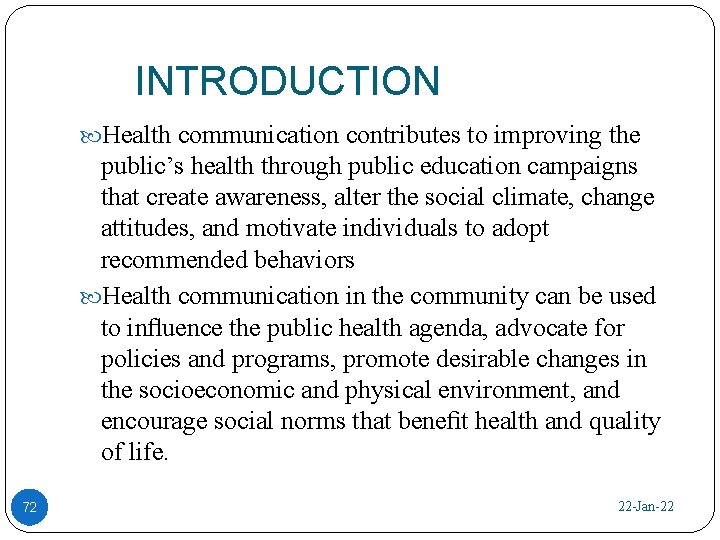
INTRODUCTION Health communication contributes to improving the public’s health through public education campaigns that create awareness, alter the social climate, change attitudes, and motivate individuals to adopt recommended behaviors Health communication in the community can be used to influence the public health agenda, advocate for policies and programs, promote desirable changes in the socioeconomic and physical environment, and encourage social norms that benefit health and quality of life. 72 22 -Jan-22