
Chapter Four Business Government and Institutional Buying Key
Chapter Four Business, Government, and Institutional Buying Key Words / Outline Intermediaries, Business-to-Business, Straight rebuys, Modified re buys, New task purchases, Structural influences, Purchasing roles, Organization-specific factors, Purchasing policies and procedures, Initiators, users, influencers, deciders, buyers, gatekeepers, Sole sourcing, Lethargic organization Mc. Graw-Hill/Irwin Marketing Management, 8 e © 2007 The Mc. Graw-Hill Companies, Inc. , All Rights Reserved.
Buyer Categories • Producers: Businesses that buy goods and services in order to produce other goods and services • Intermediaries: Purchase products to resell at a profit • Government agencies: 86, 000 Government agencies spend trillions of dollars on machinery, equipment, facilities, supplies and services • Other institutions: Such as hospitals, museums, universities, nursing homes, and churches 4 -3
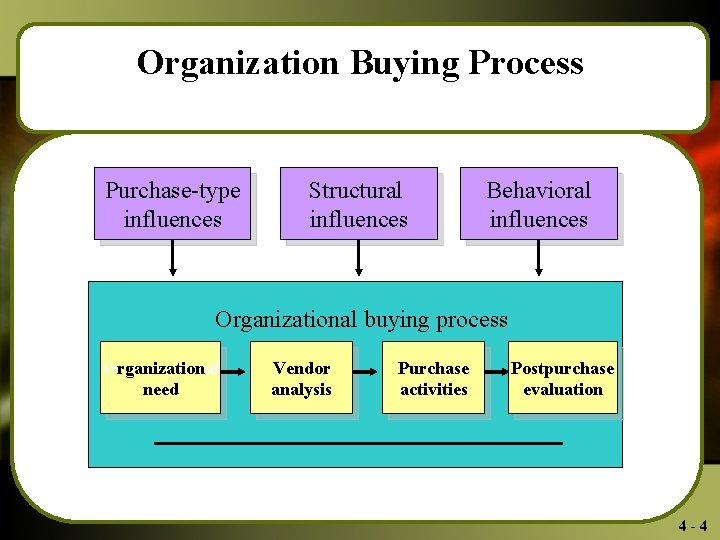
Organization Buying Process Purchase-type influences Structural influences Behavioral influences Organizational buying process Organizational need Vendor analysis Purchase activities Postpurchase evaluation 4 -4
Purchase Types • Straight rebuy: Routine reordering from a supplier used in the past • Modified rebuy: Purchase involves considering a limited number of alternatives before making a selection • New task purchase: Involves an extensive search for information and a formal decision process 4 -5

Purchase Types Purchase Type Complexity Time Frame Number Of Suppliers Straight Rebuy Simple Short One Modified Rebuy Moderate Medium Few New Task Purchase Complex Long Many 4 -6
Organizational Buying Distinctions • How marketing to organizational buyers differs from marketing to consumers - More variation in buyer-seller relationships Shorter distribution channels Greater emphasis on personal selling Greater web integration Unique promotional strategies 4 -7
Purchasing Roles • Initiators – Recognizing need starts process • Users – People who use the product • Influencers – People who affect the buying process 4 -8
Purchasing Roles • Buyers – Those with formal authority and responsibility • Deciders – Those with formal or informal power to select or approve suppliers • Gatekeepers – Those who control information flow to the buying center 4 -9
Organization-Specific Factors • Orientation: Dominant function in an organization controlling decisions • Size of organization: Larger the organization higher degree of joint decision, smaller the organization autonomous decision making • Degree of centralization: This influences whether the decisions are made individually or jointly with others 4 - 10
Purchasing Policies • Sole sourcing – all of a particular product is purchased from a single supplier • Direct buying – list of approved vendors for particular products • Competitive bidding – for large, one-time purchases 4 - 11
Behavioral Influences • Personal motivations: Factors such as friendship, professional pride, fear and uncertainty, trust and personal ambition • Role perceptions: Their commitment lies in what they believe is their perceived or expected role - Organizations can be divided into three groups based on commitment • Innovative • Adaptive • Lethargic 4 - 12
Understanding Buyers’ Code of Ethics • Avoid the intent or appearance of unethical activity • Demonstrate loyalty to employee by being lawful and using reason • Refrain from private or personal activity that could create conflicts of interest • Refrain from soliciting or accepting gifts, loans, or services from potential suppliers 4 - 13
Understanding Buyers’ Code of Ethics • Handle confidential information with proper consideration • Promote positive relationships with suppliers through impartiality • Refrain from reciprocal agreements that restrain competition • Know and obey both the letter and spirit of laws governing the purchasing function 4 - 14
Understanding Buyers’ Code of Ethics • Encourage all segments of society to participate by supporting disadvantaged interests • Discourage involvement in personal purchases that are not business related • Enhance the stature of the purchasing profession by keeping up with current knowledge and standards • Conduct international purchasing with regards to U. S. laws and ethical guidelines 4 - 15
Purchasing Agent Influences • • • Design of the product Cost of the product Performance life Naming a specific supplier Assessing engineering support from the supplier Reduction of rejects 4 - 16
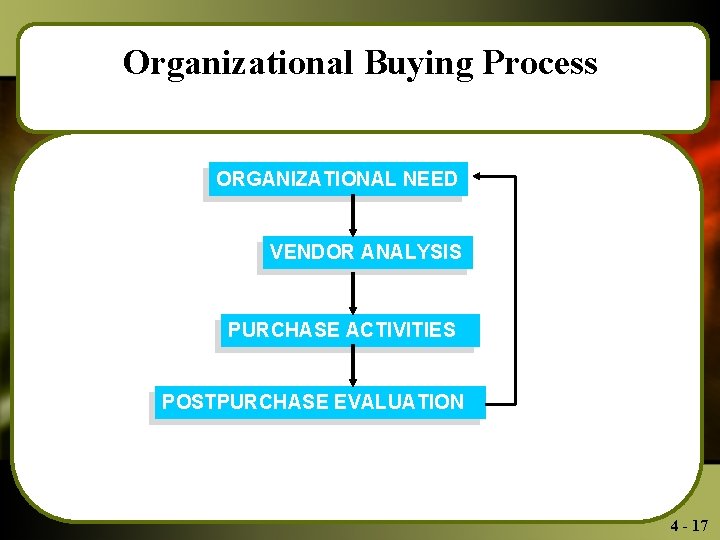
Organizational Buying Process ORGANIZATIONAL NEED VENDOR ANALYSIS PURCHASE ACTIVITIES POSTPURCHASE EVALUATION 4 - 17
Organizational Buying Process • Organizational Need - Needs based on survivability and stated objectives of the organization • Vendor analysis - Search for, locate and evaluate potential providers of goods and services - Rate them based on quality, on-time delivery, price, payment terms, and use of technology 4 - 18
Organizational Buying Process • Purchase activities - Purchases can involve extensive negotiations on price, term of contract – increases with complex goods and services • Postpurchase evaluation - Does the purchase perform as expected? - Should the supplier be used again? 4 - 19
Functional Areas in Organizational Buying • • Design and development Production Sales / marketing Maintenance Finance / accounting Purchasing Quality control 4 - 20
- Slides: 20