
Chapter Four 2 D Steady State Conduction Examples

- Slides: 7
Chapter Four 2 D – Steady State Conduction Examples – Part II Prepared By: Dawit M.
Outline Example 1: Use of Finite Difference Equation by Energy Method (with volumetric heat generation and no convection) Example 2: Use of Finite Difference Equation (with convection and no internal heat generation)
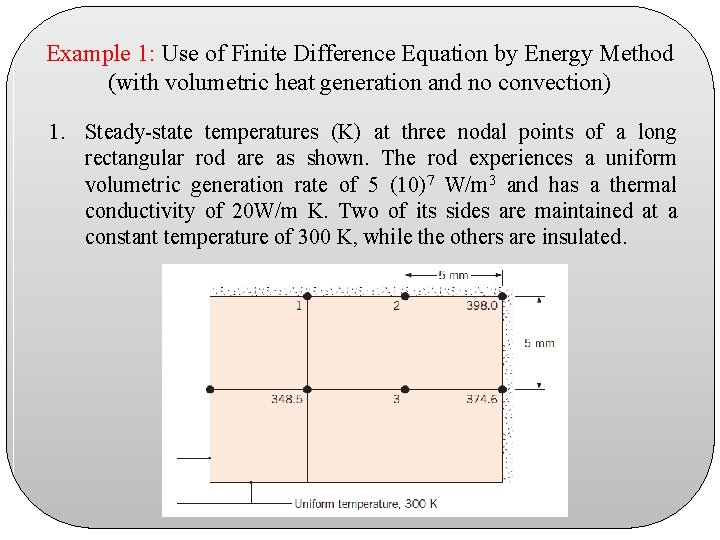
Example 1: Use of Finite Difference Equation by Energy Method (with volumetric heat generation and no convection) 1. Steady-state temperatures (K) at three nodal points of a long rectangular rod are as shown. The rod experiences a uniform volumetric generation rate of 5 (10)7 W/m 3 and has a thermal conductivity of 20 W/m K. Two of its sides are maintained at a constant temperature of 300 K, while the others are insulated.
Cont’d … (a) Determine the temperatures at nodes 1, 2, and 3. (b) Calculate the heat transfer rate per unit length (W/m) from the rod using the nodal temperatures. Compare this result with the heat rate calculated from knowledge of the volumetric generation rate and the rod dimensions.
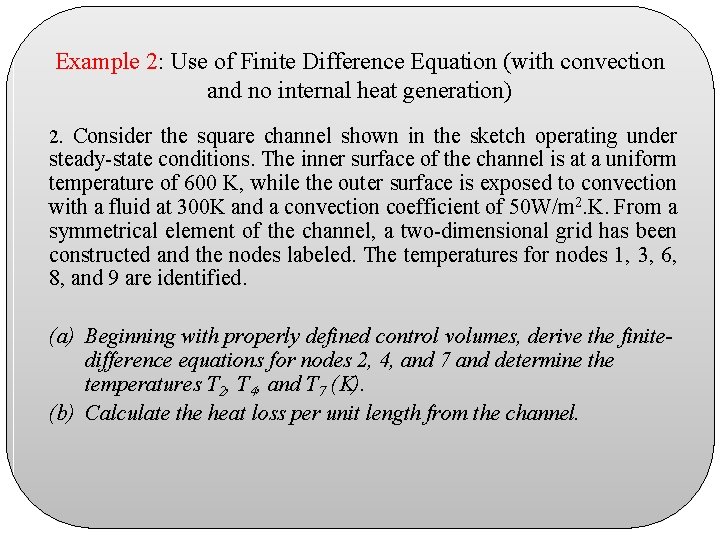
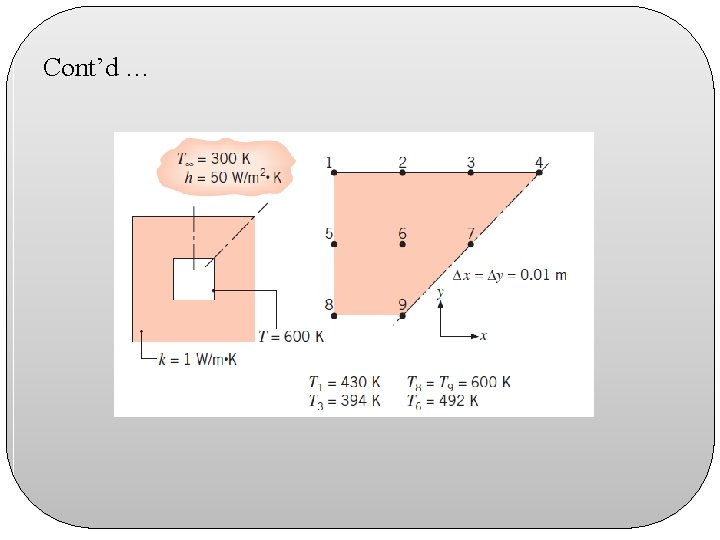
Example 2: Use of Finite Difference Equation (with convection and no internal heat generation) 2. Consider the square channel shown in the sketch operating under steady-state conditions. The inner surface of the channel is at a uniform temperature of 600 K, while the outer surface is exposed to convection with a fluid at 300 K and a convection coefficient of 50 W/m 2. K. From a symmetrical element of the channel, a two-dimensional grid has been constructed and the nodes labeled. The temperatures for nodes 1, 3, 6, 8, and 9 are identified. (a) Beginning with properly defined control volumes, derive the finitedifference equations for nodes 2, 4, and 7 and determine the temperatures T 2, T 4, and T 7 (K). (b) Calculate the heat loss per unit length from the channel.
Cont’d …
Any Question? Thank You!