
CHAPTER FIVE Where People Live PersonEnvironment Interactions What
- Slides: 21
CHAPTER FIVE Where People Live: Person-Environment Interactions
What are your 5 most important belongings? IMAGINE…you have been in a terrible car accident and need medical care round the clock for an indefinite amount of time. You are going to be admitted to a local nursing home and are allowed to bring 5 personal items with you (in addition to clothes and toiletries). Write down one item per notecard. Briefly explain why the item is important to you.
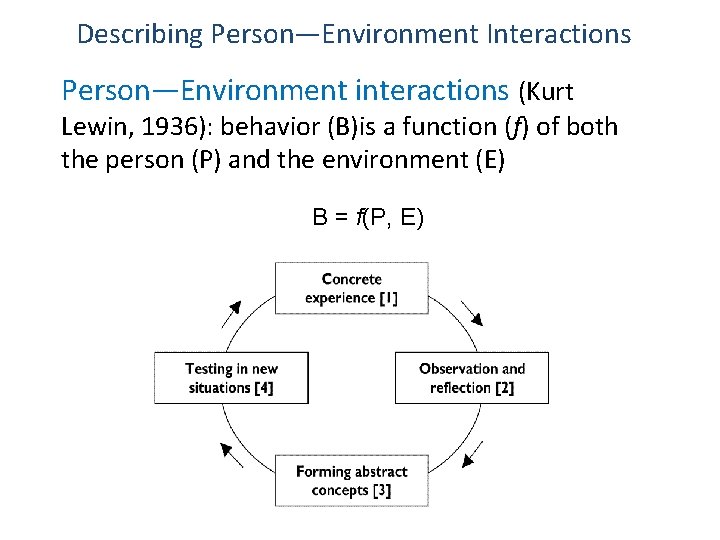
Describing Person—Environment Interactions Person—Environment interactions (Kurt Lewin, 1936): behavior (B)is a function (f) of both the person (P) and the environment (E) B = f(P, E)
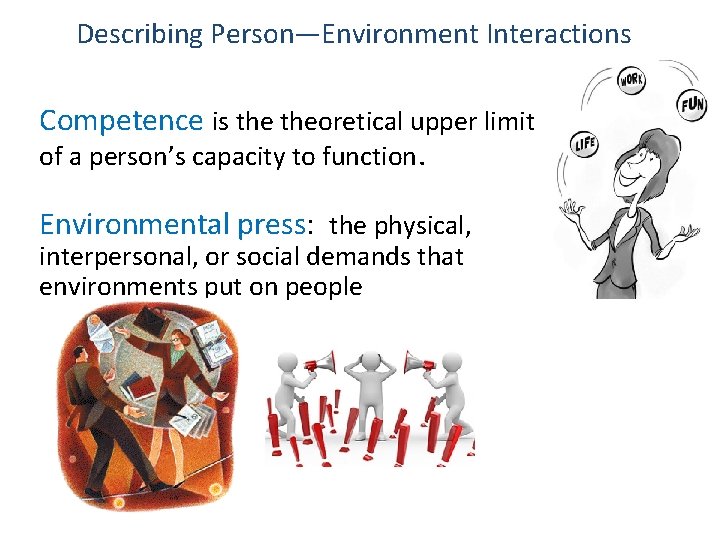
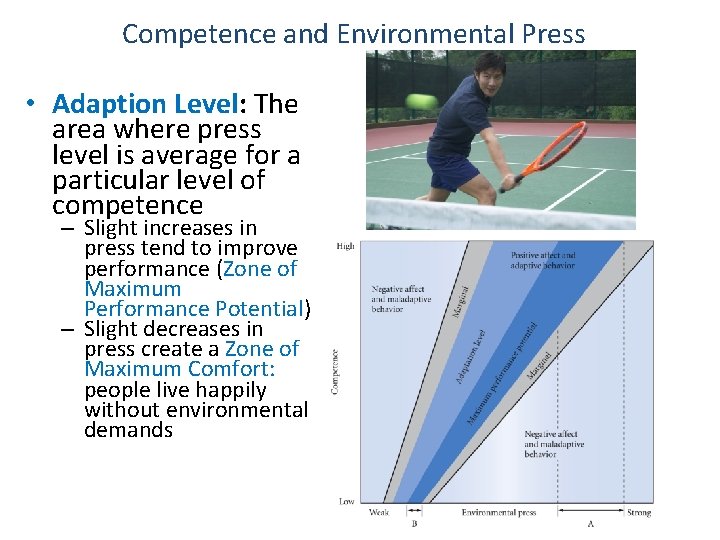
Describing Person—Environment Interactions Competence is theoretical upper limit of a person’s capacity to function. Environmental press: the physical, interpersonal, or social demands that environments put on people
Competence and Environmental Press • Adaption Level: The area where press level is average for a particular level of competence – Slight increases in press tend to improve performance (Zone of Maximum Performance Potential) – Slight decreases in press create a Zone of Maximum Comfort: people live happily without environmental demands
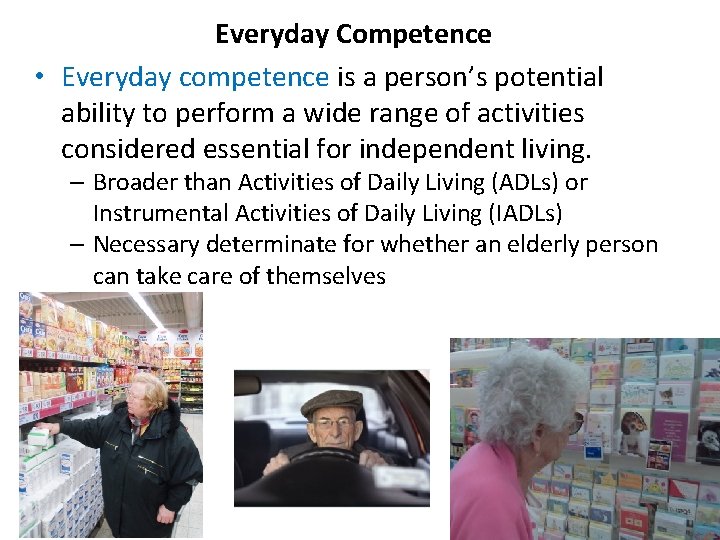
Everyday Competence • Everyday competence is a person’s potential ability to perform a wide range of activities considered essential for independent living. – Broader than Activities of Daily Living (ADLs) or Instrumental Activities of Daily Living (IADLs) – Necessary determinate for whether an elderly person can take care of themselves
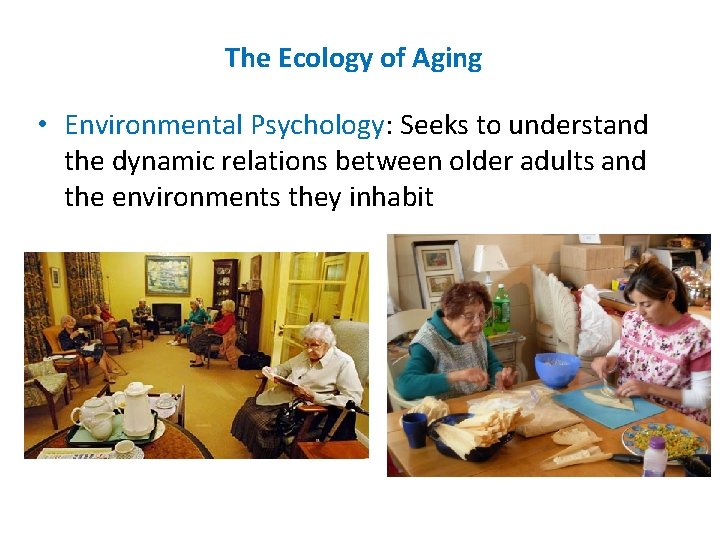
The Ecology of Aging • Environmental Psychology: Seeks to understand the dynamic relations between older adults and the environments they inhabit
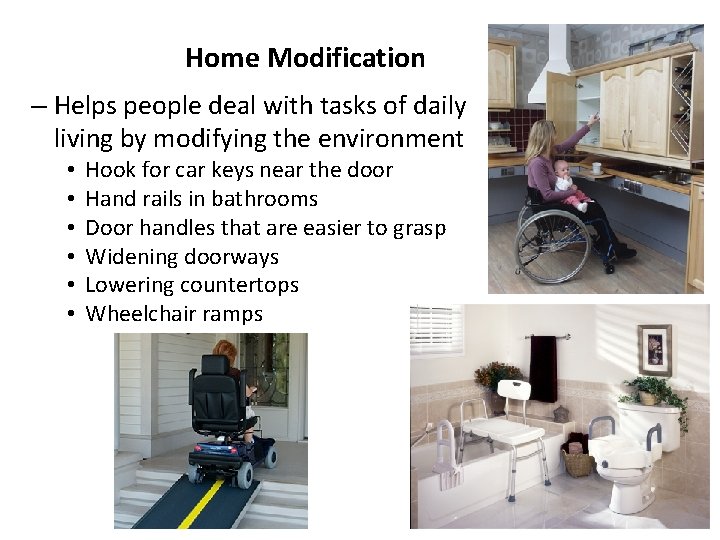
Home Modification – Helps people deal with tasks of daily living by modifying the environment • • • Hook for car keys near the door Hand rails in bathrooms Door handles that are easier to grasp Widening doorways Lowering countertops Wheelchair ramps
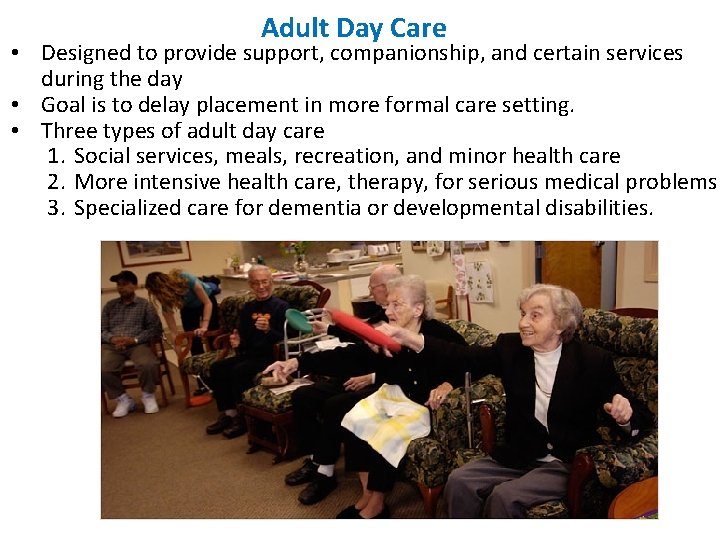
Adult Day Care • Designed to provide support, companionship, and certain services during the day • Goal is to delay placement in more formal care setting. • Three types of adult day care 1. Social services, meals, recreation, and minor health care 2. More intensive health care, therapy, for serious medical problems 3. Specialized care for dementia or developmental disabilities.
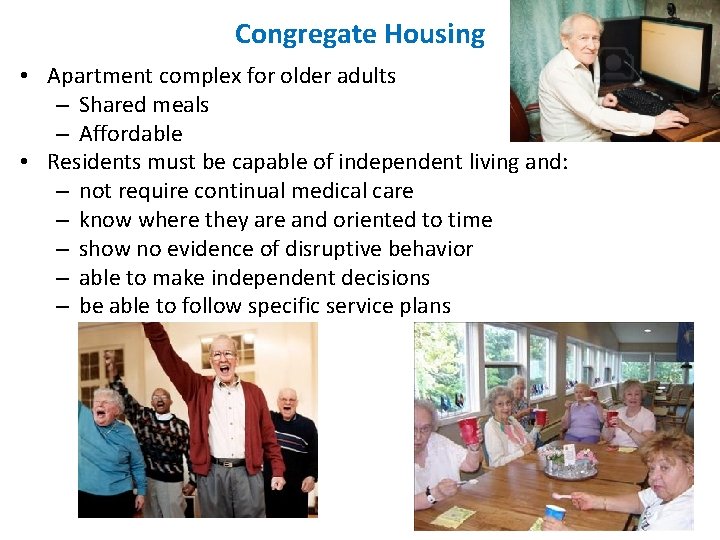
Congregate Housing • Apartment complex for older adults – Shared meals – Affordable • Residents must be capable of independent living and: – not require continual medical care – know where they are and oriented to time – show no evidence of disruptive behavior – able to make independent decisions – be able to follow specific service plans
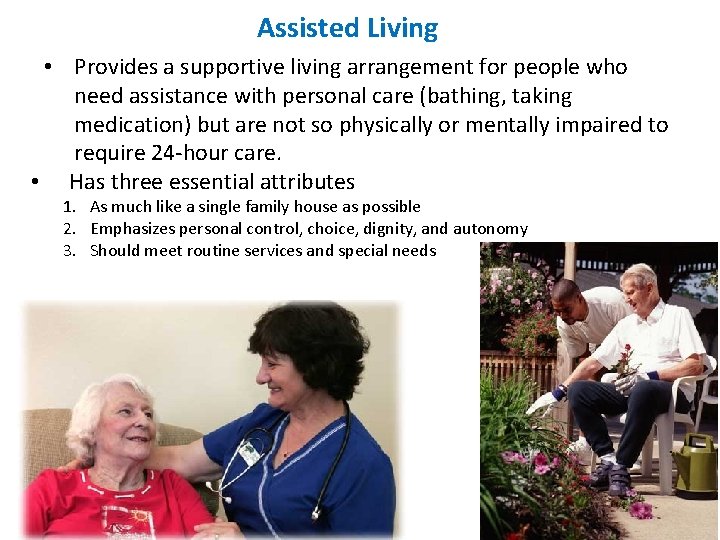
Assisted Living • Provides a supportive living arrangement for people who need assistance with personal care (bathing, taking medication) but are not so physically or mentally impaired to require 24 -hour care. • Has three essential attributes 1. As much like a single family house as possible 2. Emphasizes personal control, choice, dignity, and autonomy 3. Should meet routine services and special needs
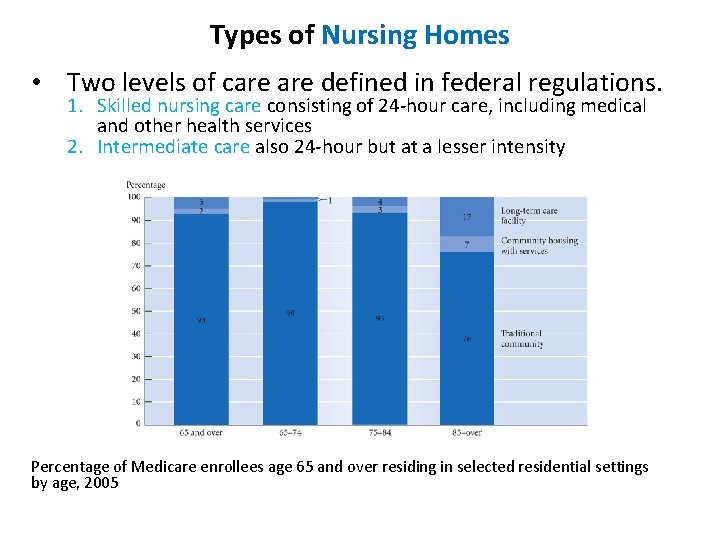
Types of Nursing Homes • Two levels of care defined in federal regulations. 1. Skilled nursing care consisting of 24 -hour care, including medical and other health services 2. Intermediate care also 24 -hour but at a lesser intensity Percentage of Medicare enrollees age 65 and over residing in selected residential settings by age, 2005
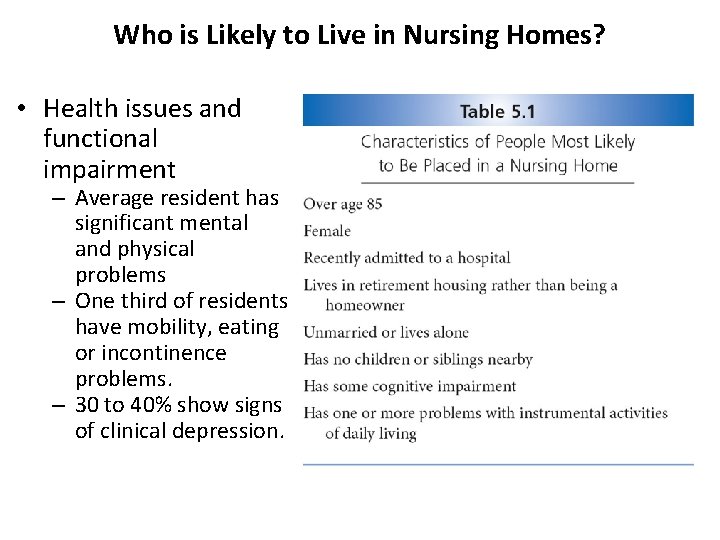
Who is Likely to Live in Nursing Homes? • Health issues and functional impairment – Average resident has significant mental and physical problems – One third of residents have mobility, eating or incontinence problems. – 30 to 40% show signs of clinical depression.
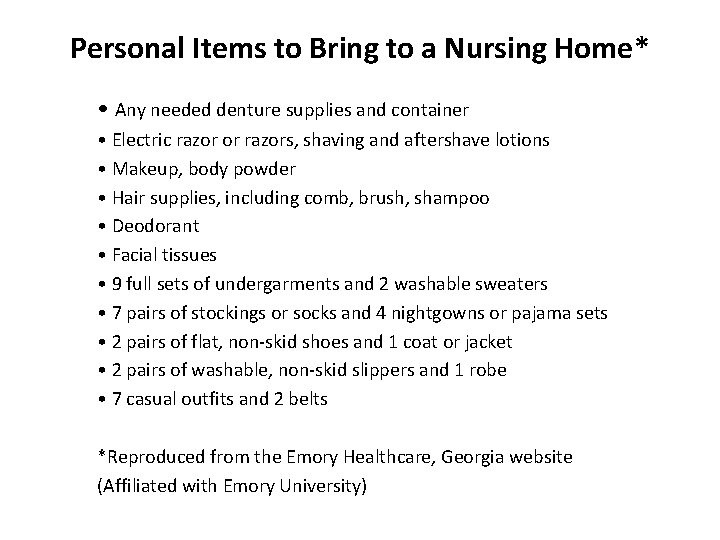
Personal Items to Bring to a Nursing Home* • Any needed denture supplies and container • Electric razor or razors, shaving and aftershave lotions • Makeup, body powder • Hair supplies, including comb, brush, shampoo • Deodorant • Facial tissues • 9 full sets of undergarments and 2 washable sweaters • 7 pairs of stockings or socks and 4 nightgowns or pajama sets • 2 pairs of flat, non-skid shoes and 1 coat or jacket • 2 pairs of washable, non-skid slippers and 1 robe • 7 casual outfits and 2 belts *Reproduced from the Emory Healthcare, Georgia website (Affiliated with Emory University)
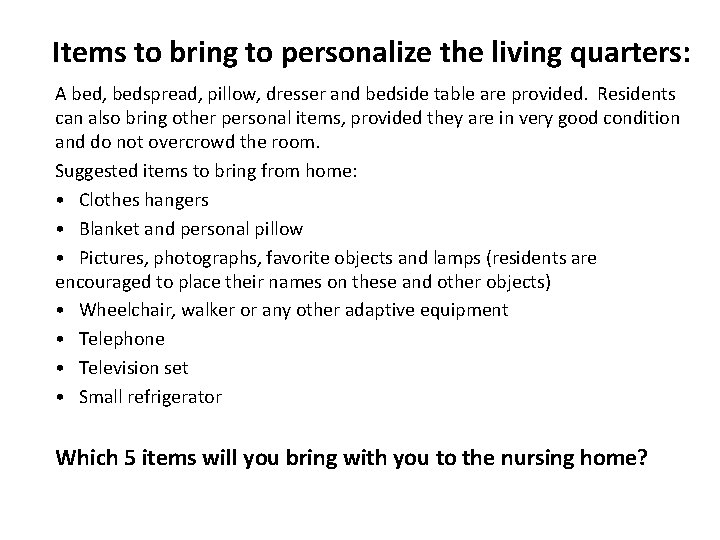
Items to bring to personalize the living quarters: A bed, bedspread, pillow, dresser and bedside table are provided. Residents can also bring other personal items, provided they are in very good condition and do not overcrowd the room. Suggested items to bring from home: • Clothes hangers • Blanket and personal pillow • Pictures, photographs, favorite objects and lamps (residents are encouraged to place their names on these and other objects) • Wheelchair, walker or any other adaptive equipment • Telephone • Television set • Small refrigerator Which 5 items will you bring with you to the nursing home?
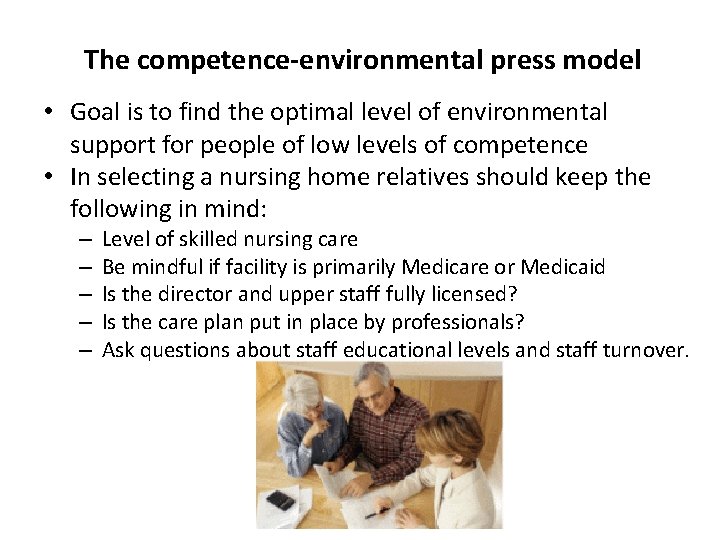
The competence-environmental press model • Goal is to find the optimal level of environmental support for people of low levels of competence • In selecting a nursing home relatives should keep the following in mind: – – – Level of skilled nursing care Be mindful if facility is primarily Medicare or Medicaid Is the director and upper staff fully licensed? Is the care plan put in place by professionals? Ask questions about staff educational levels and staff turnover.
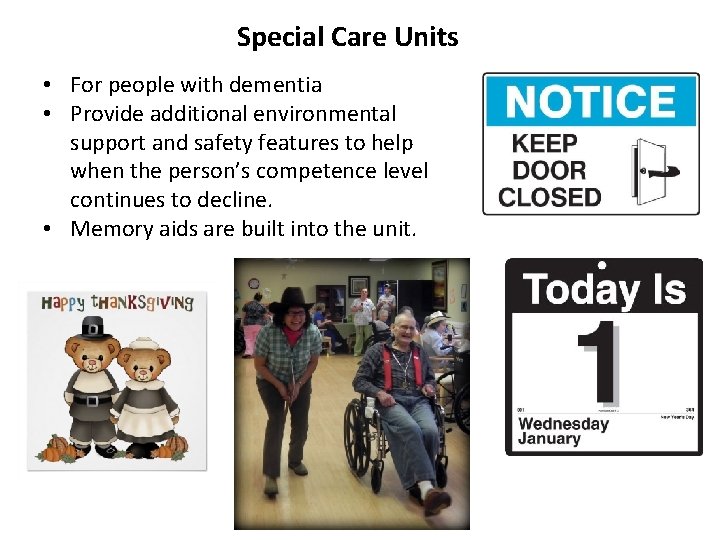
Special Care Units • For people with dementia • Provide additional environmental support and safety features to help when the person’s competence level continues to decline. • Memory aids are built into the unit.
Person-centered planning: What can be done to foster the sense of home? • Include the relocating individual in the selection of a specific nursing home • Allow the relocating individual to direct his/her own daily schedule and activities as much as possible • Learn about the new environment and try to have positive experiences • Define the home in terms of family and social relationships rather than place, objects, or total autonomy • Establish a continuity between home and nursing home • Reminiscing about home may facilitate adjustment
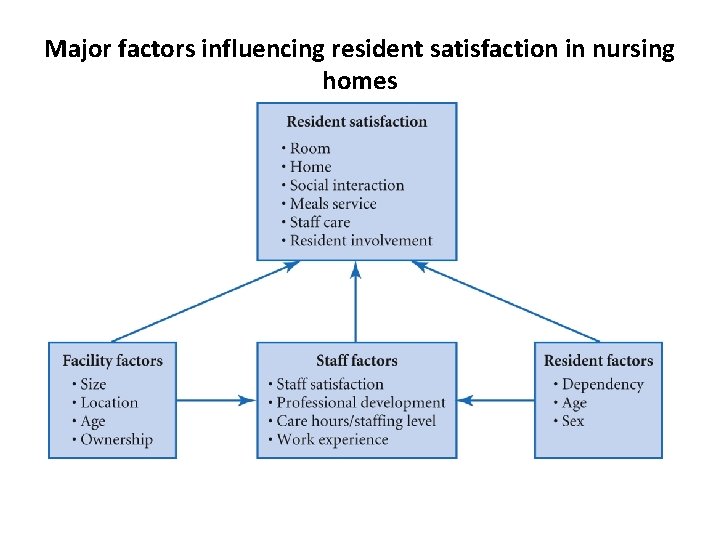
Major factors influencing resident satisfaction in nursing homes
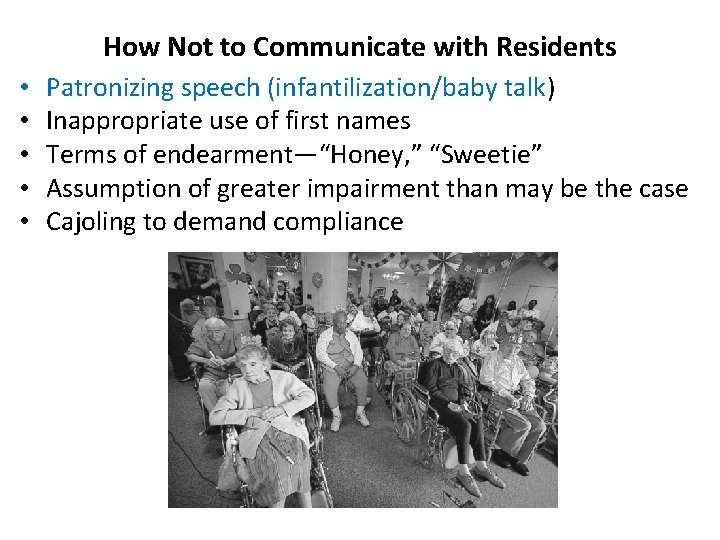
How Not to Communicate with Residents • • • Patronizing speech (infantilization/baby talk) Inappropriate use of first names Terms of endearment—“Honey, ” “Sweetie” Assumption of greater impairment than may be the case Cajoling to demand compliance
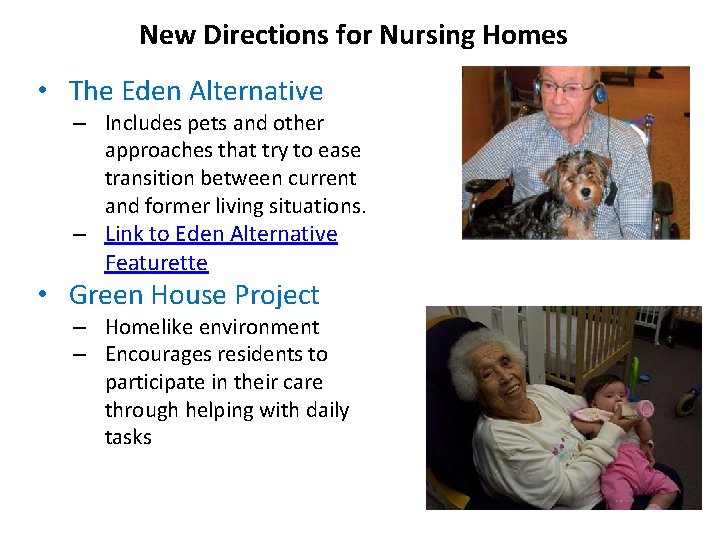
New Directions for Nursing Homes • The Eden Alternative – Includes pets and other approaches that try to ease transition between current and former living situations. – Link to Eden Alternative Featurette • Green House Project – Homelike environment – Encourages residents to participate in their care through helping with daily tasks