
CHAPTER FIVE SOURCES AND METHODS OF DATA COLLECTION

- Slides: 26
CHAPTER FIVE SOURCES AND METHODS OF DATA COLLECTION
Contents • Sources of data • Advantages and dis advantages of primary and secondary sources • Observation method • Questionnaire • Interviews • Survey
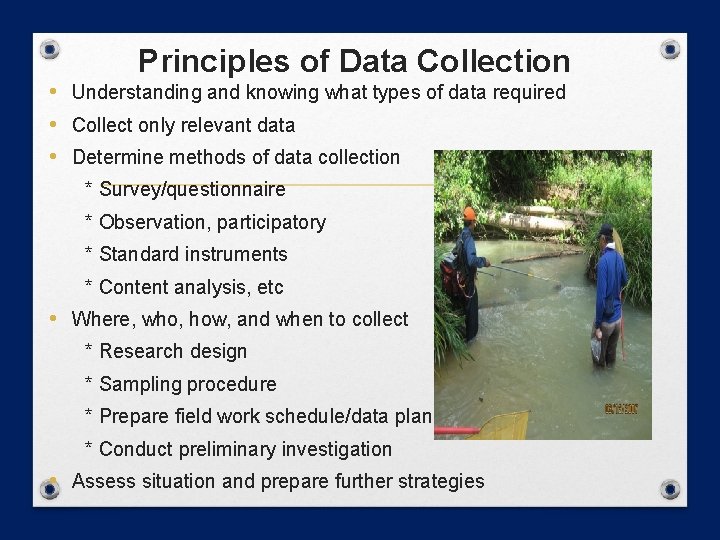
Principles of Data Collection • Understanding and knowing what types of data required • Collect only relevant data • Determine methods of data collection * Survey/questionnaire * Observation, participatory * Standard instruments * Content analysis, etc • Where, who, how, and when to collect * Research design * Sampling procedure * Prepare field work schedule/data plan * Conduct preliminary investigation • Assess situation and prepare further strategies
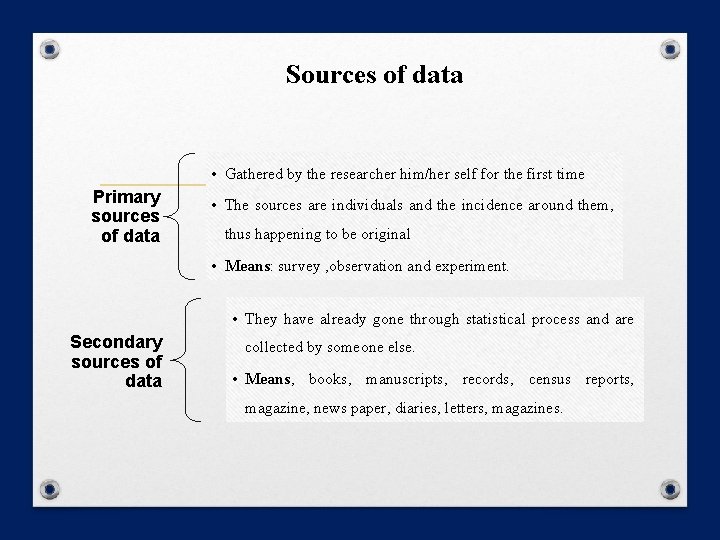
Sources of data • Gathered by the researcher him/her self for the first time Primary sources of data • The sources are individuals and the incidence around them, thus happening to be original • Means: survey , observation and experiment. • They have already gone through statistical process and are Secondary sources of data collected by someone else. • Means, books, manuscripts, records, census reports, magazine, news paper, diaries, letters, magazines.
Instrumentation • A process of selecting and developing research tool for the purpose of data collection • Examples of instrument: * Questionnaire * Interview checklist * Observational form * Attitude/view scale * Content analysis form * Researcher-designed achievement test * Field Tools and equipments • Depends on method of study
Personal Interview • A personal interview is a form of direct communication in which an interviewer asks respondents in a face to face situation. • Personal interviews can take place in a factory, cafe homeowner’s doorway, in an executive office or in other settings.
Advantages of Interview • Opportunity for feed back • Probing complex answers • Greater flexibility to restructure questions • Less Item non response • More information in greater detail • Observation method as well can be applied • Supplementary information about the respondent can be obtained • Illiterate and functionally participants can be reached
Disadvantages of Interview • Reluctant to provide confidential information to another person. • Interviewer Bias - the interviewer tone of voice and the interviewer’s appearance may influence the respondents answer. • Costly - Personal interviews are generally more expensive than mail internet and telephone surveys. • Social interest bias may occur • Need for highly trained interviewers • Not all participants are available or accessible
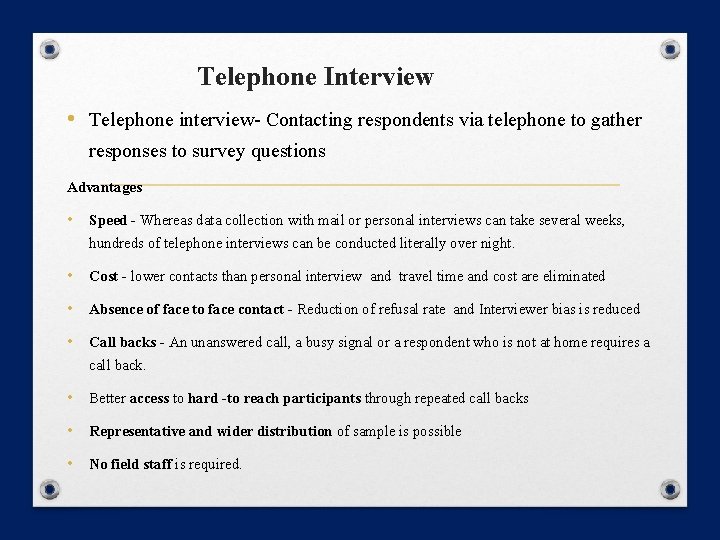
Telephone Interview • Telephone interview- Contacting respondents via telephone to gather responses to survey questions Advantages • Speed - Whereas data collection with mail or personal interviews can take several weeks, hundreds of telephone interviews can be conducted literally over night. • Cost - lower contacts than personal interview and travel time and cost are eliminated • Absence of face to face contact - Reduction of refusal rate and Interviewer bias is reduced • Call backs - An unanswered call, a busy signal or a respondent who is not at home requires a call back. • Better access to hard -to reach participants through repeated call backs • Representative and wider distribution of sample is possible • No field staff is required.
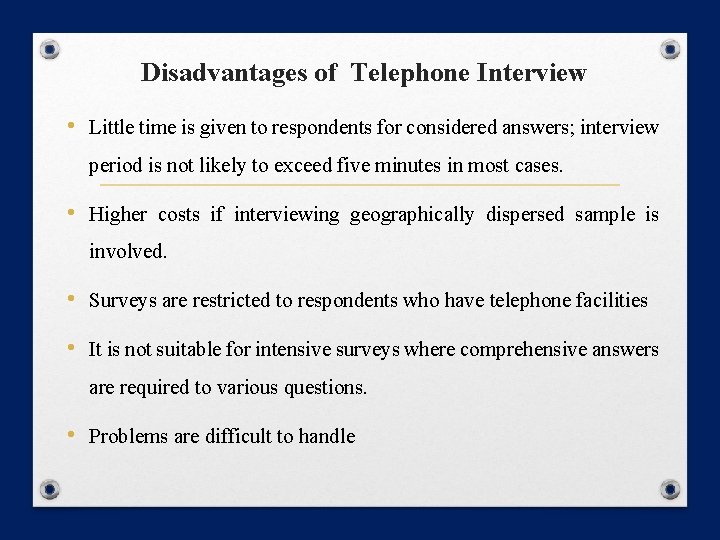
Disadvantages of Telephone Interview • Little time is given to respondents for considered answers; interview period is not likely to exceed five minutes in most cases. • Higher costs if interviewing geographically dispersed sample is involved. • Surveys are restricted to respondents who have telephone facilities • It is not suitable for intensive surveys where comprehensive answers are required to various questions. • Problems are difficult to handle
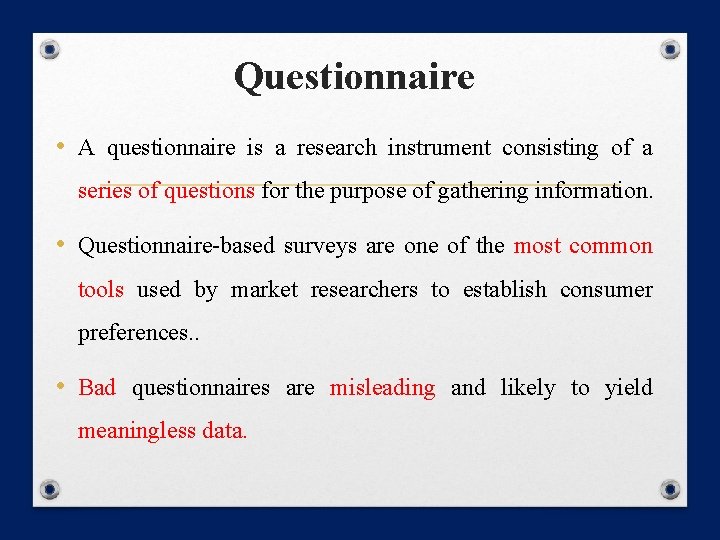
Questionnaire • A questionnaire is a research instrument consisting of a series of questions for the purpose of gathering information. • Questionnaire-based surveys are one of the most common tools used by market researchers to establish consumer preferences. . • Bad questionnaires are misleading and likely to yield meaningless data.
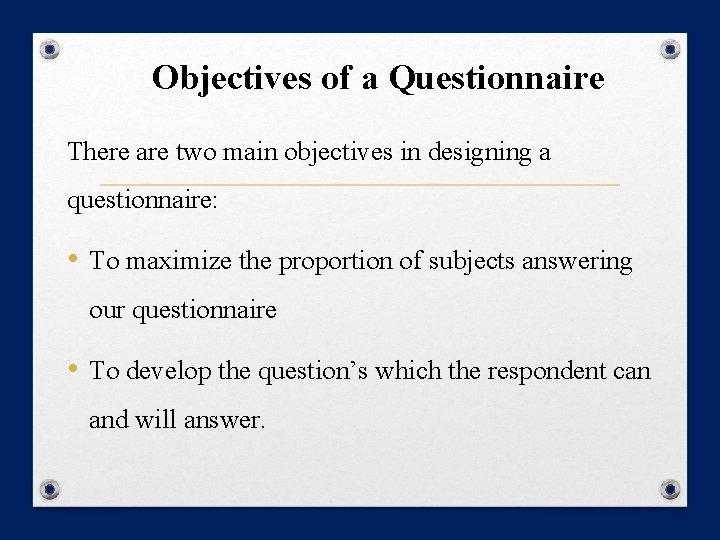
Objectives of a Questionnaire There are two main objectives in designing a questionnaire: • To maximize the proportion of subjects answering our questionnaire • To develop the question’s which the respondent can and will answer.
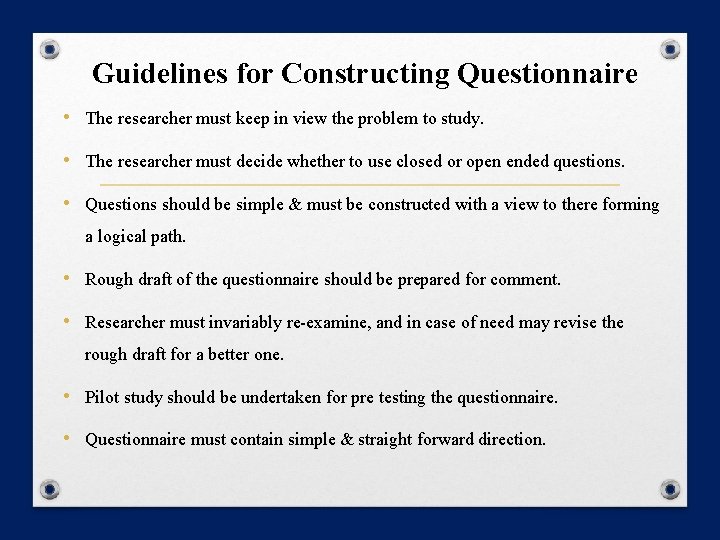
Guidelines for Constructing Questionnaire • The researcher must keep in view the problem to study. • The researcher must decide whether to use closed or open ended questions. • Questions should be simple & must be constructed with a view to there forming a logical path. • Rough draft of the questionnaire should be prepared for comment. • Researcher must invariably re-examine, and in case of need may revise the rough draft for a better one. • Pilot study should be undertaken for pre testing the questionnaire. • Questionnaire must contain simple & straight forward direction.
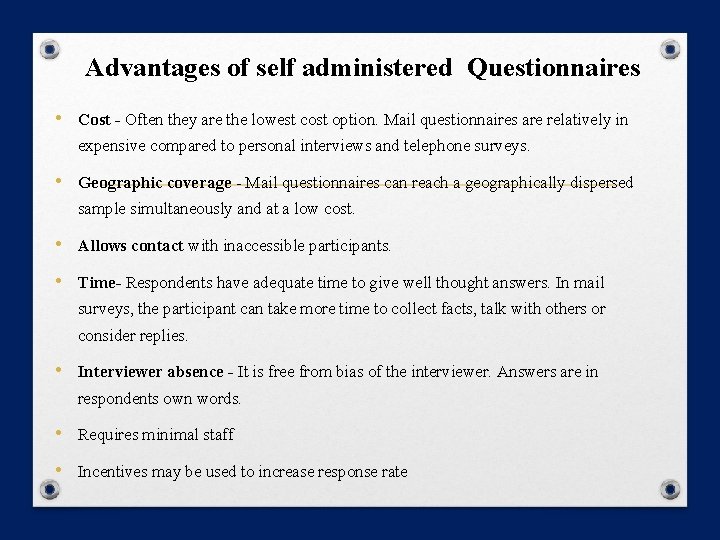
Advantages of self administered Questionnaires • Cost - Often they are the lowest cost option. Mail questionnaires are relatively in expensive compared to personal interviews and telephone surveys. • Geographic coverage - Mail questionnaires can reach a geographically dispersed sample simultaneously and at a low cost. • Allows contact with inaccessible participants. • Time- Respondents have adequate time to give well thought answers. In mail surveys, the participant can take more time to collect facts, talk with others or consider replies. • Interviewer absence - It is free from bias of the interviewer. Answers are in respondents own words. • Requires minimal staff • Incentives may be used to increase response rate
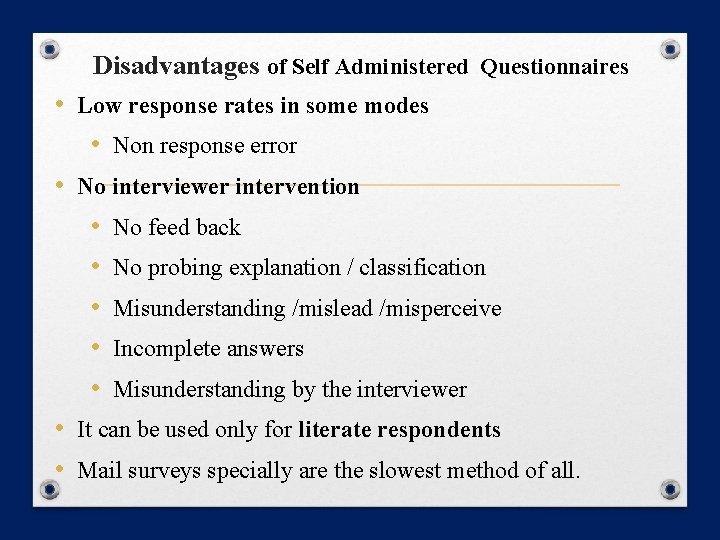
Disadvantages of Self Administered Questionnaires • Low response rates in some modes • Non response error • No interviewer intervention • No feed back • No probing explanation / classification • Misunderstanding /mislead /misperceive • Incomplete answers • Misunderstanding by the interviewer • It can be used only for literate respondents • Mail surveys specially are the slowest method of all.
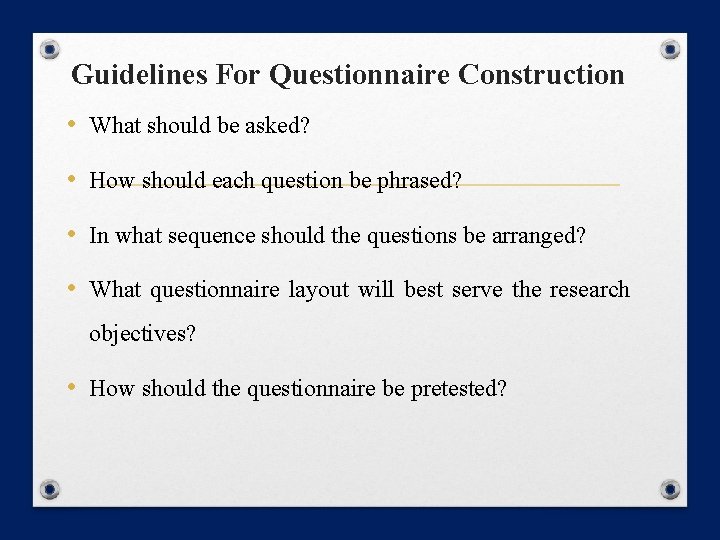
Guidelines For Questionnaire Construction • What should be asked? • How should each question be phrased? • In what sequence should the questions be arranged? • What questionnaire layout will best serve the research objectives? • How should the questionnaire be pretested?
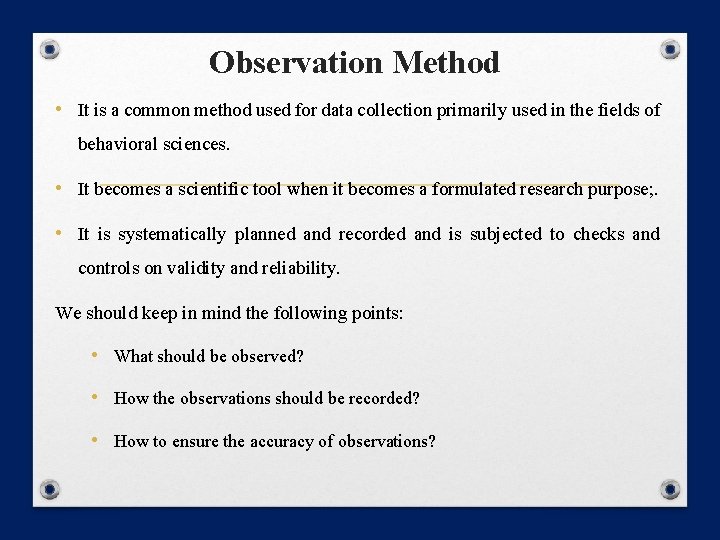
Observation Method • It is a common method used for data collection primarily used in the fields of behavioral sciences. • It becomes a scientific tool when it becomes a formulated research purpose; . • It is systematically planned and recorded and is subjected to checks and controls on validity and reliability. We should keep in mind the following points: • What should be observed? • How the observations should be recorded? • How to ensure the accuracy of observations?
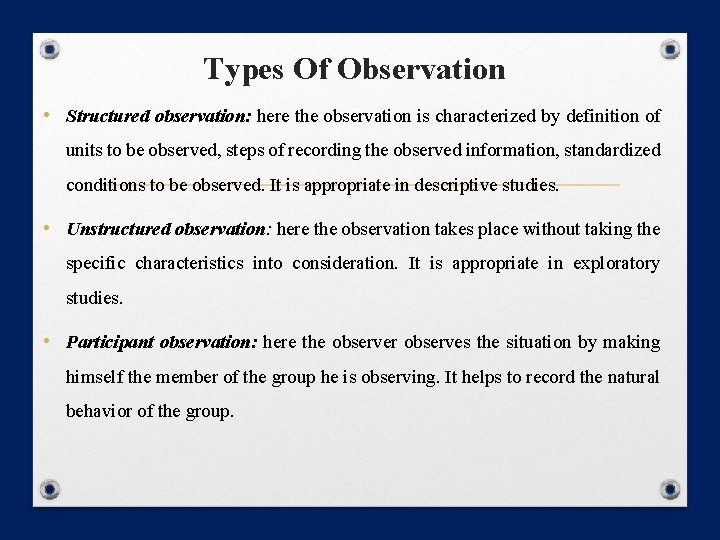
Types Of Observation • Structured observation: here the observation is characterized by definition of units to be observed, steps of recording the observed information, standardized conditions to be observed. It is appropriate in descriptive studies. • Unstructured observation: here the observation takes place without taking the specific characteristics into consideration. It is appropriate in exploratory studies. • Participant observation: here the observer observes the situation by making himself the member of the group he is observing. It helps to record the natural behavior of the group.
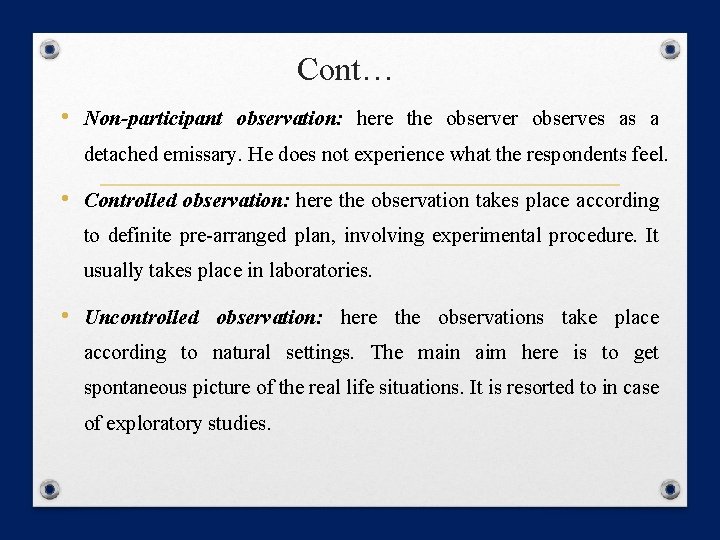
Cont… • Non-participant observation: here the observer observes as a detached emissary. He does not experience what the respondents feel. • Controlled observation: here the observation takes place according to definite pre-arranged plan, involving experimental procedure. It usually takes place in laboratories. • Uncontrolled observation: here the observations take place according to natural settings. The main aim here is to get spontaneous picture of the real life situations. It is resorted to in case of exploratory studies.
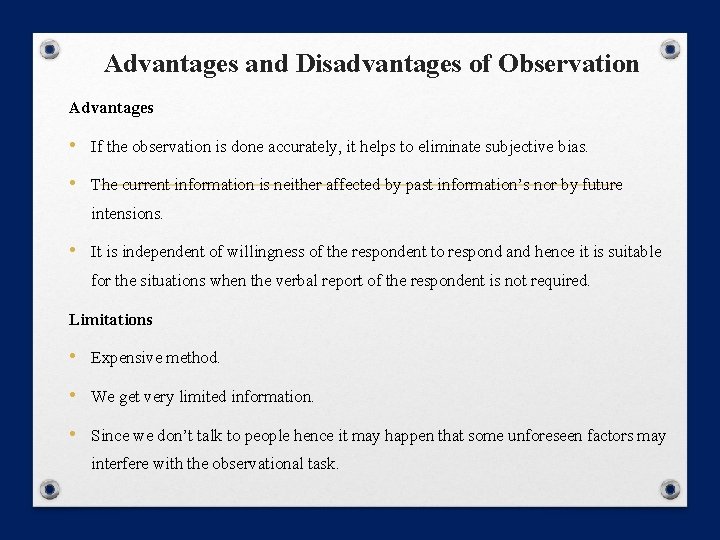
Advantages and Disadvantages of Observation Advantages • If the observation is done accurately, it helps to eliminate subjective bias. • The current information is neither affected by past information’s nor by future intensions. • It is independent of willingness of the respondent to respond and hence it is suitable for the situations when the verbal report of the respondent is not required. Limitations • Expensive method. • We get very limited information. • Since we don’t talk to people hence it may happen that some unforeseen factors may interfere with the observational task.
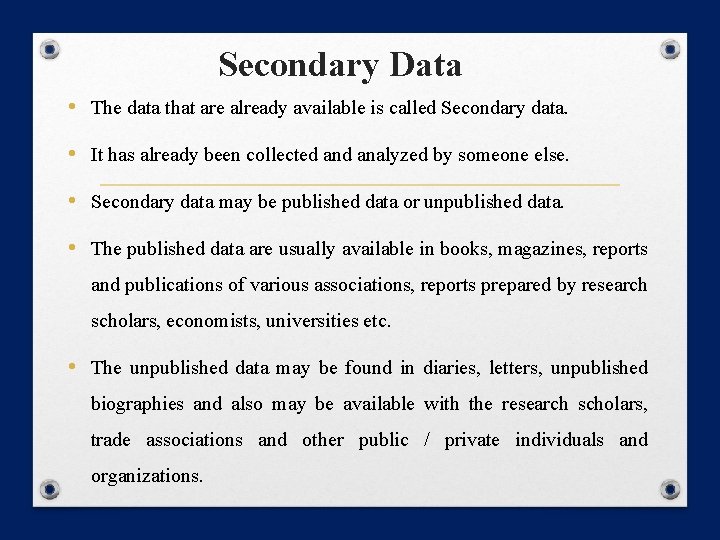
Secondary Data • The data that are already available is called Secondary data. • It has already been collected analyzed by someone else. • Secondary data may be published data or unpublished data. • The published data are usually available in books, magazines, reports and publications of various associations, reports prepared by research scholars, economists, universities etc. • The unpublished data may be found in diaries, letters, unpublished biographies and also may be available with the research scholars, trade associations and other public / private individuals and organizations.
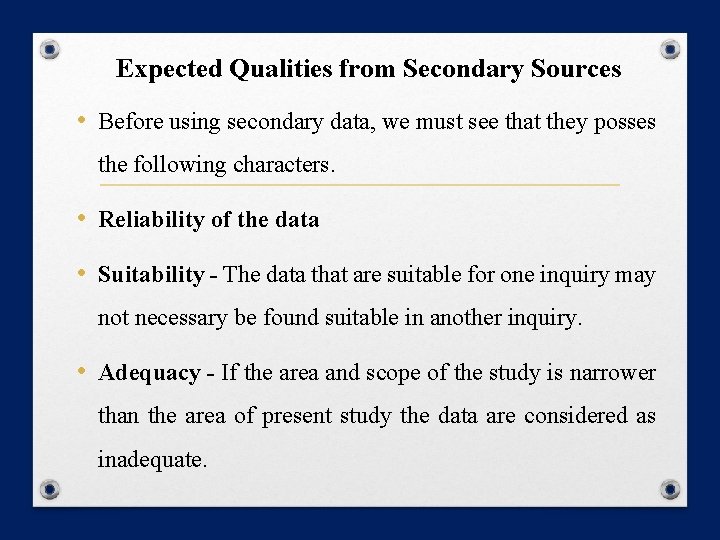
Expected Qualities from Secondary Sources • Before using secondary data, we must see that they posses the following characters. • Reliability of the data • Suitability - The data that are suitable for one inquiry may not necessary be found suitable in another inquiry. • Adequacy - If the area and scope of the study is narrower than the area of present study the data are considered as inadequate.
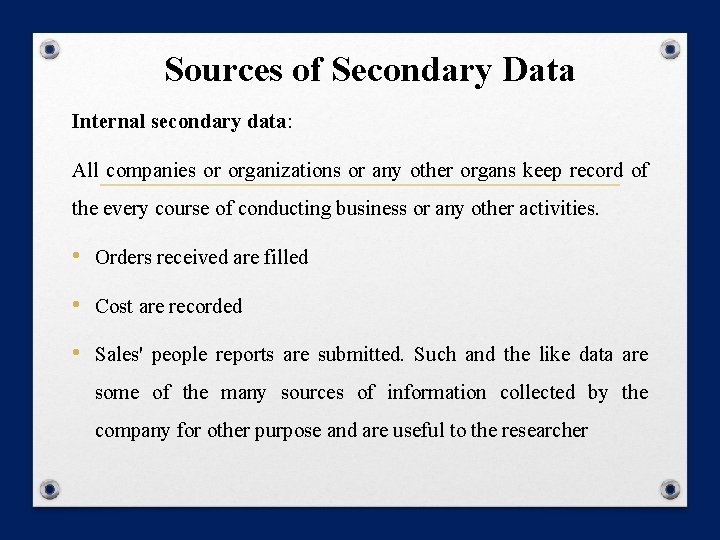
Sources of Secondary Data Internal secondary data: All companies or organizations or any other organs keep record of the every course of conducting business or any other activities. • Orders received are filled • Cost are recorded • Sales' people reports are submitted. Such and the like data are some of the many sources of information collected by the company for other purpose and are useful to the researcher
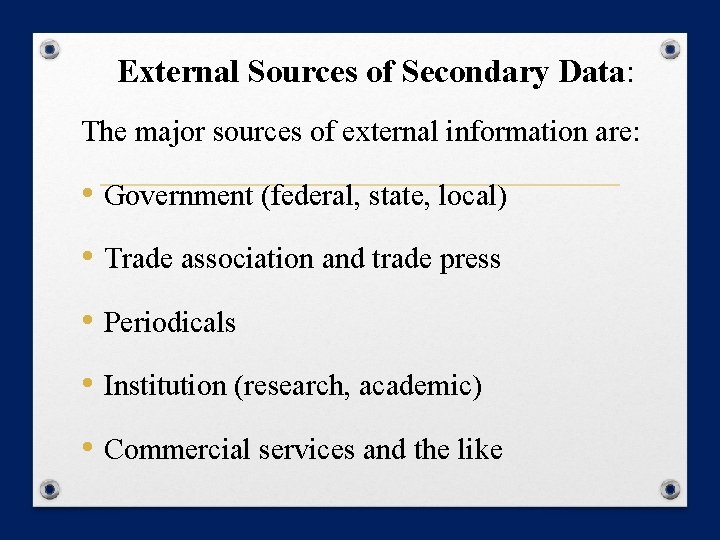
External Sources of Secondary Data: The major sources of external information are: • Government (federal, state, local) • Trade association and trade press • Periodicals • Institution (research, academic) • Commercial services and the like
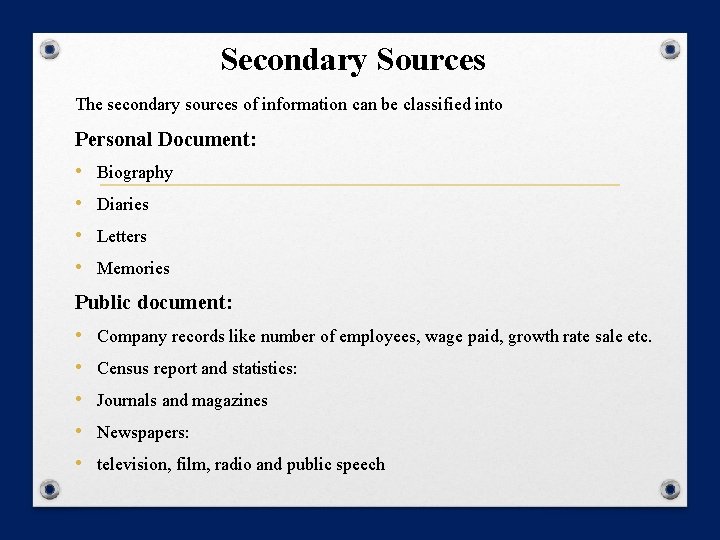
Secondary Sources The secondary sources of information can be classified into Personal Document: • Biography • Diaries • Letters • Memories Public document: • Company records like number of employees, wage paid, growth rate sale etc. • Census report and statistics: • Journals and magazines • Newspapers: • television, film, radio and public speech
• Any ? Welcome