
Chapter Five Secondary Sources of Marketing Data Esther

- Slides: 17
Chapter Five Secondary Sources of Marketing Data Esther, Tseng 曾愛華 1
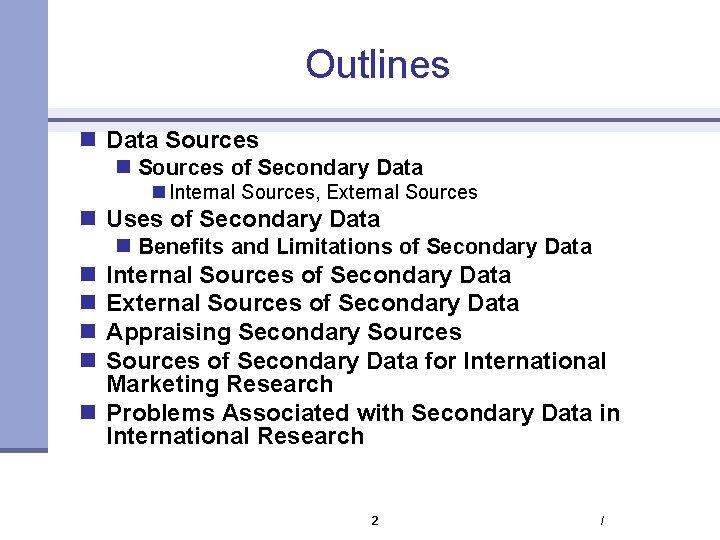
Outlines n Data Sources n Sources of Secondary Data n Internal Sources, External Sources n Uses of Secondary Data n Benefits and Limitations of Secondary Data n n Internal Sources of Secondary Data External Sources of Secondary Data Appraising Secondary Sources of Secondary Data for International Marketing Research n Problems Associated with Secondary Data in International Research 2 /
Data Sources n Secondary Data n Primary Data 3 /
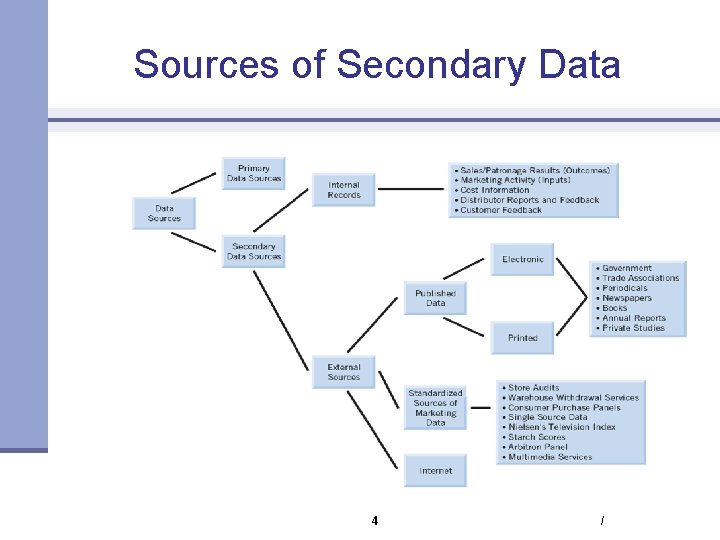
Sources of Secondary Data 4 /
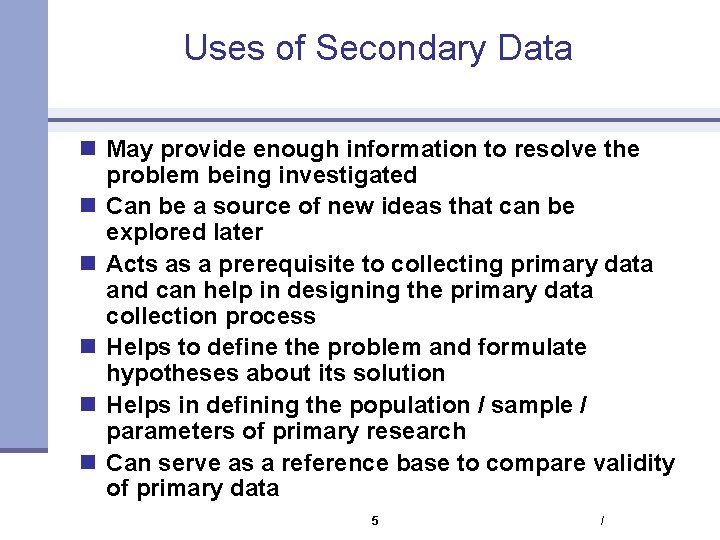
Uses of Secondary Data n May provide enough information to resolve the problem being investigated n Can be a source of new ideas that can be explored later n Acts as a prerequisite to collecting primary data and can help in designing the primary data collection process n Helps to define the problem and formulate hypotheses about its solution n Helps in defining the population / sample / parameters of primary research n Can serve as a reference base to compare validity of primary data 5 /
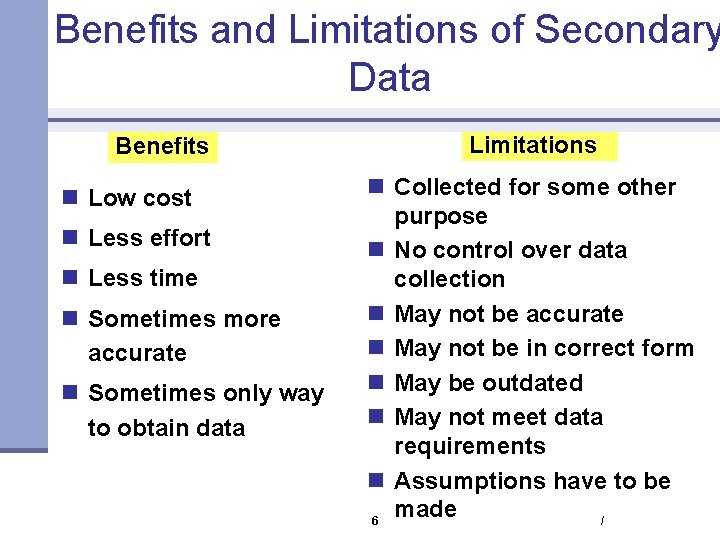
Benefits and Limitations of Secondary Data Benefits n Low cost n Less effort n Less time n Sometimes more accurate n Sometimes only way to obtain data Limitations n Collected for some other purpose n No control over data collection n May not be accurate n May not be in correct form n May be outdated n May not meet data requirements n Assumptions have to be made 6 /
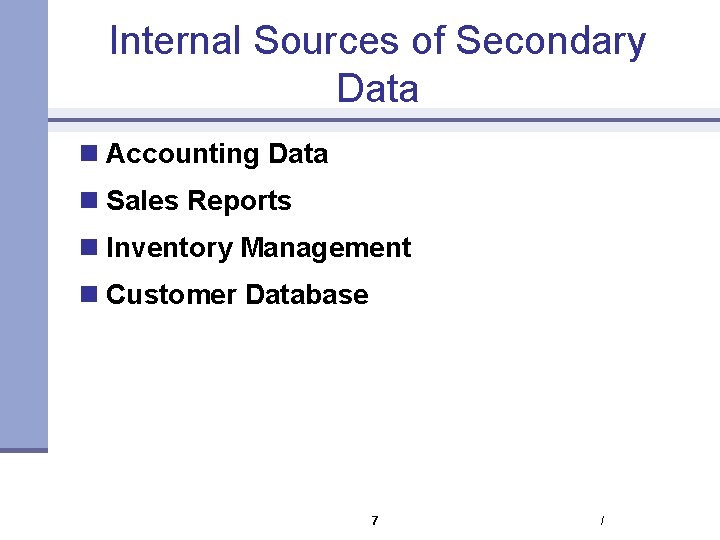
Internal Sources of Secondary Data n Accounting Data n Sales Reports n Inventory Management n Customer Database 7 /
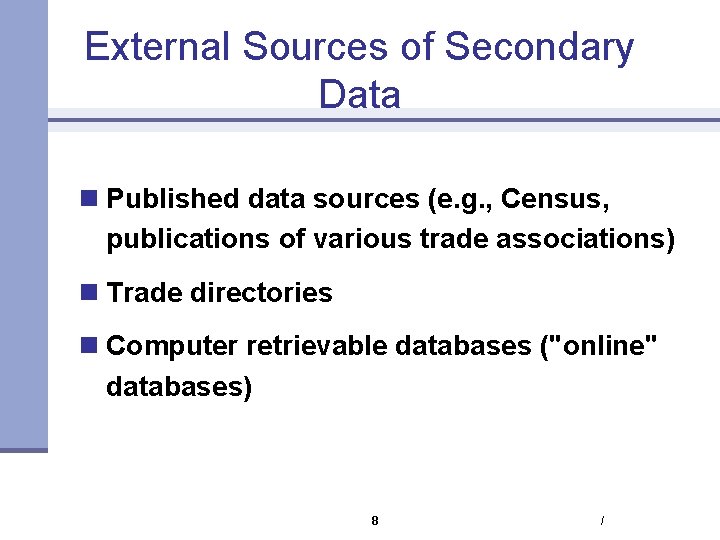
External Sources of Secondary Data n Published data sources (e. g. , Census, publications of various trade associations) n Trade directories n Computer retrievable databases ("online" databases) 8 /
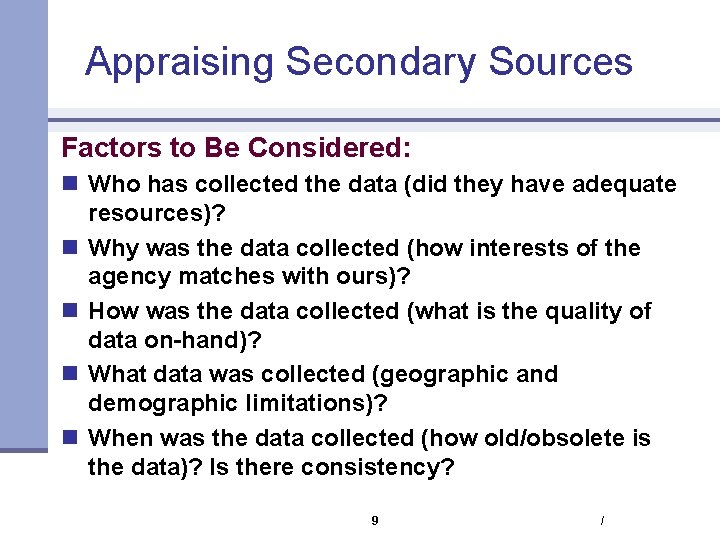
Appraising Secondary Sources Factors to Be Considered: n Who has collected the data (did they have adequate resources)? n Why was the data collected (how interests of the agency matches with ours)? n How was the data collected (what is the quality of data on-hand)? n What data was collected (geographic and demographic limitations)? n When was the data collected (how old/obsolete is the data)? Is there consistency? 9 /
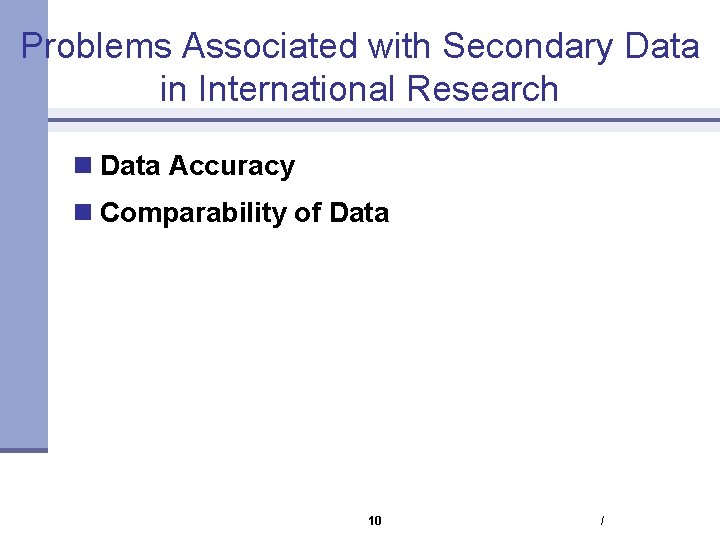
Problems Associated with Secondary Data in International Research n Data Accuracy n Comparability of Data 10 /
The End Thank you!! 11
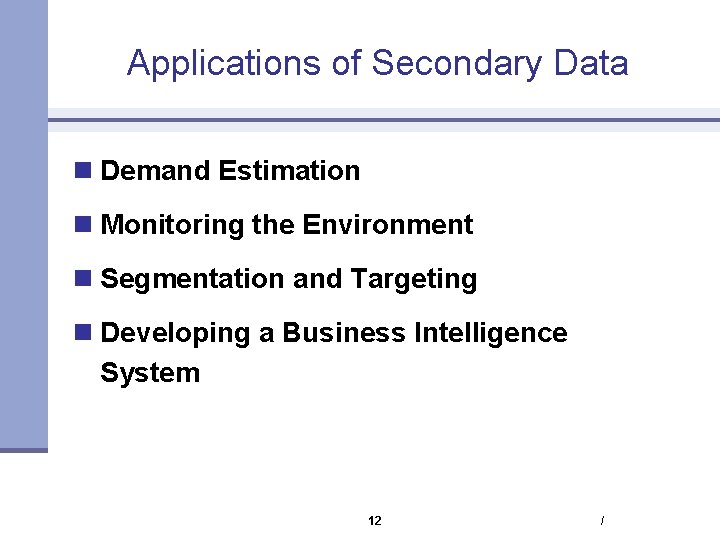
Applications of Secondary Data n Demand Estimation n Monitoring the Environment n Segmentation and Targeting n Developing a Business Intelligence System 12 /
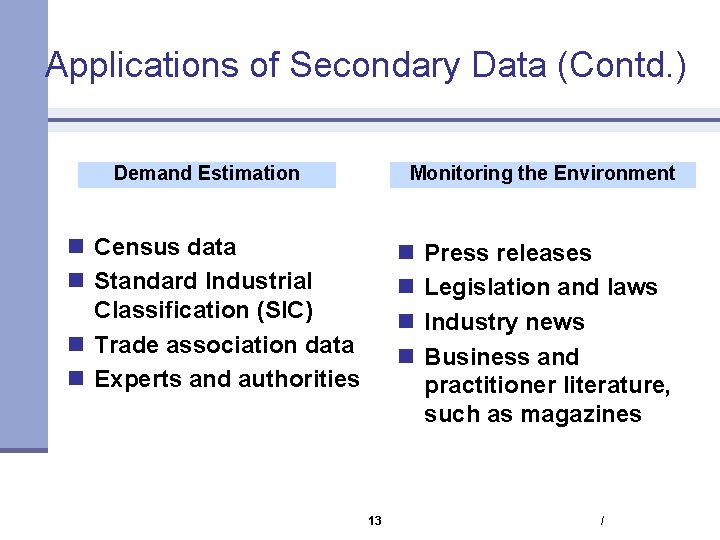
Applications of Secondary Data (Contd. ) Demand Estimation Monitoring the Environment n Census data n Standard Industrial Classification (SIC) n Trade association data n Experts and authorities n n 13 Press releases Legislation and laws Industry news Business and practitioner literature, such as magazines /
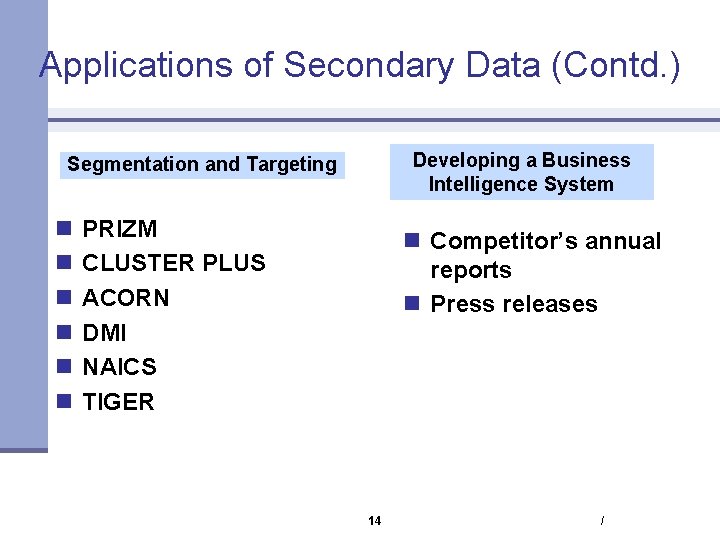
Applications of Secondary Data (Contd. ) Developing a Business Intelligence System Segmentation and Targeting n n n PRIZM CLUSTER PLUS ACORN DMI NAICS TIGER n Competitor’s annual reports n Press releases 14 /
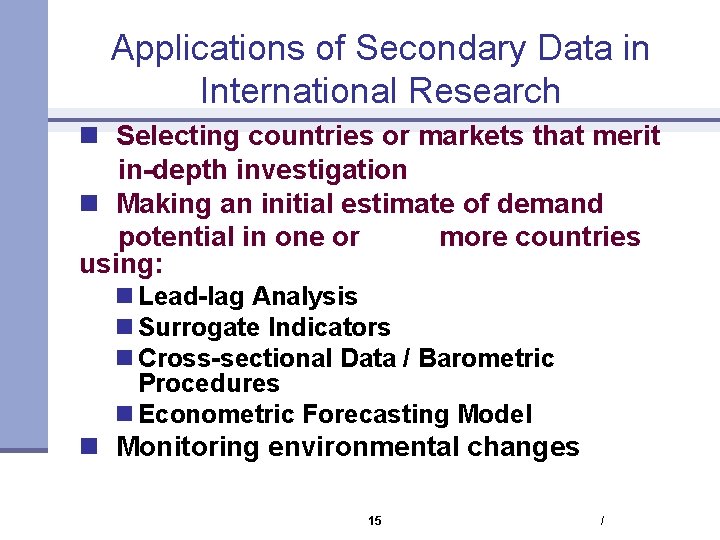
Applications of Secondary Data in International Research n Selecting countries or markets that merit in-depth investigation n Making an initial estimate of demand potential in one or more countries using: n Lead-lag Analysis n Surrogate Indicators n Cross-sectional Data / Barometric Procedures n Econometric Forecasting Model n Monitoring environmental changes 15 /
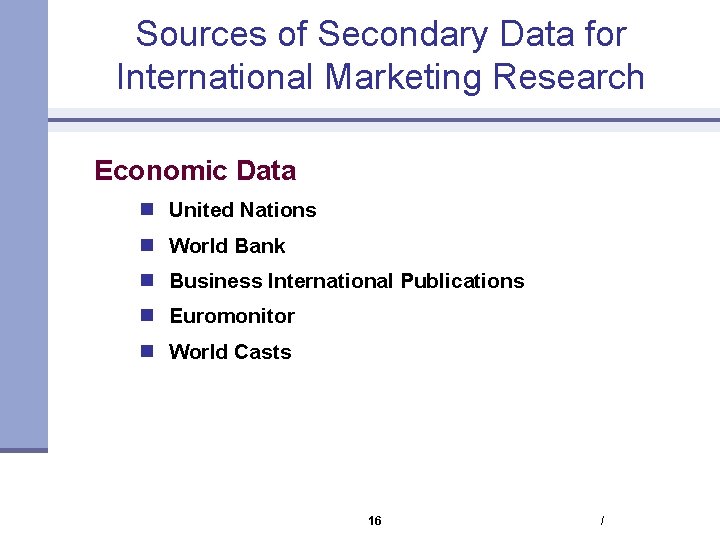
Sources of Secondary Data for International Marketing Research Economic Data n United Nations n World Bank n Business International Publications n Euromonitor n World Casts 16 /
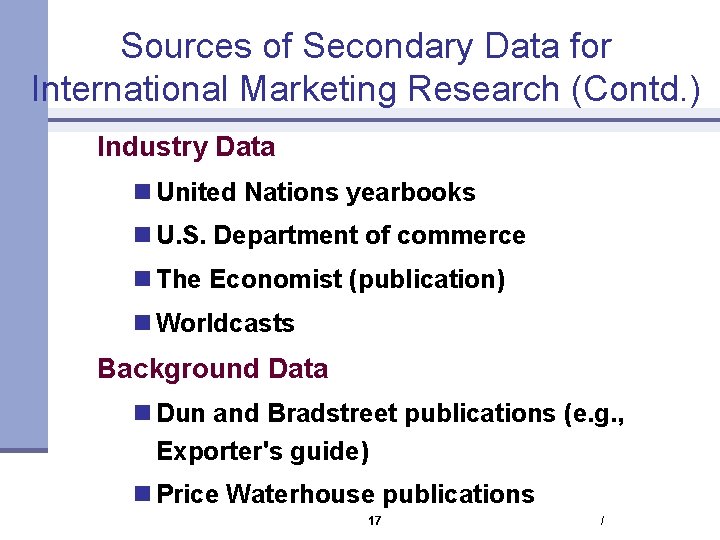
Sources of Secondary Data for International Marketing Research (Contd. ) Industry Data n United Nations yearbooks n U. S. Department of commerce n The Economist (publication) n Worldcasts Background Data n Dun and Bradstreet publications (e. g. , Exporter's guide) n Price Waterhouse publications 17 /