
Chapter Five Research Methods in Social Medicine contents
- Slides: 38
第五章 社会医学研究方法 Chapter Five Research Methods in Social Medicine 哈尔滨医科大学 社会医学教研室
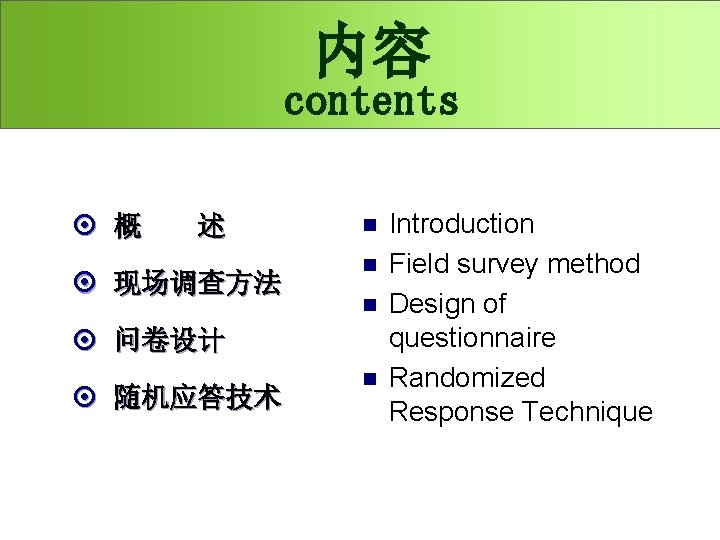
内容 contents ¤ 概 述 ¤ 现场调查方法 n n n ¤ 问卷设计 ¤ 随机应答技术 n Introduction Field survey method Design of questionnaire Randomized Response Technique
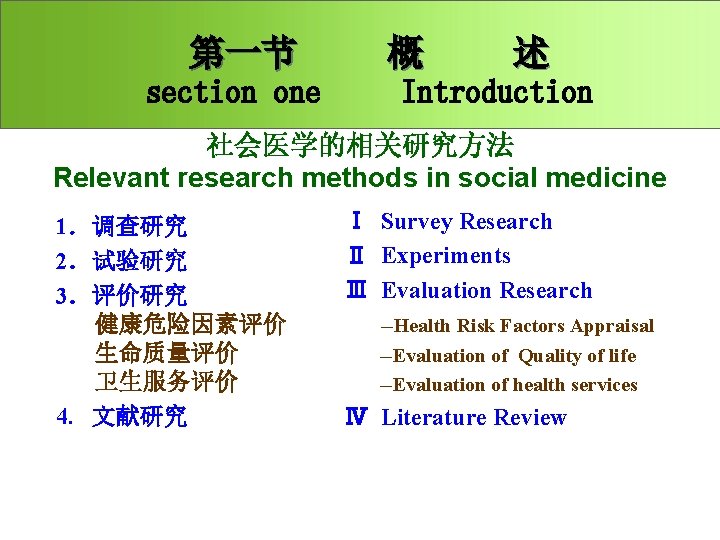
第一节 section one 概 述 Introduction 社会医学的相关研究方法 Relevant research methods in social medicine 1.调查研究 2.试验研究 3.评价研究 健康危险因素评价 生命质量评价 卫生服务评价 4. 文献研究 Ⅰ Survey Research Ⅱ Experiments Ⅲ Evaluation Research --Health Risk Factors Appraisal --Evaluation of Quality of life --Evaluation of health services Ⅳ Literature Review
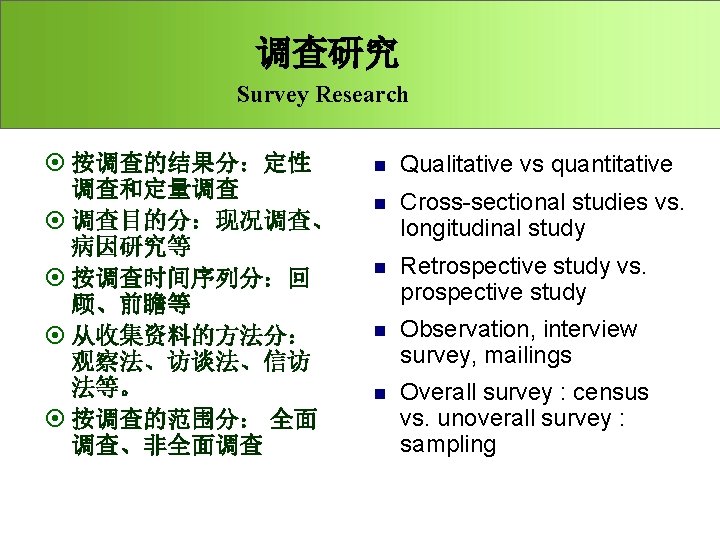
调查研究 Survey Research ¤ 按调查的结果分:定性 调查和定量调查 ¤ 调查目的分:现况调查、 病因研究等 ¤ 按调查时间序列分:回 顾、前瞻等 ¤ 从收集资料的方法分: 观察法、访谈法、信访 法等。 ¤ 按调查的范围分: 全面 调查、非全面调查 n Qualitative vs quantitative n Cross-sectional studies vs. longitudinal study n Retrospective study vs. prospective study n Observation, interview survey, mailings n Overall survey : census vs. unoverall survey : sampling
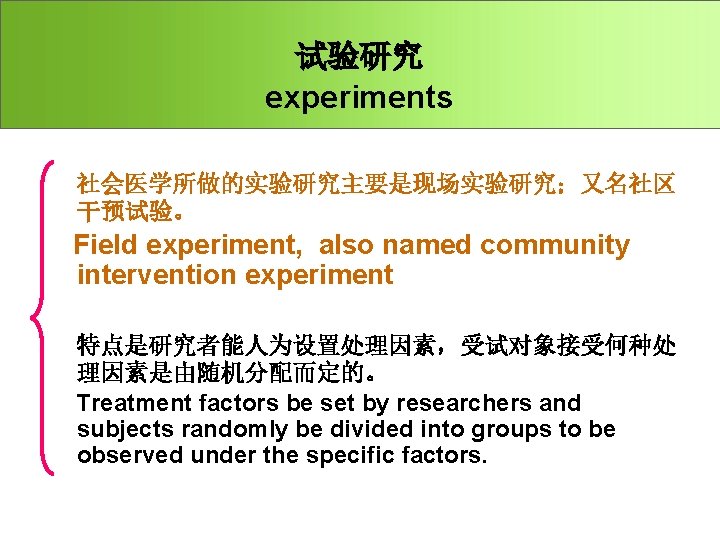
试验研究 experiments 社会医学所做的实验研究主要是现场实验研究;又名社区 干预试验。 Field experiment, also named community intervention experiment 特点是研究者能人为设置处理因素,受试对象接受何种处 理因素是由随机分配而定的。 Treatment factors be set by researchers and subjects randomly be divided into groups to be observed under the specific factors.
评价研究 evaluation study 健康危险因素评价 Health Risk Factors Appraisal n 生命质量评价 Evaluation of Quality of life n 卫生服务评价 Evaluation of health services n
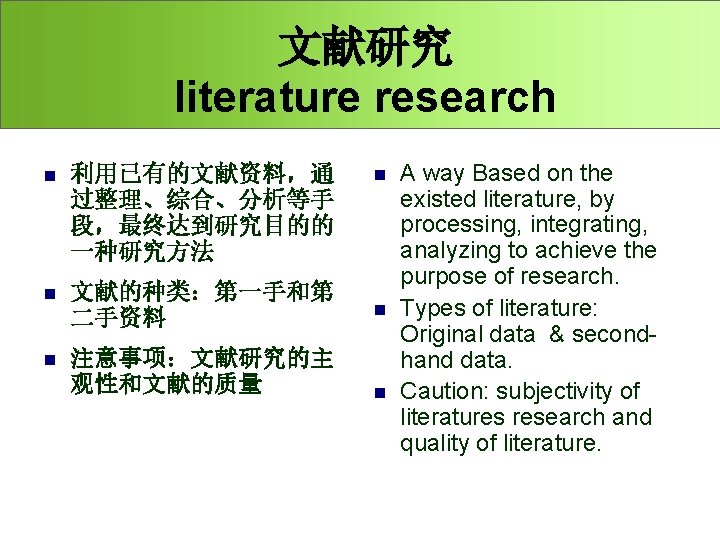
文献研究 literature research n 利用已有的文献资料,通 过整理、综合、分析等手 段,最终达到研究目的的 一种研究方法 n 文献的种类:第一手和第 二手资料 n 注意事项:文献研究的主 观性和文献的质量 n n n A way Based on the existed literature, by processing, integrating, analyzing to achieve the purpose of research. Types of literature: Original data & secondhand data. Caution: subjectivity of literatures research and quality of literature.
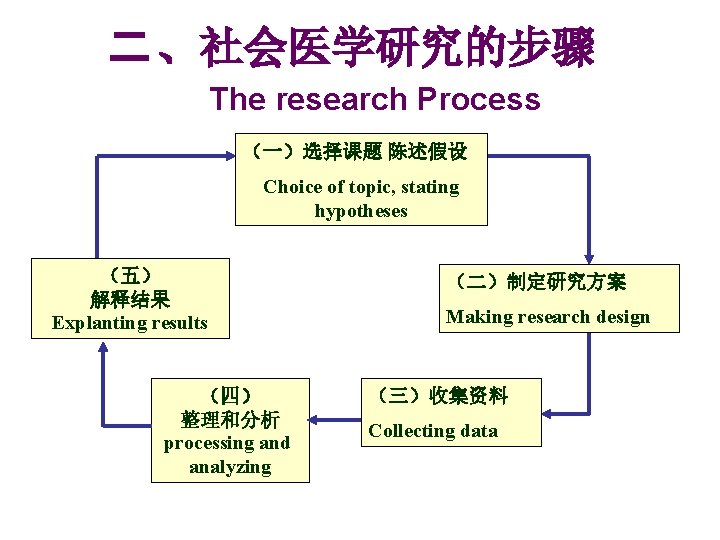
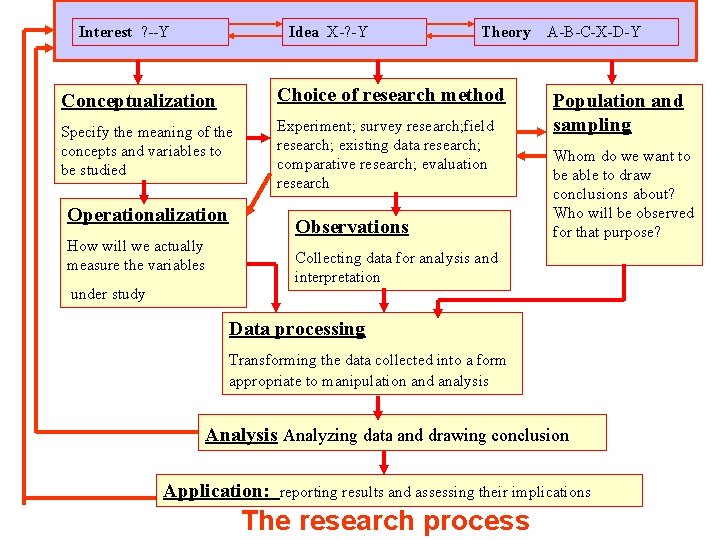
二 、社会医学研究的步骤 The research Process (一)选择课题 陈述假设 Choice of topic, stating hypotheses (五) 解释结果 Explanting results (四) 整理和分析 processing and analyzing (二)制定研究方案 Making research design (三)收集资料 Collecting data
Interest ? --Y Idea X-? -Y Theory Conceptualization Choice of research method Specify the meaning of the concepts and variables to be studied Experiment; survey research; field research; existing data research; comparative research; evaluation research Operationalization Observations How will we actually measure the variables A-B-C-X-D-Y Population and sampling Whom do we want to be able to draw conclusions about? Who will be observed for that purpose? Collecting data for analysis and interpretation under study Data processing Transforming the data collected into a form appropriate to manipulation and analysis Analyzing data and drawing conclusion Application: reporting results and assessing their implications The research process
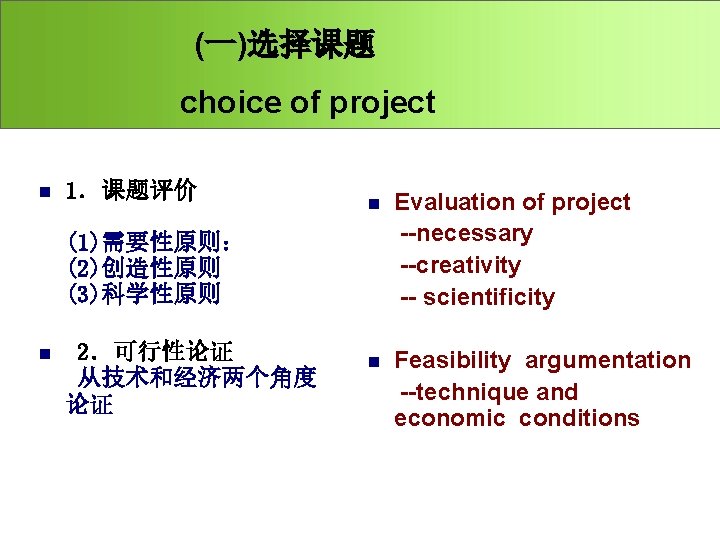
(一)选择课题 n choice of project 1.课题评价 (1)需要性原则: (2)创造性原则 (3)科学性原则 n 2.可行性论证 从技术和经济两个角度 论证 Evaluation of project --necessary --creativity -- scientificity n Feasibility argumentation --technique and economic conditions n
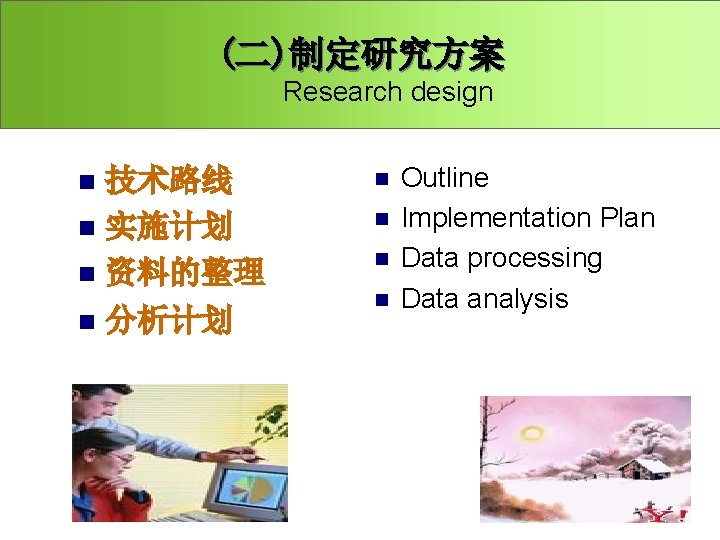
(二)制定研究方案 Research design 技术路线 n 实施计划 n 资料的整理 n 分析计划 n n n Outline Implementation Plan Data processing Data analysis
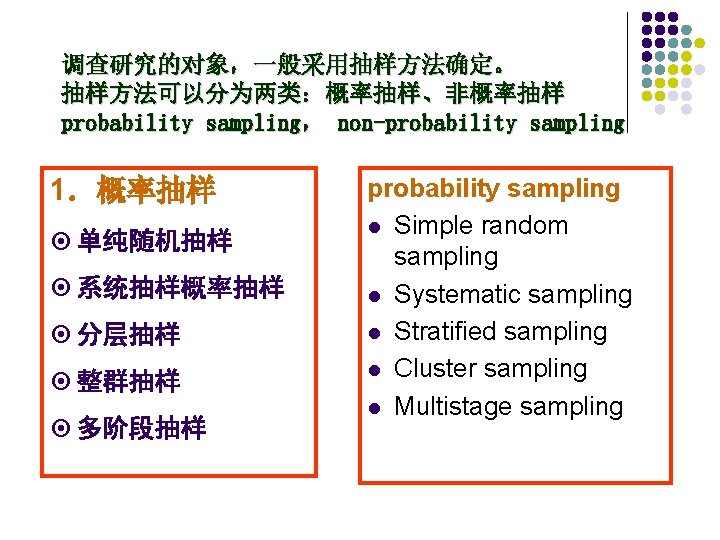
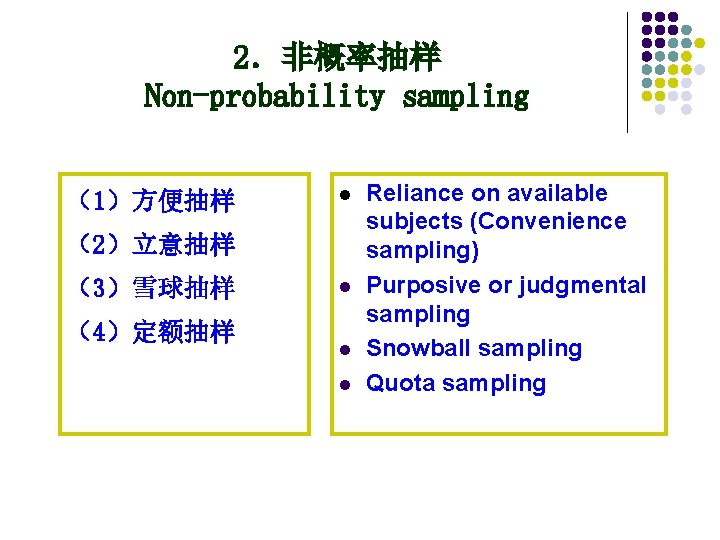
调查研究的对象,一般采用抽样方法确定。 抽样方法可以分为两类:概率抽样、非概率抽样 probability sampling, non-probability sampling 1.概率抽样 ¤ 单纯随机抽样 ¤ 系统抽样概率抽样 ¤ 分层抽样 ¤ 整群抽样 ¤ 多阶段抽样 probability sampling l Simple random sampling l Systematic sampling l Stratified sampling l Cluster sampling l Multistage sampling
2.非概率抽样 Non-probability sampling (1)方便抽样 l (2)立意抽样 (3)雪球抽样 (4)定额抽样 l l l Reliance on available subjects (Convenience sampling) Purposive or judgmental sampling Snowball sampling Quota sampling
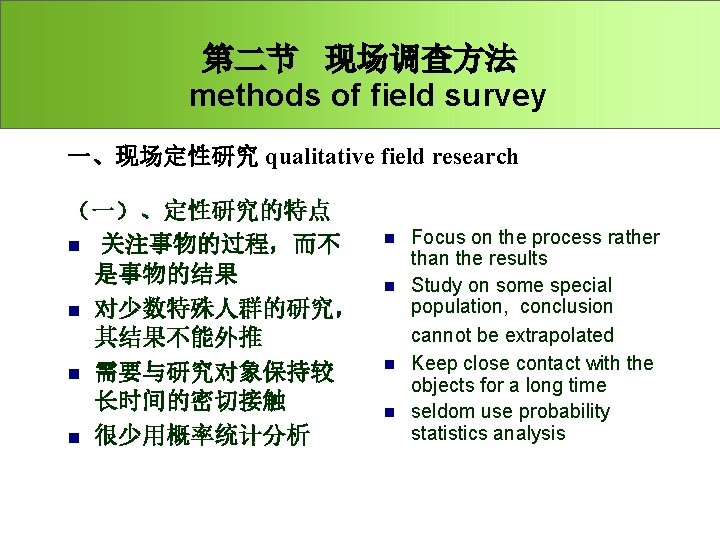
第二节 现场调查方法 methods of field survey 一、现场定性研究 qualitative field research (一)、定性研究的特点 n 关注事物的过程,而不 是事物的结果 n 对少数特殊人群的研究, 其结果不能外推 n 需要与研究对象保持较 长时间的密切接触 n 很少用概率统计分析 n n Focus on the process rather than the results Study on some special population, conclusion cannot be extrapolated Keep close contact with the objects for a long time seldom use probability statistics analysis
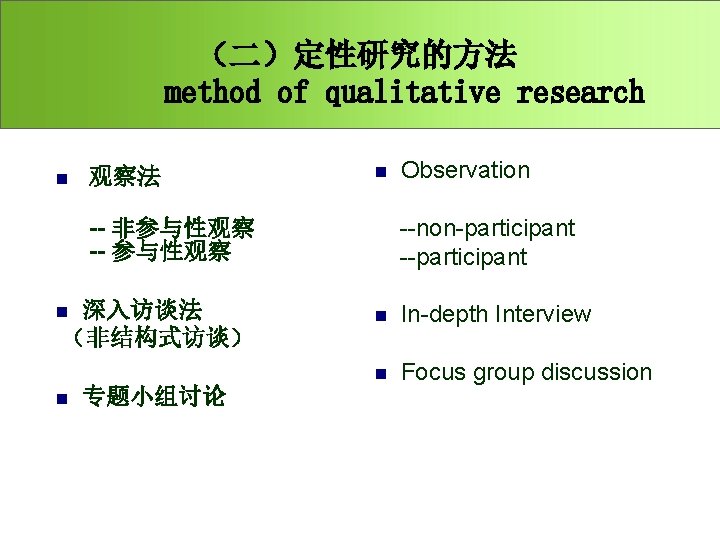
(二)定性研究的方法 method of qualitative research n 观察法 n --non-participant --participant -- 非参与性观察 -- 参与性观察 深入访谈法 (非结构式访谈) n n 专题小组讨论 Observation n In-depth Interview n Focus group discussion
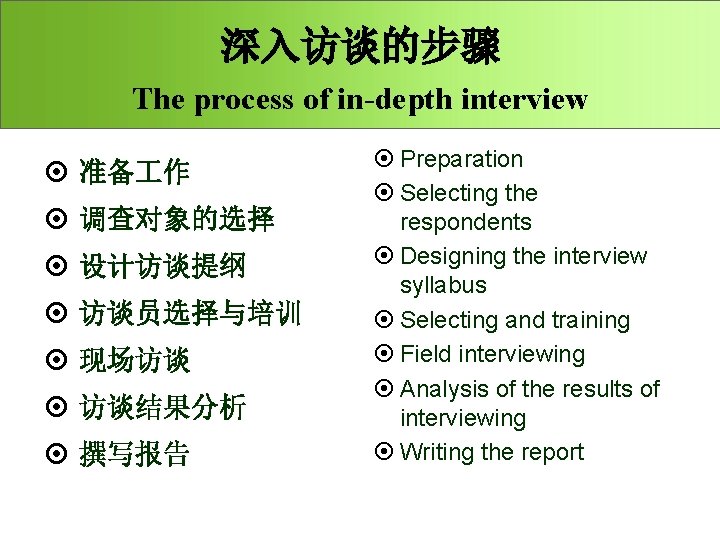
深入访谈的步骤 The process of in-depth interview ¤ 准备 作 ¤ 调查对象的选择 ¤ 设计访谈提纲 ¤ 访谈员选择与培训 ¤ 现场访谈 ¤ 访谈结果分析 ¤ 撰写报告 ¤ Preparation ¤ Selecting the respondents ¤ Designing the interview syllabus ¤ Selecting and training ¤ Field interviewing ¤ Analysis of the results of interviewing ¤ Writing the report
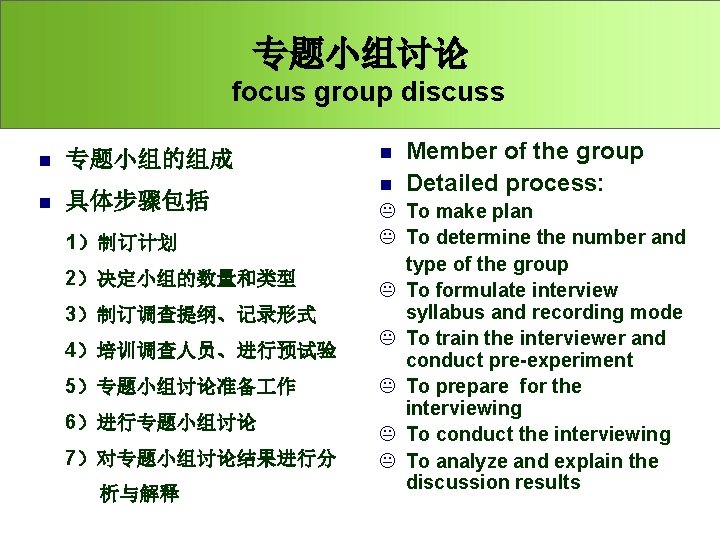
专题小组讨论 focus group discuss n n 专题小组的组成 具体步骤包括 1)制订计划 2)决定小组的数量和类型 3)制订调查提纲、记录形式 4)培训调查人员、进行预试验 5)专题小组讨论准备 作 6)进行专题小组讨论 7)对专题小组讨论结果进行分 析与解释 n n Member of the group Detailed process: K To make plan K To determine the number and type of the group K To formulate interview syllabus and recording mode K To train the interviewer and conduct pre-experiment K To prepare for the interviewing K To conduct the interviewing K To analyze and explain the discussion results
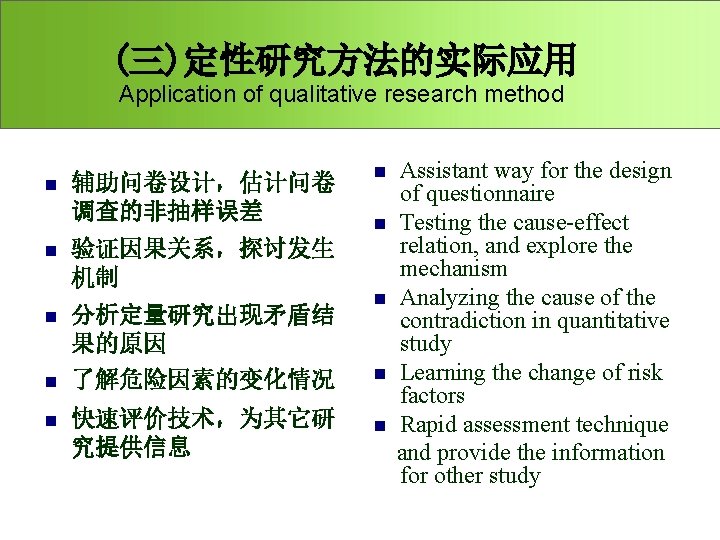
(三)定性研究方法的实际应用 Application of qualitative research method n n 辅助问卷设计,估计问卷 调查的非抽样误差 验证因果关系,探讨发生 机制 n n 分析定量研究出现矛盾结 果的原因 n 了解危险因素的变化情况 n n 快速评价技术,为其它研 究提供信息 n Assistant way for the design of questionnaire Testing the cause-effect relation, and explore the mechanism Analyzing the cause of the contradiction in quantitative study Learning the change of risk factors Rapid assessment technique and provide the information for other study
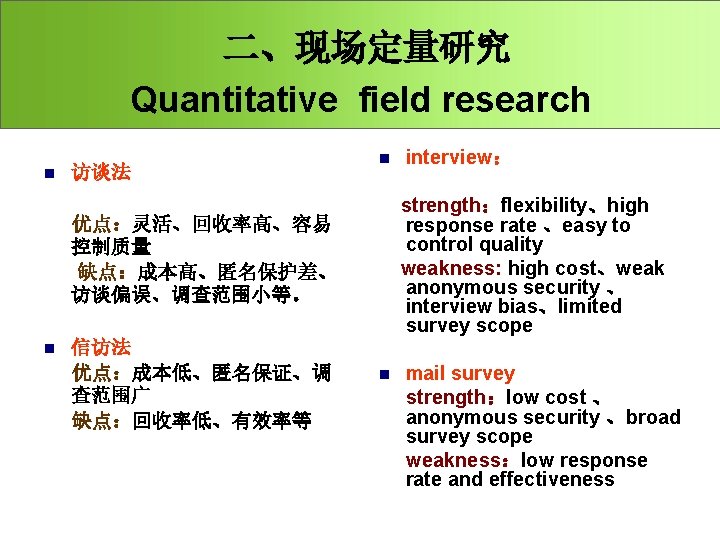
二、现场定量研究 Quantitative field research n 访谈法 优点:灵活、回收率高、容易 控制质量 缺点:成本高、匿名保护差、 访谈偏误、调查范围小等。 信访法 优点:成本低、匿名保证、调 查范围广 缺点:回收率低、有效率等 n interview: strength:flexibility、high response rate 、easy to control quality weakness: high cost、weak anonymous security 、 interview bias、limited survey scope n mail survey strength:low cost 、 anonymous security 、broad survey scope weakness:low response rate and effectiveness n
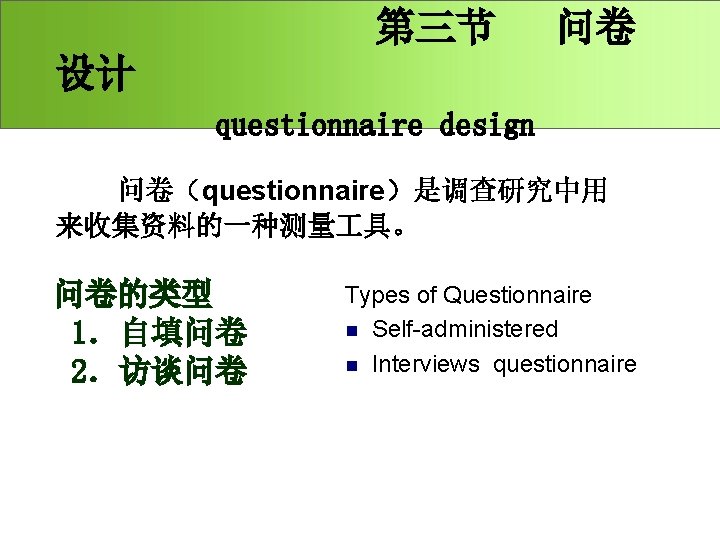
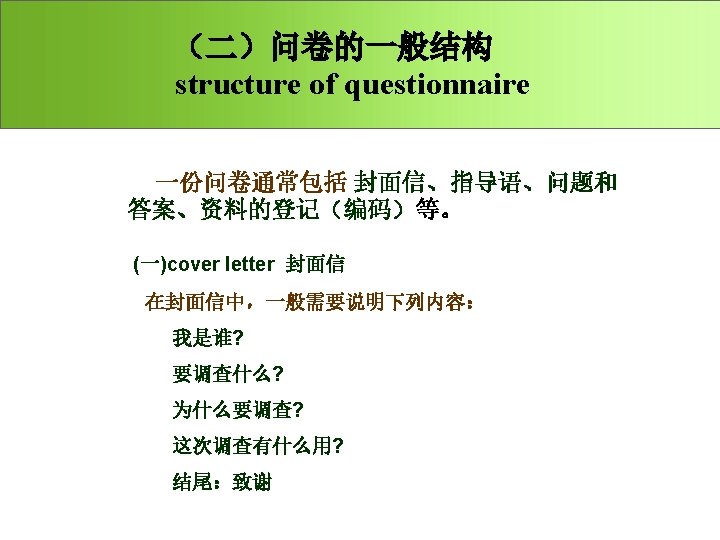
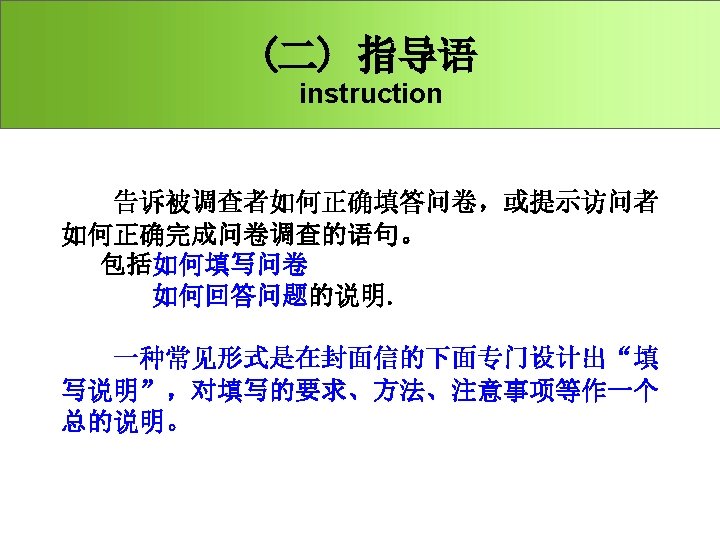
第三节 问卷 设计 questionnaire design 问卷(questionnaire)是调查研究中用 来收集资料的一种测量 具。 问卷的类型 1.自填问卷 2.访谈问卷 Types of Questionnaire n Self-administered n Interviews questionnaire
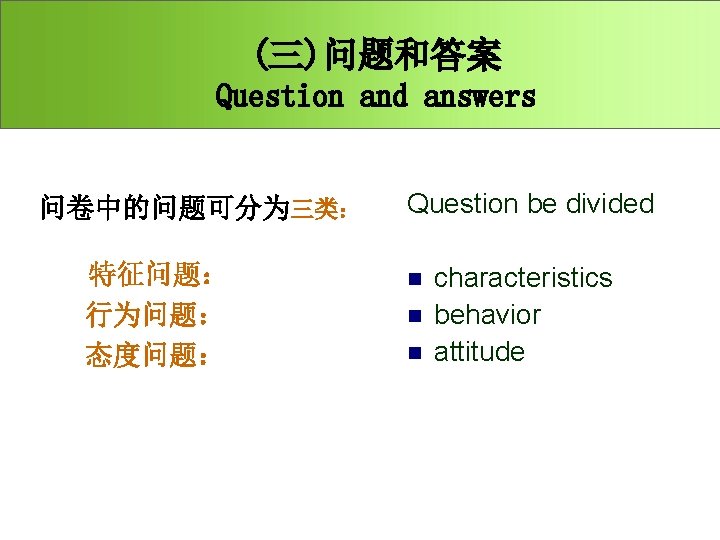
(三)问题和答案 Question and answers 问卷中的问题可分为三类: Question be divided 特征问题: 行为问题: 态度问题: n n n characteristics behavior attitude
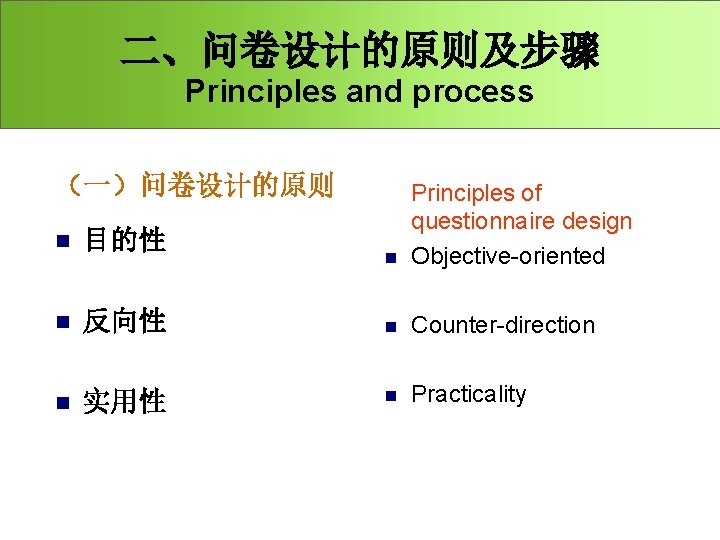
二、问卷设计的原则及步骤 Principles and process (一)问卷设计的原则 目的性 n 反向性 n 实用性 n n Principles of questionnaire design Objective-oriented n Counter-direction n Practicality
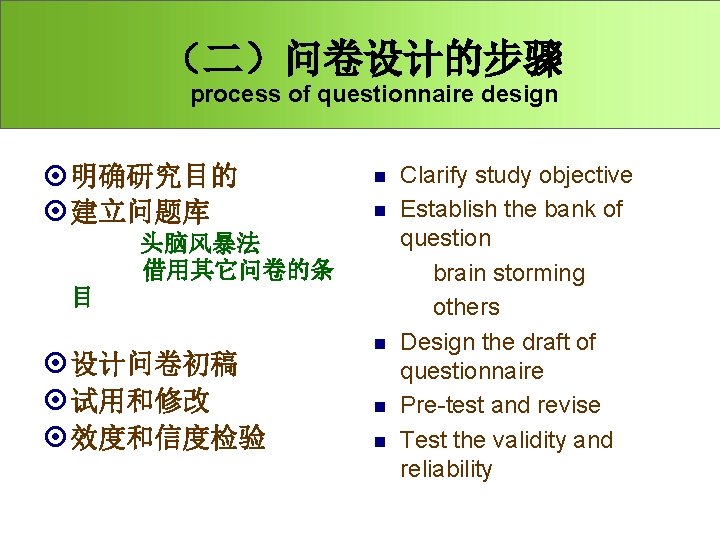
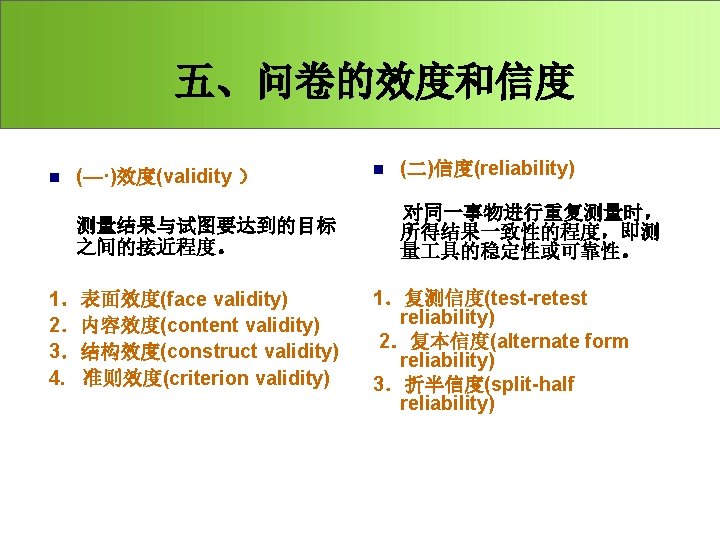
(二)问卷设计的步骤 process of questionnaire design ¤ 明确研究目的 ¤ 建立问题库 n n 头脑风暴法 借用其它问卷的条 目 ¤ 设计问卷初稿 ¤ 试用和修改 ¤ 效度和信度检验 n n n Clarify study objective Establish the bank of question brain storming others Design the draft of questionnaire Pre-test and revise Test the validity and reliability
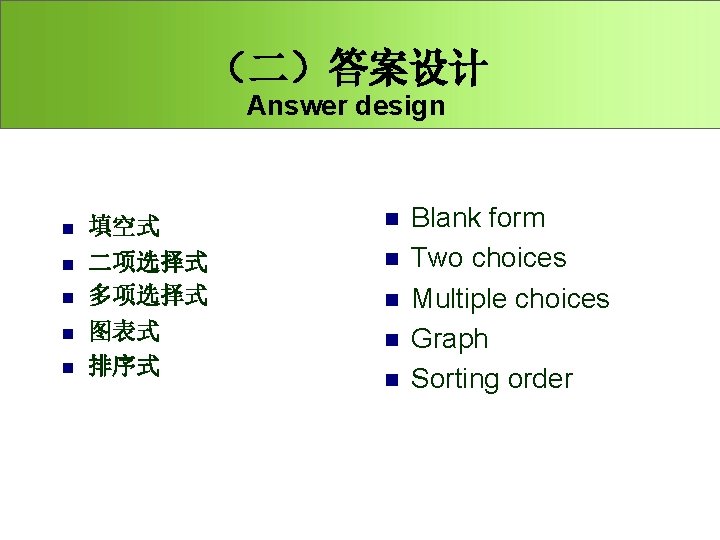
(二)答案设计 Answer design n n n 填空式 二项选择式 多项选择式 图表式 排序式 n n n Blank form Two choices Multiple choices Graph Sorting order
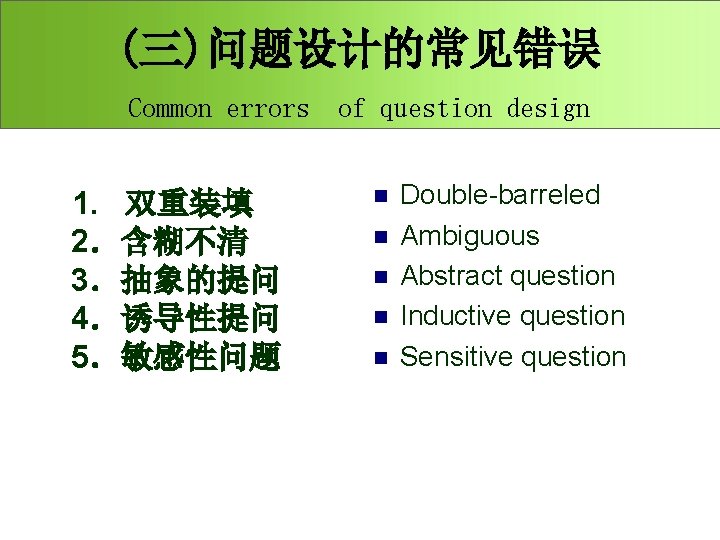
(三)问题设计的常见错误 Common errors 1. 双重装填 2.含糊不清 3.抽象的提问 4.诱导性提问 5.敏感性问题 of question design n n Double-barreled Ambiguous Abstract question Inductive question Sensitive question