
CHAPTER FIVE DIRECTIVE LEADERSHIP BEHAVIOR Prentice Hall 2006
CHAPTER FIVE DIRECTIVE LEADERSHIP BEHAVIOR © Prentice Hall 2006 5 -1
Learning Objectives After reading this chapter, you should be able to do the following: ¡ ¡ ¡ Describe directive leadership and give examples of directive leadership behaviors. Explain why directive leadership is important for individual followers and groups. Explain why directive leaders do not need to be authoritarian or autocratic 专制 to be effective. © Prentice Hall 2006 5 -2
Learning Objectives After reading this chapter, you should be able to do the following: ¡ ¡ ¡ Describe personal traits, skills, and sources of influence that leaders need to develop in order to be effective directive leaders. Identify factors which can encourage or discourage leaders from being directive. Describe the major impacts directive leadership has on followers’ psychological 心理 © Prentice Hall 2006 (xinli) reactions and behaviors. 5 -2
Learning Objectives (cont. ) After reading this chapter, you should be able to do the following: Identify organizational situations where directive leadership is especially effective. Identify situations where directive leadership is probably not effective. Explain how leaders can modify situations to make their directive leadership more effective. © Prentice Hall 2006 5 -3
Directive Leadership Directive leadership involves leader activities that guide and structure the actions of group members. P. 96 © Prentice Hall 2006 5 -4
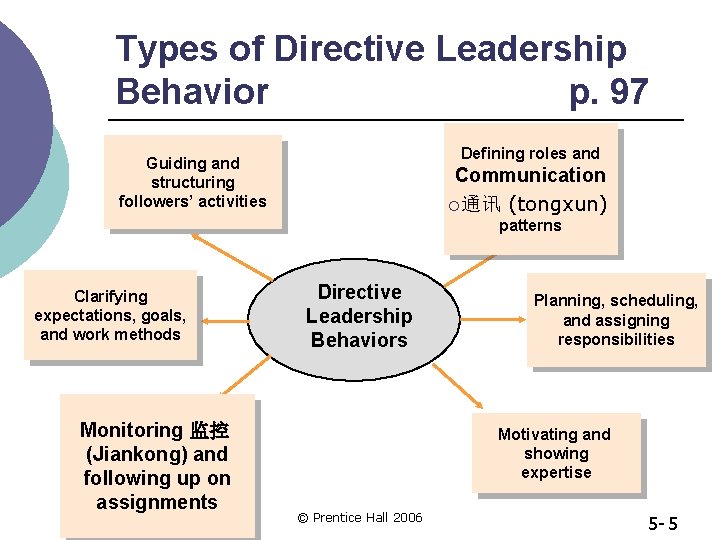
Types of Directive Leadership Behavior p. 97 Defining roles and Guiding and structuring followers’ activities Communication ¡通讯 (tongxun) patterns Clarifying expectations, goals, and work methods Monitoring 监控 (Jiankong) and following up on assignments Directive Leadership Behaviors Planning, scheduling, and assigning responsibilities Motivating and showing expertise © Prentice Hall 2006 5 -5
Avoiding Ineffective Directive Leadership p. 99 Leader directive behavior may result in inefficiency 效率低下 (xiaolu dixia) and ineffectiveness 无效 (wuxiao) if provided without the right context 景况 (jingkuang) and other needed information. Timing and feedback are important. © Prentice Hall 2006 5 -6
Avoiding Ineffective Directive Leadership p. 99 Some tasks require structure and guidance during the goal-setting stage. Some tasks require clarification 澄 清 and performance feedback during the task. Some followers need guidance to relate their work to that of other employees. © Prentice Hall 2006 5 -6
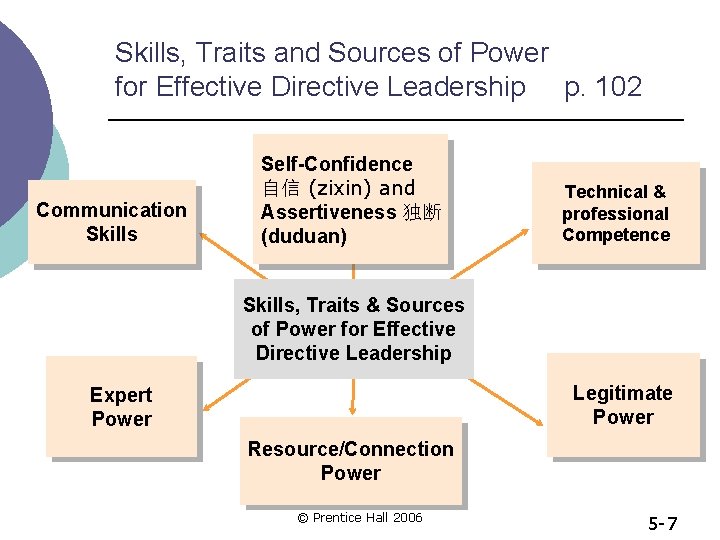
Skills, Traits and Sources of Power for Effective Directive Leadership p. 102 Communication Skills Self-Confidence 自信 (zixin) and Assertiveness 独断 (duduan) Technical & professional Competence Skills, Traits & Sources of Power for Effective Directive Leadership Legitimate Power Expert Power Resource/Connection Power © Prentice Hall 2006 5 -7
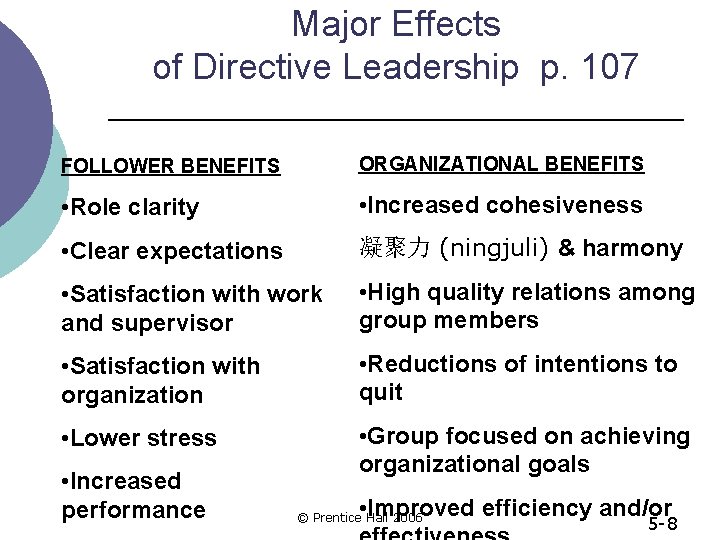
Major Effects of Directive Leadership p. 107 FOLLOWER BENEFITS ORGANIZATIONAL BENEFITS • Role clarity • Increased cohesiveness • Clear expectations 凝聚力 (ningjuli) & harmony • Satisfaction with work and supervisor • High quality relations among group members • Satisfaction with organization • Reductions of intentions to quit • Lower stress • Group focused on achieving organizational goals • Increased performance • Improved efficiency and/or © Prentice Hall 2006 5 -8
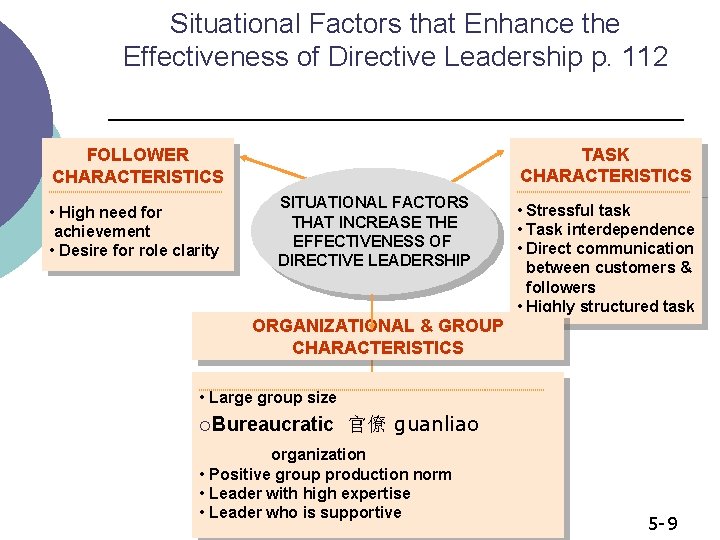
Situational Factors that Enhance the Effectiveness of Directive Leadership p. 112 TASK CHARACTERISTICS FOLLOWER CHARACTERISTICS • High need for achievement • Desire for role clarity SITUATIONAL FACTORS THAT INCREASE THE EFFECTIVENESS OF DIRECTIVE LEADERSHIP • Stressful task • Task interdependence • Direct communication between customers & followers • Highly structured task ORGANIZATIONAL & GROUP CHARACTERISTICS • Large group size ¡Bureaucratic 官僚 guanliao organization • Positive group production norm • Leader with high expertise • Leader who©is. Prentice supportive Hall 2006 5 -9
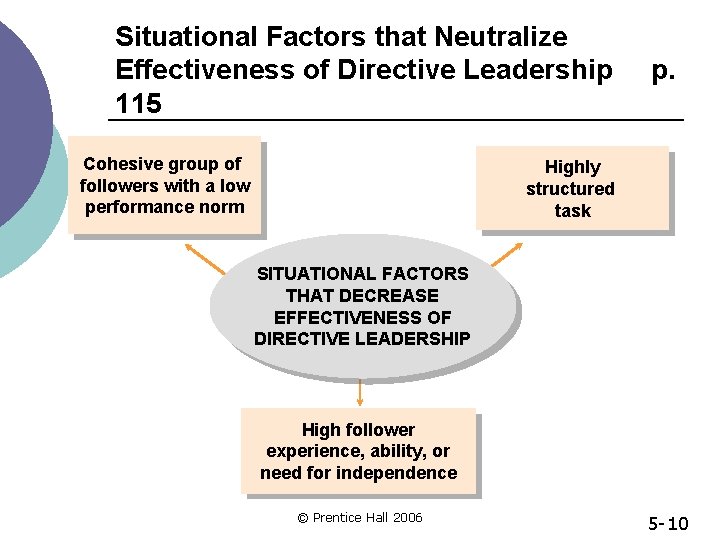
Situational Factors that Neutralize Effectiveness of Directive Leadership 115 Cohesive group of followers with a low performance norm p. Highly structured task SITUATIONAL FACTORS THAT DECREASE EFFECTIVENESS OF DIRECTIVE LEADERSHIP High follower experience, ability, or need for independence © Prentice Hall 2006 5 -10
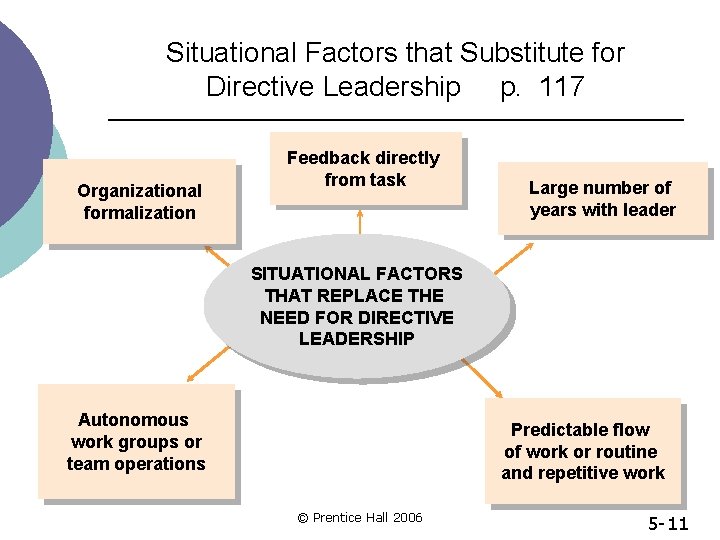
Situational Factors that Substitute for Directive Leadership p. 117 Organizational formalization Feedback directly from task Large number of years with leader SITUATIONAL FACTORS THAT REPLACE THE NEED FOR DIRECTIVE LEADERSHIP Autonomous work groups or team operations Predictable flow of work or routine and repetitive work © Prentice Hall 2006 5 -11
CHAPTER SUMMARY 1. 2. Directive leadership is a pattern of behaviors that provides guidance and structure for followers to help them complete tasks and make group performance successful. Effective directive leadership: a. Defines roles for group members b. Clear expectations for members c. Planning and Scheduling © Prentice Hall 2006 5 -6
CHAPTER SUMMARY d. Explain how to do the work e. Follow up and give feedback on assignments f. Motivate and coach 3. Leaders can be directive without overemphasizing 过分强调 (guofen qiangdiao) power or authority and still get input from followers. 4. Self-confidence自信 (zixin) and assertiveness独断 (duduan) are the 2 most helpful traits for directive leaders. © Prentice Hall 2006 5 -6
CHAPTER SUMMARY 5. Leaders must develop good communication 通讯 (tongxun) skills, competence 权限 (quanxian) and experience. 6. When directive leaders implement 贯彻 (guanche) these skills and traits, followers perform better, are satisfied with their jobs and the group also works together better and performs at a high level. © Prentice Hall 2006 5 -6
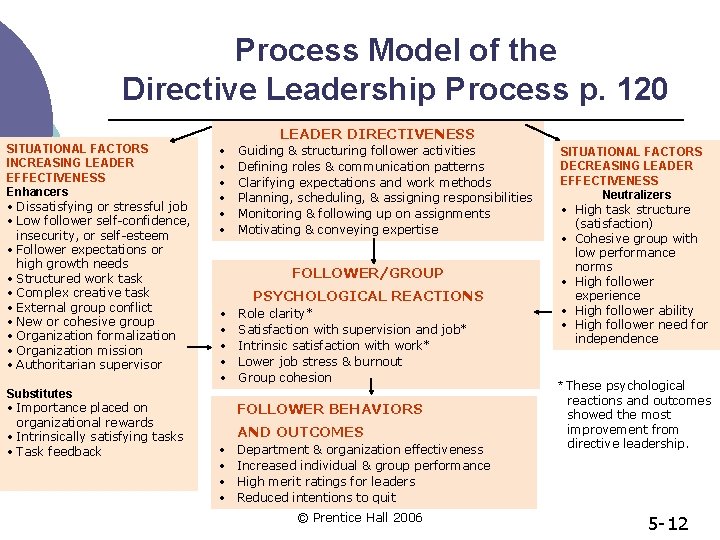
Process Model of the Directive Leadership Process p. 120 LEADER DIRECTIVENESS SITUATIONAL FACTORS INCREASING LEADER EFFECTIVENESS Enhancers • Dissatisfying or stressful job • Low follower self-confidence, insecurity, or self-esteem • Follower expectations or high growth needs • Structured work task • Complex creative task • External group conflict • New or cohesive group • Organization formalization • Organization mission • Authoritarian supervisor Substitutes • Importance placed on organizational rewards • Intrinsically satisfying tasks • Task feedback • • • Guiding & structuring follower activities Defining roles & communication patterns Clarifying expectations and work methods Planning, scheduling, & assigning responsibilities Monitoring & following up on assignments Motivating & conveying expertise FOLLOWER/GROUP PSYCHOLOGICAL REACTIONS • • • Role clarity* Satisfaction with supervision and job* Intrinsic satisfaction with work* Lower job stress & burnout Group cohesion FOLLOWER BEHAVIORS AND OUTCOMES • • Department & organization effectiveness Increased individual & group performance High merit ratings for leaders Reduced intentions to quit © Prentice Hall 2006 SITUATIONAL FACTORS DECREASING LEADER EFFECTIVENESS Neutralizers • High task structure (satisfaction) • Cohesive group with low performance norms • High follower experience • High follower ability • High follower need for independence * These psychological reactions and outcomes showed the most improvement from directive leadership. 5 -12
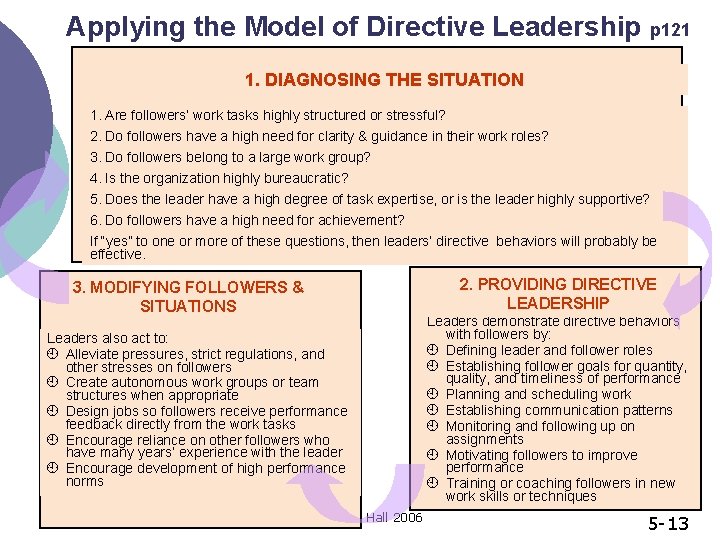
Applying the Model of Directive Leadership p 121 1. DIAGNOSING THE SITUATION 1. Are followers’ work tasks highly structured or stressful? 2. Do followers have a high need for clarity & guidance in their work roles? 3. Do followers belong to a large work group? 4. Is the organization highly bureaucratic? 5. Does the leader have a high degree of task expertise, or is the leader highly supportive? 6. Do followers have a high need for achievement? If “yes” to one or more of these questions, then leaders’ directive behaviors will probably be effective. 3. MODIFYING FOLLOWERS & SITUATIONS Leaders also act to: ¿ Alleviate pressures, strict regulations, and other stresses on followers ¿ Create autonomous work groups or team structures when appropriate ¿ Design jobs so followers receive performance feedback directly from the work tasks ¿ Encourage reliance on other followers who have many years’ experience with the leader ¿ Encourage development of high performance norms © Prentice Hall 2006 2. PROVIDING DIRECTIVE LEADERSHIP Leaders demonstrate directive behaviors with followers by: ¿ Defining leader and follower roles ¿ Establishing follower goals for quantity, quality, and timeliness of performance ¿ Planning and scheduling work ¿ Establishing communication patterns ¿ Monitoring and following up on assignments ¿ Motivating followers to improve performance ¿ Training or coaching followers in new work skills or techniques 5 -13
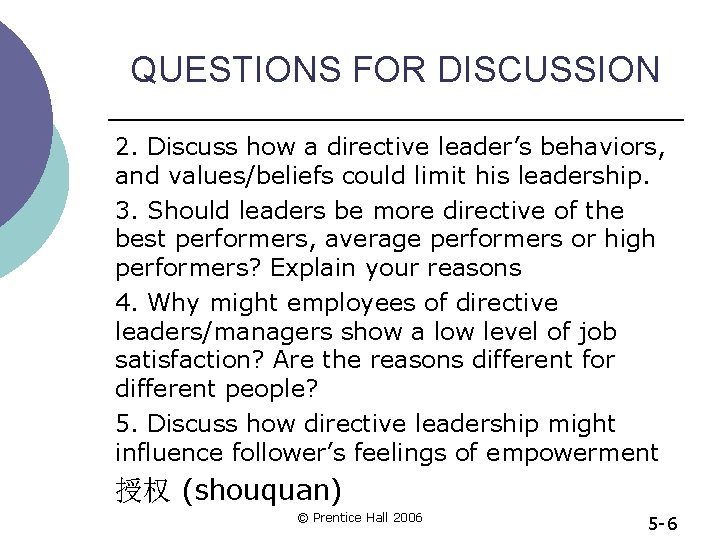
QUESTIONS FOR DISCUSSION 2. Discuss how a directive leader’s behaviors, and values/beliefs could limit his leadership. 3. Should leaders be more directive of the best performers, average performers or high performers? Explain your reasons 4. Why might employees of directive leaders/managers show a low level of job satisfaction? Are the reasons different for different people? 5. Discuss how directive leadership might influence follower’s feelings of empowerment 授权 (shouquan) © Prentice Hall 2006 5 -6
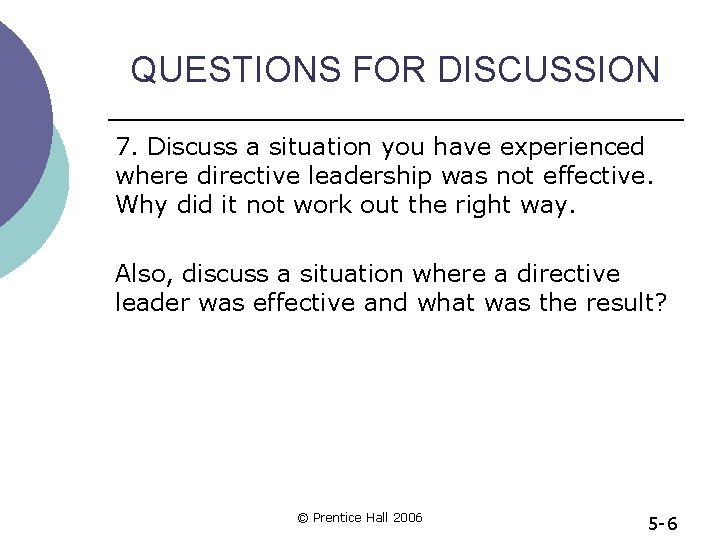
QUESTIONS FOR DISCUSSION 7. Discuss a situation you have experienced where directive leadership was not effective. Why did it not work out the right way. Also, discuss a situation where a directive leader was effective and what was the result? © Prentice Hall 2006 5 -6
MORE QUESTIONS FOR DISCUSSION Read the case studies about Frances Hesselbein and A Type of Direction and answer the questions? Groups 1, 3, 5, 7, 9, 11 read Hesselbein and Groups 2, 4, 6, 8, 10 read A Type of Direction. © Prentice Hall 2006 5 -6
- Slides: 21