
Chapter Five Choosing a Form of Business Ownership
Chapter Five Choosing a Form of Business Ownership
Types of Business Ownership • Sole Proprietorship • Partnership – General – LLP • Corporation – C-Corp – S-Corp – LLC Copyright © Houghton Mifflin Company. All rights reserved. 5|2
Sole Proprietorships • A business that is owned (and usually operated) by one person • The simplest form of business ownership and the easiest to start • The most widespread form of business ownership Copyright © Houghton Mifflin Company. All rights reserved. 5|3
Advantages and Disadvantages of Sole Proprietorships ADVANTAGES – Ease of start-up (and shut down) – Pride of ownership – Retention of profits – Flexibility – No special taxes Copyright © Houghton Mifflin Company. All rights reserved. DISADVANTAGES – Unlimited liability • A legal concept that holds a business owner personally responsible for all the debts of the business – Lack of continuity – Lack of money – Limited management skills – Difficulty in hiring employees 5|4
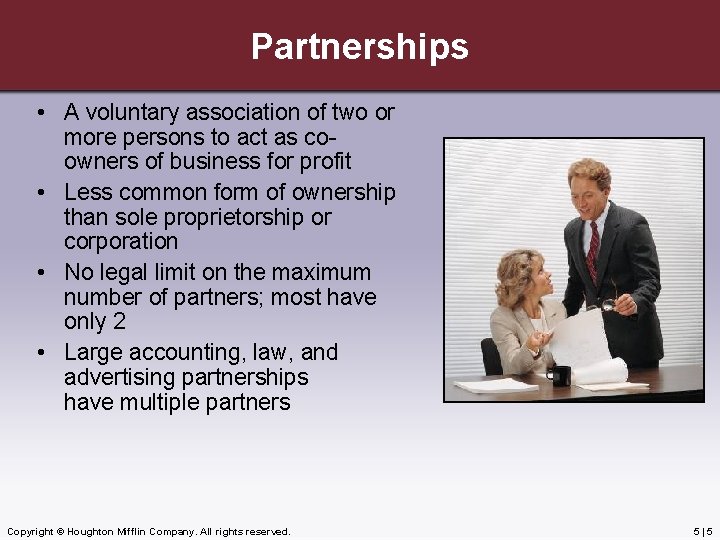
Partnerships • A voluntary association of two or more persons to act as coowners of business for profit • Less common form of ownership than sole proprietorship or corporation • No legal limit on the maximum number of partners; most have only 2 • Large accounting, law, and advertising partnerships have multiple partners Copyright © Houghton Mifflin Company. All rights reserved. 5|5
Types of Partners • General partner – A person who assumes full or shared responsibility for operating a business • Limited partner – A person who contributes capital to a business but has no management responsibility or liability for losses beyond the amount he or she invested in the partnership Copyright © Houghton Mifflin Company. All rights reserved. 5|6
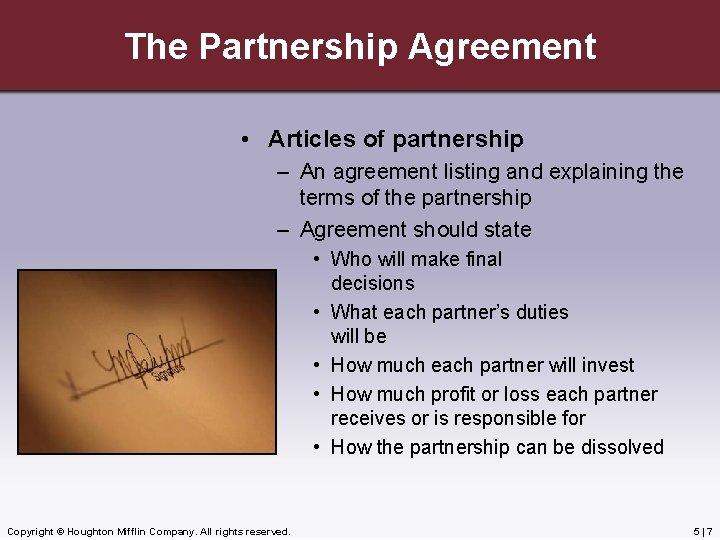
The Partnership Agreement • Articles of partnership – An agreement listing and explaining the terms of the partnership – Agreement should state • Who will make final decisions • What each partner’s duties will be • How much each partner will invest • How much profit or loss each partner receives or is responsible for • How the partnership can be dissolved Copyright © Houghton Mifflin Company. All rights reserved. 5|7
Advantages and Disadvantages of Partnerships ADVANTAGES – Ease of start-up – Availability of capital and credit – Personal interest – Combined business skills and knowledge – Retention of profits – No special taxes Copyright © Houghton Mifflin Company. All rights reserved. DISADVANTAGES – Unlimited liability – Lack of continuity – Management disagreements – Lack of continuity – Frozen investment 5|8
Corporations • An artificial person created by law with most of the legal rights of a real person, including the rights to start and operate a business, to buy or sell property, to borrow money, to sue or be sued, and to enter into binding contracts • There are 5. 1 million corporations in the U. S. • They comprise only 20% of all businesses, but they account for 84. 4 % of sales revenues Copyright © Houghton Mifflin Company. All rights reserved. 5|9
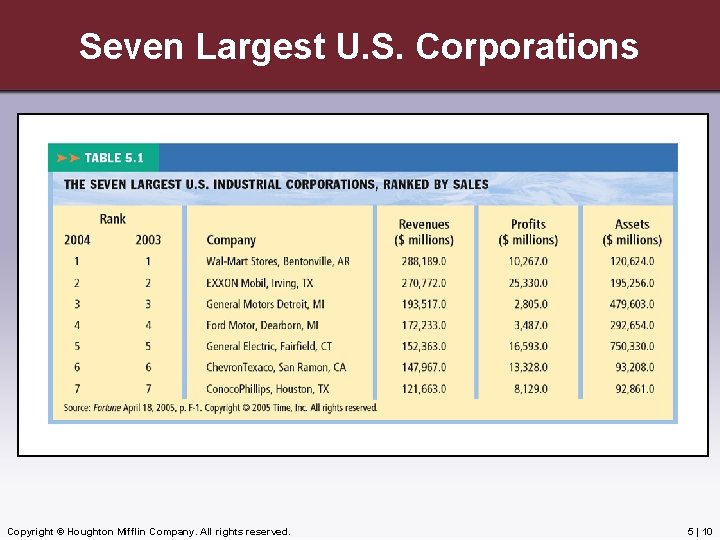
Seven Largest U. S. Corporations Insert Table 5. 1, 9 e, p. 158 with title and source Copyright © Houghton Mifflin Company. All rights reserved. 5 | 10
Corporations (cont’d) • Corporate ownership – Stock • The shares of ownership of a corporation – Stockholder • A person who owns a corporation’s stock – Closed corporation • A corporation whose stock is owned by relatively few people and is not sold to the general public – Open corporation • A corporation whose stock is bought and sold on security exchanges and can be purchased by any individual Copyright © Houghton Mifflin Company. All rights reserved. 5 | 11
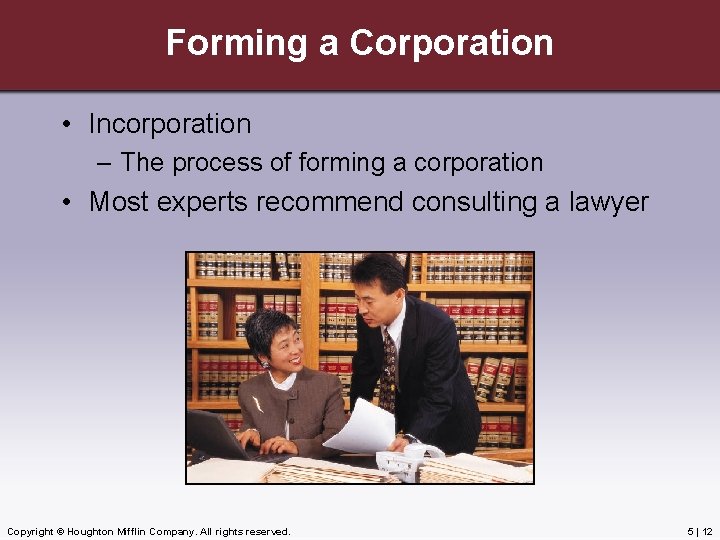
Forming a Corporation • Incorporation – The process of forming a corporation • Most experts recommend consulting a lawyer Copyright © Houghton Mifflin Company. All rights reserved. 5 | 12
Forming a Corporation (cont’d) • Where to incorporate – Businesses can incorporate in any state they choose – Some states offer fewer restrictions, lower taxes, and other benefits to attract new firms – Domestic corporation • A corporation in the state in which it is incorporated – Foreign corporation • A corporation in any state in which it does business except the one it which it is incorporated – Alien corporation • A corporation chartered by a foreign government and conducting business in the U. S. Copyright © Houghton Mifflin Company. All rights reserved. 5 | 13
Forming a Corporation (cont’d) • Corporate charter – A contract (submitted as articles of incorporation) between the corporation and the state in which the state recognizes the formation of the artificial person that is the corporation – Charter includes • • Firm’s name and address Incorporators’ names and addresses Purpose of the corporation Maximum amount of stock and types of stock to be issued • Rights and privileges of stockholders • Length of time the corporation is to exist Copyright © Houghton Mifflin Company. All rights reserved. 5 | 14
Forming a Corporation (cont’d) • Stockholders’ rights – Common stock • Stock owned by individuals or firms who may vote on corporate matters but whose claims on profit and assets are subordinate to the claims of others – Preferred stock • Stock owned by individuals or firms who usually do not have voting rights but whose claims on dividends are paid before those of common-stock holders – Dividend • A distribution of earnings to the stockholders of a corporation – Proxy • A legal form listing issues to be decided at a stockholders’ meeting and enabling stockholders to transfer their voting rights to some other individual or individuals Copyright © Houghton Mifflin Company. All rights reserved. 5 | 15
Corporate Structure • Board of directors – The top governing body of a corporation, the members of which are elected by the stockholders – Responsible for setting corporate goals, developing strategic plans to meet those goals, and the firm’s overall operation – Outside directors: experienced managers or entrepreneurs from outside the corporation who have specific talents – Inside directors: top managers from within the corporation Copyright © Houghton Mifflin Company. All rights reserved. 5 | 16
Corporate Structure (cont’d) • Corporate officers – The chairman of the board, president, executive vice presidents, corporate secretary, treasurer, or any other top executive appointed by the board – Implement the chosen strategy and direct the work of the corporation, periodically reporting results to the board Copyright © Houghton Mifflin Company. All rights reserved. 5 | 17
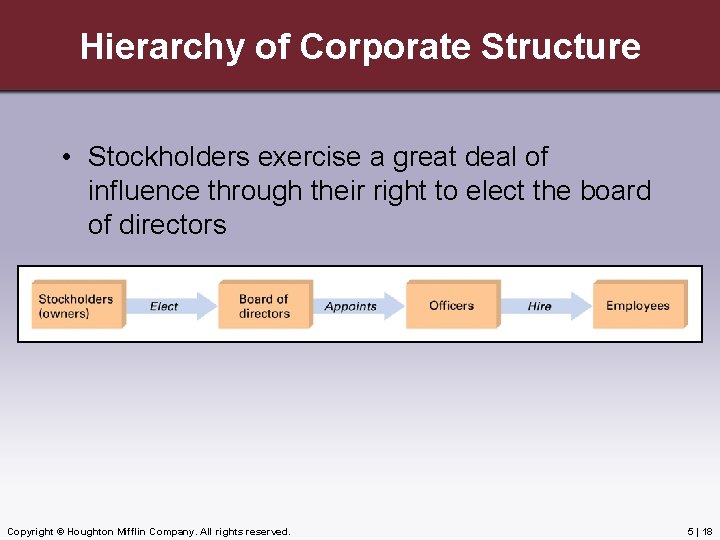
Hierarchy of Corporate Structure • Stockholders exercise a great deal of influence through their right to elect the board of directors Copyright © Houghton Mifflin Company. All rights reserved. 5 | 18
Advantages and Disadvantages of Corporations ADVANTAGES – Limited liability • Each owner’s financial liability is limited to the amount of money that he or she has paid for the corporation’s stock – Ease of raising capital – Ease of transfer of ownership – Perpetual life – Specialized management Copyright © Houghton Mifflin Company. All rights reserved. DISADVANTAGES – Difficulty and expense of formation – Government regulation and increased paperwork – Double taxation – Lack of secrecy 5 | 19
Special Types of Business Ownership • S-corporations – A corporation that is taxed as though it were a partnership (income is taxed only as the personal income of stockholders) – Advantages • Avoids double taxation of a corporation • Retains the corporation’s legal benefit of limited liability – S-corporation criteria • No more than 100 stockholders allowed • Stockholders must be individuals, estates, or exempt organizations • There can be only one class of outstanding stock • The firm must be a domestic corporation • There can be no nonresident-alien stockholders • All stockholders must agree to the decision to form an Scorporation Copyright © Houghton Mifflin Company. All rights reserved. 5 | 20
Special Types of Business Ownership (cont’d) • Limited-liability company (LLC) – A form of business ownership that provides limited -liability protection and is taxed like a partnership – Advantages • Avoids double taxation of a corporation • Retains the corporation’s legal benefit of limited liability – Difference between LLC and S-corporation • LLCs not restricted to 100 stockholders • LLCs have fewer restrictions on who can be a stockholder Copyright © Houghton Mifflin Company. All rights reserved. 5 | 21
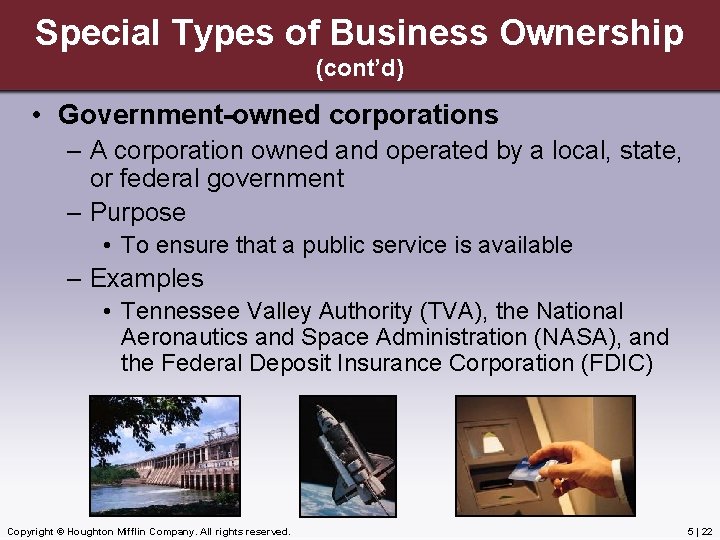
Special Types of Business Ownership (cont’d) • Government-owned corporations – A corporation owned and operated by a local, state, or federal government – Purpose • To ensure that a public service is available – Examples • Tennessee Valley Authority (TVA), the National Aeronautics and Space Administration (NASA), and the Federal Deposit Insurance Corporation (FDIC) Copyright © Houghton Mifflin Company. All rights reserved. 5 | 22
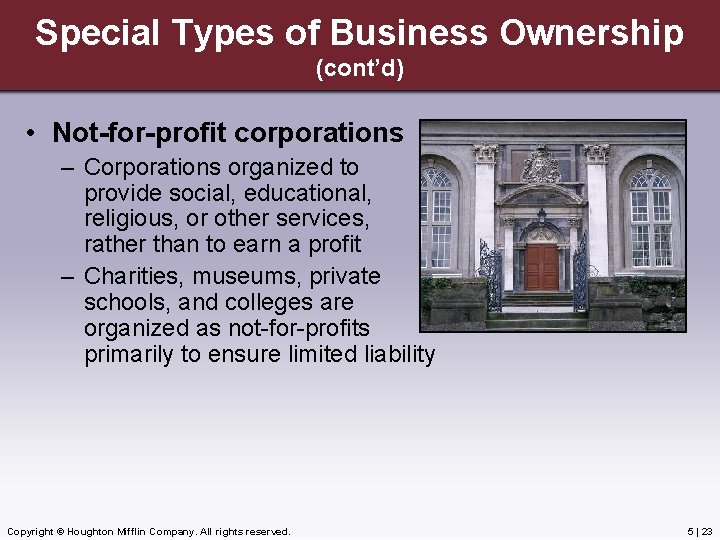
Special Types of Business Ownership (cont’d) • Not-for-profit corporations – Corporations organized to provide social, educational, religious, or other services, rather than to earn a profit – Charities, museums, private schools, and colleges are organized as not-for-profits primarily to ensure limited liability Copyright © Houghton Mifflin Company. All rights reserved. 5 | 23
Starting a business http: //www. nj. gov/njbusiness/start/ Businesses are registered with the State’s Secretary of State Copyright © Houghton Mifflin Company. All rights reserved. 5 | 24
- Slides: 24