
Chapter Five Behavior and Attitudes 1 Private beliefsfeelings
Chapter Five • Behavior and Attitudes – 1. Private beliefs/feelings determines our public behaviors – 2. Change behavior- 1 st change heart/mind BUT this is FALSE https: //youtu. be/c. BXMWWDl-OU 1
Attitude • 1990’s Definition – 3 key parts: – Tricomponent • • • – Not all three needed • Question of degree/emphasis • Today- Single Component theory • Favorable or unfavorable evaluative reaction toward something or someone • • • Functions of Attitude 1. 2. 3. 4. Ego Defense Express value • Automatic Evaluations- Amygdala – “good/bad” assessment is vital for survival • Difficulty is in the placing of values to those assessments of attitude. 2
How Well Do Our Attitudes Predict Our Behavior? • Expressed attitudes – – – • – Religious attitudes = behavior on church attendance Moral hypocrisy - – – Example- Morality vs greed Assigning people to do a task • A. 1/2 reward for a positive task B. 1/2 no reward boring task A. B. 3
When Attitude Predicts Behavior • • Types of attitude: – Implicit (unconscious) • Positive or Negative depends upon association of past – Explicit (conscious) • Easier to change/control • Combination of all three components – Duel Attitude • Verbal responses can be explicit but their Nonverbal responses reflect truer Implicit Ways to measure how attitude predicts behavior. • 1. Facial muscle responses • 2. Implicit Association Test– – Uses reaction time to measure how quickly people associate concepts – Studies toward racism/ homosexuality/ religion – Test is not 100% accurate and results are disputed. 4
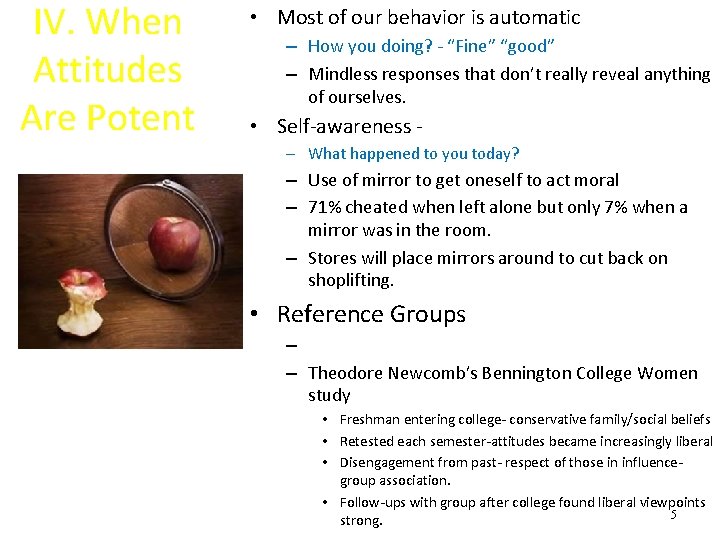
IV. When Attitudes Are Potent • Most of our behavior is automatic – How you doing? - “Fine” “good” – Mindless responses that don’t really reveal anything of ourselves. • Self-awareness – What happened to you today? – Use of mirror to get oneself to act moral – 71% cheated when left alone but only 7% when a mirror was in the room. – Stores will place mirrors around to cut back on shoplifting. • Reference Groups – – Theodore Newcomb’s Bennington College Women study • Freshman entering college- conservative family/social beliefs • Retested each semester-attitudes became increasingly liberal • Disengagement from past- respect of those in influencegroup association. • Follow-ups with group after college found liberal viewpoints 5 strong.
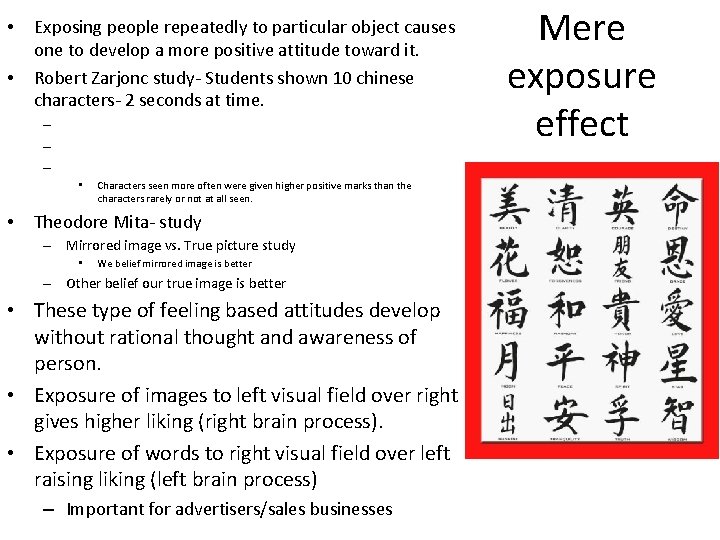
• • Exposing people repeatedly to particular object causes one to develop a more positive attitude toward it. Robert Zarjonc study- Students shown 10 chinese characters- 2 seconds at time. – – – • • Characters seen more often were given higher positive marks than the characters rarely or not at all seen. Theodore Mita- study – Mirrored image vs. True picture study • We belief mirrored image is better – Other belief our true image is better • These type of feeling based attitudes develop without rational thought and awareness of person. • Exposure of images to left visual field over right gives higher liking (right brain process). • Exposure of words to right visual field over left raising liking (left brain process) – Important for advertisers/sales businesses Mere exposure effect
Attitude and Physical Expressions • Facial Feedback hypothesis- facial expressions infer one must have an attitude consistent with expression. – • • Fritz Strack study– – – Students put a pen between teeth- lips- non-dominate hand Read amusing cartoons Rate humor of 1 -10 scale Teeth gave highest rating – non-dominate hand then lips lowest. Teeth makes a smile of facial muscles- lips make a frown • Robert Zajonc Vascular Theory of emotion. Raising/lowering brain temperature and the resulting pleasant or not mood. • .
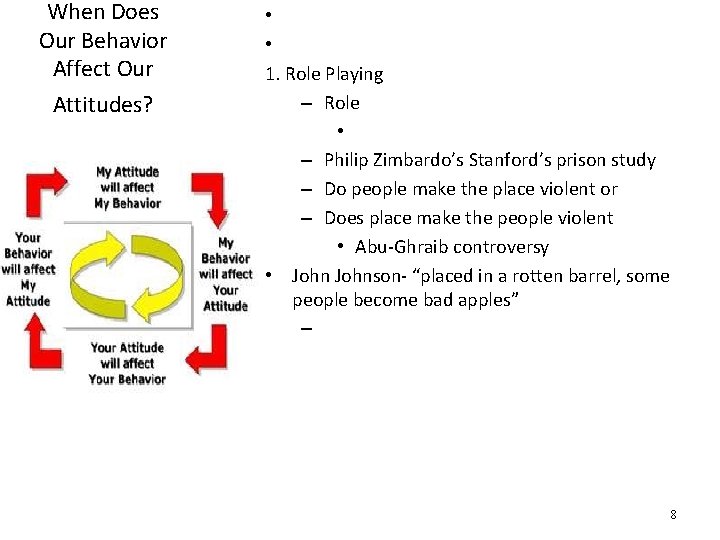
When Does Our Behavior Affect Our Attitudes? • • 1. Role Playing – Role • – Philip Zimbardo’s Stanford’s prison study – Do people make the place violent or – Does place make the people violent • Abu-Ghraib controversy • Johnson- “placed in a rotten barrel, some people become bad apples” – 8

2. Attitude through Classical- Operant Conditioning • • Arthur and Carolyn Staats study – – Altering people’s attitude toward social groups – Pair pos/neg objects to a neutral word/group to change Development of prejudices/racisms – – Subliminal conditioning- absence of conscious awareness – Advertising- use of positive images/words with object • Operant Conditioning- reinforcement/punishment –. – Direct conditioning and observable learning- Albert Bandura • Modeling behavior- choosing behaviors that you want to emulate. 9
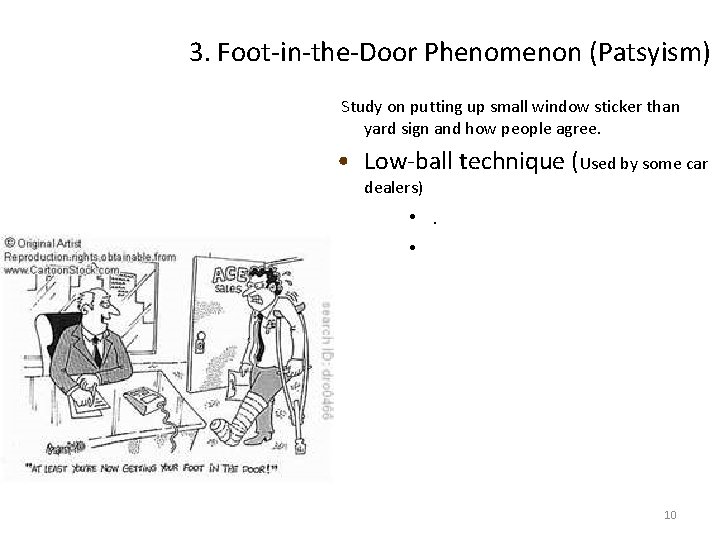
3. Foot-in-the-Door Phenomenon (Patsyism) Study on putting up small window sticker than yard sign and how people agree. • Low-ball technique (Used by some car dealers) • 10
4. Evil and Moral Acts Evil gradually escalates • – Starts out simple • 1. 2. 3. 4. No consequence/punishment Reduce moral sensitivity Hurt those we don’t like and don’t like those we hurt. • Wartime – • • • – Actions and attitudes feed on each other When evil behavior occurs we tend to justify it as right Killing begets killing Does TV/Video violence increase violent behavior? 11
5. Interracial Behavior and Social Attitudes • Racial behavior help shape our social consciousness – “Wait for heart to change or give it an external boost” • By doing, not saying racial attitudes were changed – Legislating morality - laws requiring racial equality helped build positive race relations • Social Movements – • Theodore Newcomb research 1930 s – College students entering school had Conservative political beliefs – Upon leaving viewpoints were much more liberal – Conscious/unconscious effects. 12
Theories on Behavior and Attitude: Chicken and the egg 1. Self Presentation theory – Our behaviors are shaped by other peoples attitudes/beliefs 2. Cognitive Dissonance Theory – Reduce discomfort to justify actions to ourselves- behavior and attitude don’t mesh. 3. Self-perception theory – Our actions/behavior influences our attitudes 13
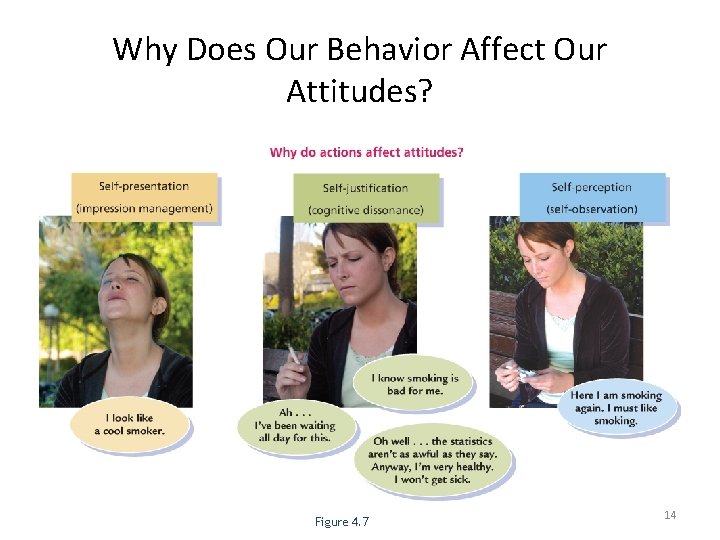
Why Does Our Behavior Affect Our Attitudes? Figure 4. 7 14
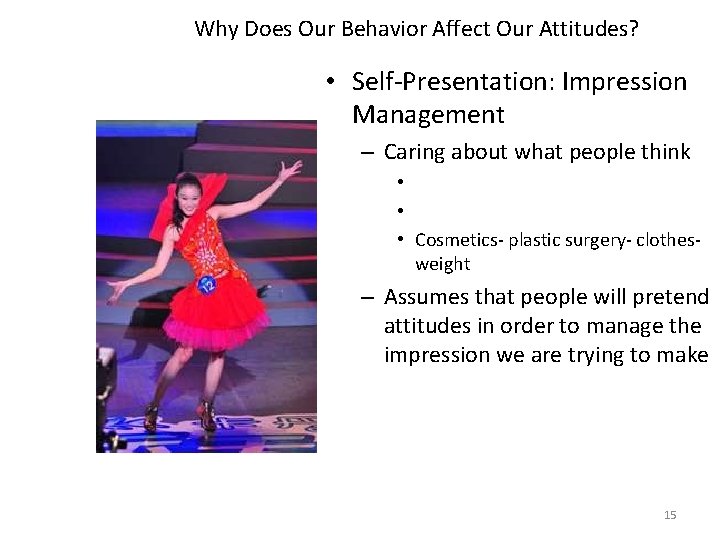
Why Does Our Behavior Affect Our Attitudes? • Self-Presentation: Impression Management – Caring about what people think • • • Cosmetics- plastic surgery- clothesweight – Assumes that people will pretend attitudes in order to manage the impression we are trying to make 15
Self-Justification: Cognitive Dissonance • Discrepancy between behavior/attitude – • To reduce this tension, we adjust our thinking – Iraq war- reason for war- no weapons • 38% war justification if no weapons • No weapons - 58% still supported • Developed by Leon Festinger – We may appear logical in thinking/behavior – We engage in irrational behavior to maintain cognitive consistency – Research studies of Cognitive Dissonance 16
Cognitive Consistency is NOT Universal Motive • Comparing Individual to collective cultures the Cognitive Dissonance Theory fails. • Individual – success very replicated – believing one thing but having actions of the opposite- high level of dissonance • Collectivist societies- people are interdependent solvers= more flexible and comfortable with contradiction – Two selves: • Ura (back) self believing aspect hidden from public • Omote (front)- outward behaving aspect of social group • Preference for Consistency Scale – People score high are highly motivated to keep behavior consistent with attitudes – People score low are less bothered by inconsistent action and appear open to flexibility. – Not only is this inconsistency prevalent in independent culture but in individual as well
• Forming an attitude based on observing one’s behavior. – Unlike cognitive dissonance we don’t know what our attitude is • Instead we follow our behavior and the situation at the moment. – We sometimes lack an attitude for a situation we have little control or are coaxed into • But when give free opportunity to form an attitude we will follow what we got from the behavior/situation. • Shelly Chaiken/Mark Baldwin study – Pro-environment vs weak attitude • When we behave in ways at odds with well defined attitudes we experience dissonance – Change in attitude to rationalize behavior. • Behave in less out of line with defined attitude experience little to no dissonance. Selfperception – Ex: Old man pays children to play and reduces pay to $0 children quit. 18
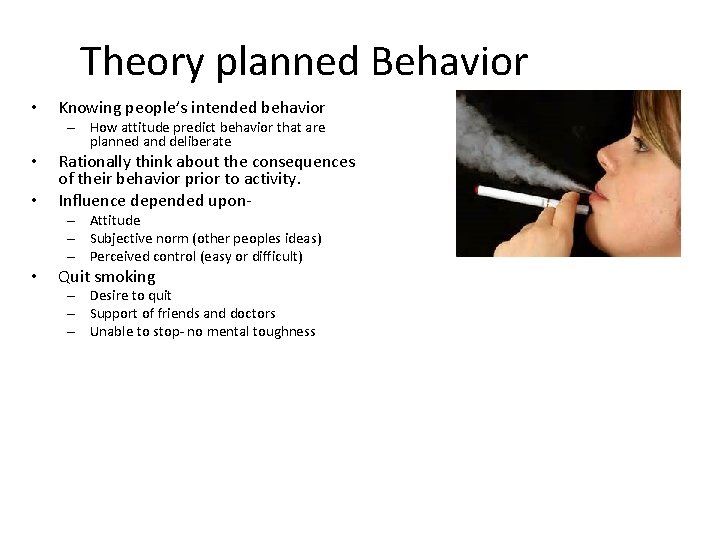
Theory planned Behavior • Knowing people’s intended behavior – How attitude predict behavior that are planned and deliberate • • Rationally think about the consequences of their behavior prior to activity. Influence depended upon– Attitude – Subjective norm (other peoples ideas) – Perceived control (easy or difficult) • Quit smoking – Desire to quit – Support of friends and doctors – Unable to stop- no mental toughness
Research Topics 1. 2. 3. 4. 5. 6. 7. Leon Festinger- Boring/Interesting activity Children mild/severe toy threat Freedom of choice and dissonance Dissonance with group/relationship Severity of initiation Immoral behavior and dissonance Postdecision Dissonance and altered perceptions
Leon Festinger- Boring activity http: //www. youtube. com/watch? v=kor. GK 0 y. GIDo • Participants conduct a boring activity with blocks • At end research explains assist had to leave – • • After lieing to person about activity they are given a survey to fill out. • • Those paid $20 felt no dissonance and rated it boring.
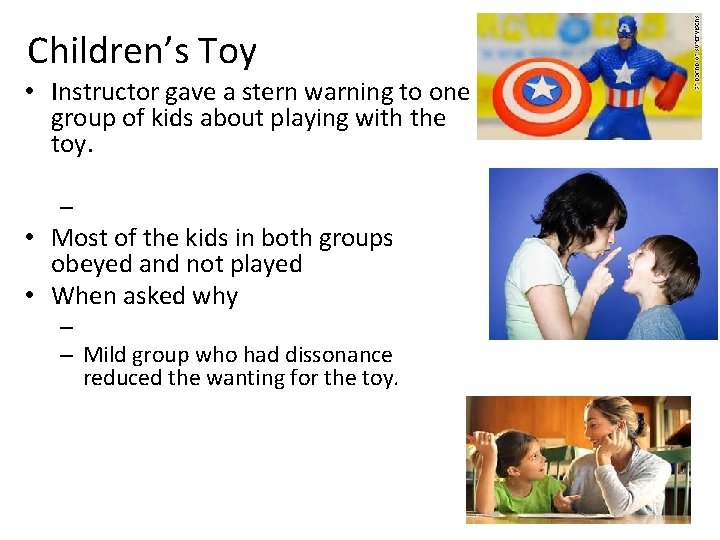
Children’s Toy • Instructor gave a stern warning to one group of kids about playing with the toy. – • Most of the kids in both groups obeyed and not played • When asked why – – Mild group who had dissonance reduced the wanting for the toy.
Freedom of Choice • College students assigned essay on controversial issue – Those opposed had to write a pro paper and vice-versa • One group was give assignment as “NO Choice” and was paid between. 502. 50 • • • Those in 2 nd group with low pay had major dissonance and changed attitude on paper.
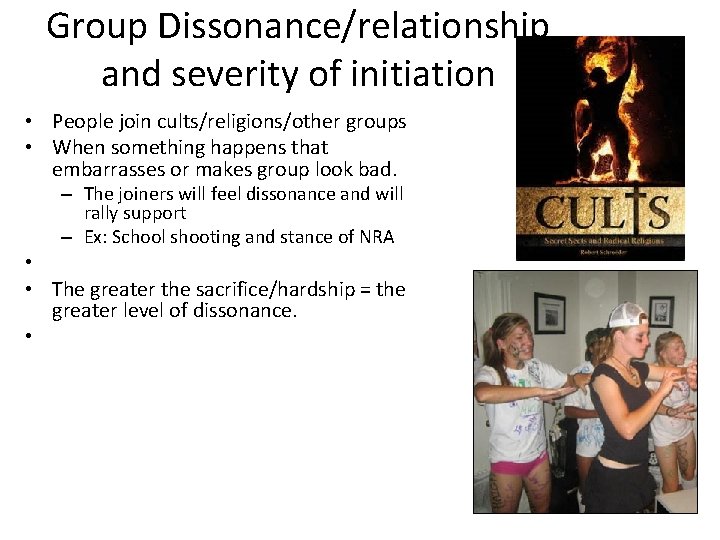
Group Dissonance/relationship and severity of initiation • People join cults/religions/other groups • When something happens that embarrasses or makes group look bad. – The joiners will feel dissonance and will rally support – Ex: School shooting and stance of NRA • • The greater the sacrifice/hardship = the greater level of dissonance. •
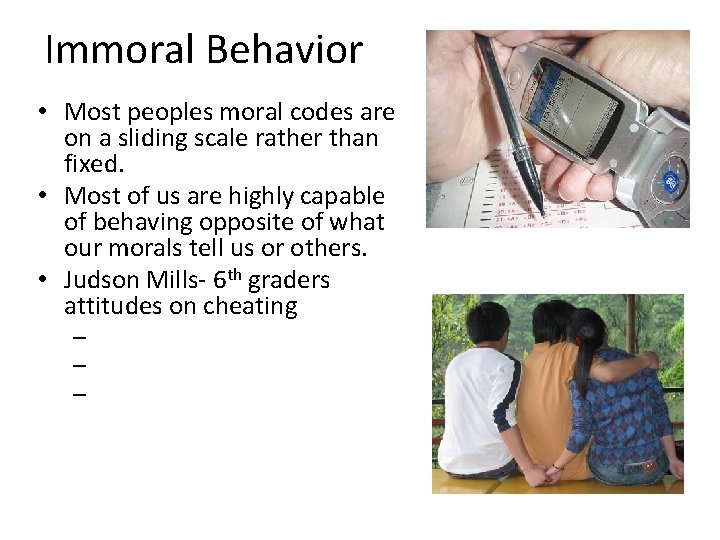
Immoral Behavior • Most peoples moral codes are on a sliding scale rather than fixed. • Most of us are highly capable of behaving opposite of what our morals tell us or others. • Judson Mills- 6 th graders attitudes on cheating – – –
- Slides: 25