
Chapter Fifteen Sampling and Sample Size Winston Jackson
- Slides: 18
Chapter Fifteen Sampling and Sample Size Winston Jackson and Norine Verberg Methods: Doing Social Research, 4 e © 2007 Pearson Education Canada
The Rationale of Sampling n Sampling a segment of a population can save time and money, yet provide an accurate description of a population Key issue: sample must be representative n Poorly selected samples misrepresent the population n n Literary Digest poll failed to predict outcome of 1936 American election: Landon versus Roosevelt Used large sample - polled subscribers n Subscribers not representative of population n © 2007 Pearson Education Canada 2
Key Distinctions n Population (also called universe): the entire group one wishes to describe n e. g. , American electors, students living in residence n Sampling frame: the list from which a sample is selected n Ideally, sampling frame same as population, but seldom possible. Creates challenges n Sample: units (e. g. , individuals) selected for a study n Variation in sampling techniques n Response rate: the percentage of delivered questionnaires completed and returned © 2007 Pearson Education Canada 3
Probability Sampling Techniques n Techniques for selecting sampling units so that each unit has a known change of being included n Also called random sample because sampling units are selected “at random” n Tests of significance only valid for probability samples © 2007 Pearson Education Canada 4
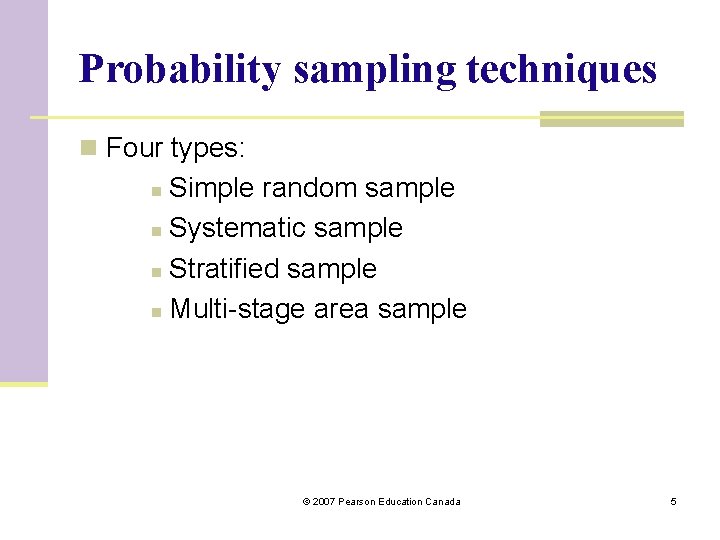
Probability sampling techniques n Four types: Simple random sample n Systematic sample n Stratified sample n Multi-stage area sample n © 2007 Pearson Education Canada 5
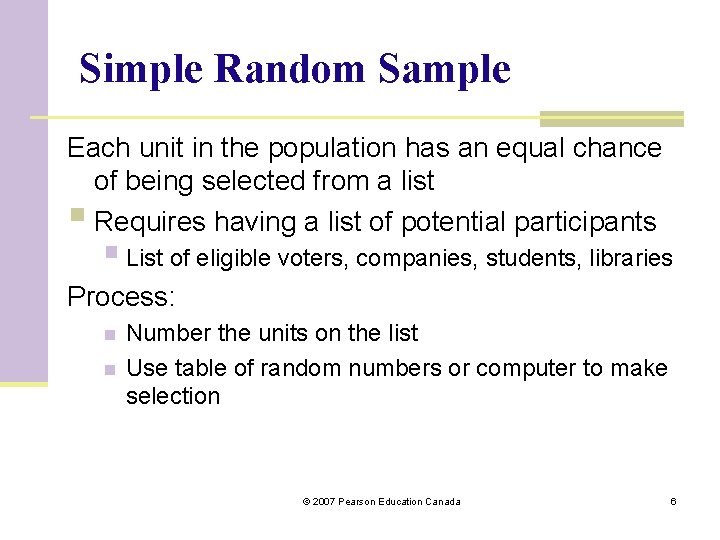
Simple Random Sample Each unit in the population has an equal chance of being selected from a list Requires having a list of potential participants § § List of eligible voters, companies, students, libraries Process: n n Number the units on the list Use table of random numbers or computer to make selection © 2007 Pearson Education Canada 6
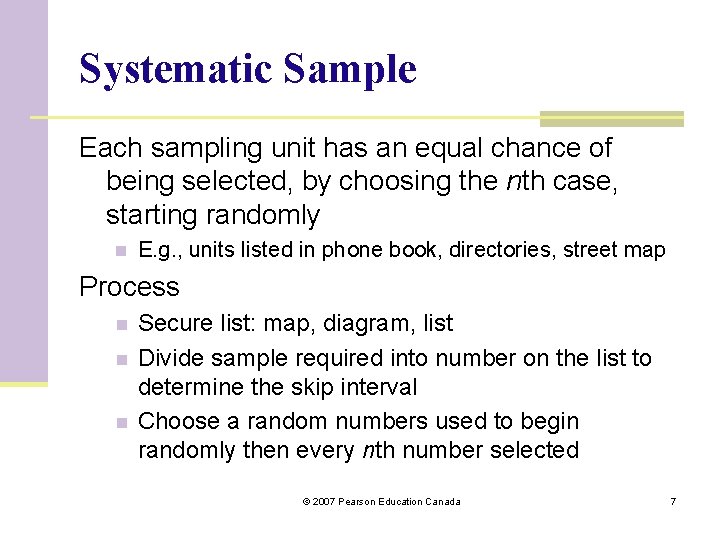
Systematic Sample Each sampling unit has an equal chance of being selected, by choosing the nth case, starting randomly n E. g. , units listed in phone book, directories, street map Process n n n Secure list: map, diagram, list Divide sample required into number on the list to determine the skip interval Choose a random numbers used to begin randomly then every nth number selected © 2007 Pearson Education Canada 7
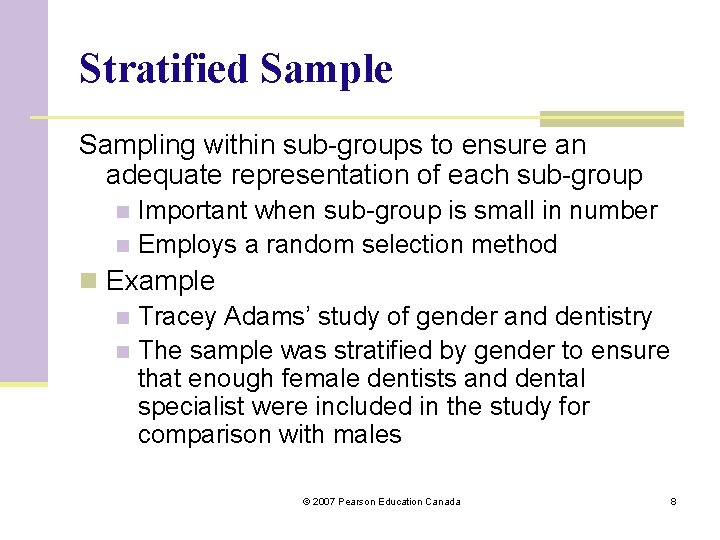
Stratified Sample Sampling within sub-groups to ensure an adequate representation of each sub-group Important when sub-group is small in number n Employs a random selection method n n Example n Tracey Adams’ study of gender and dentistry n The sample was stratified by gender to ensure that enough female dentists and dental specialist were included in the study for comparison with males © 2007 Pearson Education Canada 8
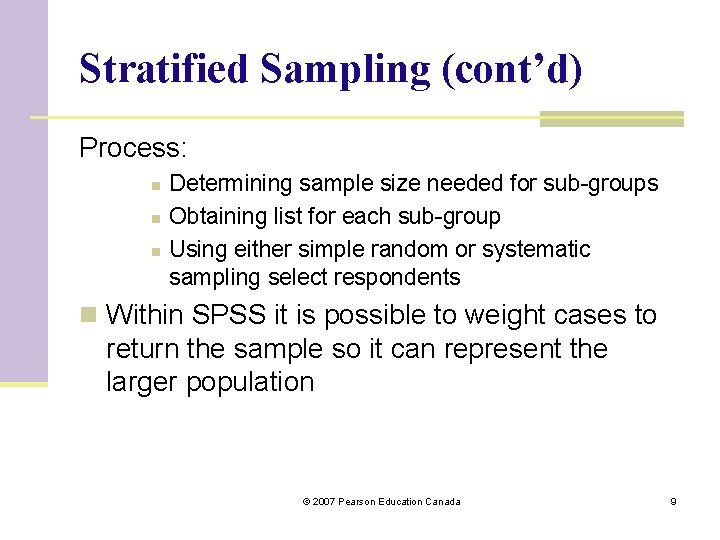
Stratified Sampling (cont’d) Process: n n n Determining sample size needed for sub-groups Obtaining list for each sub-group Using either simple random or systematic sampling select respondents n Within SPSS it is possible to weight cases to return the sample so it can represent the larger population © 2007 Pearson Education Canada 9
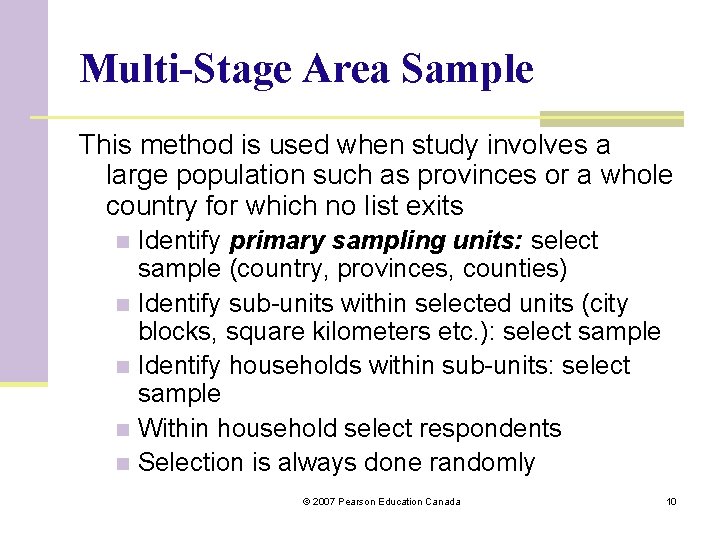
Multi-Stage Area Sample This method is used when study involves a large population such as provinces or a whole country for which no list exits Identify primary sampling units: select sample (country, provinces, counties) n Identify sub-units within selected units (city blocks, square kilometers etc. ): select sample n Identify households within sub-units: select sample n Within household select respondents n Selection is always done randomly n © 2007 Pearson Education Canada 10
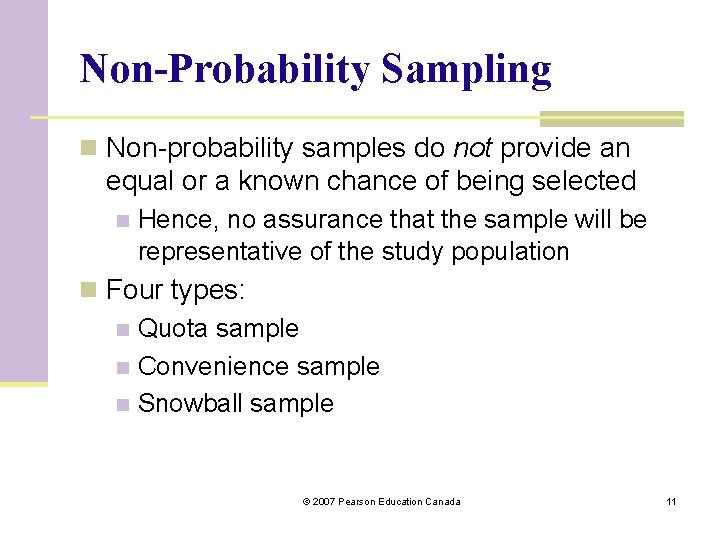
Non-Probability Sampling n Non-probability samples do not provide an equal or a known chance of being selected n Hence, no assurance that the sample will be representative of the study population n Four types: n Quota sample n Convenience sample n Snowball sample © 2007 Pearson Education Canada 11
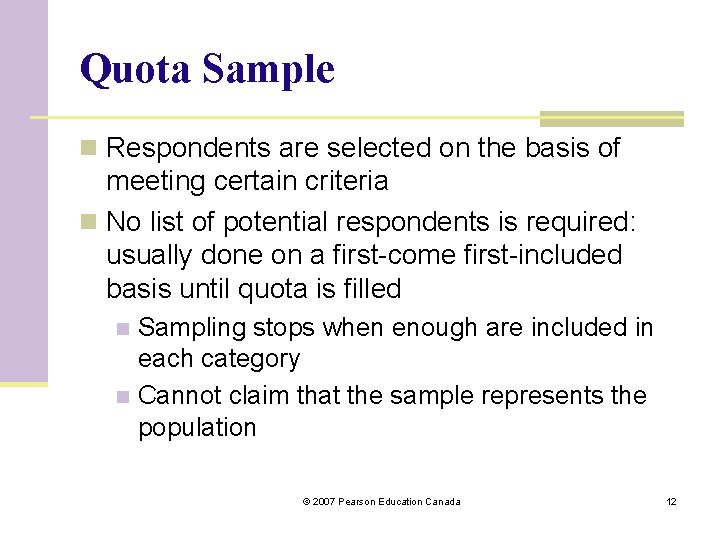
Quota Sample n Respondents are selected on the basis of meeting certain criteria n No list of potential respondents is required: usually done on a first-come first-included basis until quota is filled Sampling stops when enough are included in each category n Cannot claim that the sample represents the population n © 2007 Pearson Education Canada 12
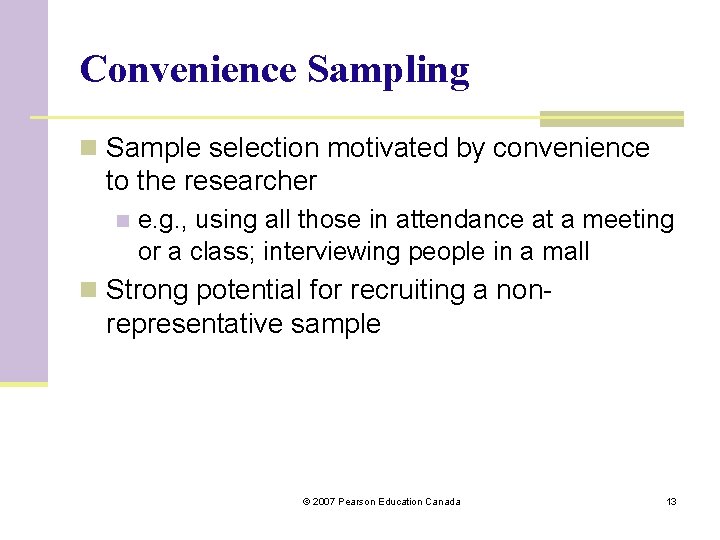
Convenience Sampling n Sample selection motivated by convenience to the researcher n e. g. , using all those in attendance at a meeting or a class; interviewing people in a mall n Strong potential for recruiting a non- representative sample © 2007 Pearson Education Canada 13
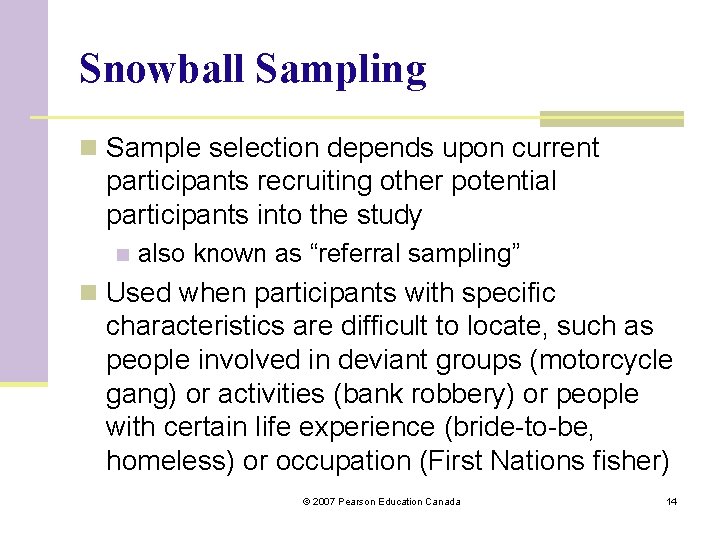
Snowball Sampling n Sample selection depends upon current participants recruiting other potential participants into the study n also known as “referral sampling” n Used when participants with specific characteristics are difficult to locate, such as people involved in deviant groups (motorcycle gang) or activities (bank robbery) or people with certain life experience (bride-to-be, homeless) or occupation (First Nations fisher) © 2007 Pearson Education Canada 14
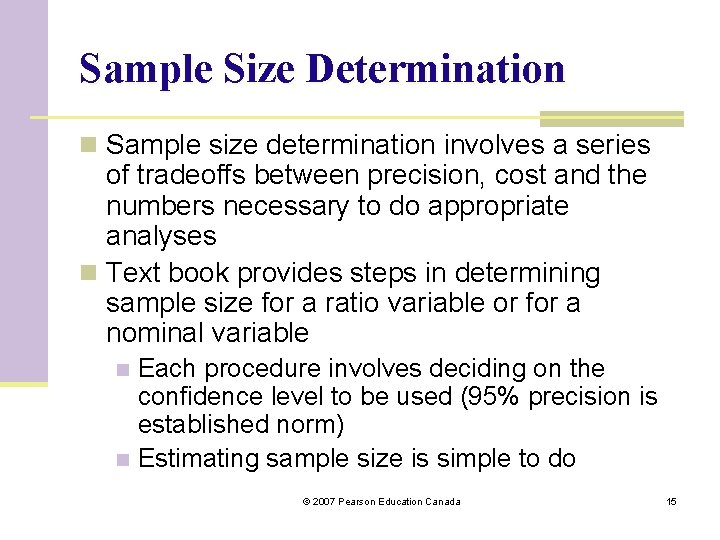
Sample Size Determination n Sample size determination involves a series of tradeoffs between precision, cost and the numbers necessary to do appropriate analyses n Text book provides steps in determining sample size for a ratio variable or for a nominal variable Each procedure involves deciding on the confidence level to be used (95% precision is established norm) n Estimating sample size is simple to do n © 2007 Pearson Education Canada 15
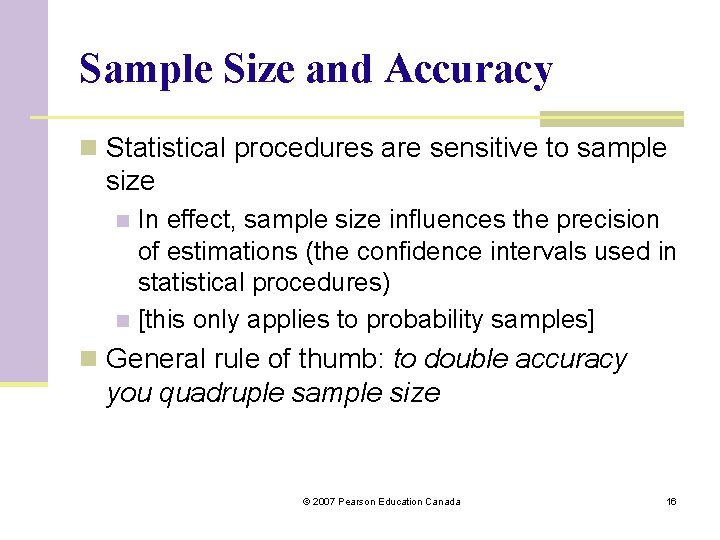
Sample Size and Accuracy n Statistical procedures are sensitive to sample size In effect, sample size influences the precision of estimations (the confidence intervals used in statistical procedures) n [this only applies to probability samples] n n General rule of thumb: to double accuracy you quadruple sample size © 2007 Pearson Education Canada 16
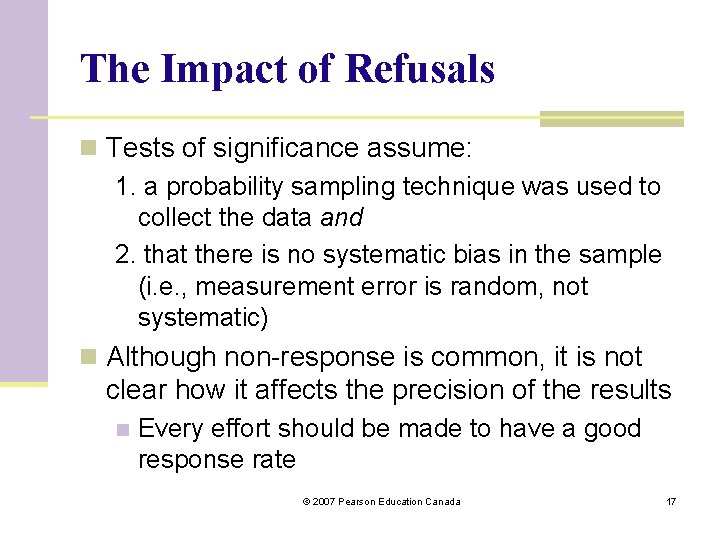
The Impact of Refusals n Tests of significance assume: 1. a probability sampling technique was used to collect the data and 2. that there is no systematic bias in the sample (i. e. , measurement error is random, not systematic) n Although non-response is common, it is not clear how it affects the precision of the results n Every effort should be made to have a good response rate © 2007 Pearson Education Canada 17
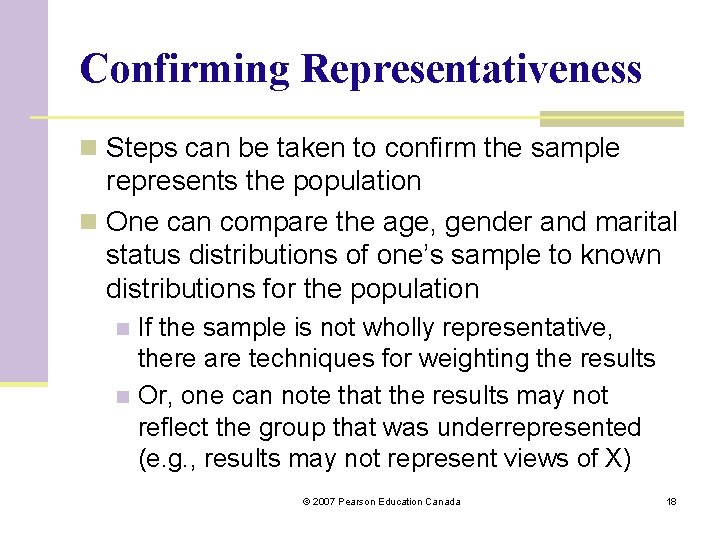
Confirming Representativeness n Steps can be taken to confirm the sample represents the population n One can compare the age, gender and marital status distributions of one’s sample to known distributions for the population If the sample is not wholly representative, there are techniques for weighting the results n Or, one can note that the results may not reflect the group that was underrepresented (e. g. , results may not represent views of X) n © 2007 Pearson Education Canada 18