
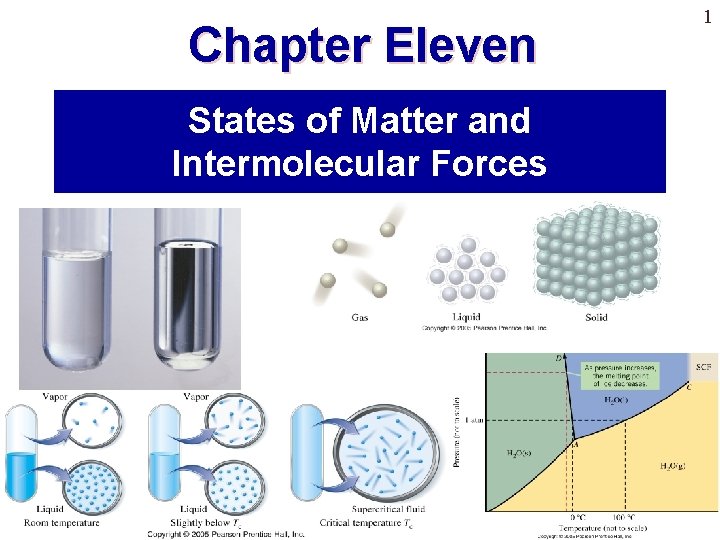
Chapter Eleven 1 States of Matter and Intermolecular
- Slides: 73
Chapter Eleven 1 States of Matter and Intermolecular Forces Prentice Hall © 2005 General Chemistry 4 th edition, Hill, Petrucci, Mc. Creary, Perry Chapter Eleven
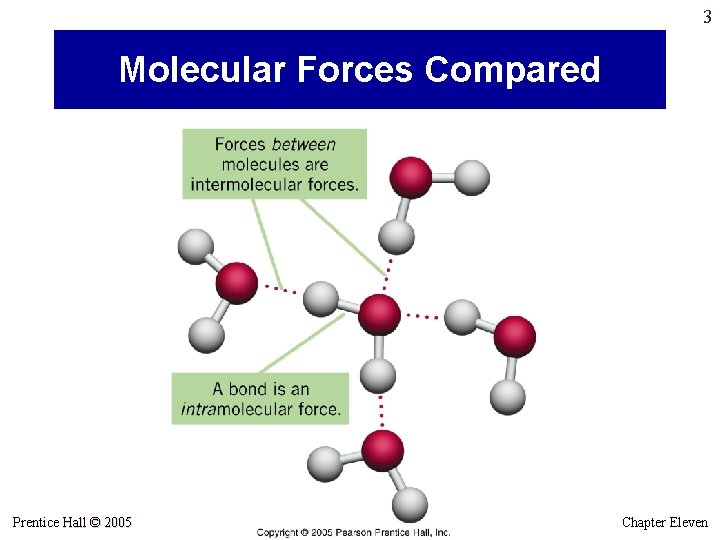
2 Chapter Preview • Intramolecular forces (bonds) govern molecular properties such as molecular geometries and dipole moments. • Intermolecular forces determine the macroscopic physical properties of liquids and solids. • This chapter: – describes changes from one state of matter to another. – explores the types of intermolecular forces that underlie these and other physical properties of substances. Prentice Hall © 2005 General Chemistry 4 th edition, Hill, Petrucci, Mc. Creary, Perry Chapter Eleven
3 Molecular Forces Compared Prentice Hall © 2005 General Chemistry 4 th edition, Hill, Petrucci, Mc. Creary, Perry Chapter Eleven
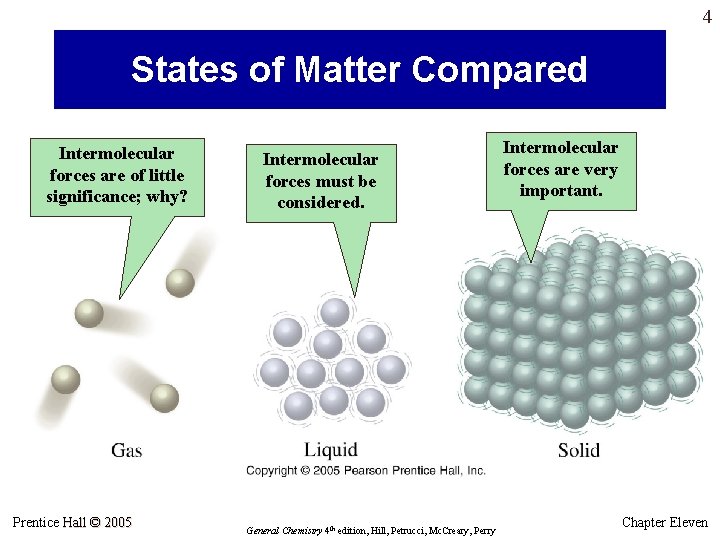
4 States of Matter Compared Intermolecular forces are of little significance; why? Prentice Hall © 2005 Intermolecular forces must be considered. General Chemistry 4 th edition, Hill, Petrucci, Mc. Creary, Perry Intermolecular forces are very important. Chapter Eleven
5 Vaporization and Condensation • Vaporization is the conversion of a liquid to a gas. • The enthalpy of vaporization (DHvapn) is the quantity of heat that must be absorbed to vaporize a given amount of liquid at a constant temperature. • Condensation is the reverse of vaporization. The enthalpy of condensation (DHcondn) accompanies this change of a gas to a liquid. • Enthalpy is a function of state: therefore, if a liquid is vaporized and the vapor condensed at constant temperature, the total DH must be zero: DHvapn + DHcondn = 0 DHcondn = –DHvapn Prentice Hall © 2005 General Chemistry 4 th edition, Hill, Petrucci, Mc. Creary, Perry Chapter Eleven
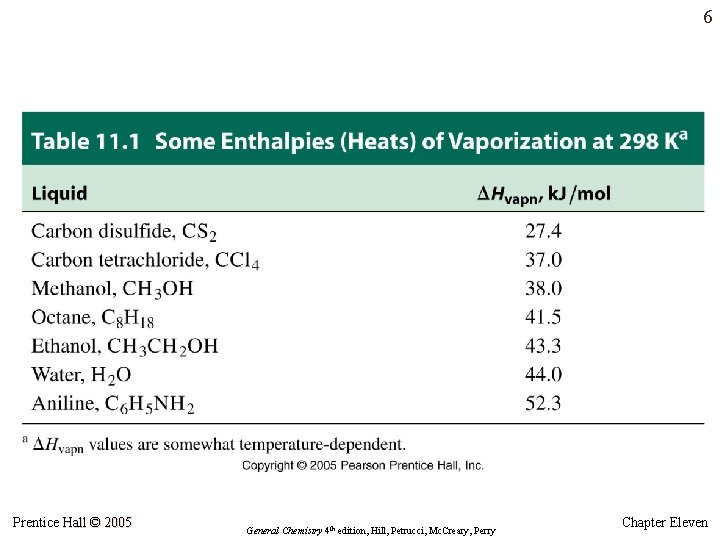
6 Prentice Hall © 2005 General Chemistry 4 th edition, Hill, Petrucci, Mc. Creary, Perry Chapter Eleven
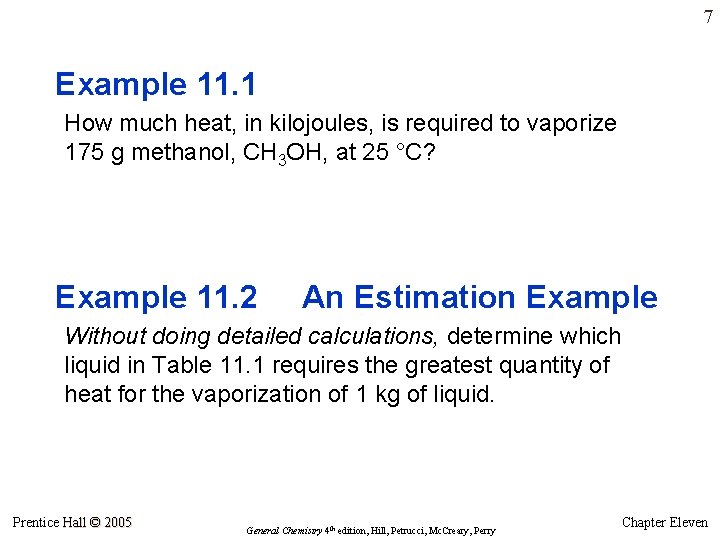
7 Example 11. 1 How much heat, in kilojoules, is required to vaporize 175 g methanol, CH 3 OH, at 25 °C? Example 11. 2 An Estimation Example Without doing detailed calculations, determine which liquid in Table 11. 1 requires the greatest quantity of heat for the vaporization of 1 kg of liquid. Prentice Hall © 2005 General Chemistry 4 th edition, Hill, Petrucci, Mc. Creary, Perry Chapter Eleven
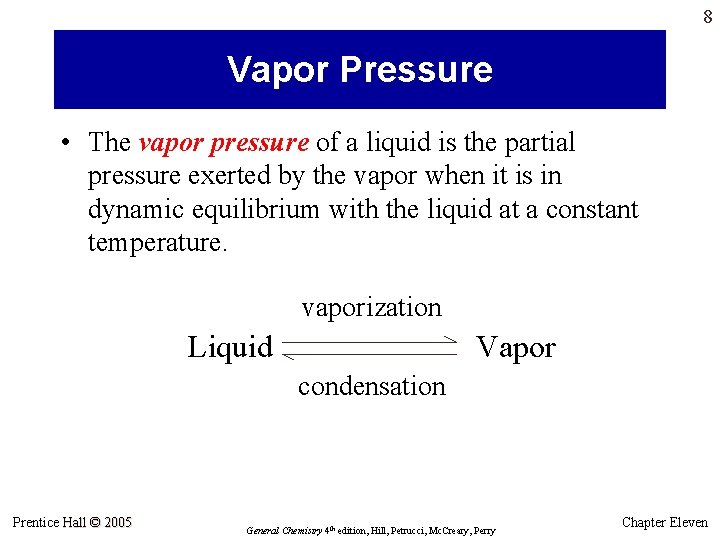
8 Vapor Pressure • The vapor pressure of a liquid is the partial pressure exerted by the vapor when it is in dynamic equilibrium with the liquid at a constant temperature. vaporization Liquid Vapor condensation Prentice Hall © 2005 General Chemistry 4 th edition, Hill, Petrucci, Mc. Creary, Perry Chapter Eleven
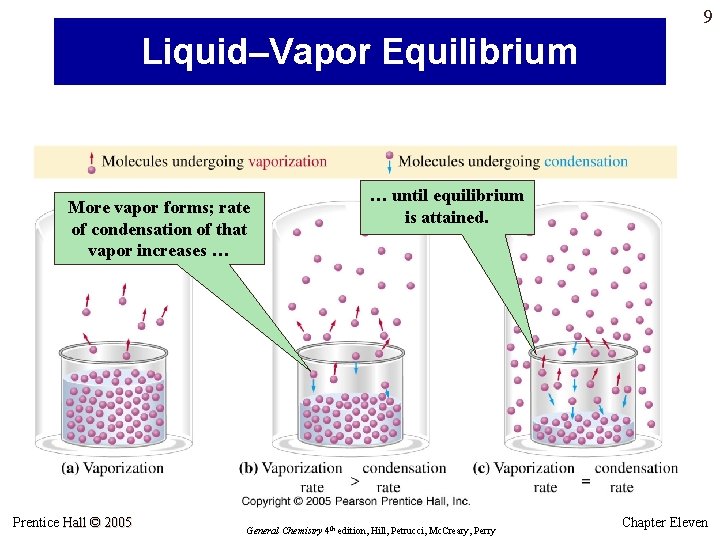
9 Liquid–Vapor Equilibrium More vapor forms; rate of condensation of that vapor increases … Prentice Hall © 2005 … until equilibrium is attained. General Chemistry 4 th edition, Hill, Petrucci, Mc. Creary, Perry Chapter Eleven
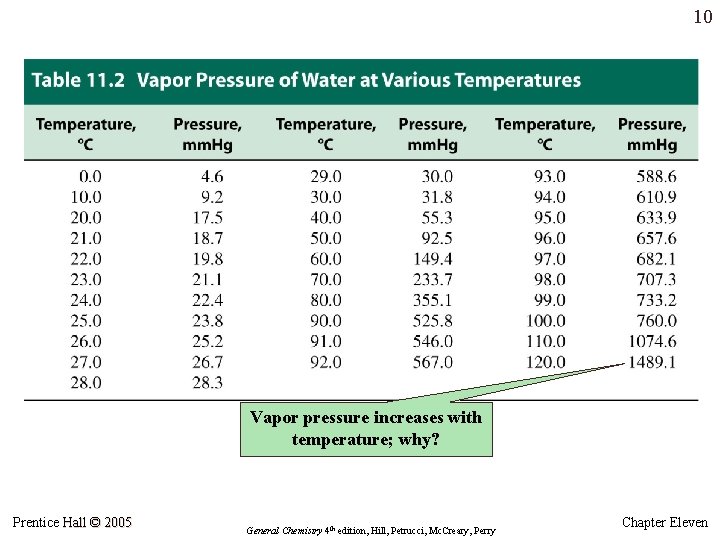
10 Vapor pressure increases with temperature; why? Prentice Hall © 2005 General Chemistry 4 th edition, Hill, Petrucci, Mc. Creary, Perry Chapter Eleven
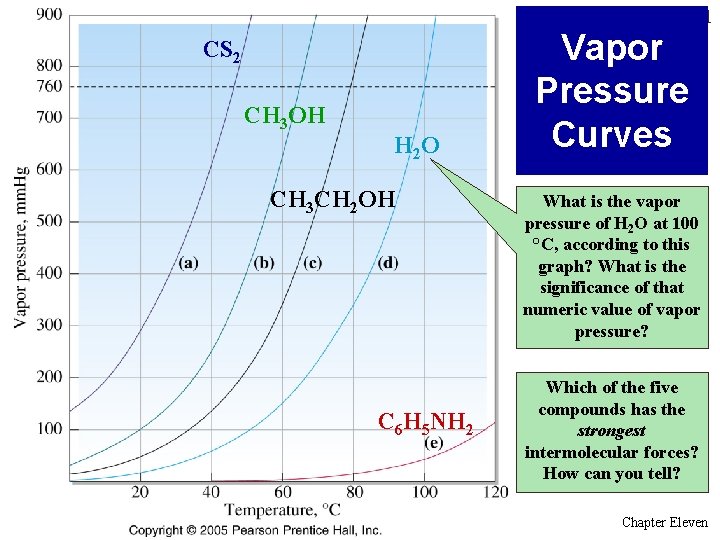
11 CS 2 CH 3 OH H 2 O CH 3 CH 2 OH C 6 H 5 NH 2 Prentice Hall © 2005 General Chemistry 4 th edition, Hill, Petrucci, Mc. Creary, Perry Vapor Pressure Curves What is the vapor pressure of H 2 O at 100 °C, according to this graph? What is the significance of that numeric value of vapor pressure? Which of the five compounds has the strongest intermolecular forces? How can you tell? Chapter Eleven
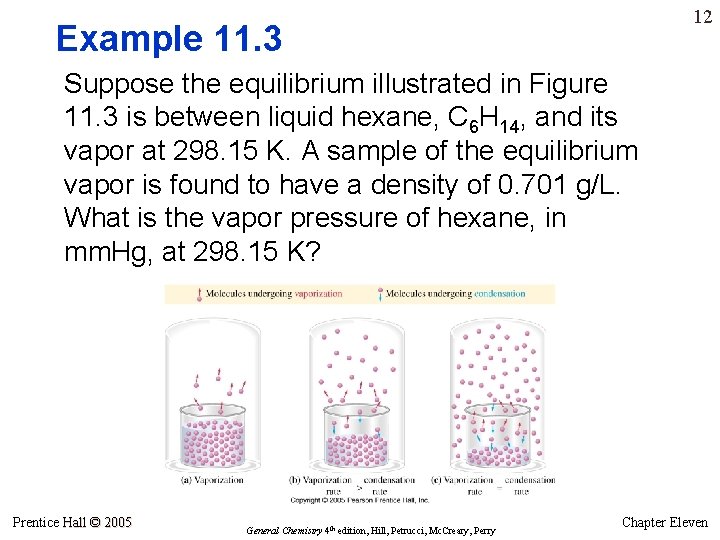
12 Example 11. 3 Suppose the equilibrium illustrated in Figure 11. 3 is between liquid hexane, C 6 H 14, and its vapor at 298. 15 K. A sample of the equilibrium vapor is found to have a density of 0. 701 g/L. What is the vapor pressure of hexane, in mm. Hg, at 298. 15 K? Prentice Hall © 2005 General Chemistry 4 th edition, Hill, Petrucci, Mc. Creary, Perry Chapter Eleven
13 Boiling Point and Critical Point • Boiling point: the temperature at which the vapor pressure of the liquid equals the external pressure. • Normal boiling point: boiling point at 1 atm. • Critical temperature (Tc): the highest temperature at which a liquid can exist. • The critical pressure, Pc, is the vapor pressure at the critical temperature. • The condition corresponding to a temperature of Tc and a pressure of Pc is called the critical point. Prentice Hall © 2005 General Chemistry 4 th edition, Hill, Petrucci, Mc. Creary, Perry Chapter Eleven
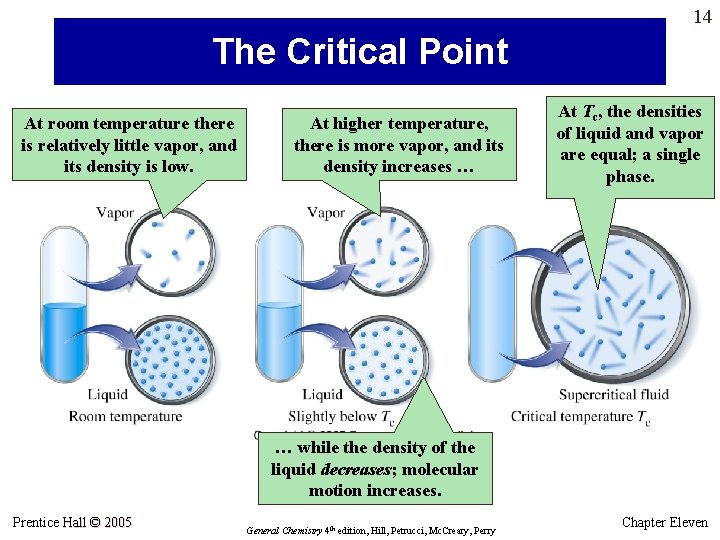
14 The Critical Point At room temperature there is relatively little vapor, and its density is low. At higher temperature, there is more vapor, and its density increases … At Tc, the densities of liquid and vapor are equal; a single phase. … while the density of the liquid decreases; molecular motion increases. Prentice Hall © 2005 General Chemistry 4 th edition, Hill, Petrucci, Mc. Creary, Perry Chapter Eleven
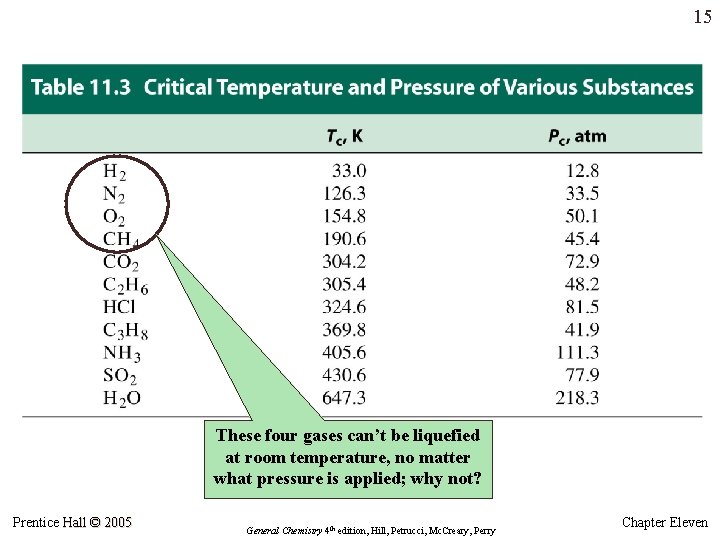
15 These four gases can’t be liquefied at room temperature, no matter what pressure is applied; why not? Prentice Hall © 2005 General Chemistry 4 th edition, Hill, Petrucci, Mc. Creary, Perry Chapter Eleven
16 Example 11. 4 A Conceptual Example To keep track of how much gas remains in a cylinder, we can weigh the cylinder when it is empty, when it is full, and after each use. In some cases, though, we can equip the cylinder with a pressure gauge and simply relate the amount of gas to the measured gas pressure. Which method should we use to keep track of the bottled propane, C 3 H 8, in a gas barbecue? Prentice Hall © 2005 General Chemistry 4 th edition, Hill, Petrucci, Mc. Creary, Perry Chapter Eleven
17 Phase Changes Involving Solids • Melting (fusion): transition of solid liquid. • Melting point: temperature at which melting occurs. – Same as freezing point! • Enthalpy of fusion, DHfusion, is the quantity of heat required to melt a set amount (one gram, one mole) of solid. • Sublimation: transition of solid vapor. – Example: Ice cubes slowly “disappear” in the freezer. • Enthalpy of sublimation, DHsubln, is the sum of the enthalpies of fusion and vaporization. • Triple point: all three phases—solid, liquid, vapor—are in equilibrium. Prentice Hall © 2005 General Chemistry 4 th edition, Hill, Petrucci, Mc. Creary, Perry Chapter Eleven
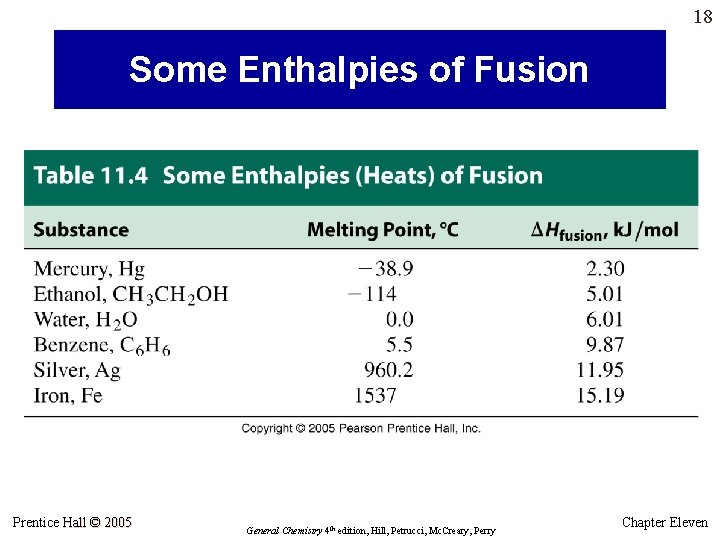
18 Some Enthalpies of Fusion Prentice Hall © 2005 General Chemistry 4 th edition, Hill, Petrucci, Mc. Creary, Perry Chapter Eleven
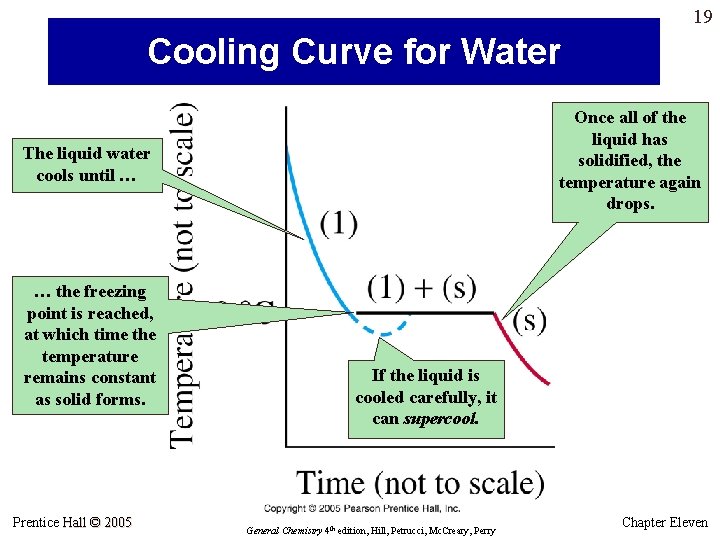
19 Cooling Curve for Water Once all of the liquid has solidified, the temperature again drops. The liquid water cools until … … the freezing point is reached, at which time the temperature remains constant as solid forms. Prentice Hall © 2005 If the liquid is cooled carefully, it can supercool. General Chemistry 4 th edition, Hill, Petrucci, Mc. Creary, Perry Chapter Eleven
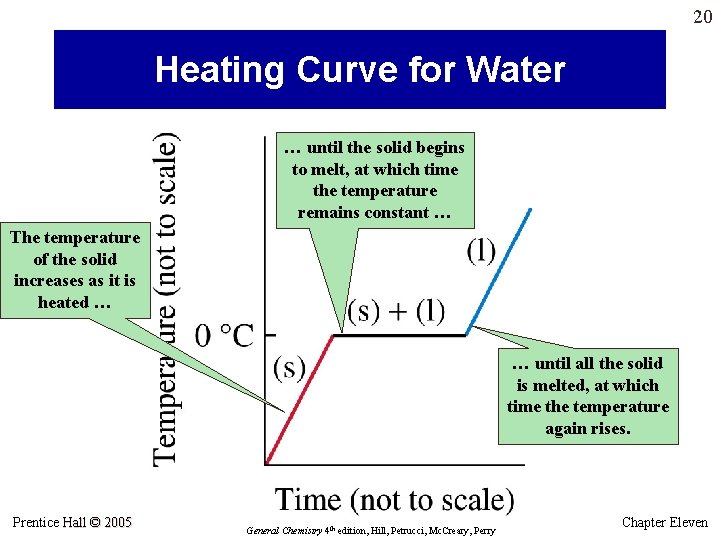
20 Heating Curve for Water … until the solid begins to melt, at which time the temperature remains constant … The temperature of the solid increases as it is heated … … until all the solid is melted, at which time the temperature again rises. Prentice Hall © 2005 General Chemistry 4 th edition, Hill, Petrucci, Mc. Creary, Perry Chapter Eleven
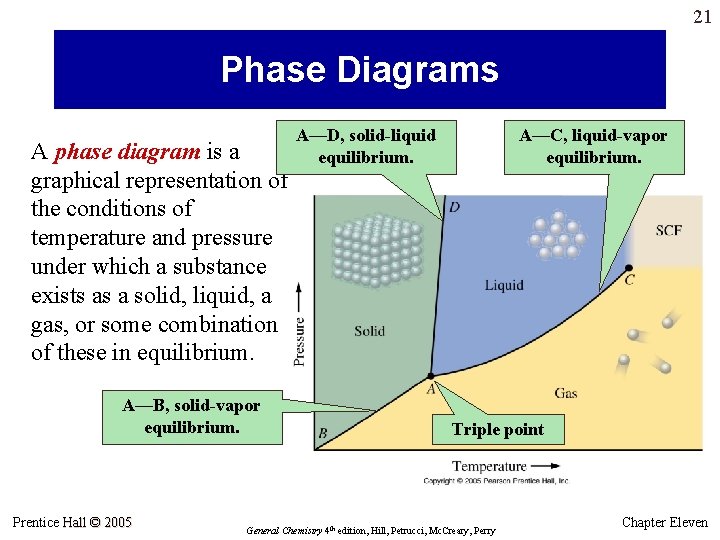
21 Phase Diagrams A phase diagram is a graphical representation of the conditions of temperature and pressure under which a substance exists as a solid, liquid, a gas, or some combination of these in equilibrium. A—B, solid-vapor equilibrium. Prentice Hall © 2005 A—D, solid-liquid equilibrium. A—C, liquid-vapor equilibrium. Triple point General Chemistry 4 th edition, Hill, Petrucci, Mc. Creary, Perry Chapter Eleven
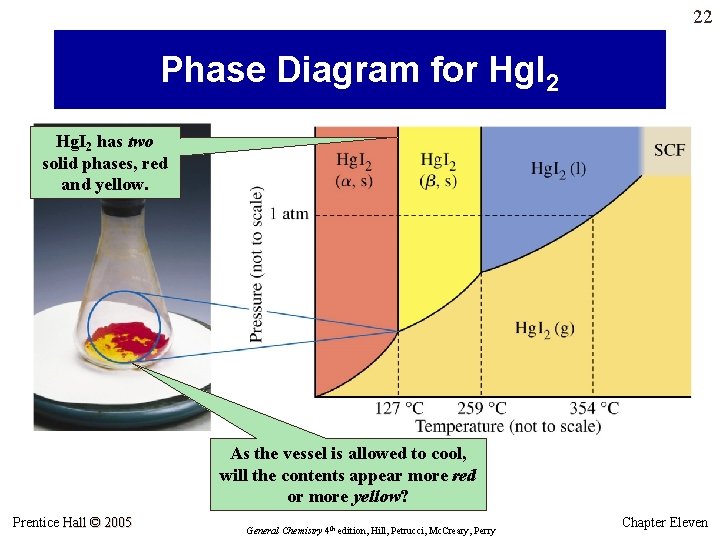
22 Phase Diagram for Hg. I 2 has two solid phases, red and yellow. As the vessel is allowed to cool, will the contents appear more red or more yellow? Prentice Hall © 2005 General Chemistry 4 th edition, Hill, Petrucci, Mc. Creary, Perry Chapter Eleven
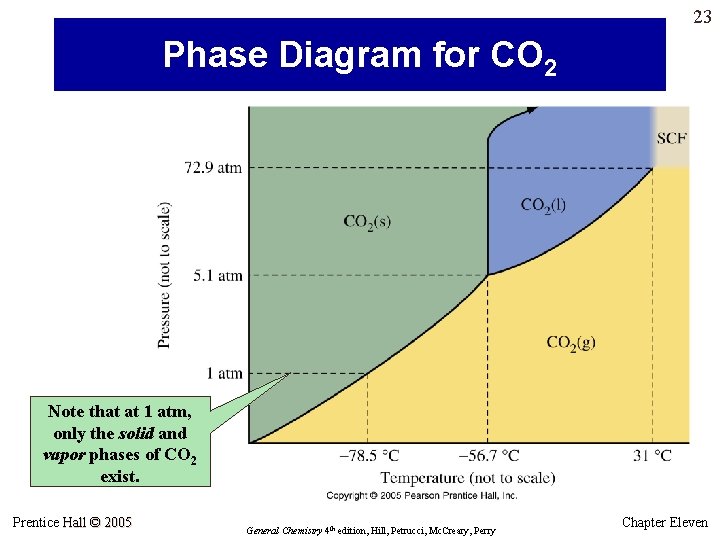
23 Phase Diagram for CO 2 Note that at 1 atm, only the solid and vapor phases of CO 2 exist. Prentice Hall © 2005 General Chemistry 4 th edition, Hill, Petrucci, Mc. Creary, Perry Chapter Eleven
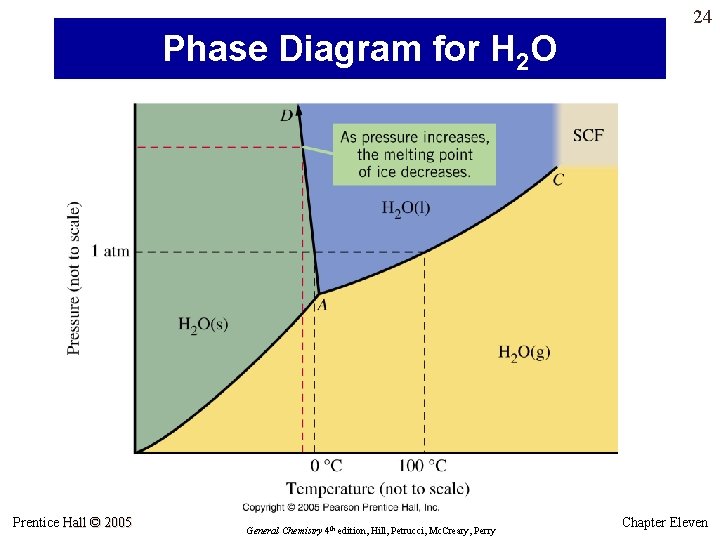
24 Phase Diagram for H 2 O Prentice Hall © 2005 General Chemistry 4 th edition, Hill, Petrucci, Mc. Creary, Perry Chapter Eleven
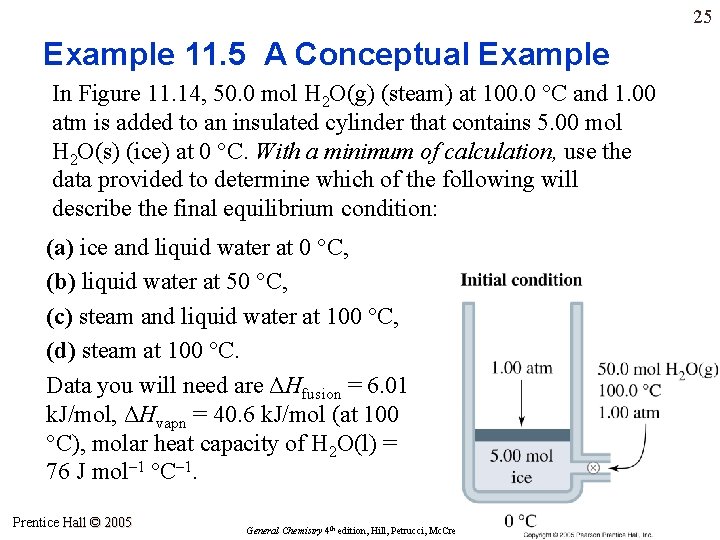
25 Example 11. 5 A Conceptual Example In Figure 11. 14, 50. 0 mol H 2 O(g) (steam) at 100. 0 °C and 1. 00 atm is added to an insulated cylinder that contains 5. 00 mol H 2 O(s) (ice) at 0 °C. With a minimum of calculation, use the data provided to determine which of the following will describe the final equilibrium condition: (a) ice and liquid water at 0 °C, (b) liquid water at 50 °C, (c) steam and liquid water at 100 °C, (d) steam at 100 °C. Data you will need are ΔHfusion = 6. 01 k. J/mol, ΔHvapn = 40. 6 k. J/mol (at 100 °C), molar heat capacity of H 2 O(l) = 76 J mol– 1 °C– 1. Prentice Hall © 2005 General Chemistry 4 th edition, Hill, Petrucci, Mc. Creary, Perry Chapter Eleven
26 Intermolecular Forces • … are forces between molecules. • They determine melting points, freezing points, and other physical properties. • Types of intermolecular forces include: • dispersion forces • Dipole–dipole forces • hydrogen bonding Prentice Hall © 2005 General Chemistry 4 th edition, Hill, Petrucci, Mc. Creary, Perry Chapter Eleven
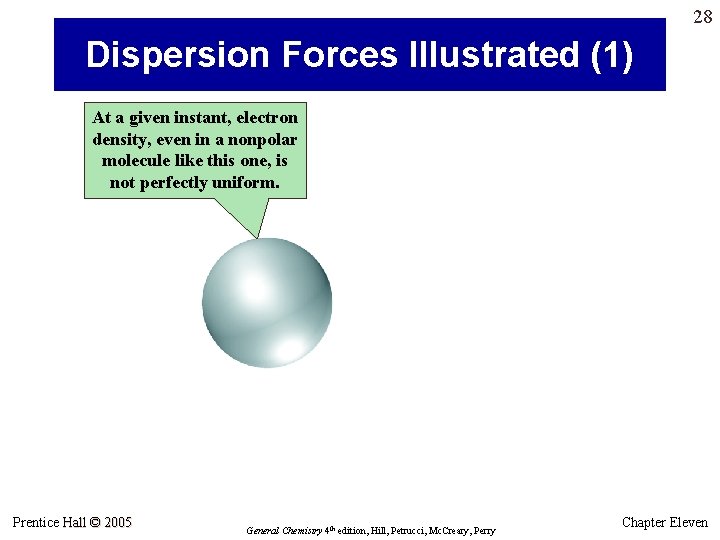
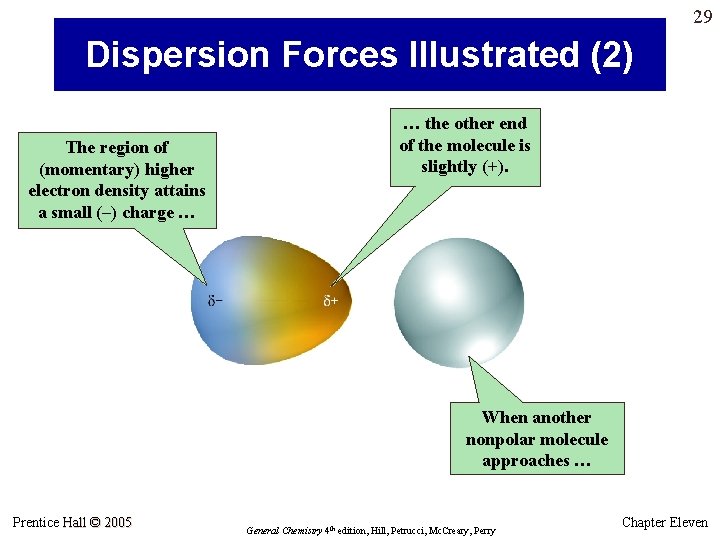
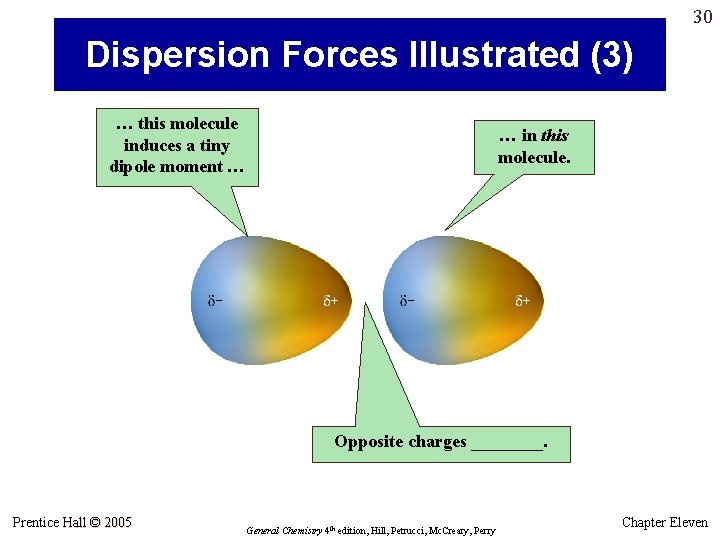
27 Dispersion Forces • … exist between any two particles. • Also called London forces (after Fritz London, who offered a theoretical explanation of these forces in 1928). • Dispersion forces arise because the electron cloud is not perfectly uniform. • Tiny, momentary dipole moments can exist even in nonpolar molecules. Prentice Hall © 2005 General Chemistry 4 th edition, Hill, Petrucci, Mc. Creary, Perry Chapter Eleven
28 Dispersion Forces Illustrated (1) At a given instant, electron density, even in a nonpolar molecule like this one, is not perfectly uniform. Prentice Hall © 2005 General Chemistry 4 th edition, Hill, Petrucci, Mc. Creary, Perry Chapter Eleven
29 Dispersion Forces Illustrated (2) The region of (momentary) higher electron density attains a small (–) charge … … the other end of the molecule is slightly (+). When another nonpolar molecule approaches … Prentice Hall © 2005 General Chemistry 4 th edition, Hill, Petrucci, Mc. Creary, Perry Chapter Eleven
30 Dispersion Forces Illustrated (3) … this molecule induces a tiny dipole moment … … in this molecule. Opposite charges ____. Prentice Hall © 2005 General Chemistry 4 th edition, Hill, Petrucci, Mc. Creary, Perry Chapter Eleven
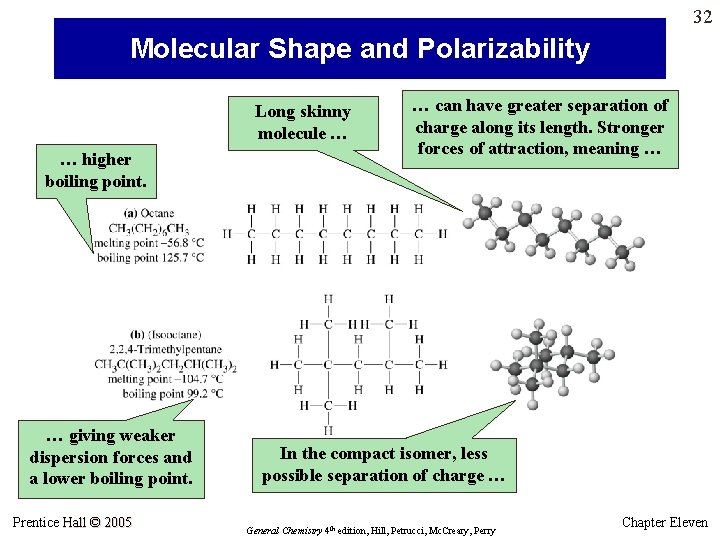
31 Strength of Dispersion Forces • Dispersion force strength depends on polarizability: the ease with which the electron cloud is distorted by an external electrical field. • The greater the polarizability of molecules, the stronger the dispersion forces between them. • Polarizability in turn depends on molecular size and shape. • Heavier molecule => more electrons => a morepolarizable molecule. • As to molecular shape … Prentice Hall © 2005 General Chemistry 4 th edition, Hill, Petrucci, Mc. Creary, Perry Chapter Eleven
32 Molecular Shape and Polarizability Long skinny molecule … … higher boiling point. … giving weaker dispersion forces and a lower boiling point. Prentice Hall © 2005 … can have greater separation of charge along its length. Stronger forces of attraction, meaning … In the compact isomer, less possible separation of charge … General Chemistry 4 th edition, Hill, Petrucci, Mc. Creary, Perry Chapter Eleven
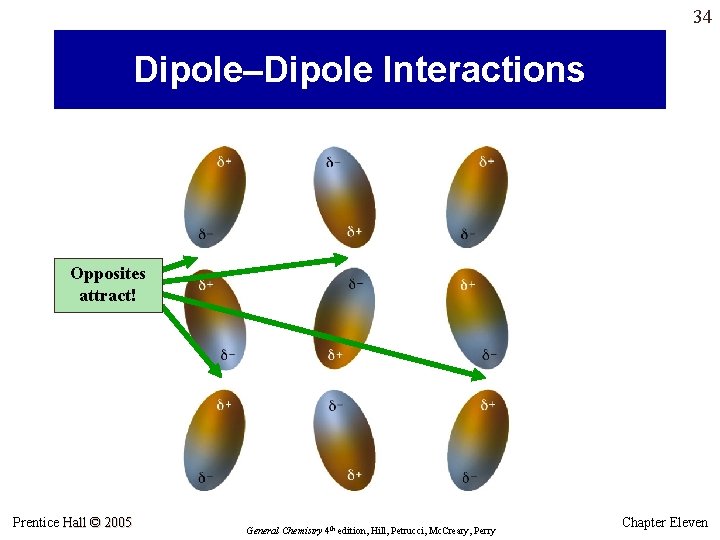
33 Dipole–Dipole Forces • A polar molecule has a positively charged “end” (δ+) and a negatively charged “end” (δ–). • When molecules come close to one another, repulsions occur between like-charged regions of dipoles. Opposite charges tend to attract one another. • The more polar a molecule, the more pronounced is the effect of dipole–dipole forces on physical properties. Prentice Hall © 2005 General Chemistry 4 th edition, Hill, Petrucci, Mc. Creary, Perry Chapter Eleven
34 Dipole–Dipole Interactions Opposites attract! Prentice Hall © 2005 General Chemistry 4 th edition, Hill, Petrucci, Mc. Creary, Perry Chapter Eleven
35 Predicting Physical Properties of Molecular Substances • Dispersion forces become stronger with increasing molar mass and elongation of molecules. In comparing nonpolar substances, molar mass and molecular shape are the essential factors. • Dipole–dipole and dipole-induced dipole forces are found in polar substances. The more polar the substance, the greater the intermolecular force is expected to be. • Because they occur in all substances, dispersion forces must always be considered. Often they predominate. Prentice Hall © 2005 General Chemistry 4 th edition, Hill, Petrucci, Mc. Creary, Perry Chapter Eleven
36 Example 11. 6 Arrange the following substances in the expected order of increasing boiling point: carbon tetrabromide, CBr 4; butane, CH 3 CH 2 CH 3; fluorine, F 2; acetaldehyde, CH 3 CHO. Prentice Hall © 2005 General Chemistry 4 th edition, Hill, Petrucci, Mc. Creary, Perry Chapter Eleven
37 Homology • A series of compounds whose formulas and structures vary in a regular manner also have properties that vary in a predictable manner. • This principle is called homology. • Example: both densities and boiling points of the straight-chain alkanes increase in a continuous and regular fashion with increasing numbers of carbon atoms in the chain. • Trends result from the regular increase in molar mass, which produces a fairly regular increase in the strength of dispersion forces. Prentice Hall © 2005 General Chemistry 4 th edition, Hill, Petrucci, Mc. Creary, Perry Chapter Eleven
38 Example 11. 7 An Estimation Example The boiling points of the straight-chain alkanes pentane, hexane, heptane, and octane are 36. 1, 68. 7, 98. 4, and 125. 7 °C, respectively. Estimate the boiling point of the straight-chain alkane decane. Prentice Hall © 2005 General Chemistry 4 th edition, Hill, Petrucci, Mc. Creary, Perry Chapter Eleven
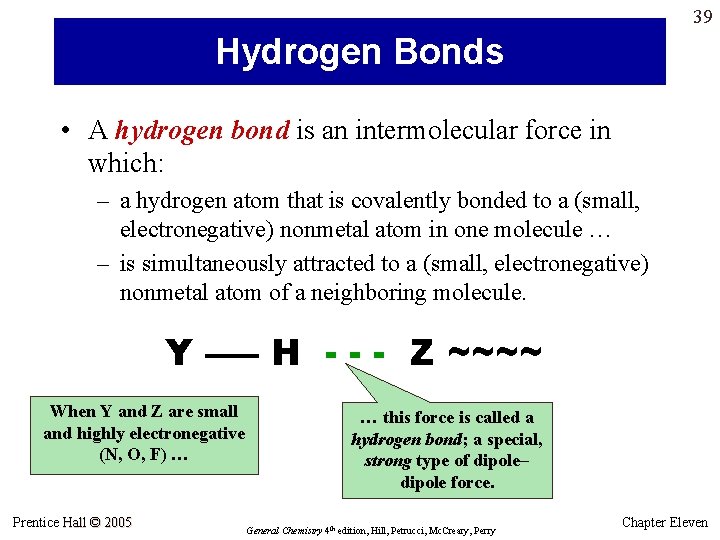
39 Hydrogen Bonds • A hydrogen bond is an intermolecular force in which: – a hydrogen atom that is covalently bonded to a (small, electronegative) nonmetal atom in one molecule … – is simultaneously attracted to a (small, electronegative) nonmetal atom of a neighboring molecule. Y ––– H - - - Z ~~~~ When Y and Z are small and highly electronegative (N, O, F) … Prentice Hall © 2005 … this force is called a hydrogen bond; a special, strong type of dipole– dipole force. General Chemistry 4 th edition, Hill, Petrucci, Mc. Creary, Perry Chapter Eleven
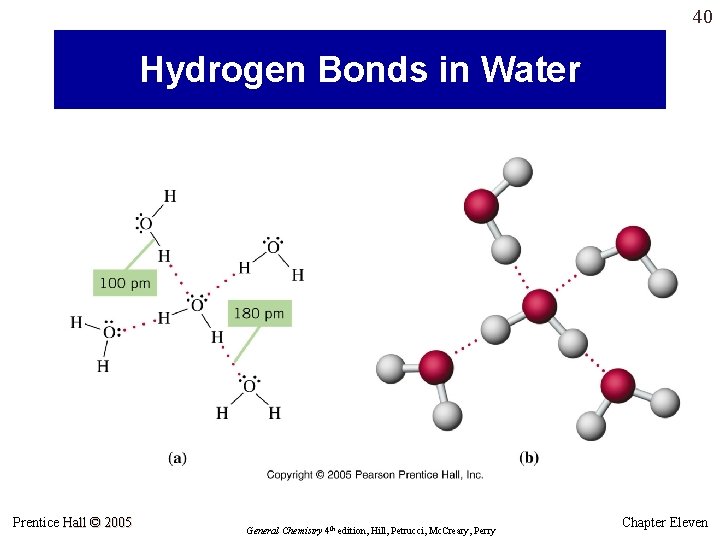
40 Hydrogen Bonds in Water Prentice Hall © 2005 General Chemistry 4 th edition, Hill, Petrucci, Mc. Creary, Perry Chapter Eleven
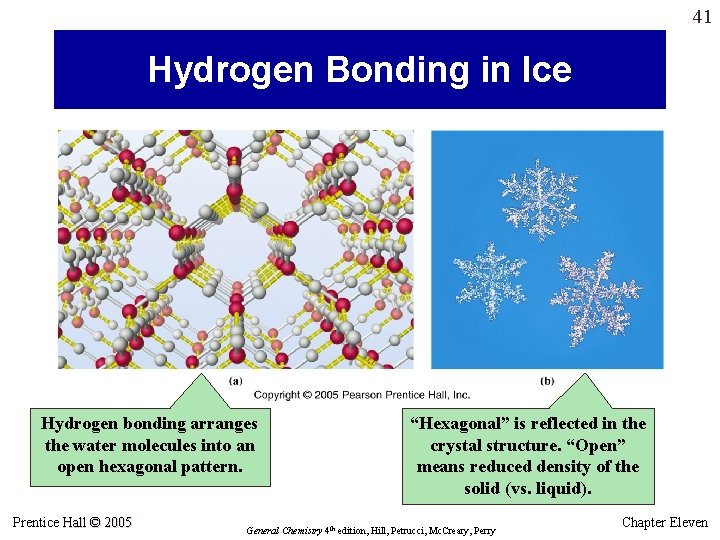
41 Hydrogen Bonding in Ice Hydrogen bonding arranges the water molecules into an open hexagonal pattern. Prentice Hall © 2005 “Hexagonal” is reflected in the crystal structure. “Open” means reduced density of the solid (vs. liquid). General Chemistry 4 th edition, Hill, Petrucci, Mc. Creary, Perry Chapter Eleven
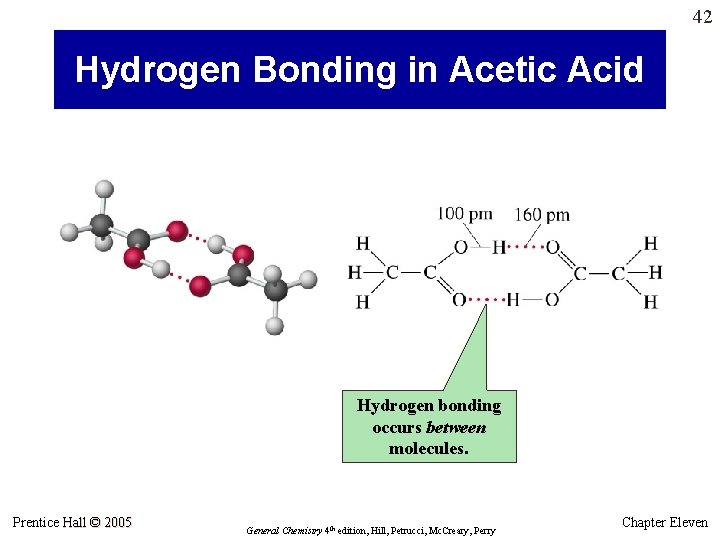
42 Hydrogen Bonding in Acetic Acid Hydrogen bonding occurs between molecules. Prentice Hall © 2005 General Chemistry 4 th edition, Hill, Petrucci, Mc. Creary, Perry Chapter Eleven
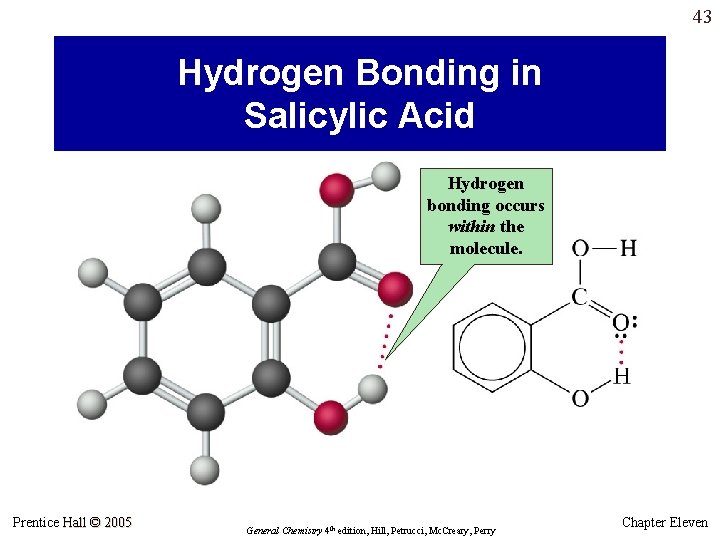
43 Hydrogen Bonding in Salicylic Acid Hydrogen bonding occurs within the molecule. Prentice Hall © 2005 General Chemistry 4 th edition, Hill, Petrucci, Mc. Creary, Perry Chapter Eleven
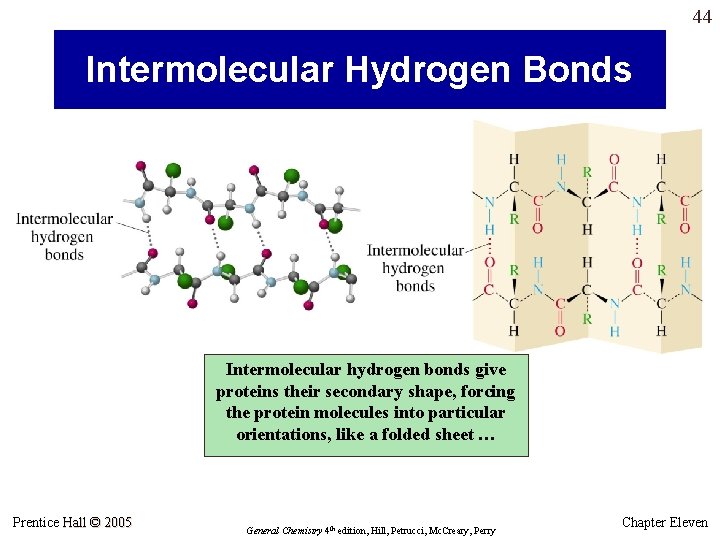
44 Intermolecular Hydrogen Bonds Intermolecular hydrogen bonds give proteins their secondary shape, forcing the protein molecules into particular orientations, like a folded sheet … Prentice Hall © 2005 General Chemistry 4 th edition, Hill, Petrucci, Mc. Creary, Perry Chapter Eleven
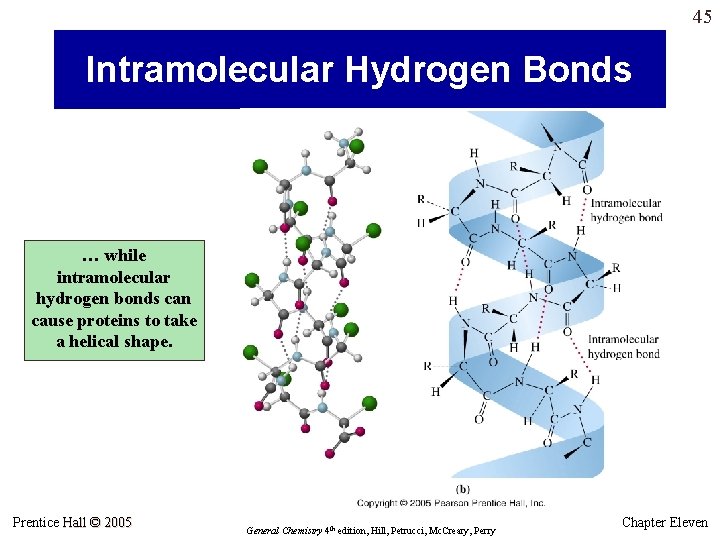
45 Intramolecular Hydrogen Bonds … while intramolecular hydrogen bonds can cause proteins to take a helical shape. Prentice Hall © 2005 General Chemistry 4 th edition, Hill, Petrucci, Mc. Creary, Perry Chapter Eleven
46 Example 11. 8 In which of these substances is hydrogen bonding an important intermolecular force: N 2, HI, HF, CH 3 CHO, and CH 3 OH? Explain. Prentice Hall © 2005 General Chemistry 4 th edition, Hill, Petrucci, Mc. Creary, Perry Chapter Eleven
47 Liquids and Intermolecular Forces • Much behavior and many properties of liquids can be attributed to intermolecular forces. • Surface tension (g) is the amount of work required to extend a liquid surface and is usually expressed in J/m 2. • Adhesive forces are intermolecular forces between unlike molecules. • Cohesive forces are intermolecular forces between like molecules. • A meniscus is the interface between a liquid and the air above it. • Viscosity is a measure of a liquid’s resistance to flow. Prentice Hall © 2005 General Chemistry 4 th edition, Hill, Petrucci, Mc. Creary, Perry Chapter Eleven
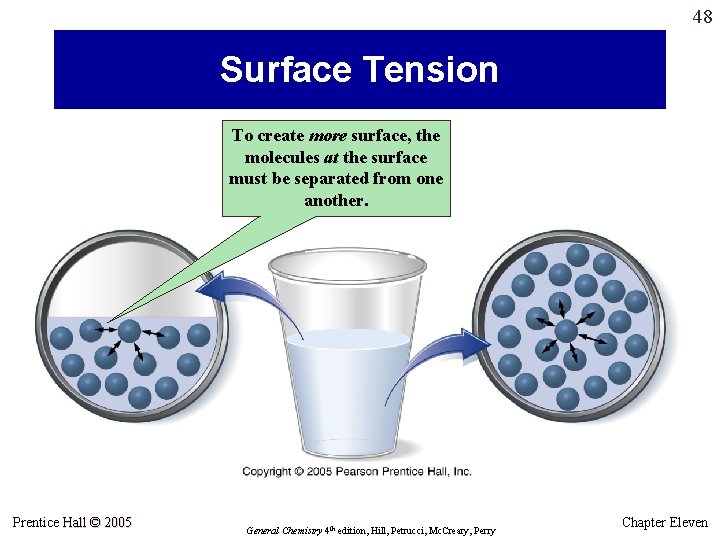
48 Surface Tension To create more surface, the molecules at the surface must be separated from one another. Prentice Hall © 2005 General Chemistry 4 th edition, Hill, Petrucci, Mc. Creary, Perry Chapter Eleven
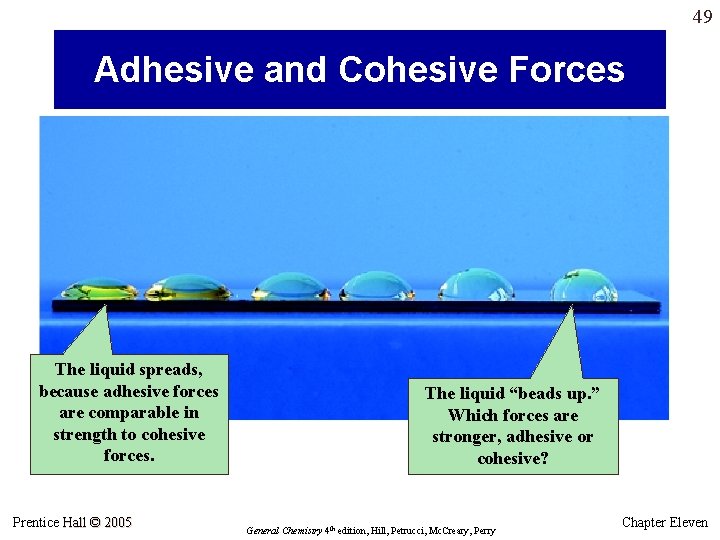
49 Adhesive and Cohesive Forces The liquid spreads, because adhesive forces are comparable in strength to cohesive forces. Prentice Hall © 2005 The liquid “beads up. ” Which forces are stronger, adhesive or cohesive? General Chemistry 4 th edition, Hill, Petrucci, Mc. Creary, Perry Chapter Eleven
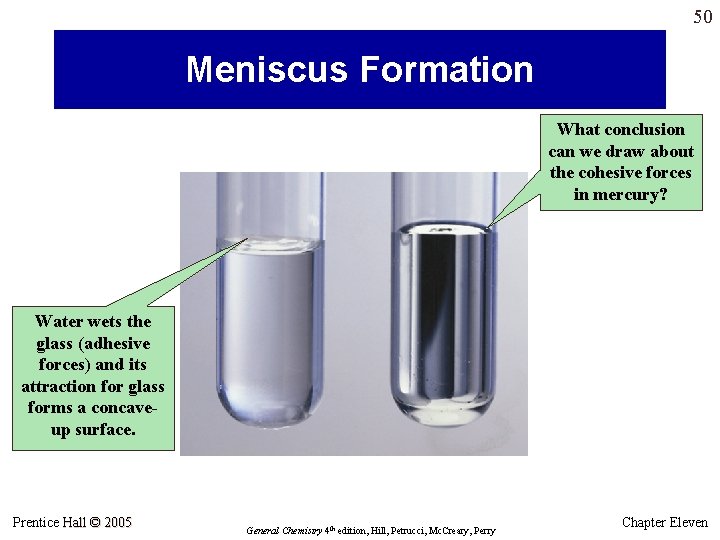
50 Meniscus Formation What conclusion can we draw about the cohesive forces in mercury? Water wets the glass (adhesive forces) and its attraction for glass forms a concaveup surface. Prentice Hall © 2005 General Chemistry 4 th edition, Hill, Petrucci, Mc. Creary, Perry Chapter Eleven
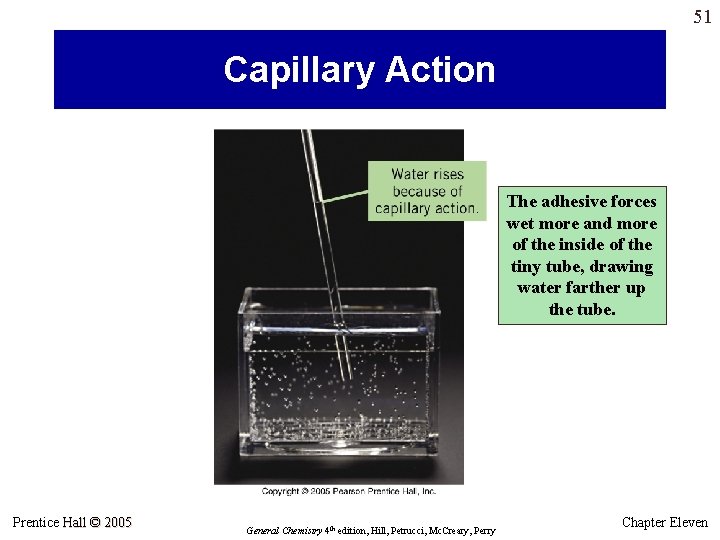
51 Capillary Action The adhesive forces wet more and more of the inside of the tiny tube, drawing water farther up the tube. Prentice Hall © 2005 General Chemistry 4 th edition, Hill, Petrucci, Mc. Creary, Perry Chapter Eleven
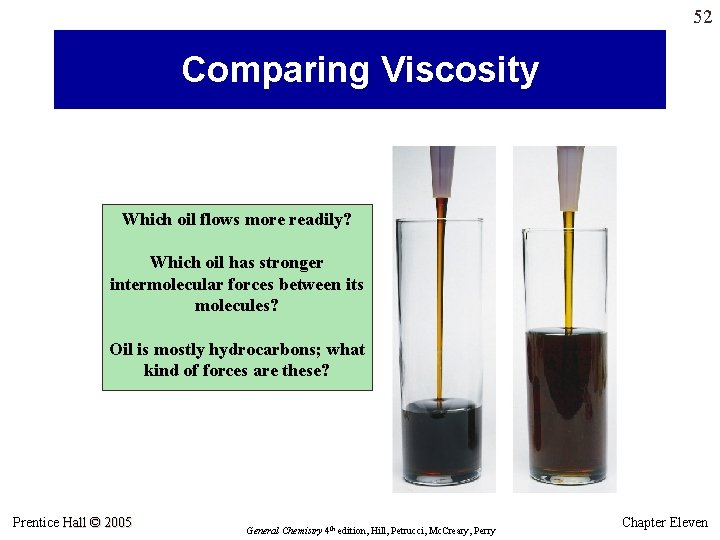
52 Comparing Viscosity Which oil flows more readily? Which oil has stronger intermolecular forces between its molecules? Oil is mostly hydrocarbons; what kind of forces are these? Prentice Hall © 2005 General Chemistry 4 th edition, Hill, Petrucci, Mc. Creary, Perry Chapter Eleven
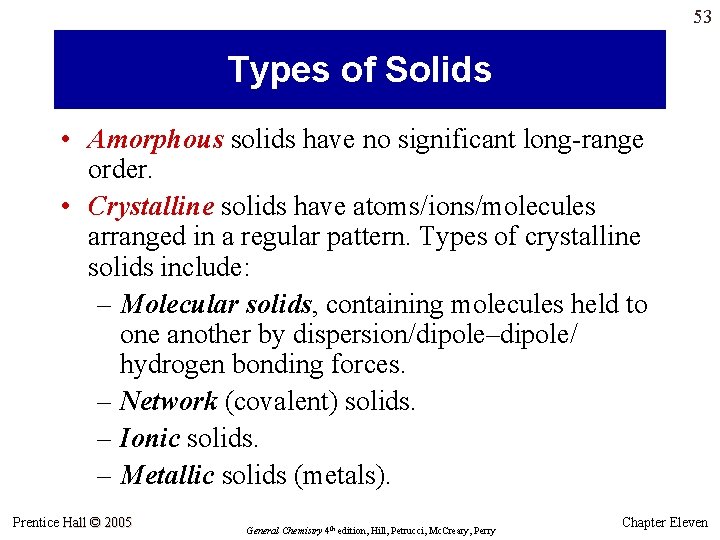
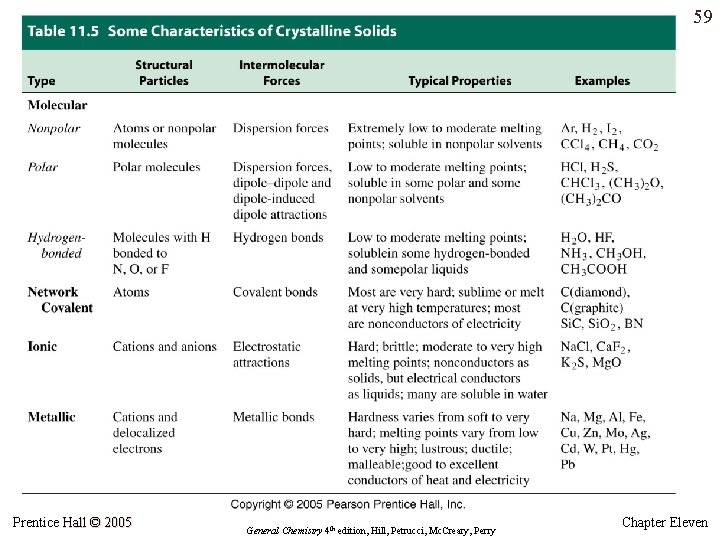
53 Types of Solids • Amorphous solids have no significant long-range order. • Crystalline solids have atoms/ions/molecules arranged in a regular pattern. Types of crystalline solids include: – Molecular solids, containing molecules held to one another by dispersion/dipole–dipole/ hydrogen bonding forces. – Network (covalent) solids. – Ionic solids. – Metallic solids (metals). Prentice Hall © 2005 General Chemistry 4 th edition, Hill, Petrucci, Mc. Creary, Perry Chapter Eleven
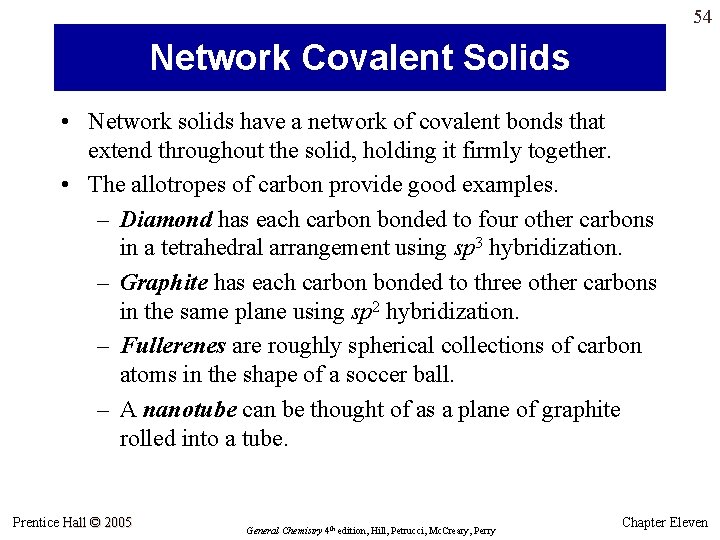
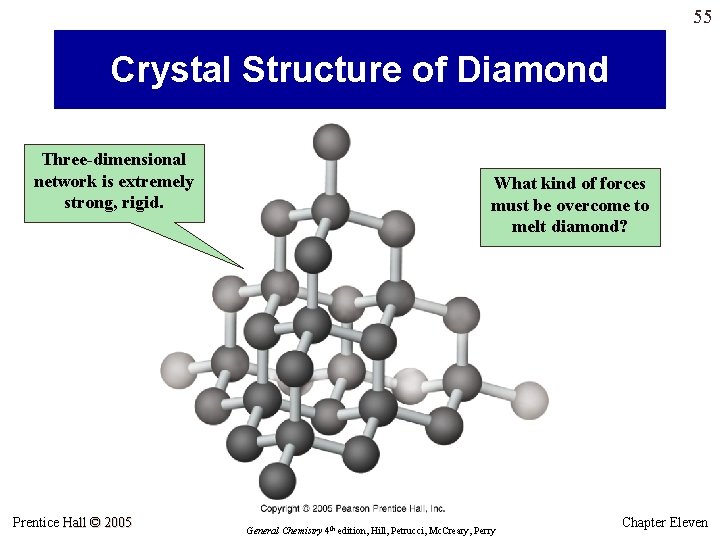
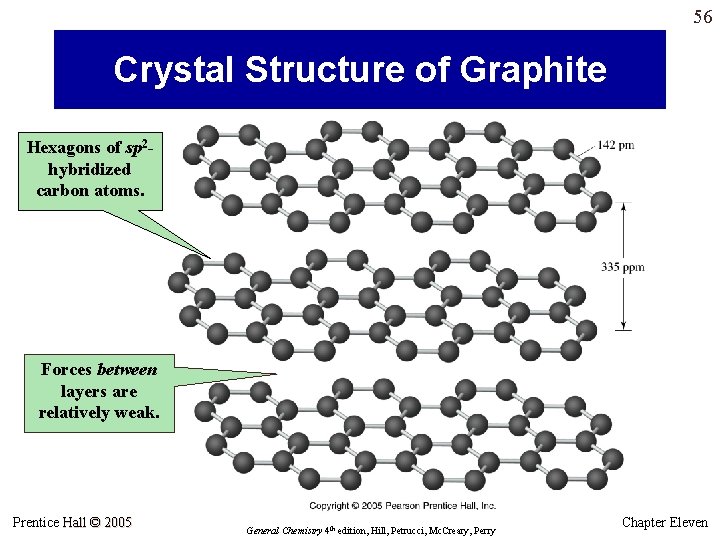
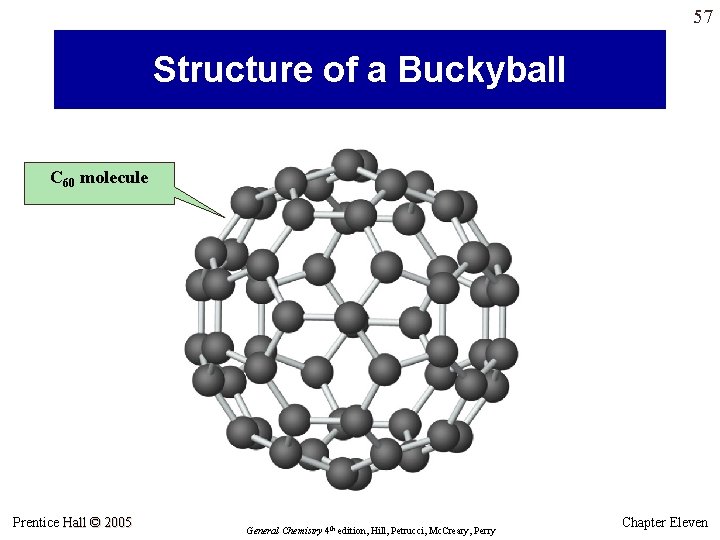
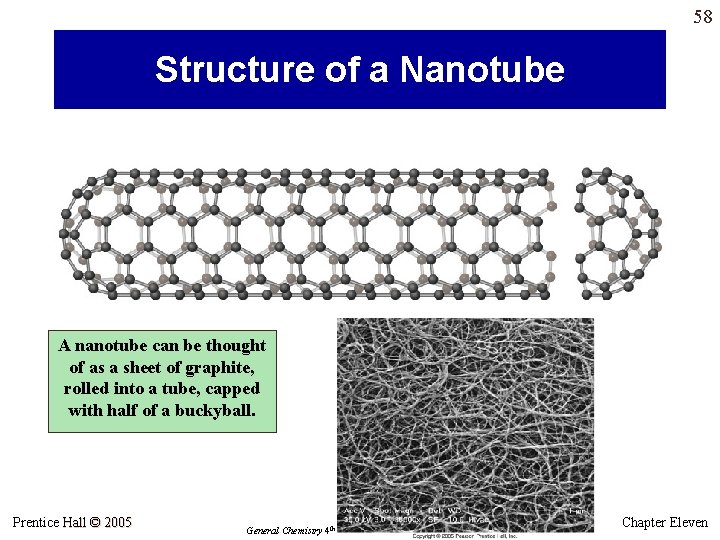
54 Network Covalent Solids • Network solids have a network of covalent bonds that extend throughout the solid, holding it firmly together. • The allotropes of carbon provide good examples. – Diamond has each carbon bonded to four other carbons in a tetrahedral arrangement using sp 3 hybridization. – Graphite has each carbon bonded to three other carbons in the same plane using sp 2 hybridization. – Fullerenes are roughly spherical collections of carbon atoms in the shape of a soccer ball. – A nanotube can be thought of as a plane of graphite rolled into a tube. Prentice Hall © 2005 General Chemistry 4 th edition, Hill, Petrucci, Mc. Creary, Perry Chapter Eleven
55 Crystal Structure of Diamond Three-dimensional network is extremely strong, rigid. Prentice Hall © 2005 What kind of forces must be overcome to melt diamond? General Chemistry 4 th edition, Hill, Petrucci, Mc. Creary, Perry Chapter Eleven
56 Crystal Structure of Graphite Hexagons of sp 2 hybridized carbon atoms. Forces between layers are relatively weak. Prentice Hall © 2005 General Chemistry 4 th edition, Hill, Petrucci, Mc. Creary, Perry Chapter Eleven
57 Structure of a Buckyball C 60 molecule Prentice Hall © 2005 General Chemistry 4 th edition, Hill, Petrucci, Mc. Creary, Perry Chapter Eleven
58 Structure of a Nanotube A nanotube can be thought of as a sheet of graphite, rolled into a tube, capped with half of a buckyball. Prentice Hall © 2005 General Chemistry 4 th edition, Hill, Petrucci, Mc. Creary, Perry Chapter Eleven
59 Prentice Hall © 2005 General Chemistry 4 th edition, Hill, Petrucci, Mc. Creary, Perry Chapter Eleven
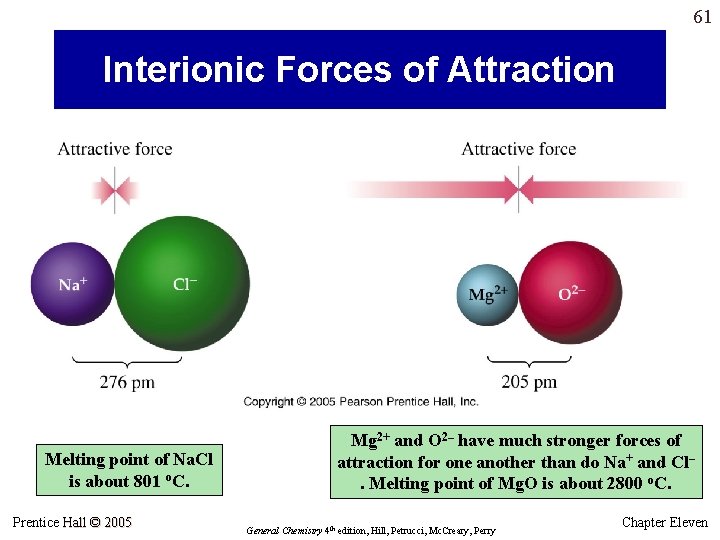
60 Ionic Bonds as “Intermolecular” Forces • There are no molecules in an ionic solid, and therefore there can’t be any intermolecular forces. • The attractions are electrostatic interionic attractions. • Lattice energy (Chapter 9) is a measure of the strength of interionic attraction. • The attractive force between a pair of oppositely charged ions increases: – as the charges on the ions increase. – as the ionic radii decrease. • Lattice energies increase accordingly. Prentice Hall © 2005 General Chemistry 4 th edition, Hill, Petrucci, Mc. Creary, Perry Chapter Eleven
61 Interionic Forces of Attraction Melting point of Na. Cl is about 801 o. C. Prentice Hall © 2005 Mg 2+ and O 2– have much stronger forces of attraction for one another than do Na+ and Cl–. Melting point of Mg. O is about 2800 o. C. General Chemistry 4 th edition, Hill, Petrucci, Mc. Creary, Perry Chapter Eleven
62 Example 11. 9 Arrange the ionic solids Mg. O, Na. Br, and Na. Cl in the expected order of increasing melting point. Prentice Hall © 2005 General Chemistry 4 th edition, Hill, Petrucci, Mc. Creary, Perry Chapter Eleven
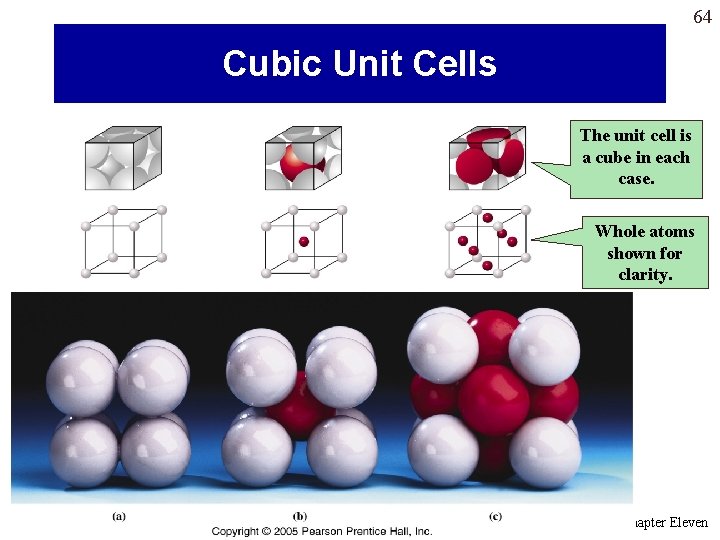
63 Crystal Lattices • To describe crystals, three-dimensional views must be used. • The repeating unit of the lattice is called the unit cell. • There a number of different types of unit cell; hexagonal, rhombic, cubic, etc. • The three types of cubic unit cells are: simple cubic, body-centered cubic (bcc), face-centered cubic (fcc). Prentice Hall © 2005 General Chemistry 4 th edition, Hill, Petrucci, Mc. Creary, Perry Chapter Eleven
64 Cubic Unit Cells The unit cell is a cube in each case. Whole atoms shown for clarity. Prentice Hall © 2005 General Chemistry 4 th edition, Hill, Petrucci, Mc. Creary, Perry Chapter Eleven
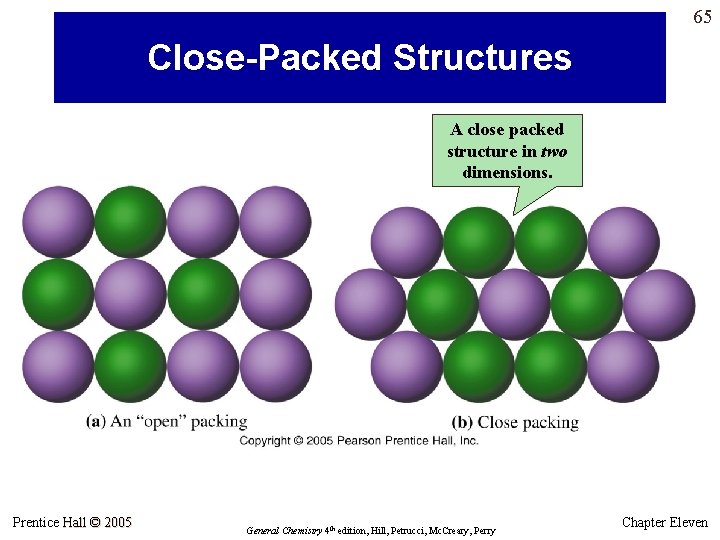
65 Close-Packed Structures A close packed structure in two dimensions. Prentice Hall © 2005 General Chemistry 4 th edition, Hill, Petrucci, Mc. Creary, Perry Chapter Eleven
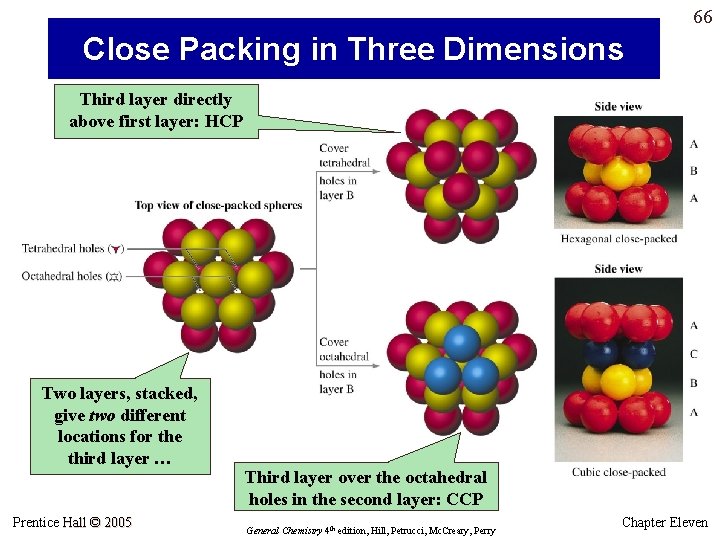
66 Close Packing in Three Dimensions Third layer directly above first layer: HCP Two layers, stacked, give two different locations for the third layer … Prentice Hall © 2005 Third layer over the octahedral holes in the second layer: CCP General Chemistry 4 th edition, Hill, Petrucci, Mc. Creary, Perry Chapter Eleven
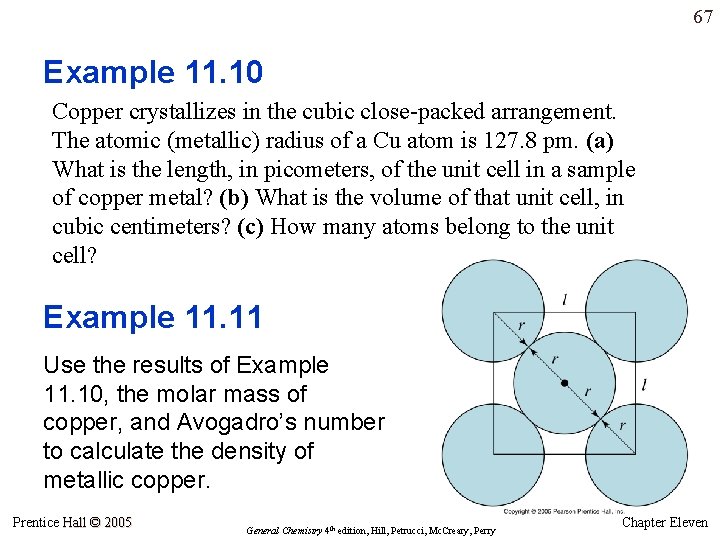
67 Example 11. 10 Copper crystallizes in the cubic close-packed arrangement. The atomic (metallic) radius of a Cu atom is 127. 8 pm. (a) What is the length, in picometers, of the unit cell in a sample of copper metal? (b) What is the volume of that unit cell, in cubic centimeters? (c) How many atoms belong to the unit cell? Example 11. 11 Use the results of Example 11. 10, the molar mass of copper, and Avogadro’s number to calculate the density of metallic copper. Prentice Hall © 2005 General Chemistry 4 th edition, Hill, Petrucci, Mc. Creary, Perry Chapter Eleven
68 Ionic Crystal Structures • Ionic crystals have two different types of structural units— cations and anions. • The cations and anions ordinarily are different sizes. • Smaller cations can fill the voids between the larger anions. • Where the cations go depends on the size of the cations and on the size of the voids. • The smallest voids are the tetrahedral holes, then the octahedral holes, and finally the holes in a cubic structure. Therefore … Prentice Hall © 2005 General Chemistry 4 th edition, Hill, Petrucci, Mc. Creary, Perry Chapter Eleven
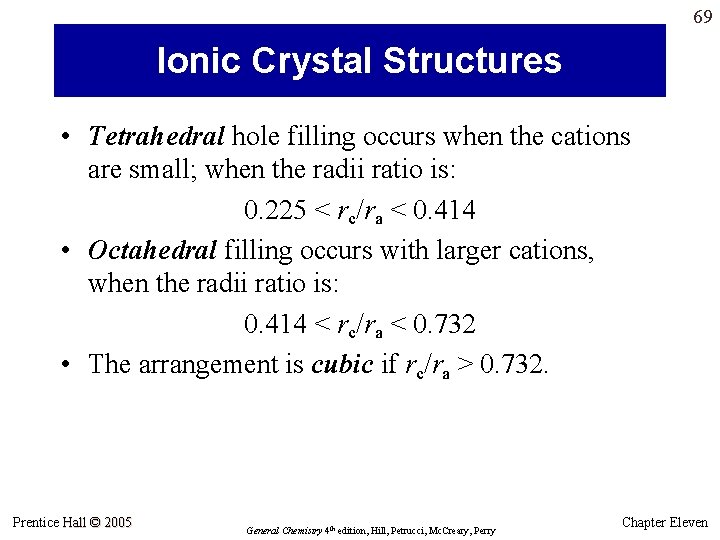
69 Ionic Crystal Structures • Tetrahedral hole filling occurs when the cations are small; when the radii ratio is: 0. 225 < rc/ra < 0. 414 • Octahedral filling occurs with larger cations, when the radii ratio is: 0. 414 < rc/ra < 0. 732 • The arrangement is cubic if rc/ra > 0. 732. Prentice Hall © 2005 General Chemistry 4 th edition, Hill, Petrucci, Mc. Creary, Perry Chapter Eleven
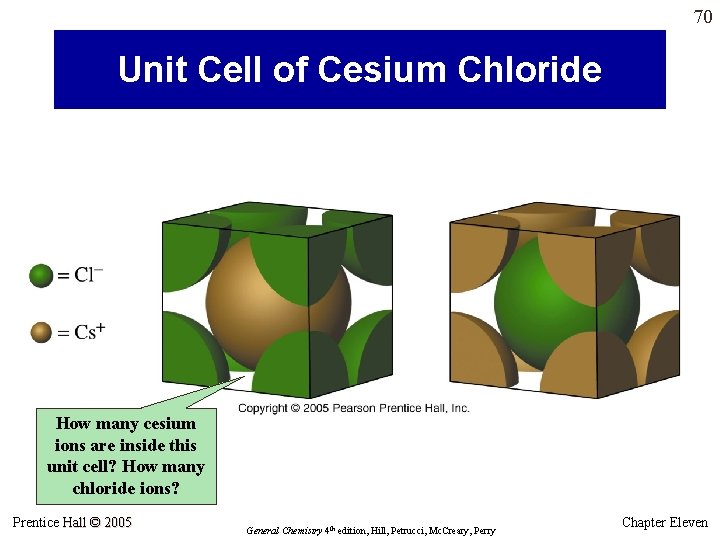
70 Unit Cell of Cesium Chloride How many cesium ions are inside this unit cell? How many chloride ions? Prentice Hall © 2005 General Chemistry 4 th edition, Hill, Petrucci, Mc. Creary, Perry Chapter Eleven
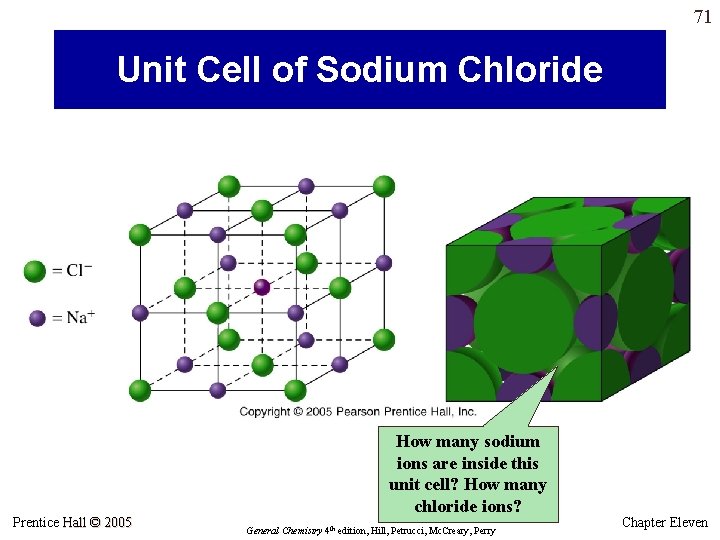
71 Unit Cell of Sodium Chloride Prentice Hall © 2005 How many sodium ions are inside this unit cell? How many chloride ions? General Chemistry 4 th edition, Hill, Petrucci, Mc. Creary, Perry Chapter Eleven
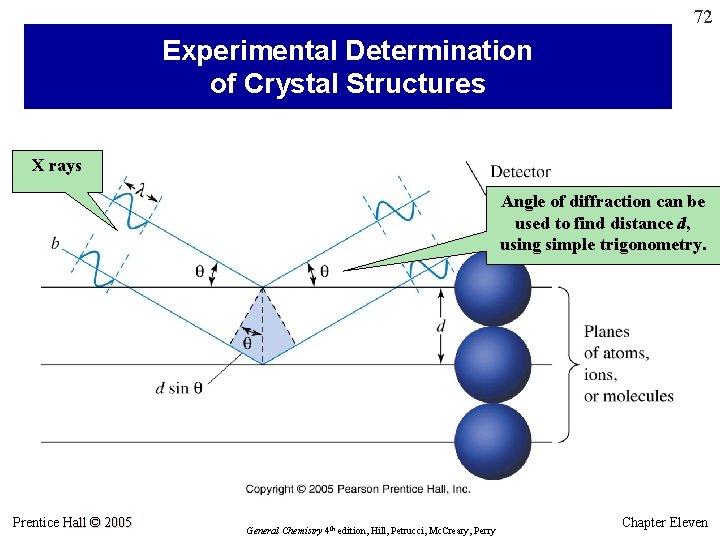
72 Experimental Determination of Crystal Structures X rays Angle of diffraction can be used to find distance d, using simple trigonometry. Prentice Hall © 2005 General Chemistry 4 th edition, Hill, Petrucci, Mc. Creary, Perry Chapter Eleven
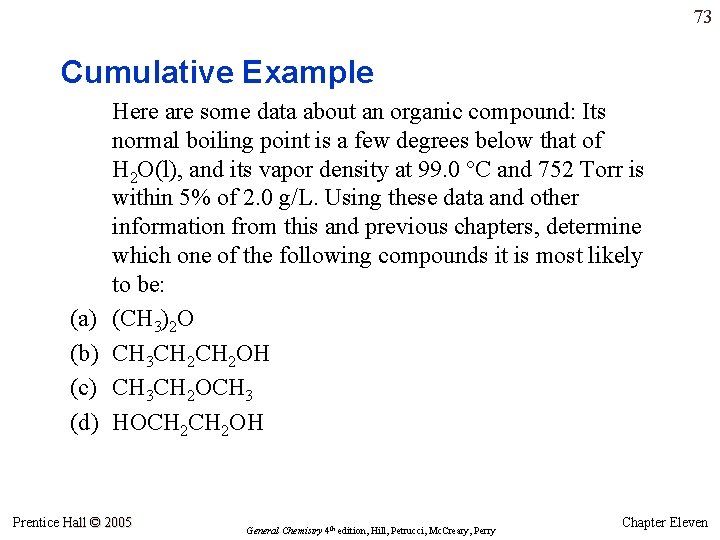
73 Cumulative Example (a) (b) (c) (d) Here are some data about an organic compound: Its normal boiling point is a few degrees below that of H 2 O(l), and its vapor density at 99. 0 °C and 752 Torr is within 5% of 2. 0 g/L. Using these data and other information from this and previous chapters, determine which one of the following compounds it is most likely to be: (CH 3)2 O CH 3 CH 2 OH CH 3 CH 2 OCH 3 HOCH 2 OH Prentice Hall © 2005 General Chemistry 4 th edition, Hill, Petrucci, Mc. Creary, Perry Chapter Eleven