
Chapter Eight Managing Strategy and Strategic Planning Slide


- Slides: 35
Chapter Eight Managing Strategy and Strategic Planning Slide content created by Charlie Cook, The University of West Alabama Copyright © Houghton Mifflin Company. All rights reserved.
Learning Objectives After studying this chapter, you should be able to: 1. Discuss the components of strategy, types of strategic alternatives, and the distinction between strategy formulation and strategy implementation. 2. Describe how to use SWOT analysis in formulating strategy. 3. Identify and describe various alternative approaches to business-level strategy formulation. 4. Describe how business-level strategies are implemented. 5. Identify and describe various alternative approaches to corporate-level strategy formulation. 6. Describe how corporate-level strategies are implemented. 7. Discuss international and global strategies. Copyright © Houghton Mifflin Company. All rights reserved. 2
The Nature of Strategic Management • Strategy – A comprehensive plan for accomplishing an organization’s goals. • Strategic Management – A way of approaching business opportunities and challenges aimed at formulating and implementing effective strategies. • Effective Strategies – Strategies that promote a superior alignment between the organization and its environment and the achievement of its goals. Copyright © Houghton Mifflin Company. All rights reserved. 3
Components of Strategy • Distinctive Competence – Something an organization does exceptionally well. • Scope – Range of markets in which an organization will compete. • Resource Deployment – How an organization will distribute its resources across the areas in which it competes. Copyright © Houghton Mifflin Company. All rights reserved. 4
Types of Strategic Alternatives • Business-Level Strategy – The set of strategic alternatives that an organization chooses from as it conducts business in a particular industry or a particular market. • Corporate-Level Strategy – The set of strategic alternatives that an organization chooses from as it manages its operations simultaneously across several industries and several markets. Copyright © Houghton Mifflin Company. All rights reserved. 5
Strategy Formulation and Implementation • Strategy Formulation – The set of processes involved in creating or determining the organization’s strategies; it focuses on the content of strategies. • Strategy Implementation – The methods by which strategies are operationalized or executed within the organization; it focuses on the processes through which strategies are achieved. Copyright © Houghton Mifflin Company. All rights reserved. 6
Strategy Formulation and Implementation (cont’d) • Deliberate Strategy – A plan, chosen and implemented to support specific goals, that is the result of a rational, systematic, and planned process of strategy formulation and implementation. • Emergent Strategy – A pattern of action that develops over time in the absence of goals or missions, or despite goals and missions. Copyright © Houghton Mifflin Company. All rights reserved. 7
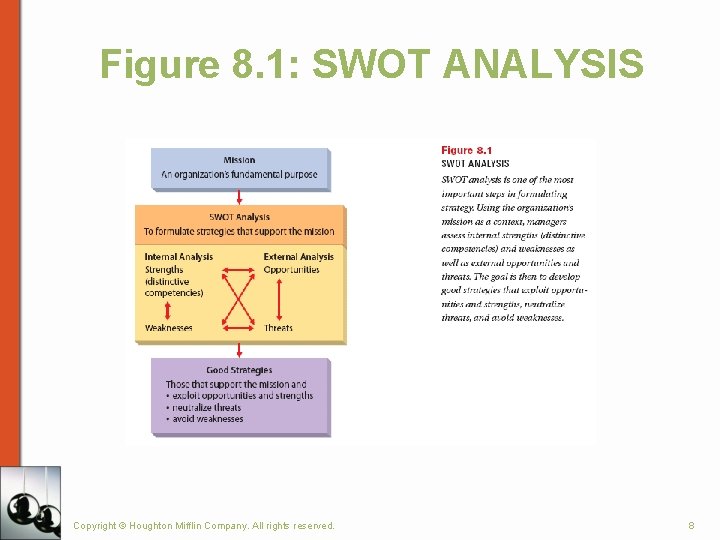
Figure 8. 1: SWOT ANALYSIS Copyright © Houghton Mifflin Company. All rights reserved. 8
Using SWOT Analysis to Formulate Strategy • Evaluating Organizational Strengths – Organizational strengths • are skills and abilities enabling an organization to conceive of and implement strategies. – Common organizational strengths • are organizational capabilities possessed by numerous competing firms. – Distinctive competencies • are useful for competitive advantage and superior performance. – Imitation of distinctive competencies • is duplicating another firm’s distinctive competence. Copyright © Houghton Mifflin Company. All rights reserved. 9
Using SWOT Analysis to Formulate Strategy (cont’d) • Evaluating Organizational Strengths (cont’d) – Sustained competitive advantage • occurs when a distinctive competence cannot be easily duplicated. • is what remains after all attempts at strategic imitations have ceased. – Strategic imitation is difficult when: • Distinctive competence is based on unique historical circumstances. • Competitors do not understand the nature or character of a firm’s competence. • The competence is based on a complex phenomenon, such as organizational culture. Copyright © Houghton Mifflin Company. All rights reserved. 10
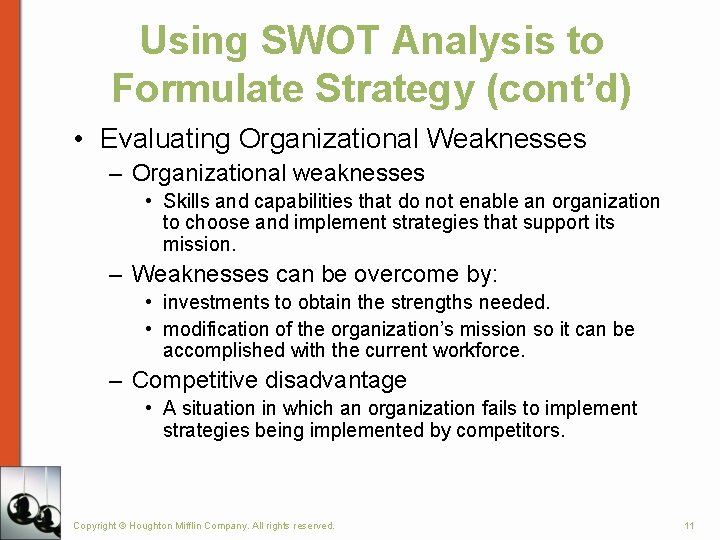
Using SWOT Analysis to Formulate Strategy (cont’d) • Evaluating Organizational Weaknesses – Organizational weaknesses • Skills and capabilities that do not enable an organization to choose and implement strategies that support its mission. – Weaknesses can be overcome by: • investments to obtain the strengths needed. • modification of the organization’s mission so it can be accomplished with the current workforce. – Competitive disadvantage • A situation in which an organization fails to implement strategies being implemented by competitors. Copyright © Houghton Mifflin Company. All rights reserved. 11
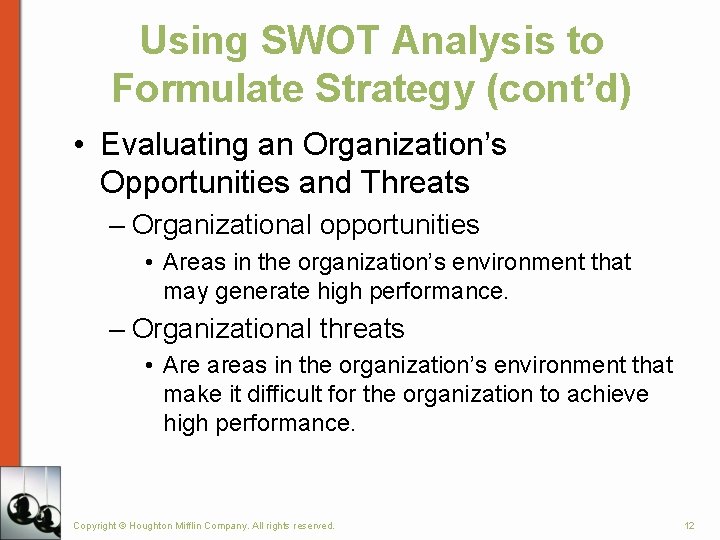
Using SWOT Analysis to Formulate Strategy (cont’d) • Evaluating an Organization’s Opportunities and Threats – Organizational opportunities • Areas in the organization’s environment that may generate high performance. – Organizational threats • Are areas in the organization’s environment that make it difficult for the organization to achieve high performance. Copyright © Houghton Mifflin Company. All rights reserved. 12
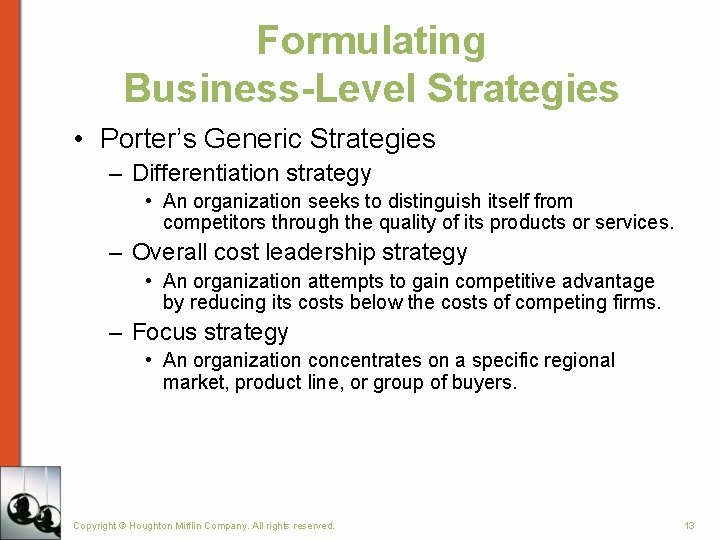
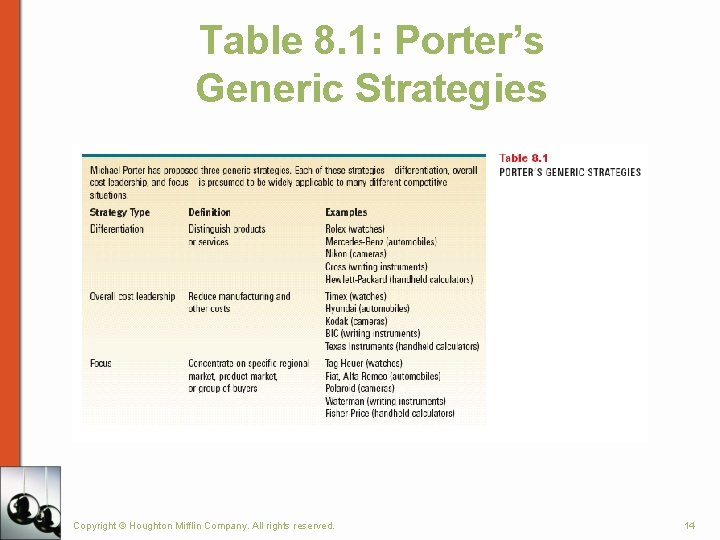
Formulating Business-Level Strategies • Porter’s Generic Strategies – Differentiation strategy • An organization seeks to distinguish itself from competitors through the quality of its products or services. – Overall cost leadership strategy • An organization attempts to gain competitive advantage by reducing its costs below the costs of competing firms. – Focus strategy • An organization concentrates on a specific regional market, product line, or group of buyers. Copyright © Houghton Mifflin Company. All rights reserved. 13
Table 8. 1: Porter’s Generic Strategies Copyright © Houghton Mifflin Company. All rights reserved. 14
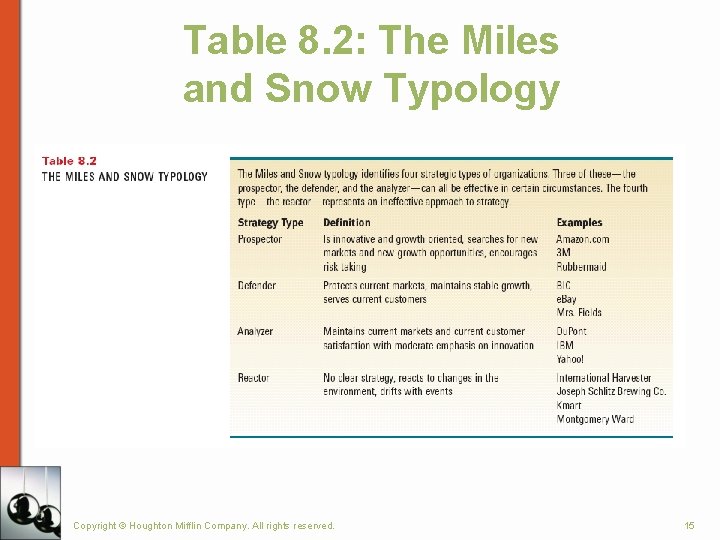
Table 8. 2: The Miles and Snow Typology Copyright © Houghton Mifflin Company. All rights reserved. 15
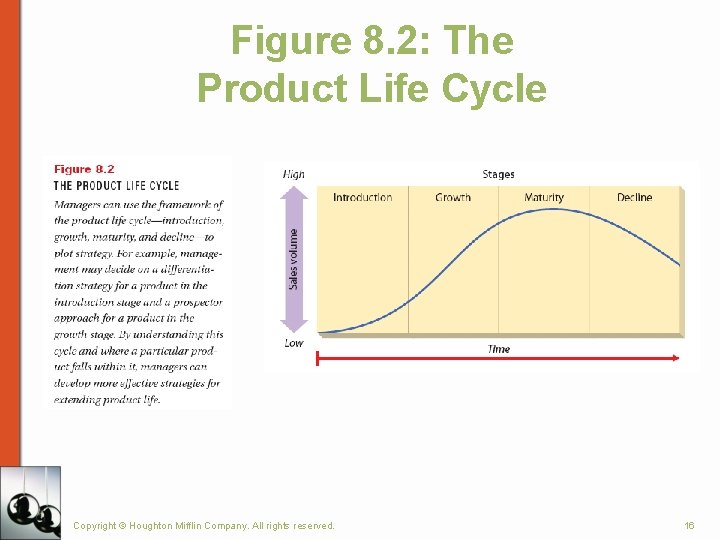
Figure 8. 2: The Product Life Cycle Copyright © Houghton Mifflin Company. All rights reserved. 16
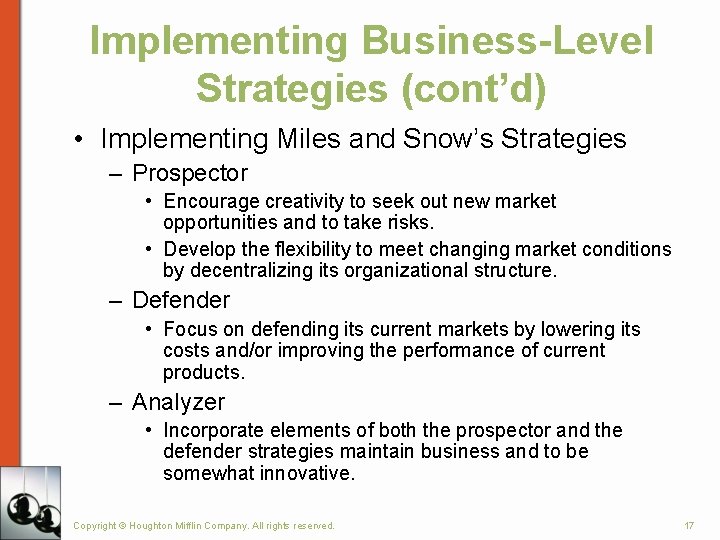
Implementing Business-Level Strategies (cont’d) • Implementing Miles and Snow’s Strategies – Prospector • Encourage creativity to seek out new market opportunities and to take risks. • Develop the flexibility to meet changing market conditions by decentralizing its organizational structure. – Defender • Focus on defending its current markets by lowering its costs and/or improving the performance of current products. – Analyzer • Incorporate elements of both the prospector and the defender strategies maintain business and to be somewhat innovative. Copyright © Houghton Mifflin Company. All rights reserved. 17
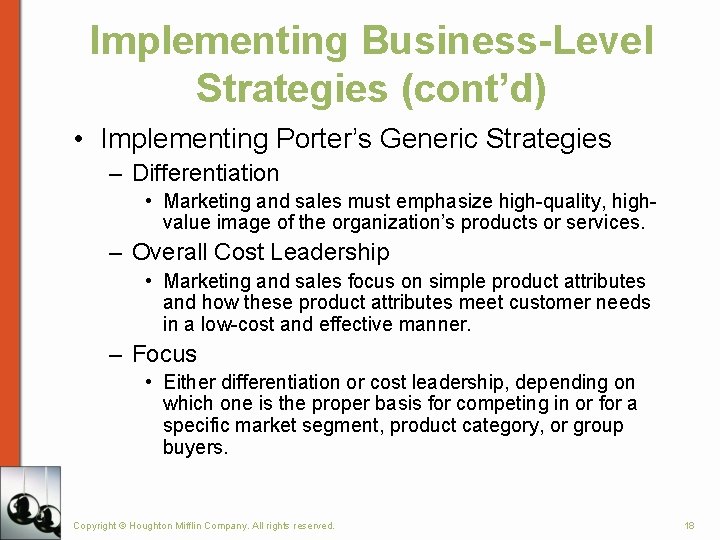
Implementing Business-Level Strategies (cont’d) • Implementing Porter’s Generic Strategies – Differentiation • Marketing and sales must emphasize high-quality, highvalue image of the organization’s products or services. – Overall Cost Leadership • Marketing and sales focus on simple product attributes and how these product attributes meet customer needs in a low-cost and effective manner. – Focus • Either differentiation or cost leadership, depending on which one is the proper basis for competing in or for a specific market segment, product category, or group buyers. Copyright © Houghton Mifflin Company. All rights reserved. 18
Formulating Corporate-Level Strategies • Strategic Business Units – Each business or group of businesses within an organization is engaged in serving the same markets, customers, or products. • Diversification – The number of businesses an organization is engaged in and the extent to which these businesses are related to one another Copyright © Houghton Mifflin Company. All rights reserved. 19
Formulating Corporate-Level Strategies (cont’d) • Single-Product Strategy – An organization manufactures one product or service and sells it in a single geographic market. • Related Diversification – A strategy in which an organization operates in several different businesses, industries, or markets that are somehow linked. – Avoids the disadvantages and risks of a singleproduct strategy. Copyright © Houghton Mifflin Company. All rights reserved. 20
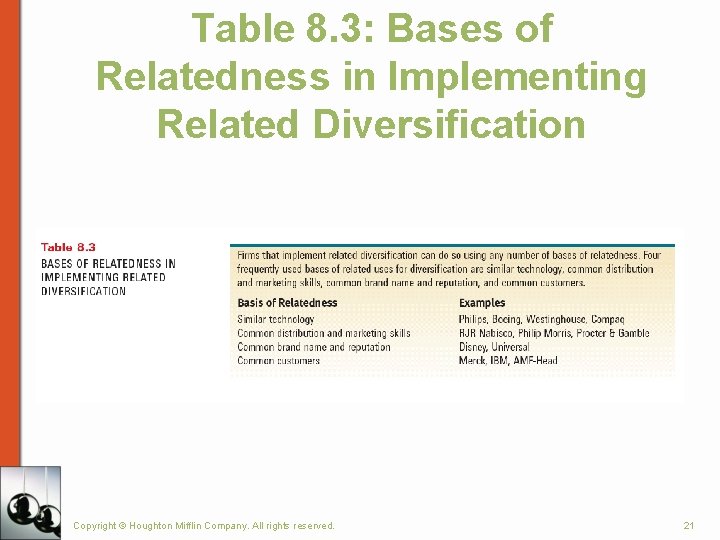
Table 8. 3: Bases of Relatedness in Implementing Related Diversification Copyright © Houghton Mifflin Company. All rights reserved. 21
Formulating Corporate-Level Strategies (cont’d) • Advantages of Related Diversification – Reduces an organization’s dependence on any one of its business activities and thus reduces economic risk. – Reduces overhead costs associated with managing any one business through economies of scale and economies of scope. – Allows an organization to exploit its strengths and capabilities in more than one business. – Synergy exists among a set of businesses when the businesses’ value together is greater than their economic value separately. Copyright © Houghton Mifflin Company. All rights reserved. 22
Formulating Corporate-Level Strategies (cont’d) • Unrelated Diversification – An organization operates multiple businesses that are not logically associated with one another. – Advantages • Stable of performance over time due to business cycle differences among the multiple businesses. • Allocation of resources to areas with the highest return potentials to maximize corporate performance. – Disadvantages • Poor performance due to the complexity of managing a diversity of businesses. • Failing to exploit key synergies puts the firm at a competitive disadvantage to firms with related diversification strategies. Copyright © Houghton Mifflin Company. All rights reserved. 23
Implementing Corporate-Level Strategies • Becoming a Diversified Firm – Internal development of new products • Developing products and services within the boundaries of traditional business operations. – Replacement of suppliers and customers • Backward vertical integration – Beginning a business that furnishes resources previously handled by a supplier. • Forward vertical integration – Beginning a business previously handled by an intermediary and selling more directly to customers. Copyright © Houghton Mifflin Company. All rights reserved. 24
Implementing Corporate-Level Strategies (cont’d) • Becoming a Diversified Firm (cont’d) – Merger • Purchase of one firm by another firm of approximately the same size. – Acquisition • Purchase of a firm by another firm that is considerably larger. – Purposes of mergers and acquisitions • To diversify through vertical integration. • To acquire complementary products or services linked by a common technology and common customers. • To create or exploit synergies that reduce the combined organizations’ costs of doing business to increase revenues. Copyright © Houghton Mifflin Company. All rights reserved. 25
Managing Diversification • Major Tools for Managing Diversification – Organization structure • A detailed discussion of organization structure is contained in Chapter 12. – Portfolio management techniques • Methods that diversified organizations use to make decisions about what businesses to engage in and how to manage these multiple businesses to maximize corporate performance. – Two important portfolio management techniques • The BCG Matrix • The GE Business Screen Copyright © Houghton Mifflin Company. All rights reserved. 26
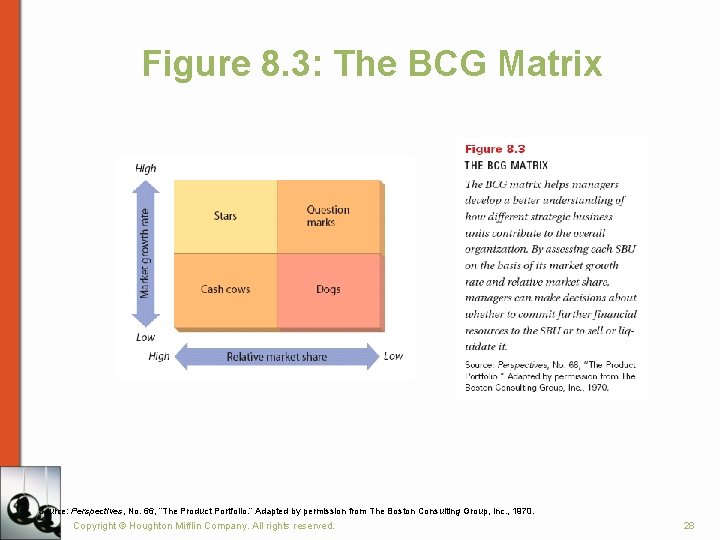
Managing Diversification (cont’d) • BCG Matrix – A method of evaluating businesses relative to the growth rate of their market and the organization’s share of the market. – The matrix classifies the types of businesses that a diversified organization can engage as: • “Dogs” have small market shares and no growth prospects. • “Cash cows” have large shares of mature markets. • “Question marks” have small market shares in quickly growing markets. • “Stars” have large shares of rapidly growing markets. Copyright © Houghton Mifflin Company. All rights reserved. 27
Figure 8. 3: The BCG Matrix Source: Perspectives, No. 66, “The Product Portfolio. ” Adapted by permission from The Boston Consulting Group, Inc. , 1970. Copyright © Houghton Mifflin Company. All rights reserved. 28
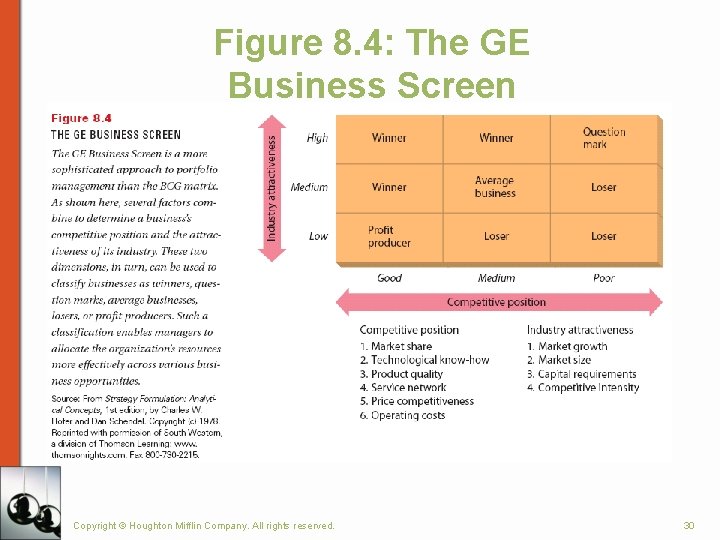
Managing Diversification • GE Business Screen – A method of evaluating business in a diversified portfolio along two dimensions, each of which contains multiple factors: • Industry attractiveness. • Competitive position (strength) of each firm in the portfolio. – In general, the more attractive the industry and the more competitive a business is, the more resources an organization should invest in that business. Copyright © Houghton Mifflin Company. All rights reserved. 29
Figure 8. 4: The GE Business Screen Copyright © Houghton Mifflin Company. All rights reserved. 30
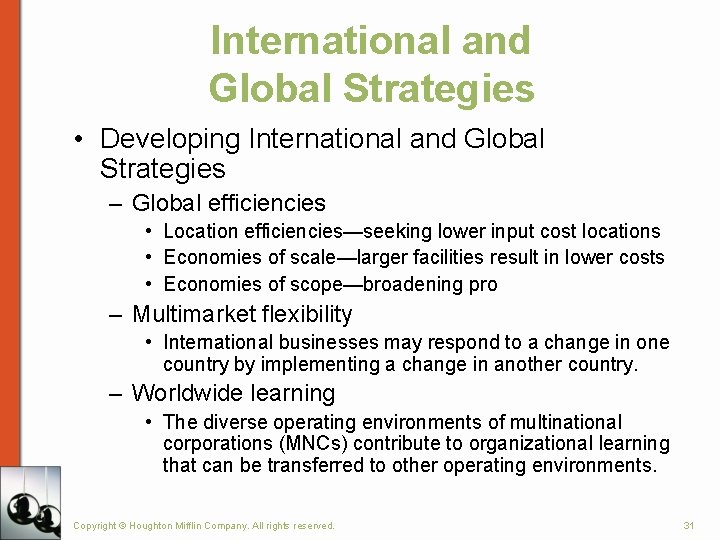
International and Global Strategies • Developing International and Global Strategies – Global efficiencies • Location efficiencies—seeking lower input cost locations • Economies of scale—larger facilities result in lower costs • Economies of scope—broadening pro – Multimarket flexibility • International businesses may respond to a change in one country by implementing a change in another country. – Worldwide learning • The diverse operating environments of multinational corporations (MNCs) contribute to organizational learning that can be transferred to other operating environments. Copyright © Houghton Mifflin Company. All rights reserved. 31
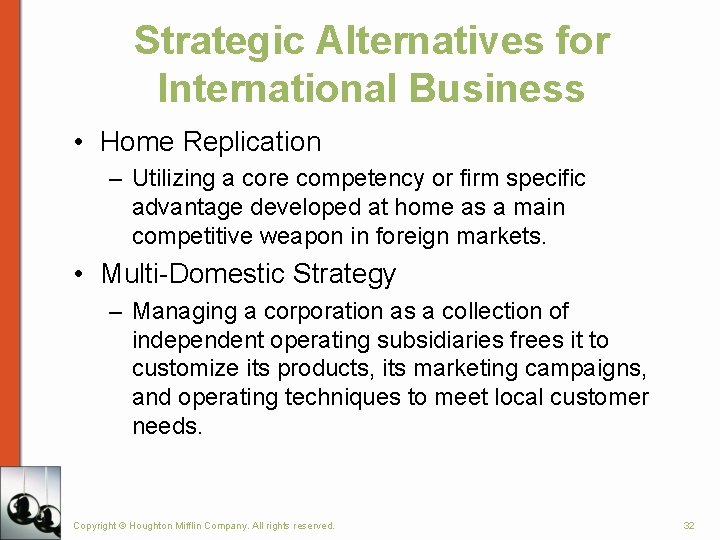
Strategic Alternatives for International Business • Home Replication – Utilizing a core competency or firm specific advantage developed at home as a main competitive weapon in foreign markets. • Multi-Domestic Strategy – Managing a corporation as a collection of independent operating subsidiaries frees it to customize its products, its marketing campaigns, and operating techniques to meet local customer needs. Copyright © Houghton Mifflin Company. All rights reserved. 32
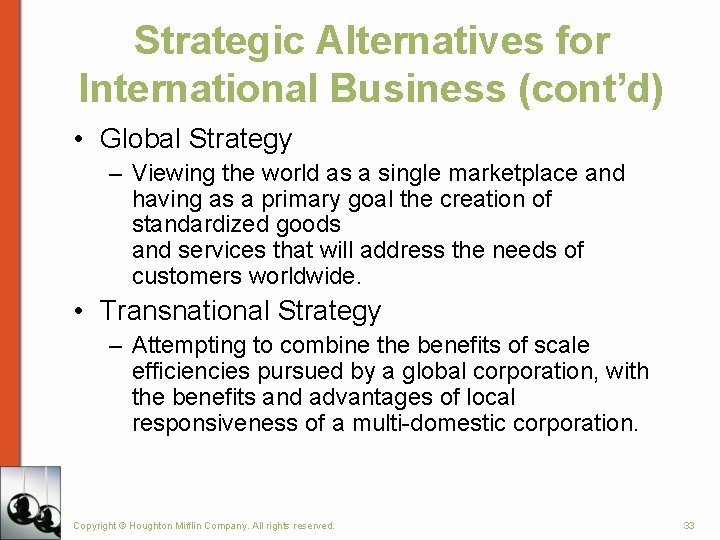
Strategic Alternatives for International Business (cont’d) • Global Strategy – Viewing the world as a single marketplace and having as a primary goal the creation of standardized goods and services that will address the needs of customers worldwide. • Transnational Strategy – Attempting to combine the benefits of scale efficiencies pursued by a global corporation, with the benefits and advantages of local responsiveness of a multi-domestic corporation. Copyright © Houghton Mifflin Company. All rights reserved. 33
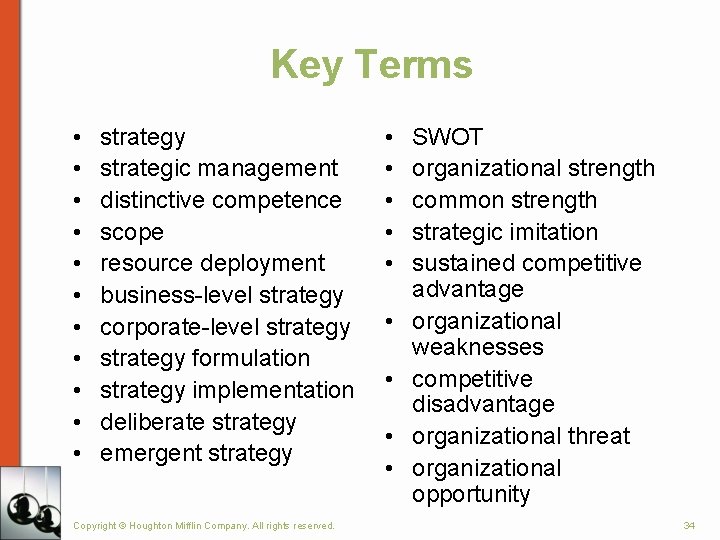
Key Terms • • • strategy strategic management distinctive competence scope resource deployment business-level strategy corporate-level strategy formulation strategy implementation deliberate strategy emergent strategy Copyright © Houghton Mifflin Company. All rights reserved. • • • SWOT organizational strength common strength strategic imitation sustained competitive advantage organizational weaknesses competitive disadvantage organizational threat organizational opportunity 34
Key Terms (cont’d) • differentiation strategy • overall cost leadership strategy • focus strategy • prospector strategy • defender strategy • analyzer strategy • reactor strategy • product life cycle • diversification • single-product strategy • related diversification Copyright © Houghton Mifflin Company. All rights reserved. • unrelated diversification • backward vertical integration • forward vertical integration • merger • acquisition • BCG matrix • GE Business Screen • home replication strategy • multidomestic strategy • global strategy • transnational strategy 35