
Chapter Eight Gasoline Manufacturing Processes Catalytic Reforming Alkylation

- Slides: 53
Chapter Eight: Gasoline Manufacturing Processes Catalytic Reforming Alkylation Polymerization Isomerization 1
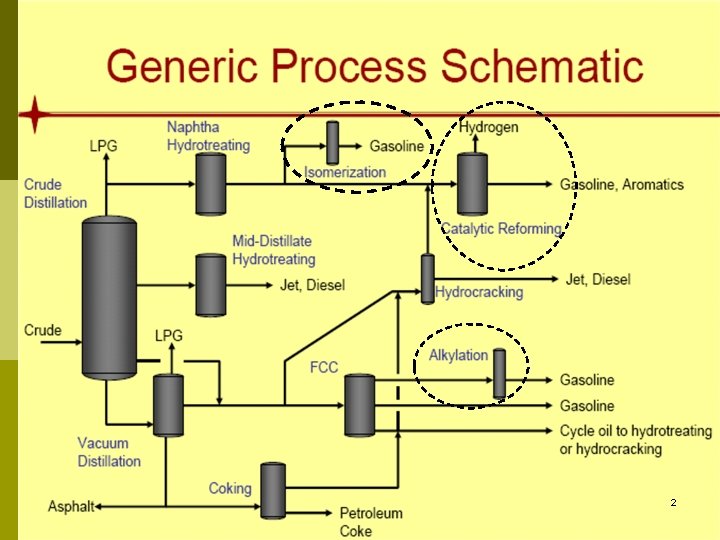
2
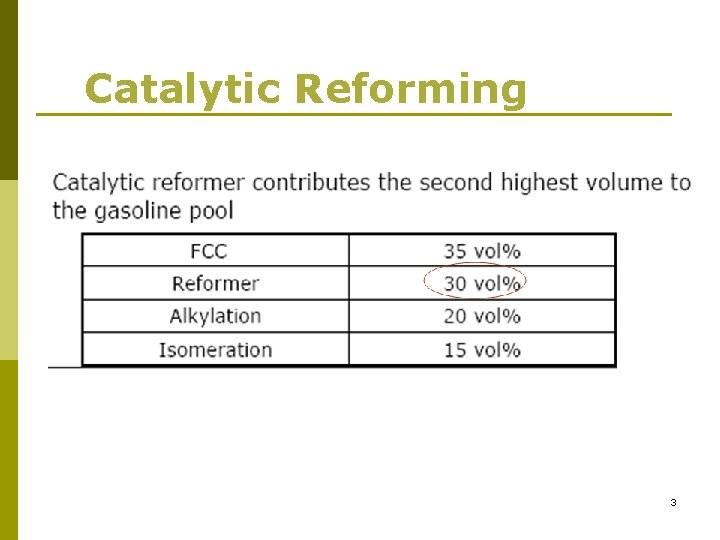
Catalytic Reforming 3
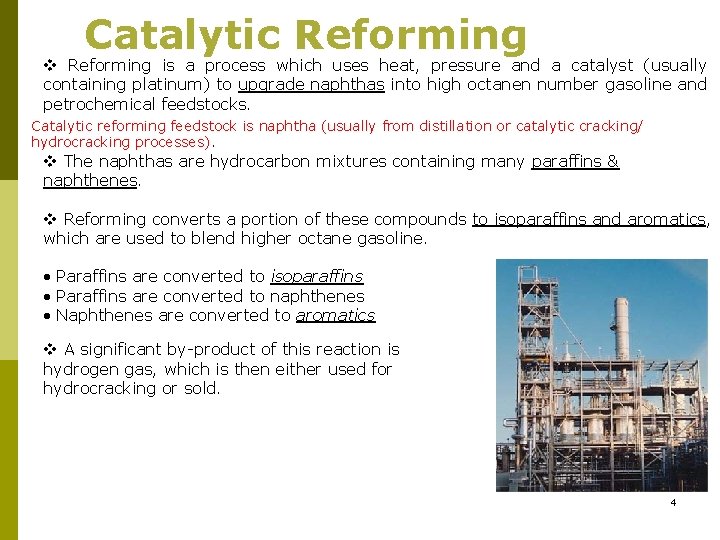
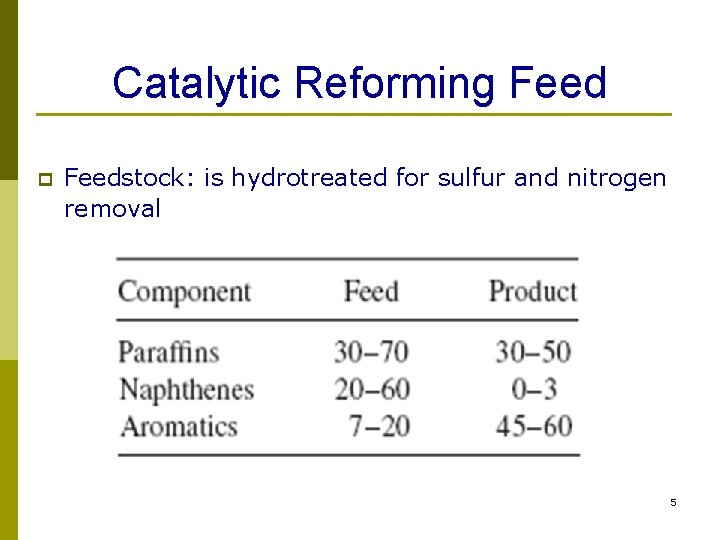
Catalytic Reforming v Reforming is a process which uses heat, pressure and a catalyst (usually containing platinum) to upgrade naphthas into high octanen number gasoline and petrochemical feedstocks. Catalytic reforming feedstock is naphtha (usually from distillation or catalytic cracking/ hydrocracking processes). v The naphthas are hydrocarbon mixtures containing many paraffins & naphthenes. v Reforming converts a portion of these compounds to isoparaffins and aromatics, which are used to blend higher octane gasoline. Paraffins are converted to isoparaffins Paraffins are converted to naphthenes Naphthenes are converted to aromatics v A significant by-product of this reaction is hydrogen gas, which is then either used for hydrocracking or sold. 4
Catalytic Reforming Feed p Feedstock: is hydrotreated for sulfur and nitrogen removal 5
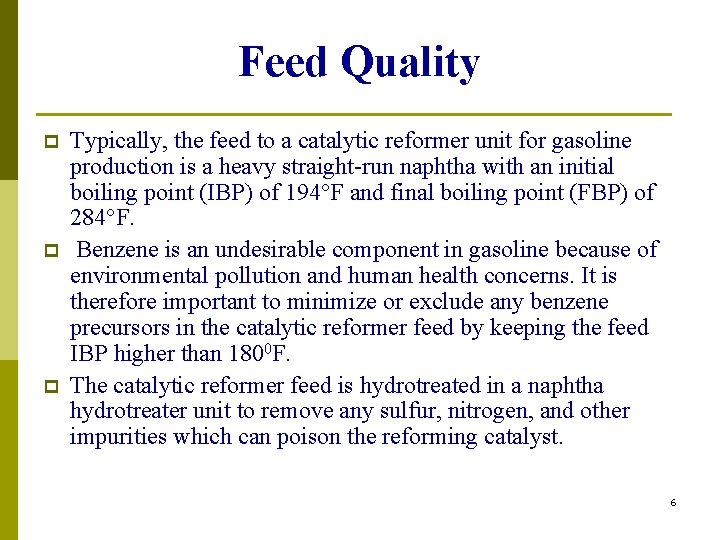
Feed Quality p p p Typically, the feed to a catalytic reformer unit for gasoline production is a heavy straight-run naphtha with an initial boiling point (IBP) of 194°F and final boiling point (FBP) of 284°F. Benzene is an undesirable component in gasoline because of environmental pollution and human health concerns. It is therefore important to minimize or exclude any benzene precursors in the catalytic reformer feed by keeping the feed IBP higher than 1800 F. The catalytic reformer feed is hydrotreated in a naphtha hydrotreater unit to remove any sulfur, nitrogen, and other impurities which can poison the reforming catalyst. 6
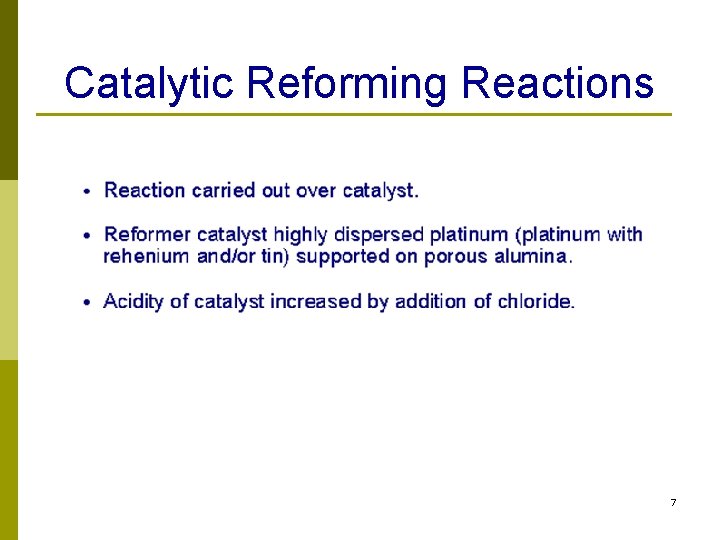
Catalytic Reforming Reactions 7
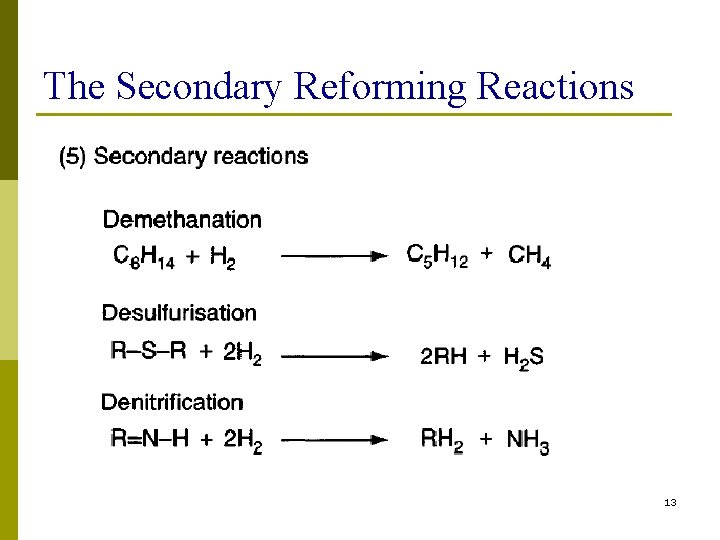
Catalytic Reforming Reactions p The main reforming reactions can be categorized into four groups. p In addition to the main reactions, there also some other secondary reactions. 8
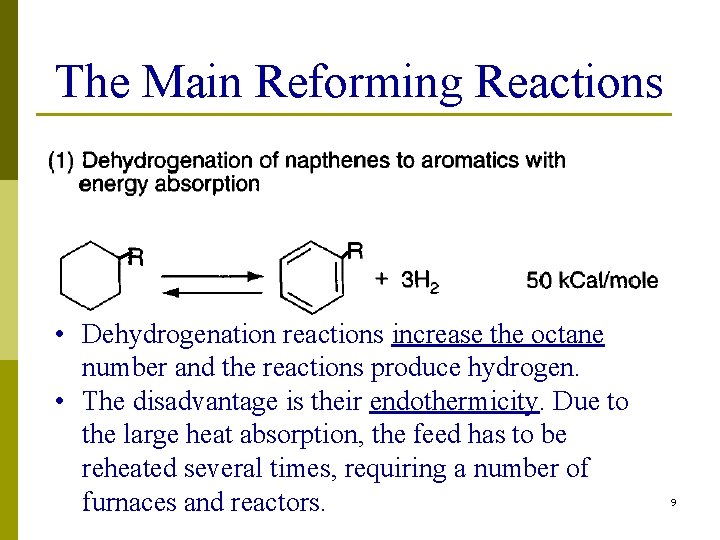
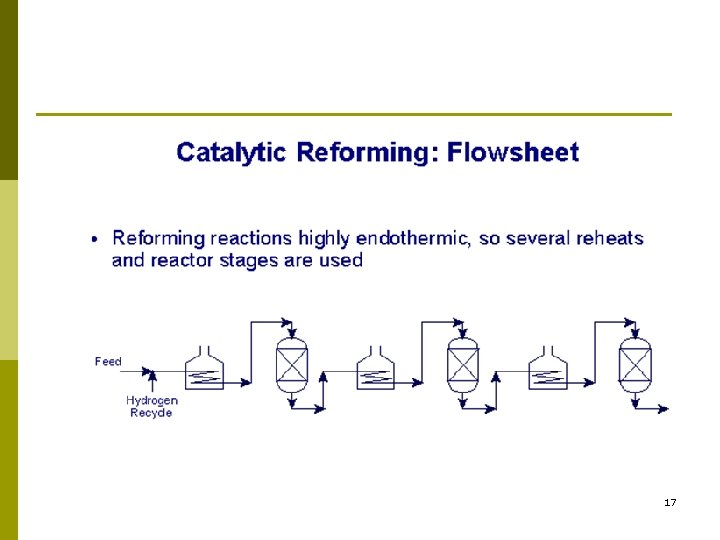
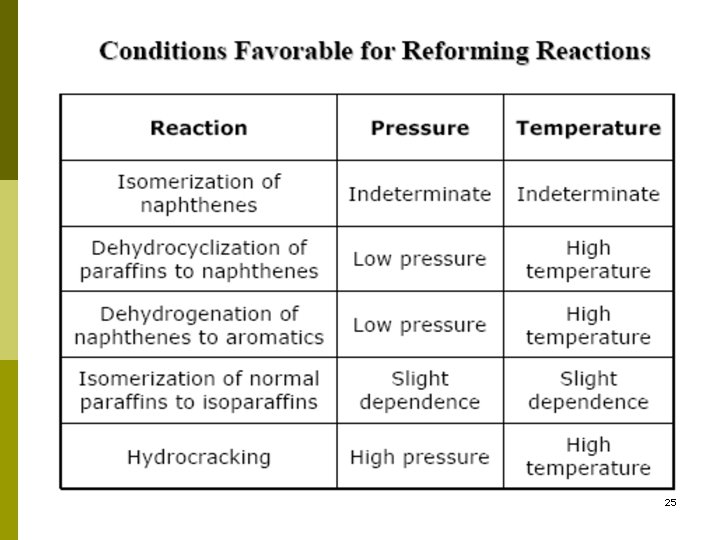
The Main Reforming Reactions • Dehydrogenation reactions increase the octane number and the reactions produce hydrogen. • The disadvantage is their endothermicity. Due to the large heat absorption, the feed has to be reheated several times, requiring a number of furnaces and reactors. 9
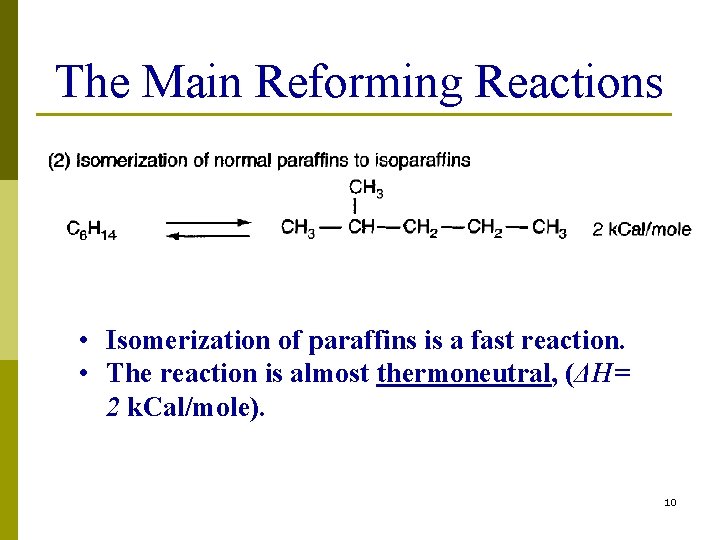
The Main Reforming Reactions • Isomerization of paraffins is a fast reaction. • The reaction is almost thermoneutral, (ΔH= 2 k. Cal/mole). 10
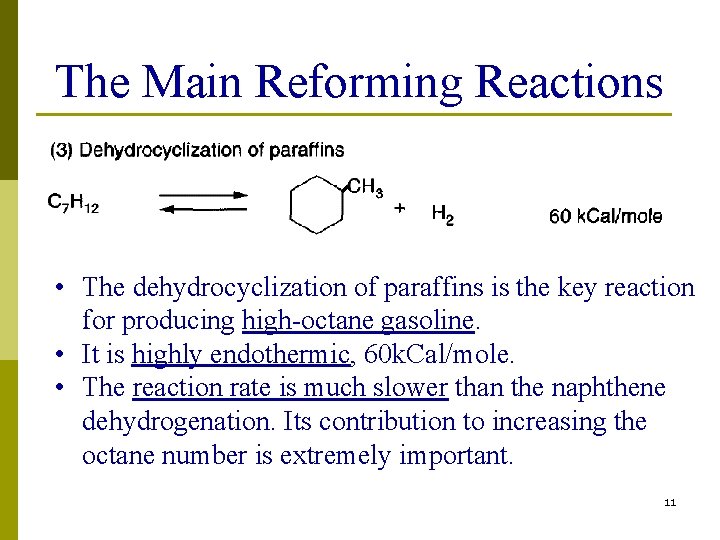
The Main Reforming Reactions • The dehydrocyclization of paraffins is the key reaction for producing high-octane gasoline. • It is highly endothermic, 60 k. Cal/mole. • The reaction rate is much slower than the naphthene dehydrogenation. Its contribution to increasing the octane number is extremely important. 11
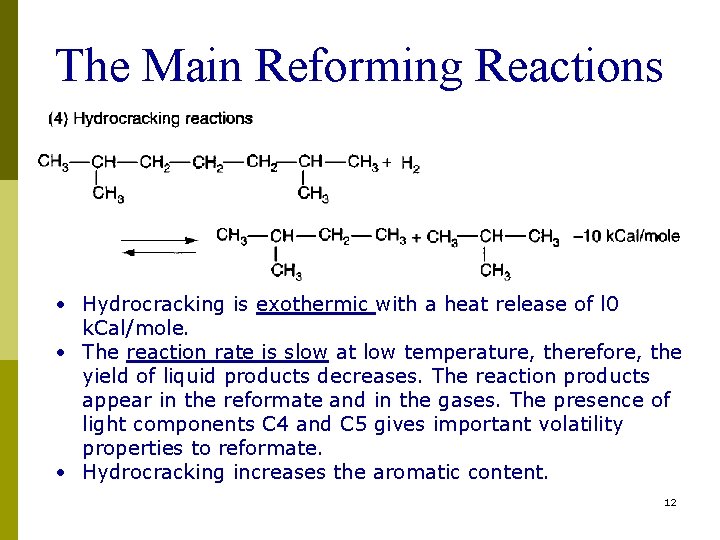
The Main Reforming Reactions • Hydrocracking is exothermic with a heat release of l 0 k. Cal/mole. • The reaction rate is slow at low temperature, therefore, the yield of liquid products decreases. The reaction products appear in the reformate and in the gases. The presence of light components C 4 and C 5 gives important volatility properties to reformate. • Hydrocracking increases the aromatic content. 12
The Secondary Reforming Reactions 13
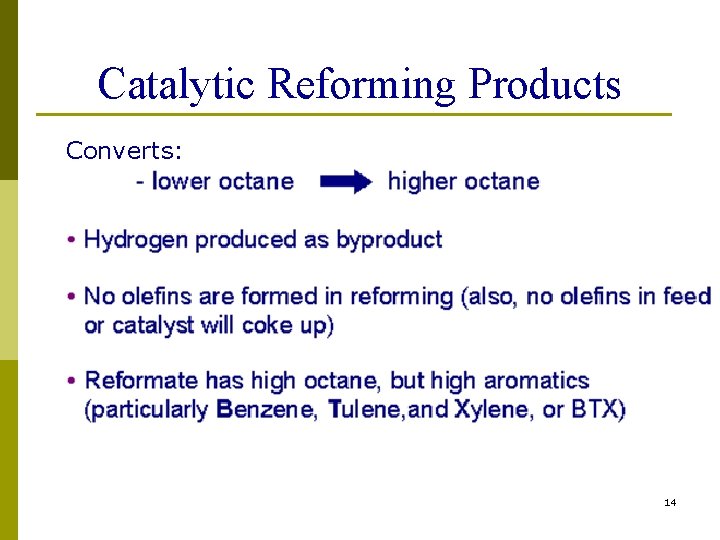
Catalytic Reforming Products Converts: 14
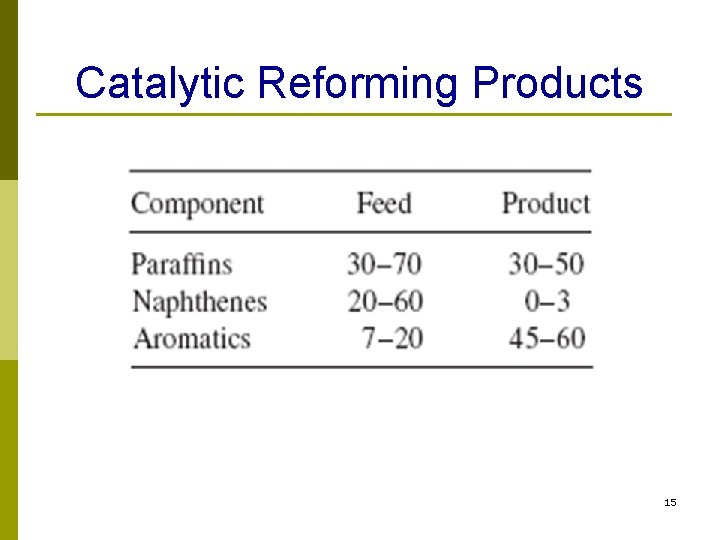
Catalytic Reforming Products 15
16
17
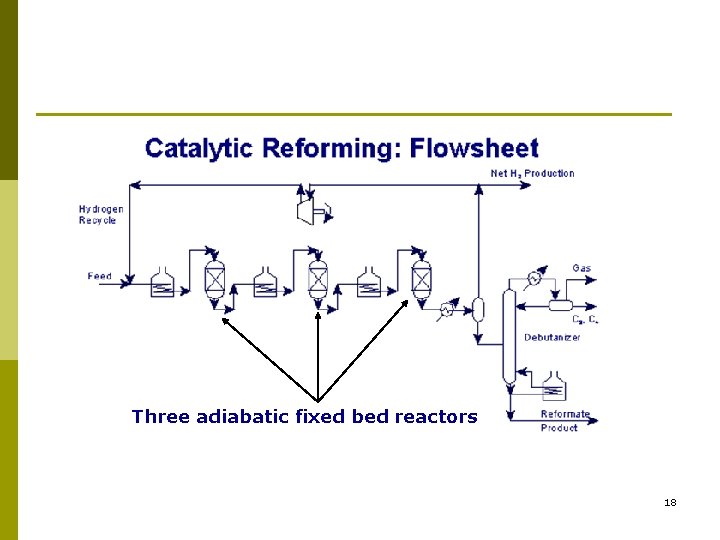
Three adiabatic fixed bed reactors 18
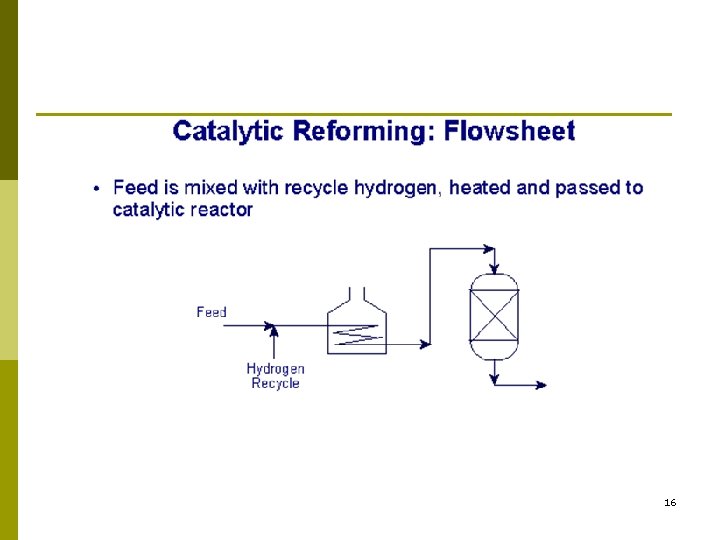
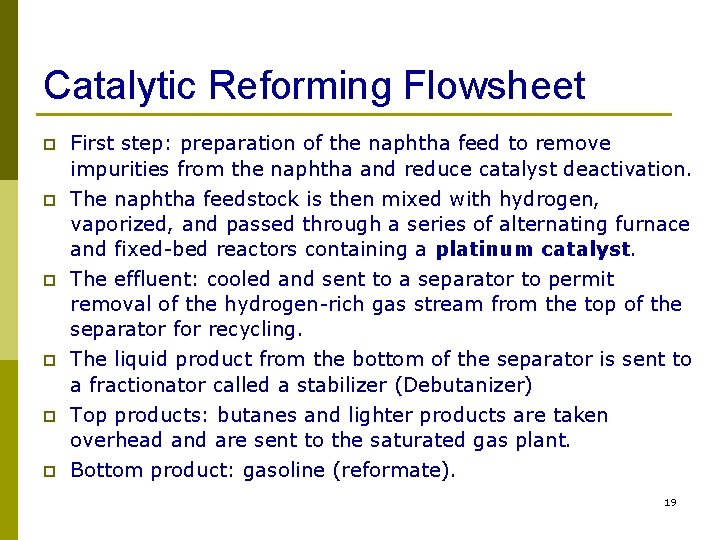
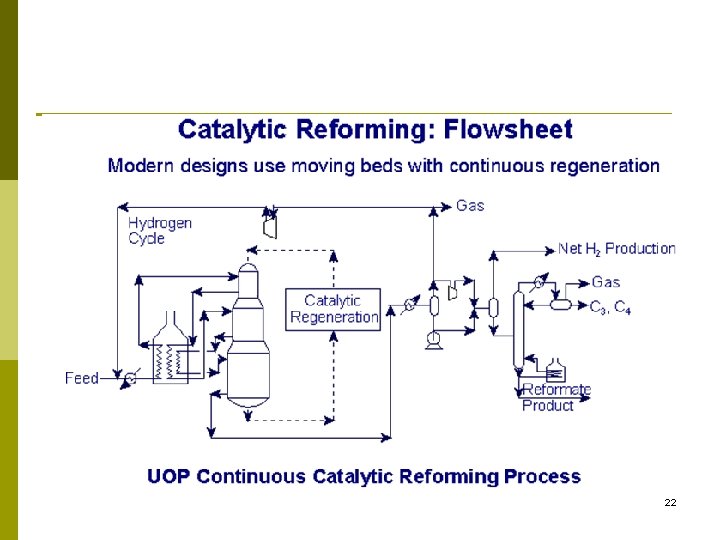
Catalytic Reforming Flowsheet p p p First step: preparation of the naphtha feed to remove impurities from the naphtha and reduce catalyst deactivation. The naphtha feedstock is then mixed with hydrogen, vaporized, and passed through a series of alternating furnace and fixed-bed reactors containing a platinum catalyst. The effluent: cooled and sent to a separator to permit removal of the hydrogen-rich gas stream from the top of the separator for recycling. The liquid product from the bottom of the separator is sent to a fractionator called a stabilizer (Debutanizer) Top products: butanes and lighter products are taken overhead and are sent to the saturated gas plant. Bottom product: gasoline (reformate). 19
20
21
22
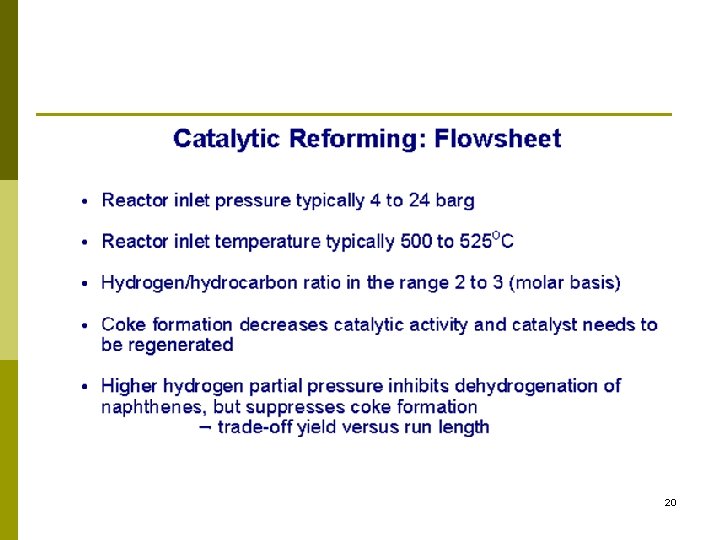
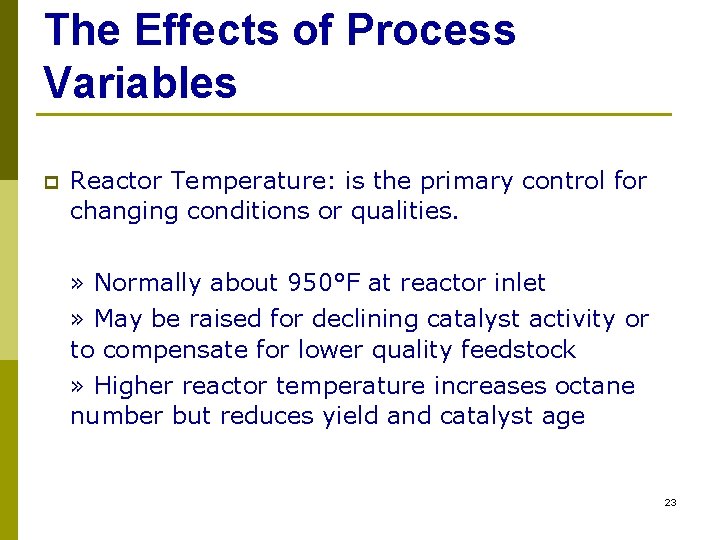
The Effects of Process Variables p Reactor Temperature: is the primary control for changing conditions or qualities. » Normally about 950°F at reactor inlet » May be raised for declining catalyst activity or to compensate for lower quality feedstock » Higher reactor temperature increases octane number but reduces yield and catalyst age 23
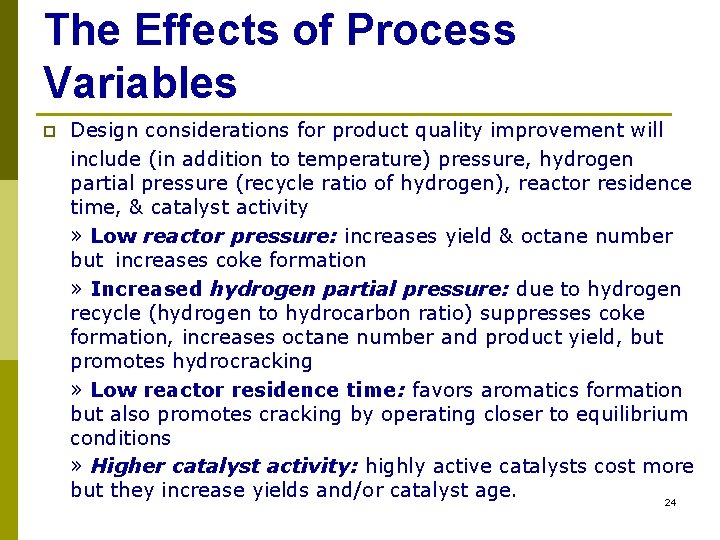
The Effects of Process Variables p Design considerations for product quality improvement will include (in addition to temperature) pressure, hydrogen partial pressure (recycle ratio of hydrogen), reactor residence time, & catalyst activity » Low reactor pressure: increases yield & octane number but increases coke formation » Increased hydrogen partial pressure: due to hydrogen recycle (hydrogen to hydrocarbon ratio) suppresses coke formation, increases octane number and product yield, but promotes hydrocracking » Low reactor residence time: favors aromatics formation but also promotes cracking by operating closer to equilibrium conditions » Higher catalyst activity: highly active catalysts cost more but they increase yields and/or catalyst age. 24
25
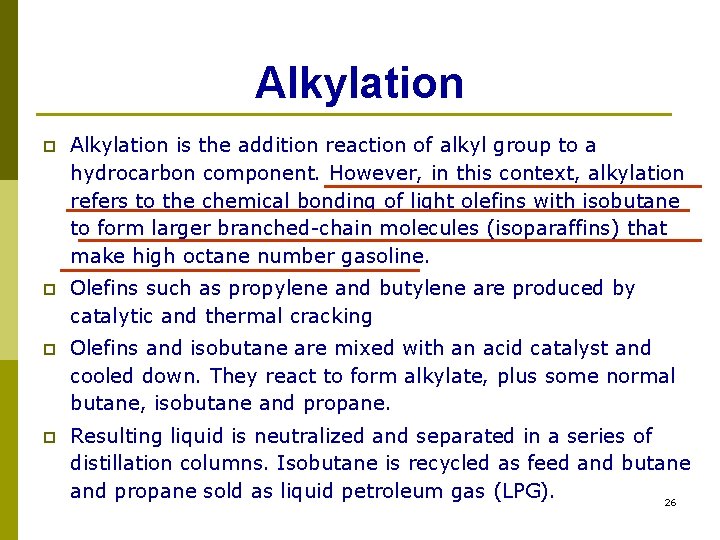
Alkylation p Alkylation is the addition reaction of alkyl group to a hydrocarbon component. However, in this context, alkylation refers to the chemical bonding of light olefins with isobutane to form larger branched-chain molecules (isoparaffins) that make high octane number gasoline. p Olefins such as propylene and butylene are produced by catalytic and thermal cracking p Olefins and isobutane are mixed with an acid catalyst and cooled down. They react to form alkylate, plus some normal butane, isobutane and propane. p Resulting liquid is neutralized and separated in a series of distillation columns. Isobutane is recycled as feed and butane and propane sold as liquid petroleum gas (LPG). 26
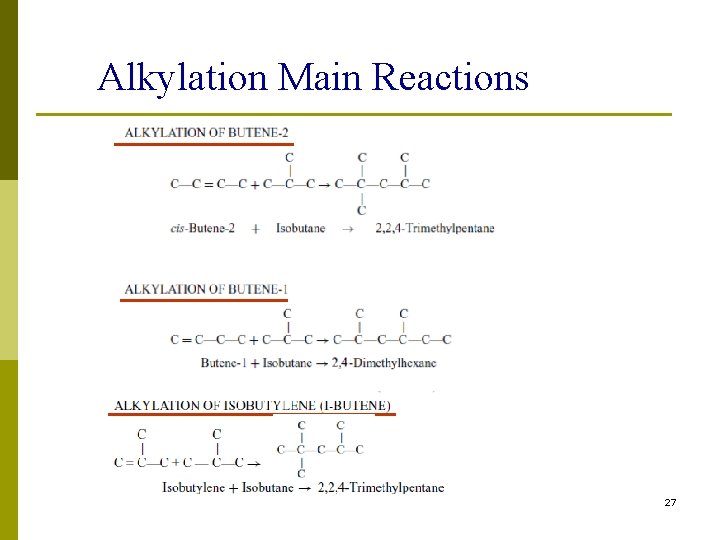
Alkylation Main Reactions 27
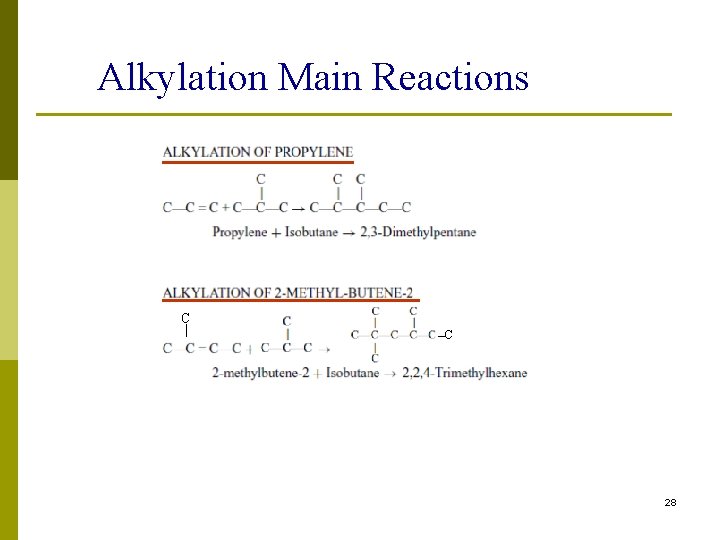
Alkylation Main Reactions C C 28
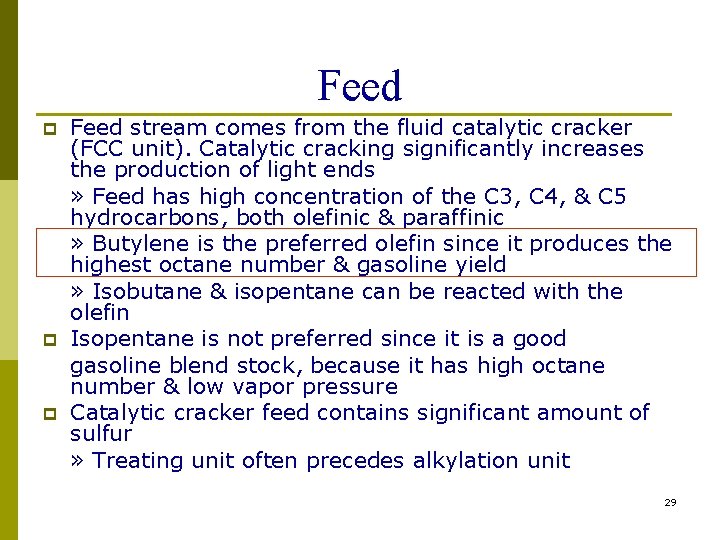
Feed p p p Feed stream comes from the fluid catalytic cracker (FCC unit). Catalytic cracking significantly increases the production of light ends » Feed has high concentration of the C 3, C 4, & C 5 hydrocarbons, both olefinic & paraffinic » Butylene is the preferred olefin since it produces the highest octane number & gasoline yield » Isobutane & isopentane can be reacted with the olefin Isopentane is not preferred since it is a good gasoline blend stock, because it has high octane number & low vapor pressure Catalytic cracker feed contains significant amount of sulfur » Treating unit often precedes alkylation unit 29
Product p p p Alkylation plant: reverse of cracking: small hydrocarbons react to give a larger, highly branched hydrocarbon. An example of a primary reaction that occurs in alkylation is: C 4 H 8 + i - C 4 H 10 ---> C 8 H 18 Alkylate (gasoline) is desirable component for high engine performance because it has: » Very high octane number » Low vapor pressure » Low sulfur levels » Essentially no olefins, benzene or aromatics p Contributes large volume to the gasoline pool (20 % vol) 30
Process p Favored at low temperature and high pressure. p In the presence of catalyst, the reaction is run at very low temperature (40 o. F or lower) and low pressure (5 to 8 atm). Such low operating conditions prevents polymerization or tar formation p The reaction rates are rather slow, so the total contact time in the alkylation reactors is up to 30 minutes. p Typical isobutane: olefin ratios = 8: 1 15: 1. High isobutane: olefin ratio minimizes polymerization. Isobutane is recycled to the reactor. 31
Chemistry p Either HF or H 2 S 04 is used as catalyst p The catalyst promotes carbenium ion on a tertiary isoparaffin that rapidly reacts with any double bond it encounters (propylene, butylene, or pentylene) p Reaction is carried out in the liquid phase at moderate temperatures 32
Operation p p p Capacity of alkylation unit expressed in terms of capacity of alkylate product, not feed capacity Critical measures for success » Alkylate octane number » Volume of olefin & isobutane consumed per volume of alkylate produced & degree of undesirable side reactions » Acid consumption Most important variables in alkylation: » Type of olefin- Propylene, butylene, or pentene » Isobutane concentration » Olefin injection & mixing » Reaction temperature » Catalyst type & strength 33
Catalyst p The catalyst should be a strong acid since weak acids cause polymerization p Hydrofluoric (HF) and H 2 SO 4 are both suitable for use as alkylation catalysts because both are strong acids. p Acid concentration in acid solution needs to be maintained at >88% p Acid is recycled/regenerated from HC to be used again. p Sulfuric acid & HF acid alkylation process are similar - At optimum operating conditions, product quality is also similar 34
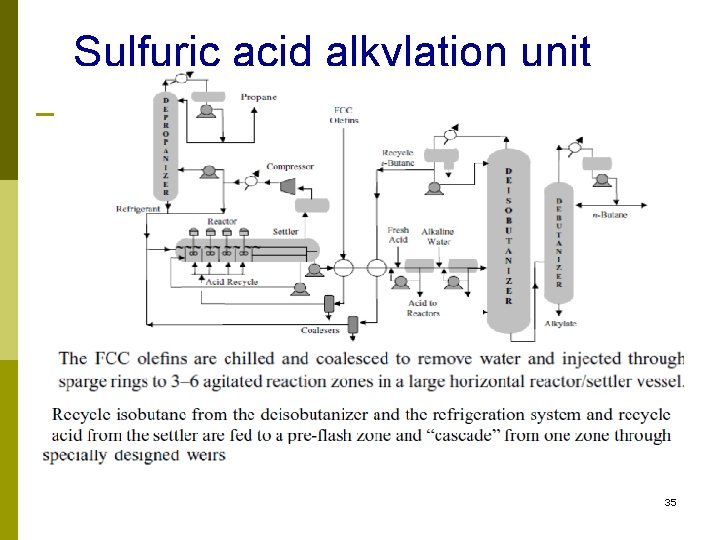
Sulfuric acid alkylation unit 35
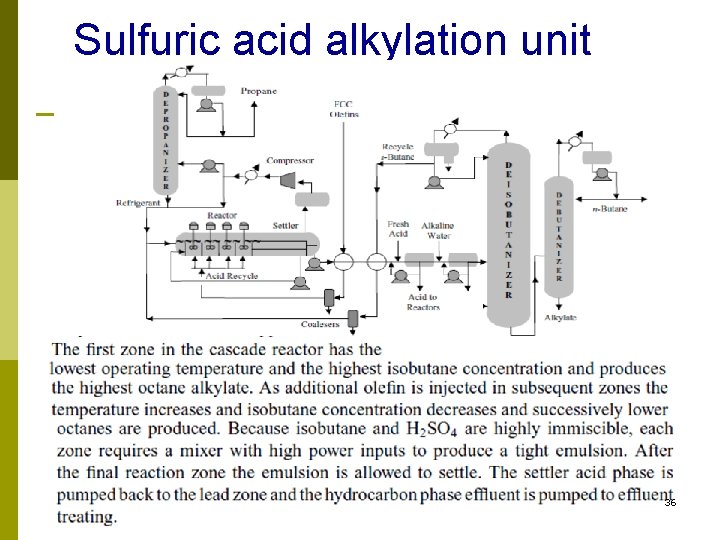
Sulfuric acid alkylation unit 36
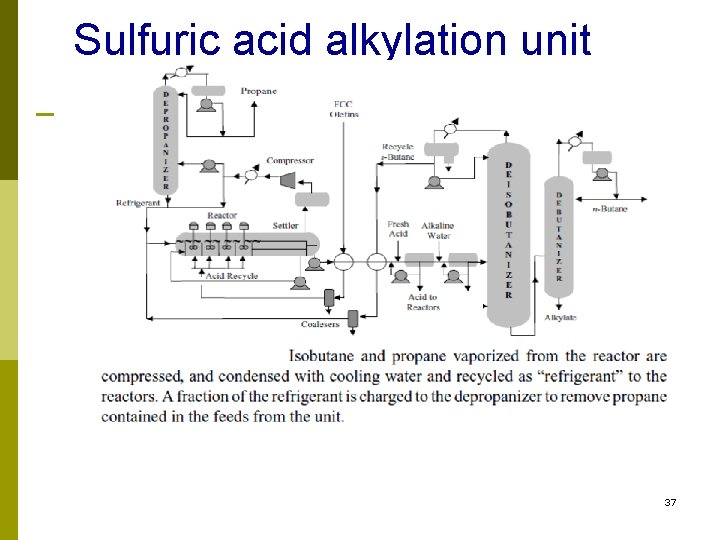
Sulfuric acid alkylation unit 37
Polymerization p Presently replaced by alkylation as it produces 0. 7 barrels of gasoline per barrel of olefin. (alkylation 1. 5 barrels) p Process: Under pressure and temperature, over an acidic catalyst, supported on inert support. React butenes with iso-butane to obtain a high octane number component called polymer gasoline p Uses low temperature reforming to increase the octane number of gasoline p 38
Catalytic Polymerization Background p p p Purpose of the Catalytic Polymerization Unit (CPU) is to upgrade olefins to products of higher market value (gasoline). Feed comes from the catalytic cracking unit and contains C 3+C 4 olefins as well as propane and butane. The product from the CPU is known as Polygas Reactions are exothermic Reactions believed to occur through carbenium ion mechanism 39
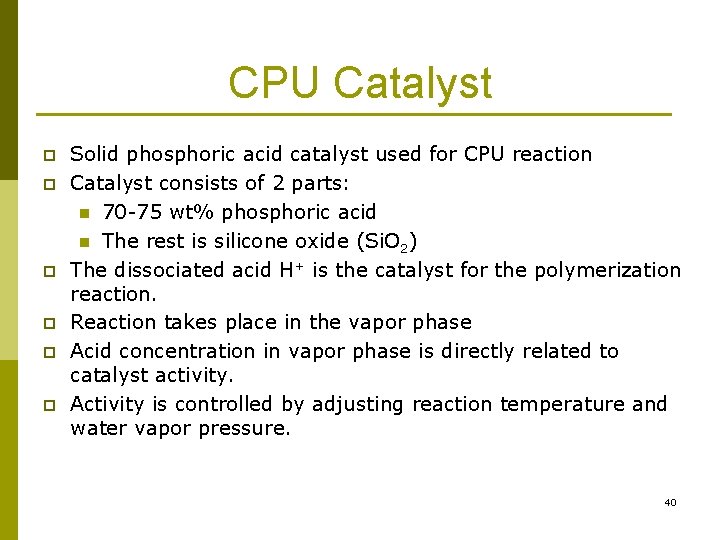
CPU Catalyst p p p Solid phosphoric acid catalyst used for CPU reaction Catalyst consists of 2 parts: n 70 -75 wt% phosphoric acid n The rest is silicone oxide (Si. O 2) The dissociated acid H+ is the catalyst for the polymerization reaction. Reaction takes place in the vapor phase Acid concentration in vapor phase is directly related to catalyst activity. Activity is controlled by adjusting reaction temperature and water vapor pressure. 40
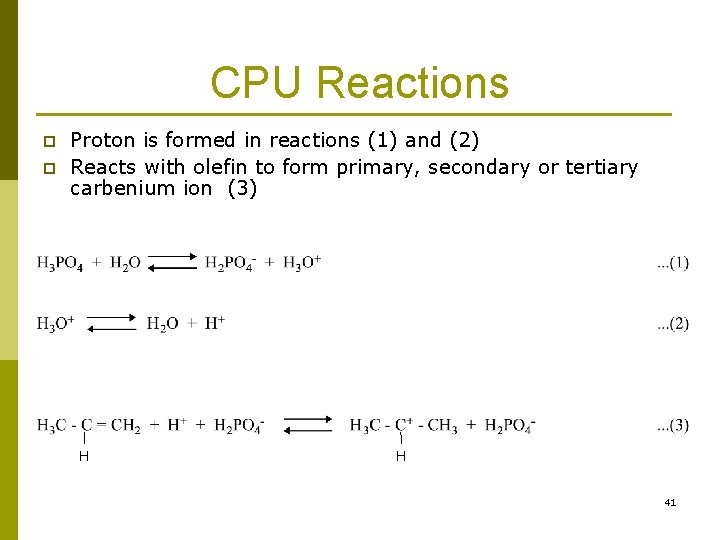
CPU Reactions p p Proton is formed in reactions (1) and (2) Reacts with olefin to form primary, secondary or tertiary carbenium ion (3) H H 41
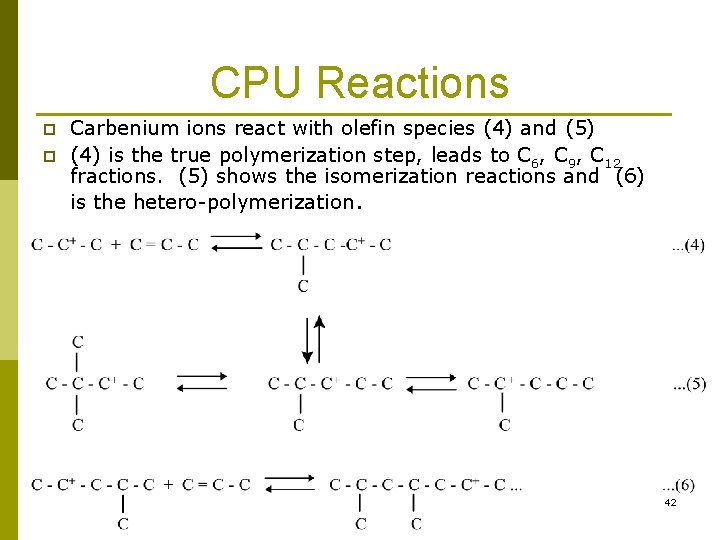
CPU Reactions p p Carbenium ions react with olefin species (4) and (5) (4) is the true polymerization step, leads to C 6, C 9, C 12 fractions. (5) shows the isomerization reactions and (6) is the hetero-polymerization. 42
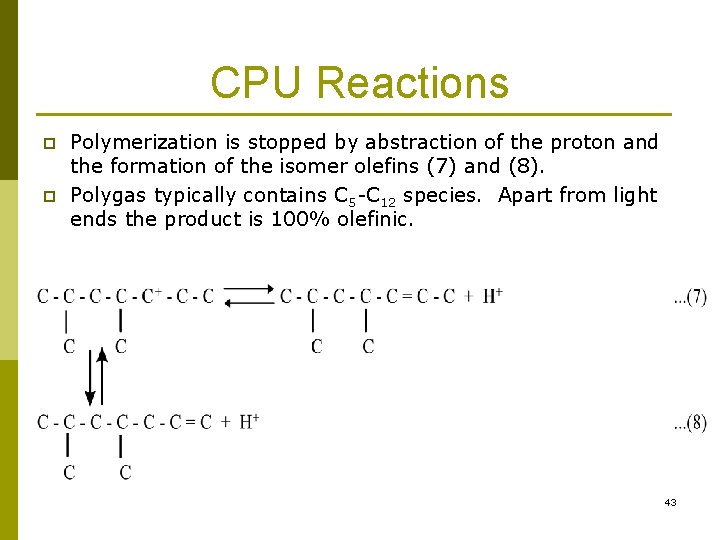
CPU Reactions p p Polymerization is stopped by abstraction of the proton and the formation of the isomer olefins (7) and (8). Polygas typically contains C 5 -C 12 species. Apart from light ends the product is 100% olefinic. 43
Uses of Polygas p p Polygas is currently blended into gasoline n Benefits – low Reid vapor pressure (RVP), high octane number n Disadvantages – 100% olefin content Alternative uses n Can be used as chemical feedstocks for petrochemical industries. 44
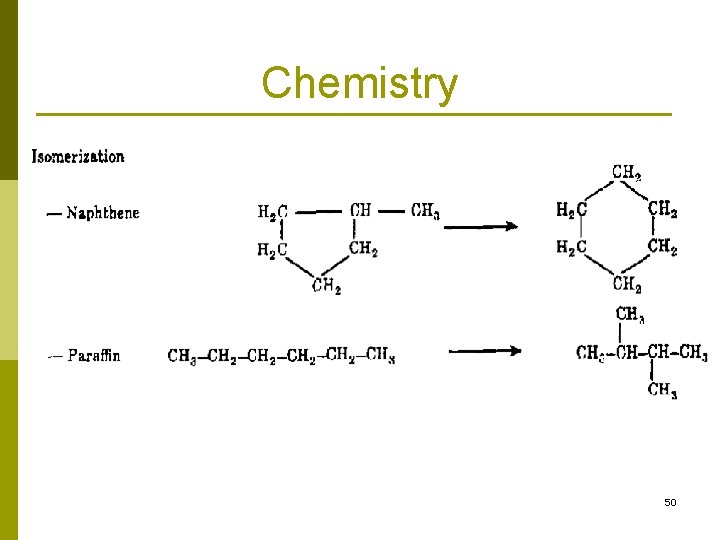
Isomerization p Isomerization refers to chemical rearrangement of straight-chain hydrocarbons (paraffins), so that they contain branches attached to the main chain (isoparaffins). p This is done for two reasons: - to create extra isobutane feed for alkylation -to improve the octane number of straight run pentanes and hexanes and hence make them into better gasoline blending components. p Isomerization is achieved by mixing normal Hexane/pentane with a little hydrogen and organic chloride and allow the mixture to react in the presence of a catalyst to form isohexane/isopentane, plus a small amount of butane and some lighter gases. p Products are separated in a fractionator. The lighter gases are used as refinery fuel and the butane recycled as feed. 45
Catalyst p Chloride alumina catalyst » Organic chloride (such as carbon tetrachloride) is deposited on active metal sites by high temperature treatment. This chloride catalyst is sensitive to moisture » Drying of feed & hydrogen make-up is essential p Acidic zeolite with noble metal catalyst can be used as alternative catalyst. 46
Feedstock p Light naphtha feedstock with pentanes, hexanes, & small amounts of heptanes p Sulfur & nitrogen must be removed (through hydrotreatment) to prevent catalyst poisoning 47
Products p Small amounts of light gases p Isobutane which is used in the alkylation process p Isomerate (gasoline) Ø Increased severity increases octane number but also increases yield of light ends Ø Yields depend on feedstock characteristics & product octane number. Ø Poor quality feeds might yield 85% or less liquid product whilst good feeds might yield 97% liquid product 48
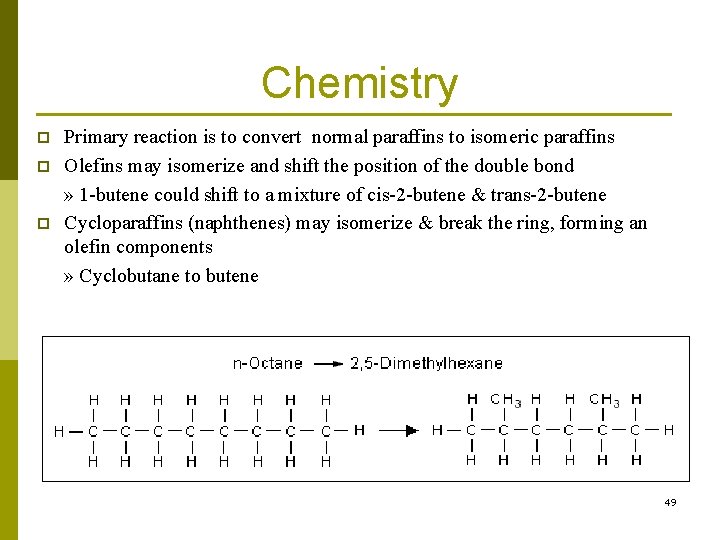
Chemistry p p p Primary reaction is to convert normal paraffins to isomeric paraffins Olefins may isomerize and shift the position of the double bond » 1 -butene could shift to a mixture of cis-2 -butene & trans-2 -butene Cycloparaffins (naphthenes) may isomerize & break the ring, forming an olefin components » Cyclobutane to butene 49
Chemistry 50
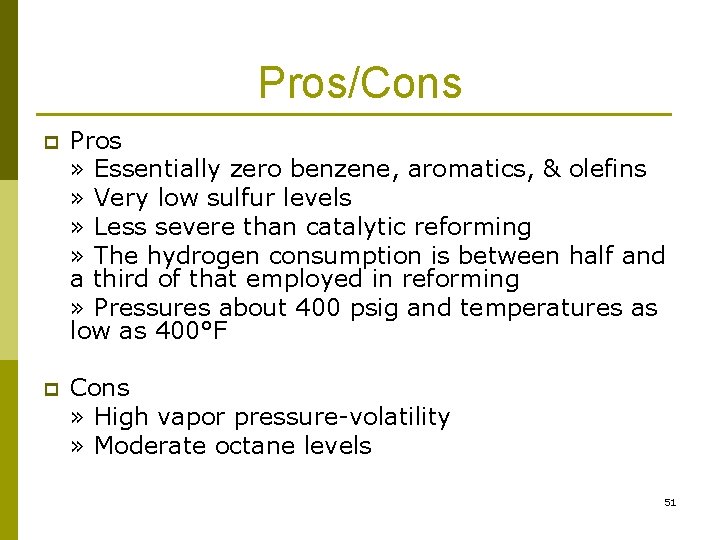
Pros/Cons p Pros » Essentially zero benzene, aromatics, & olefins » Very low sulfur levels » Less severe than catalytic reforming » The hydrogen consumption is between half and a third of that employed in reforming » Pressures about 400 psig and temperatures as low as 400°F p Cons » High vapor pressure-volatility » Moderate octane levels 51
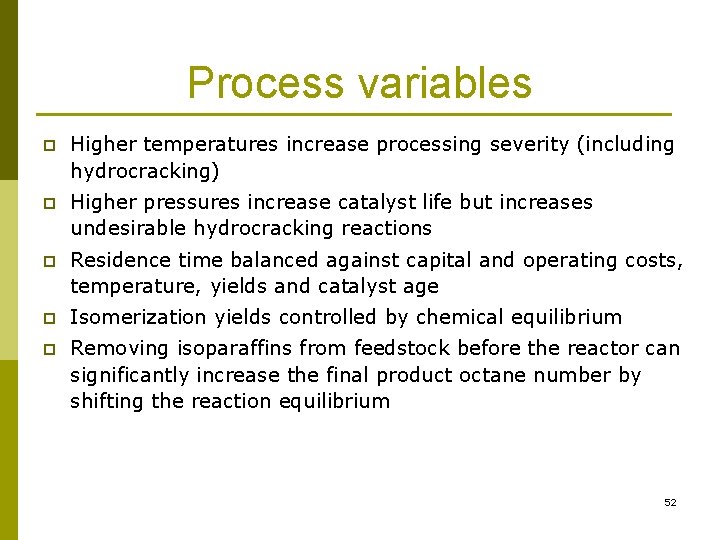
Process variables p Higher temperatures increase processing severity (including hydrocracking) p Higher pressures increase catalyst life but increases undesirable hydrocracking reactions p Residence time balanced against capital and operating costs, temperature, yields and catalyst age p Isomerization yields controlled by chemical equilibrium p Removing isoparaffins from feedstock before the reactor can significantly increase the final product octane number by shifting the reaction equilibrium 52
End of Chapter Eight 53