
CHAPTER EIGHT COLLECTING DATA I THE QUESTIONNAIRE SURVEY

- Slides: 23
CHAPTER EIGHT COLLECTING DATA I: THE QUESTIONNAIRE SURVEY
QUESTIONNAIRES A standardised set of questions to gain information from a subject. They are often associated with quantitative research designs, when relatively simple measurements are required from a large sample group.
TYPES OF QUESTIONNAIRE 1. Postal questionnaire. The questionnaire is given or posted to the participant, who completes it in his or her own time. The participant then posts the completed questionnaire back to the researcher. Alternatively, the questionnaire may be emailed to the respondent for completion online.
2. Online questionnaire. Respondents are able to complete the questionnaire electronically, and results are downloaded by the researcher.
3. Telephone questionnaire. The researcher questions the participant over the telephone and the researcher fills in the responses.
4. Face to face questionnaire. The researcher and participant are in the same location, and the researcher asks the questions ‘face to face’.
ADVANTAGES OF QUESTIONNAIRES • Low cost. • Reduced bias. • Anonymity. • Accessibility. • Time for respondents to reply.
DISADVANTAGES OF QUESTIONNAIRES • Simple questions. • No control over who fills it out. • No opportunity to explain questions. • No opportunity to probe. • Low response rates.
DESIGNING A QUESTIONNAIRE More difficult than you may believe. 1. Identify information needs. 2. Identify what type of measurement is required. 3. Determine the question type to get that information. 4. Design questionnaire. 5. Pilot questionnaire. 6. Evaluate pilot study and redesign questionnaire. 7. Repilot questionnaire. 8. Final design.
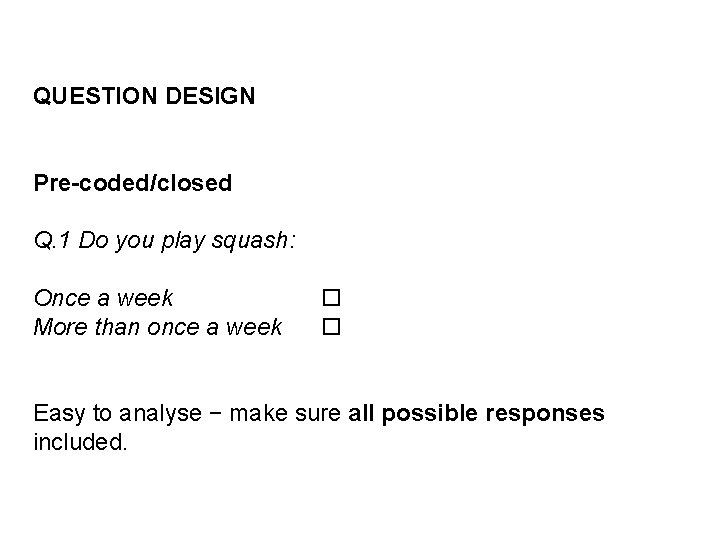
QUESTION DESIGN Pre-coded/closed Q. 1 Do you play squash: Once a week More than once a week Easy to analyse − make sure all possible responses included.
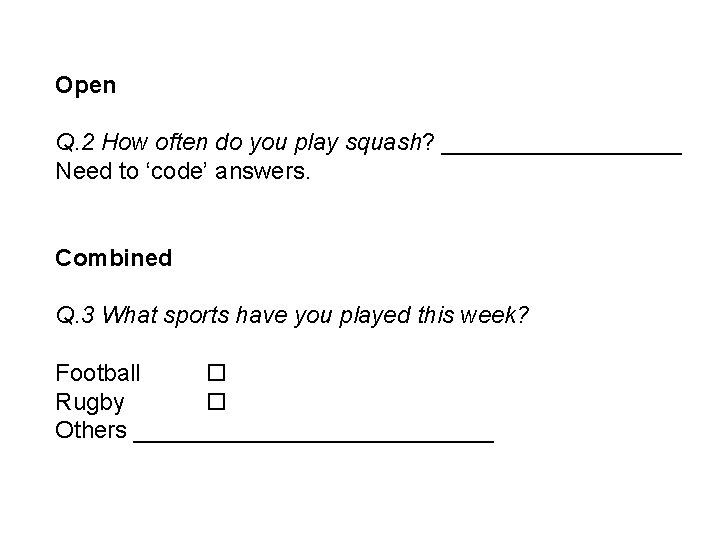
Open Q. 2 How often do you play squash? _________ Need to ‘code’ answers. Combined Q. 3 What sports have you played this week? Football Rugby Others ______________
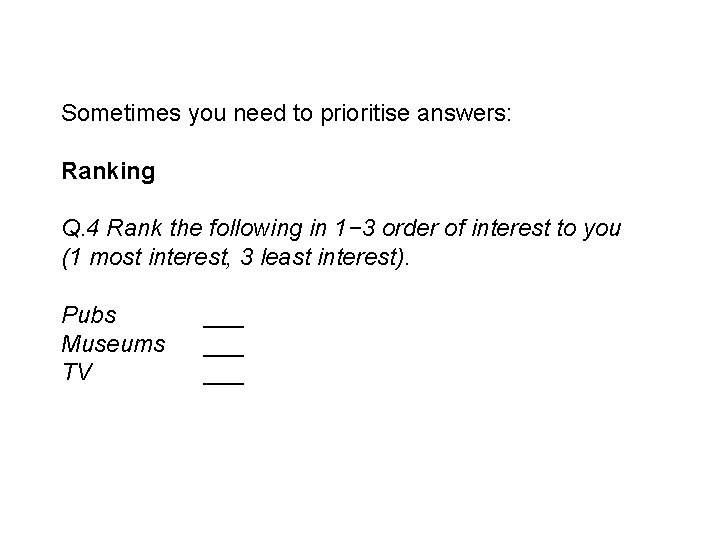
Sometimes you need to prioritise answers: Ranking Q. 4 Rank the following in 1− 3 order of interest to you (1 most interest, 3 least interest). Pubs Museums TV ___ ___
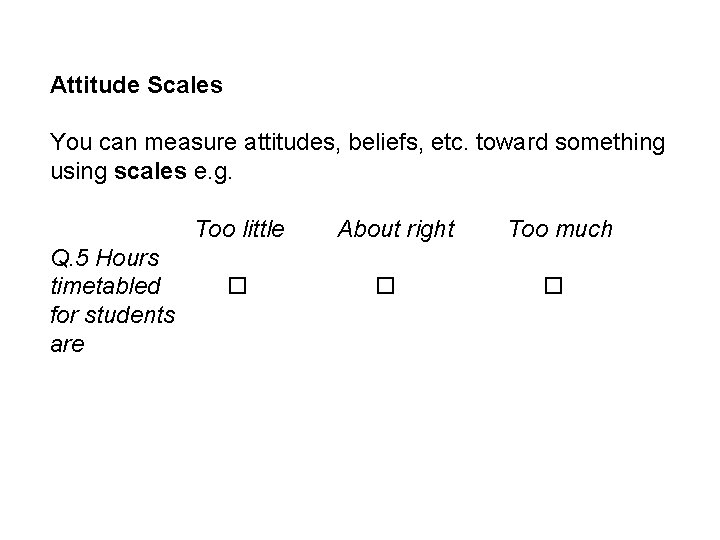
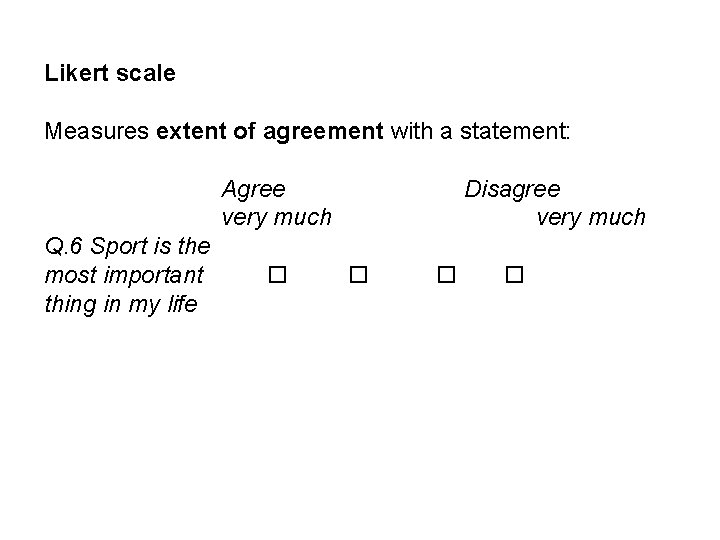
Attitude Scales You can measure attitudes, beliefs, etc. toward something using scales e. g. Too little Q. 5 Hours timetabled for students are About right Too much
Likert scale Measures extent of agreement with a statement: Agree very much Q. 6 Sport is the most important thing in my life Disagree very much
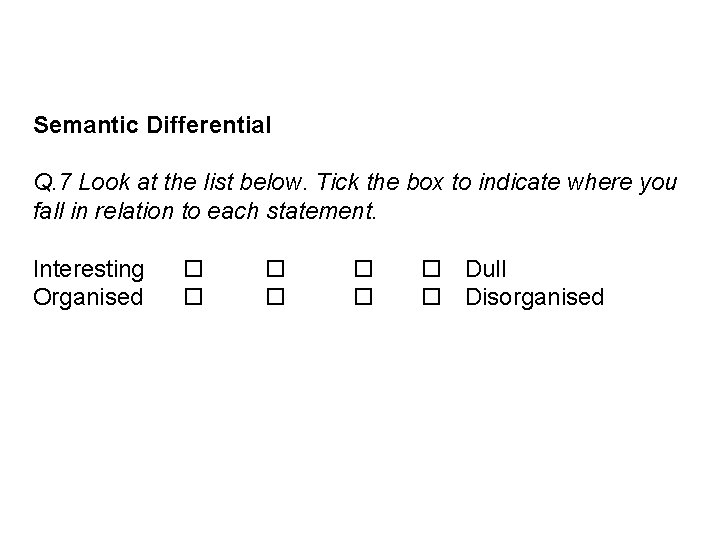
Semantic Differential Q. 7 Look at the list below. Tick the box to indicate where you fall in relation to each statement. Interesting Organised Dull Disorganised
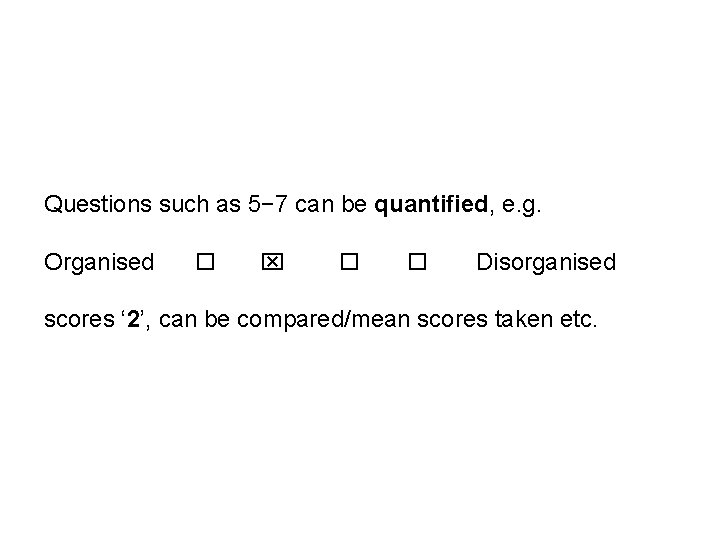
Questions such as 5− 7 can be quantified, e. g. Organised Disorganised scores ‘ 2’, can be compared/mean scores taken etc.
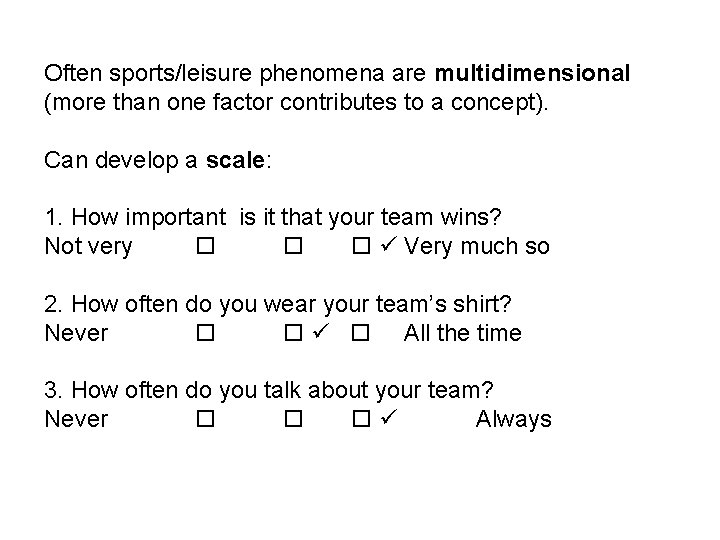
Often sports/leisure phenomena are multidimensional (more than one factor contributes to a concept). Can develop a scale: 1. How important is it that your team wins? Not very Very much so 2. How often do you wear your team’s shirt? Never All the time 3. How often do you talk about your team? Never Always
Filter questions Not all questions apply to each respondent: Do you regularly watch sport on TV? Yes − Go to question 2. No − Go to question 5.
Pilot Questionnaires You must do a pilot. To check: • wording and sequence • layout • response rate • completion time • analysis procedures • administration. You will get one chance to do your survey!
INCREASING RESPONSE RATES Consider: • Interest of respondent. • Length. • Design and presentation. • Order − difficult questions last! • Covering letter. • Incentive. • Pre-paid reply envelope. • Follow up letter/call.
COVERING LETTERS Essential for postal questionnaires. • Identify researcher. • Explain purpose. • State why it is important. • Assure confidentiality (if appropriate). • Provide contact details.
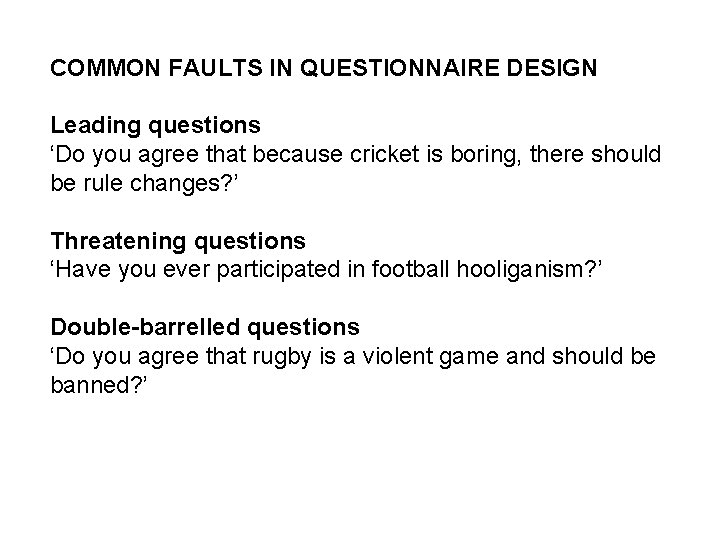
COMMON FAULTS IN QUESTIONNAIRE DESIGN Leading questions ‘Do you agree that because cricket is boring, there should be rule changes? ’ Threatening questions ‘Have you ever participated in football hooliganism? ’ Double-barrelled questions ‘Do you agree that rugby is a violent game and should be banned? ’
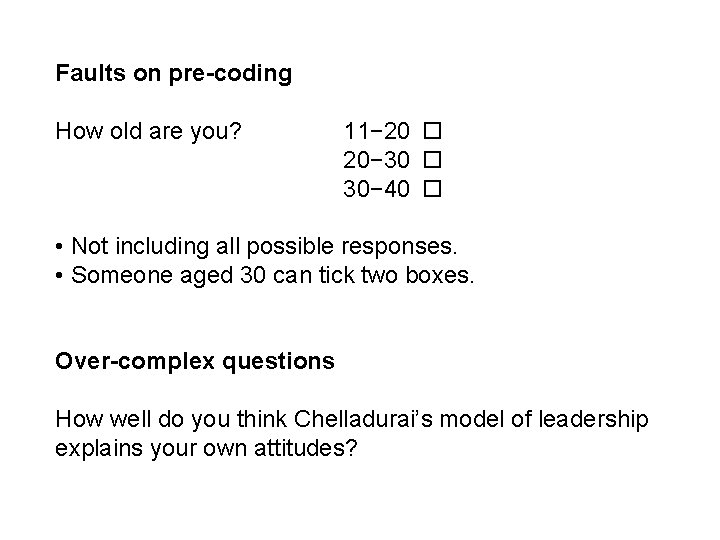
Faults on pre-coding How old are you? 11− 20 20− 30 30− 40 • Not including all possible responses. • Someone aged 30 can tick two boxes. Over-complex questions How well do you think Chelladurai’s model of leadership explains your own attitudes?