
Chapter DecisionMaking Processes 12 Organization Theory and Design
- Slides: 20
Chapter Decision-Making Processes 12 Organization Theory and Design Twelfth Edition Richard L. Daft © 2017 Cengage Learning. All Rights Reserved. May not be scanned, copied or duplicated, or posted to a publicly accessible website, in whole or in part.
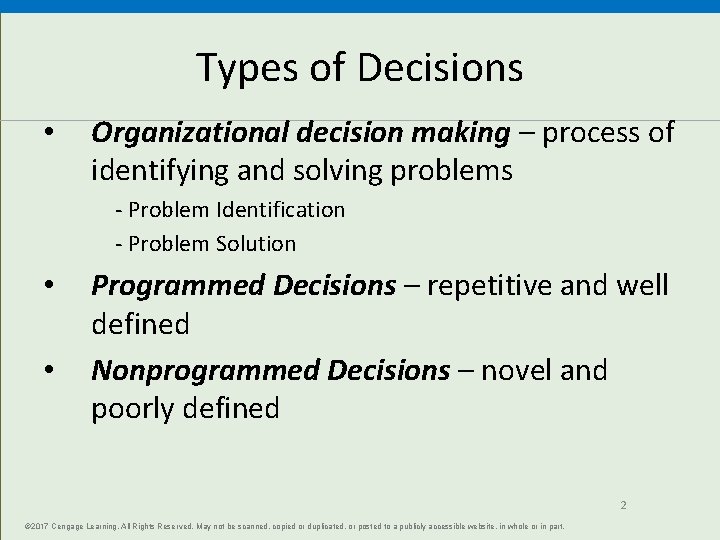
Types of Decisions • Organizational decision making – process of identifying and solving problems - Problem Identification - Problem Solution • • Programmed Decisions – repetitive and well defined Nonprogrammed Decisions – novel and poorly defined 2 © 2017 Cengage Learning. All Rights Reserved. May not be scanned, copied or duplicated, or posted to a publicly accessible website, in whole or in part.
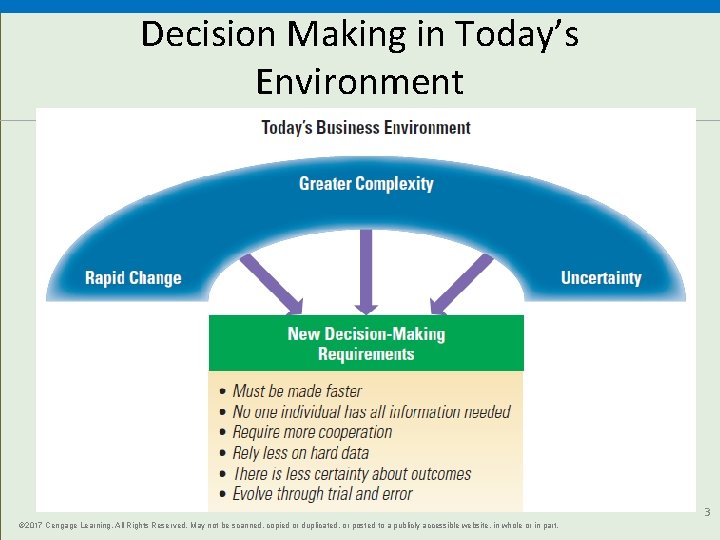
Decision Making in Today’s Environment 3 © 2017 Cengage Learning. All Rights Reserved. May not be scanned, copied or duplicated, or posted to a publicly accessible website, in whole or in part.
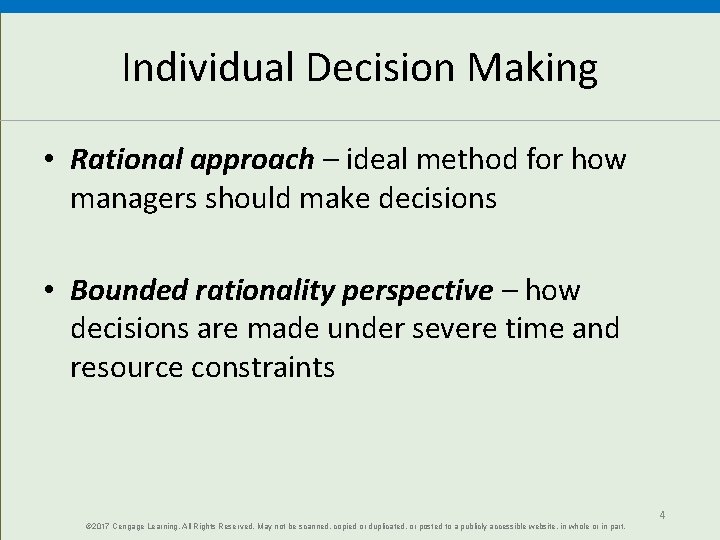
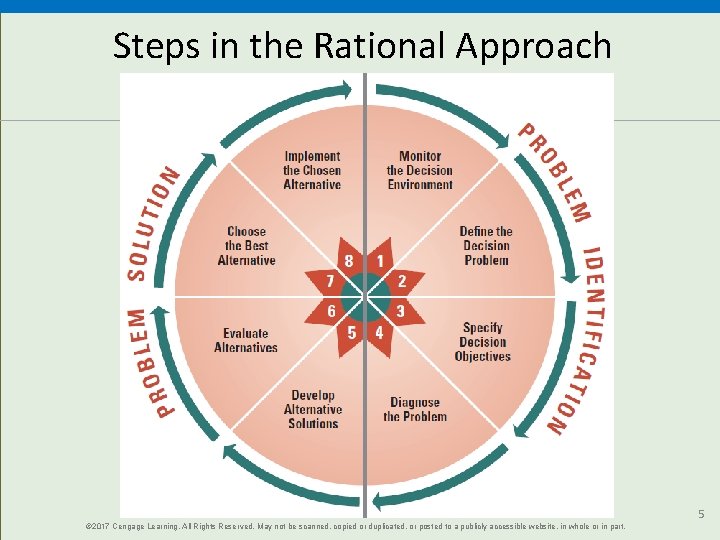
Individual Decision Making • Rational approach – ideal method for how managers should make decisions • Bounded rationality perspective – how decisions are made under severe time and resource constraints © 2017 Cengage Learning. All Rights Reserved. May not be scanned, copied or duplicated, or posted to a publicly accessible website, in whole or in part. 4
Steps in the Rational Approach © 2017 Cengage Learning. All Rights Reserved. May not be scanned, copied or duplicated, or posted to a publicly accessible website, in whole or in part. 5
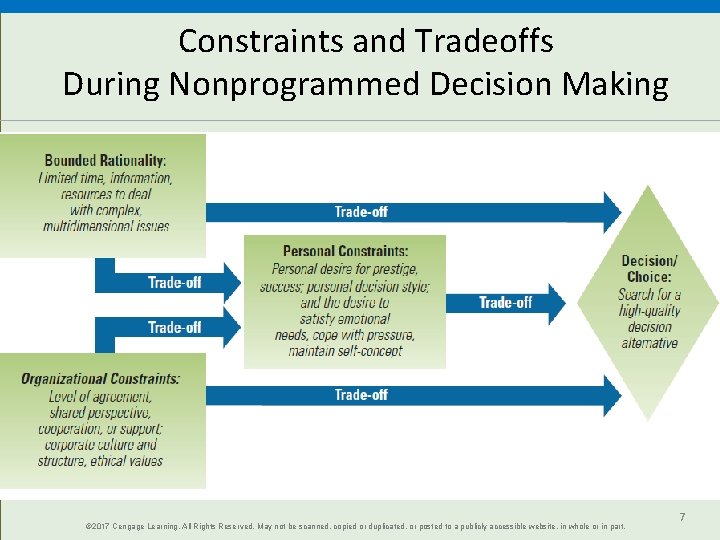
Bounded Rationality Perspective • There is a limit to how rational managers can be—time and resource constraints – Nonprogrammed decisions • Constraints and Tradeoffs – Constraints impinge the decision maker • The Role of Intuition – Experience and judgment rather than logic © 2017 Cengage Learning. All Rights Reserved. May not be scanned, copied or duplicated, or posted to a publicly accessible website, in whole or in part. 6
Constraints and Tradeoffs During Nonprogrammed Decision Making © 2017 Cengage Learning. All Rights Reserved. May not be scanned, copied or duplicated, or posted to a publicly accessible website, in whole or in part. 7
Organizational Decision Making ü Management Science Approach ü Carnegie Model ü Incremental Decision Model © 2017 Cengage Learning. All Rights Reserved. May not be scanned, copied or duplicated, or posted to a publicly accessible website, in whole or in part. 8
Management Science Approach • Use of statistics to identify relevant variables • Remove human element • Very successful for military problems • Good tool for decisions where variables can be indentified and measured • A drawback of management science is that quantitative data are not rich and lack tacit knowledge © 2017 Cengage Learning. All Rights Reserved. May not be scanned, copied or duplicated, or posted to a publicly accessible website, in whole or in part. 9
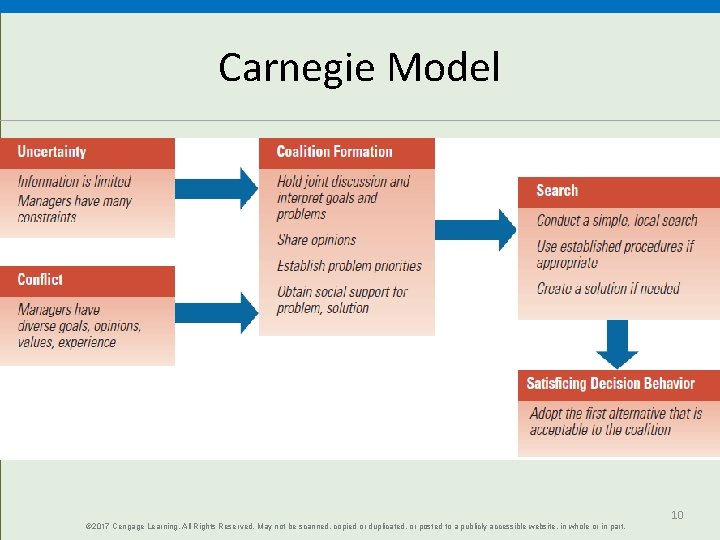
Carnegie Model © 2017 Cengage Learning. All Rights Reserved. May not be scanned, copied or duplicated, or posted to a publicly accessible website, in whole or in part. 10
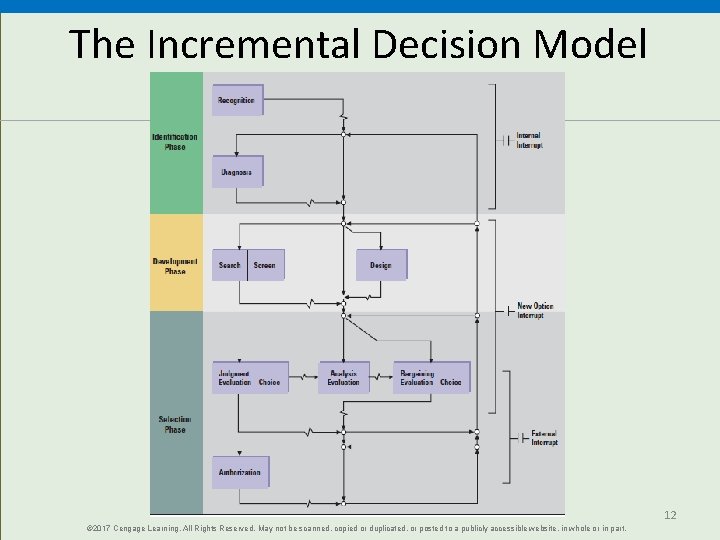
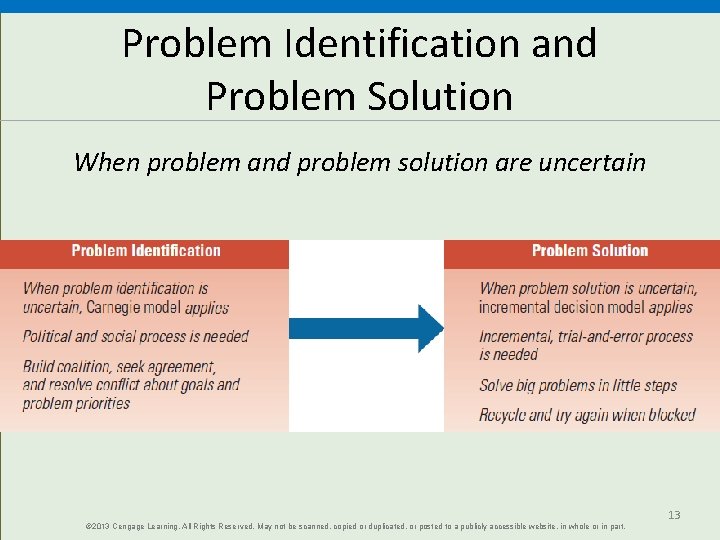
Incremental Decision Model • Focus on structured sequence of activities from discovery to solution • Large decisions are a collection of small choices • Decision interrupts are barriers – Identification Phase – Development Phase – Selection Phase – Dynamic Factors © 2017 Cengage Learning. All Rights Reserved. May not be scanned, copied or duplicated, or posted to a publicly accessible website, in whole or in part. 11
The Incremental Decision Model 12 © 2017 Cengage Learning. All Rights Reserved. May not be scanned, copied or duplicated, or posted to a publicly accessible website, in whole or in part.
Problem Identification and Problem Solution When problem and problem solution are uncertain © 2013 Cengage Learning. All Rights Reserved. May not be scanned, copied or duplicated, or posted to a publicly accessible website, in whole or in part. 13
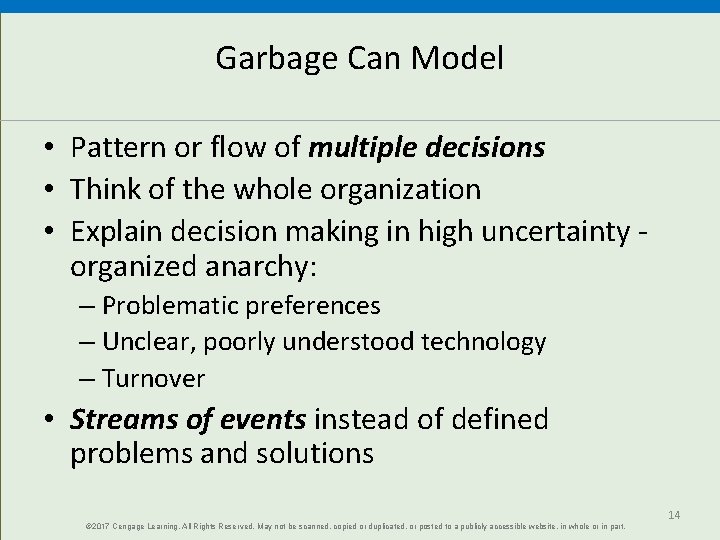
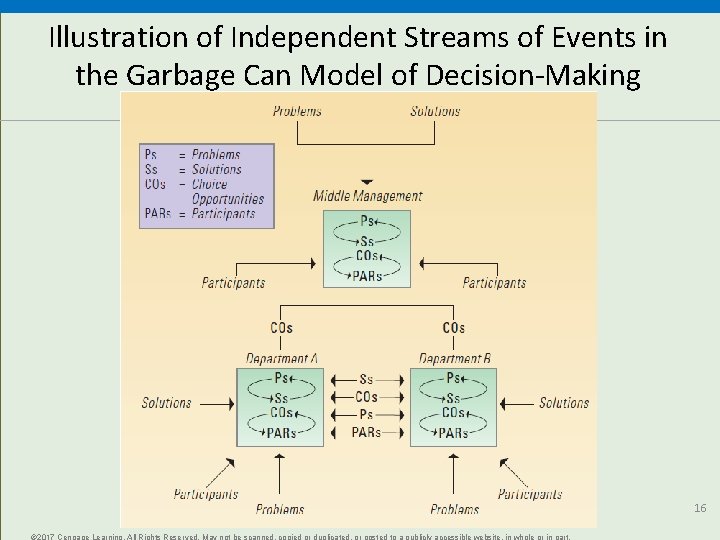
Garbage Can Model • Pattern or flow of multiple decisions • Think of the whole organization • Explain decision making in high uncertainty organized anarchy: – Problematic preferences – Unclear, poorly understood technology – Turnover • Streams of events instead of defined problems and solutions © 2017 Cengage Learning. All Rights Reserved. May not be scanned, copied or duplicated, or posted to a publicly accessible website, in whole or in part. 14
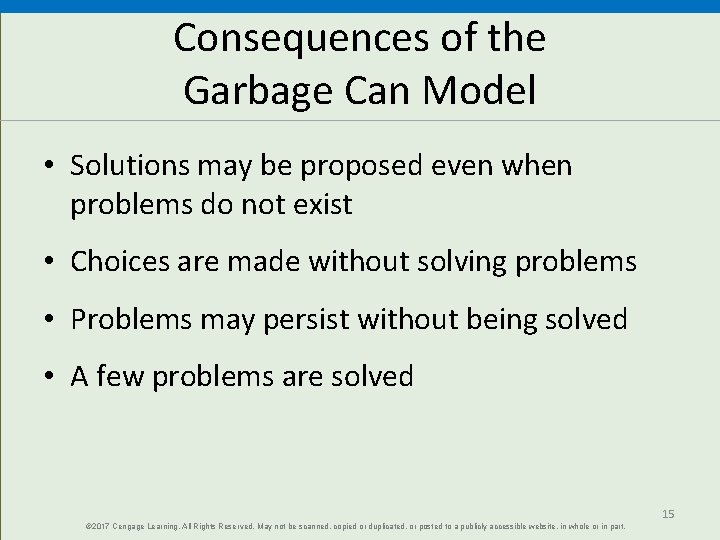
Consequences of the Garbage Can Model • Solutions may be proposed even when problems do not exist • Choices are made without solving problems • Problems may persist without being solved • A few problems are solved © 2017 Cengage Learning. All Rights Reserved. May not be scanned, copied or duplicated, or posted to a publicly accessible website, in whole or in part. 15
Illustration of Independent Streams of Events in the Garbage Can Model of Decision-Making 16
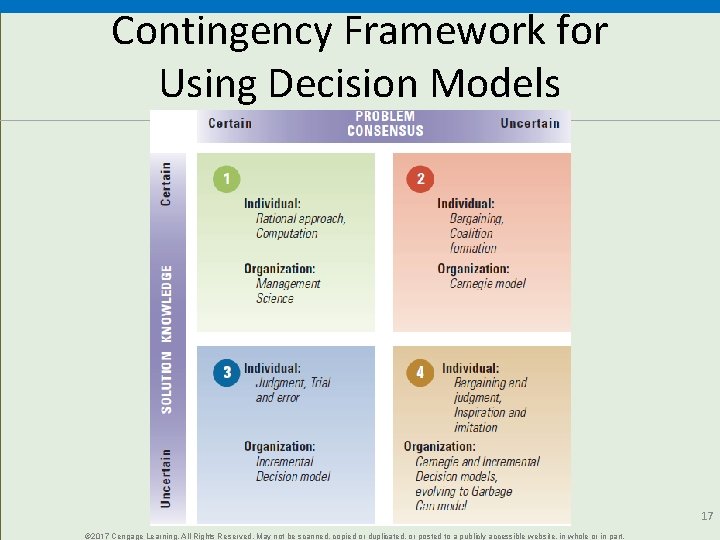
Contingency Framework for Using Decision Models 17 © 2017 Cengage Learning. All Rights Reserved. May not be scanned, copied or duplicated, or posted to a publicly accessible website, in whole or in part.
Special Decision Circumstances • Today’s environment presents high-stakes, quick decisions • Managers must deal with: – High-velocity environments – Learning from decision mistakes – Understanding cognitive and personal biases • Escalating commitment • Prospect theory • Groupthink • Evidence-based management • Encourages dissent and diversity © 2017 Cengage Learning. All Rights Reserved. May not be scanned, copied or duplicated, or posted to a publicly accessible website, in whole or in part. 18
Design Essentials Most decisions are not made in a logical manner Individuals make decisions, but organizational decisions are not made by a single individual Conflict exists when problems are not agreed on © 2017 Cengage Learning. All Rights Reserved. May not be scanned, copied or duplicated, or posted to a publicly accessible website, in whole or in part. 19
Design Essentials The garbage can model has become a description of decision-making Organizations operate in high-velocity environments and must make decisions with speed Allowing biases to cloud decision making can have negative consequences