
Chapter Contents Introduction to System of Linear Equations
- Slides: 37
Chapter Contents • • Introduction to System of Linear Equations Gaussian Elimination Matrices and Matrix Operations Inverses; Rules of Matrix Arithmetic Elementary Matrices and a Method for Finding A-1 Further Results on Systems of Equations and Invertibility Diagonal, Triangular, and Symmetric Matrices 1
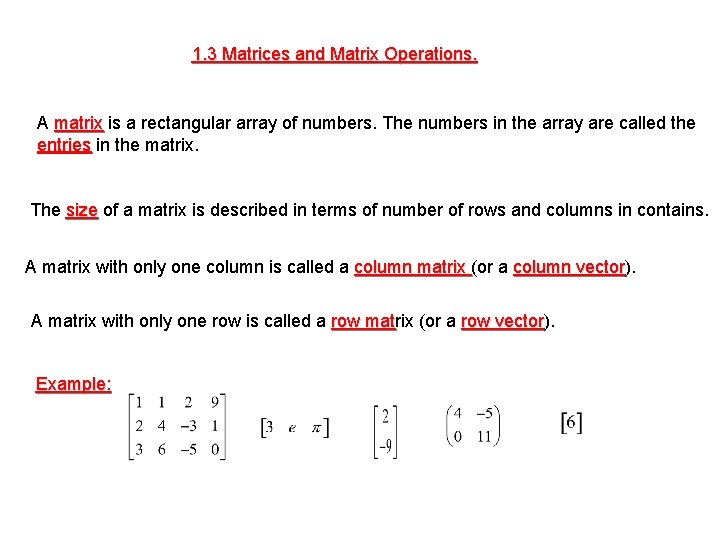
1. 3 Matrices and Matrix Operations. A matrix is a rectangular array of numbers. The numbers in the array are called the entries in the matrix. The size of a matrix is described in terms of number of rows and columns in contains. A matrix with only one column is called a column matrix (or a column vector). vector A matrix with only one row is called a row matrix mat (or a row vector). vector Example:
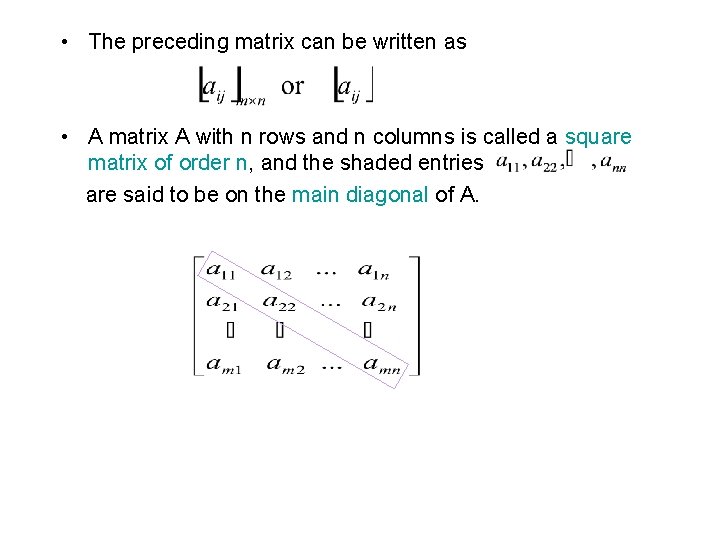
• The preceding matrix can be written as • A matrix A with n rows and n columns is called a square matrix of order n, and the shaded entries are said to be on the main diagonal of A.
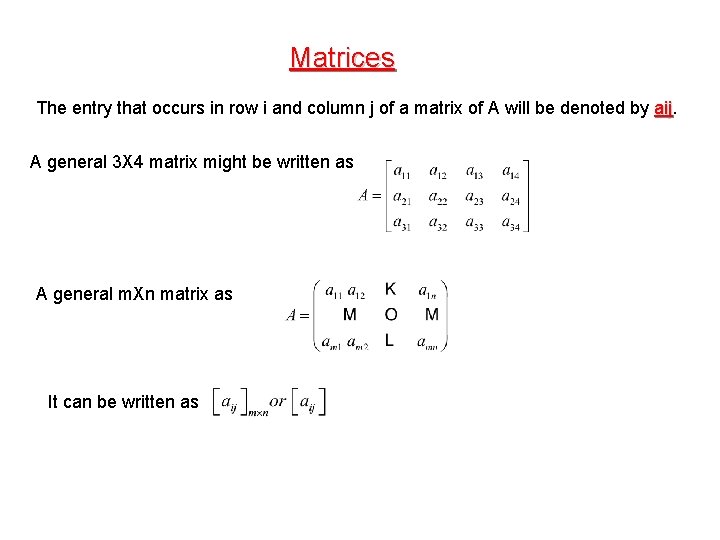
Matrices The entry that occurs in row i and column j of a matrix of A will be denoted by aij A general 3 X 4 matrix might be written as A general m. Xn matrix as It can be written as
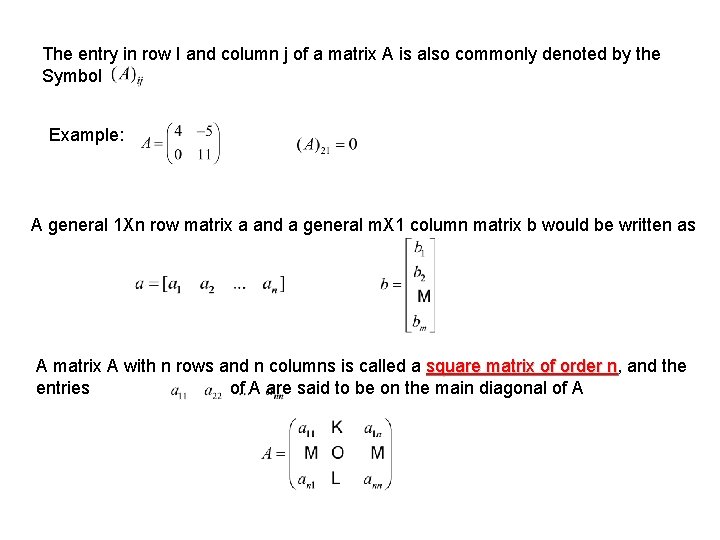
The entry in row I and column j of a matrix A is also commonly denoted by the Symbol Example: A general 1 Xn row matrix a and a general m. X 1 column matrix b would be written as A matrix A with n rows and n columns is called a square matrix of order n, n and the entries of A are said to be on the main diagonal of A
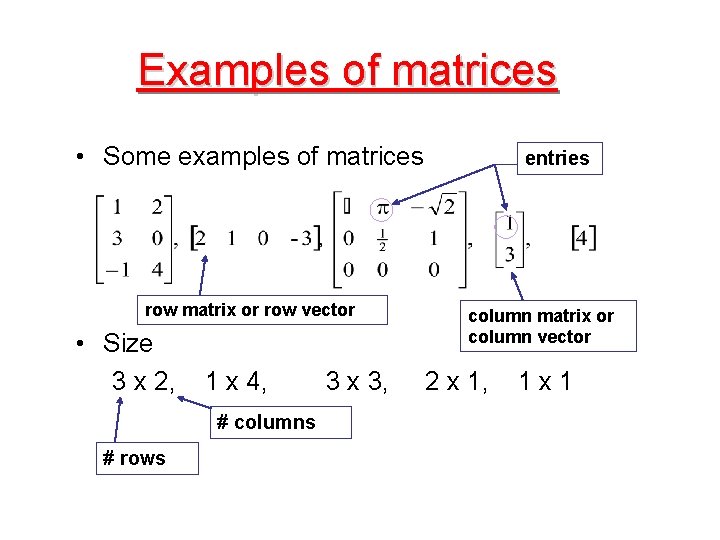
Examples of matrices • Some examples of matrices row matrix or row vector • Size 3 x 2, 1 x 4, # columns # rows 3 x 3, entries column matrix or column vector 2 x 1, 1 x 1
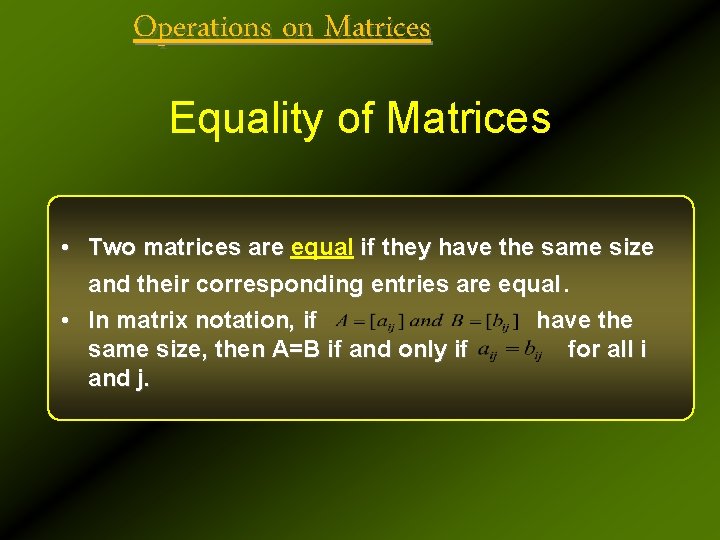
Operations on Matrices Equality of Matrices • Two matrices are equal if they have the same size and their corresponding entries are equal. • In matrix notation, if have the same size, then A=B if and only if for all i and j.
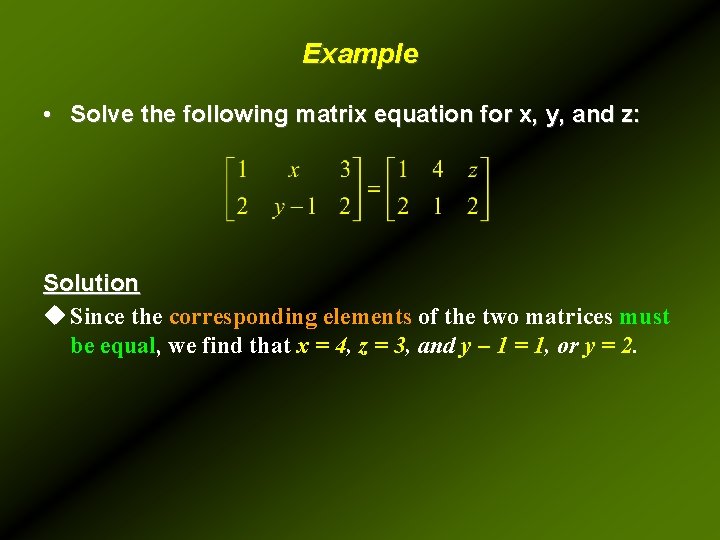
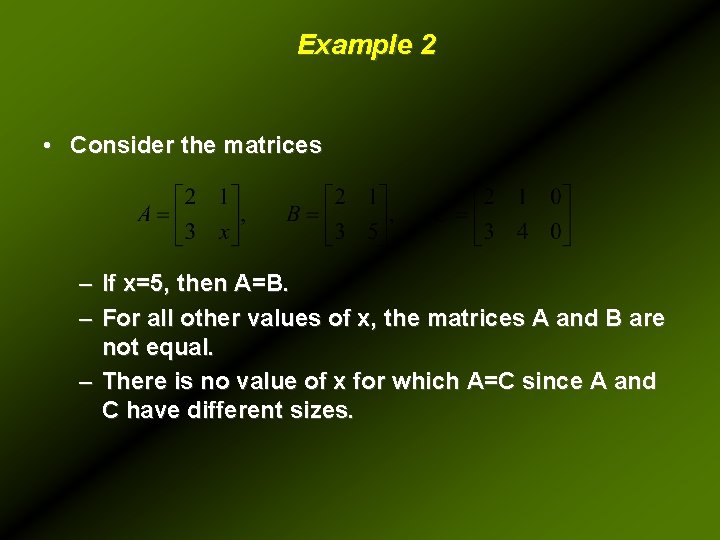
Example • Solve the following matrix equation for x, y, and z: Solution u Since the corresponding elements of the two matrices must be equal, we find that x = 4, z = 3, and y – 1 = 1, or y = 2.
Example 2 • Consider the matrices – If x=5, then A=B. – For all other values of x, the matrices A and B are not equal. – There is no value of x for which A=C since A and C have different sizes.
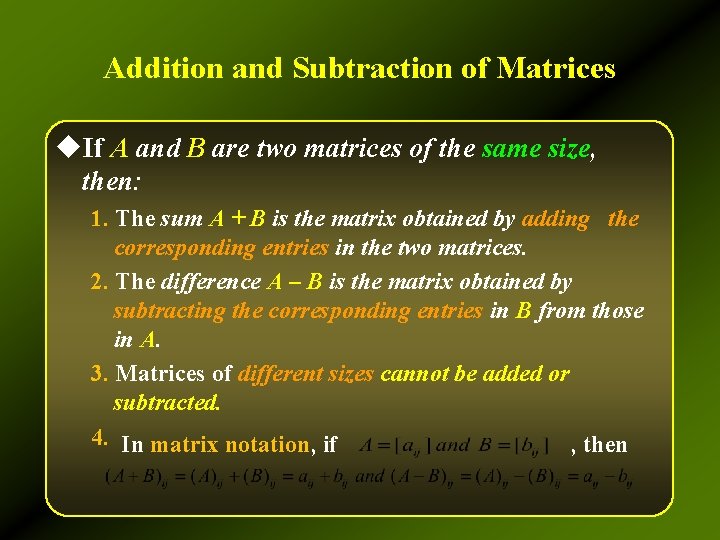
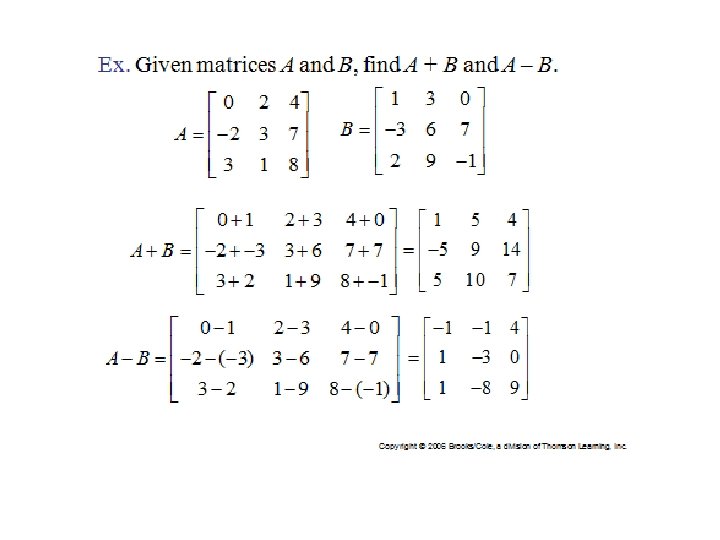
Addition and Subtraction of Matrices u. If A and B are two matrices of the same size, then: 1. The sum A + B is the matrix obtained by adding the corresponding entries in the two matrices. 2. The difference A – B is the matrix obtained by subtracting the corresponding entries in B from those in A. 3. Matrices of different sizes cannot be added or subtracted. 4. In matrix notation, if , then
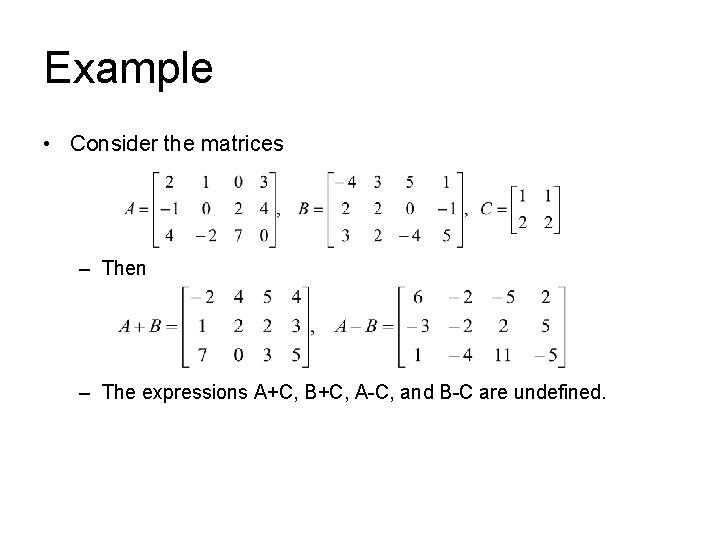
Example • Consider the matrices – Then – The expressions A+C, B+C, A-C, and B-C are undefined.
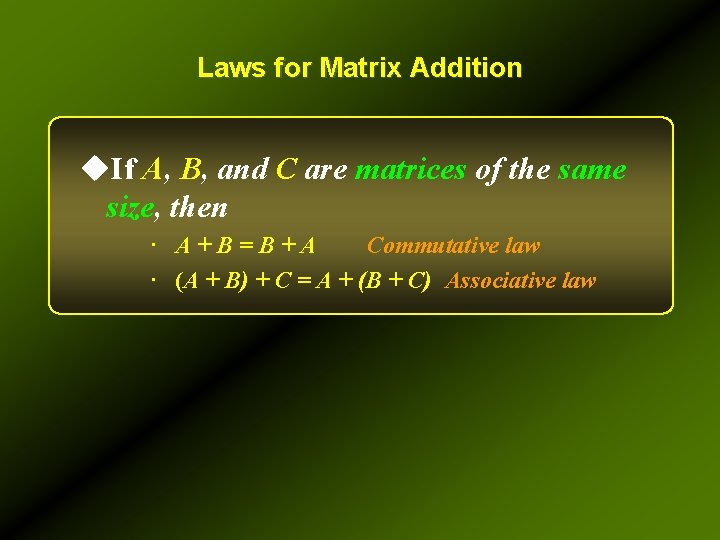
Laws for Matrix Addition u. If A, B, and C are matrices of the same size, then • A+B=B+A Commutative law • (A + B) + C = A + (B + C) Associative law
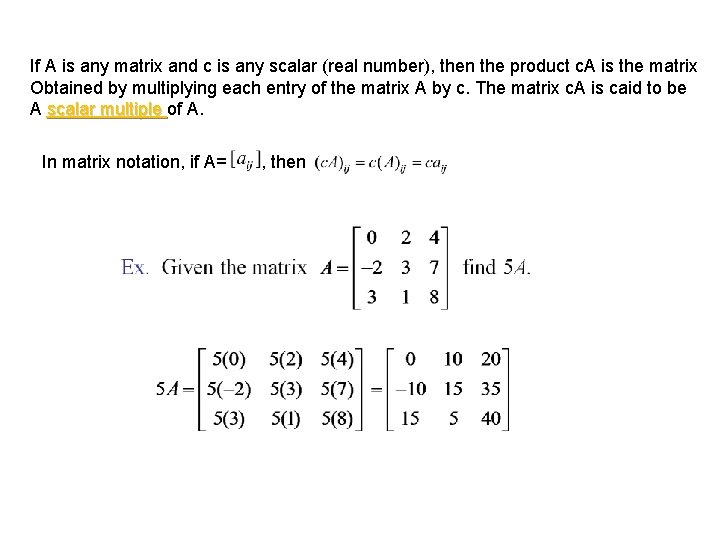
If A is any matrix and c is any scalar (real number), then the product c. A is the matrix Obtained by multiplying each entry of the matrix A by c. The matrix c. A is caid to be A scalar multiple of A. In matrix notation, if A= , then
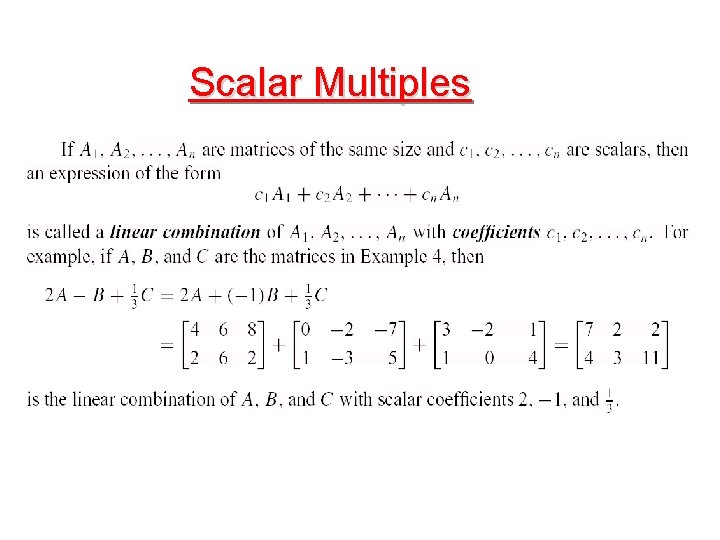
Scalar Multiples
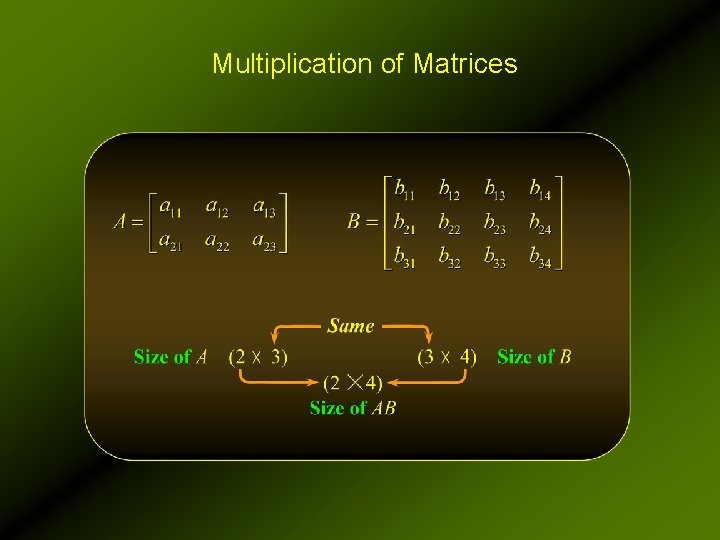
Multiplication of Matrices
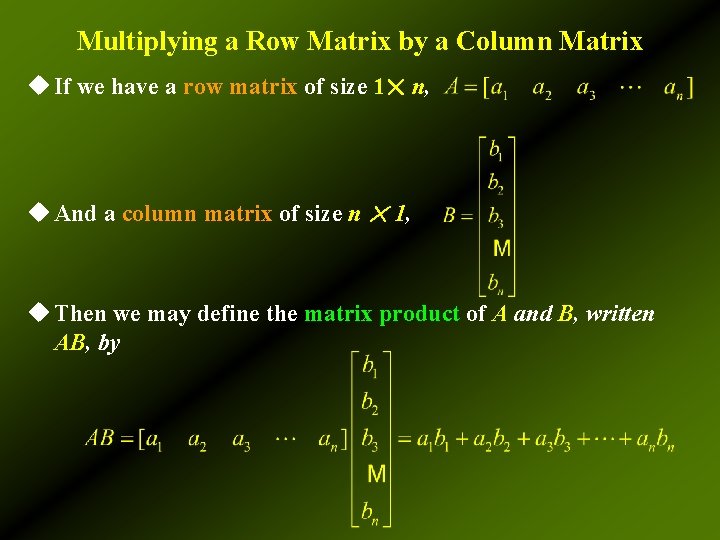
Multiplying a Row Matrix by a Column Matrix u If we have a row matrix of size 1☓ n, u And a column matrix of size n ☓ 1, u Then we may define the matrix product of A and B, written AB, by
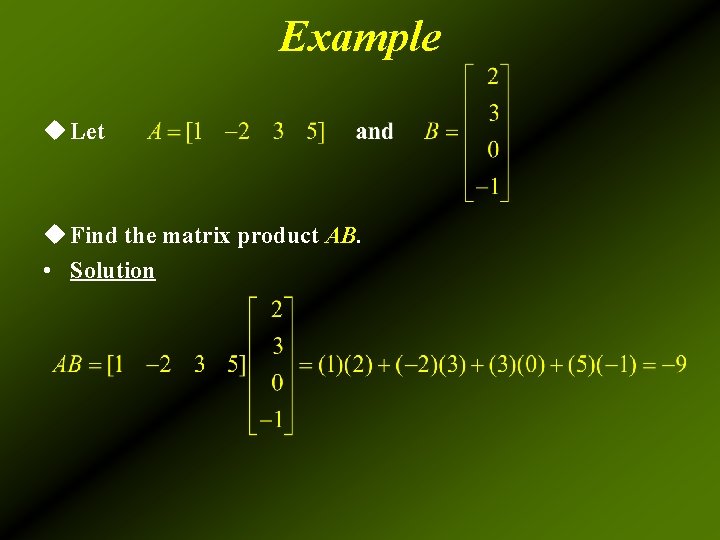
Example u Let u Find the matrix product AB. • Solution
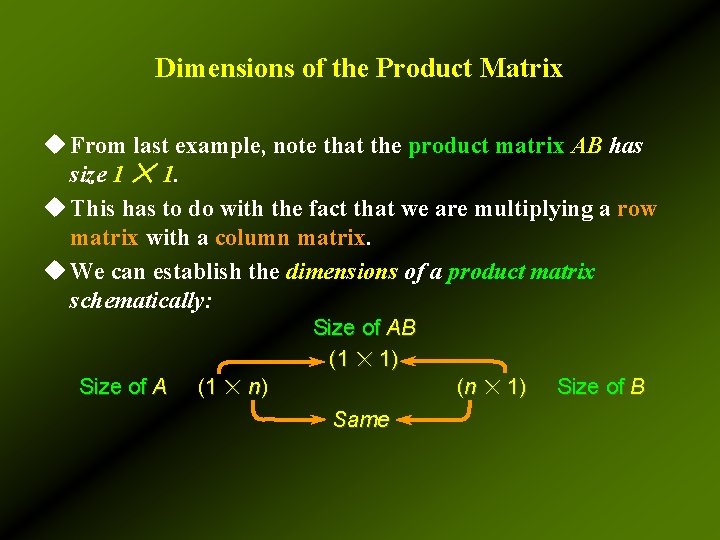
Dimensions of the Product Matrix u From last example, note that the product matrix AB has size 1 ☓ 1. u This has to do with the fact that we are multiplying a row matrix with a column matrix. u We can establish the dimensions of a product matrix schematically: Size of AB (1 ☓ 1 ) Size of A (1 ☓ n) (n ☓ 1 ) Same Size of B
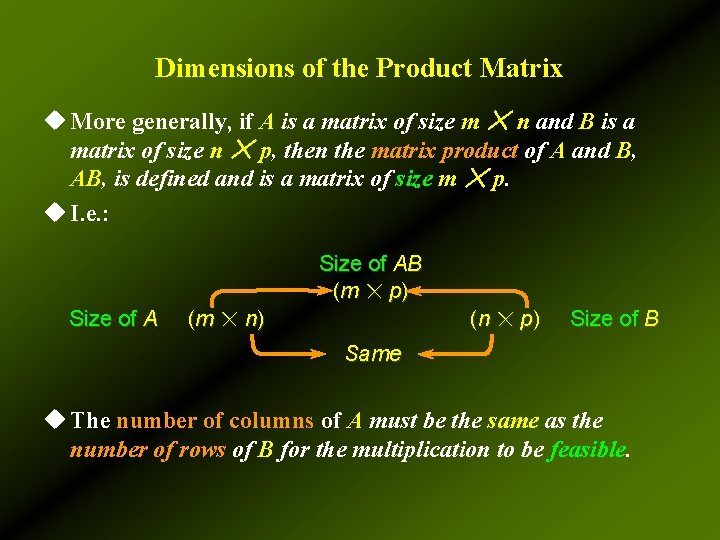
Dimensions of the Product Matrix u More generally, if A is a matrix of size m ☓ n and B is a matrix of size n ☓ p, then the matrix product of A and B, AB, is defined and is a matrix of size m ☓ p. u I. e. : Size of AB (m ☓ p ) Size of A (m ☓ n ) (n ☓ p ) Size of B Same u The number of columns of A must be the same as the number of rows of B for the multiplication to be feasible.
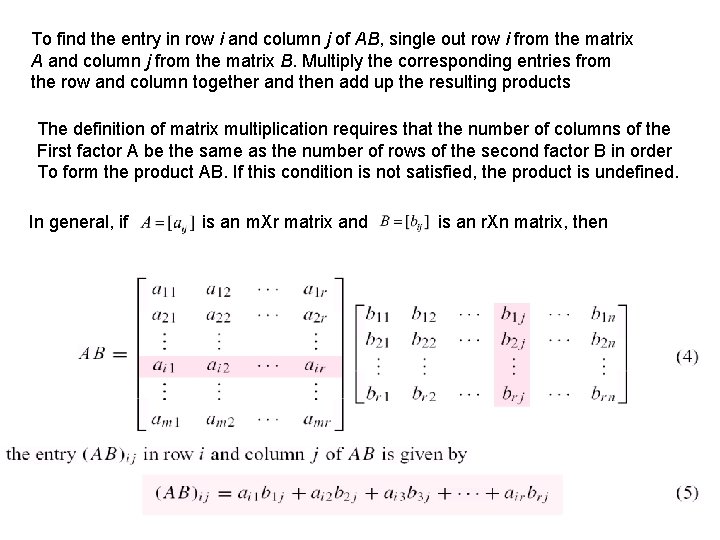
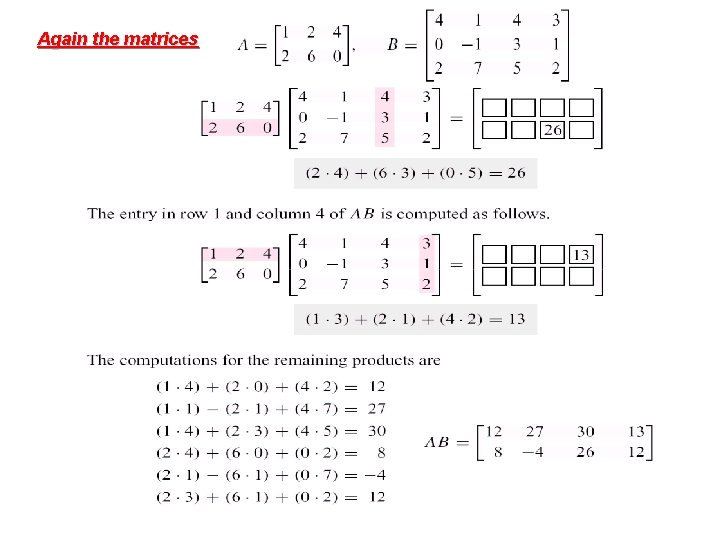
To find the entry in row i and column j of AB, single out row i from the matrix A and column j from the matrix B. Multiply the corresponding entries from the row and column together and then add up the resulting products The definition of matrix multiplication requires that the number of columns of the First factor A be the same as the number of rows of the second factor B in order To form the product AB. If this condition is not satisfied, the product is undefined. In general, if is an m. Xr matrix and is an r. Xn matrix, then
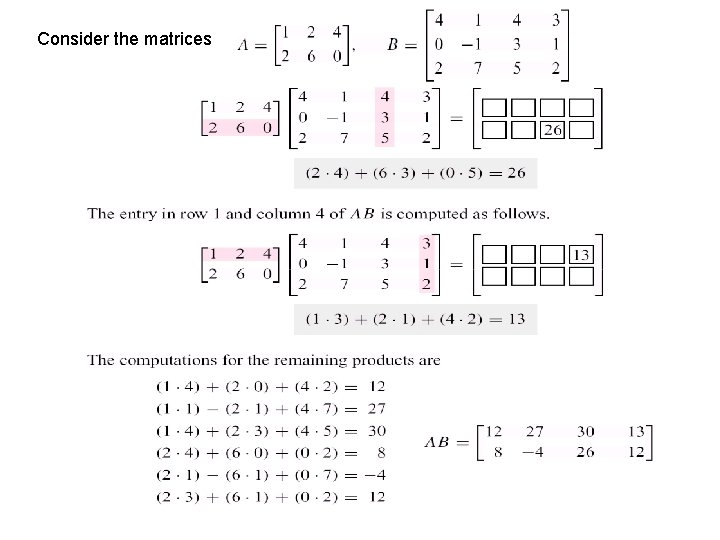
Consider the matrices
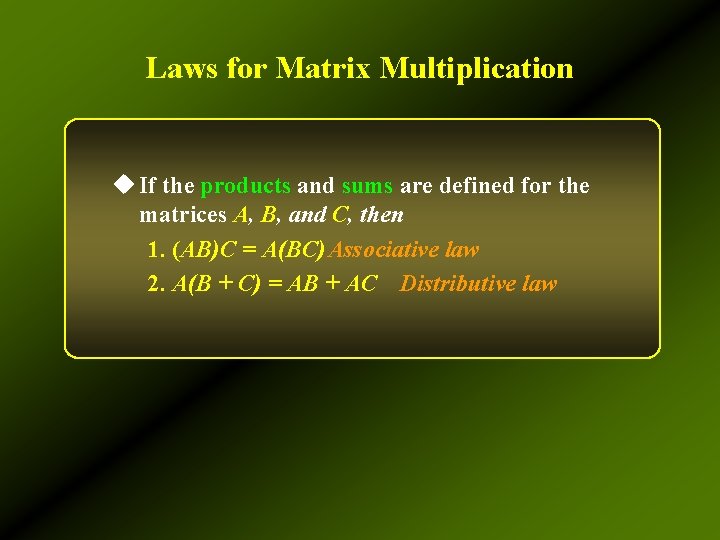
Laws for Matrix Multiplication u If the products and sums are defined for the matrices A, B, and C, then 1. (AB)C = A(BC) Associative law 2. A(B + C) = AB + AC Distributive law
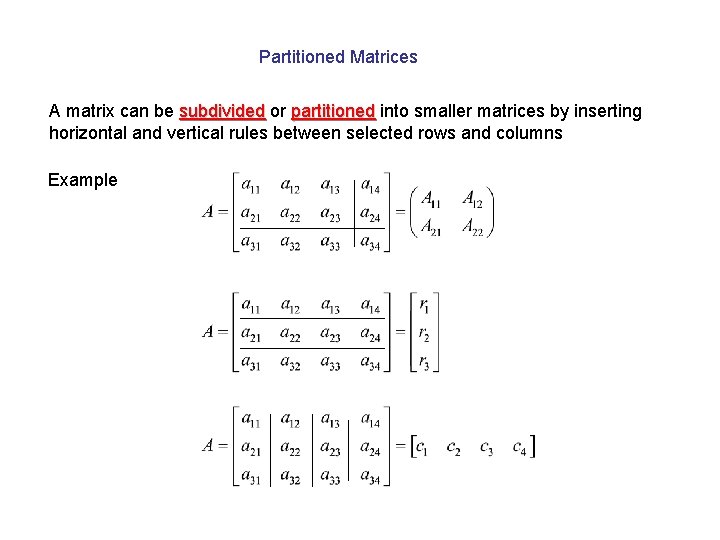
Partitioned Matrices A matrix can be subdivided or partitioned into smaller matrices by inserting horizontal and vertical rules between selected rows and columns Example
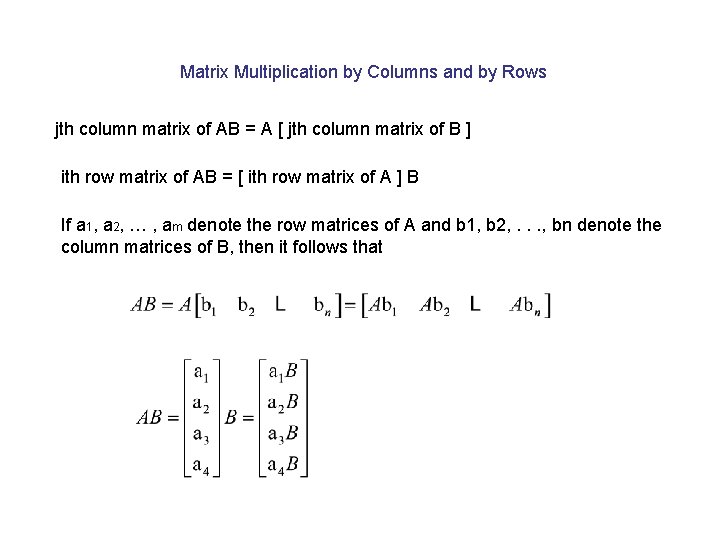
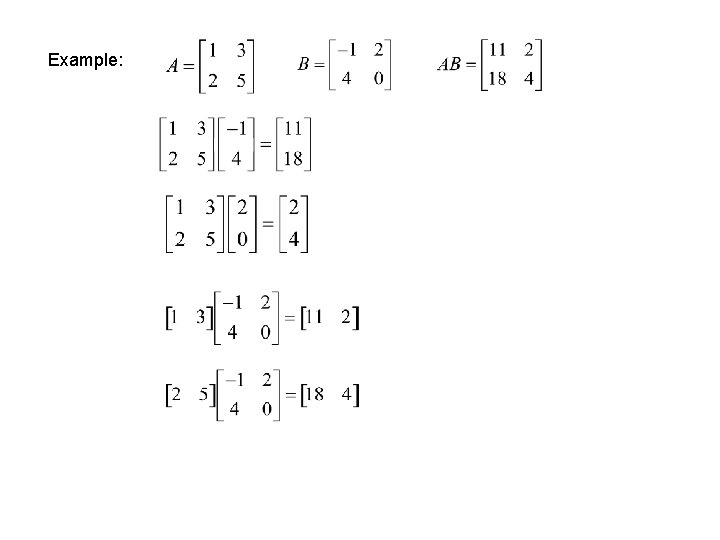
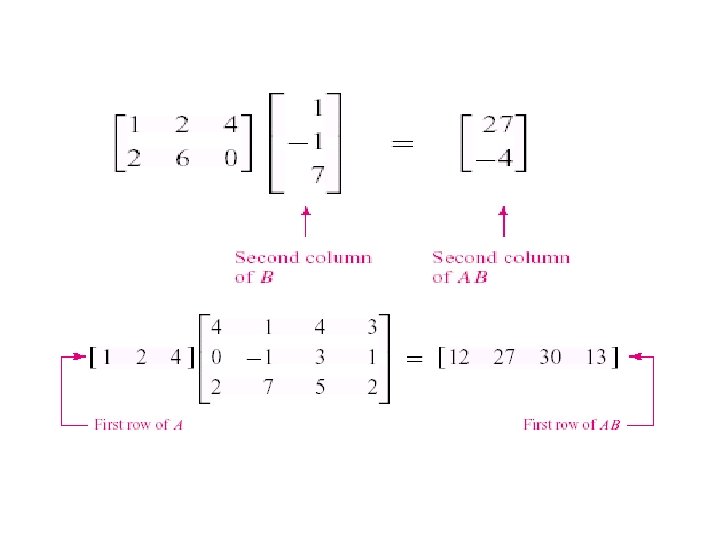
Matrix Multiplication by Columns and by Rows jth column matrix of AB = A [ jth column matrix of B ] ith row matrix of AB = [ ith row matrix of A ] B If a 1, a 2, … , am denote the row matrices of A and b 1, b 2, . . . , bn denote the column matrices of B, then it follows that
Example:
Again the matrices
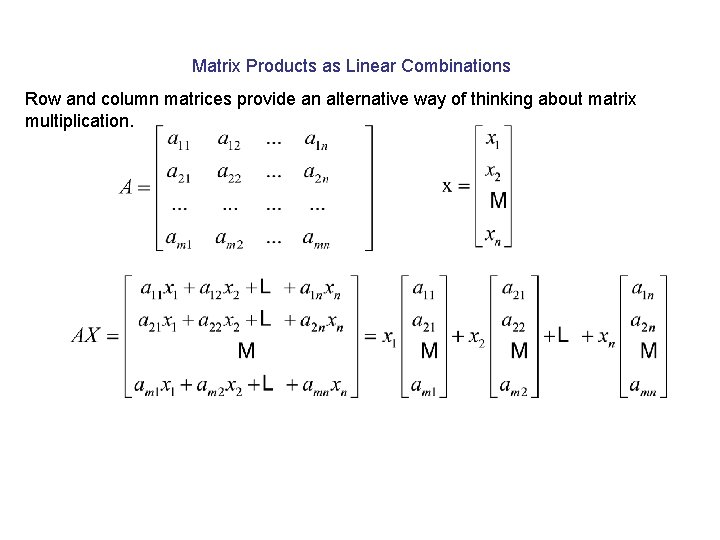
Matrix Products as Linear Combinations Row and column matrices provide an alternative way of thinking about matrix multiplication.
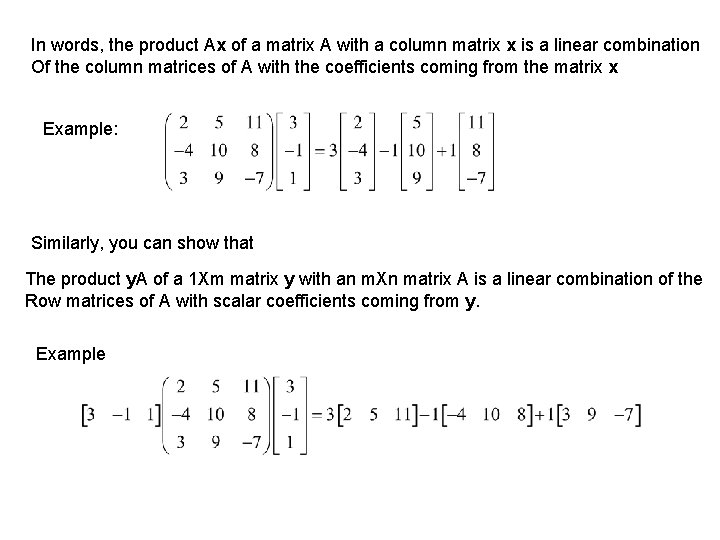
In words, the product Ax of a matrix A with a column matrix x is a linear combination Of the column matrices of A with the coefficients coming from the matrix x Example: Similarly, you can show that The product y. A of a 1 Xm matrix y with an m. Xn matrix A is a linear combination of the Row matrices of A with scalar coefficients coming from y. Example
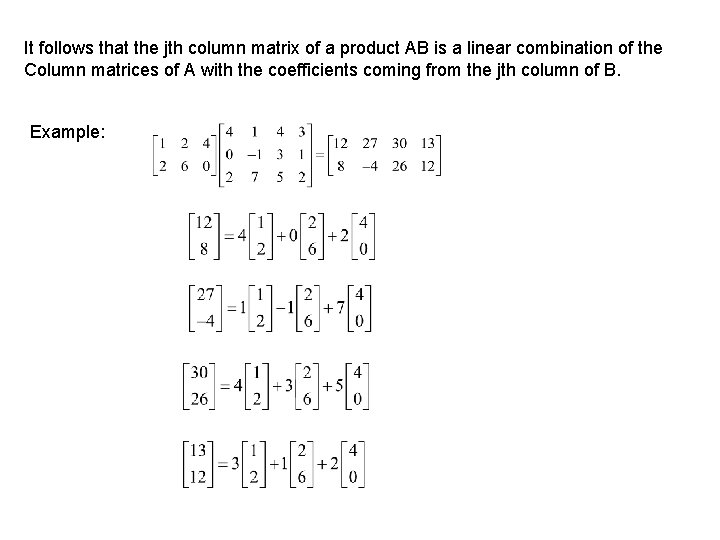
It follows that the jth column matrix of a product AB is a linear combination of the Column matrices of A with the coefficients coming from the jth column of B. Example:
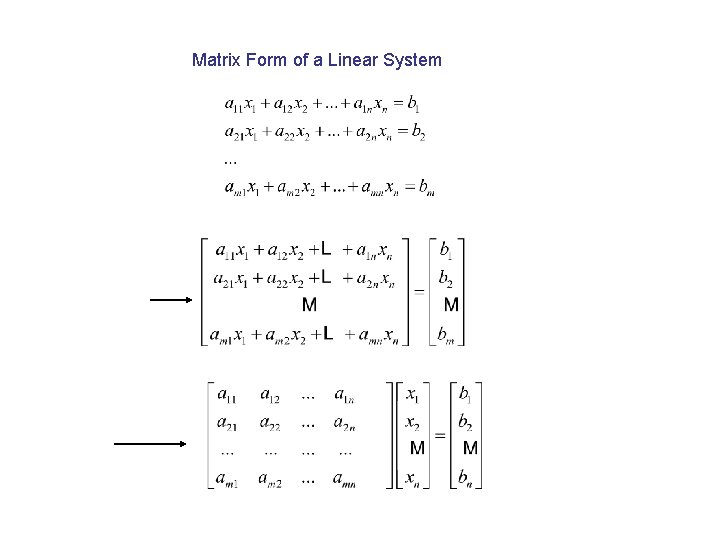
Matrix Form of a Linear System
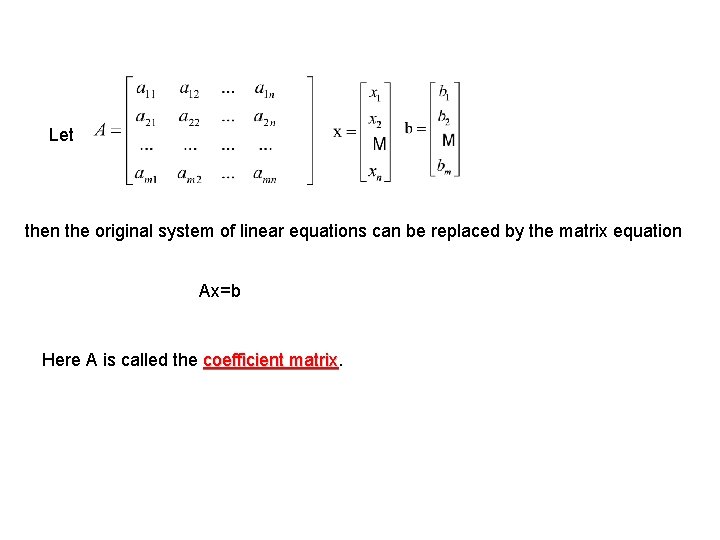
Let then the original system of linear equations can be replaced by the matrix equation Ax=b Here A is called the coefficient matrix
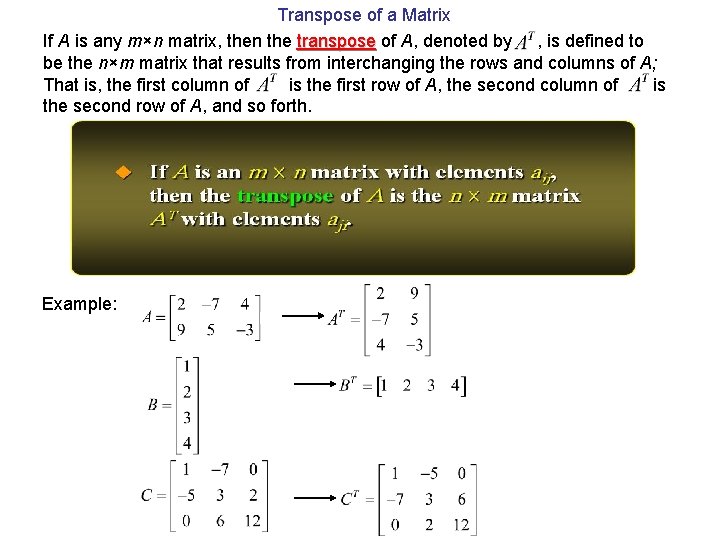
Transpose of a Matrix If A is any m×n matrix, then the transpose of A, denoted by , is defined to be the n×m matrix that results from interchanging the rows and columns of A; That is, the first column of is the first row of A, the second column of is the second row of A, and so forth. Example:
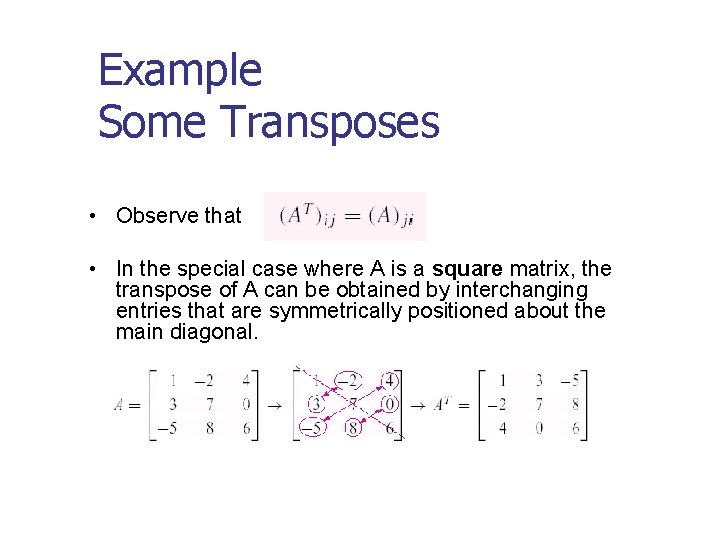
Example Some Transposes • Observe that • In the special case where A is a square matrix, the transpose of A can be obtained by interchanging entries that are symmetrically positioned about the main diagonal.
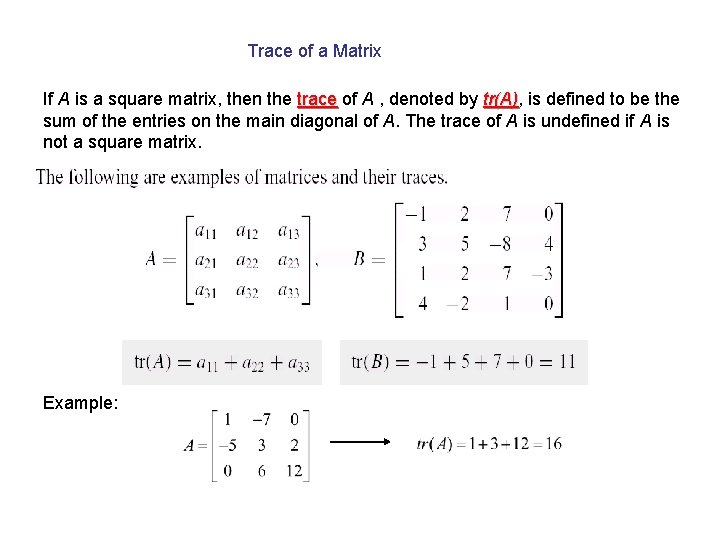
Trace of a Matrix If A is a square matrix, then the trace of A , denoted by tr(A), is defined to be the sum of the entries on the main diagonal of A. The trace of A is undefined if A is not a square matrix. Example: