
Chapter chapter 44 Inclusion Concepts Processes and Models

- Slides: 28
Chapter chapter 44 Inclusion Concepts, Processes, and Models Author name here for Edited books Terry Long and Terry Robertson
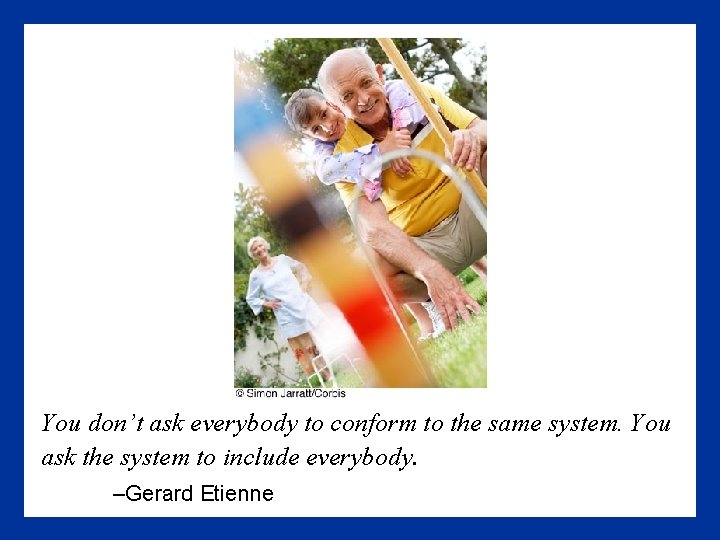
You don’t ask everybody to conform to the same system. You ask the system to include everybody. –Gerard Etienne
What Is a Model? • Symbolic representations used to explain or describe a concept, process, or system • A small representation of a big concept • Can be literal or symbolic • Inclusion models can help guide efforts to provide best practice
Prerequisites to Inclusion • Accessibility • Accommodation – Removing barriers that might otherwise prevent participation – Barrier is not inherently related to the activity • Adaptation – Alteration of variables that are directly related to the participant’s ability to perform the activity at hand – Barrier is inherently related to the activity
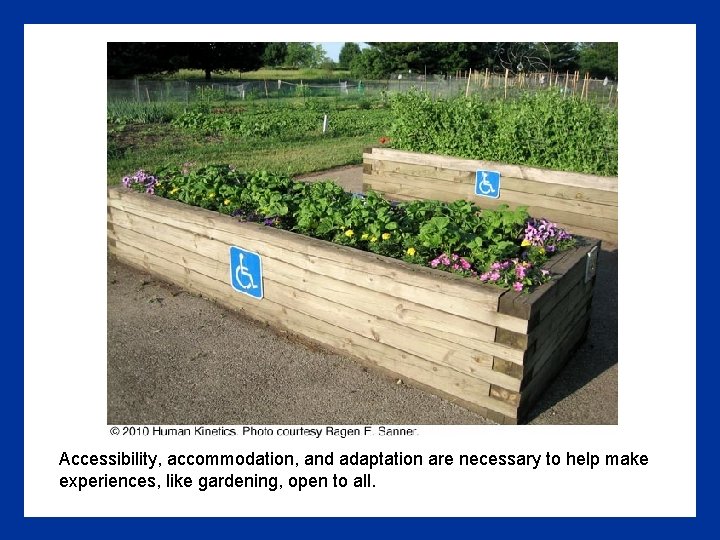
Accessibility, accommodation, and adaptation are necessary to help make experiences, like gardening, open to all.
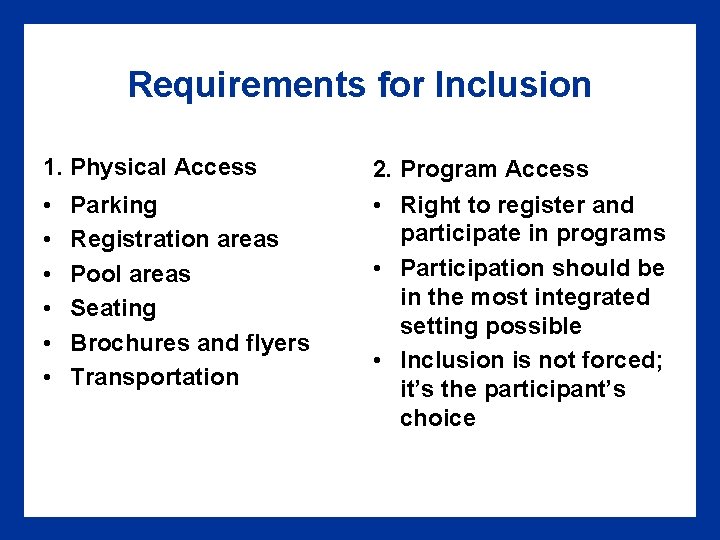
Requirements for Inclusion 1. Physical Access • • • Parking Registration areas Pool areas Seating Brochures and flyers Transportation 2. Program Access • Right to register and participate in programs • Participation should be in the most integrated setting possible • Inclusion is not forced; it’s the participant’s choice
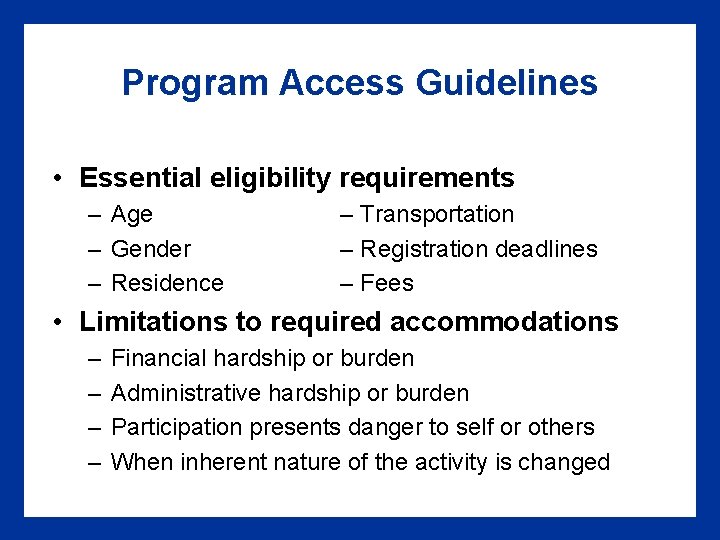
Program Access Guidelines • Essential eligibility requirements – Age – Gender – Residence – Transportation – Registration deadlines – Fees • Limitations to required accommodations – – Financial hardship or burden Administrative hardship or burden Participation presents danger to self or others When inherent nature of the activity is changed
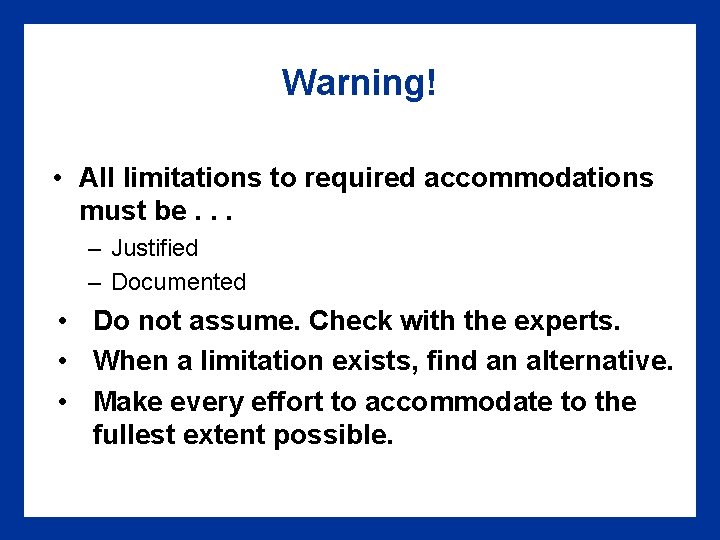
Warning! • All limitations to required accommodations must be. . . – Justified – Documented • Do not assume. Check with the experts. • When a limitation exists, find an alternative. • Make every effort to accommodate to the fullest extent possible.
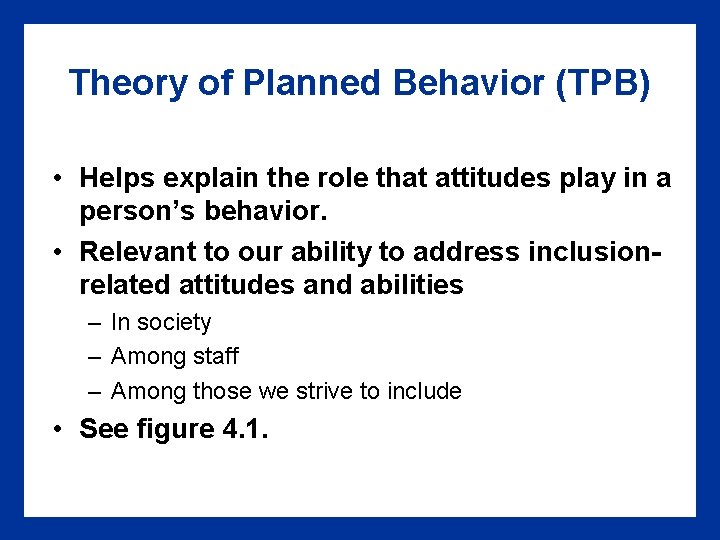
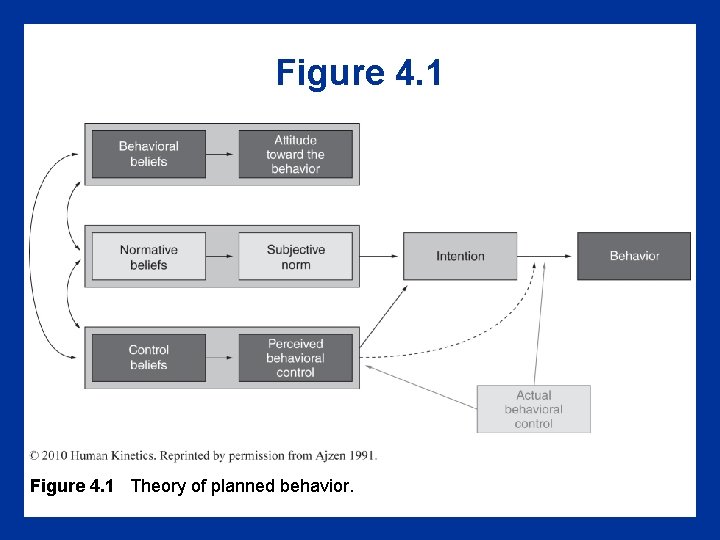
Theory of Planned Behavior (TPB) • Helps explain the role that attitudes play in a person’s behavior. • Relevant to our ability to address inclusionrelated attitudes and abilities – In society – Among staff – Among those we strive to include • See figure 4. 1.
Figure 4. 1 Theory of planned behavior.
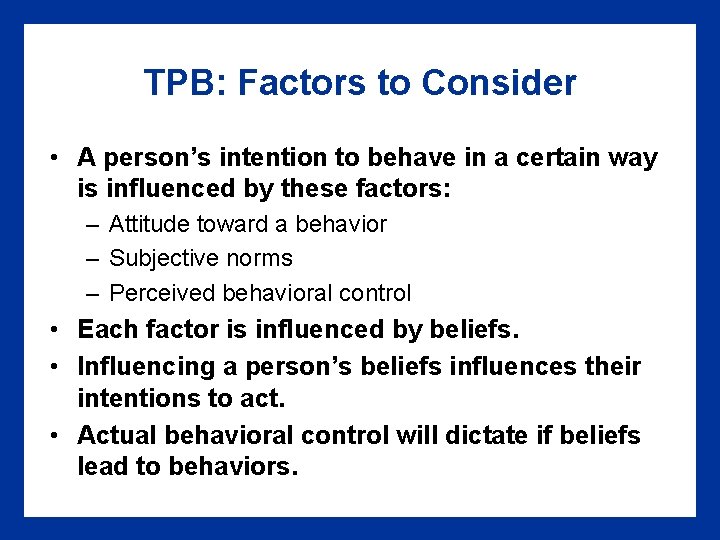
TPB: Factors to Consider • A person’s intention to behave in a certain way is influenced by these factors: – Attitude toward a behavior – Subjective norms – Perceived behavioral control • Each factor is influenced by beliefs. • Influencing a person’s beliefs influences their intentions to act. • Actual behavioral control will dictate if beliefs lead to behaviors.
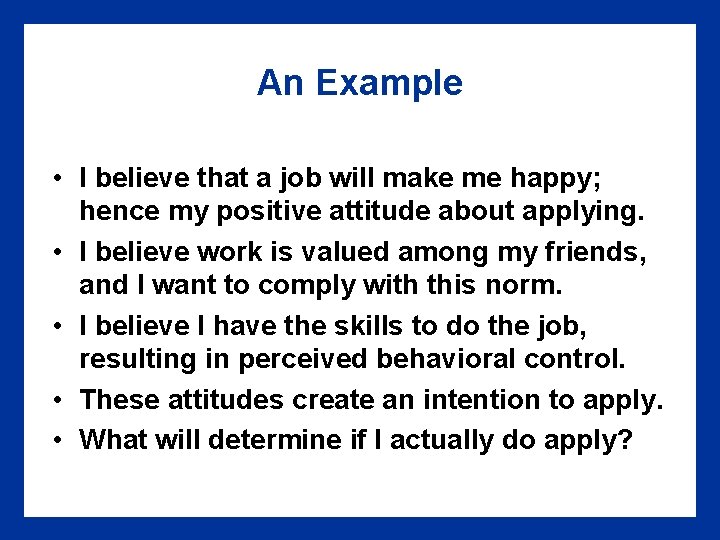
An Example • I believe that a job will make me happy; hence my positive attitude about applying. • I believe work is valued among my friends, and I want to comply with this norm. • I believe I have the skills to do the job, resulting in perceived behavioral control. • These attitudes create an intention to apply. • What will determine if I actually do apply?
Maximizing Self-Determination • • • Promote communication. Respond to preferences. Foster active participation. Encourage empowerment. Expand repertoires and increase competence.
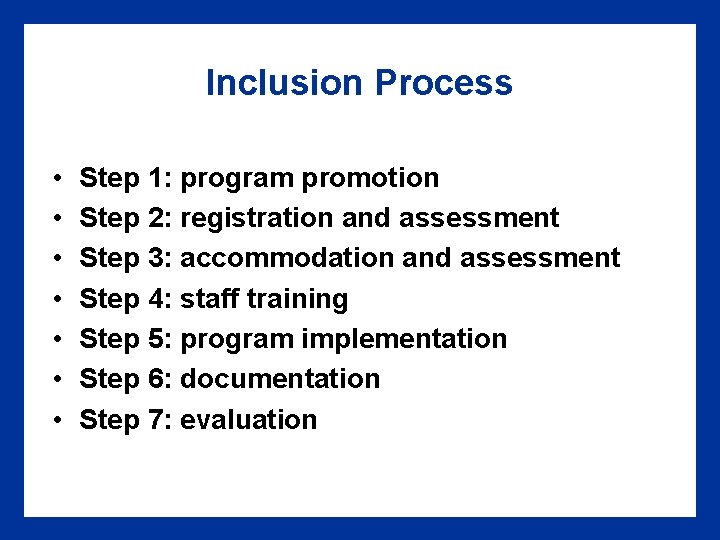
Inclusion Process • • Step 1: program promotion Step 2: registration and assessment Step 3: accommodation and assessment Step 4: staff training Step 5: program implementation Step 6: documentation Step 7: evaluation
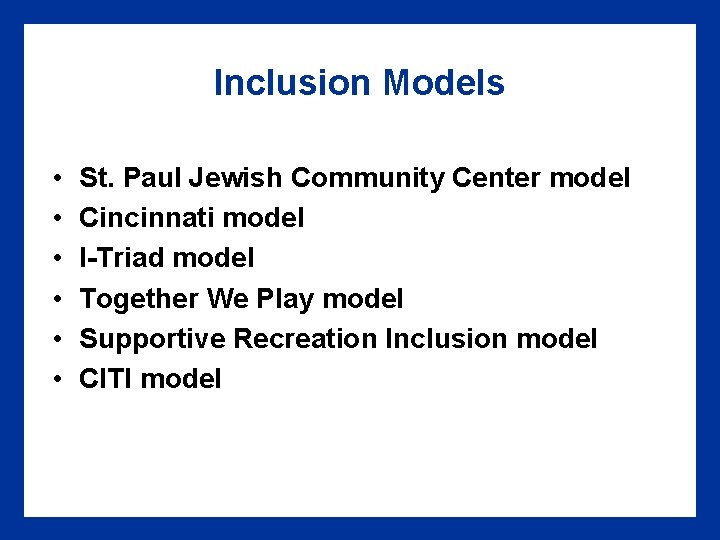
Inclusion Models • • • St. Paul Jewish Community Center model Cincinnati model I-Triad model Together We Play model Supportive Recreation Inclusion model CITI model
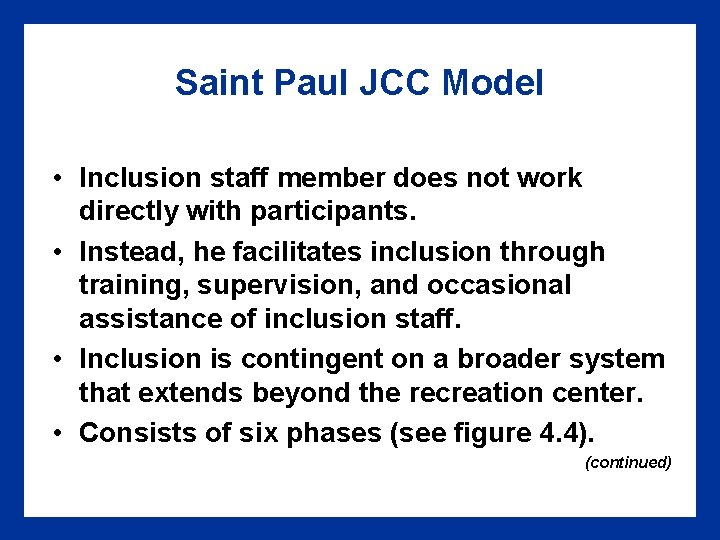
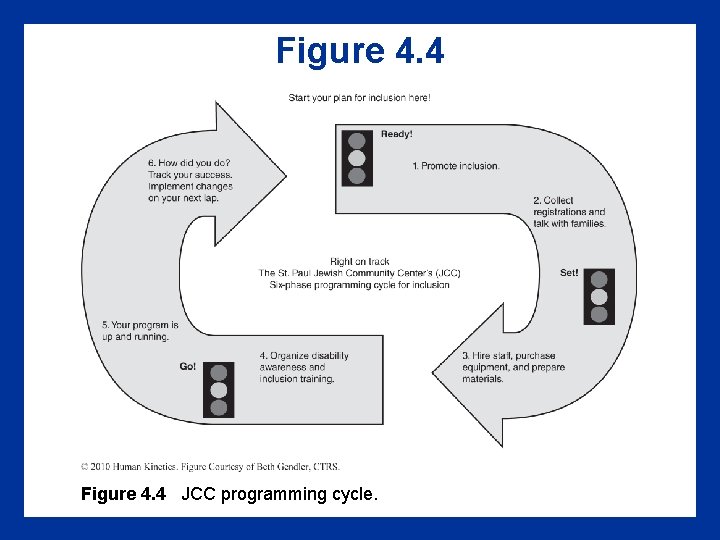
Saint Paul JCC Model • Inclusion staff member does not work directly with participants. • Instead, he facilitates inclusion through training, supervision, and occasional assistance of inclusion staff. • Inclusion is contingent on a broader system that extends beyond the recreation center. • Consists of six phases (see figure 4. 4). (continued)
Figure 4. 4 JCC programming cycle.
Saint Paul JCC Model (continued) • The six phases of the model are cyclic and conducted repeatedly. • Allows for consistent redirection of goals and processes. • Agencies using this model are expected to reach out to other agencies or services. • This creates a community-wide network.
Cincinnati Model • Similar to JCC model, but regional. • Inclusion teams work with recreation centers to provide inclusive services. • Teams consist of these staff: – An inclusion coordinator – An inclusion specialist • Teams work within a designated region. • Services are provided through existing recreation programs.
Components of Cincinnati Model Service Delivery • • Inclusion support within community centers Disability awareness program Staff training Internal and external marketing Advocacy Integration Regional representation on an inclusion counsel
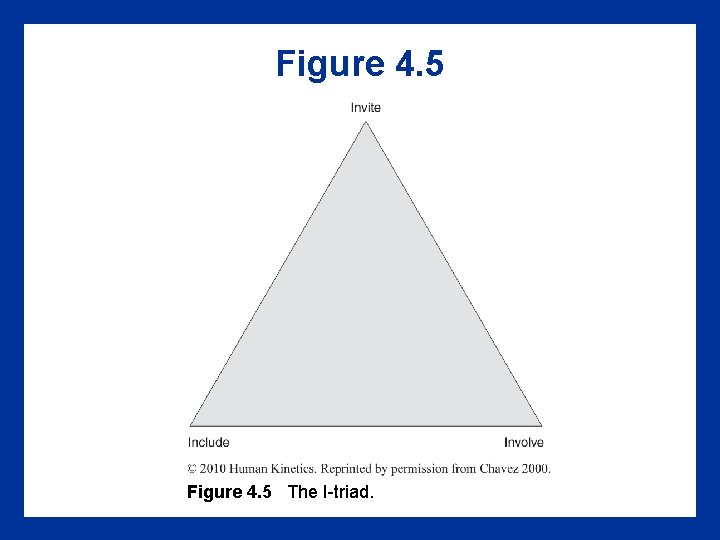
I-Triad Model • Invite – Diverse depictions in advertisements and brochures – Multilingual signage and advertisement • Include – Reach out to community leaders for feedback – Ask participants how you are doing • Involve – Hire diverse staff – Recruit diverse boards and executives • See figure 4. 5
Figure 4. 5 The I-triad.
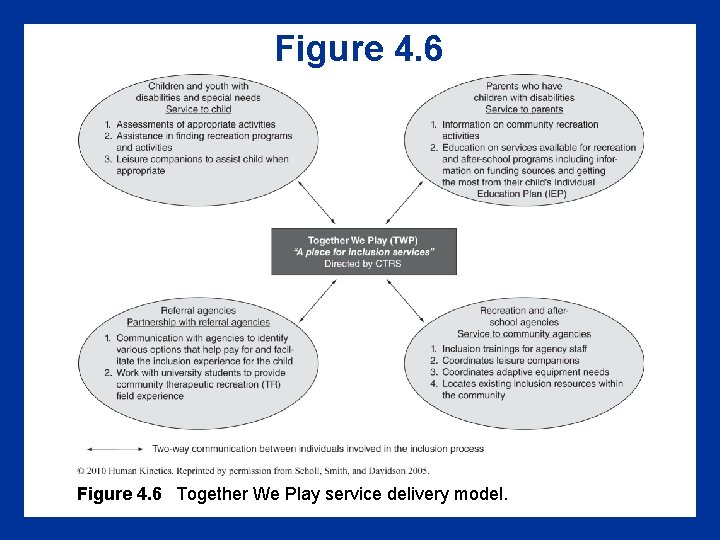
Together We Play Model • Certified therapeutic recreation specialist serves as the inclusion service coordinator. • CTRS actively serves these people: – – Participants Parents Referral agencies Community agencies • This ecological approach allows for synergy across various entities in the environment (see figure 4. 6).
Figure 4. 6 Together We Play service delivery model.
Supportive Recreation Inclusion Model • • Component 1: the individual Component 2: support systems Component 3: recreation service provider Component 4: community at large
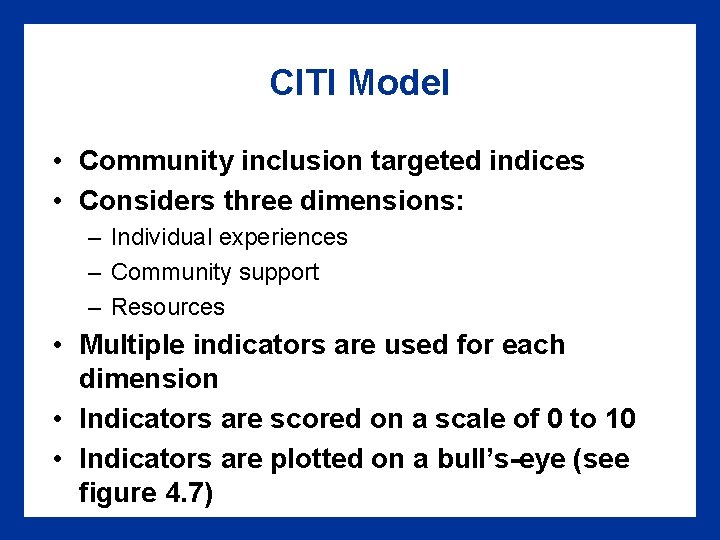
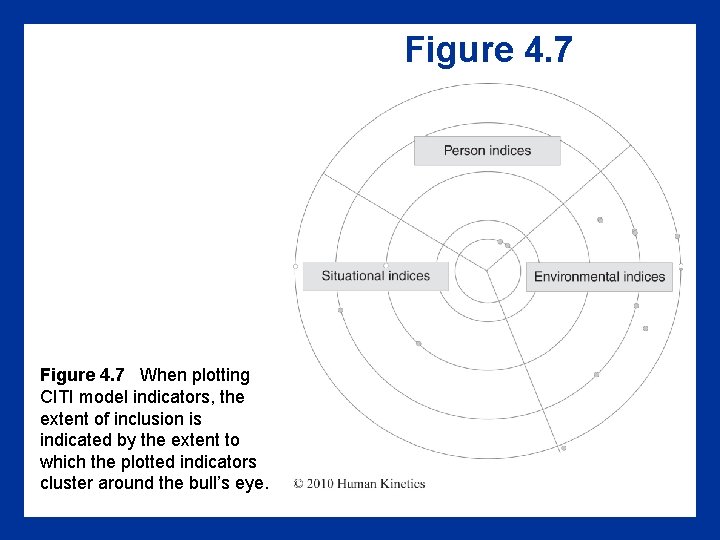
CITI Model • Community inclusion targeted indices • Considers three dimensions: – Individual experiences – Community support – Resources • Multiple indicators are used for each dimension • Indicators are scored on a scale of 0 to 10 • Indicators are plotted on a bull’s-eye (see figure 4. 7)
Figure 4. 7 When plotting CITI model indicators, the extent of inclusion is indicated by the extent to which the plotted indicators cluster around the bull’s eye.
Summary • Inclusion Models can help us understand: – Concepts – processes – Systems • Models presented in this chapter serve a variety of purposes. • Each can be useful when applied within the context of its intended purpose.