
CHAPTER Cell Structure and Function CHAPTER INTRODUCTION Chapter

- Slides: 44
CHAPTER Cell Structure and Function CHAPTER INTRODUCTION Chapter Introduction Lesson 1: Cells and Life CHAPTER Lesson 2: The Cell Lesson 3: Moving Cellular Material Lesson 4: Cells and Energy Chapter Wrap-Up
CHAPTER Cell Structure and Function CHAPTER INTRODUCTION How do the structures and processes of a cell enable it to survive?
CHAPTER Cell Structure and Function CHAPTER INTRODUCTION Alien Life? Look at the photo at the beginning of the chapter. You might think this unicellular organism looks like something out of a science-fiction movie. Although it looks scary, the hairlike structures in its mouth enable the organism to survive. • What do you think the hairlike structures do? • How might the shape of the hairlike structures relate to their function? • How do you think the structures and processes of a cell enable it to survive?
CHAPTER Cell Structure and Function CHAPTER WRAP-UP How do the structures and processes of a cell enable it to survive? A cell is made up of structures that provide support and movement; process energy; and transport materials into, within, and out of a cell.
CHAPTER Cell Structure and Function CHAPTER WRAP-UP Lesson 1: Cells and Life • The invention of the microscope led to discoveries about cells. In time, scientists used these discoveries to develop the cell theory, which explains how cells and living things are related. • Cells are composed mainly of water, proteins, nucleic acids, lipids, and carbohydrates.
LESSON 1 Cells and Life LESSON INTRODUCTION Get Ready What do you think? Before you begin, decide if you agree or disagree with each of these statements. As you view this presentation, see if you change your mind about any of the statements.
LESSON 1 Cells and Life LESSON INTRODUCTION Get Ready Do you agree or disagree? • Nonliving things have cells. • Cells are made mostly of water.
LESSON 1 Cells and Life LESSON INTRODUCTION Key Concepts/Essential Questions • How did scientists’ understanding of cells develop? • What basic substances make up a cell?
LESSON 1 Cells and Life Vocabulary Watch out for these words! • cell theory • macromolecule • nucleic acid • protein • lipid • carbohydrate LESSON INTRODUCTION
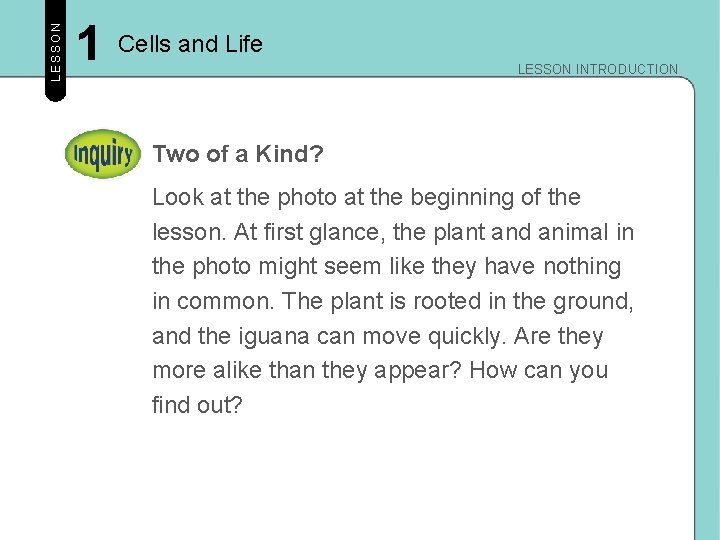
LESSON 1 Cells and Life LESSON INTRODUCTION Two of a Kind? Look at the photo at the beginning of the lesson. At first glance, the plant and animal in the photo might seem like they have nothing in common. The plant is rooted in the ground, and the iguana can move quickly. Are they more alike than they appear? How can you find out?
LESSON 1 Cells and Life LESSON WRAP-UP Lesson Review Do you agree or disagree? Nonliving things have cells. Disagree. Cells are found only in living things.
LESSON 1 Cells and Life LESSON WRAP-UP Lesson Review Do you agree or disagree? Cells are made mostly of water. Agree. Water makes up more than 75 percent of a cell’s volume.
LESSON 1 Cells and Life LESSON WRAP-UP Key Concept/Essential Question Review How did scientists’ understanding of cells develop? The invention of the microscope led to discoveries about cells. In time, scientists used these discoveries to develop the cell theory, which explains how cells and living things are related.
LESSON 1 Cells and Life LESSON WRAP-UP Key Concept/Essential Question Review What basic substances make up a cell? Cells are composed mainly of water, proteins, nucleic acids, lipids, and carbohydrates.
CHAPTER Cell Structure and Function CHAPTER WRAP-UP Lesson 2: The Cell • Cell structures have specific functions, such as supporting a cell, moving a cell, controlling cell activities, processing energy, and transporting molecules. • A prokaryotic cell lacks a nucleus and other membranebound organelles, while a eukaryotic cell has a nucleus and other membrane-bound organelles.
LESSON 2 The Cell LESSON INTRODUCTION Get Ready What do you think? Before you begin, decide if you agree or disagree with each of these statements. As you view this presentation, see if you change your mind about any of the statements.
LESSON 2 The Cell LESSON INTRODUCTION Get Ready Do you agree or disagree? • Different organisms have cells with different structures. • All cells store genetic information in their nuclei.
LESSON 2 The Cell LESSON INTRODUCTION Key Concepts/Essential Questions • How are prokaryotic cells and eukaryotic cells similar, and how are they different? • What do the structures in a cell do?
LESSON 2 The Cell LESSON INTRODUCTION Vocabulary Watch out for these words! • cell membrane • cell wall • organelle • cytoplasm • nucleus • cytoskeleton • chloroplast
LESSON 2 The Cell LESSON INTRODUCTION Hooked Together? Look at the photo at the beginning of the lesson. What do you think happens when one of the hooks in the photo above goes through one of the loops? The two sides fasten together. The shapes of the hooks and loops in the hook-and-loop tape are suited to their function—to hold the two pieces together.
LESSON 2 The Cell LESSON WRAP-UP Lesson Review Do you agree or disagree? Different organisms have cells with different structures. Agree. Two cells with two different functions will also have different structures.
LESSON 2 The Cell LESSON WRAP-UP Lesson Review Do you agree or disagree? All cells store genetic information in their nuclei. Disagree. Prokaryotic cells do not have nuclei. DNA is located in the cytoplasm.
LESSON 2 The Cell LESSON WRAP-UP Key Concept/Essential Question Review How are prokaryotic cells and eukaryotic cells similar, and how are they different? A prokaryotic cell lacks a nucleus and other membranebound organelles, while a eukaryotic cell has a nucleus and other membrane-bound organelles.
LESSON 2 The Cell LESSON WRAP-UP Key Concept/Essential Question Review What do the structures in a cell do? Cell structures have specific functions, such as supporting a cell, moving a cell, controlling cell activities, processing energy, and transporting molecules.
CHAPTER Cell Structure and Function CHAPTER WRAP-UP Lesson 3: Cellular Material • Materials enter and leave a cell through the cell membrane using passive transport or active transport. • The ratio of surface area to volume limits the size of a cell. In a smaller cell, the high surface-area-to-volume ratio allows materials to move easily to all parts of a cell.
LESSON 3 Moving Cellular Material LESSON INTRODUCTION Get Ready What do you think? Before you begin, decide if you agree or disagree with each of these statements. As you view this presentation, see if you change your mind about any of the statements.
LESSON 3 Moving Cellular Material LESSON INTRODUCTION Get Ready Do you agree or disagree? • Diffusion and osmosis are the same process. • Cells with large surface areas can transport more than cells with smaller surface areas.
LESSON 3 Moving Cellular Material LESSON INTRODUCTION Key Concepts/Essential Questions • How do materials enter and leave cells? • How does cell size affect the transport of materials?
LESSON 3 Moving Cellular Material LESSON INTRODUCTION Vocabulary Watch out for these words! • passive transport • diffusion • active transport • osmosis • endocytosis • facilitated diffusion • exocytosis
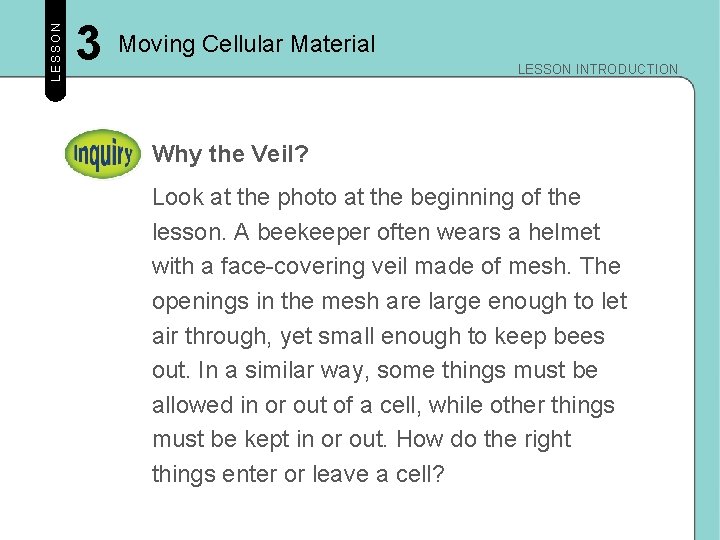
LESSON 3 Moving Cellular Material LESSON INTRODUCTION Why the Veil? Look at the photo at the beginning of the lesson. A beekeeper often wears a helmet with a face-covering veil made of mesh. The openings in the mesh are large enough to let air through, yet small enough to keep bees out. In a similar way, some things must be allowed in or out of a cell, while other things must be kept in or out. How do the right things enter or leave a cell?
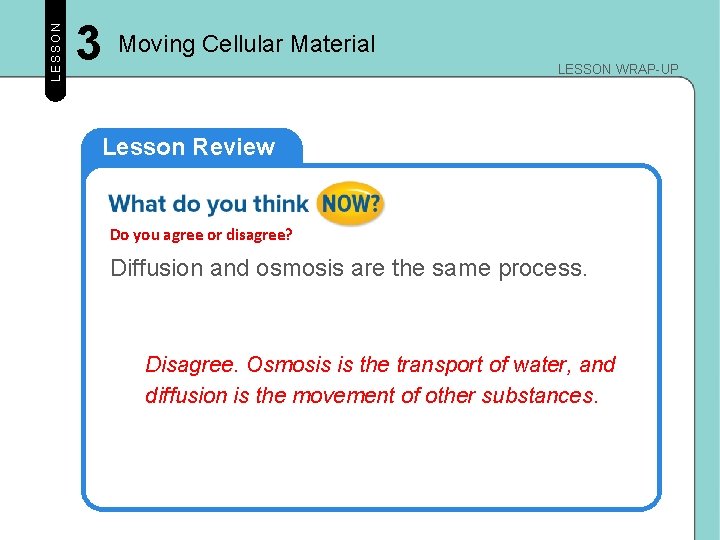
LESSON 3 Moving Cellular Material LESSON WRAP-UP Lesson Review Do you agree or disagree? Diffusion and osmosis are the same process. Disagree. Osmosis is the transport of water, and diffusion is the movement of other substances.
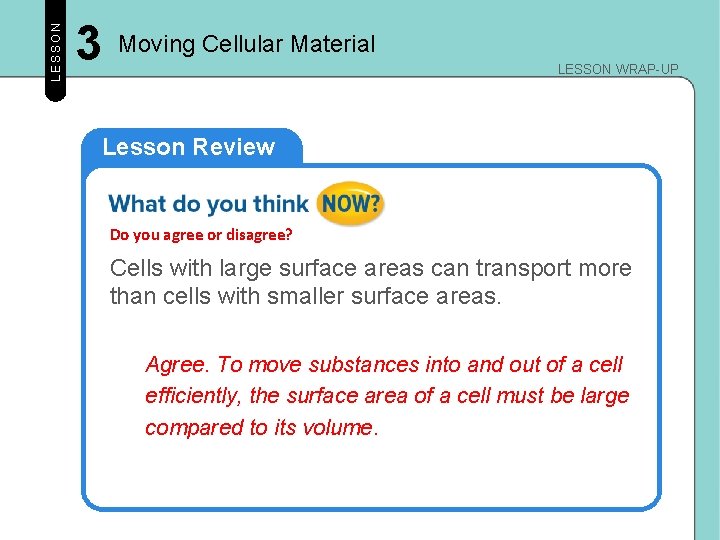
LESSON 3 Moving Cellular Material LESSON WRAP-UP Lesson Review Do you agree or disagree? Cells with large surface areas can transport more than cells with smaller surface areas. Agree. To move substances into and out of a cell efficiently, the surface area of a cell must be large compared to its volume.
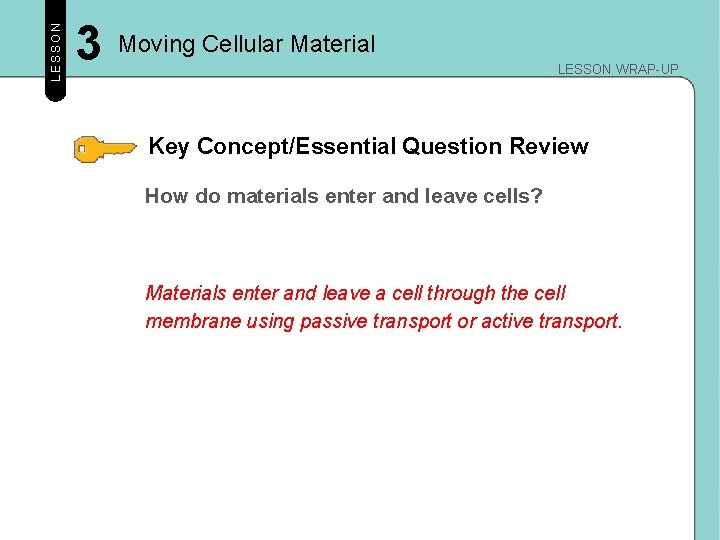
LESSON 3 Moving Cellular Material LESSON WRAP-UP Key Concept/Essential Question Review How do materials enter and leave cells? Materials enter and leave a cell through the cell membrane using passive transport or active transport.
LESSON 3 Moving Cellular Material LESSON WRAP-UP Key Concept/Essential Question Review How does cell size affect the transport of materials? The ratio of surface area to volume limits the size of a cell. In a smaller cell, the high surface-area-to-volume ratio allows materials to move easily to all parts of a cell.
CHAPTER Cell Structure and Function CHAPTER WRAP-UP Lesson 4: Cells and Energy • All living cells release energy from food molecules through cellular respiration and/or fermentation. • Some cells make food molecules using light energy through the process of photosynthesis.
LESSON 4 Cells and Energy LESSON INTRODUCTION Get Ready What do you think? Before you begin, decide if you agree or disagree with each of these statements. As you view this presentation, see if you change your mind about any of the statements.
LESSON 4 Cells and Energy LESSON INTRODUCTION Get Ready Do you agree or disagree? • ATP is the only form of energy found in cells. • Cellular respiration occurs only in lung cells.
LESSON 4 Cells and Energy LESSON INTRODUCTION Key Concepts/Essential Questions • How does a cell obtain energy? • How do some cells make food molecules?
LESSON 4 Cells and Energy Vocabulary Watch out for these words! • cellular respiration • glycolysis • fermentation • photosynthesis LESSON INTRODUCTION
LESSON 4 Cells and Energy LESSON INTRODUCTION Why are there bubbles? Look at the photo at the beginning of the lesson. Have you ever seen bubbles on a green plant in an aquarium? Where did the bubbles come from? Green plants use light energy and make sugars and oxygen.
LESSON 4 Cells and Energy LESSON WRAP-UP Lesson Review Do you agree or disagree? ATP is the only form of energy found in cells. Disagree. Cells store energy in sugars, lipids, and other molecules.
LESSON 4 Cells and Energy LESSON WRAP-UP Lesson Review Do you agree or disagree? Cellular respiration occurs only in lung cells. Disagree. Cellular respiration occurs in all cells that have mitochondria.
LESSON 4 Cells and Energy LESSON WRAP-UP Key Concept/Essential Question Review How does a cell obtain energy? All living cells release energy from food molecules through cellular respiration and/or fermentation.
LESSON 4 Cells and Energy LESSON WRAP-UP Key Concept/Essential Question Review How do some cells make food molecules? Some cells make food molecules using light energy through the process of photosynthesis.