
Chapter B 1 1 9 Newtons Laws of
Chapter B 1 1. 9 – Newton’s Laws of Motion
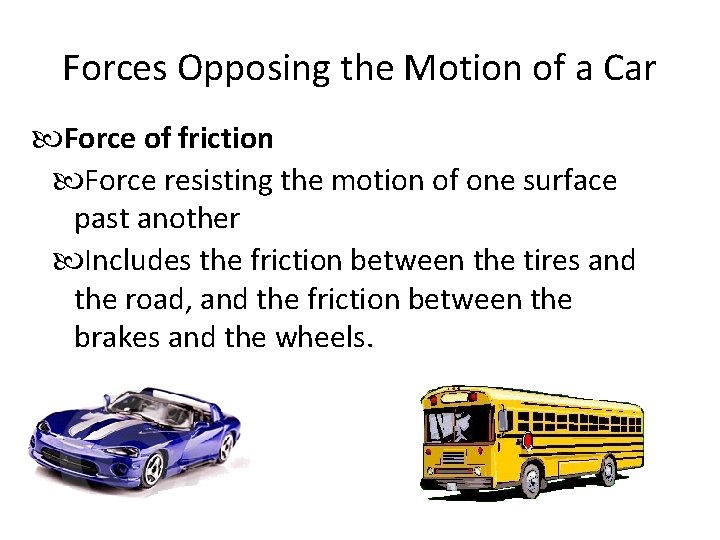
Forces Opposing the Motion of a Car Force of friction Force resisting the motion of one surface past another Includes the friction between the tires and the road, and the friction between the brakes and the wheels.
Forces Opposing the Motion of a Car Air resistance Also called “drag force” The force resisting the motion of an object through the air To minimize air resistance, cars are designed to be aerodynamic.
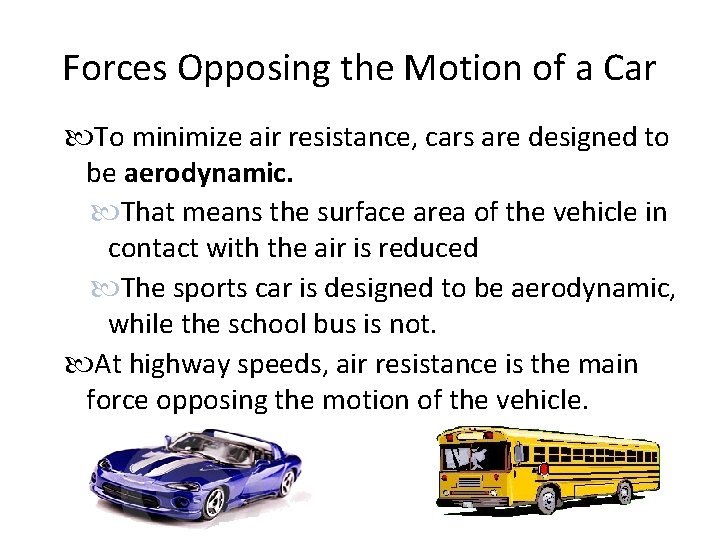
Forces Opposing the Motion of a Car To minimize air resistance, cars are designed to be aerodynamic. That means the surface area of the vehicle in contact with the air is reduced The sports car is designed to be aerodynamic, while the school bus is not. At highway speeds, air resistance is the main force opposing the motion of the vehicle.

Forces Maintaining the Motion of a Car Force: Any external force applied on an object The applied force is the force applied to the car to make it move forward. The larger the applied force, the faster the car will travel. With no resistive forces, an object that is moving would continue on that path indefinitely. Newton’s First Law of Motion An object in motion will remain in motion unless acted upon by a net force. An object at rest will tend to remain at rest.
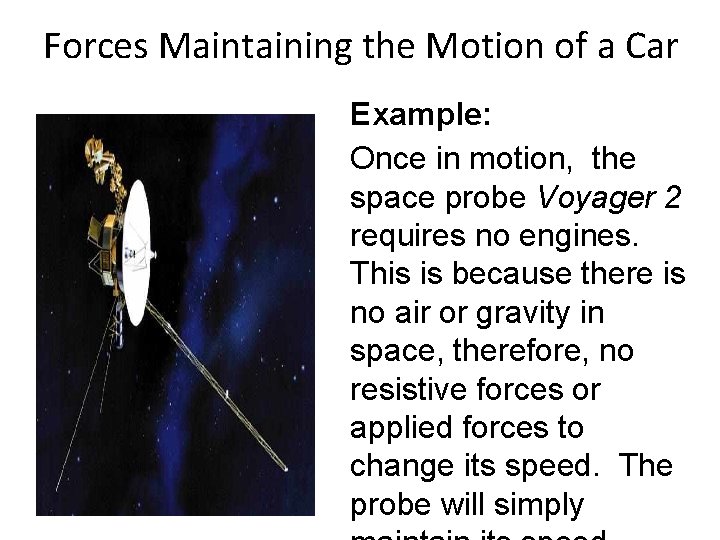
Forces Maintaining the Motion of a Car Example: Once in motion, the space probe Voyager 2 requires no engines. This is because there is no air or gravity in space, therefore, no resistive forces or applied forces to change its speed. The probe will simply
Net Force The sum of all forces acting on an object All forces are vectored quantities direction matters Unless stated otherwise: We assume that the direction of the applied force is the + direction We assume that air resistance and friction are in the – direction
Net Force Example #1: The engine of a motorcycle supplies an applied force of 1880 N east, to overcome the frictional forces of 520 N west. The motorcycle and rider have a combined mass of 245 kg. What is the acceleration of the motorcycle? Fnet = Fapplied + Ffriction = 1880 N [E] + (-520 N [W]) = 1360 N Fnet = ma a = F = 1360 N = + 5. 55 m/s 2 [E] m 245 kg
Example #2 A car with a mass of 1075 kg is traveling on a highway. The engine of the car supplies an applied force of 4800 N west to overcome frictional forces of 4800 N east. What is the acceleration of the car? m = 1075 kg Fapp = - 4800 N [W] Ffric = +4800 N [E] Fnet = Fapplied + Ffriction = -4880 N [W] + 4880 N [E] = 0 N Fnet = ma a= F = m 0 N = + 0 m/s 2 1075 kg Recall, when the net force is zero, it indicates that the object is traveling at a constant speed. Therefore, it reasons that the car’s acceleration is zero.
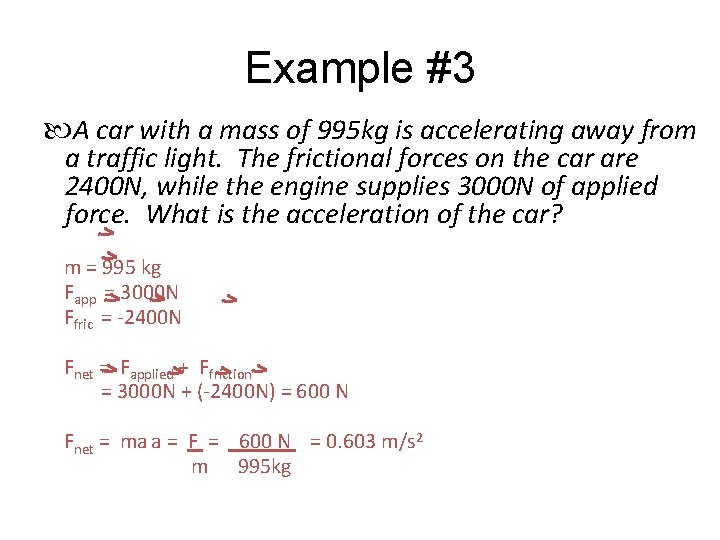
Example #3 A car with a mass of 995 kg is accelerating away from a traffic light. The frictional forces on the car are 2400 N, while the engine supplies 3000 N of applied force. What is the acceleration of the car? m = 995 kg Fapp = 3000 N Ffric = -2400 N Fnet = Fapplied + Ffriction = 3000 N + (-2400 N) = 600 N Fnet = ma a = F = 600 N = 0. 603 m/s 2 m 995 kg
- Slides: 10