
CHAPTER Asset Valuation Bonds Copyright 1999 Addison Wesley
CHAPTER Asset Valuation: Bonds Copyright © 1999 Addison Wesley Longman 8
2 Chapter 8: Asset Valuation: Bonds Objectives 1. Understand the valuation concept. 2. Show bonds are valued 3. Compute yield to maturity Copyright © 1999 Addison Wesley Longman

3 Chapter 8: Asset Valuation: Bonds The Bond Components 1. Bond: a contractual obligation of a borrower to make periodic cash interest payments to a lender for a fixed number of years 2. Coupon (CF): the periodic interest payment 3. Term to maturity (n): the number of years over which the bond contract extends Copyright © 1999 Addison Wesley Longman
4 Chapter 8: Asset Valuation: Bonds 4. Par Value (F): the number of dollars paid to the lender upon maturity 5. Coupon Rate (C/F): the coupon payment expressed as a percentage of a principal amount (Par value) 6. Market Rate or Yield (i): the actual rate paid on the bond by the market Copyright © 1999 Addison Wesley Longman
5 Chapter 8: Asset Valuation: Bonds The Value of Any Investment: u Is the present value of all future cash flows discounted at an interest rate that reflects the risk of the investment. u Bonds are valued like any other asset Copyright © 1999 Addison Wesley Longman
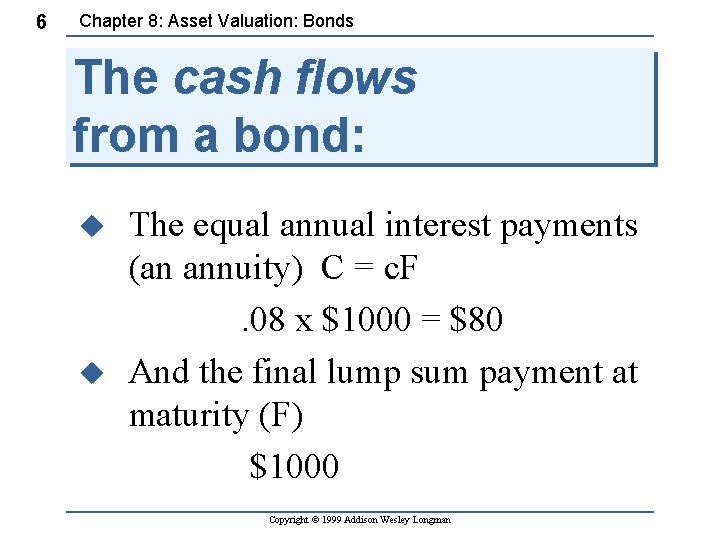
6 Chapter 8: Asset Valuation: Bonds The cash flows from a bond: u u The equal annual interest payments (an annuity) C = c. F . 08 x $1000 = $80 And the final lump sum payment at maturity (F) $1000 Copyright © 1999 Addison Wesley Longman
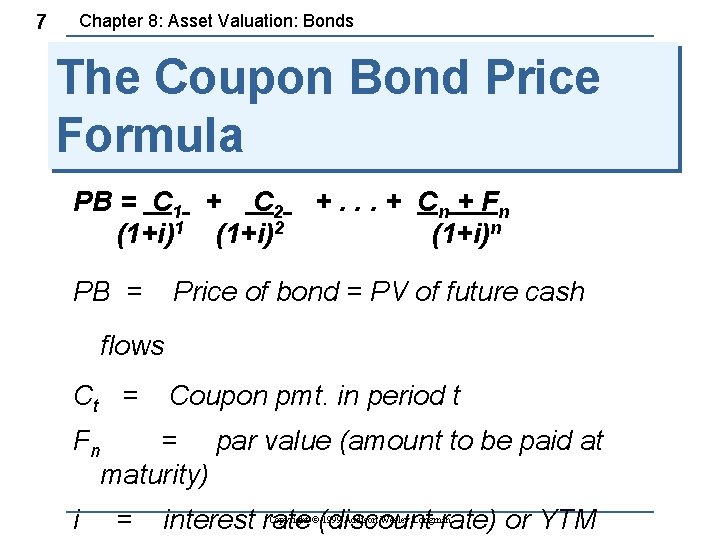
7 Chapter 8: Asset Valuation: Bonds The Coupon Bond Price Formula PB = C 1 + C 2 (1+i)1 (1+i)2 PB = +. . . + Cn + F n (1+i)n Price of bond = PV of future cash flows Ct = Coupon pmt. in period t Fn = par value (amount to be paid at maturity) i = interest rate (discount rate) or YTM Copyright © 1999 Addison Wesley Longman
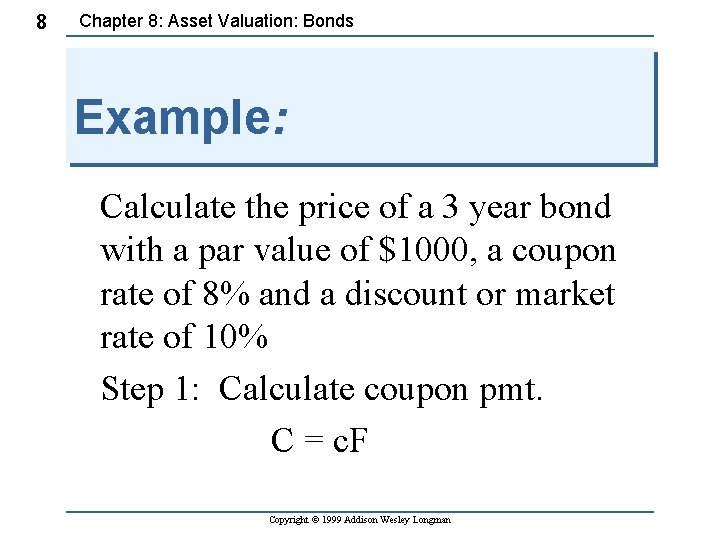
8 Chapter 8: Asset Valuation: Bonds Example: Calculate the price of a 3 year bond with a par value of $1000, a coupon rate of 8% and a discount or market rate of 10% Step 1: Calculate coupon pmt. C = c. F Copyright © 1999 Addison Wesley Longman
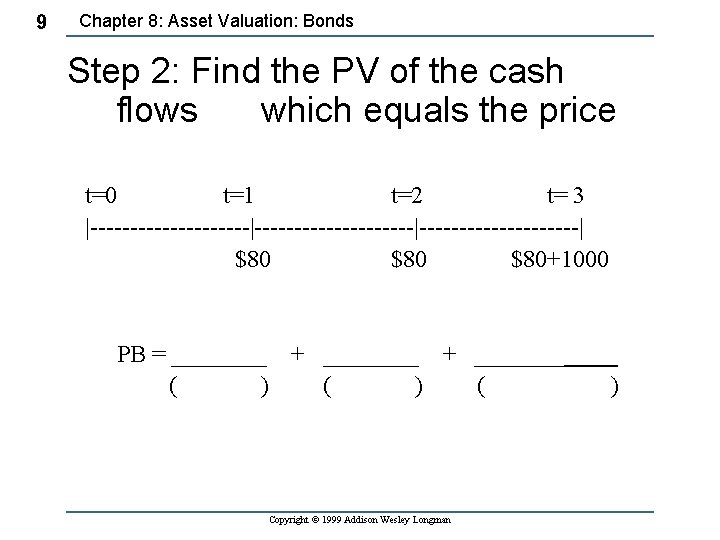
9 Chapter 8: Asset Valuation: Bonds Step 2: Find the PV of the cash flows which equals the price t=0 t=1 t=2 t= 3 |--------------------|----------| $80 $80+1000 PB = ________ + ____ ( ) ( ) Copyright © 1999 Addison Wesley Longman
![10 Chapter 8: Asset Valuation: Bonds Using the Calculator u u u [N] =](http://slidetodoc.com/presentation_image_h/22ebb688e6fc1bce1422fe2c9cd5ce1c/image-10.jpg "10 Chapter 8: Asset Valuation: Bonds Using the Calculator u u u [N] =")
10 Chapter 8: Asset Valuation: Bonds Using the Calculator u u u [N] = [I/Y] = [PV] = [PMT] = [FV] = Copyright © 1999 Addison Wesley Longman
11 Chapter 8: Asset Valuation: Bonds Properties of the Bond Price Formula 1. Case 1: coupon = market rate = PB = par value – bond is selling at par 2. Case 2: coupon < market rate = PB < par value – bond is selling at a discount 3. Case 3: coupon > market rate = PB > par value – bond is selling at a premium Copyright © 1999 Addison Wesley Longman
12 Chapter 8: Asset Valuation: Bonds The Zero Coupon Bond Price Formula Zero Coupons: 1. trade at a discount 2. have no coupon reinvestment risk 3. examples a. t-Bills b. savings bonds Copyright © 1999 Addison Wesley Longman
![13 Chapter 8: Asset Valuation: Bonds 4. PB = Fn [ 1/(1+i/k)kn] PB =](http://slidetodoc.com/presentation_image_h/22ebb688e6fc1bce1422fe2c9cd5ce1c/image-13.jpg "13 Chapter 8: Asset Valuation: Bonds 4. PB = Fn [ 1/(1+i/k)kn] PB =")
13 Chapter 8: Asset Valuation: Bonds 4. PB = Fn [ 1/(1+i/k)kn] PB = Price of bond Fn = value at maturity i = interest yield for n periods n = # of years until maturity k = # of compoundings annually Copyright © 1999 Addison Wesley Longman
14 Chapter 8: Asset Valuation: Bonds Example: Find the price of a 10 yr. Zero coupon bond with a par value of $1000 and a market rate of 12% compounded semi-annually Using Calculator [N] = [I/Y] = [PV] = [PMT] = [FV] = Copyright © 1999 Addison Wesley Longman
15 Chapter 8: Asset Valuation: Bonds Example: What is the price of a bond if it pays interest semi-annually on a 7% coupon and if it has 5 years to maturity, a $1000 face amount and a required return of 10%? Using Calculator [N] = [I/Y] = [PV] = [PMT] = [FV] = Copyright © 1999 Addison Wesley Longman
16 Chapter 8: Asset Valuation: Bonds As market interest rates rise and fall: If interest rates increase, the value of the bond falls. u If interest rates decrease, the valud of the bond rises. u As maturity decreases, the valud of the bond approaches par. u Copyright © 1999 Addison Wesley Longman
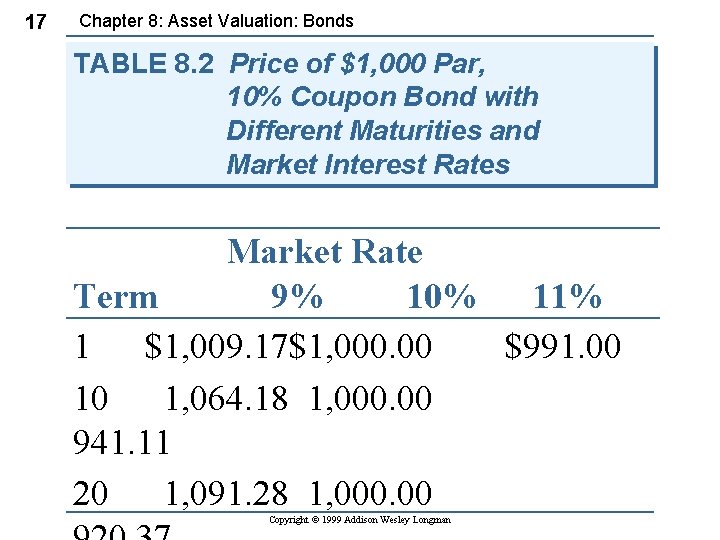
17 Chapter 8: Asset Valuation: Bonds TABLE 8. 2 Price of $1, 000 Par, 10% Coupon Bond with Different Maturities and Market Interest Rates Market Rate Term 9% 10% 1 $1, 009. 17$1, 000. 00 10 1, 064. 18 1, 000. 00 941. 11 20 1, 091. 28 1, 000. 00 Copyright © 1999 Addison Wesley Longman 11% $991. 00
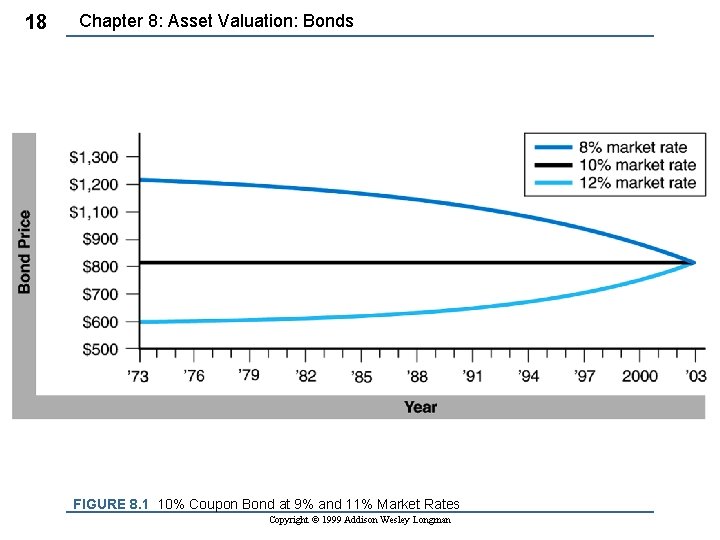
18 Chapter 8: Asset Valuation: Bonds FIGURE 8. 1 10% Coupon Bond at 9% and 11% Market Rates Copyright © 1999 Addison Wesley Longman
19 Chapter 8: Asset Valuation: Bonds Bond Yield Measures A. The actual return on the bond depends on 1. 2. 3. default risk reinvestment risk price risk B. The ideal measure tries to capture 1. 2. 3. coupon payments reinvestment rate capital gains and losses Copyright © 1999 Addison Wesley Longman
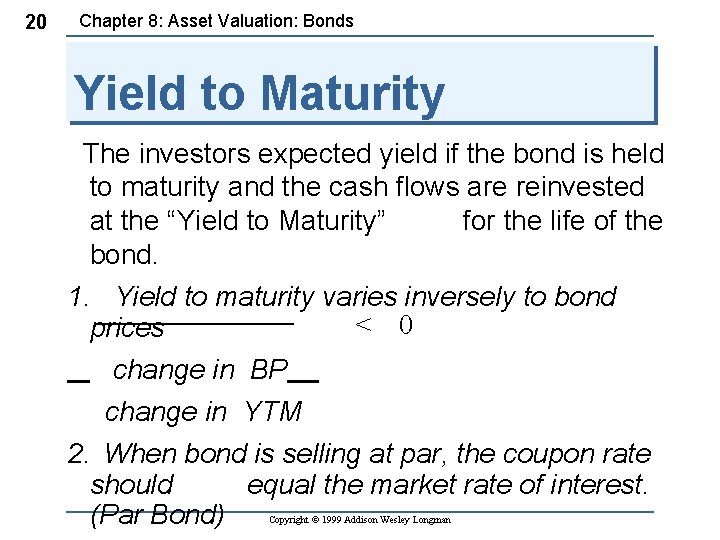
20 Chapter 8: Asset Valuation: Bonds Yield to Maturity The investors expected yield if the bond is held to maturity and the cash flows are reinvested at the “Yield to Maturity” for the life of the bond. 1. Yield to maturity varies inversely to bond < 0 prices change in BP change in YTM 2. When bond is selling at par, the coupon rate should equal the market rate of interest. (Par Bond) Copyright © 1999 Addison Wesley Longman
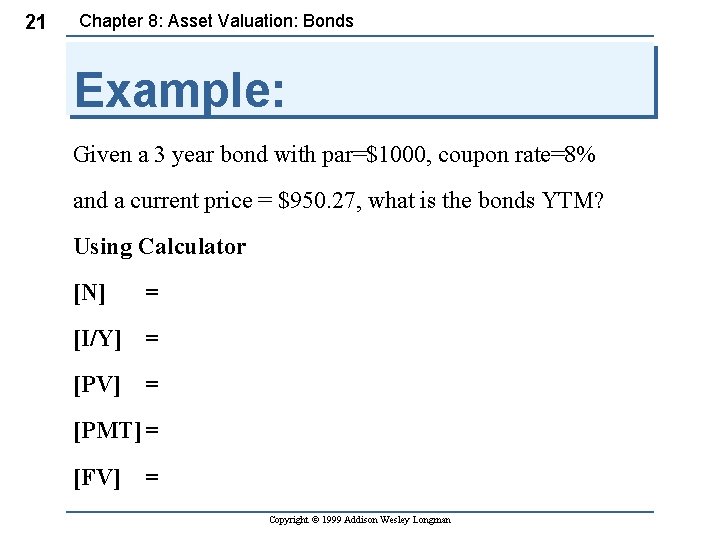
21 Chapter 8: Asset Valuation: Bonds Example: Given a 3 year bond with par=$1000, coupon rate=8% and a current price = $950. 27, what is the bonds YTM? Using Calculator [N] = [I/Y] = [PV] = [PMT] = [FV] = Copyright © 1999 Addison Wesley Longman
22 Chapter 8: Asset Valuation: Bonds Expected Yield The ex-ante yield assuming a forecasted sale price prior to maturity based on expected interest rates. Copyright © 1999 Addison Wesley Longman
23 Chapter 8: Asset Valuation: Bonds Realized Yield The ex-post actual rate of return given the cash flows actually received and their timing Realized Yields affected by: 1. change in timing of promised cash flows 2. change in the interest rates 3. sell bond before maturity at different interest rate Copyright © 1999 Addison Wesley Longman
24 Chapter 8: Asset Valuation: Bonds The Current Yield: The percentage return earned in a year from interest payments. CY = Coupon Payment / Market Price Copyright © 1999 Addison Wesley Longman
25 Chapter 8: Asset Valuation: Bonds Example: If the current market price is $900, and the coupon payment is $80, then what is the current yield? Copyright © 1999 Addison Wesley Longman
26 Chapter 8: Asset Valuation: Bonds Even though bonds are called “fixed income securities, ” They are subject to significant price changes when interest rates are volatile. Copyright © 1999 Addison Wesley Longman
27 Chapter 8: Asset Valuation: Bonds Bond Price Volatility The % change in a bond price for a given change in yield 1. volatility increases as time to maturity increases 2. volatility decreases as coupon rates increase 3. for any change in a bond price, short term Copyright © 1999 Addison Wesley Longman
28 Chapter 8: Asset Valuation: Bonds Interest Rate Risk 1. Price risk 2. Reinvestment risk 3. Price risk and reinvestment risk partially offset each other. a. PR up RR down b. PR down RR up Copyright © 1999 Addison Wesley Longman
29 Chapter 8: Asset Valuation: Bonds Duration 1. Duration is the investment period necessary for price risk and reinvestment risk to be exactly offset. 2. The weighted average # of years needed to fully recover the present value of principle and coupon payments. Copyright © 1999 Addison Wesley Longman
30 Chapter 8: Asset Valuation: Bonds Uses of Duration 1. The most important use of duration is for reducing or eliminating interest risk over a given holding period. 2. Compare sensitivity of bonds with different coupons and maturities to changes in interest Copyright © 1999 Addison Wesley Longman
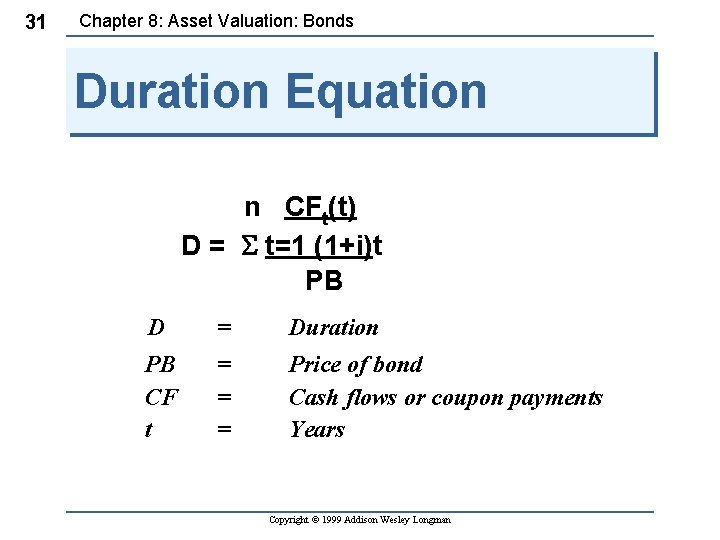
Chapter 8: Asset Valuation: Bonds 31 Duration Equation n CFt(t) D = S t=1 (1+i)t PB D PB CF t = Duration = = = Price of bond Cash flows or coupon payments Years Copyright © 1999 Addison Wesley Longman
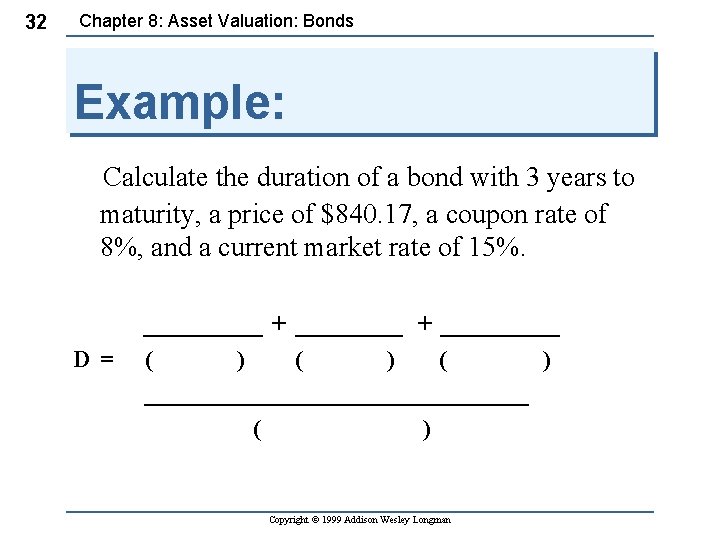
32 Chapter 8: Asset Valuation: Bonds Example: Calculate the duration of a bond with 3 years to maturity, a price of $840. 17, a coupon rate of 8%, and a current market rate of 15%. D = _____ + __________ ( ) ( ) ________________ ( ) Copyright © 1999 Addison Wesley Longman
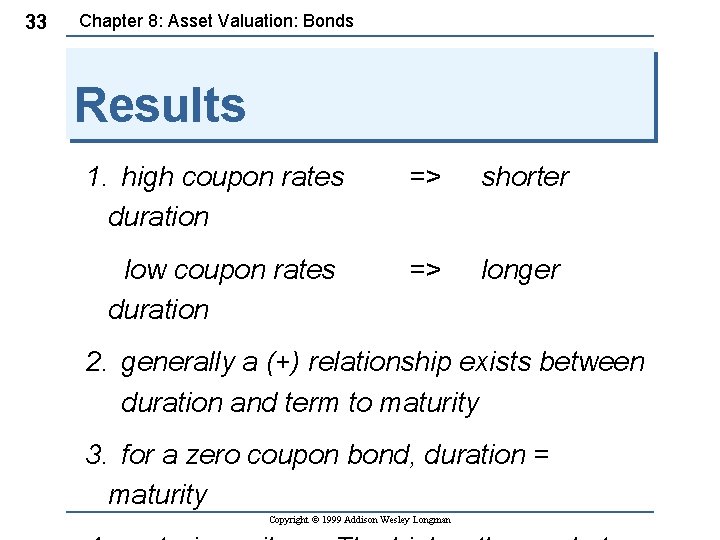
33 Chapter 8: Asset Valuation: Bonds Results 1. high coupon rates duration => shorter low coupon rates duration => longer 2. generally a (+) relationship exists between duration and term to maturity 3. for a zero coupon bond, duration = maturity Copyright © 1999 Addison Wesley Longman
- Slides: 33