
Chapter Activity and Exercise Kozier Erbs Fundamentals of
Chapter Activity and Exercise Kozier & Erb's Fundamentals of Nursing, 8 e Berman, Snyder, Kozier, Erb Copyright 2008 by Pearson Education, Inc. 44
Multimedia Directory Slide 19 Slide 20 Slide 21 Slide 22 Slide 23 Slide 24 Slide 25 Elbow Flexion/Extension Animation Elbow Pronation/Supination Animation Foot Dorsiflexion/Extension Animation Ankle Inversion/Eversion Animation Hand Opposition Animation Humerus Adduction/Abduction Animation Humerus Circumduction Animation Copyright 2008 by Pearson Education, Inc.
Learning Outcomes 1. Describe four basic elements of normal movement. 2. Differentiate isotonic, isometric, isokinetic, aerobic, and anaerobic exercise. 3. Compare the effects of exercise and immobility on body systems. 4. Identify factors influencing a person’s body alignment and activity. Copyright 2008 by Pearson Education, Inc.
Learning Outcomes 5. Assess activity-exercise pattern, alignment, mobility capabilities and limitations, activity tolerance, and potential problems related to immobility. 6. Develop nursing diagnoses and outcomes related to activity, exercise, and mobility problems. 7. Use safe practices when positioning, moving, lifting, and ambulating clients. Copyright 2008 by Pearson Education, Inc.

Pretest • Use your clickers to complete the following pretest. Copyright 2008 by Pearson Education, Inc.
Question 1 To increase stability during client transfer, the nurse increases the base of support by performing which of the following? 1. 2. 3. 4. Leaning slightly backward. Spacing the feet farther apart. Tensing the abdominal muscles. Bending the knees. Copyright 2008 by Pearson Education, Inc.
Rationales 1 1. Leaning backward actually decreases balance. 2. Correct. A key word in the question is “base, ” and the feet provide this foundation. 3. Tensing abdominal muscles alone does not affect the base of support. 4. Bending the knees does not affect the base of support. Copyright 2008 by Pearson Education, Inc.
Question 2 Five minutes after the client’s first postoperative exercise, the client’s vital signs have not yet returned to baseline. An appropriate nursing diagnosis might be: 1. 2. 3. 4. Activity Intolerance. Risk for Activity Intolerance. Impaired Physical Mobility. Risk for Disuse Syndrome. Copyright 2008 by Pearson Education, Inc.
Rationales 2 1. Correct. Vital signs that do not return to baseline 5 minutes after exercising indicate intolerance of exercise at that time. 2. This is a real problem, not “at risk for. ” 3. There is no evidence that the client requires assistance (impaired mobility). 4. There is no evidence that this client is immobile (disuse syndrome). Copyright 2008 by Pearson Education, Inc.
Question 3 Which of the following statements from a client with one weak leg regarding use of crutches when using stairs indicates a need for increased teaching? 1. 2. 3. 4. “Going up, the strong leg goes first, then the weaker leg with both crutches. ” “Going down, the weaker leg goes first with both crutches, then the strong leg. ” “The weaker leg always goes first with both crutches. ” “A cane or single crutch may be used instead of both crutches if held on the weaker side. ” Copyright 2008 by Pearson Education, Inc.
Rationales 3 1. This is correct. 2. This is correct. 3. Correct. Although the crutches (or cane) are always used along with the weaker leg, the weaker leg should go down the stairs first. The stronger leg can support the body as the weaker leg moves forward. All of the other statements are correct. 4. This is correct. Copyright 2008 by Pearson Education, Inc.
Question 4 Because the client weighs 250 pounds, the nurse should provide the unlicensed assistive personnel (UAP) with instructions that reflect an awareness of workplace injury. Which of the following is most appropriate? 1. 2. 3. 4. “Using proper body mechanics will prevent you from injuring yourself. ” “You are physically fit and at lesser risk for injury when transferring the client. ” “Use the mechanical lift and another person to transfer the client from the bed to the chair. ” “Use the back belt to avoid hurting your back. ” Copyright 2008 by Pearson Education, Inc.
Rationales 4 1. It is generally accepted that proper body mechanics alone will not prevent injury. 2. Incorrect. 3. Correct. It is prudent for nurses to understand use proper body mechanics at all times to decrease risk, while keeping in mind the importance of assistive devices and help from other staff. While, many work settings do not yet have “no manual lift” and “no solo lift” policies and resources in place. 4. Incorrect. Copyright 2008 by Pearson Education, Inc.
Question 5 The client is ambulating for the first time after surgery. The client tells the nurse, “I feel faint. ” The best action by the nurse includes which of the following? 1. Find another nurse for help. 2. Return the client to her room as quickly as possible. 3. Tell the client to take rapid, shallow breaths. 4. Assist the client to a nearby chair. Copyright 2008 by Pearson Education, Inc.
Rationales 5 1. Leaving the client creates unsafe conditions as the client may faint before being able to return to her room. 2. The client may faint before being able to return to her room. 3. Rapid, shallow breathing (hyperventilation) may increase the dizziness. 4. Correct. Placing the client in a safe position is the best maneuver. Copyright 2008 by Pearson Education, Inc.
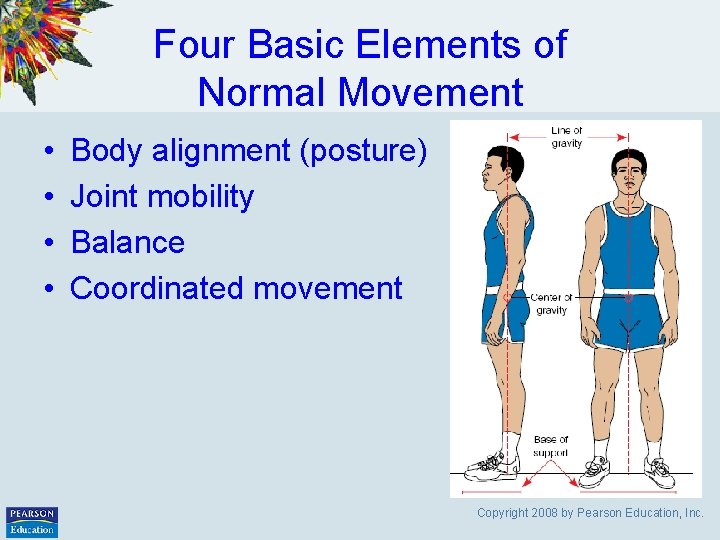
Four Basic Elements of Normal Movement • • Body alignment (posture) Joint mobility Balance Coordinated movement Copyright 2008 by Pearson Education, Inc.
Body Alignment/Posture • Brings body parts into position that promotes optimal balance and body function • Person maintains balance as long as line of gravity passes through center of gravity and base of support Copyright 2008 by Pearson Education, Inc.

Joint Mobility • ROM is maximum movement possible for joint • ROM varies and determined by: – Genetic makeup – Developmental patterns – Presence or absence of disease – Physical activity Copyright 2008 by Pearson Education, Inc.

Elbow Flexion/Extension Animation Click here to view an animation on elbow flexion and extension. Back to Directory Copyright 2008 by Pearson Education, Inc.

Elbow Pronation/Supination Animation Click here to view an animation on elbow pronation and supination. Back to Directory Copyright 2008 by Pearson Education, Inc.
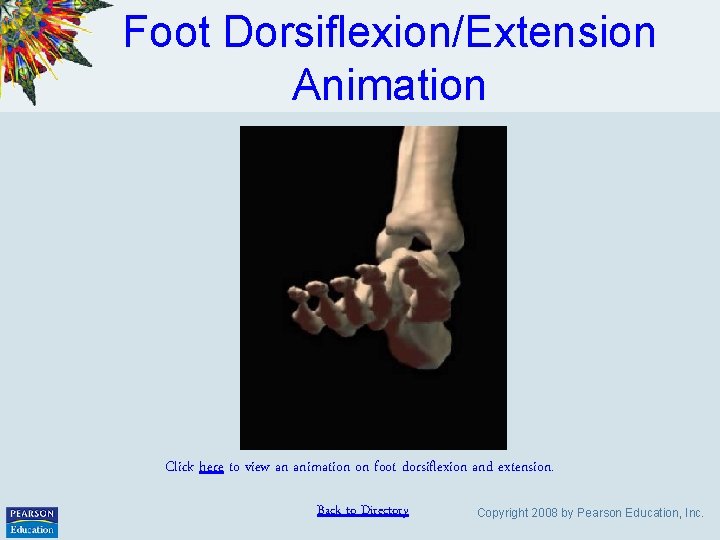
Foot Dorsiflexion/Extension Animation Click here to view an animation on foot dorsiflexion and extension. Back to Directory Copyright 2008 by Pearson Education, Inc.

Ankle Inversion/Eversion Animation Click here to view an animation on ankle inversion and eversion. Back to Directory Copyright 2008 by Pearson Education, Inc.

Hand Opposition Animation Click here to view an animation on hand opposition. Back to Directory Copyright 2008 by Pearson Education, Inc.
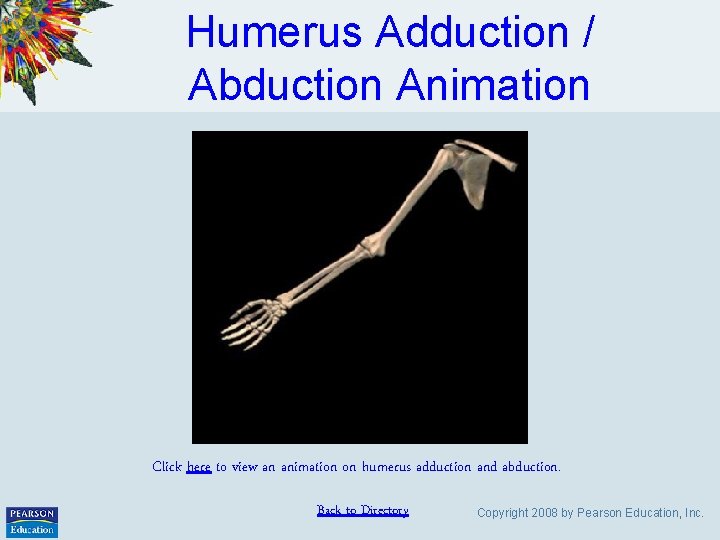
Humerus Adduction / Abduction Animation Click here to view an animation on humerus adduction and abduction. Back to Directory Copyright 2008 by Pearson Education, Inc.

Humerus Circumduction Animation Click here to view an animation on humerus circumduction. Back to Directory Copyright 2008 by Pearson Education, Inc.
Balance • Smooth, purposeful movement • Result of proper functioning of: – Cerebral cortex • Initiates voluntary movement – Cerebellum • Coordinates motor activity – Basal ganglia • Maintains posture Copyright 2008 by Pearson Education, Inc.
Coordinated Movement • Complex mechanisms • Proprioception – Awareness of posture, movement, changes in equilibrium – Knowledge of position, weight, resistance of objects in relation to body Copyright 2008 by Pearson Education, Inc.
Isotonic (Dynamic) Exercise • Muscle shortens to produce muscle contraction and active movement • Increase muscle tone, mass, and strength • Maintain joint flexibility and circulation • HR and CO quicken increase Copyright 2008 by Pearson Education, Inc.
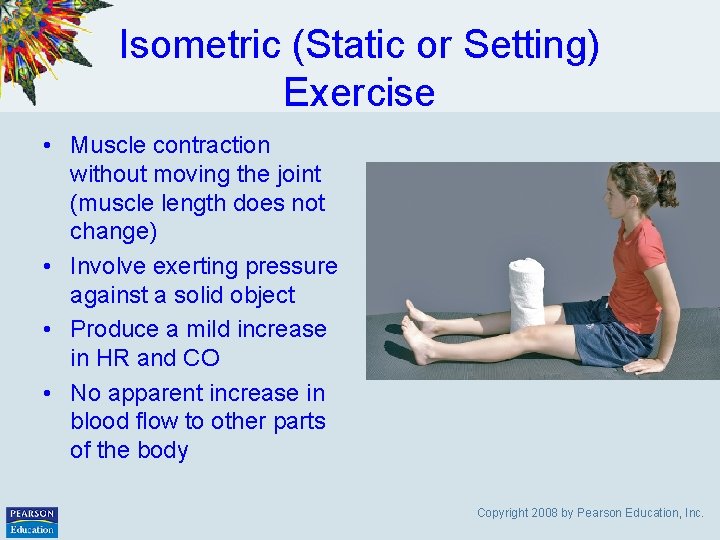
Isometric (Static or Setting) Exercise • Muscle contraction without moving the joint (muscle length does not change) • Involve exerting pressure against a solid object • Produce a mild increase in HR and CO • No apparent increase in blood flow to other parts of the body Copyright 2008 by Pearson Education, Inc.
Isokinetic (Resistive) Exercise • Muscle contraction or tension against resistance • Can either be isotonic or isometric • Person moves (isotonic) or tenses (isometric) against resistance • An increase in blood pressure and blood flow to muscles occurs Copyright 2008 by Pearson Education, Inc.
Aerobic Exercise • Activity during which the amount of oxygen taken in the body is greater than that used to perform the activity • Improve cardiovascular conditioning and physical fitness Copyright 2008 by Pearson Education, Inc.
Anaerobic Exercise • Activity in which the muscles cannot draw enough oxygen from the bloodstream • Anaerobic pathways are used to provide additional energy for a short time • Used in endurance training for athletes Copyright 2008 by Pearson Education, Inc.

Effect on Musculoskeletal System • Exercise – Maintain size, shape, tone, and strength of muscles (including the heart muscle) – Nourish joints – Increase joint flexibility, stability, and ROM – Maintain bone density and strength • Immobility – – Disuse osteoporosis Disuse atrophy Contractures Stiffness and pain in the joints Copyright 2008 by Pearson Education, Inc.
Effects on the Cardiovascular System • Exercise – Increases HR, strength of contraction, and blood supply to the heart and muscles – Mediates harmful effects of stress • Immobility – Diminished cardiac reserve – Increased use of the Valsalva maneuver – Orthostatic hypotension – Venous vasodilation and stasis – Dependent edema – Thrombus formation Copyright 2008 by Pearson Education, Inc.
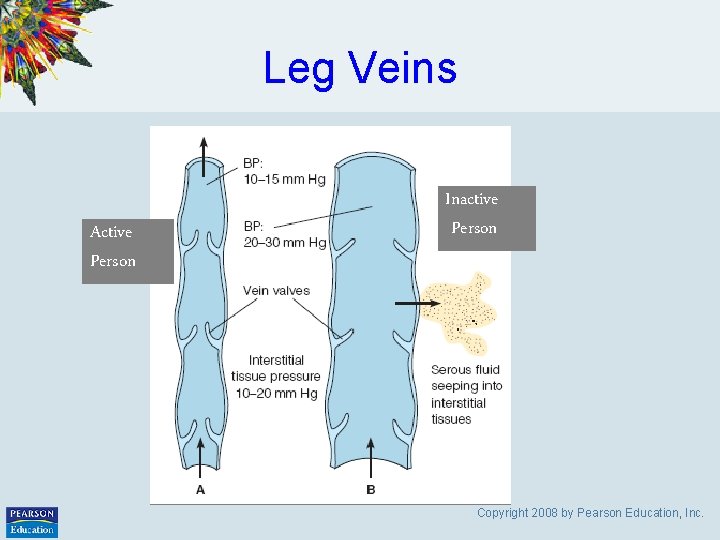
Leg Veins Active Person Inactive Person Copyright 2008 by Pearson Education, Inc.
Effect on the Respiratory System • Exercise – Increase ventilation and oxygen intake improving gas exchange – Prevents pooling of secretions in the bronchi and bronchioles • Immobility – Decreased respiratory movement – Pooling of respiratory secretions – Atelectasis – Hypostatic pneumonia Copyright 2008 by Pearson Education, Inc.
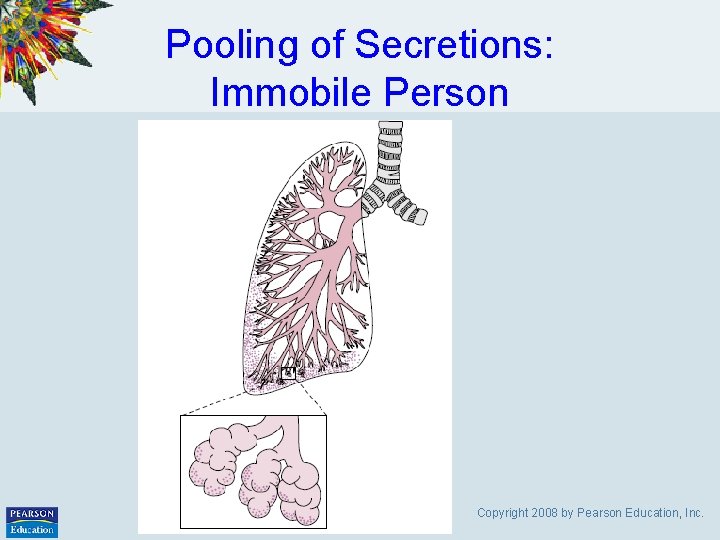
Pooling of Secretions: Immobile Person Copyright 2008 by Pearson Education, Inc.
Effects on the Metabolic/Endocrine System • Exercise – Elevates the metabolic rate – Decreases serum triglycerides and cholesterol – Stabilizes blood sugar and make cells more responsive to insulin • Immobility – Decreased metabolic rate – Negative nitrogen balance – Anorexia – Negative calcium balance Copyright 2008 by Pearson Education, Inc.
Effects on the GI System • Exercise – Improves the appetite – Increases GI tract tone – Facilitates peristalsis • Immobility – Constipation Copyright 2008 by Pearson Education, Inc.
Effect on the Urinary System • Exercise – Promotes blood flow to the kidneys causing body wastes to be excreted more effectively – Prevents stasis (stagnation) of urine in the bladder • Immobility – – Urinary stasis Renal calculi Urinary retention Urinary infection Copyright 2008 by Pearson Education, Inc.
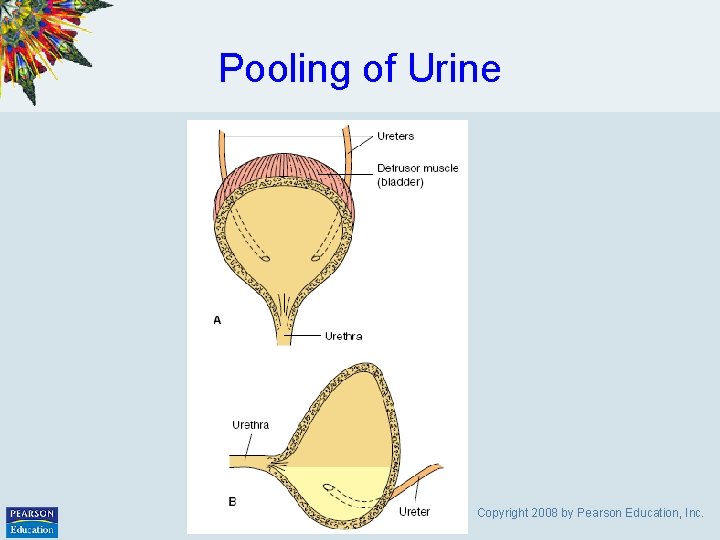
Pooling of Urine Copyright 2008 by Pearson Education, Inc.

Effect on the Immune System • Exercise – Pumps lymph fluid from tissues into lymph capillaries and vessels – Increases circulation through lymph nodes – Strenuous exercise may reduce immune function • Leaving window of opportunity for infection during recovery phase Copyright 2008 by Pearson Education, Inc.
Effect on the Psychoneurologic System • Exercise – Elevates mood – Relieves stress and anxiety – Improves quality of sleep for most individuals • Immobility – Decline in mood elevating substances – Perception of time intervals deteriorates – Problem-solving and decision-making abilities may deteriorate – Loss of control over events can cause anxiety Copyright 2008 by Pearson Education, Inc.
Effect on Cognitive Function • Exercise – Positive effects on decision-making and problem solving processes, planning, and paying attention – Induces cells in the brain to strengthen and build neuronal connections Copyright 2008 by Pearson Education, Inc.
Other Effects of Exercise and Immobility • Evidence that certain types of exercise increase spiritual health • Immobility causes reduced skin turgor and skin breakdown Copyright 2008 by Pearson Education, Inc.
Factors Affecting Body Alignment, Mobility, and DAL • Growth and development • Nutrition, personal values and attitudes • External factors – i. e. , Temperature, humidity, availability of recreational facilities, safety of the neighborhood • Prescribed limitations – i. e. , Casts, braces, traction, activity restrictions including bed rest Copyright 2008 by Pearson Education, Inc.
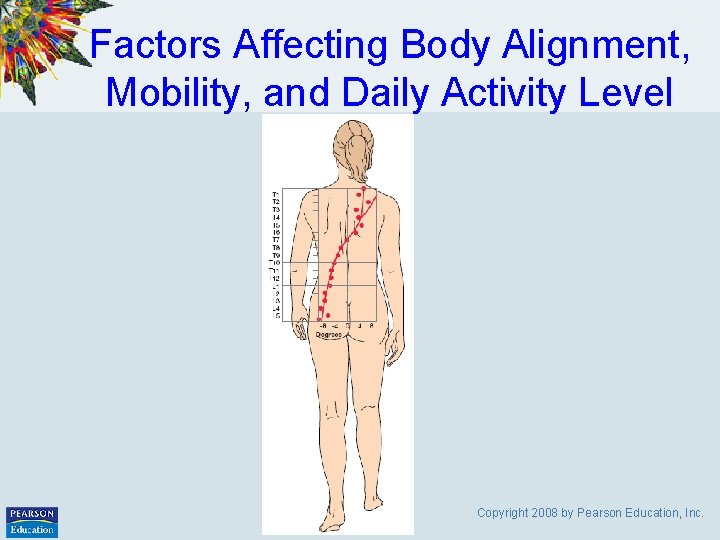
Factors Affecting Body Alignment, Mobility, and Daily Activity Level Copyright 2008 by Pearson Education, Inc.
Assessment of Activity and Exercise • Nursing History • Physical Examination: – Body alignment – Gait – Appearance and movement of joints – Capabilities and limitations for movement – Muscle mass and strength – Activity tolerance – Problems related to immobility Copyright 2008 by Pearson Education, Inc.

NANDA Nursing Diagnoses • For activity and exercise problems – Activity Intolerance – Risk for Activity Intolerance – Impaired Physical Mobility – Sedentary Lifestyle – Risk for Disuse Syndrome Copyright 2008 by Pearson Education, Inc.
NANDA Nursing Diagnoses • The mobility problem becomes the etiology: – Fear (of falling) – Ineffective Coping – Low Self-Esteem – Powerlessness – Risk for Falls – Self-Care Deficit Copyright 2008 by Pearson Education, Inc.
NANDA Nursing Diagnoses • Prolonged immobility: – Ineffective Airway Clearance – Risk for Infection – Risk for Injury – Risk for Disturbed Sleep Pattern – Risk for Situational Low Self-Esteem Copyright 2008 by Pearson Education, Inc.
Examples of Desired Outcomes (NOC Labels) • • Activity tolerance Body positioning Bowel elimination Fall prevention behavior • Immobility consequences both physiological and psychocognitive • Joint movement • Mobility • Respiratory status • Ventilation and gas exchange • Self-care • Sleep • Stress level • Weight control Copyright 2008 by Pearson Education, Inc.
Overall Goals for Problems Related to Mobility or Activity • Increased tolerance for physical activity • Restored or improved capability to ambulate and/or participate in ADLs • Absence of injury from falling or improper use of body mechanics • Enhanced physical fitness • Absence of any complications associated with immobility • Improved social, emotional, and intellectual wellbeing Copyright 2008 by Pearson Education, Inc.
Safe Practice for Positioning, Moving, Lifting, Ambulating Clients • Correct body mechanics required for nurse to prevent injury • Correct body alignment for the client also so that undue stress is not placed on the musculoskeletal system Copyright 2008 by Pearson Education, Inc.
General Guidelines for Moving and Lifting • • Before moving, assess If indicated, use pain relief modalities Prepare any needed assistive devices Plan around encumbrances Be alert to the effects of any medications Obtain required assistance Explain the procedure to the client Copyright 2008 by Pearson Education, Inc.
General Guidelines for Transferring a Client • • Plan what to do and how to do it Obtain essential equipment before starting Remove obstacles Explain transfer to client and assistive personnel Support or hold client rather than equipment Explain what client should do Make written plan, including client’s tolerance Copyright 2008 by Pearson Education, Inc.
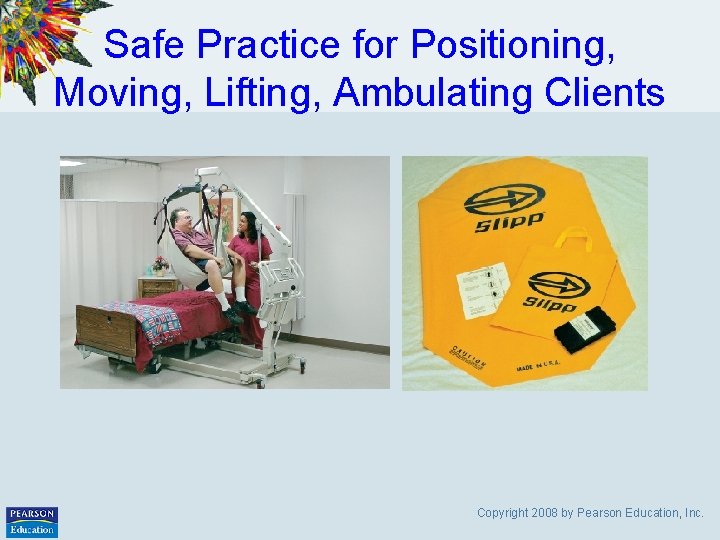
Safe Practice for Positioning, Moving, Lifting, Ambulating Clients Copyright 2008 by Pearson Education, Inc.
General Guidelines for Ambulating • Assess the amount of assistance the client will require • Assess for signs and symptoms of orthostatic hypotension • Prepare client for ambulation • Apply transfer or walking belt • Physically support client • Obtain assistance to follow with wheelchair or assist with physical support • Teach client to correctly use mechanical aids Copyright 2008 by Pearson Education, Inc.

Post Test • Use your clickers to complete the following pretest. Copyright 2008 by Pearson Education, Inc.
Question 1 To increase stability during client transfer, the nurse increases the base of support by performing which of the following? 1. 2. 3. 4. Leaning slightly backward. Spacing the feet farther apart. Tensing the abdominal muscles. Bending the knees. Copyright 2008 by Pearson Education, Inc.
Rationales 1 1. Leaning backward actually decreases balance. 2. Correct. A key word in the question is “base, ” and the feet provide this foundation. 3. Tensing abdominal muscles alone does not affect the base of support. 4. Bending the knees does not affect the base of support. Copyright 2008 by Pearson Education, Inc.
Question 2 Five minutes after the client’s first postoperative exercise, the client’s vital signs have not yet returned to baseline. An appropriate nursing diagnosis might be: 1. 2. 3. 4. Activity Intolerance. Risk for Activity Intolerance. Impaired Physical Mobility. Risk for Disuse Syndrome. Copyright 2008 by Pearson Education, Inc.
Rationales 2 1. Correct. Vital signs that do not return to baseline 5 minutes after exercising indicate intolerance of exercise at that time. 2. This is a real problem, not “at risk for. ” 3. There is no evidence that the client requires assistance (impaired mobility). 4. There is no evidence that this client is immobile (disuse syndrome). Copyright 2008 by Pearson Education, Inc.
Question 3 Which of the following statements from a client with one weak leg regarding use of crutches when using stairs indicates a need for increased teaching? 1. 2. 3. 4. “Going up, the strong leg goes first, then the weaker leg with both crutches. ” “Going down, the weaker leg goes first with both crutches, then the strong leg. ” “The weaker leg always goes first with both crutches. ” “A cane or single crutch may be used instead of both crutches if held on the weaker side. ” Copyright 2008 by Pearson Education, Inc.
Rationales 3 1. This is correct. 2. This is correct. 3. Correct. Although the crutches (or cane) are always used along with the weaker leg, the weaker leg should go down the stairs first. The stronger leg can support the body as the weaker leg moves forward. All of the other statements are correct. 4. This is correct. Copyright 2008 by Pearson Education, Inc.
Question 4 Because the client weighs 250 pounds, the nurse should provide the unlicensed assistive personnel (UAP) with instructions that reflect an awareness of workplace injury. Which of the following is most appropriate? 1. 2. 3. 4. “Using proper body mechanics will prevent you from injuring yourself. ” “You are physically fit and at lesser risk for injury when transferring the client. ” “Use the mechanical lift and another person to transfer the client from the bed to the chair. ” “Use the back belt to avoid hurting your back. ” Copyright 2008 by Pearson Education, Inc.
Rationales 4 1. It is generally accepted that proper body mechanics alone will not prevent injury. 2. Incorrect. 3. Correct. It is prudent for nurses to understand use proper body mechanics at all times to decrease risk, while keeping in mind the importance of assistive devices and help from other staff. While, many work settings do not yet have “no manual lift” and “no solo lift” policies and resources in place. 4. Incorrect. Copyright 2008 by Pearson Education, Inc.
Question 5 The client is ambulating for the first time after surgery. The client tells the nurse, “I feel faint. ” The best action by the nurse includes which of the following? 1. Find another nurse for help. 2. Return the client to her room as quickly as possible. 3. Tell the client to take rapid, shallow breaths. 4. Assist the client to a nearby chair. Copyright 2008 by Pearson Education, Inc.
Rationales 5 1. Leaving the client creates unsafe conditions as the client may faint before being able to return to her room. 2. The client may faint before being able to return to her room. 3. Rapid, shallow breathing (hyperventilation) may increase the dizziness. 4. Correct. Placing the client in a safe position is the best maneuver. Copyright 2008 by Pearson Education, Inc.
Resources • • • Audio glossary Ortho. Concepts: The Effects of Immobility Scientific discussion of the effects of immobility on cardiovascular function, metabolic equilibrium, and motor and respiratory function Nursing Spectrum: Self Education Module Nursing CEU article on immobility, including psychological and physiological changes and nursing interventions that minimize the complications of bed rest Recognized Benefits of Exercise Details the benefits of an aerobic fitness program. Includes links on exercise, nutrition, aerobic concepts, aerobic programs, exercise equipment, and diet and lifestyle. Breastfeeding and Exercise Article on effects of maternal caloric restriction and exercise during lactation Copyright 2008 by Pearson Education, Inc.
Resources • The Family Care Research Program: Immobility and Movement Information provided to patients and caregivers on effects of mobility and exercise • International Travel and Health Information on the hazards of airline travel over long distances • Page. Wise, Inc. : Exercises for the Elderly Information and an exercise program for senior citizens • Office for the Aging: Range of Motion Exercises offered by the Office for the Aging for the joints of the body • Exercise and Arthritis Information on range of motion exercises sponsored by the University of Washington Orthopedics and Sport Medicine Copyright 2008 by Pearson Education, Inc.
- Slides: 71