
Chapter 9 Water Requirement and Fluid Balance Lecture
Chapter 9: Water Requirement and Fluid Balance Lecture 6. 1
Fluid Requirements for Athletes • Athletes must be fully hydrated before they train or compete • Cannot adapt to dehydration • Performance will diminish as the athlete becomes dehydrated during competition

Ensuring Adequate Hydration Before Exercise • • Adequate hydration can be accomplished in the last few days leading up to competition Methods to check: • Urine should be pale in color - not reliable as athletes may be taking supplements that contain B vitamins that color urine yellow • Measuring urine osmolality – most reliable • > 900 m. Osmol/kg – dehydrated • 100 – 300 m. Osmol/kg – well hydrated • Measuring body weight after rising before and after voiding – moderately reliable • Sudden drop in body mass any given day can indicate dehydration
Ensuring Hydration During Exercise • • • Thirst • Relying on thirst as a signal to drink is unreliable • Dehydration can occur before thirst sensation Goals • Consume enough fluids to keep body weight constant before and after • Athletes need to acclimatize to drinking and regular intervals during exercise American and Canadian Dietetic Associations recommendations • Before Exercise: 15 minutes before consume ~ 500 ml of fluid • Hot and humid environments: frequent consumption, every 15 to 20 minutes of small volumes of 120 – 180 ml • Exercise lasting between 30 – 60 minutes water is sufficient to maintain hydration
Fluid Ingestion During Exercise • Benefits • Supplies exogenous fuel substrate – usually in the form of carbohydrates • Helps maintain plasma volume • Prevents dehydration • Gastric emptying • Availability of fluids ingested is limited by the rate of gastric emptying (intestinal absorption) • The faster gastric emptying = decreased absorption • Addition of carbohydrates to fluids decreases gastric emptying = increased absorption
Water Absorption in Small Intestine • Osmosis • Promoted by coupled transport of glucose and sodium
Composition of Sports Drinks • Dependent upon relative needs to replace water and provide fuel substrate – Main goal is rehydration i. e. heat • Carbohydrate (i. e. glucose) = 20 -60 g/L • Sodium = 20 -60 mmol/L • Not exceed isotonicity of 290 m. Osmol/L – Substrate provision to maintain endurance i. e. cooler environment • Carbohydrate (i. e. glucose polymers) = 100 -150 g/L • Gastric emptying can be minimized by adding glucose polymers • Minimize osmolarity • Keep volume of the fluid in stomach as high as is comfortable for the athlete
Composition of Sports Drinks cont. • Commercially available sports drinks • Carbohydrate (i. e. glucose, glucose polymers, and some fructose) = 60 -80 g/L, • Sodium = 20 -25 mmol/L • Ideal fluid Replacement – Tastes good – Does not cause GI discomfort when consumed in large volumes – Promotes rapid gastric emptying and fluid absorption to maintain extracellular fluid volume – Provides energy in the form of carbohydrates for working muscles – Presence of sodium promotes consumption by maintaining thirst
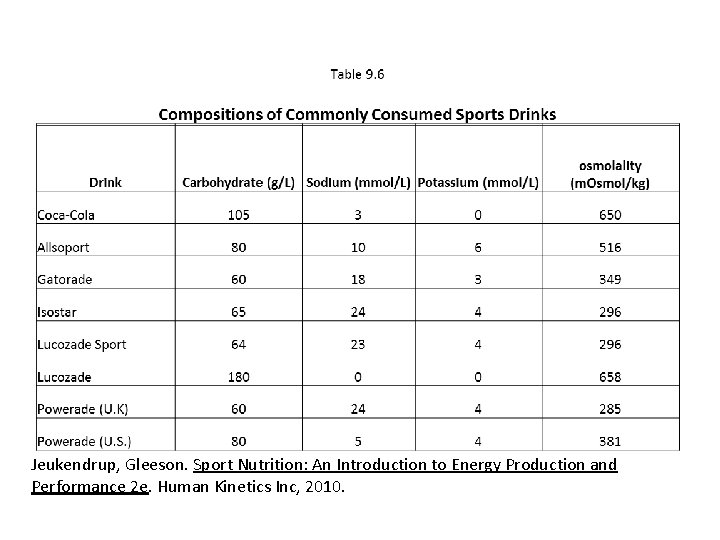
Jeukendrup, Gleeson. Sport Nutrition: An Introduction to Energy Production and Performance 2 e. Human Kinetics Inc, 2010.
Drinking During Training • Often neglected • Practice will accustom athletes to feeling of fluids in the stomach • Opportunity to experiment with different volumes and flavorings • Measure fluid consumption and body mass changes before and after – Provides an idea of athlete’s sweat rate under different environmental conditions – Help determine athlete’s requirement for fluid intakes during competition
Rehydration after Exercise • Progressive Dehydration with repeated bouts of exercise – Imparied thermoregulation – Increased cardiovascular strain – Loss of thermoregulatory advantages conferred by heat acclimation and high aerobic fitness – Loss of intracellular and extracellular volume during recovery – Reduced intracellular volume reduces rates of glycogen and protein synthesis • Main factors influencing effectiveness of postexercise rehydration – Volume and composition of fluid consumed

Sodium in Sports Drink • Major cation in intracellular fluid • Euhydration is achieved when sodium intake is greater than sodium loss (Schirreffs et. al, 1996) • Promotes rapid fluid absorption in small intestine • Allows plasma sodium concentration to remain elevated during rehydration proces • Maintains thirst • Delays stimulation of urine output
Potassium in Sports Drink • Enhance replacement of intracellular water • Promote rehydration • Further studies need to be done to confirm hypothesis
Optimal Rehydration Beverage • Carbohydrates – Glucose polymers • Stimulates fluid absorption in stomach
Fluid Consumption Post Exercise • Post Regular Exercise – Any fluid deficit incurred during one exercise can compromise the following exercise session • Ingestion of 150 % of weight loss for every kilogram of weight loss during exercise • Intake of caffeine and alcohol is discouraged – Diuretic actions • Consume solid fluids – Replace sodium and potassium losses
Recommendations on Exercise and Fluid Replacement • American College of Sports Medicine Guidelines on Fluid Intake for Exercise (2002) – Adequate fluid replacement maintains hydration and promotes health, safety and optimal performance – Consume a nutritionally balanced diet and drink adequate fluids 24 hours before an event – Consume approximately 6 -8 ml of fluid per kg of body weight about 2 hours before exercise
Recommendations on Exercise and Fluid Replacement Cont. • During exercise drink early and at regular intervals to prevent excesses of 2 % of body weight • Fluids consumed should be below ambient temperature • Add carbohydrates and sodium when exercising longer than 60 minutes • Exercise bouts > 60 minutes – Add carbohydrates at a rate of 30 -60 g/hour to maintain oxidation of carbohydrate and delay fatigue
Recommendations on Exercise and Fluid Replacement Cont. • Addition of sodium during exercise bouts lasting > 60 minutes – 500 – 700 mg/L water – Enhance palatability – Promote fluid retention – Prevent hyponatremia (in people who drink excessive amounts of fluid during prolonged exercise) • Rapid recovery from excessive dehydration – 1. 5 L of fluid for each kilogram of body weight loss – Addition of sodium will assist rapid and complete rehydration by stimulating thirst and fluid retention
- Slides: 18