
Chapter 9 Valuation of Common Stocks Objective Explain

Chapter 9: Valuation of Common Stocks Objective Explain equity evaluation using discounting Dividend policy and wealth Copyright © Prentice Hall Inc. 2000. Author: Nick Bagley, bdella. Soft, Inc. 1
Chapter 9 Contents 1. 2. 3. 4. 5. Reading stock listings The discounted dividend model Earning and investment opportunity A reconsideration of the price multiple approach Does dividend policy affect shareholder wealth? 2
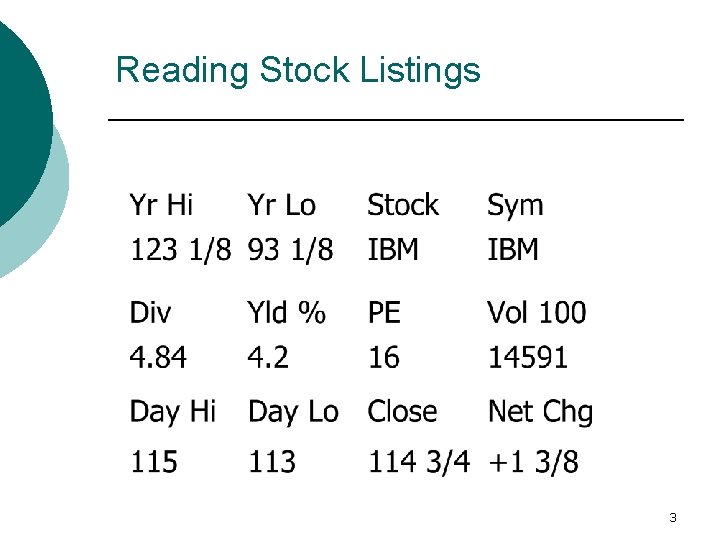
Reading Stock Listings 3
Reading Stock Listings Dividend yield: the annualized dollar dividend divided by the stock’s price ¡ Price/earnings ratio: the ratio of the current stock price to earnings during the most recent four quarters ¡ Round lots of 100 shares ¡ Odd lots requires higher commissions ¡ 4
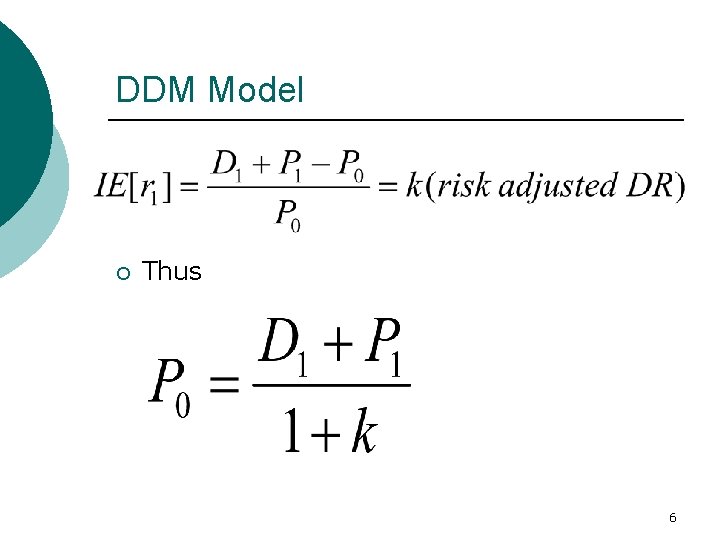
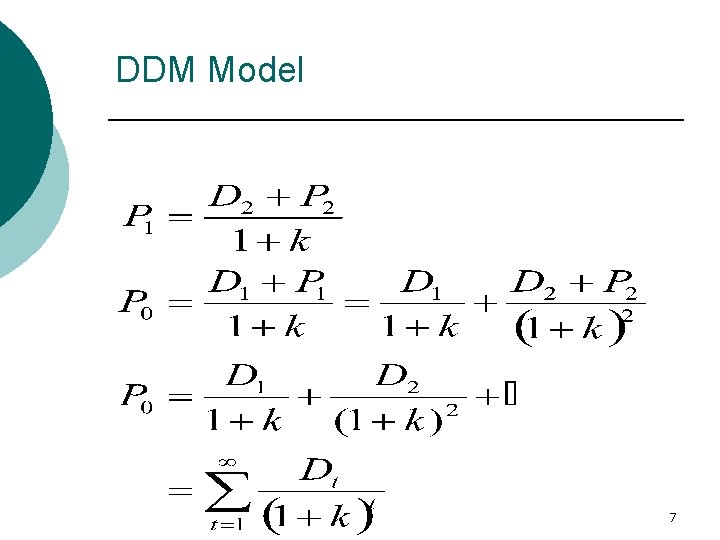
Discounted Dividend Model Computes the value of a share of stock as the present value of its expected future cash dividends. ¡ Any investor in common stock expects a return consisting of cash dividends and the change in price. ¡ Risk adjusted discount rate: the expected rate of return that investors require in order to be willing to invest in the stock. ¡ 5
DDM Model ¡ Thus 6
DDM Model 7
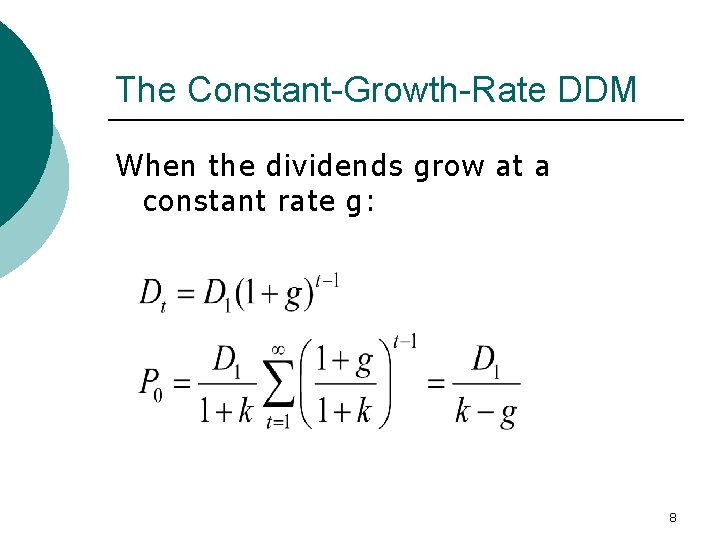
The Constant-Growth-Rate DDM When the dividends grow at a constant rate g: 8
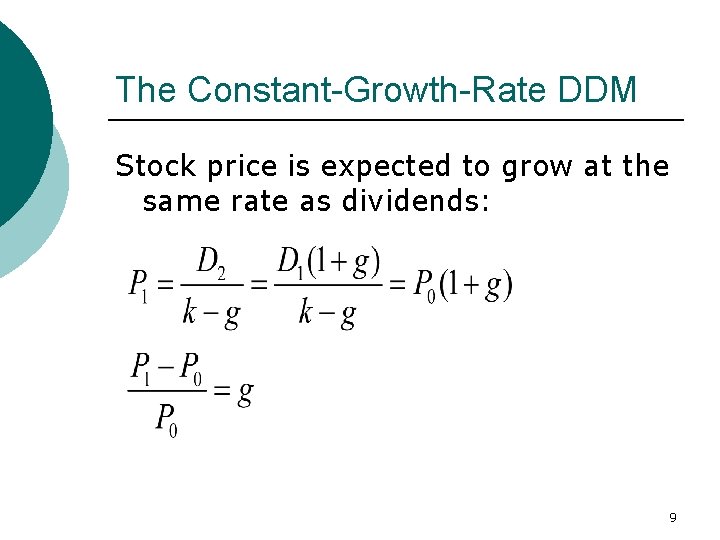
The Constant-Growth-Rate DDM Stock price is expected to grow at the same rate as dividends: 9
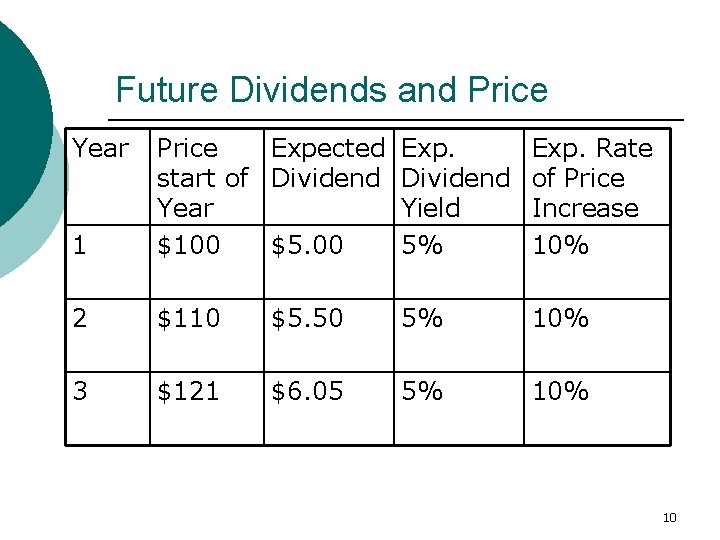
Future Dividends and Price Year 1 Price Expected Exp. Rate start of Dividend of Price Year Yield Increase $100 $5. 00 5% 10% 2 $110 $5. 50 5% 10% 3 $121 $6. 05 5% 10
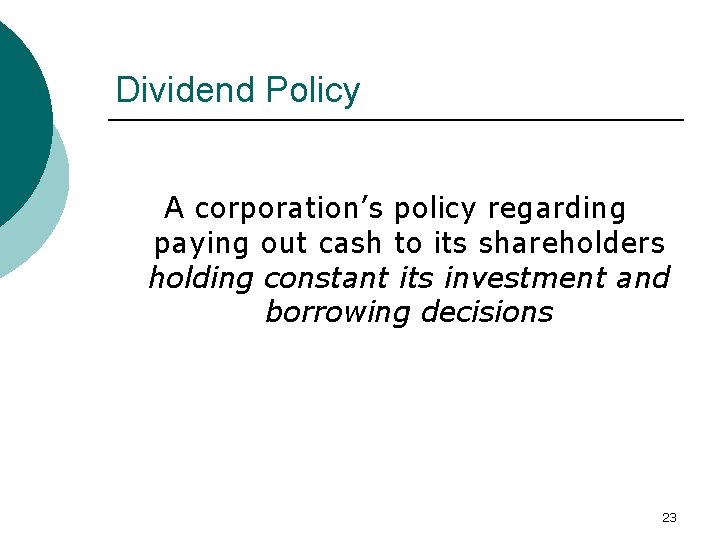
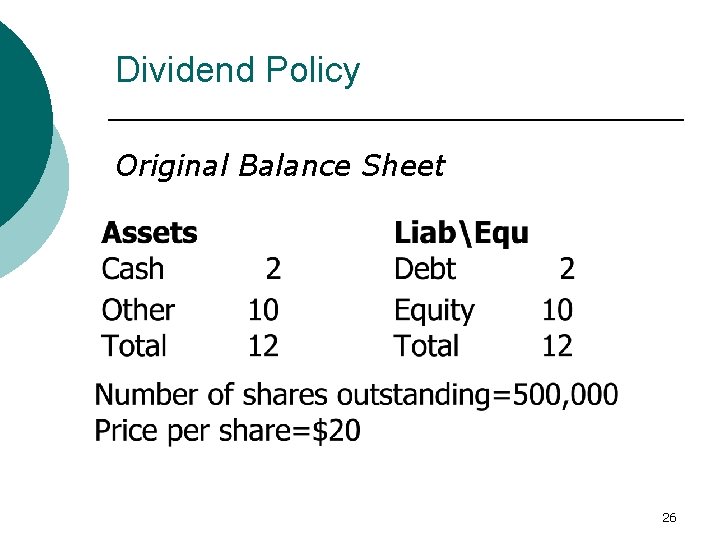
Dividend Policy A corporation’s policy regarding paying out cash to its shareholders holding constant its investment and borrowing decisions 23
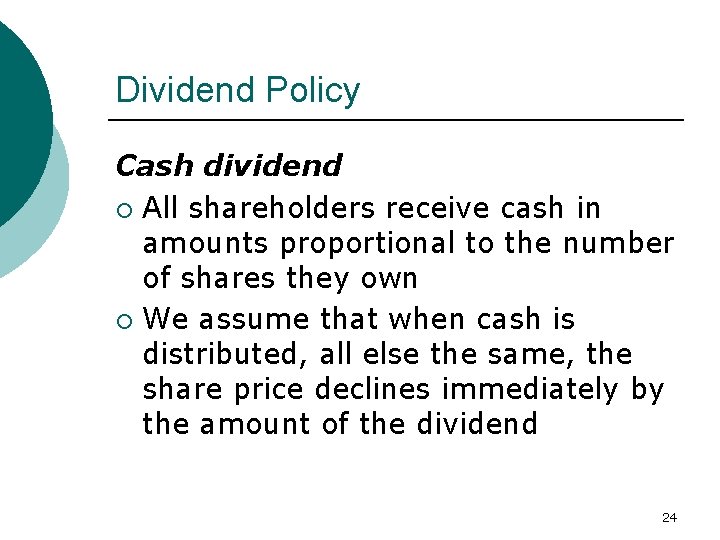
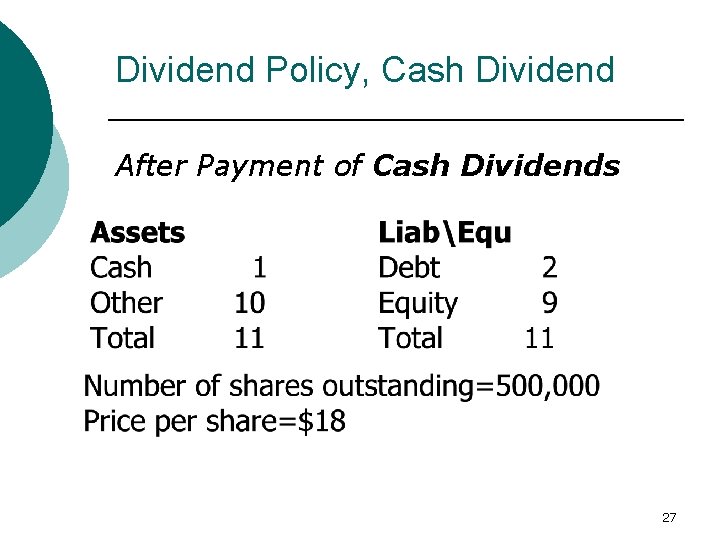
Dividend Policy Cash dividend ¡ All shareholders receive cash in amounts proportional to the number of shares they own ¡ We assume that when cash is distributed, all else the same, the share price declines immediately by the amount of the dividend 24
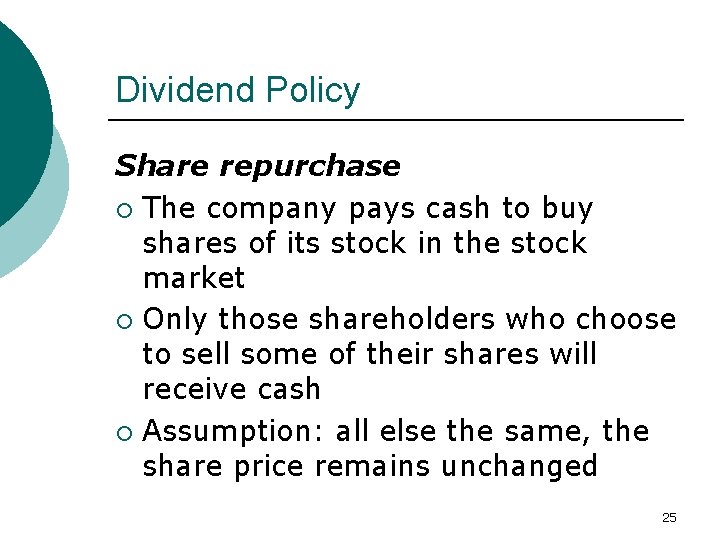
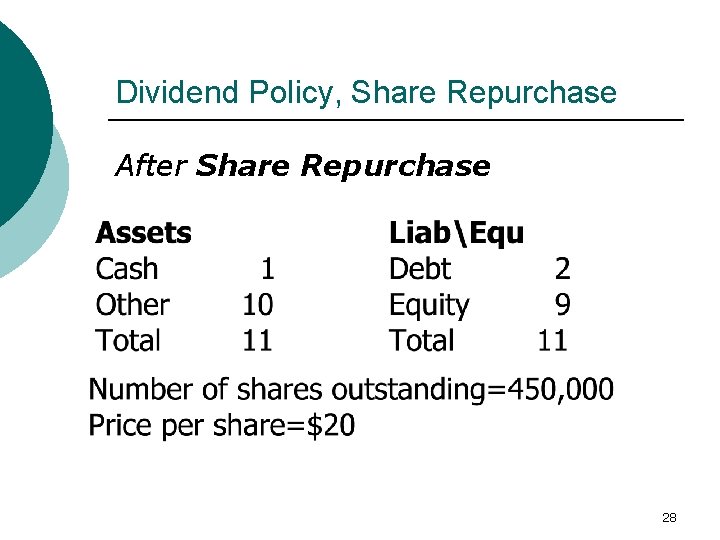
Dividend Policy Share repurchase ¡ The company pays cash to buy shares of its stock in the stock market ¡ Only those shareholders who choose to sell some of their shares will receive cash ¡ Assumption: all else the same, the share price remains unchanged 25
Dividend Policy Original Balance Sheet 26
Dividend Policy, Cash Dividend After Payment of Cash Dividends 27
Dividend Policy, Share Repurchase After Share Repurchase 28
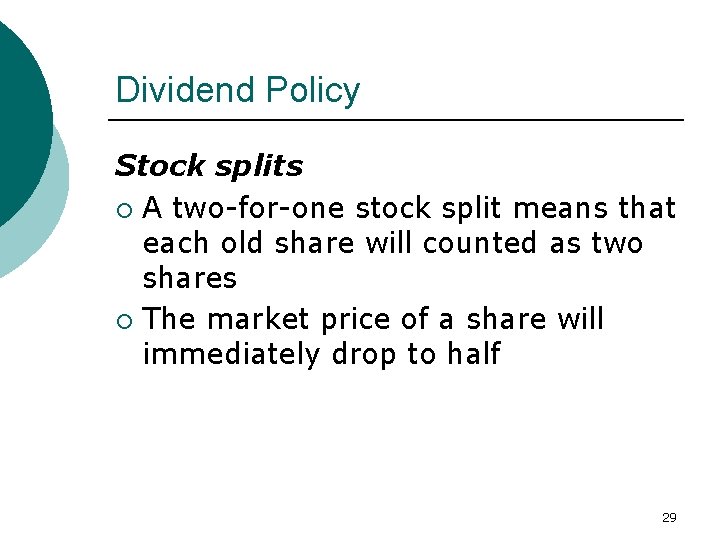
Dividend Policy Stock splits ¡ A two-for-one stock split means that each old share will counted as two shares ¡ The market price of a share will immediately drop to half 29
Dividend Policy Stock dividend ¡ The corporation distributes additional shares of stock to each stockholder ¡ Can be seen as distributing a cash dividend to existing shareholders, and then requiring them to immediately use the cash to buy additional shares ¡ No tax effect 30
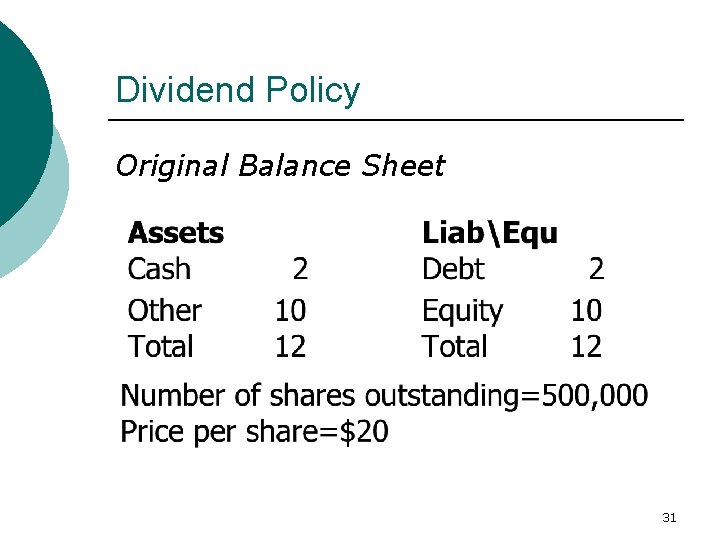
Dividend Policy Original Balance Sheet 31
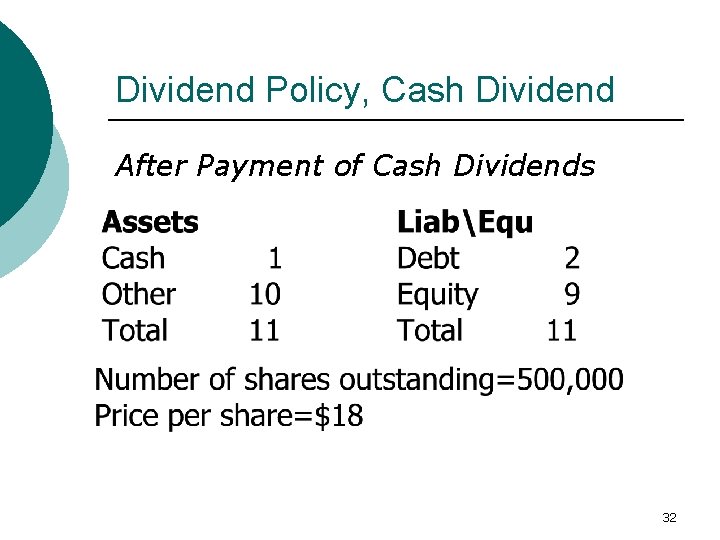
Dividend Policy, Cash Dividend After Payment of Cash Dividends 32
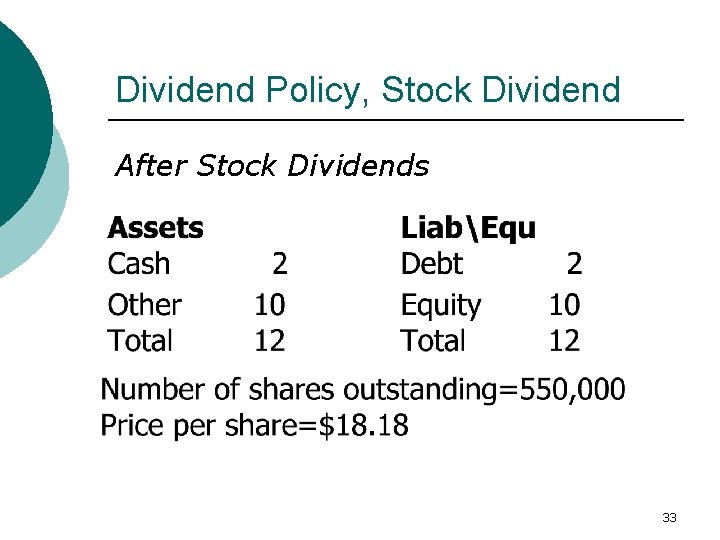
Dividend Policy, Stock Dividend After Stock Dividends 33
Dividend Policy in Frictionless Environment (M&M) ¡ M&M 1961: In a frictionless environment, in which there are no taxes and no costs of issuing new shares or repurchasing existing shares, a firm’s dividend policy can have no effect on the wealth of its current shareholders 34
Dividend Policy in a Frictionless Environment (M&M) Example(paying cash dividend or not? ) ¡ the Cashrich company decide not to pay out the $2 million in cash, but invest it in a project that leaves the total market value of the firm unchanged. A shareholder who owns 100 shares and would have preferred a cash dividend of $2 per share, can sell 10 shares, then he winds up with stock worth $1800 and cash $200. 35
Dividend Policy in a Frictionless Environment (M&M) o Suppose Cashrich pays out a cash dividend of $2 per share, and the shareholder does not want the cash. After the payment of the dividend, he has $200 in cash and $1800 in stock. He can reestablish his position by using the $200 in cash to buy more shares at the price of $18. 36
Dividend Policy in the Real World Taxes ¡ Regulations ¡ The costs of external financing ¡ Informational content of dividend ¡ 37
Tax ¡ If a corporation distributes cash by paying dividends, it forces all of its shareholders to pay taxes. If instead the firm distributes the cash by repurchasing shares, it does not create a tax liability for all of its shareholders. 38
Regulations In US there are laws that prevent corporations from using share repurchase as an alternative to dividends as a regular mechanism. ¡ There also laws that prevent corporations from retaining cash in the business that is not needed to run. ¡ 39
Cost of External Financing Favoring the nonpayment of cash to shareholders, either in the form of cash or repurchase of shares. ¡ The investment bankers who intermediate the sale of new shares to outside investors have to be paid, and the current shareholders bear the cost. ¡ 40
Cost arising from asymmetry of information Differences in information that is available to the firm’s management (insiders) and the potential buyers of new stock issued by the firm (outsiders) ¡ The outsiders may be skeptical about the reasons for issuing new stock, therefore, have to be offered a bargain price to induce them to buy new shares. ¡ 41
The Informational Content of Dividends Outside investors may interpret an increase in a corporation’s cash dividend as a positive sign and, therefore, a dividend increase might cause a rise in the stock’s price, and conversely. ¡ Corporate management is cautious about making changes in dividend payouts and usually offers an explanations to the investing public. ¡ 42
- Slides: 30