
Chapter 9 Using Information Ethically Managing and Using

- Slides: 27
Chapter 9 Using Information Ethically Managing and Using Information Systems: A Strategic Approach by Keri Pearlson & Carol Saunders
Learning Objectives • List and define PAPA and why it is important. • Identify the issues related to the ethical governance of information systems. • Understand security issues of organizations and how organizations are bolstering security. • Describe how security can be best enacted. • Define the Sarbanes-Oxley Act and the COBIT framework. Copyright 2010 John Wiley & Sons, Inc.
CONTROL OF INFORMATION Copyright 2010 John Wiley & Sons, Inc.
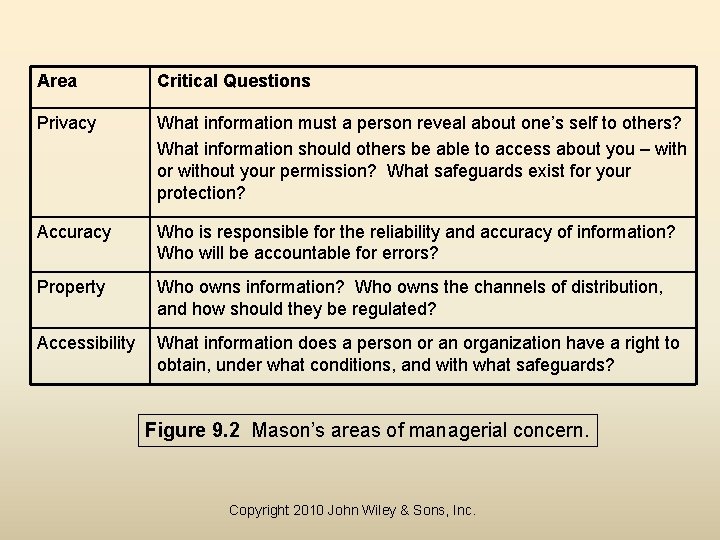
Privacy • Those who possess the “best” information and know how to use it, win. • However, keeping this information safe and secure is a high priority (see Figure 9. 2). • Privacy – “the right to be left alone”. • Managers must be aware of regulations that are in place regarding the authorized collection, disclosure and use of personal information. – Safe harbor framework of 2000. Copyright 2010 John Wiley & Sons, Inc.
Area Critical Questions Privacy What information must a person reveal about one’s self to others? What information should others be able to access about you – with or without your permission? What safeguards exist for your protection? Accuracy Who is responsible for the reliability and accuracy of information? Who will be accountable for errors? Property Who owns information? Who owns the channels of distribution, and how should they be regulated? Accessibility What information does a person or an organization have a right to obtain, under what conditions, and with what safeguards? Figure 9. 2 Mason’s areas of managerial concern. Copyright 2010 John Wiley & Sons, Inc.
Accuracy • Managers must establish controls to insure that information is accurate. • Data entry errors must be controlled and managed carefully. • Data must also be kept up to date. • Keeping data as long as it is necessary or legally mandated is a challenge. Copyright 2010 John Wiley & Sons, Inc.
Property • Mass quantities of data are now stored on clients. • Who owns this data and has rights to it is are questions that a manager must answer. • Who owns the images that are posted in cyberspace? • Managers must understand the legal rights and duties accorded to proper ownership. Copyright 2010 John Wiley & Sons, Inc.
Accessibility • Access to information systems and the data that they hold is paramount. • Users must be able to access this data from any location (if it can be properly secured and does not violate any laws or regulations). • Major issue facing managers is how to create and maintain access to information for society at large. – This access needs to be controlled to those who have a right to see and use it (identity theft). – Also, adequate security measures must be in place on their partners end. Copyright 2010 John Wiley & Sons, Inc.
PAPA and Managers • Managers must work hard to implement controls over information highlighted by PAPA. • Limit access to data – avoid identify theft, and respect customer’s privacy. • FTC requires more disclosure of how companies use customer data. – Gramm-Leach-Bliley Act (1999) • Information privacy guidelines must come from above: CEO, CFO, etc. Copyright 2010 John Wiley & Sons, Inc.
Security and Controls • PAPA principles work hand-in-hand with security and controls • Executives reported that hardware/software failures, and major viruses, had resulted in unexpected or unscheduled outages of their critical business systems (Ernst & Young). • Technologies have been devised to manage the security and control problems (see Figure 9. 3). • RFID is being used to control access and manage assets. • Employees require proper training and education. Copyright 2010 John Wiley & Sons, Inc.
IT GOVERNANCE AND SECURITY Copyright 2010 John Wiley & Sons, Inc.
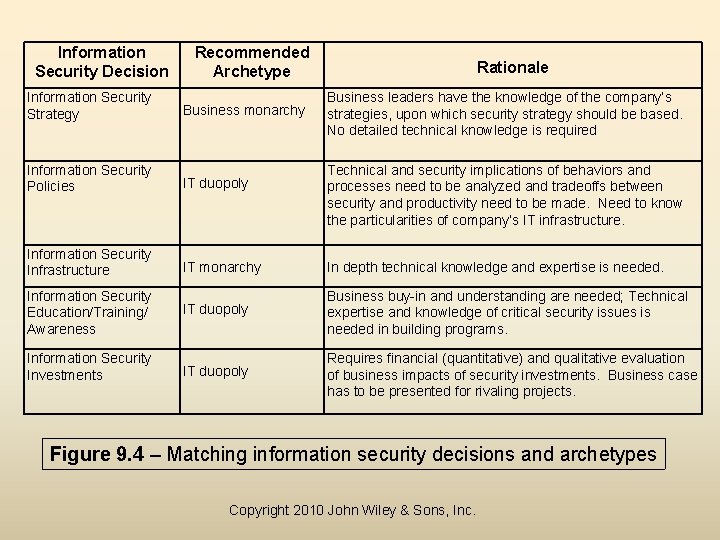
IT Governance and Security • Weill and Ross Framework for IT governance (Chap 8 ) offers a new perspective for assigning responsibility for key security decisions. • Same archetypes can be expanded for security. • Figure 9. 4 shows an appropriate governance pattern for each decision. – – – 1. Information Security Strategy 2. Information Security Policies 3. Information Security Infrastructure 4. Information Security Education/Training/Awareness 5. Information Security Investments • The archetypes clearly define the responsibilities of the major players in the company Copyright 2010 John Wiley & Sons, Inc.
Information Security Decision Information Security Strategy Recommended Archetype Business monarchy Rationale Business leaders have the knowledge of the company’s strategies, upon which security strategy should be based. No detailed technical knowledge is required Information Security Policies IT duopoly Information Security Infrastructure IT monarchy In depth technical knowledge and expertise is needed. Information Security Education/Training/ Awareness IT duopoly Business buy-in and understanding are needed; Technical expertise and knowledge of critical security issues is needed in building programs. IT duopoly Requires financial (quantitative) and qualitative evaluation of business impacts of security investments. Business case has to be presented for rivaling projects. Information Security Investments Technical and security implications of behaviors and processes need to be analyzed and tradeoffs between security and productivity need to be made. Need to know the particularities of company’s IT infrastructure. Figure 9. 4 – Matching information security decisions and archetypes Copyright 2010 John Wiley & Sons, Inc.
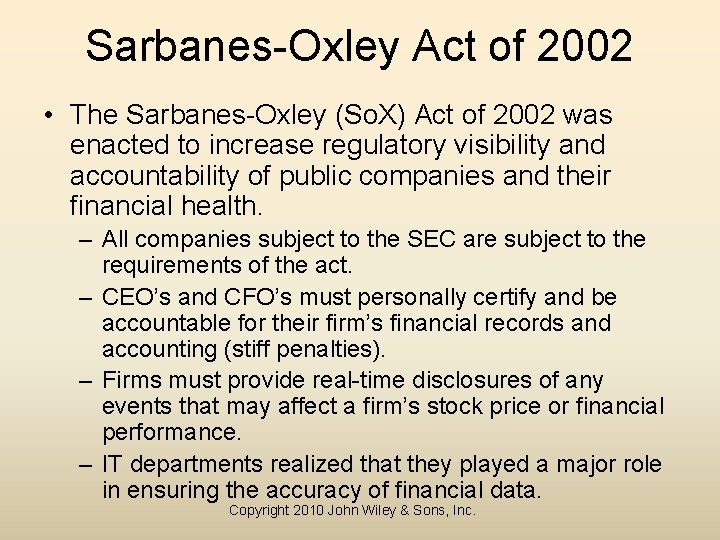
Sarbanes-Oxley Act of 2002 • The Sarbanes-Oxley (So. X) Act of 2002 was enacted to increase regulatory visibility and accountability of public companies and their financial health. – All companies subject to the SEC are subject to the requirements of the act. – CEO’s and CFO’s must personally certify and be accountable for their firm’s financial records and accounting (stiff penalties). – Firms must provide real-time disclosures of any events that may affect a firm’s stock price or financial performance. – IT departments realized that they played a major role in ensuring the accuracy of financial data. Copyright 2010 John Wiley & Sons, Inc.
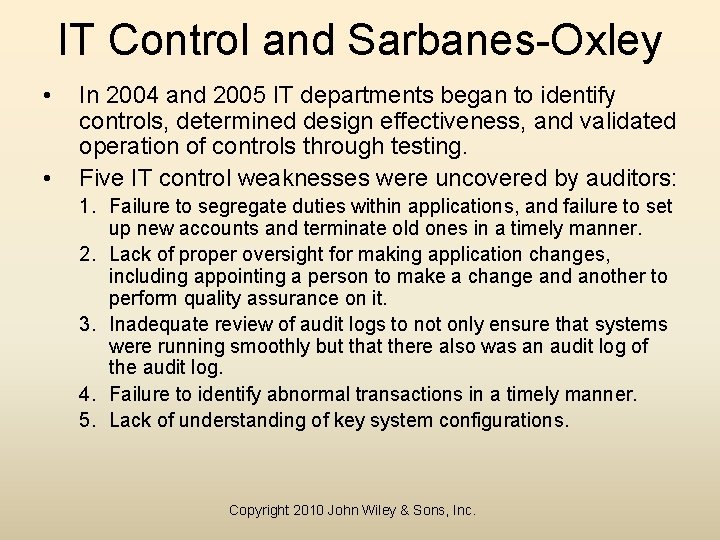
IT Control and Sarbanes-Oxley • • In 2004 and 2005 IT departments began to identify controls, determined design effectiveness, and validated operation of controls through testing. Five IT control weaknesses were uncovered by auditors: 1. Failure to segregate duties within applications, and failure to set up new accounts and terminate old ones in a timely manner. 2. Lack of proper oversight for making application changes, including appointing a person to make a change and another to perform quality assurance on it. 3. Inadequate review of audit logs to not only ensure that systems were running smoothly but that there also was an audit log of the audit log. 4. Failure to identify abnormal transactions in a timely manner. 5. Lack of understanding of key system configurations. Copyright 2010 John Wiley & Sons, Inc.
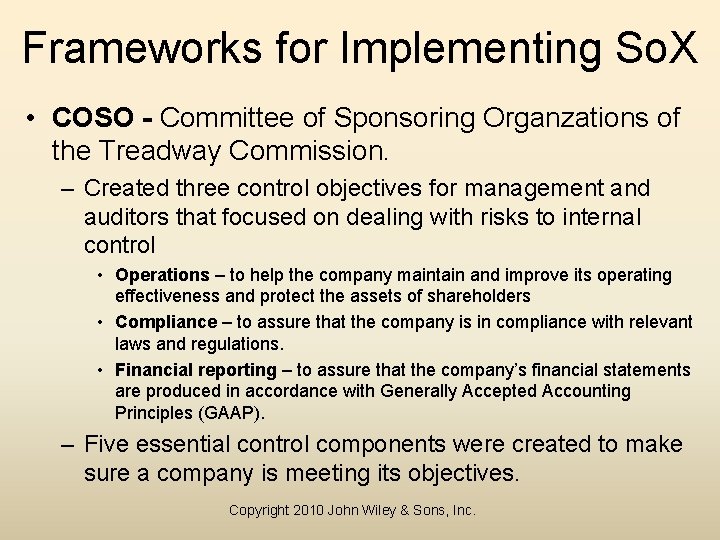
Frameworks for Implementing So. X • COSO - Committee of Sponsoring Organzations of the Treadway Commission. – Created three control objectives for management and auditors that focused on dealing with risks to internal control • Operations – to help the company maintain and improve its operating effectiveness and protect the assets of shareholders • Compliance – to assure that the company is in compliance with relevant laws and regulations. • Financial reporting – to assure that the company’s financial statements are produced in accordance with Generally Accepted Accounting Principles (GAAP). – Five essential control components were created to make sure a company is meeting its objectives. Copyright 2010 John Wiley & Sons, Inc.
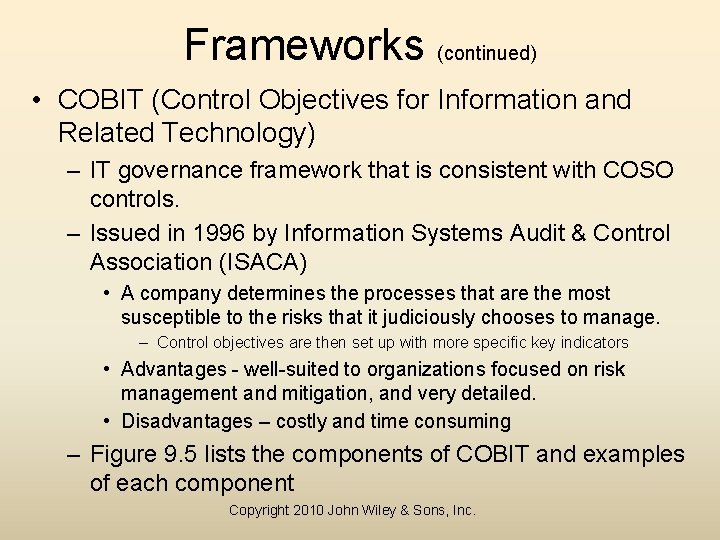
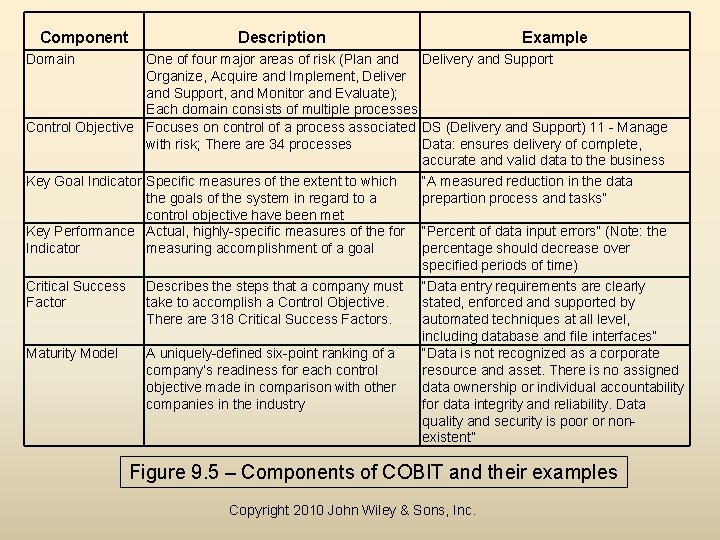
Frameworks (continued) • COBIT (Control Objectives for Information and Related Technology) – IT governance framework that is consistent with COSO controls. – Issued in 1996 by Information Systems Audit & Control Association (ISACA) • A company determines the processes that are the most susceptible to the risks that it judiciously chooses to manage. – Control objectives are then set up with more specific key indicators • Advantages - well-suited to organizations focused on risk management and mitigation, and very detailed. • Disadvantages – costly and time consuming – Figure 9. 5 lists the components of COBIT and examples of each component Copyright 2010 John Wiley & Sons, Inc.
Component Description Example Domain One of four major areas of risk (Plan and Delivery and Support Organize, Acquire and Implement, Deliver and Support, and Monitor and Evaluate); Each domain consists of multiple processes Control Objective Focuses on control of a process associated DS (Delivery and Support) 11 - Manage with risk; There are 34 processes Data: ensures delivery of complete, accurate and valid data to the business Key Goal Indicator Specific measures of the extent to which “A measured reduction in the data the goals of the system in regard to a prepartion process and tasks” control objective have been met Key Performance Actual, highly-specific measures of the for “Percent of data input errors” (Note: the Indicator measuring accomplishment of a goal percentage should decrease over specified periods of time) Critical Success Describes the steps that a company must “Data entry requirements are clearly Factor take to accomplish a Control Objective. stated, enforced and supported by There are 318 Critical Success Factors. automated techniques at all level, including database and file interfaces” Maturity Model A uniquely-defined six-point ranking of a “Data is not recognized as a corporate company’s readiness for each control resource and asset. There is no assigned objective made in comparison with other data ownership or individual accountability companies in the industry for data integrity and reliability. Data quality and security is poor or nonexistent” Figure 9. 5 – Components of COBIT and their examples Copyright 2010 John Wiley & Sons, Inc.
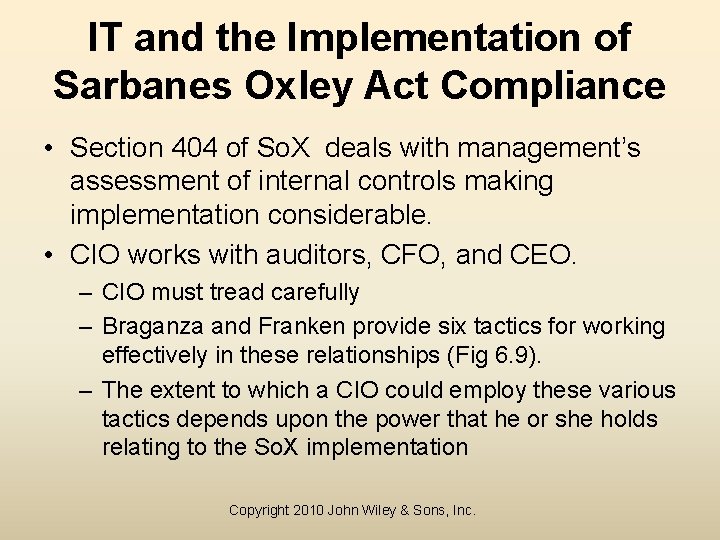
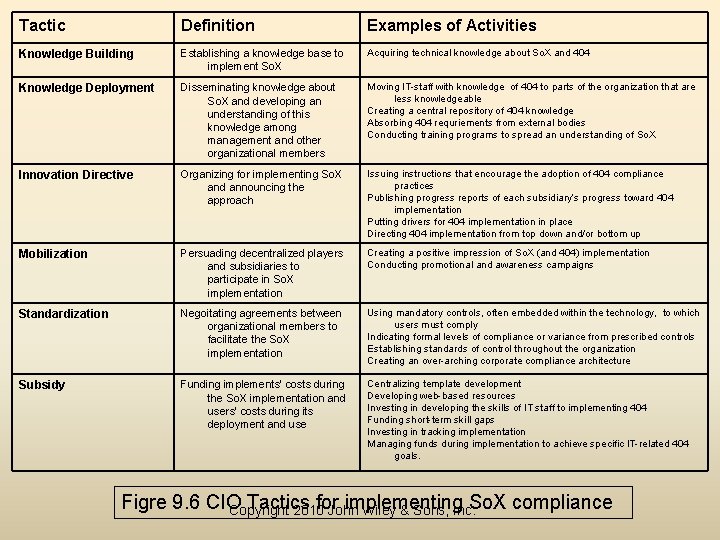
IT and the Implementation of Sarbanes Oxley Act Compliance • Section 404 of So. X deals with management’s assessment of internal controls making implementation considerable. • CIO works with auditors, CFO, and CEO. – CIO must tread carefully – Braganza and Franken provide six tactics for working effectively in these relationships (Fig 6. 9). – The extent to which a CIO could employ these various tactics depends upon the power that he or she holds relating to the So. X implementation Copyright 2010 John Wiley & Sons, Inc.
Tactic Definition Examples of Activities Knowledge Building Establishing a knowledge base to implement So. X Acquiring technical knowledge about So. X and 404 Knowledge Deployment Disseminating knowledge about So. X and developing an understanding of this knowledge among management and other organizational members Moving IT-staff with knowledge of 404 to parts of the organization that are less knowledgeable Creating a central repository of 404 knowledge Absorbing 404 requriements from external bodies Conducting training programs to spread an understanding of So. X Innovation Directive Organizing for implementing So. X and announcing the approach Issuing instructions that encourage the adoption of 404 compliance practices Publishing progress reports of each subsidiary’s progress toward 404 implementation Putting drivers for 404 implementation in place Directing 404 implementation from top down and/or bottom up Mobilization Persuading decentralized players and subsidiaries to participate in So. X implementation Creating a positive impression of So. X (and 404) implementation Conducting promotional and awareness campaigns Standardization Negoitating agreements between organizational members to facilitate the So. X implementation Using mandatory controls, often embedded within the technology, to which users must comply Indicating formal levels of compliance or variance from prescribed controls Establishing standards of control throughout the organization Creating an over-arching corporate compliance architecture Subsidy Funding implements’ costs during the So. X implementation and users’ costs during its deployment and use Centralizing template development Developing web-based resources Investing in developing the skills of IT staff to implementing 404 Funding short-term skill gaps Investing in tracking implementation Managing funds during implementation to achieve specific IT-related 404 goals. Figre 9. 6 CIO Tactics for implementing Copyright 2010 John Wiley & Sons, Inc. So. X compliance
Other Control Frameworks • ISO – ISO (International Organization for Standardization) is the world's largest developer and publisher of International Standards • Information Technology Infrastructure Library (ITIL) – Set of concepts and techniques for managing IT – Offers 8 sets of management procedures Copyright 2010 John Wiley & Sons, Inc.
GREEN COMPUTING Copyright 2010 John Wiley & Sons, Inc.
Green Computing • Concerned with using computing resources efficiently. • Gartner put Green Computing at top of list of upcoming strategic technologies. – Due to increasing energy demands to run IT infrastructure. – Largest 5 search companies use more power that generated by Hoover Dam. • Companies are working to become more efficient by: – – – Replacing older systems with more energy efficient ones. Moving workloads based on energy efficiency. Using most power inefficient servers only at peak usage times. Improving data center air flows. Turning to virtualization. Copyright 2010 John Wiley & Sons, Inc.
Green Computing • Green programs have a triple bottom line (TBL or 3 BL): – Economic – Environmental – Social • Can be considered from the Social Contract Theory perspective. – People and Planet motivations • Stockholder Theory Perspective Copyright 2010 John Wiley & Sons, Inc.
SUMMARY Copyright 2010 John Wiley & Sons, Inc.
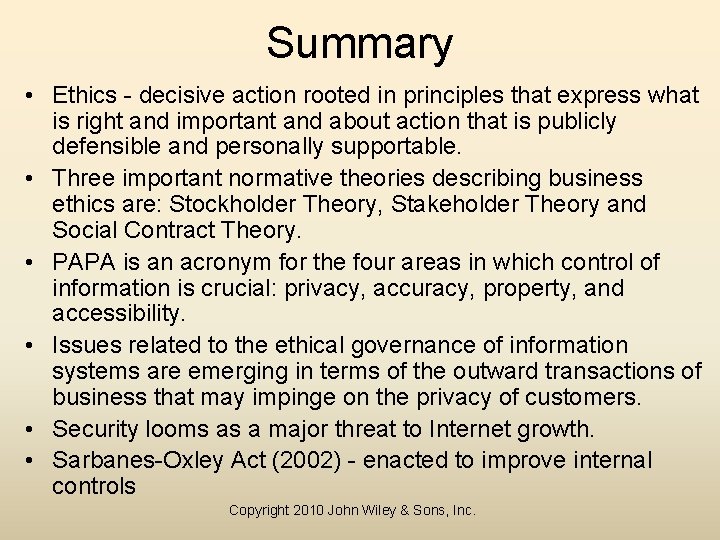
Summary • Ethics - decisive action rooted in principles that express what is right and important and about action that is publicly defensible and personally supportable. • Three important normative theories describing business ethics are: Stockholder Theory, Stakeholder Theory and Social Contract Theory. • PAPA is an acronym for the four areas in which control of information is crucial: privacy, accuracy, property, and accessibility. • Issues related to the ethical governance of information systems are emerging in terms of the outward transactions of business that may impinge on the privacy of customers. • Security looms as a major threat to Internet growth. • Sarbanes-Oxley Act (2002) - enacted to improve internal controls Copyright 2010 John Wiley & Sons, Inc.
• Copyright 2010 John Wiley & Sons, Inc. • All rights reserved. Reproduction or translation of this work beyond that named in Section 117 of the 1976 United States Copyright Act without the express written consent of the copyright owner is unlawful. Request for further information should be addressed to the Permissions Department, John Wiley & Sons, Inc. The purchaser may make back-up copies for his/her own use only and not for distribution or resale. The Publisher assumes no responsibility for errors, omissions, or damages, caused by the use of these programs or from the use of the information contained herein Copyright 2010 John Wiley & Sons, Inc.