
Chapter 9 Understanding the Atom Lesson 1 Discovering

- Slides: 42
Chapter 9: Understanding the Atom
Lesson 1: Discovering Parts of an Atom Vocabulary words: atom, electron, nucleus, proton, neutron, electron cloud
Early Ideas About Matter 2, 000 years ago, Greek philosophers thought that all matter is made of only four elements____________________ ___. They were not able to test the ideas because the scientific tools and methods were not developed yet. Most influential philosophers ideas were accepted _______ (460 -370 B. C. ) was a philosopher who challenged that idea of matter.
Aristotle He did not believe that ____________. He believed that all matter is made of fire, water, air, and earth. Because he was so influential, his ideas were accepted. _______ (460 -370 B. C. ) was a philosopher who challenged that idea of matter.
Democritus He believed that matter is made of small, solid objects that cannot be divided, created, or destroyed. These are called __________ He proposed that different types of matter are made up of different types of atoms. He also proposed that nothing lies between these atoms except _____________. Democritus’s ideas were not studied for more than 2, 000 years (and his are similar to what scientists think today).
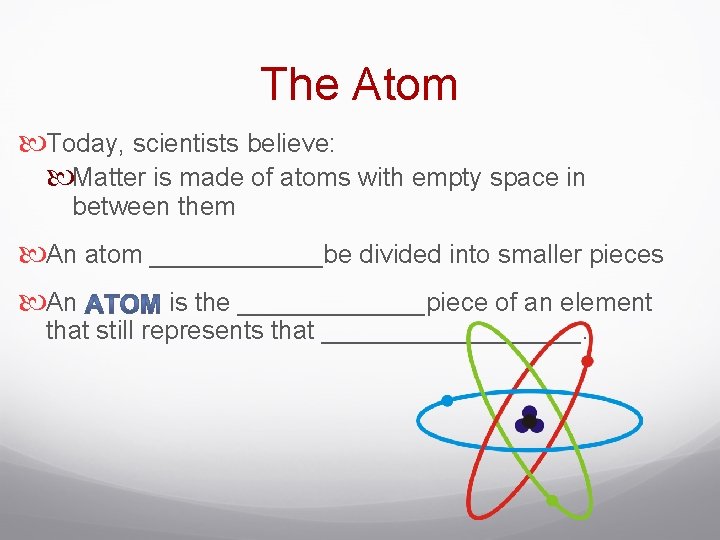
The Atom Today, scientists believe: Matter is made of atoms with empty space in between them An atom ______be divided into smaller pieces An is the _______piece of an element that still represents that _________.
Thomson- Discovering Electrons J. J. Thomson worked with ________ tubes Neon sign, computer monitor, ATM screen A glass tube with pieces of metal called electrodes inside the tube. Electrodes are connected to a wire which is connected to a battery He discovered that if the air was removed and electricity passed through the wires, greenishcolored rays traveled from an ________ to the other end of the tube.
Negative Particles Thomson wanted to know if the rays had an electric charge. Opposite charges _____; Like charges _______ He placed two plates (+ & -) on opposite sides of the tube. Rays bent towards the ______ plate and away from the negative plate. In conclusion, the cathode rays are _________ charged.
Parts of Atoms These rays were made of particles that were even smaller than atoms. Thomson concluded that cathode rays were made of small, negatively charged particles. is a particle with one negative charge. Because atoms are neutral, Thomson proposed that atoms also must contain a _______ charge that balances the negatively charged electrons.
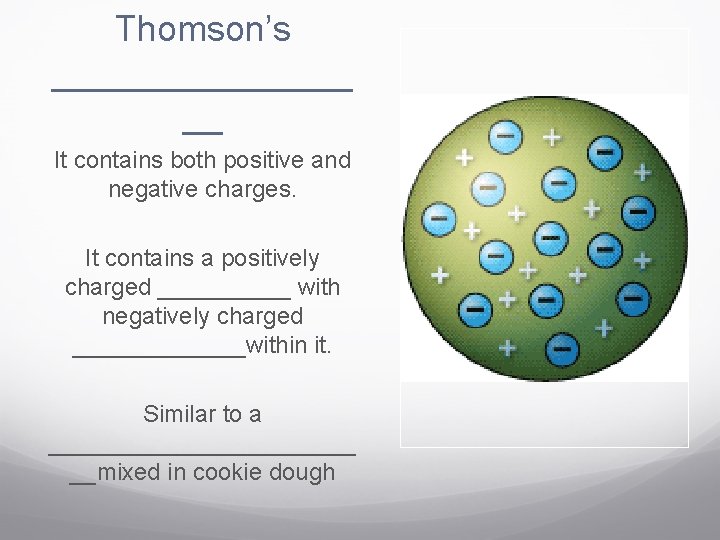
Thomson’s ________ __ It contains both positive and negative charges. It contains a positively charged _____ with negatively charged _______within it. Similar to a ____________ __mixed in cookie dough
Rutherford- Discovering the Nucleus ______________ was a student of Thomson. Rutherford’s students tested Thomson’s atomic model and discovered another surprise.
Rutherford’s Predicted Result Students expected the path of the alpha particle to travel straight through the foil without changing direction. Reasons why? Alpha particles are ____and _____ charged Another dense particle would be needed to change its path The atom is too spread out and not dense enough to change the path of the alpha particle Electrons do not have enough mass to affect the path either
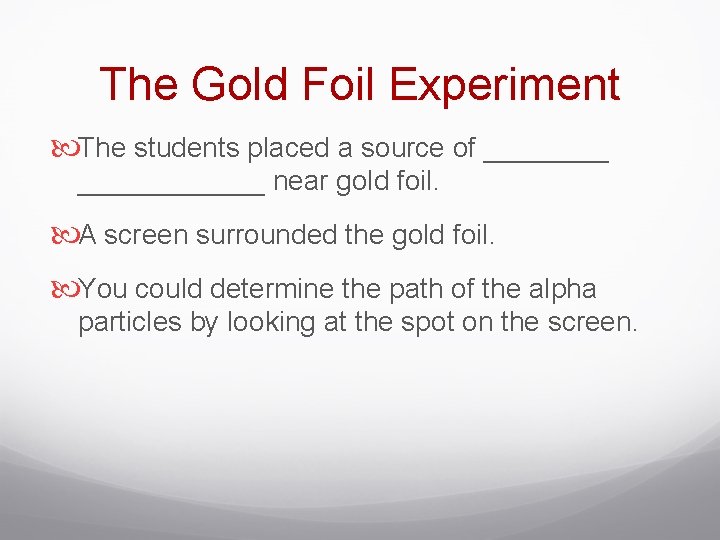
The Gold Foil Experiment The students placed a source of ____________ near gold foil. A screen surrounded the gold foil. You could determine the path of the alpha particles by looking at the spot on the screen.
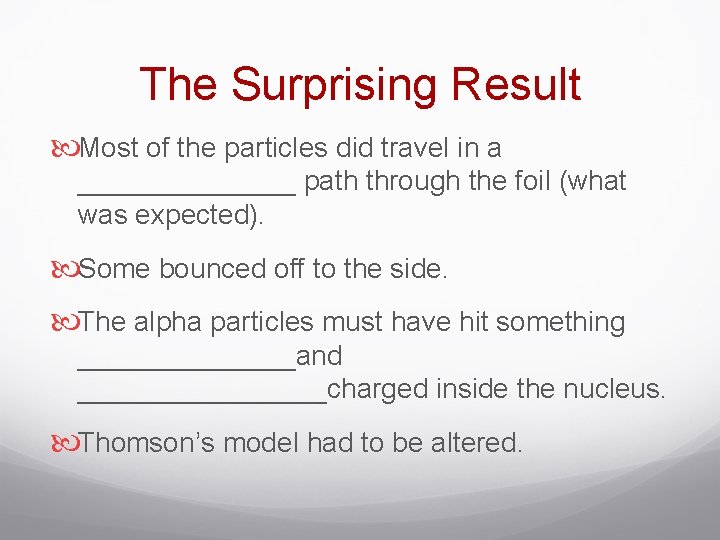
The Surprising Result Most of the particles did travel in a _______ path through the foil (what was expected). Some bounced off to the side. The alpha particles must have hit something _______and ________charged inside the nucleus. Thomson’s model had to be altered.
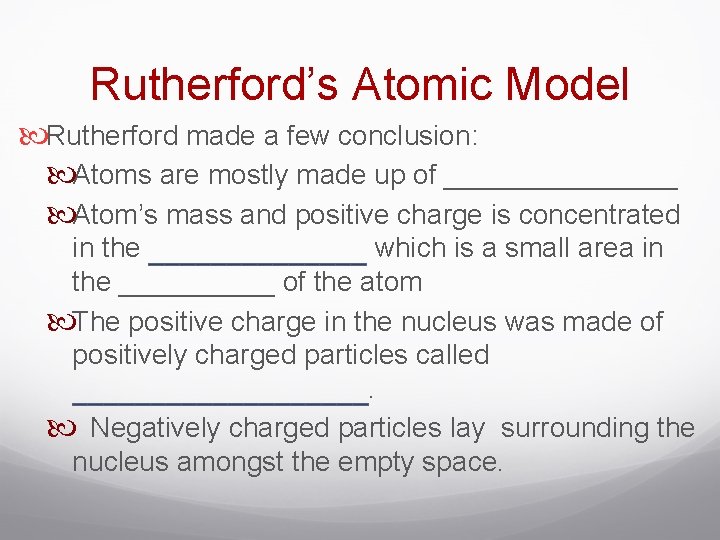
Rutherford’s Atomic Model Rutherford made a few conclusion: Atoms are mostly made up of ________ Atom’s mass and positive charge is concentrated in the which is a small area in the _____ of the atom The positive charge in the nucleus was made of positively charged particles called. Negatively charged particles lay surrounding the nucleus amongst the empty space.
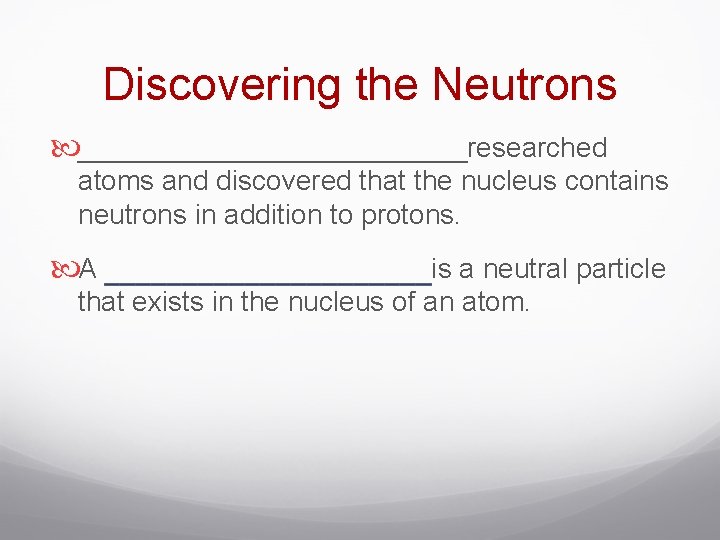
Discovering the Neutrons _____________researched atoms and discovered that the nucleus contains neutrons in addition to protons. A is a neutral particle that exists in the nucleus of an atom.
Bohr’s Atomic Model __________ , a student of Rutherford, experimented with hydrogen. He added electric energy and studied what was released His experiments led to a revised atomic model.
Electrons in the Bohr Model Bohr proposed that electrons move in circular _______________around the nucleus. In an energy level, there is a specific amount of __________ Electrons closer to the nucleus have _____ energy than electrons farther away from the nucleus Electrons can gain energy move from a lower energy level to a higher energy level When they return to the lower energy level, they release energy as ________.
Limitations Bohr reasoned that his model was accurate for atoms with one electron. Therefore, it must be correct for atoms with more than one electron. Electrons do have a certain amount of ______. However, they are not arranged in circular orbits.
The Modern Atomic Model Electrons form an which is an area around an atomic nucleus where an electron is most likely to be located. Electrons are constantly ________ around the nucleus but it is hard to know their ______ location and speed. Scientists can only _______ a particular location. Figure 10 shows mostly empty space. Darker shades areas where electrons are more likely to be.
Quarks Protons and neutrons are made up of smaller particles called ________. Electrons are not made of smaller parts. Six types of quarks The current model of the atom may change with new technology that allows new discoveries.
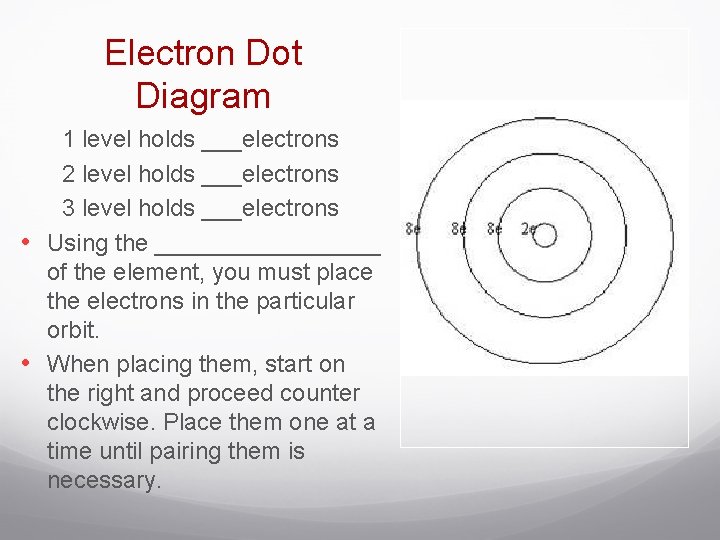
Electron Dot Diagram 1 level holds ___electrons 2 level holds ___electrons 3 level holds ___electrons • Using the _________ of the element, you must place the electrons in the particular orbit. • When placing them, start on the right and proceed counter clockwise. Place them one at a time until pairing them is necessary.
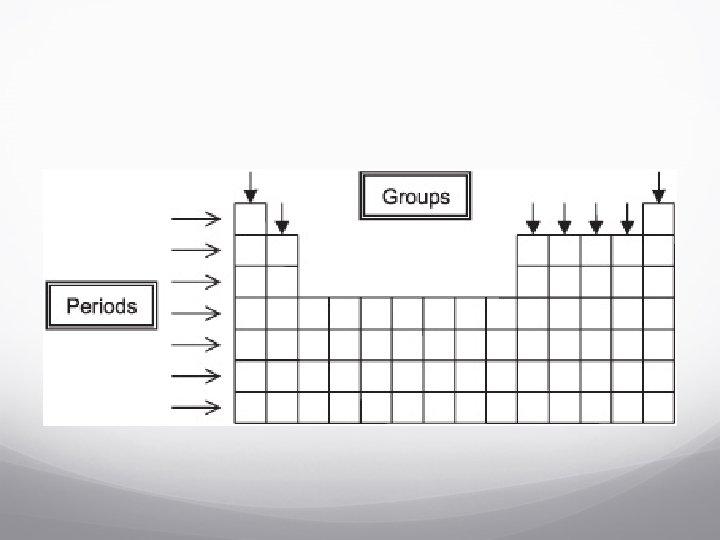
Lewis Dot Diagram Only concerned with the _________ or the electrons that land in the _________. The element’s group can help figuring out how many valence electrons there are. An element is _____ when its outer shell is full. How many is that? _________ An element is very ______ when its outer shell is not full. ____ valence electron and ____ valence electrons Almost full!
http: //www. youtube. com/watch? v=ulyopnxj. AZ 8
Lesson Two: Protons, Neutrons, and Electrons- How Atoms Differ
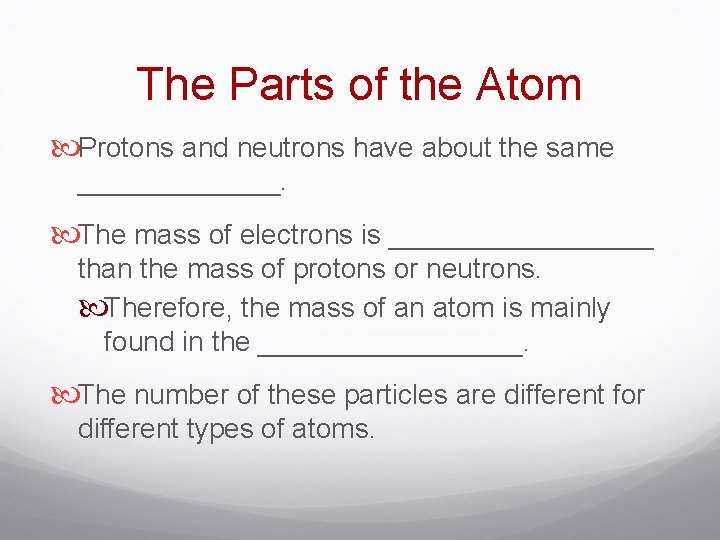
The Parts of the Atom Protons and neutrons have about the same _______. The mass of electrons is _________ than the mass of protons or neutrons. Therefore, the mass of an atom is mainly found in the _________. The number of these particles are different for different types of atoms.
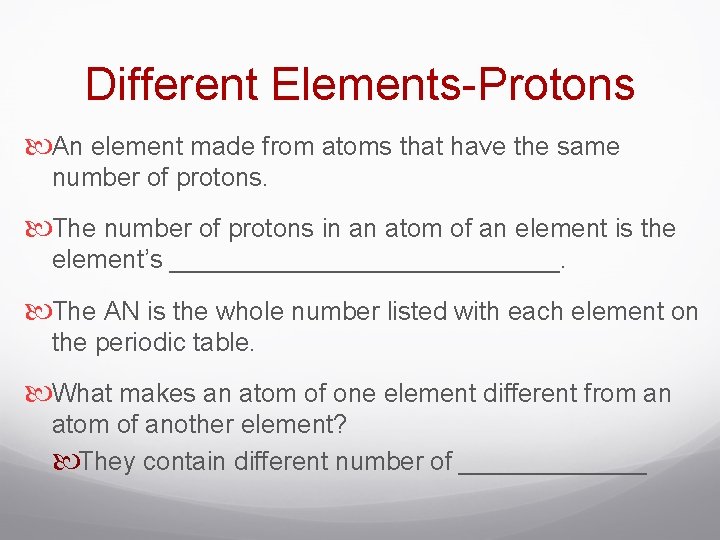
Different Elements-Protons An element made from atoms that have the same number of protons. The number of protons in an atom of an element is the element’s ______________. The AN is the whole number listed with each element on the periodic table. What makes an atom of one element different from an atom of another element? They contain different number of _______
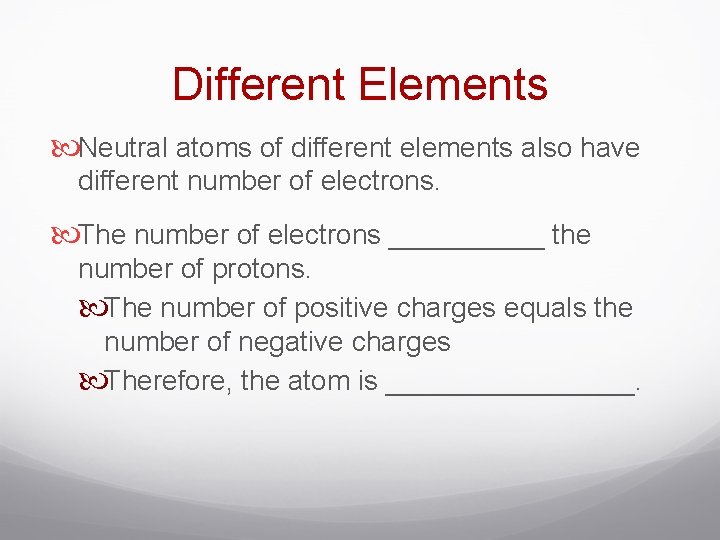
Different Elements Neutral atoms of different elements also have different number of electrons. The number of electrons _____ the number of protons. The number of positive charges equals the number of negative charges Therefore, the atom is ________.
Neutrons and Isotopes Atoms of the same element have the same number of protons. However, atoms of the same element have different number of _________. For example, Carbon has six protons but can have six, seven, or eight neutrons. These are called. Most elements have isotopes. An isotope is written with the element name followed by the mass number. Carbon-12
Protons, Neutrons, and Mass Number The Mass Number of an atom is the sum of the number of protons and neutrons in an atom. Mass Number= ______+ _______
Average Atomic Mass The of an element is the average mass of the element’s isotopes, weighted according to the _________ of each isotope. Table 3 shows three isotopes of carbon. Why isn’t the average 13 since the average of 12, 13, & 14 is 13? The average AM is weighted bases on how much of each isotope _________________. Most of Earth’s carbon is carbon-12 which is why the AM 12. 01.
Radioactivity ___________ discovered that the radiation released by uranium was made of energy and particles. This radiation came from the nuclei of the ________ atom. The number of protons in one atom of uranium changes. When uranium releases radiation, it changes to a different element.
Types of Decay Radioactive elements contain _______ nuclei. (does not hold together well) They undergo nuclear reactions that form atoms of different AN or AM. _________is a process that occurs when an unstable atomic nucleus changes into another more ________ nucleus by emitting radiation. Nuclear decay can produce three different types of radiation by the unstable nucleus _____ particles, _____particles, and _______rays
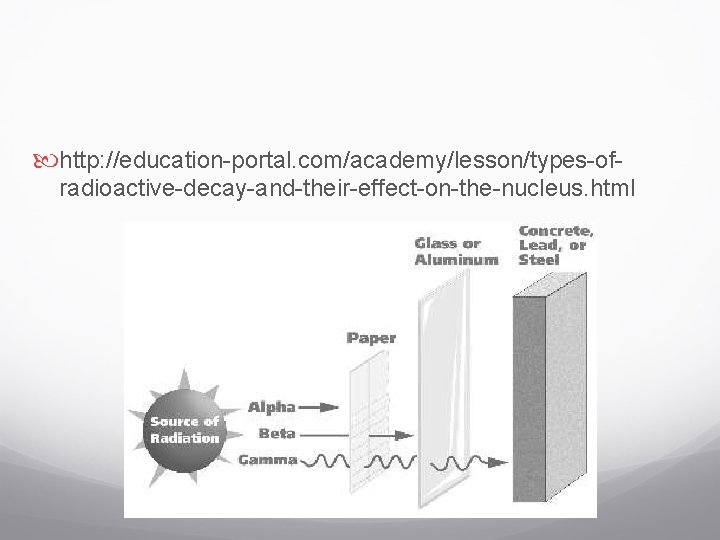
Alpha Decay An alpha particle is made of ____________________ (like a helium nucleus). When an atom releases an alpha particle, its atomic number decreases by _____and the atomic mass by ____. Alpha particles move fast but they can be stopped by collisions with atoms. It can cause injury like a ____ A shield can be _______.
Beta Decay A neutron in an atom changes into a ____ and high-energy ______ called a beta particle. The new proton becomes part of the nucleus and the beta particle (electron) is released. The AN increases by ___ because it has gained a proton. They travel ____ than alpha particles. They can travel through the human body and damage its cells.
Gamma Decay They do not contain particles, but they do contain a lot of ______. Similar to _______ It ______ cause a change in either AM or the AN. The energy releases is _________. It can pass through thin sheets of lead They can pass right through a human body and cause ___________________.
http: //education-portal. com/academy/lesson/types-ofradioactive-decay-and-their-effect-on-the-nucleus. html
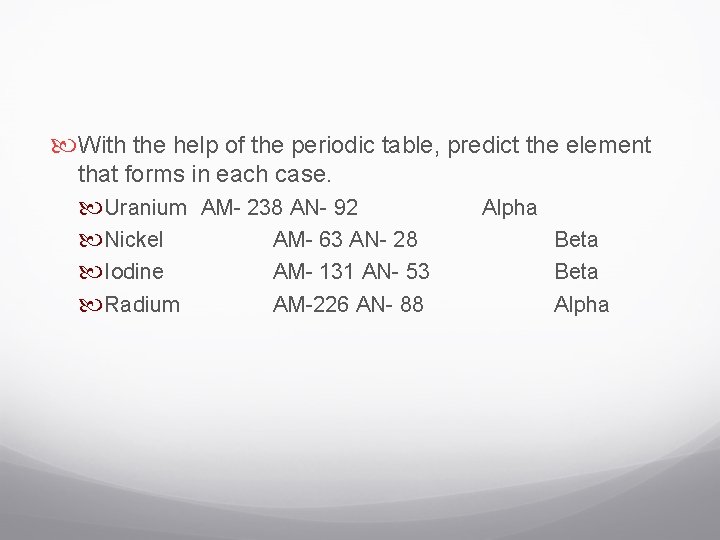
With the help of the periodic table, predict the element that forms in each case. Uranium AM- 238 AN- 92 Nickel AM- 63 AN- 28 Iodine AM- 131 AN- 53 Radium AM-226 AN- 88 Alpha Beta Alpha
Ions- Gaining and Losing Electrons When electrons are added to or removed from an atom, that atom becomes an. An ion is an atom that is no longer neutral because it has _______________.
Positive Ions An atom ______________. It has more protons than electrons. Therefore, it has a ______ charge. It can be called a positive ion or ______. It is represented by the element symbol followed by an exponent plus sign (Na+)
Negative Ions An atom _____________. It has more electrons than protons. It has a ________charge. An atom with a negative charge is called a negative ion or an __________. It is represent by the element’s symbol followed by an exponent negative sign (F_)