
Chapter 9 Transformations and Design 1 Objectives of
Chapter 9 Transformations and Design 1
Objectives of the Chapter Relate transformations to symmetry and design in logos P Analyze the geometric aspects of logos and other designs P Investigate the effects of geometric transformations using technology P Create a personal logo involving symmetry and transformation using technology P Investigate the characteristics of shapes that tile a plane P Create designs involving tiling patterns using technology P 2
The Big Picture Design a business Ä Create a logo (applying principles from chapter) Ä Design a product for your business Ä 3
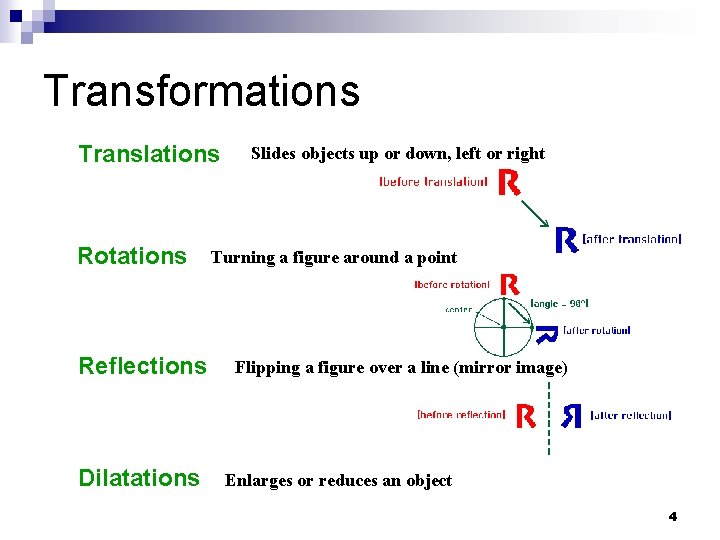
Transformations Translations Rotations Reflections Dilatations Slides objects up or down, left or right Turning a figure around a point Flipping a figure over a line (mirror image) Enlarges or reduces an object 4
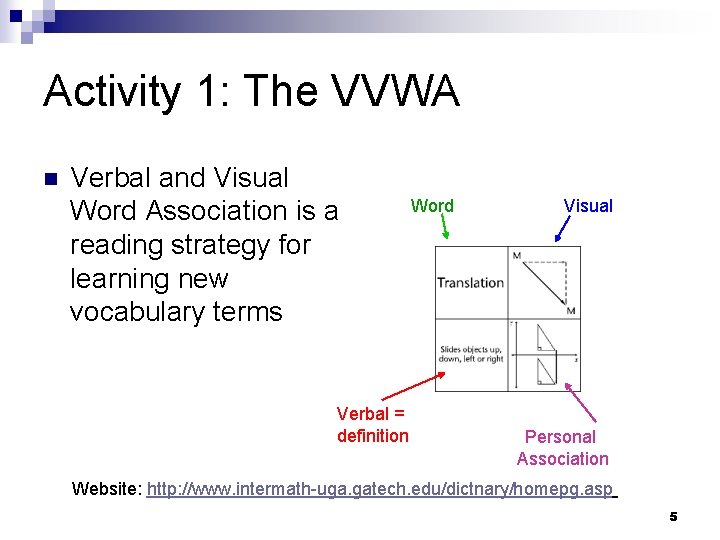
Activity 1: The VVWA n Verbal and Visual Word Association is a reading strategy for learning new vocabulary terms Verbal = definition Word Visual Personal Association Website: http: //www. intermath-uga. gatech. edu/dictnary/homepg. asp 5
Using Dynamic Geometry Software Geometer sketchpad n Winplot n n n (http: //math. exeter. edu/rparris/winplot. html) Simple graphing program: http: //www. serpik. com/agrapher/ Autograph 6
Designing a Logo n Points to remember ¨ Keep it clean and simple ¨ Font Thick = strength and power n Script = elegance n Slant = movement n ¨ Colour Blue, maroon, dark teal = conservative n Black and white = contemporary n 7
Designing a Logo n Software cites to look at: Logo design software: http: //www. aaa-logo. com Microsoft Photodraw Corel. Draw (http: //www. corel. com) Adobe Illustrator and Adobe Photoshop (http: //www. adobe. com/support/downloads) Macromedia Freehand or Flash (http: //www. macromedia. com/downloads/) Drawing program: http: //www. drawinghand. com/ 8
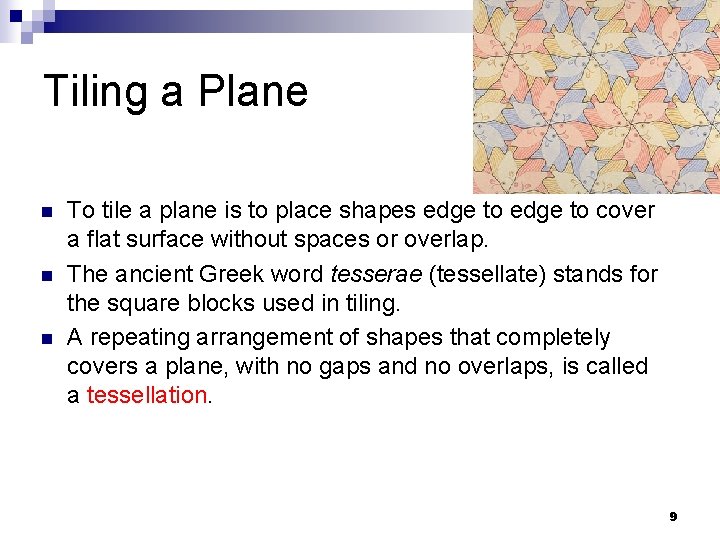
Tiling a Plane n n n To tile a plane is to place shapes edge to cover a flat surface without spaces or overlap. The ancient Greek word tesserae (tessellate) stands for the square blocks used in tiling. A repeating arrangement of shapes that completely covers a plane, with no gaps and no overlaps, is called a tessellation. 9
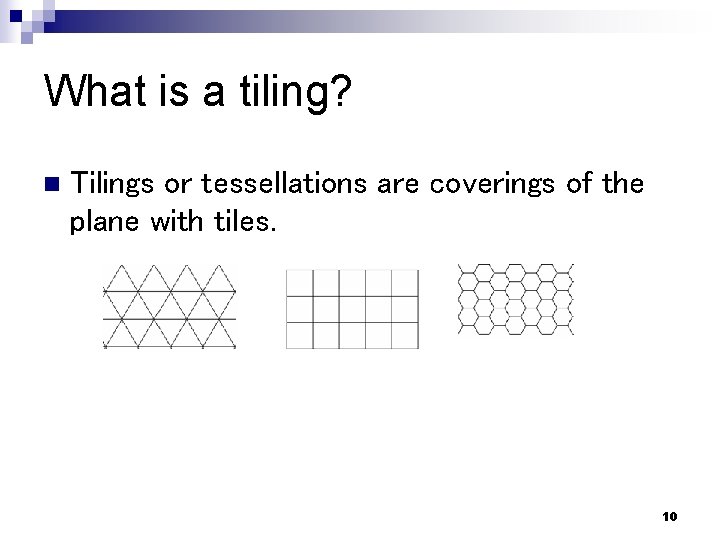
What is a tiling? n Tilings or tessellations are coverings of the plane with tiles. 10
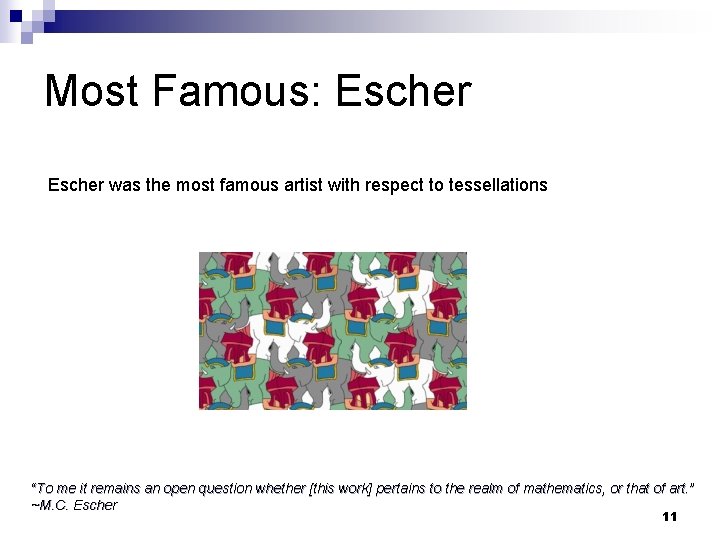
Most Famous: Escher was the most famous artist with respect to tessellations “To me it remains an open question whether [this work] pertains to the realm of mathematics, or that of art. ” ~M. C. Escher 11
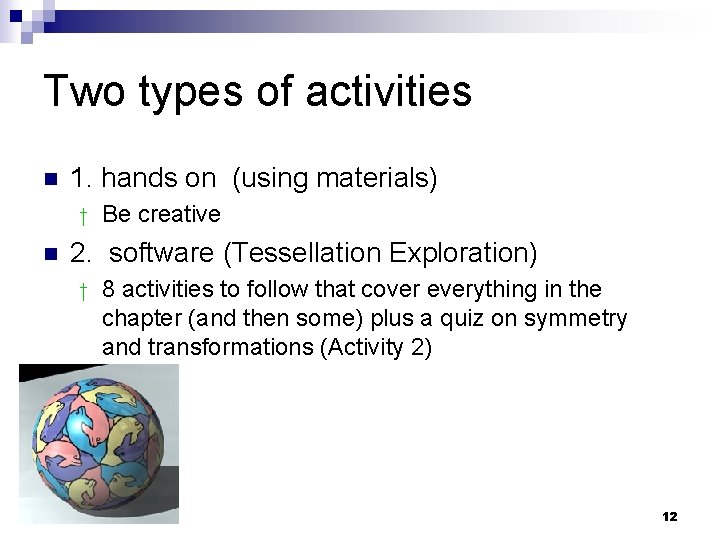
Two types of activities n 1. hands on (using materials) † n Be creative 2. software (Tessellation Exploration) † 8 activities to follow that cover everything in the chapter (and then some) plus a quiz on symmetry and transformations (Activity 2) 12
- Slides: 12