
CHAPTER 9 TRAINING AND DEVELOPMENT Power Point Presentation
- Slides: 12
CHAPTER 9 TRAINING AND DEVELOPMENT Power. Point Presentation by Charlie Cook Copyright © 2002 South-Western. All rights reserved
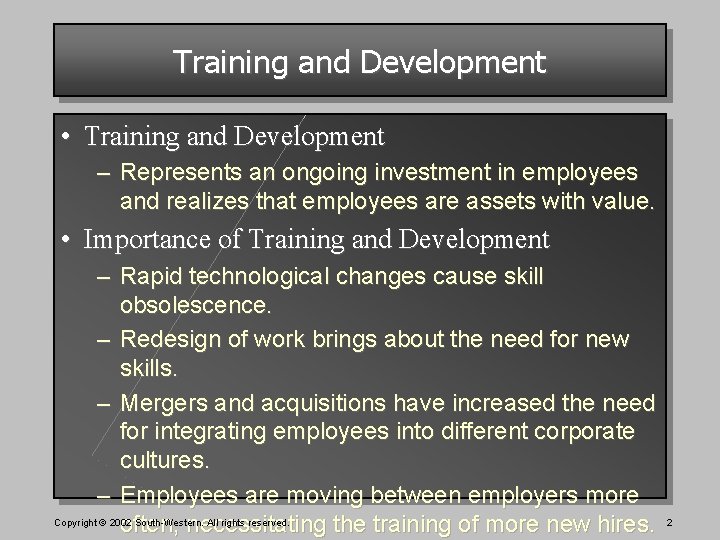
Training and Development • Training and Development – Represents an ongoing investment in employees and realizes that employees are assets with value. • Importance of Training and Development – Rapid technological changes cause skill obsolescence. – Redesign of work brings about the need for new skills. – Mergers and acquisitions have increased the need for integrating employees into different corporate cultures. – Employees are moving between employers more Copyright © 2002 South-Western. All rights reserved. often, necessitating the training of more new hires. 2
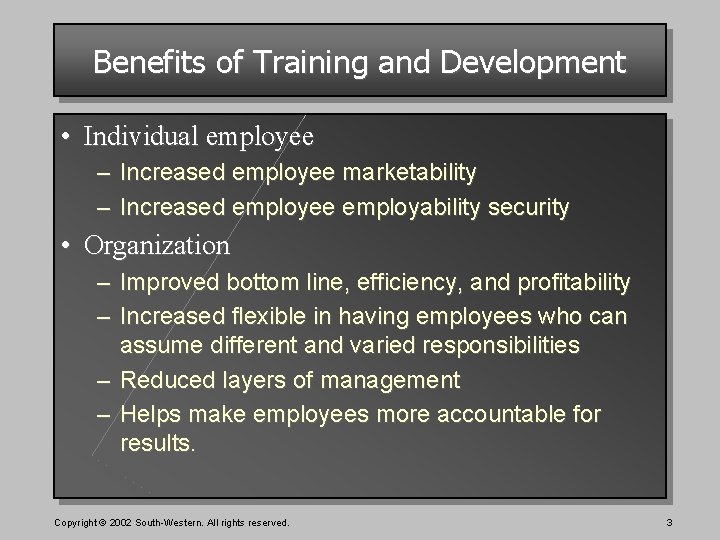
Benefits of Training and Development • Individual employee – Increased employee marketability – Increased employee employability security • Organization – Improved bottom line, efficiency, and profitability – Increased flexible in having employees who can assume different and varied responsibilities – Reduced layers of management – Helps make employees more accountable for results. Copyright © 2002 South-Western. All rights reserved. 3
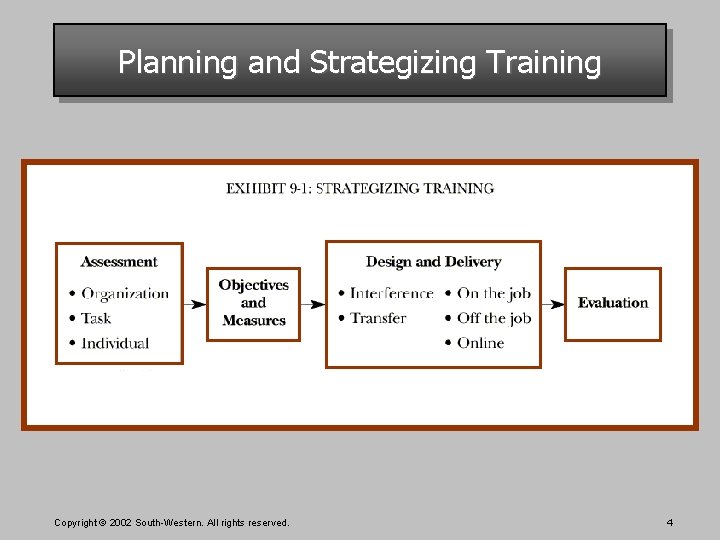
Planning and Strategizing Training Copyright © 2002 South-Western. All rights reserved. 4
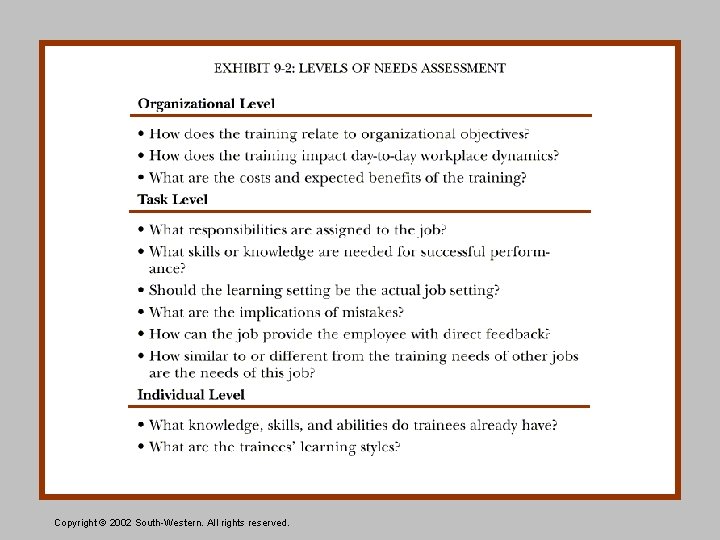
Copyright © 2002 South-Western. All rights reserved.
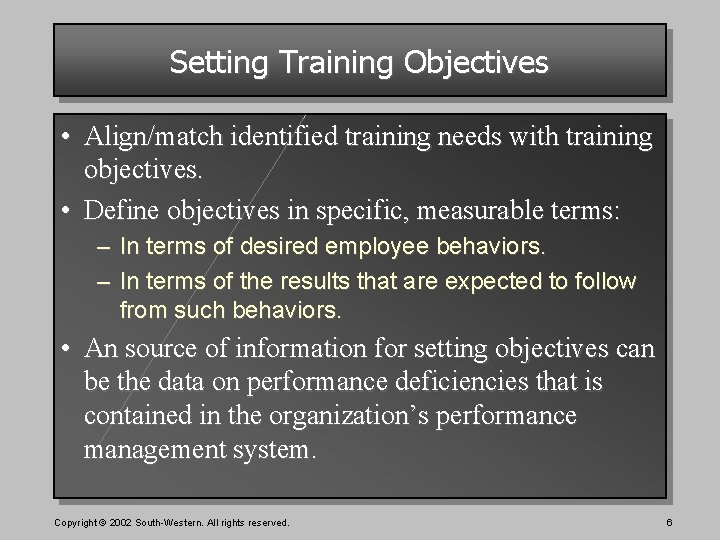
Setting Training Objectives • Align/match identified training needs with training objectives. • Define objectives in specific, measurable terms: – In terms of desired employee behaviors. – In terms of the results that are expected to follow from such behaviors. • An source of information for setting objectives can be the data on performance deficiencies that is contained in the organization’s performance management system. Copyright © 2002 South-Western. All rights reserved. 6
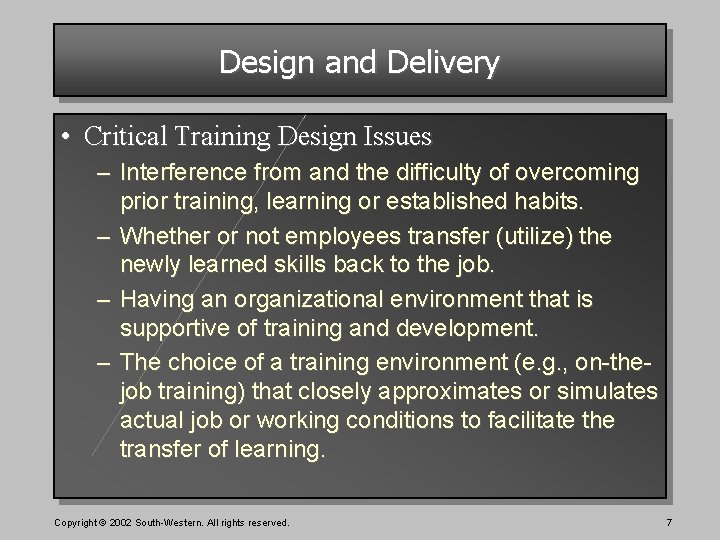
Design and Delivery • Critical Training Design Issues – Interference from and the difficulty of overcoming prior training, learning or established habits. – Whether or not employees transfer (utilize) the newly learned skills back to the job. – Having an organizational environment that is supportive of training and development. – The choice of a training environment (e. g. , on-thejob training) that closely approximates or simulates actual job or working conditions to facilitate the transfer of learning. Copyright © 2002 South-Western. All rights reserved. 7
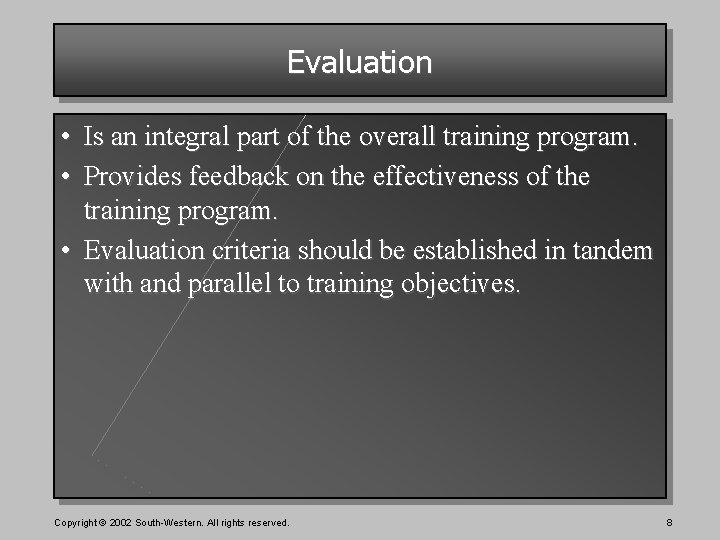
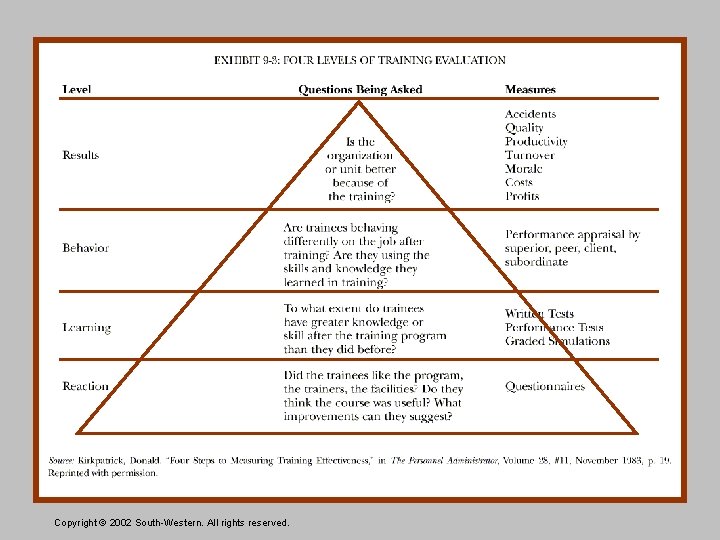
Evaluation • Is an integral part of the overall training program. • Provides feedback on the effectiveness of the training program. • Evaluation criteria should be established in tandem with and parallel to training objectives. Copyright © 2002 South-Western. All rights reserved. 8
Copyright © 2002 South-Western. All rights reserved.
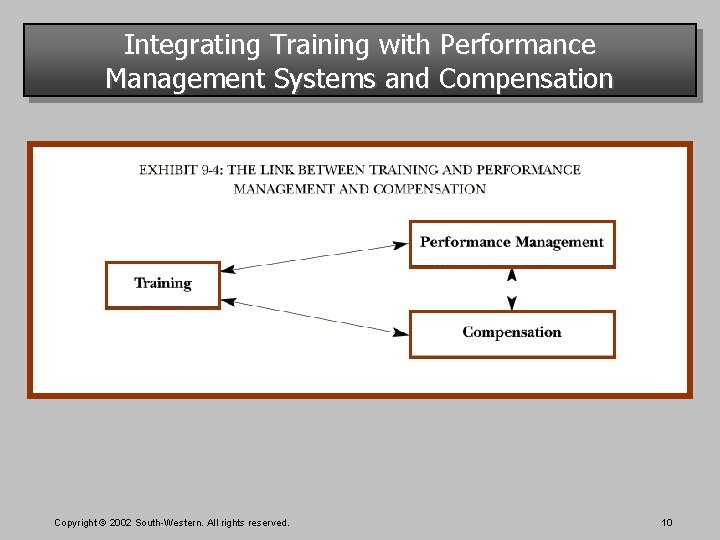
Integrating Training with Performance Management Systems and Compensation Copyright © 2002 South-Western. All rights reserved. 10
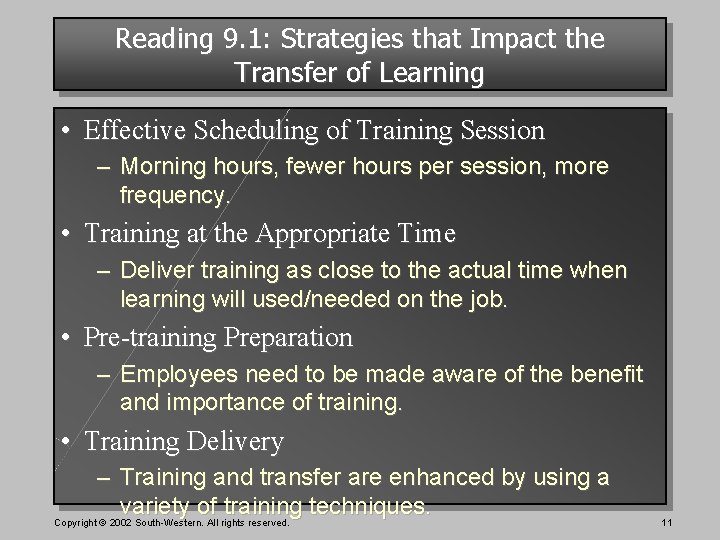
Reading 9. 1: Strategies that Impact the Transfer of Learning • Effective Scheduling of Training Session – Morning hours, fewer hours per session, more frequency. • Training at the Appropriate Time – Deliver training as close to the actual time when learning will used/needed on the job. • Pre-training Preparation – Employees need to be made aware of the benefit and importance of training. • Training Delivery – Training and transfer are enhanced by using a variety of training techniques. Copyright © 2002 South-Western. All rights reserved. 11
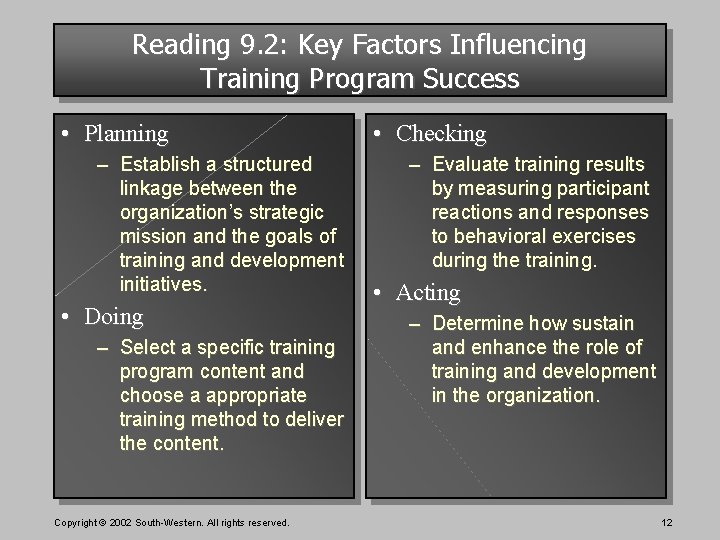
Reading 9. 2: Key Factors Influencing Training Program Success • Planning – Establish a structured linkage between the organization’s strategic mission and the goals of training and development initiatives. • Doing – Select a specific training program content and choose a appropriate training method to deliver the content. Copyright © 2002 South-Western. All rights reserved. • Checking – Evaluate training results by measuring participant reactions and responses to behavioral exercises during the training. • Acting – Determine how sustain and enhance the role of training and development in the organization. 12