
CHAPTER 9 TRAINING AND DEVELOPMENT KEY CONCEPTS AND
- Slides: 39
CHAPTER 9 – TRAINING AND DEVELOPMENT
KEY CONCEPTS AND SKILLS ➲ ➲ ➲ ➲ Process of training needs analysis at organisation level, operations level and individual level How micro training needs can be managed and controlled How orientation training can be carried out and why it is important Guidelines on conducting successful training programmes Effective presentation techniques How trainer can use green light signals to improve trainee participation Methods of evaluating training and the four levels of evaluation
CHAPTER OUTLINE ➲ ➲ ➲ ➲ Why training and development Training needs analysis Micro training needs Employee development Orientation training On-the-job training Job instruction training Conducting training programmes Effective presentation techniques Red-light and green-light signals Evaluation of training Methods of evaluating training Four levels of evaluation
TRAINING AND DEVELOPMENT The planned, continuous effort by management to improve employee competency levels and organisational performance Training ➲ Activities designed to improve an individual’s performance on a currently held job, aimed at helping employees do their present job correctly and effectively. Development ➲ Activities designed to help the individual to grow and move with the organisation as it develops, changes, and grows; it is aimed at helping employees to handle future responsibilities. ➲
WHY TRAINING AND DEVELOPMENT? ➲ ➲ ➲ ➲ Business and industries more complicated and advanced Rapidly advancing technology Jobs increasingly complex and ever-changing With increasing global competition, need for quality and productivity For business today, economic survival is synonymous with productivity With rapidly changing technology, another major goal is to prevent obsolescence of skills Training and development costs should be accepted as an investment in human resources.
TRAINING NEEDS ANALYSIS ➲ ➲ An analysis of the organisation’s training needs, aimed at answering the questions of who in the organisation need training, and what type of training do they need. Three different levels
TRAINING NEEDS ANALYSIS Organisation Level ➲ Focus is on identifying where within the organisation training is needed ➲ Study of entire organisation – vision, mission, objectives, resources, as well as the total environment in which organisation operates ➲ Obtain clear understanding of organisation’s longterm goals and then establish specific goals and strategies for the different departments ➲ Next examine attempts made to meet organisational goals and where gap is in meeting those goals.
TRAINING NEEDS ANALYSIS Operations Level ➲ Analysis aimed at identifying content of training, or what an employee must do in order to perform competently ➲ Involves careful study of jobs within organisation to define specific content of training ➲ Organisational level training need will exist if new products, equipment, processes, or changes in standards, or new policies.
TRAINING NEEDS ANALYSIS Individual Analysis ➲ Focus is on the individual in a given job, and not on the job itself. ➲ Three issues involved: ➲ Determining whether performance is up to standard and whether training is needed ➲ Determining whether current employees are capable of training ➲ Determining whether existing employees with substandard performances can be improved through appropriate training
MICRO TRAINING NEEDS ➲ ➲ ➲ Training needs involving only a few individual employees. Macro training needs often met through in-house training programmes Micro training needs usually means sending an employee to an external programme. External programmes often more expensive on per head basis compared to in-house programmes Important that selection and justification are done properly Need for control system to ensure that employees sent for external training programmes actually benefit from the training.
EMPLOYEE DEVELOPMENT What Is Employee Development? ➲ A joint effort on part of an employee and organisation to upgrade employee's knowledge, skills, and abilities ➲ Will contribute to organisational performance because employees with better skills can accomplish more work
EMPLOYEE DEVELOPMENT Why Should Employee Skills and Abilities Be Developed? ➲ Organisational performance will be improved ➲ Employees will tend to stay on with organisation thus reducing employee turnover
EMPLOYEE DEVELOPMENT Role of Superior in Employee Development ➲ Employee development not sole responsibility of human resource department ➲ Major roles for superior are to provide information and support to facilitate employee's development, coach employees and provide feedback, allot time for development experiences, and ensure that the employee is given opportunities to apply new learnings.
EMPLOYEE DEVELOPMENT Role of Employee ➲ To identify goals for new skills and abilities and look for ways to achieve those goals ➲ Be committed to seek a variety of assignments, and not be afraid to seek new experiences and learn ➲ To attend training and development programmes with open mind to learn new concepts and skills.
EMPLOYEE DEVELOPMENT Employee Experiences and Actions ➲ Employee development not only about attending training and development programmes ➲ Experiences that can contribute to employee development: ➲ temporary assignments ➲ job rotation ➲ cross-training ➲ making presentations ➲ participation in specific organisation committees ➲ having a more experienced person as a mentor.
ORIENTATION TRAINING ➲ Training for new employees to help them familiarise and adapt to the new organisation, where they are provided with the information and skills they need to be successful in their new jobs.
ORIENTATION TRAINING Problems of New Employees ➲ They felt anxious and ill at ease on the first days on the job. ➲ Ragging by older employees intensified anxiety. ➲ Their anxiety interfered with the training process. ➲ Turnover of new employees was caused primarily by anxiety. ➲ New employees were reluctant to discuss problems with their supervisors.
ORIENTATION TRAINING Purposes of Orientation ➲ Three main purposes: ➲ Easing new employees’ adjustment to the organisation ➲ Providing information on tasks and performance expectations ➲ Creating a favourable impression of the organisation Benefits of Orientation ➲ Two major benefits – reduced turnover and acceleration of learning time.
ORIENTATION TRAINING Three Step Orientation Process 1. Organisational level (General information) 2. Departmental level (Specific information) 3. Evaluation and follow up
ORIENTATION TRAINING Organisational Level ➲ General information provided about the organisation ➲ Matters that relate to all new employees like overview of organisation and its history, policies and procedures, and other information of interest to all new employees regardless job or department ➲ Some organisations have New Employee Checklist to ensure all necessary information provided and nothing left out ➲ Also provide some information on organisation’s products or services and role organisation plays as a responsible corporate citizen.
ORIENTATION TRAINING Departmental Level ➲ Information relevant only to each department ➲ New employee’s immediate supervisor usually responsible ➲ Areas to be covered normally include overview of department, job requirements and performance standards, safety regulations, work rules, tour of department, and introductions to other employees ➲ Usually end with question and answer session ➲ Major responsibility of supervisor is also to help new employee to be socialised as quickly as possible.
ORIENTATION TRAINING Evaluation and Follow Up of Orientation Programme ➲ Conducted by HR department together with new employees’ immediate supervisors ➲ New employee may still face some problems after the orientation ➲ What is needed is a formalised follow up system by immediate supervisor and HR department representative ➲ Employee may have some important questions now ➲ Follow up checklist may be used
ORIENTATION TRAINING Planning and Conducting an Orientation Programme ➲ HR department usually given overall responsibility for planning and conducting orientation programme ➲ Division of duties between HR department and new employees’ respective supervisors made clear to avoid duplication or omission of important information. ➲ Another aspect is preparation of an Orientation Kit ➲ Also plan for member of top management to speak to new employees about organisation’s philosophy and expectations
ORIENTATION TRAINING Topics of general interest by HR department: ➲ History of the organisation ➲ Traditions of the organisation ➲ Products and services ➲ Key policies and procedures ➲ Major fringe benefits ➲ Safety and accident-prevention procedures ➲ Employee-management relations ➲ Grievance procedures
ORIENTATION TRAINING Items covered in departmental orientation programme ➲ Organisation of the department ➲ Relationship of the department with other departments ➲ Departmental policies and procedures ➲ Job duties ➲ Performance standards ➲ Responsibilities expected of members of the department ➲ Tour of department ➲ Introductions to colleagues
ORIENTATION TRAINING Evaluation of Orientation Programme ➲ Should be a comprehensive evaluation of whole orientation programme ➲ Conducted at least once a year to see if the orientation programme as a whole meets with its objectives and how the programme can be further improved. ➲ Obtain feedback information from all those involved in the orientation programme
ORIENTATION TRAINING Objective of evaluation to find out: 1. Is the programme appropriate and does it convey an accurate impression of the organisation? 2. Is the programme easily understood? 3. Is the programme interesting? 4. Does the programme stress the importance of people? 5. Is the programme economical?
ORIENTATION TRAINING Training the Supervisor ➲ Supervisor responsible for helping new employee to adjust and integrate with new environment ➲ All supervisors should be trained so that they can help new employees to adjust quickly, reduce their anxieties, and become productive members of the team ➲ Skills needed by supervisor: ➲ make new employee develop confidence in himself ➲ explain advantages and disadvantages of job and performance standards to new employee ➲ introduce new employee to work group in such a way that he feels welcomed
ON-THE-JOB TRAINING ➲ ➲ ➲ The systematic training of employees by direct superiors at the workplace through actual work. Advantage of OJT is it permits employee to learn job tasks by actually performing them and there is no problem in later transferring what has been learned to the task Every new employee should be trained by OJT also useful for other employees who are not performing to standard Major disadvantage of OJT is at times there is more emphasis on job and productivity than is on training aspect
JOB INSTRUCTION TRAINING ➲ ➲ 1. 2. 3. 4. A four-step training process that involves four training methods: a lecture, a demonstration, a performance tryout and a critique. Steps are: Getting the trainee ready to learn Demonstrate how the job should be done Try the trainees out by letting them do the job Provide feedback and put the trainees on their own gradually
CONDUCTING TRAINING PROGRAMMES Overcoming Anxiety ➲ Most trainers usually have some amount of initial anxiety ➲ Two things that may help reduce anxiety problems: ➲ Breathing deeply ➲ Relaxing the muscles
CONDUCTING TRAINING PROGRAMMES Hygiene Factors in Training Programmes ➲ Factors which can cause training participants to be dissatisfied if they are not kept up to standard, but will not necessarily ensure a successful training programme even if they are kept up to or exceed the standard.
Hygiene factors 1. Seating 2. Lighting 3. The Room 4. Noise 5. Temperature 6. Food 7. Timing
EFFECTIVE PRESENTATION TECHNIQUES ➲ ➲ ➲ ➲ ➲ Give listeners signals to help them follow the ideas presented. Do not start off on the wrong foot. Be alert to the trainees. Maintain eye contact with the trainees. Vary the speed of delivery. Make sure that everyone in the room can hear. Use natural gestures. Avoid putting the hands near the face. Use pauses effectively. Keep the conclusion short.
RED-LIGHT AND GREEN-LIGHT SIGNALS Red-Light Signals ➲ Signals coming from trainers that discourage discussions and questions from participants. Green-Light Signals ➲ Signals coming from trainers that encourage discussions and questions from participants.
EVALUATION OF TRAINING Why Evaluate Training? ➲ Four main reasons: ➲ to see if training programme has accomplished its objectives ➲ to identify the strengths and weaknesses of the training activity ➲ to analyse cost-benefit analysis of specific training programmes ➲ to establish a data base that can demonstrate productivity of HR department
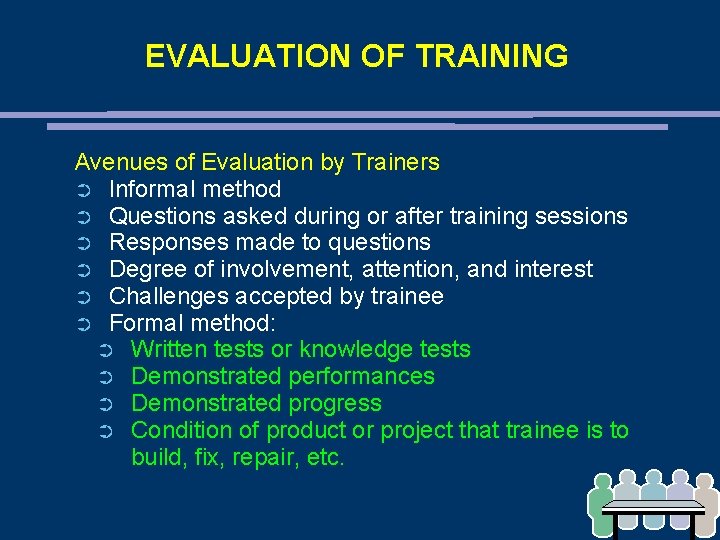
EVALUATION OF TRAINING Avenues of Evaluation by Trainers ➲ Informal method ➲ Questions asked during or after training sessions ➲ Responses made to questions ➲ Degree of involvement, attention, and interest ➲ Challenges accepted by trainee ➲ Formal method: ➲ Written tests or knowledge tests ➲ Demonstrated performances ➲ Demonstrated progress ➲ Condition of product or project that trainee is to build, fix, repair, etc.
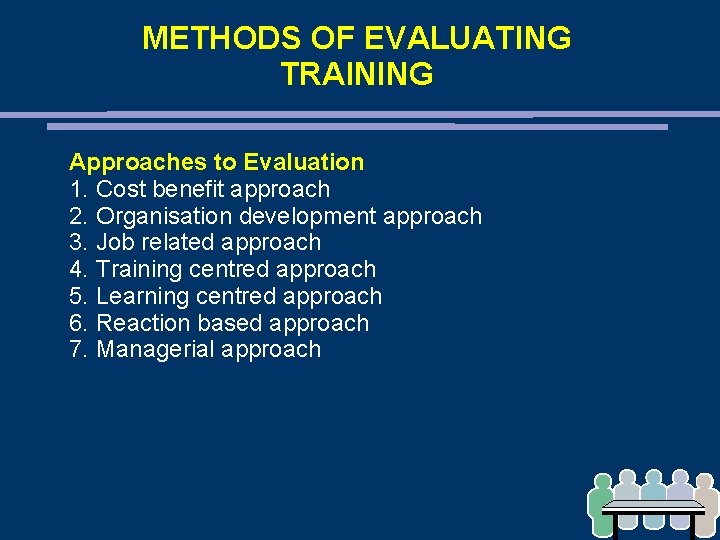
METHODS OF EVALUATING TRAINING Approaches to Evaluation 1. Cost benefit approach 2. Organisation development approach 3. Job related approach 4. Training centred approach 5. Learning centred approach 6. Reaction based approach 7. Managerial approach
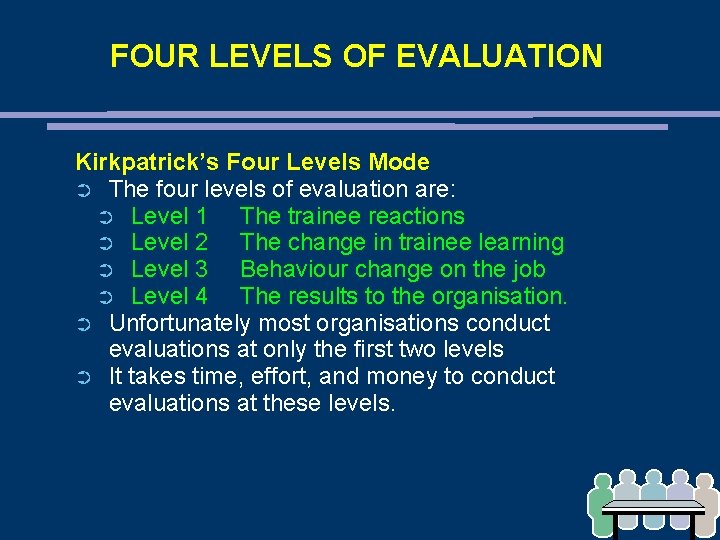
FOUR LEVELS OF EVALUATION Kirkpatrick’s Four Levels Mode ➲ The four levels of evaluation are: ➲ Level 1 The trainee reactions ➲ Level 2 The change in trainee learning ➲ Level 3 Behaviour change on the job ➲ Level 4 The results to the organisation. ➲ Unfortunately most organisations conduct evaluations at only the first two levels ➲ It takes time, effort, and money to conduct evaluations at these levels.