
Chapter 9 The World of Polymers and Plastics
- Slides: 34
Chapter 9: The World of Polymers and Plastics Why is plastic so important? What happens to recycled plastics and polymers? Are there downsides to recycling?
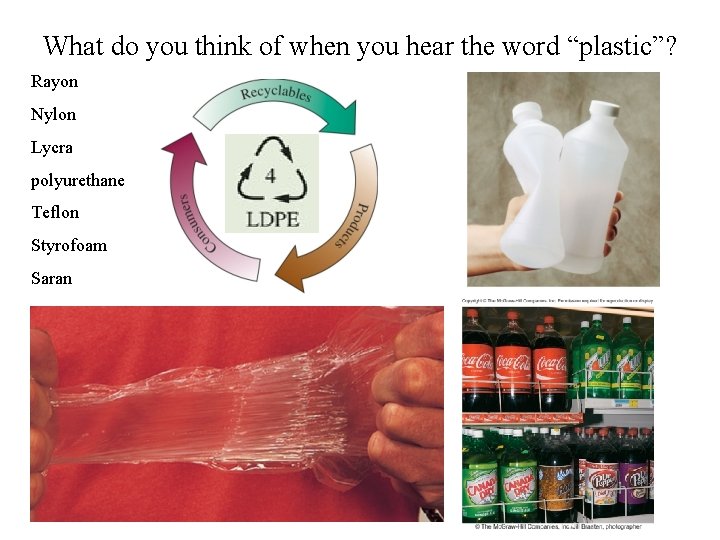
What do you think of when you hear the word “plastic”? Rayon Nylon Lycra polyurethane Teflon Styrofoam Saran
Polymer – very long molecules composed of one or more repeating units. From 'poly' meaning 'many' and 'mer' whose root means 'unit' A monomer is the building block of a polymer. Different monomers may be used together to enhance/modify a polymers properties.
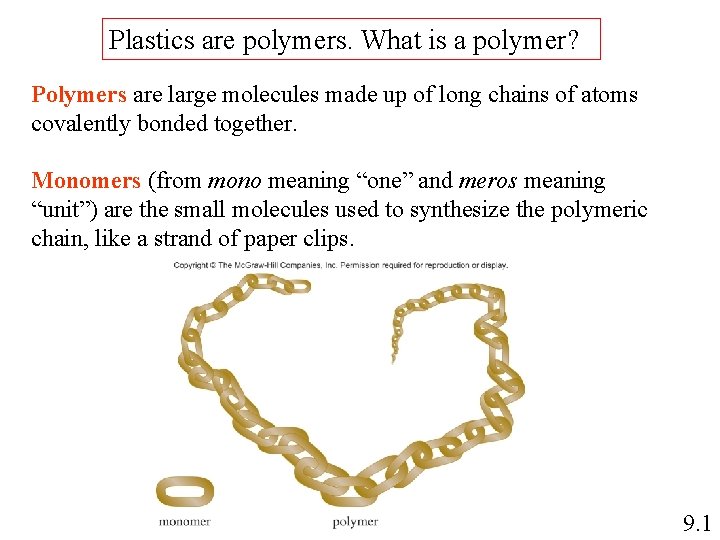
Plastics are polymers. What is a polymer? Polymers are large molecules made up of long chains of atoms covalently bonded together. Monomers (from mono meaning “one” and meros meaning “unit”) are the small molecules used to synthesize the polymeric chain, like a strand of paper clips. 9. 1
There are thousands of natural and manmade polymers. Man made polymers include polyesters, nylons, kevlar, polyethylene, polystyrene. . . Natural polymers include cellulose, starches, hair, fingernails, tar, crab shells, DNA/RNA strands. . .
Each of these may have variety of properties, including melting point, strength, reactivity… All polyesters, for example, are not identical. -some may form stronger fibers -some may melt at higher temperatures -some may be more flexible
Each polymer is one molecule and may have 50, 000 or more atoms or repeating units. A small piece of plastic or rubber will typically contain trillions of these molecules. These molecules are usually twisted, coiled and entangled with each other
Polymers have been with us since the beginning of time. Natural polymers include such things as cellulose, starch, tar and shellac, tortoise shell and horns, as well as tree saps that produce amber and latex. These polymers were processed with heat and pressure into useful articles like hair ornaments and jewelry. Natural polymers began to be chemically modified during the 1800 s to produce many materials. The most famous of these were vulcanized rubber, cotton, and celluloid. The first semi-synthetic polymer produced was Bakelite in 1909 and was soon followed by the first synthetic fiber, rayon, which was developed in 1911. 9. 1
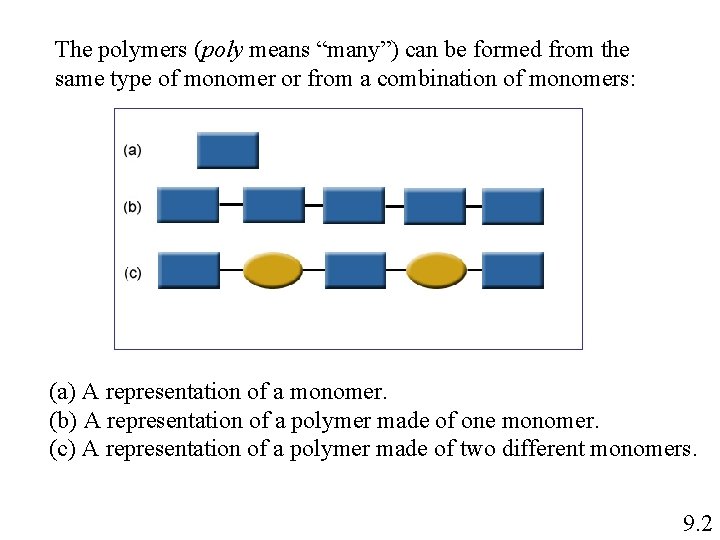
The polymers (poly means “many”) can be formed from the same type of monomer or from a combination of monomers: (a) A representation of a monomer. (b) A representation of a polymer made of one monomer. (c) A representation of a polymer made of two different monomers. 9. 2
The properties of a polymer depend on: The composition of the polymer backbone The polymerization process Functional groups attached to the backbone How the polymer is formed into its final form:
Composition: There are six main classes commercially of man made polymers, but thousands of sub-classes. The polymer may come from one monomer or from a mixture of monomers Each monomer adds different properties to the polymer Some backbones may be more straight, some more rigid, some stronger than others, and some more stable at higher temperatures.
Polymerization: Even with the same monomer, the polymerization process can dramatically affect the properties: The backbone may be one long continuous strand (though actually coiled like tangled yarn) shorter strands have lower melting points It may also be branched, like many strings knotted together this also lowers the melting point It may be crosslinked, which prevents the material from melting at all
Functional groups: Small molecules attached to the backbone. Some of the properties they can affect are: Chemical reactivity Polymer strength Color Solubility Melting point Cross-linking (chemically bonding one polymer to another)
End Product: Solid pieces of plastic more rigid more structural stability Fibers/rope often stronger, more flexible, more elastic Post treatment (“drawing”) can improve strength and stiffness, but reduces elasticity
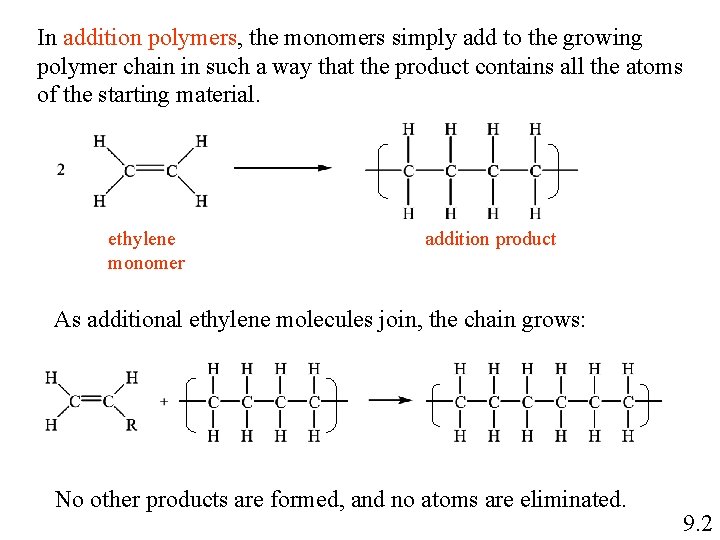
In addition polymers, the monomers simply add to the growing polymer chain in such a way that the product contains all the atoms of the starting material. ethylene monomer addition product As additional ethylene molecules join, the chain grows: No other products are formed, and no atoms are eliminated. 9. 2
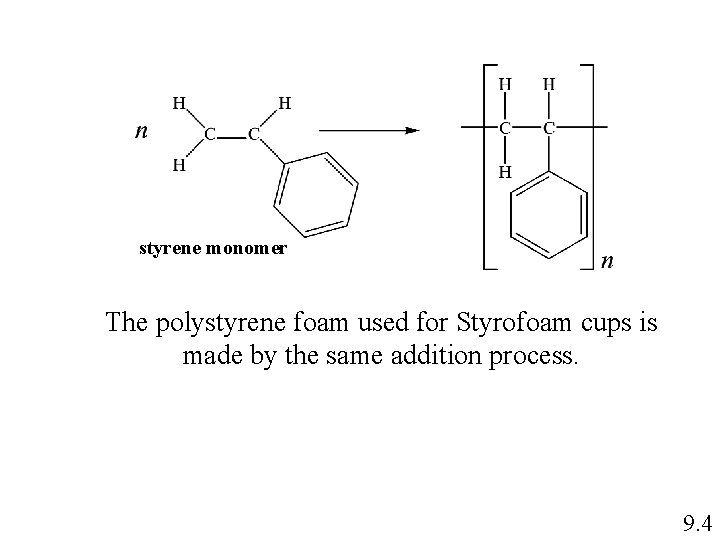
styrene monomer The polystyrene foam used for Styrofoam cups is made by the same addition process. 9. 4
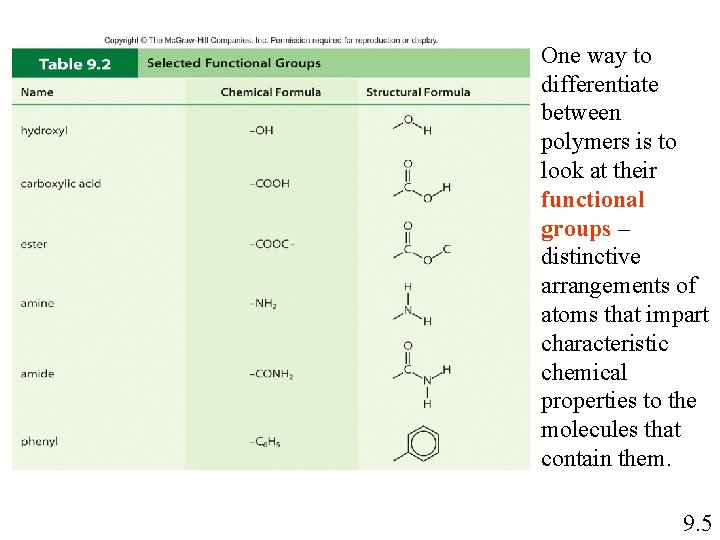
One way to differentiate between polymers is to look at their functional groups – distinctive arrangements of atoms that impart characteristic chemical properties to the molecules that contain them. 9. 5
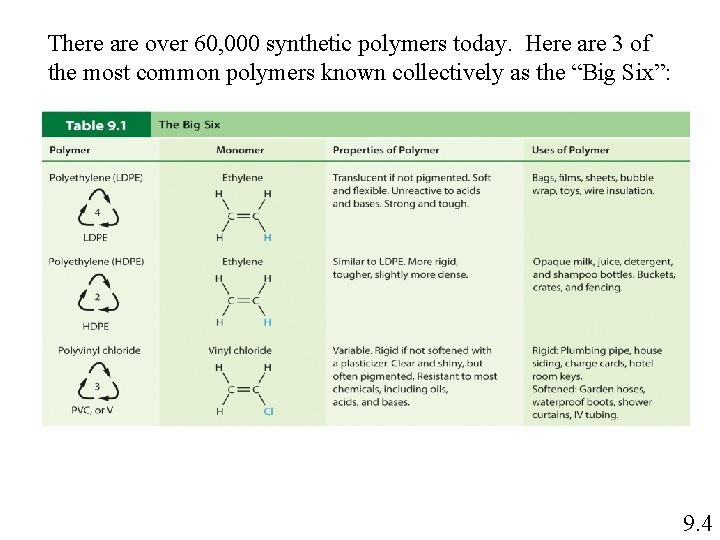
There are over 60, 000 synthetic polymers today. Here are 3 of the most common polymers known collectively as the “Big Six”: 9. 4
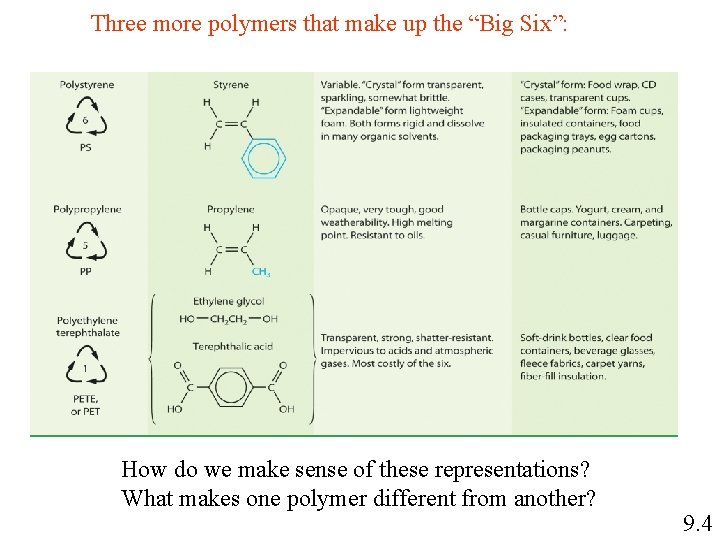
Three more polymers that make up the “Big Six”: How do we make sense of these representations? What makes one polymer different from another? 9. 4
Most natural fibers (cellulose, wool, silk) have very polar functional groups (-OH). Therefore they are more strongly attracted to water, wick water from our skin, and feel more comfortable. Most man-made fibers are hydrophobic – not attracted to water. Functional groups are added to some manmade fibers to make them attracted to water.
The polymerization may be adjusted to control parameters such as: Polymer length Frequency/length of branches Order and type of monomers in the backbone
Drawing – basically stretching the material to align the polymer molecules First, remember that a polymer sample contains many polymer molecules. The molecules are twisted and tangled when the polymer is formed. If formed into a string and stretched, the molecules align and maximize their strength, though this increases stiffness also.
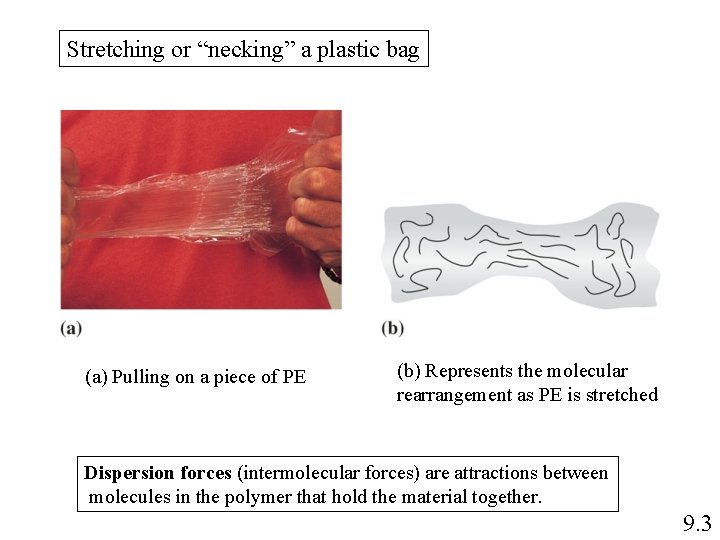
Stretching or “necking” a plastic bag (a) Pulling on a piece of PE (b) Represents the molecular rearrangement as PE is stretched Dispersion forces (intermolecular forces) are attractions between molecules in the polymer that hold the material together. 9. 3
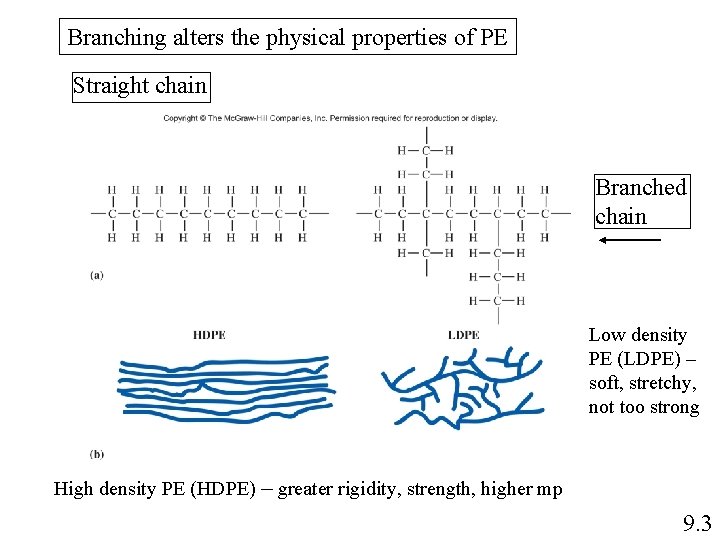
Branching alters the physical properties of PE Straight chain Branched chain Low density PE (LDPE) – soft, stretchy, not too strong High density PE (HDPE) – greater rigidity, strength, higher mp 9. 3
Thermoplastic polymers – may be melted and reformed or reshaped. Shorter molecules, more branching, less cross-linking and less intermolecular forces all lower the melting points of polymers. These polymers may be more easily recycled by melting the object, though there is some degradation of the structure with remelting.
Very long polymers or heavily cross-linked polymers often cannot be melted. These are called thermosetting polymers. They are difficult to recycle since they cannot be melted and reshaped. Polymers in car tires, for example, are basically crosslinked to form one huge molecule. They may be cut into pieces for alternate uses, or possibly depolymerized (a difficult process)
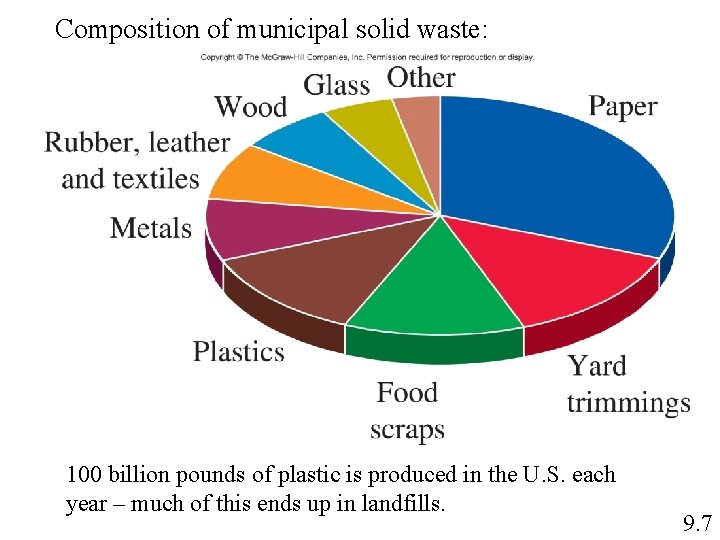
Composition of municipal solid waste: 100 billion pounds of plastic is produced in the U. S. each year – much of this ends up in landfills. 9. 7
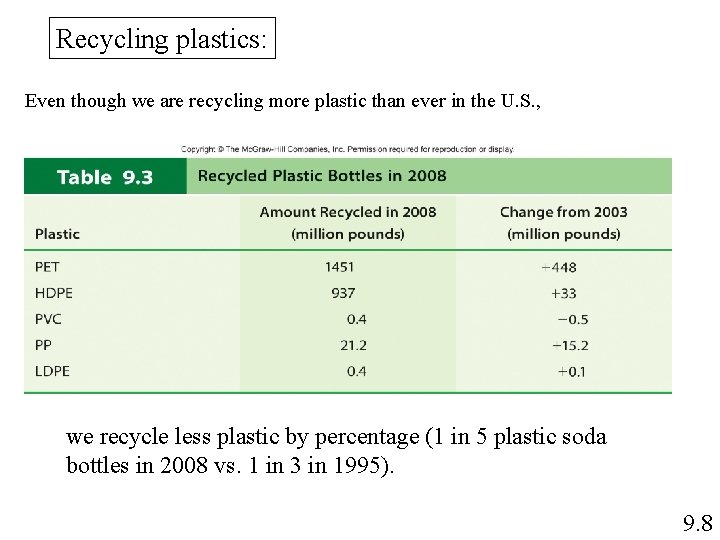
Recycling plastics: Even though we are recycling more plastic than ever in the U. S. , we recycle less plastic by percentage (1 in 5 plastic soda bottles in 2008 vs. 1 in 3 in 1995). 9. 8
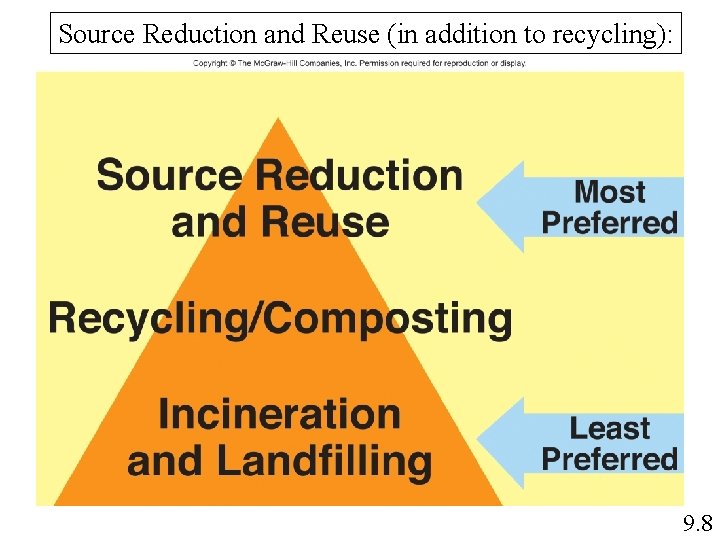
Source Reduction and Reuse (in addition to recycling): 9. 8
Source Reduction and Reuse Reduces raw materials needed Less waste Reuse/re-purposing -less processing than recycling -does not have recycling degradation issues Examples include Minimizing shrink wrap packaging Use less plastic wrap for food storage Reuse grocery bags for trash bags or other uses
Recycling Sort polymers by type Clean polymers to remove impurities Remelt polymers (if possible) and form in to new products Requires less energy than forming new polymers Reduces dependence on crude oil (in terms of energy used as well as raw materials for polymers) But polymer properties degrade with recycling
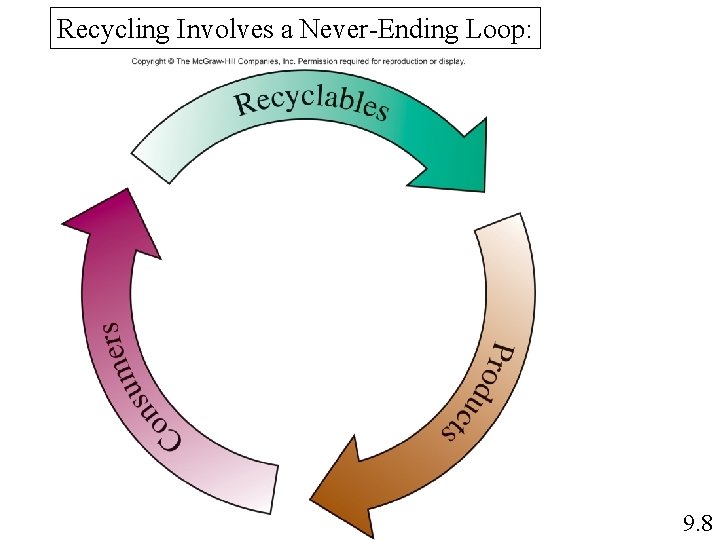
Recycling Involves a Never-Ending Loop: 9. 8
Recycling Polymers Pros: Less material in landfills Reduces resources needed Lower carbon footprint Cost? Cons: Need new infrastructure Each type of polymer must be separated Hard to recycle thermosetting polymers (e. g. car tires) Degradation of polymers Impurities can ruin recycled material Cost?
Incineration and Landfilling Polymers contain a significant amount of chemical energy (most come from fossil fuels) Incineration at least produces energy from polymers: But some polymers and their additives may release toxic fumes when burned Landfilling is often the least desirable process: Polymers may take thousands of years to decompose This is wasting a useful resource