
Chapter 9 The Use of Force Learning Objectives
Chapter 9 The Use of Force
Learning Objectives 1. Define force and understand the link between the threat of violence and the actual use of violence. 2. Distinguish the policy of defense from that of deterrence. 3. Explain the effects of WMD on deterrence, defense, and crisis stability. Copyright © 2014 Cengage Learning. All rights reserved. 2
Learning Objectives 4. Define terrorism. 5. Summarize and evaluate the competing explanations of the causes of terrorism. 6. Link different explanations of terrorism to possible policy responses. Copyright © 2014 Cengage Learning. All rights reserved. 3
Military Force and Its Purposes § Force § Use or threat of violence to achieve a political goal § Euphemism for the word violence § Threat of violence seen as use of force Copyright © 2014 Cengage Learning. All rights reserved. 4
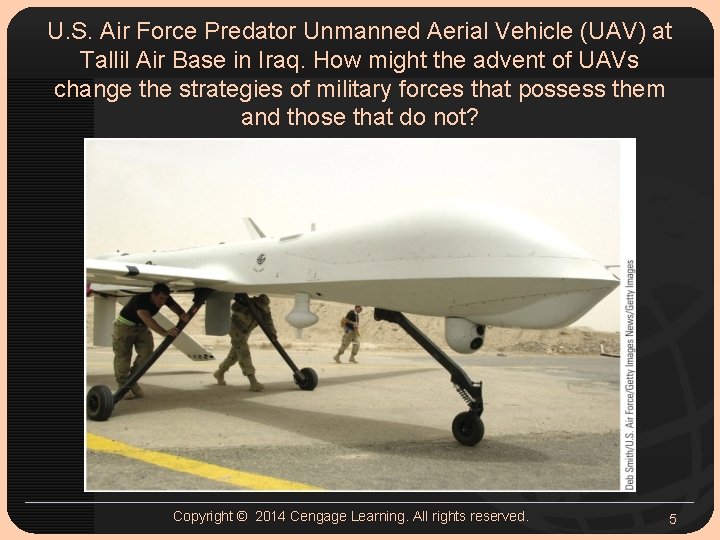
U. S. Air Force Predator Unmanned Aerial Vehicle (UAV) at Tallil Air Base in Iraq. How might the advent of UAVs change the strategies of military forces that possess them and those that do not? Copyright © 2014 Cengage Learning. All rights reserved. 5
Military Force and Its Purposes § Coercive Diplomacy § Threat used to change another actor’s behavior § Explicit or implicit threats § Every negotiation entails implied threat § Credibility § Ability and will to carry out a threat Copyright © 2014 Cengage Learning. All rights reserved. 6
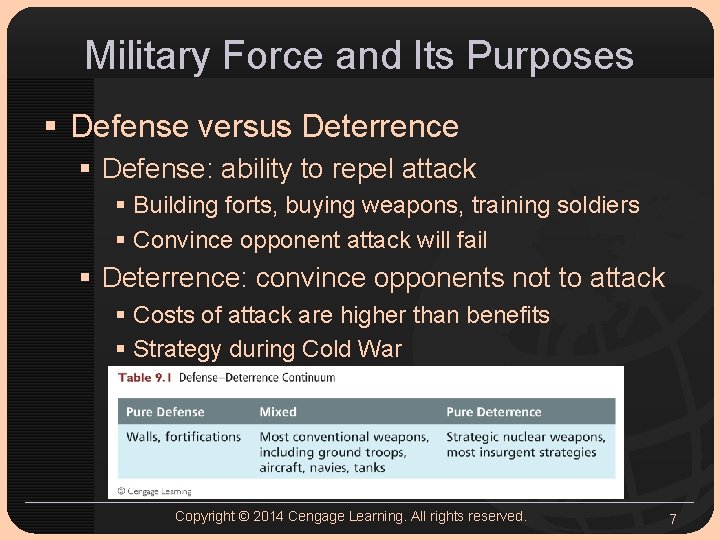
Military Force and Its Purposes § Defense versus Deterrence § Defense: ability to repel attack § Building forts, buying weapons, training soldiers § Convince opponent attack will fail § Deterrence: convince opponents not to attack § Costs of attack are higher than benefits § Strategy during Cold War Copyright © 2014 Cengage Learning. All rights reserved. 7
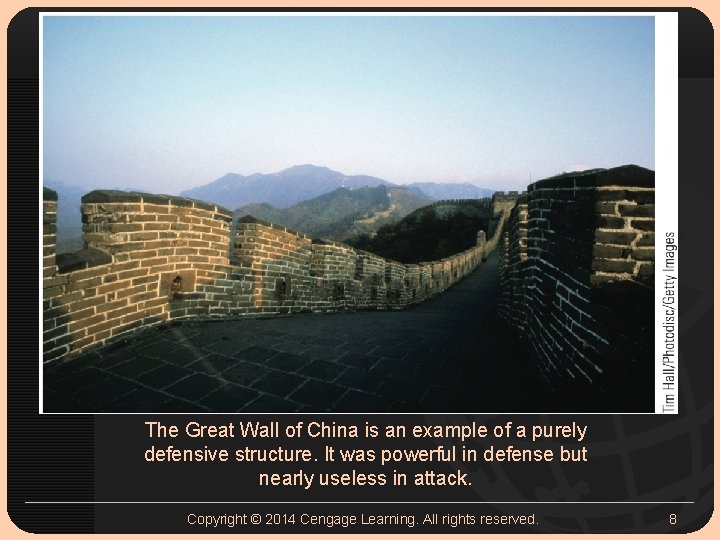
The Great Wall of China is an example of a purely defensive structure. It was powerful in defense but nearly useless in attack. Copyright © 2014 Cengage Learning. All rights reserved. 8
Military Force and Its Purposes § The Security Dilemma § Military capability seen as a threat § Other states act accordingly § Increase their military capability § Attack preemptively Copyright © 2014 Cengage Learning. All rights reserved. 9
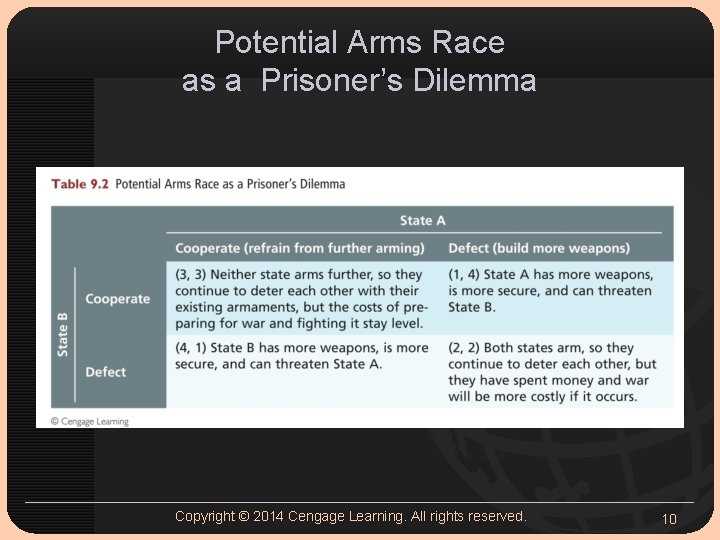
Potential Arms Race as a Prisoner’s Dilemma Copyright © 2014 Cengage Learning. All rights reserved. 10
Contemporary Competition for Military Advantage § Military Preponderance § U. S. advantage in military weaponry § Quality and quantity favor U. S. § Most advanced weaponry in world § Ability to deploy around world for long time periods § Spends more money on military Copyright © 2014 Cengage Learning. All rights reserved. 11
Contemporary Competition for Military Advantage § The Role of High-Tech Weapons § Precision-guided munitions § Hit targets with high degree of accuracy § Low “collateral damage” § Cyber Warfare § Available to range of actors § Characteristics of terrorism and insurgency § Able to disguise source of attack Copyright © 2014 Cengage Learning. All rights reserved. 12
Contemporary Competition for Military Advantage § Proliferation of Low-Tech Weapons § § Assault rifles, grenade launchers, Improvised Explosive Devices (IEDs) Inexpensive, widely available materials Huge number of weapons § Rwanda Copyright © 2014 Cengage Learning. All rights reserved. 13
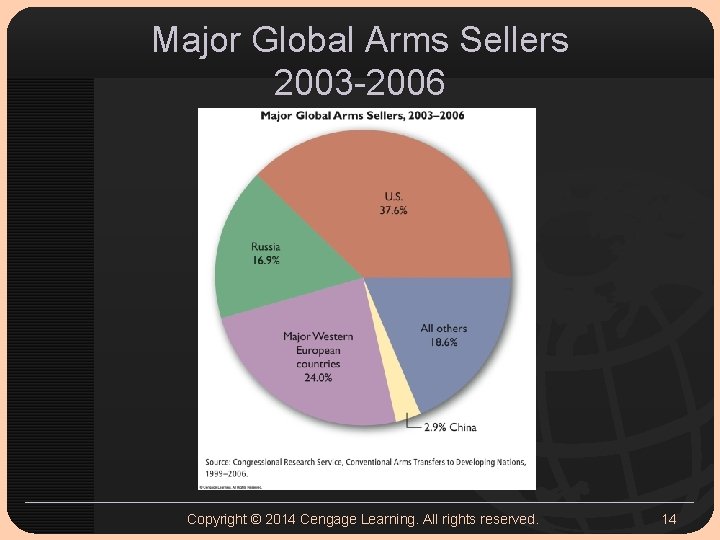
Major Global Arms Sellers 2003 -2006 Copyright © 2014 Cengage Learning. All rights reserved. 14
Contemporary Competition for Military Advantage § Sensitivity to Casualties § Since WWII sensitivity has increased § Higher tolerance when defending homeland § Military support depends on casualties § Must keep amount low for public support Copyright © 2014 Cengage Learning. All rights reserved. 15
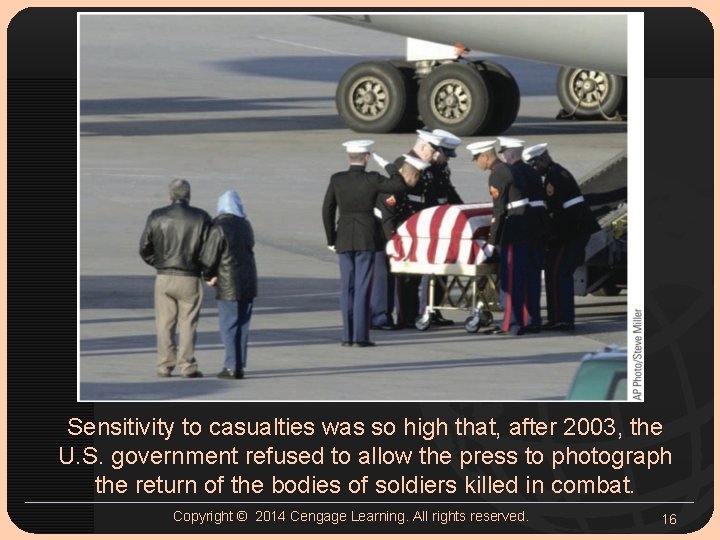
Sensitivity to casualties was so high that, after 2003, the U. S. government refused to allow the press to photograph the return of the bodies of soldiers killed in combat. Copyright © 2014 Cengage Learning. All rights reserved. 16
Weapons of Mass Destruction § Advent of nuclear weapons § Shifted focus from defense to deterrence § Shifted goal of policy § Create fear that any war could lead to nuclear response Copyright © 2014 Cengage Learning. All rights reserved. 17
Weapons of Mass Destruction § Five Categories of WMDs § § § Nuclear Weapons Chemical Weapons Biological Weapons Radiological Weapons Electromagnetic Pulse Weapons Copyright © 2014 Cengage Learning. All rights reserved. 18
Weapons of Mass Destruction § Nonnuclear WMDs § Attractive to weaker states § Easier and cheaper to make § Nuclear Deterrence in the Cold War § U. S. and Soviets faced two challenges § Crisis stability § Nuclear coercion Copyright © 2014 Cengage Learning. All rights reserved. 19
Weapons of Mass Destruction § Proliferation § May not defeat opponent conventionally § WMDs make cost of attack very high § WMD as a Deterrent § Unknown if WMDs actually deter attack Copyright © 2014 Cengage Learning. All rights reserved. 20
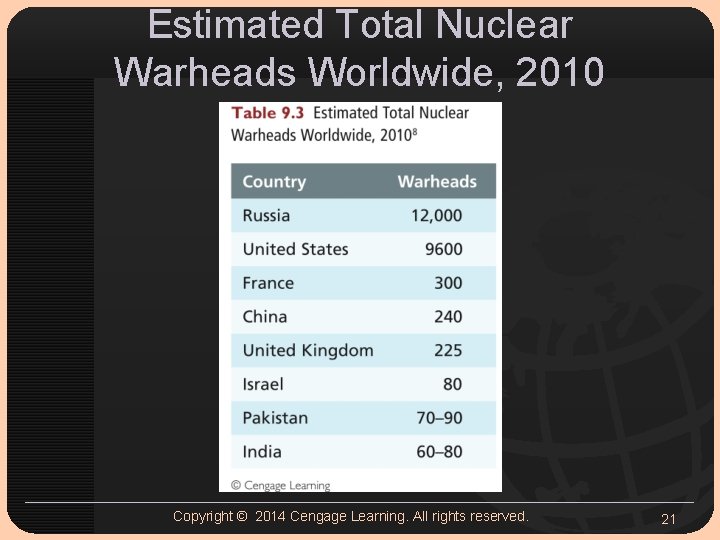
Estimated Total Nuclear Warheads Worldwide, 2010 Copyright © 2014 Cengage Learning. All rights reserved. 21
Weapons of Mass Destruction § WMD and Crisis Stability § Waltz: nuclear weapons make the world more safe § Arguments against Waltz § Assumption that leaders are rational § Leaders have effective control § Fear of radical groups Copyright © 2014 Cengage Learning. All rights reserved. 22
Terrorism, Insurgency, and Counterinsurgency § Insurgency and guerilla warfare § § § Same logic as WMDs Raise costs of conflict to be high Deter continuation of conflict Used by weaker actors Asymmetric conflict Copyright © 2014 Cengage Learning. All rights reserved. 23
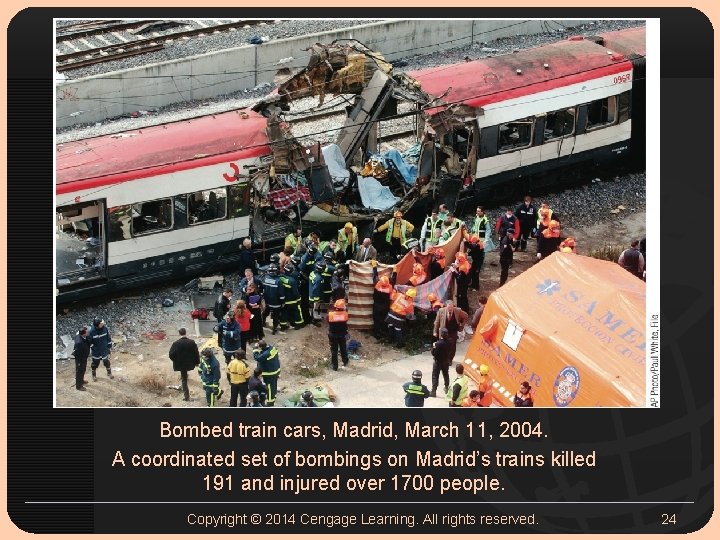
Bombed train cars, Madrid, March 11, 2004. A coordinated set of bombings on Madrid’s trains killed 191 and injured over 1700 people. Copyright © 2014 Cengage Learning. All rights reserved. 24
Power and Purpose of Terrorism § Defining Terrorism § Use or threat of violence by nongovernmental actors to create fear § Three key points § Method not goal § Violence by government, not labeled terrorism § Target not the immediate victims Copyright © 2014 Cengage Learning. All rights reserved. 25
Power and Purpose of Terrorism § States, Nonstate Actors, and Terrorism § Terrorists are private actors § Use violence for public goals § Terrorism as Asymmetric Conflict § States control territories, can be deterred § Terrorists control terms of conflict Copyright © 2014 Cengage Learning. All rights reserved. 26
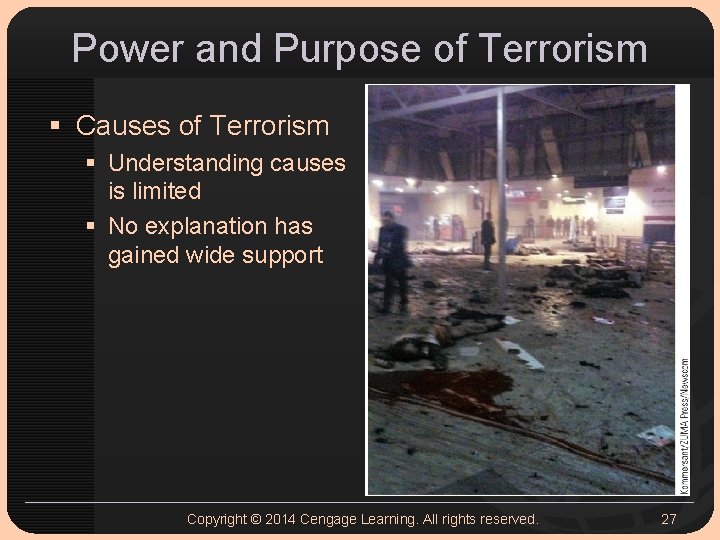
Power and Purpose of Terrorism § Causes of Terrorism § Understanding causes is limited § No explanation has gained wide support Copyright © 2014 Cengage Learning. All rights reserved. 27
Power and Purpose of Terrorism § Rational Choice Explanations § Options available to weak actors § Fighting powerful governments § Unable to wage successful conventional war § Distinction between defense and retaliation Copyright © 2014 Cengage Learning. All rights reserved. 28
Power and Purpose of Terrorism § Poverty § § § Underlying cause of terrorism? Sense of desperation and alienation No hope for advancement or a good job People susceptible to radical doctrines Little evidence to support theory Copyright © 2014 Cengage Learning. All rights reserved. 29
Power and Purpose of Terrorism § Religions produce beliefs to justify § God’s will justifies any means § Islam § Qu’ran justifies holy war § Many Muslims do not recognize Qu’ran sanctions § Other religious extremists claim divine support Copyright © 2014 Cengage Learning. All rights reserved. 30
Power and Purpose of Terrorism § Individual Level § What makes a person a terrorist? § When powerful agendas cannot be advanced through other means § Most grievances do not lead to terrorism § Few conclusive findings on “profiles” Copyright © 2014 Cengage Learning. All rights reserved. 31
Power and Purpose of Terrorism § Group Dynamics and Terrorism § Key factor is organization, not individual § Wide range of people are potential suicide bombers § Societal level § Does the society support such tactics? Copyright © 2014 Cengage Learning. All rights reserved. 32
- Slides: 32