
Chapter 9 The polymerase chain reaction 1 contents






- Slides: 48
Chapter 9 The polymerase chain reaction 1
contents n n n 9. 1 The polymerase chain reaction in outline 9. 2 PCR in more detail 9. 2. 1 Designing the oligonucleotide primers for a PCR 9. 2. 2 Working out the correct temperatures to use 9. 2. 3 After the PCR: studying PCR products 9. 3 Problems with the error rates of Taq polymerase 2
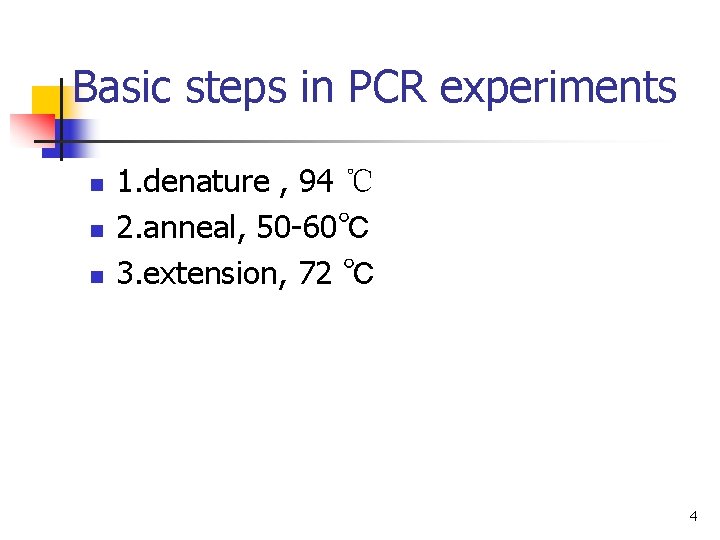
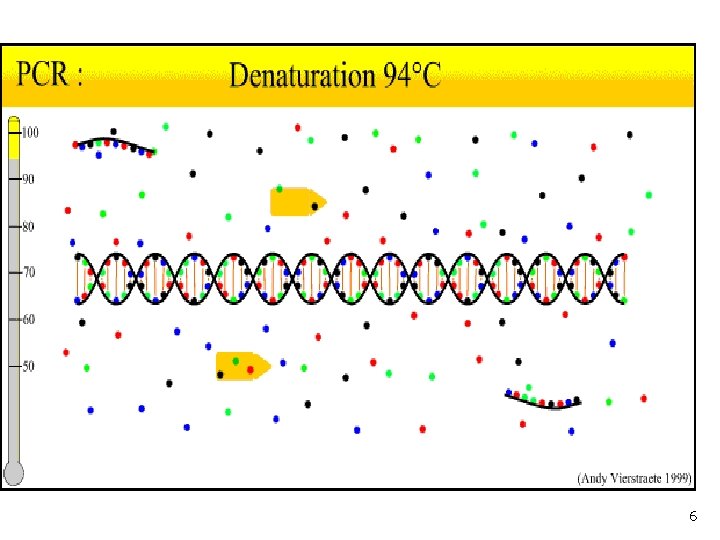
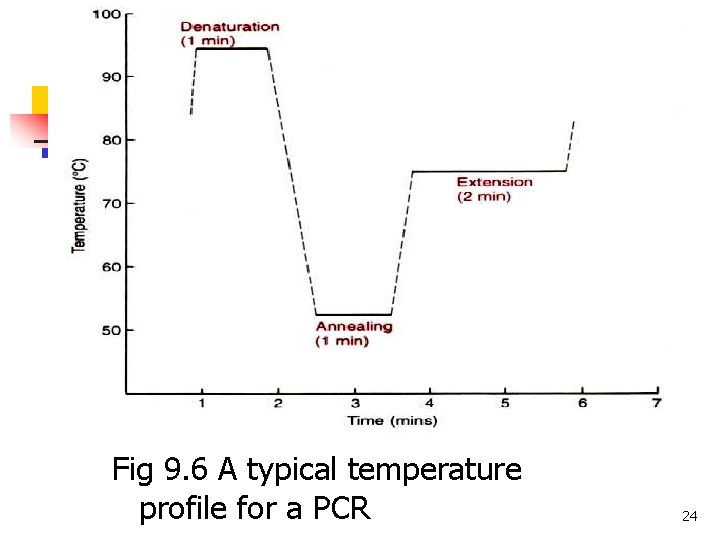
Basic steps in PCR experiments n n n 1. denature , 94 ℃ 2. anneal, 50 -60℃ 3. extension, 72 ℃ 4
PCR reaction 5
6
n n n Template DNA Primer Taq polymerase d. NTPs Mg 2+ 7
9. 2 PCR in more detail Primers 2. Template 3. Enzyme 4. Mg 2+ 5. d. NTPs 6. balanced solution 7. temperature 1. 8
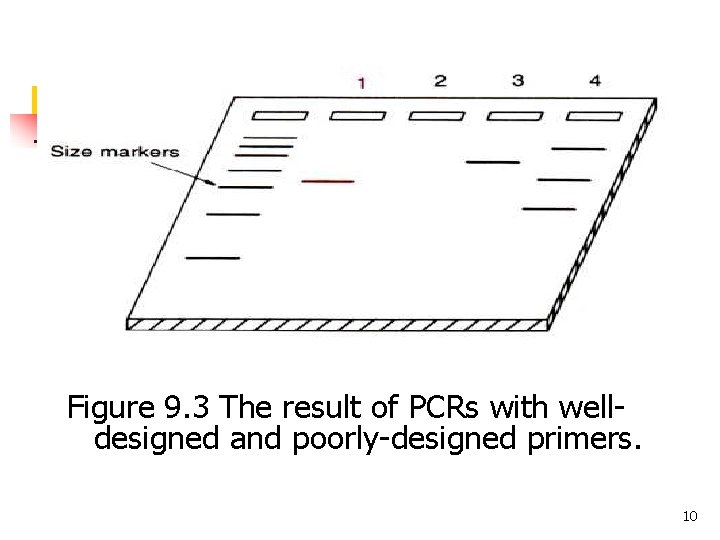
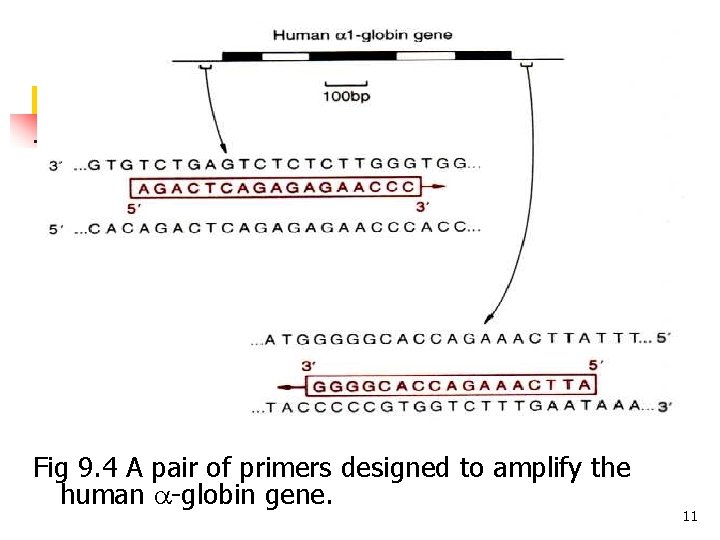
9. 2. 1 Designing the oligonucleotide primers for a PCR (设计PCR的寡核苷酸引物) n n n Thought on design of primers: Complementary to its template strand 3’ ends of the hybridized primers should point towards one anotherfig 9. 4. DNA fragments to be amplified< 3 kb 9
Figure 9. 3 The result of PCRs with welldesigned and poorly-designed primers. 10
Fig 9. 4 A pair of primers designed to amplify the human -globin gene. 11
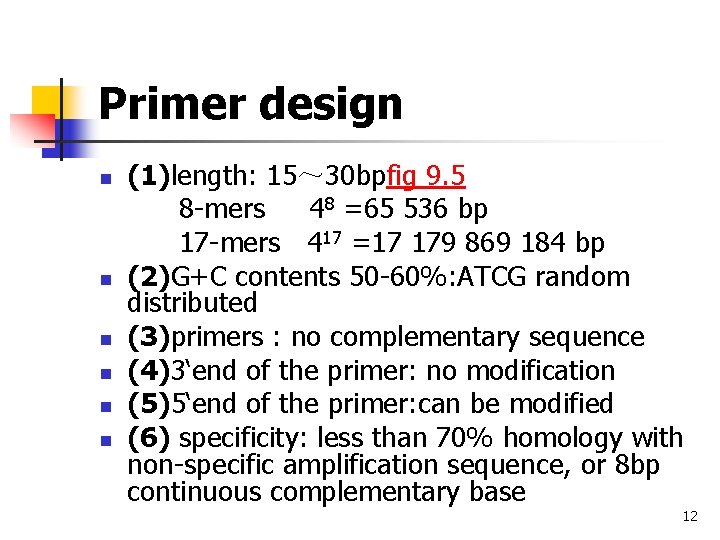
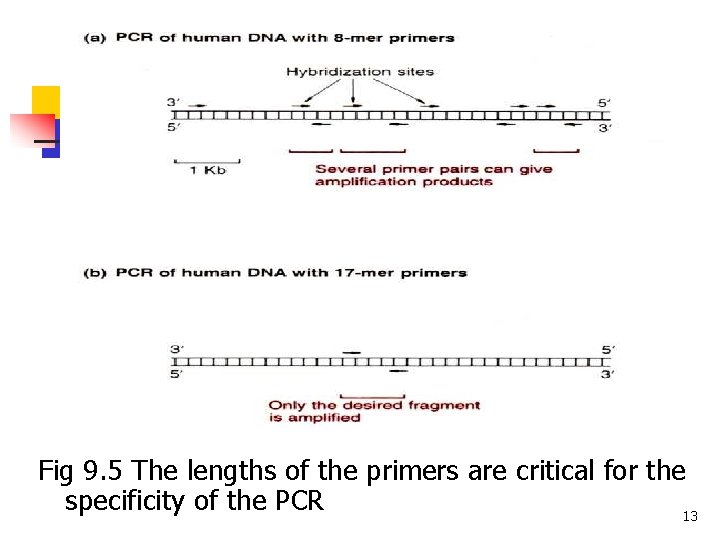
Primer design n n n (1)length: 15~ 30 bpfig 9. 5 8 -mers 48 =65 536 bp 17 -mers 417 =17 179 869 184 bp (2)G+C contents 50 -60%: ATCG random distributed (3)primers : no complementary sequence (4)3‘end of the primer: no modification (5)5‘end of the primer: can be modified (6) specificity: less than 70% homology with non-specific amplification sequence, or 8 bp continuous complementary base 12
Fig 9. 5 The lengths of the primers are critical for the specificity of the PCR 13
Template 模板 n n n PCR can some times amplify as little as one molecule of starting template. Template source: Any source of DNA that provides one or more target molecules can in principle be used as a template for PCR. DNA prepared from blood , sperm or any other tissue, from older forensic specimens, from ancient biological samples or in the laboratory from bacterial colonies or phage plaques as well as purified DNA. Partial sequence information is known so that primers can be designed. 15
Template size (模板大小) Amplification products are typically in the size range 100 -1500 bp. • Longer targets are amplifiable — >25 kb. • Requires modified reaction buffer, cocktails of polymerases, and longer extension times. • Limited by the integrity of the starting target DNA — > 50 kb. n 16
Enzyme-酶 n n Taq polymerase, high thermostable optimum working temperature: 75 -80 C Activities: 5— 3’ polymerase activity 5 ---3’ exonuclease activity 17
n Activators: d. NTP 0. 7 -0. 8 m. M, Mg 2+ KCl 50 m. M urea 1 M 2 m. M n Inhibitor: DMSO 10% n Concentration of Taq polymerase: 1 -2 U 18
Mg 2+ The fidelity of the PCR depends on [Mg 2+]. Low: low activity high: non-specific amplification n [Mg 2+] : 0. 5 mmol/L-2. 5 mmol/L n EDTA can bind to Mg 2+ , use low concentration TE (10 m. M Tris, 1 m. MEDTA); • Vary [Mg 2+] in steps of 0. 5 m. M. • Sometimes a compromise between yield and specificity. 19
Other factors n n d. NTPs: concentration : 20 -200 umol/L,-20℃。 d. NTPs should be the same concentration Buffer : 10 -50 mmol/L Tris-HCl (p. H 8. 3 -8. 8, 20℃)。 20
9. 2. 2 Working out the correct temperatures to use 1. Denaturation temperature, 94ºC, 1 min breaks the base pairs and releases singlestranded DNA to act as templates 21
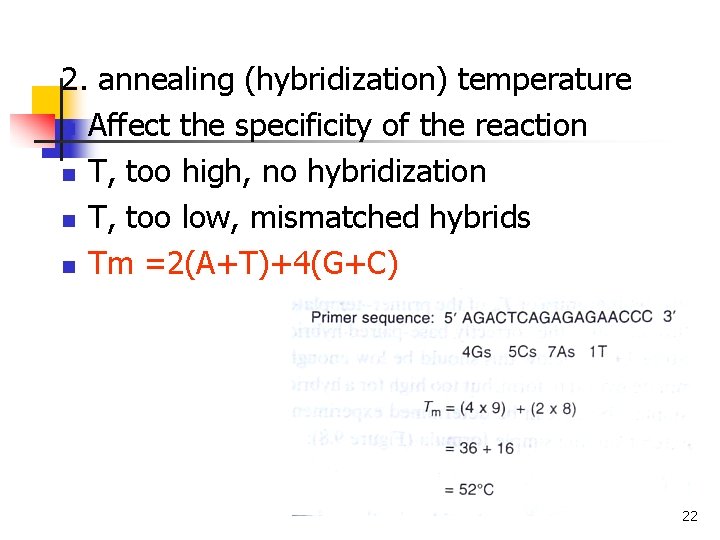
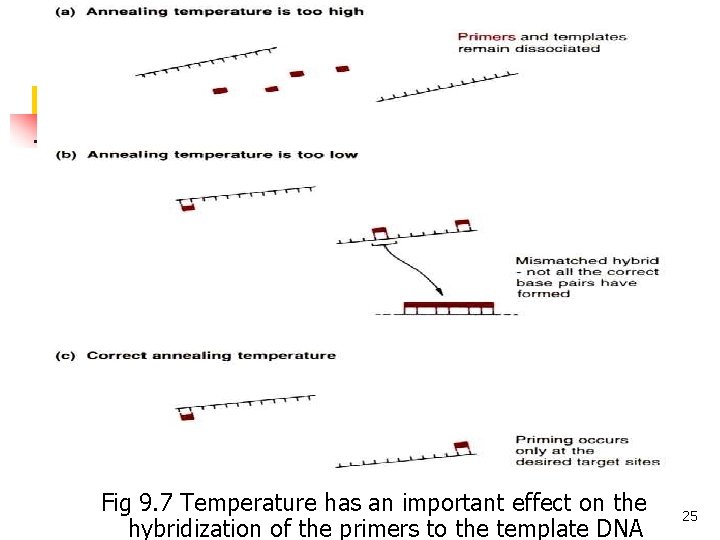
2. annealing (hybridization) temperature n Affect the specificity of the reaction n T, too high, no hybridization n T, too low, mismatched hybrids n Tm =2(A+T)+4(G+C) 22
n 3. extension temperature, 72 C 23
Fig 9. 6 A typical temperature profile for a PCR 24
Fig 9. 7 Temperature has an important effect on the hybridization of the primers to the template DNA 25
9. 2. 3 After the PCR: studying PCR products n n n (1) gel electrophoresis (2) Cloning of PCR products (3) Sequencing of PCR products 26
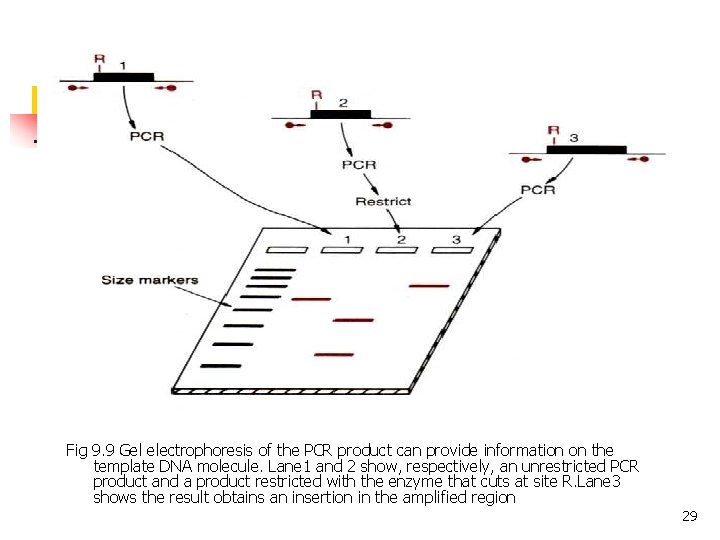
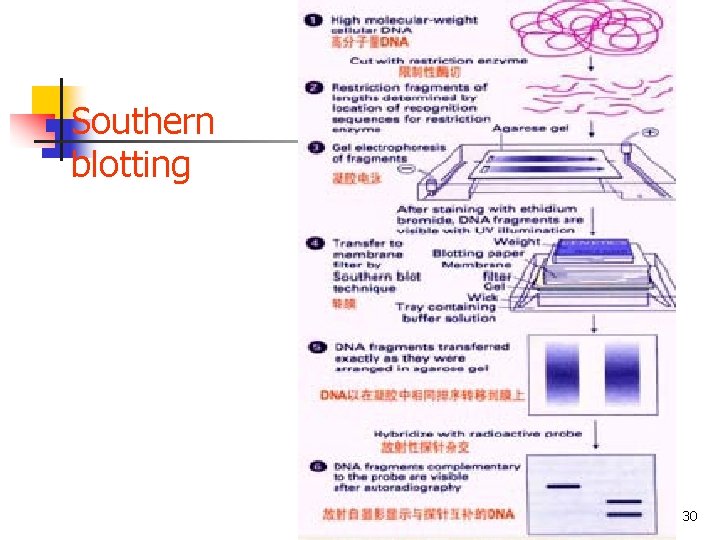
Gel electrophoresis of PCR products- PCR产物的凝胶电泳 1. directly determined the size of the amplified DNA fig 9. 9. EB staining n Low yield: Southern hybridization#30 2. restriction sites in the amplified DNA n Restriction fragment length polymorphism analysis (RFLP) fig 9. 9: a mutation that results in alteration of a restriction site and hence a change in the pattern of fragments obtained when a DNA molecule is cut with a restriction endonuclease 27
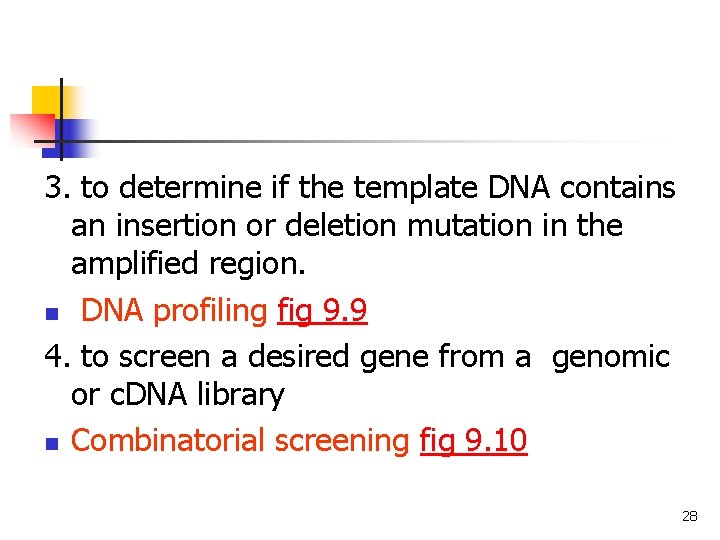
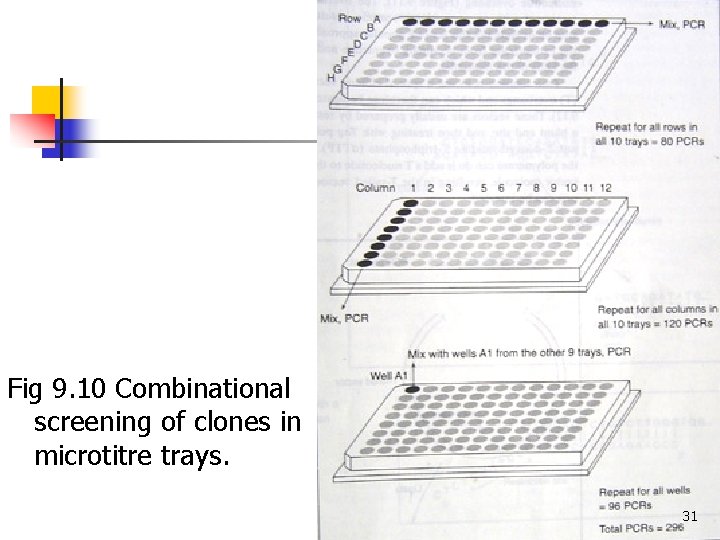
3. to determine if the template DNA contains an insertion or deletion mutation in the amplified region. n DNA profiling fig 9. 9 4. to screen a desired gene from a genomic or c. DNA library n Combinatorial screening fig 9. 10 28
Fig 9. 9 Gel electrophoresis of the PCR product can provide information on the template DNA molecule. Lane 1 and 2 show, respectively, an unrestricted PCR product and a product restricted with the enzyme that cuts at site R. Lane 3 shows the result obtains an insertion in the amplified region 29
n Southern blotting 30
Fig 9. 10 Combinational screening of clones in microtitre trays. 31
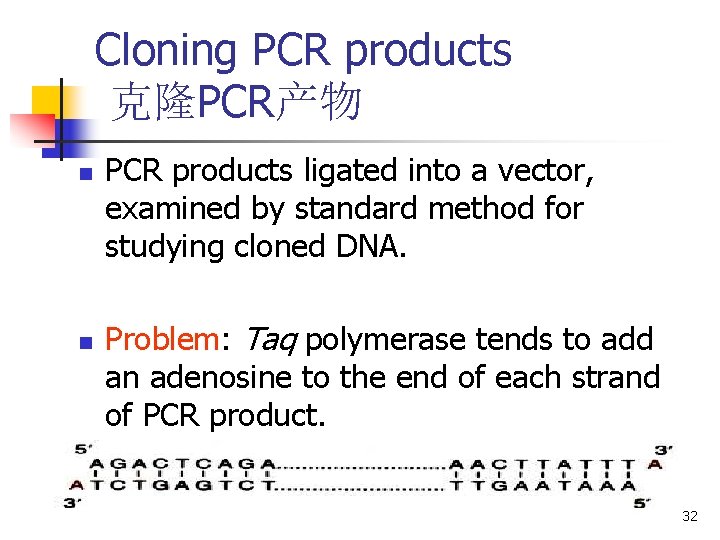
Cloning PCR products 克隆PCR产物 n n PCR products ligated into a vector, examined by standard method for studying cloned DNA. Problem: Taq polymerase tends to add an adenosine to the end of each strand of PCR product. 32
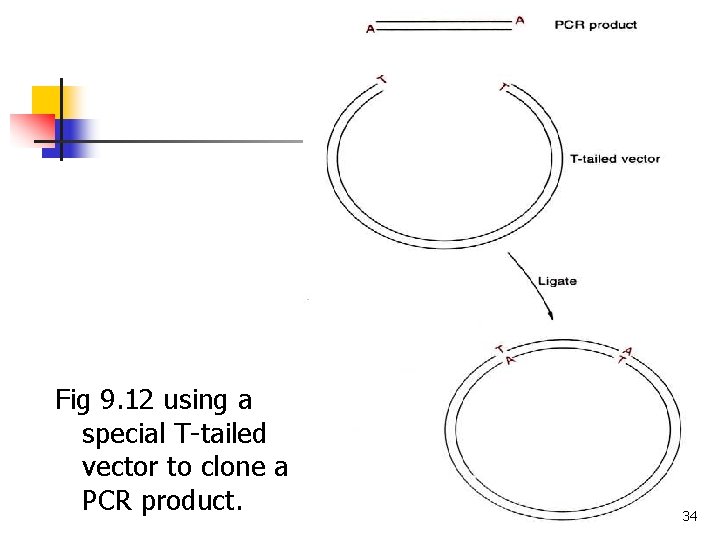
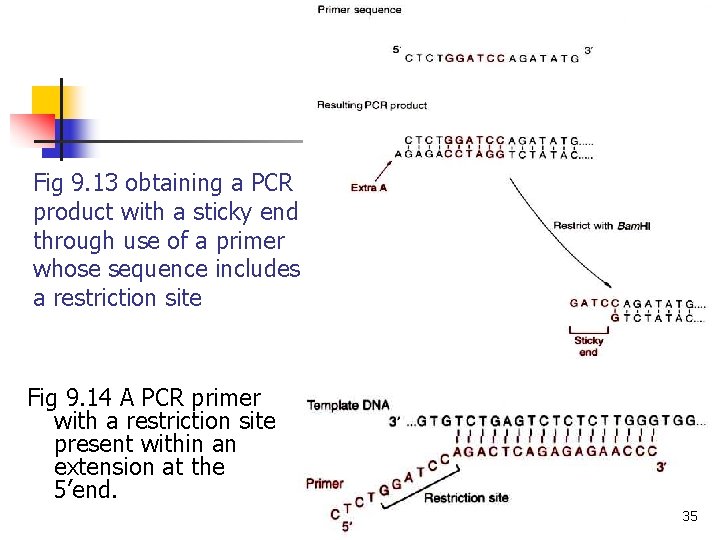
Solution: 1. using T-tailed vector fig 9. 12 2. design primers containing restriction sites Fig 9. 13 & Fig 9. 14 n 33
Fig 9. 12 using a special T-tailed vector to clone a PCR product. 34
Fig 9. 13 obtaining a PCR product with a sticky end through use of a primer whose sequence includes a restriction site Fig 9. 14 A PCR primer with a restriction site present within an extension at the 5’end. 35
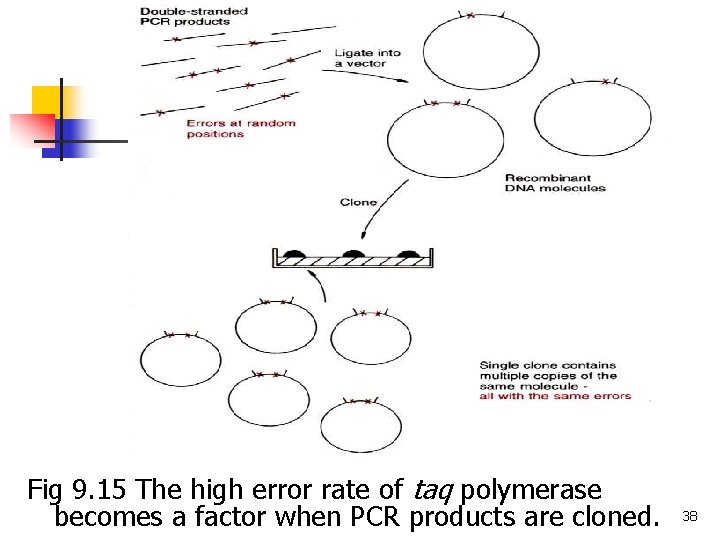
9. 3 Problems with the error rate of Taq polymerase n n n Taq polymerase : no 3’ 5’ proofreading exonuclease activity. Does not have proof reading ability. Error rate : 1 in 9000 bases After 30 cycles, 1 in 300 bp not good for cloning fig 9. 15. 36
n n High-accuracy DNA polymerase is available commercially. New polymerases have high fidelity: Pfu、Deep Vent、Pwo、KOD、 Pyrobest、Primer. Star 37
Fig 9. 15 The high error rate of taq polymerase becomes a factor when PCR products are cloned. 38
Hot-start protocol n n Add the DNA polymerase after the heatdenaturation step of the first cycle. To overcome the problem that would arise if the DNA polymerase were added to complete the assembly of the PCR reaction mixture at a relatively low temperature. 39
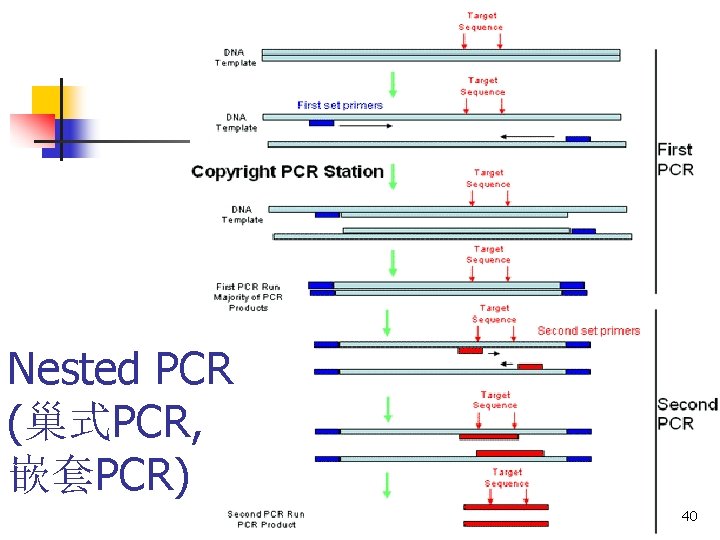
Nested PCR (巢式PCR, 嵌套PCR) 40
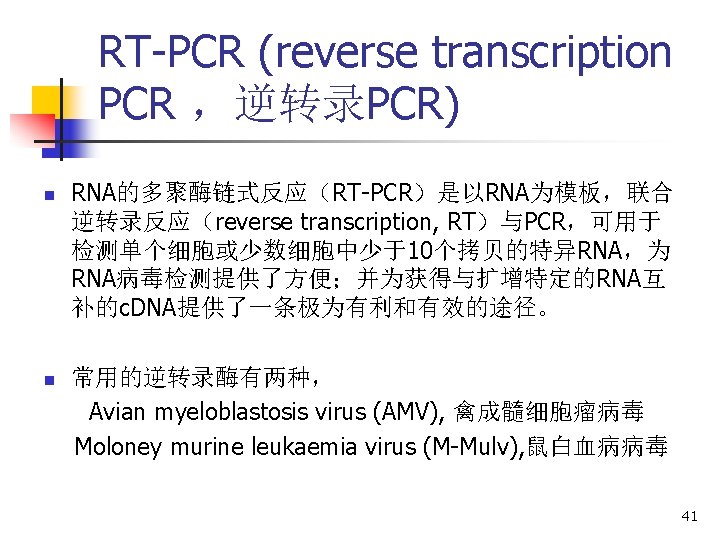
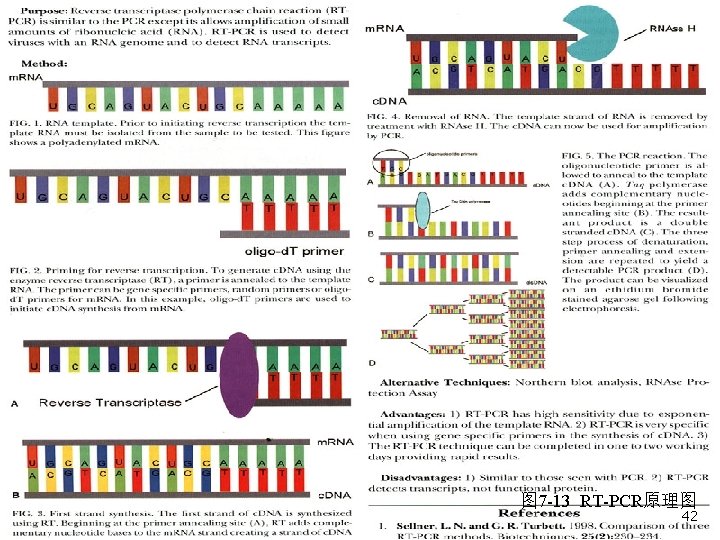
图 7 -13 RT-PCR原理图 42
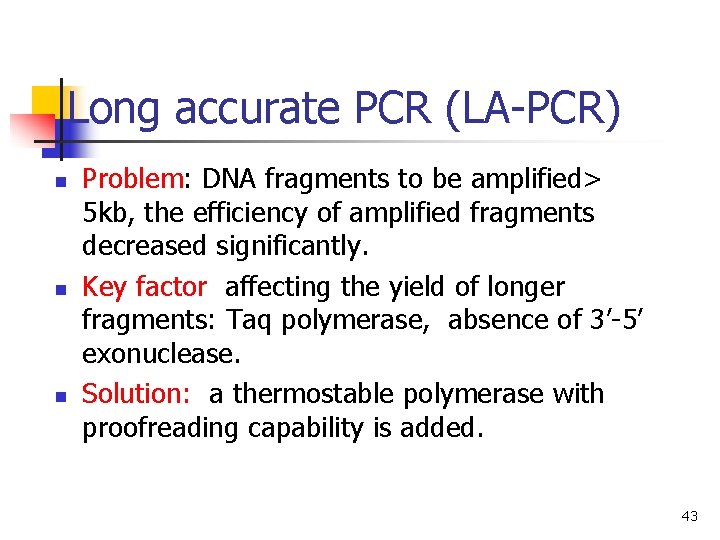
Long accurate PCR (LA-PCR) n n n Problem: DNA fragments to be amplified> 5 kb, the efficiency of amplified fragments decreased significantly. Key factor affecting the yield of longer fragments: Taq polymerase, absence of 3’-5’ exonuclease. Solution: a thermostable polymerase with proofreading capability is added. 43
Table 2. 1 Sources of thermostable DNA polymerase with proofreading (3’-5’ exonuclease) acitivity DNA polymerase Source Tma Thermotoga maritima Deep Vent TM Pyrococcus sp. Tli Thermococcus litoralis Pfu Pyrococcus furiosus Pwo Pyrococcus woesi 44
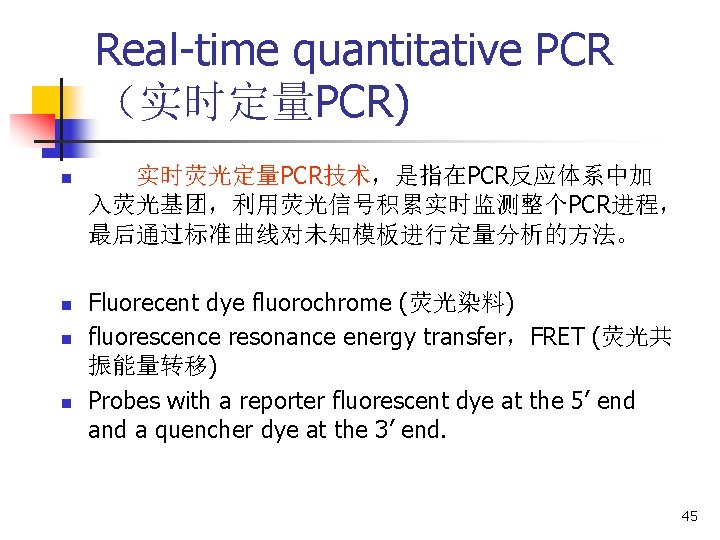
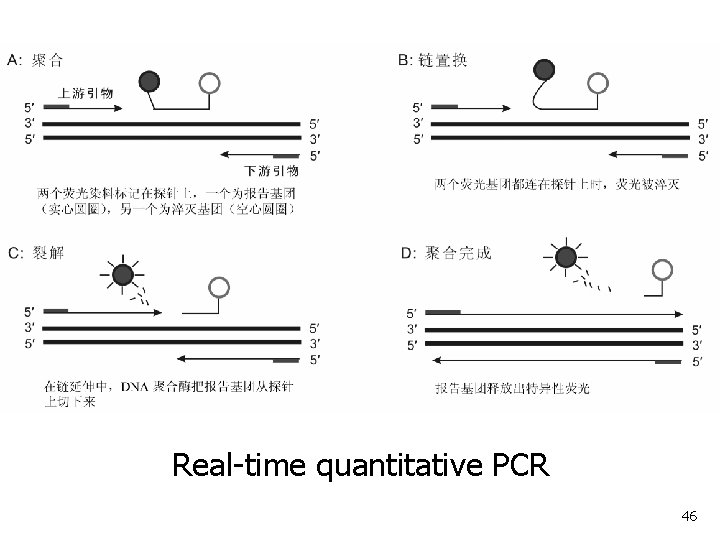
Real-time quantitative PCR (实时定量PCR) n n 实时荧光定量PCR技术,是指在PCR反应体系中加 入荧光基团,利用荧光信号积累实时监测整个PCR进程, 最后通过标准曲线对未知模板进行定量分析的方法。 Fluorecent dye fluorochrome (荧光染料) fluorescence resonance energy transfer,FRET (荧光共 振能量转移) Probes with a reporter fluorescent dye at the 5’ end a quencher dye at the 3’ end. 45
Real-time quantitative PCR 46
本章小结 n n n 9. 1 PCR简介 (The polymerase chain reaction in outline) 原理 9. 2 PCR的更多细节 (PCR in more detail) 9. 2. 1 设计PCR的寡核苷酸引物 (Designing the oligonucleotide primers for a PCR) 引物设计原则 9. 2. 2 设定正确的温度 (Working out the correct temperatures to use) 9. 2. 3 PCR 之后的 作-研究PCR产物 (After the PCR: studying PCR products) 9. 3 Taq 聚合酶的错误率问题 (Problems with the error rates of Taq polymerase) 47
n n 嵌套PCR/巢式PCR RT-PCR 超长精确PCR 实时定量PCR 48