
Chapter 9 The Judicial Branch The U S
Chapter 9: The Judicial Branch
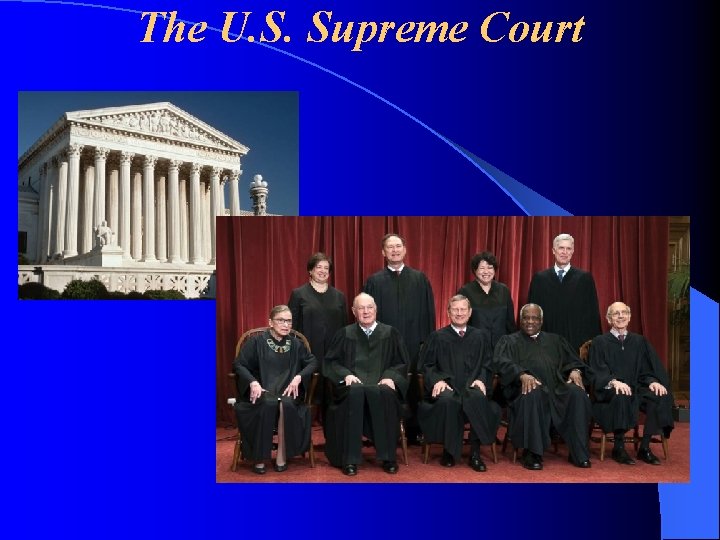
The U. S. Supreme Court
The Supreme Court Justices The main job of the United States Supreme Court is to decide the “constitutionality of laws” l The Supreme Court stands above all other courts in the United States – it is the highest court in the land! l Judges who serve on the Supreme Court are called justices l
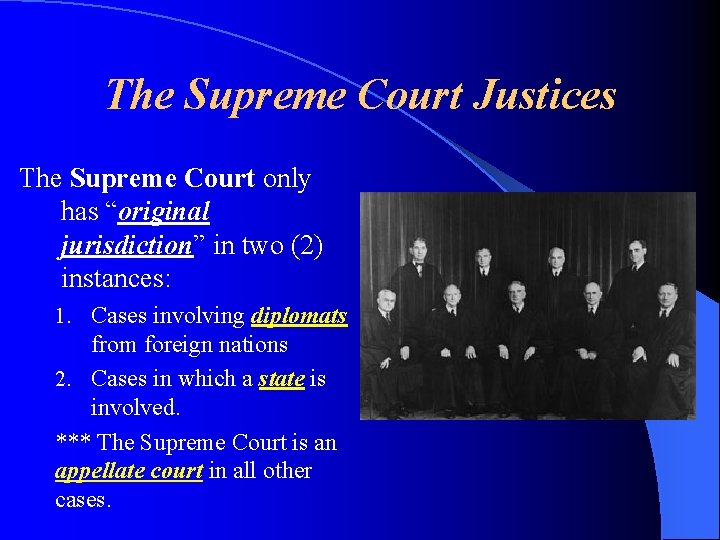
The Supreme Court Justices The Supreme Court only has “original jurisdiction” in two (2) instances: 1. Cases involving diplomats from foreign nations 2. Cases in which a state is involved. *** The Supreme Court is an appellate court in all other cases.
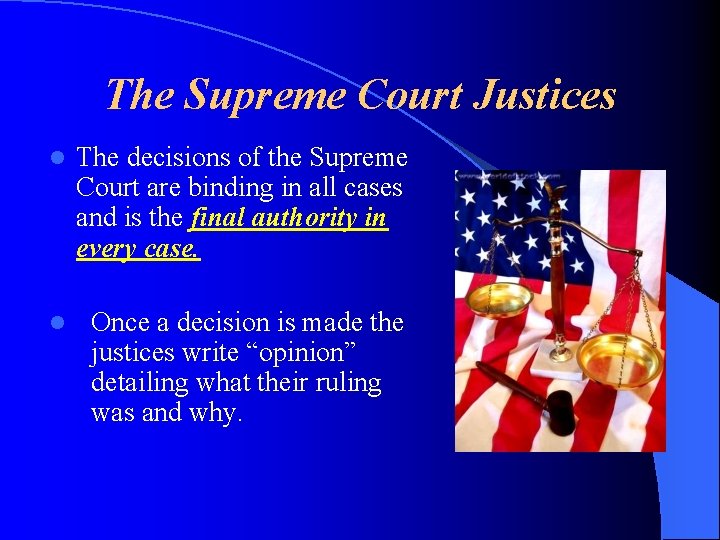
The Supreme Court Justices l The decisions of the Supreme Court are binding in all cases and is the final authority in every case. l Once a decision is made the justices write “opinion” detailing what their ruling was and why.

The Supreme Court Justices The Supreme Court is made up of nine justices (1 Chief Justice and 8 Associate Justices) l Our current Chief Justice is John Roberts l The main duty of The Court is to hear and rule on cases l – (thousands are appealed to them each year, but they decide which few ones to hear)
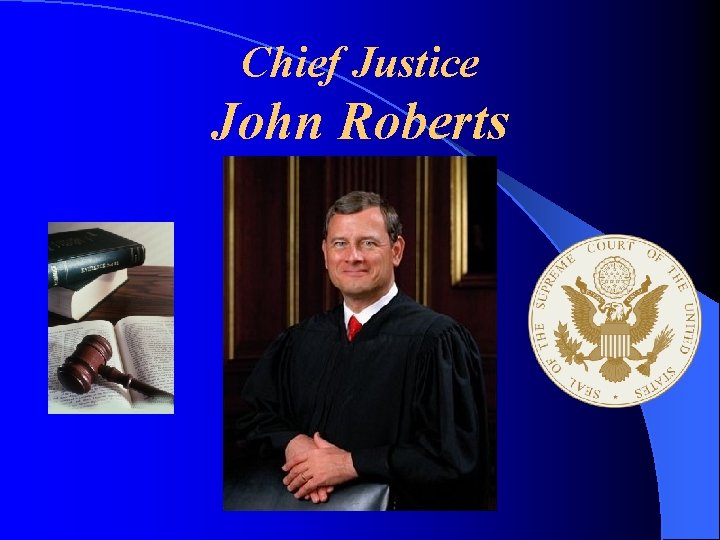
Chief Justice John Roberts
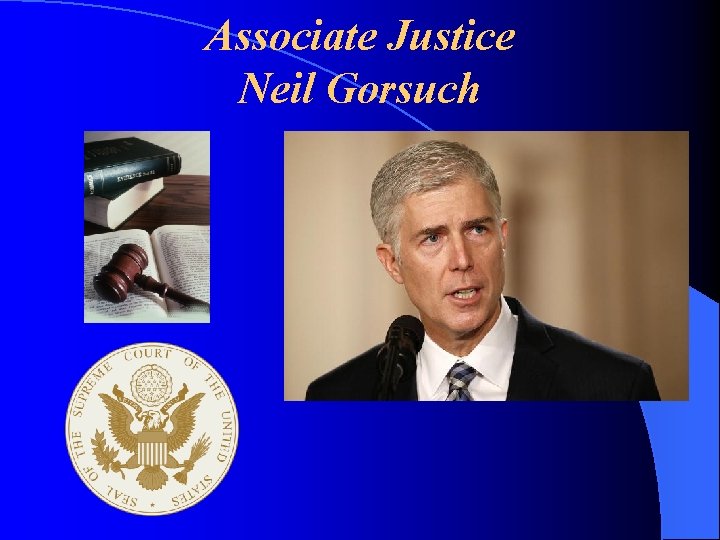
Associate Justice Neil Gorsuch ?
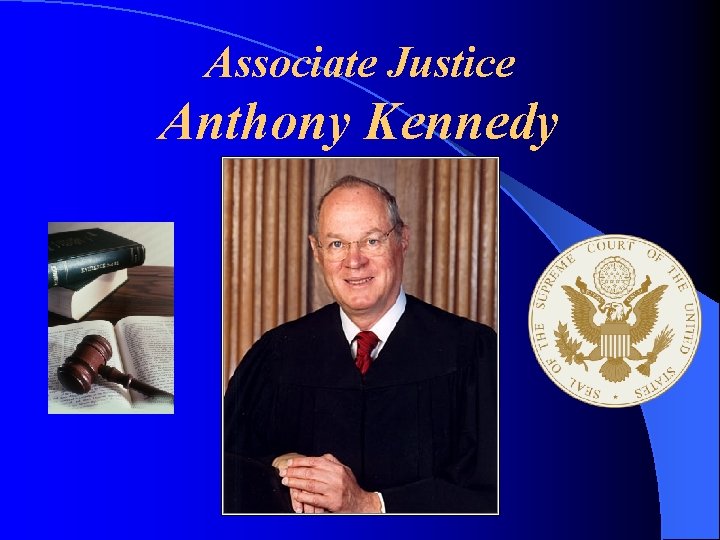
Associate Justice Anthony Kennedy
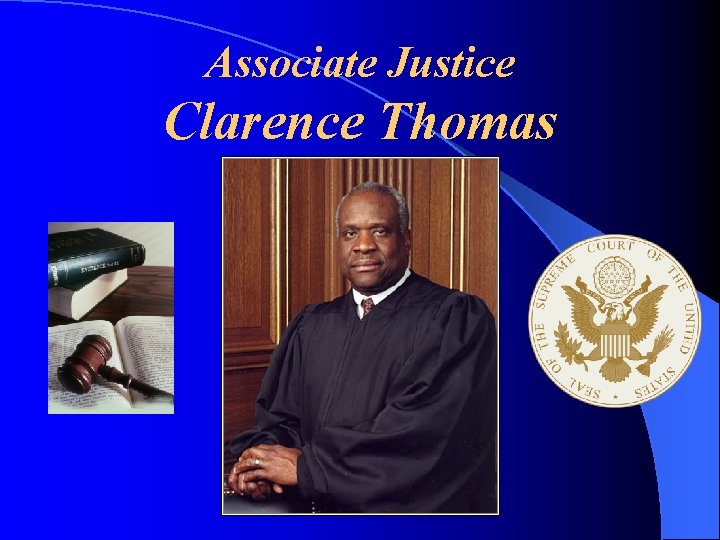
Associate Justice Clarence Thomas
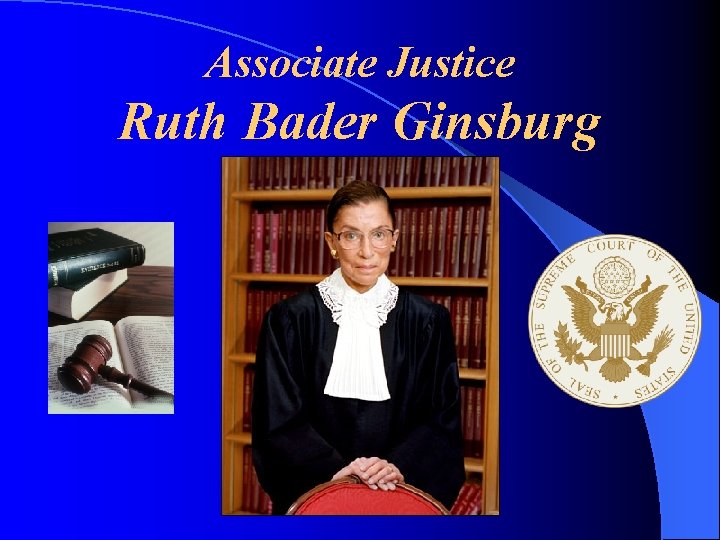
Associate Justice Ruth Bader Ginsburg
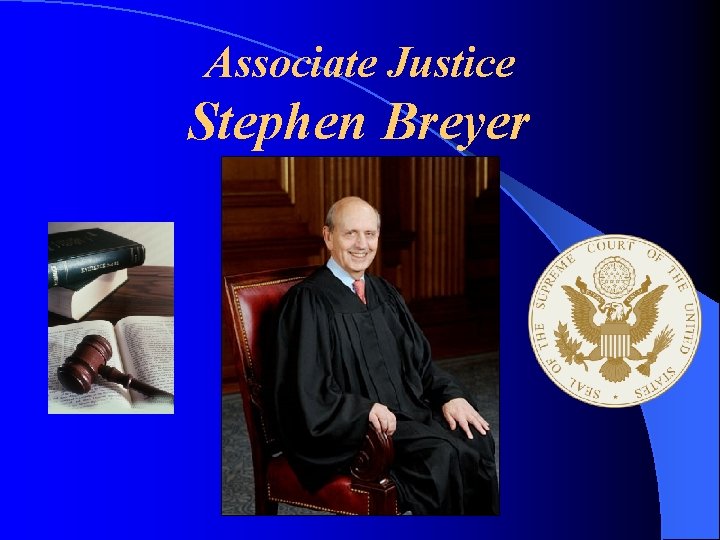
Associate Justice Stephen Breyer

Associate Justice Samuel Alito

Associate Justice Sonia Sotomayer
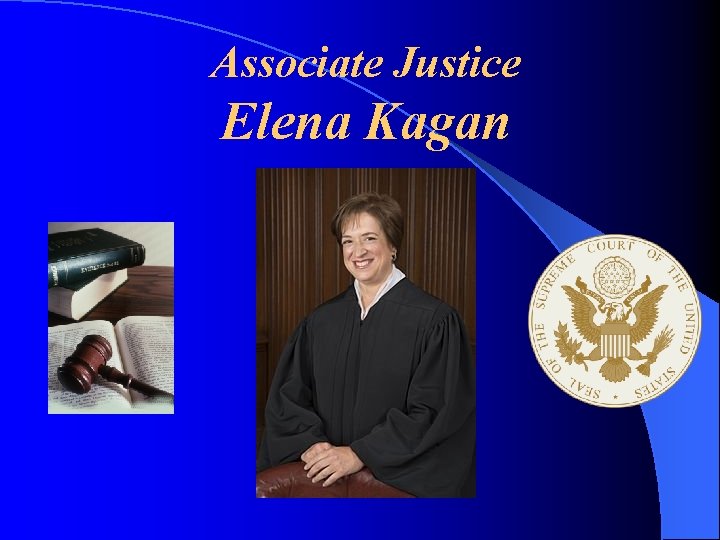
Associate Justice Elena Kagan
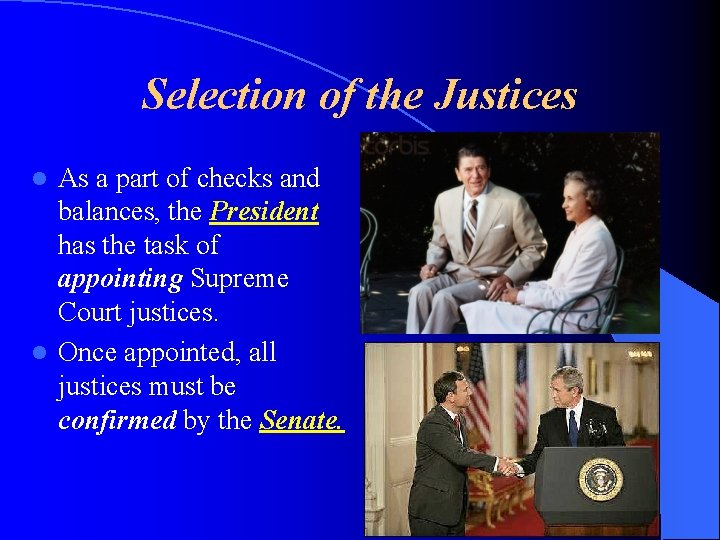
Selection of the Justices As a part of checks and balances, the President has the task of appointing Supreme Court justices. l Once appointed, all justices must be confirmed by the Senate. l
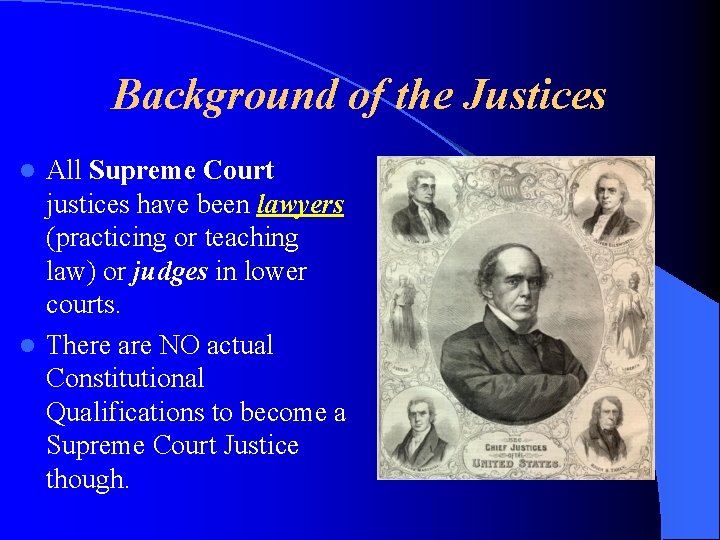
Background of the Justices All Supreme Court justices have been lawyers (practicing or teaching law) or judges in lower courts. l There are NO actual Constitutional Qualifications to become a Supreme Court Justice though. l
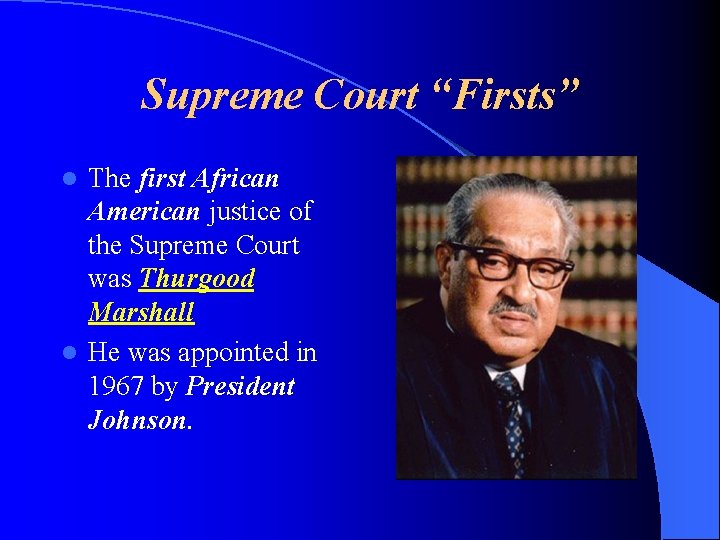
Supreme Court “Firsts” The first African American justice of the Supreme Court was Thurgood Marshall l He was appointed in 1967 by President Johnson. l
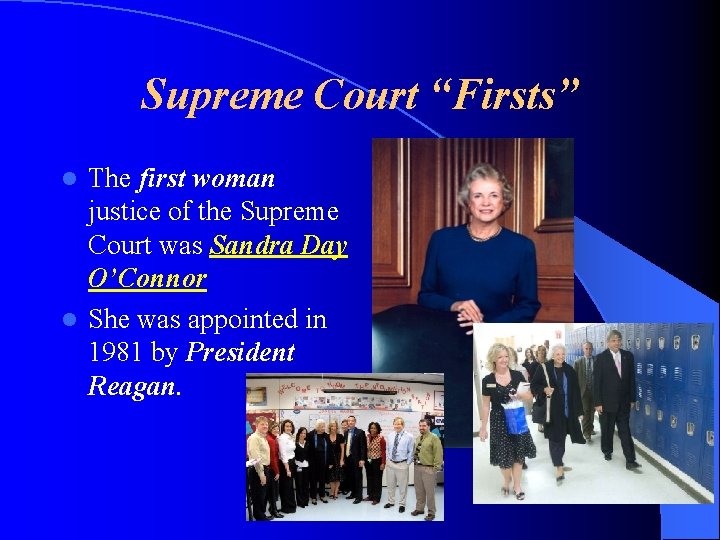
Supreme Court “Firsts” The first woman justice of the Supreme Court was Sandra Day O’Connor l She was appointed in 1981 by President Reagan. l
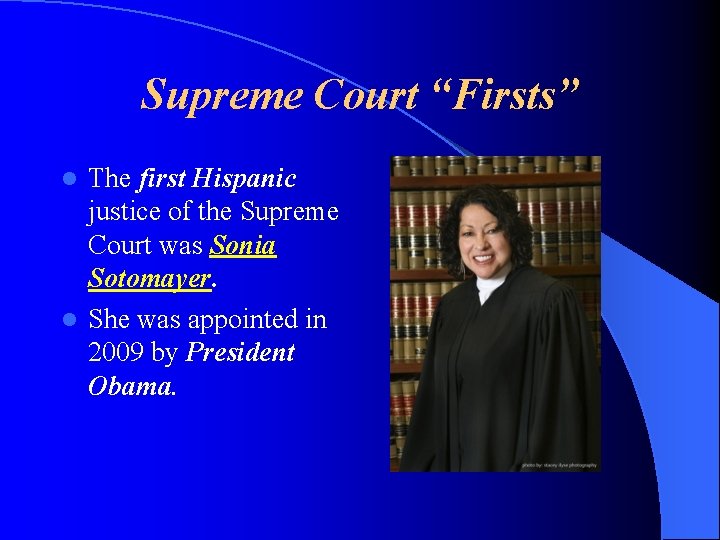
Supreme Court “Firsts” The first Hispanic justice of the Supreme Court was Sonia Sotomayer. l She was appointed in 2009 by President Obama. l
Powers of the Supreme Court l The Supreme Court has the power of “judicial review” (the power to decide if any local, state, or federal law goes against the Constitution) – This allows them the power to “nullify” (or cancel) that law…
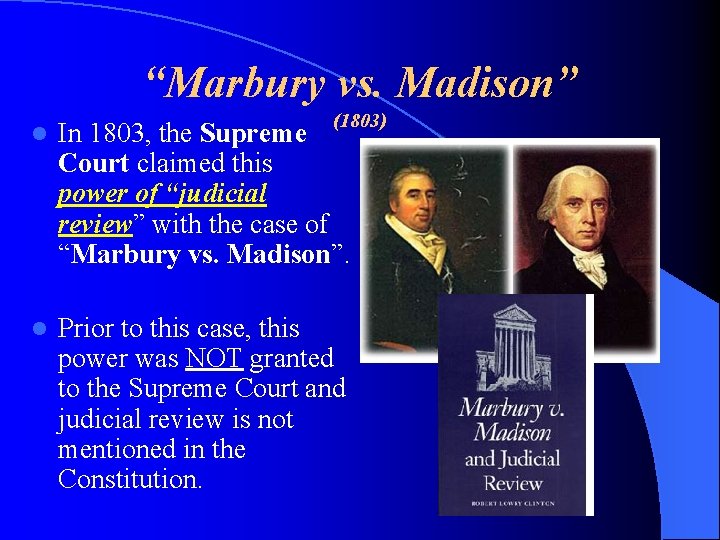
“Marbury vs. Madison” (1803) l In 1803, the Supreme Court claimed this power of “judicial review” with the case of “Marbury vs. Madison”. l Prior to this case, this power was NOT granted to the Supreme Court and judicial review is not mentioned in the Constitution.
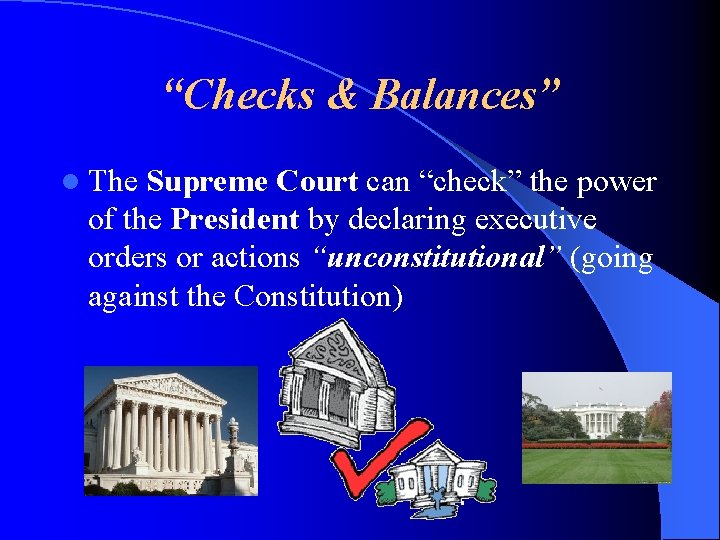
“Checks & Balances” l The Supreme Court can “check” the power of the President by declaring executive orders or actions “unconstitutional” (going against the Constitution)
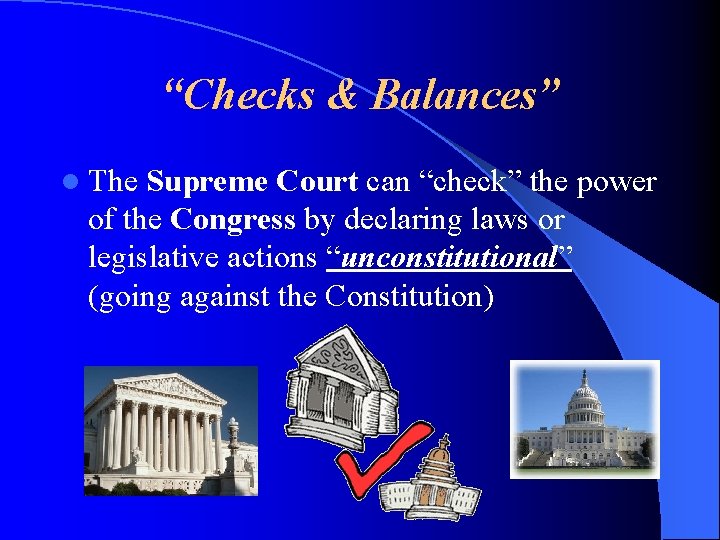
“Checks & Balances” l The Supreme Court can “check” the power of the Congress by declaring laws or legislative actions “unconstitutional” (going against the Constitution)
Judicial Interpretation The Supreme Court has the final interpretation of the Constitution (what THEY say goes…) l They also interpret laws created by Congress (who often write very “vague” laws…) l
Limits to the Supreme Court l The Supreme Court must rely on the President and to enforce their rulings… or Congress to make laws that abide by their rulings l The court has no power to force the other branches to obey their ruling… l As a part of our system of limited government, no one branch can force the other into doing one thing or another. (because no branch is more powerful than another and no one is above the law…)
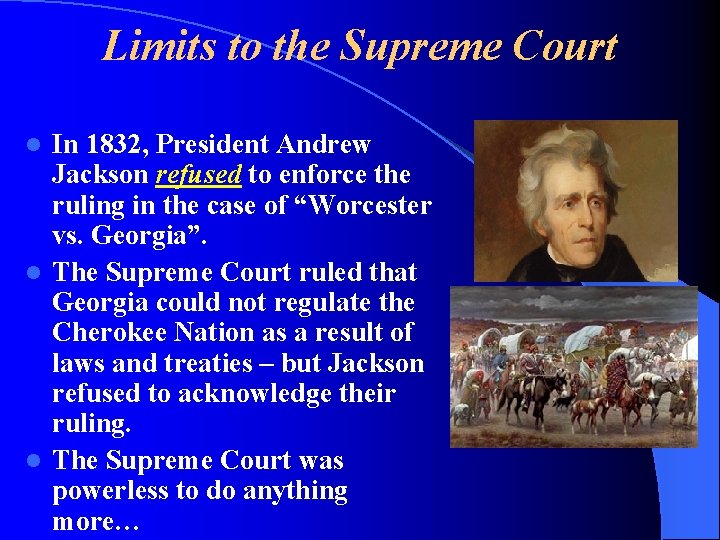
Limits to the Supreme Court In 1832, President Andrew Jackson refused to enforce the ruling in the case of “Worcester vs. Georgia”. l The Supreme Court ruled that Georgia could not regulate the Cherokee Nation as a result of laws and treaties – but Jackson refused to acknowledge their ruling. l The Supreme Court was powerless to do anything more… l
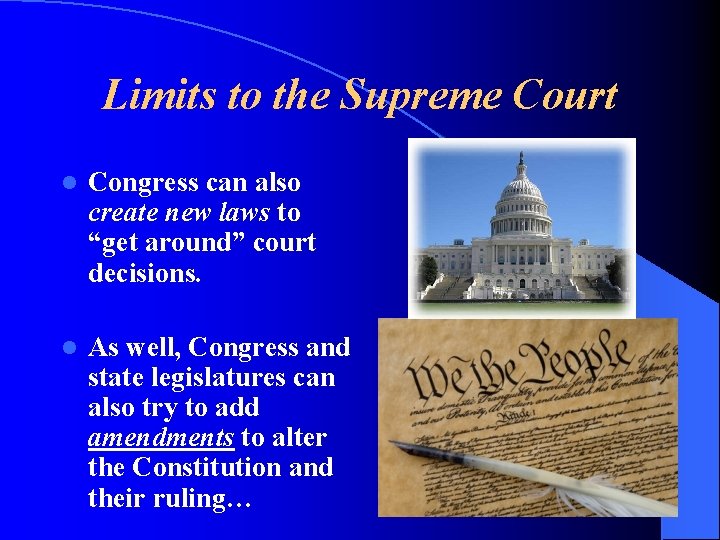
Limits to the Supreme Court l Congress can also create new laws to “get around” court decisions. l As well, Congress and state legislatures can also try to add amendments to alter the Constitution and their ruling…
Limits to the Supreme Court l Congress also has the power to “impeach” and remove justices from the Supreme Court (if warranted)
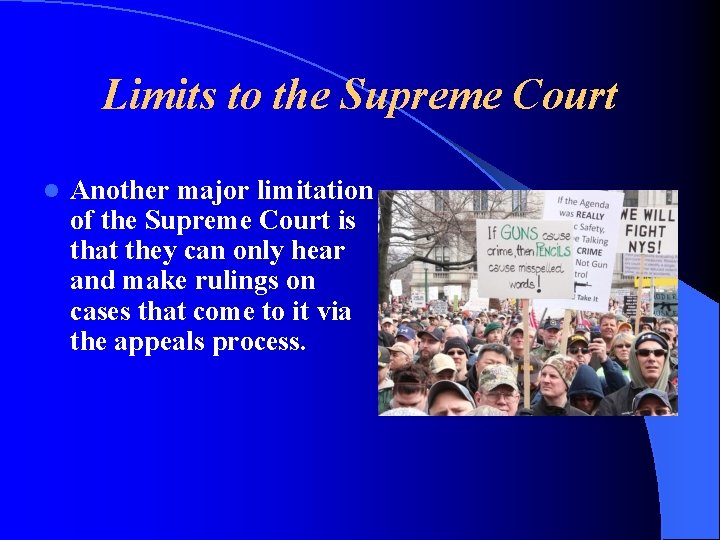
Limits to the Supreme Court l Another major limitation of the Supreme Court is that they can only hear and make rulings on cases that come to it via the appeals process.
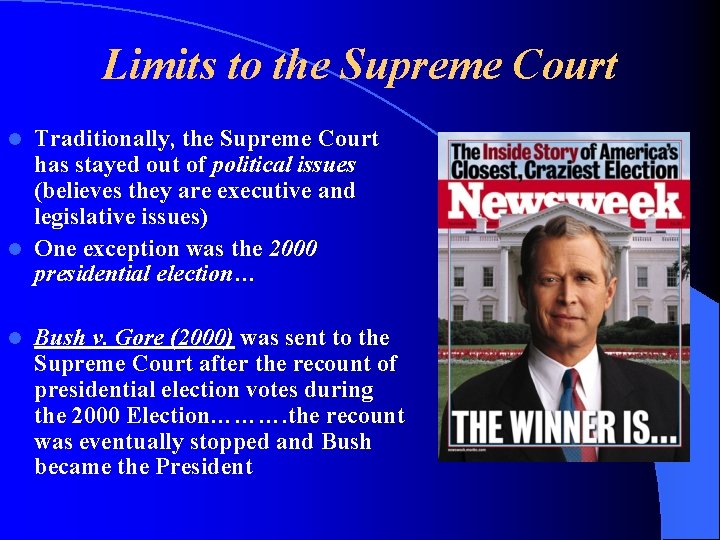
Limits to the Supreme Court Traditionally, the Supreme Court has stayed out of political issues (believes they are executive and legislative issues) l One exception was the 2000 presidential election… l l Bush v. Gore (2000) was sent to the Supreme Court after the recount of presidential election votes during the 2000 Election………. the recount was eventually stopped and Bush became the President
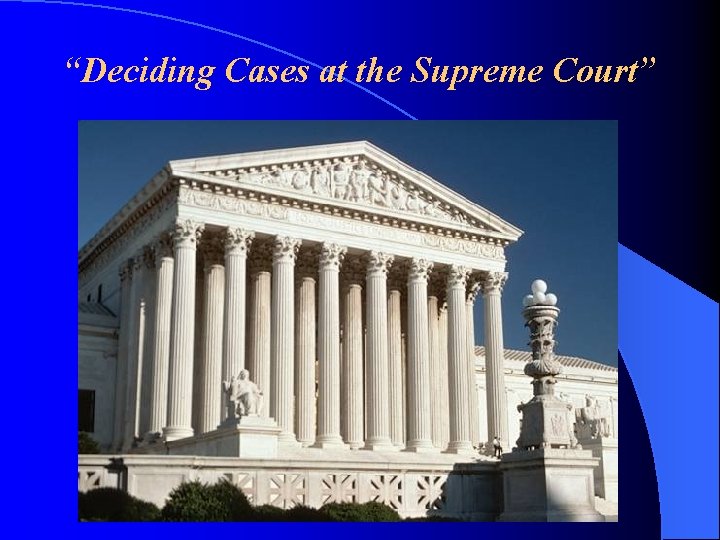
“Deciding Cases at the Supreme Court”
Supreme Court in Action The Supreme Court is in session from October to June or July. l During this time, they listen to oral arguments on cases. l Every two weeks, they take “recess” (to write opinions and study new cases) l
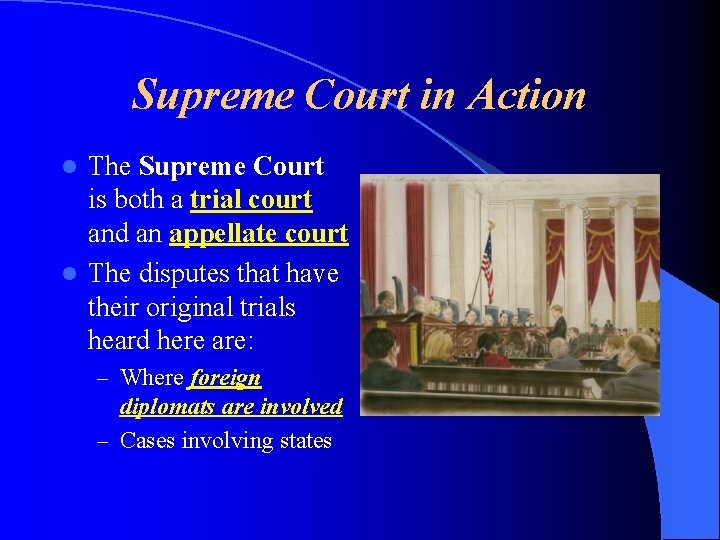
Supreme Court in Action The Supreme Court is both a trial court and an appellate court l The disputes that have their original trials heard here are: l – Where foreign diplomats are involved – Cases involving states
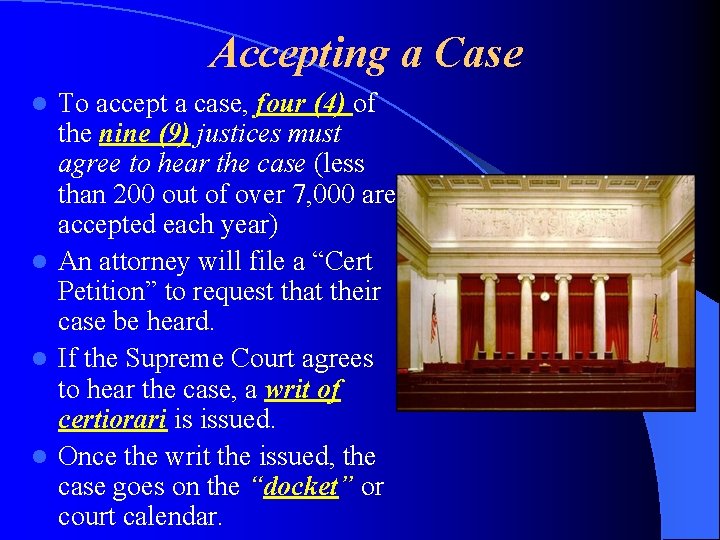
Accepting a Case To accept a case, four (4) of the nine (9) justices must agree to hear the case (less than 200 out of over 7, 000 are accepted each year) l An attorney will file a “Cert Petition” to request that their case be heard. l If the Supreme Court agrees to hear the case, a writ of certiorari is issued. l Once the writ the issued, the case goes on the “docket” or court calendar. l
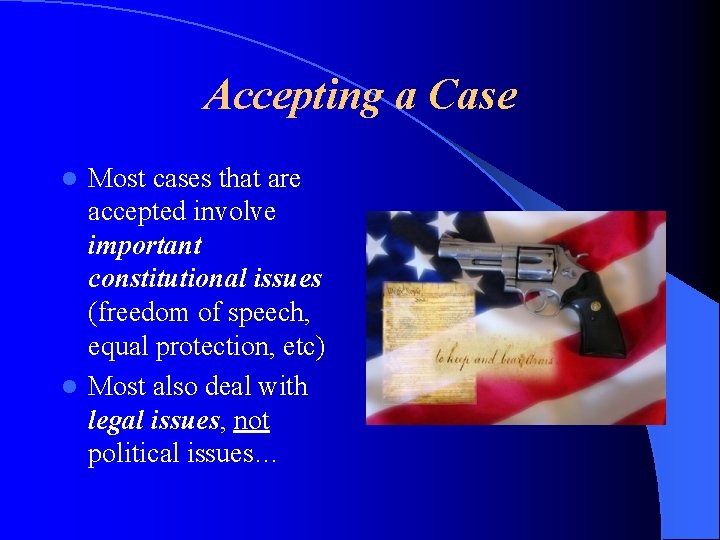
Accepting a Case Most cases that are accepted involve important constitutional issues (freedom of speech, equal protection, etc) l Most also deal with legal issues, not political issues… l
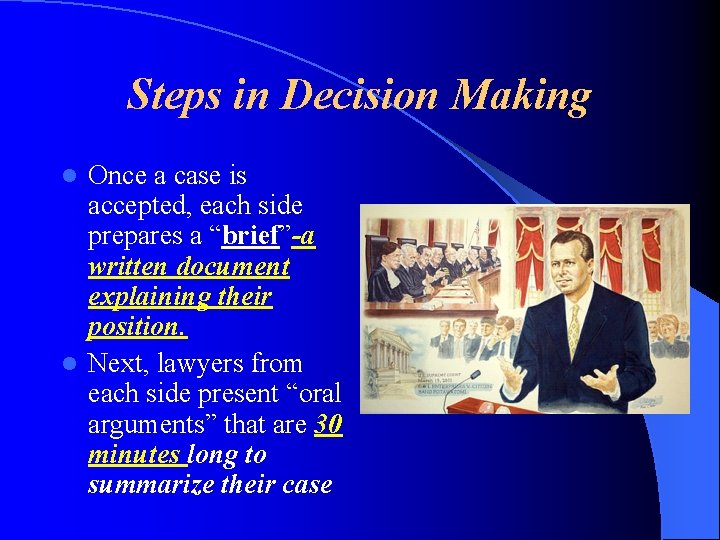
Steps in Decision Making Once a case is accepted, each side prepares a “brief”-a written document explaining their position. l Next, lawyers from each side present “oral arguments” that are 30 minutes long to summarize their case l
Steps in Decision Making On Fridays, the justices get together to make their first decisions about the case (must have a “quorum” – 6 out of 9 are required to hear a case. ) l They meet in secret (with no audience or records kept) l All cases are decided by a majority vote. l
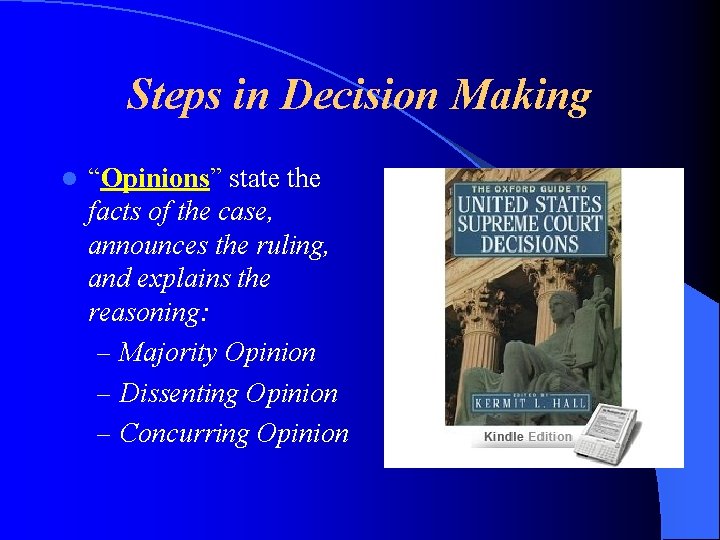
Steps in Decision Making l “Opinions” state the facts of the case, announces the ruling, and explains the reasoning: – Majority Opinion – Dissenting Opinion – Concurring Opinion
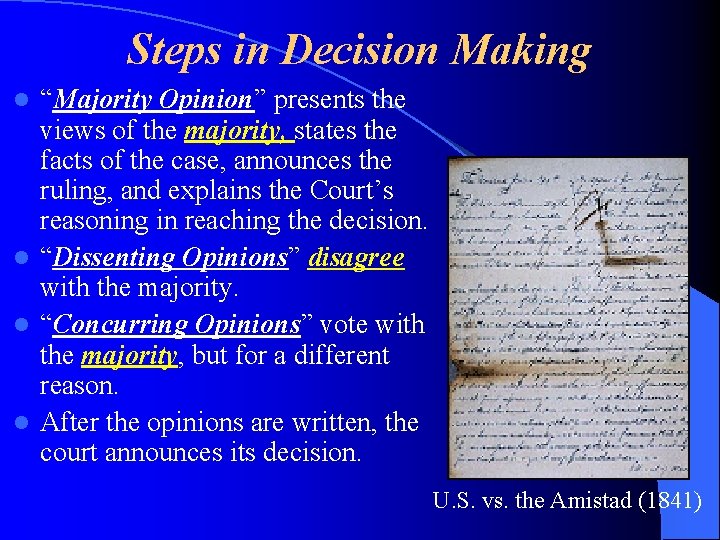
Steps in Decision Making “Majority Opinion” presents the views of the majority, states the facts of the case, announces the ruling, and explains the Court’s reasoning in reaching the decision. l “Dissenting Opinions” disagree with the majority. l “Concurring Opinions” vote with the majority, but for a different reason. l After the opinions are written, the court announces its decision. l U. S. vs. the Amistad (1841)
Supreme Court Reasoning The law is supposed to be the most important influence on a justice’s decision. l “Stare decisis” which means let the decision stand, is the guiding principle for all judges… l
Supreme Court Reasoning l Justices must understand that they: – The law must adapt to fit the times – Consider precedent when making a decision – Sometimes need to clarify the “meaning” of the Constitution – In Bush v Gore, some of the justices argued that it did not have the jurisdiction(power) to hear cases based on state elections since the states have power over their own state’s elections (reserved powers/federalism)
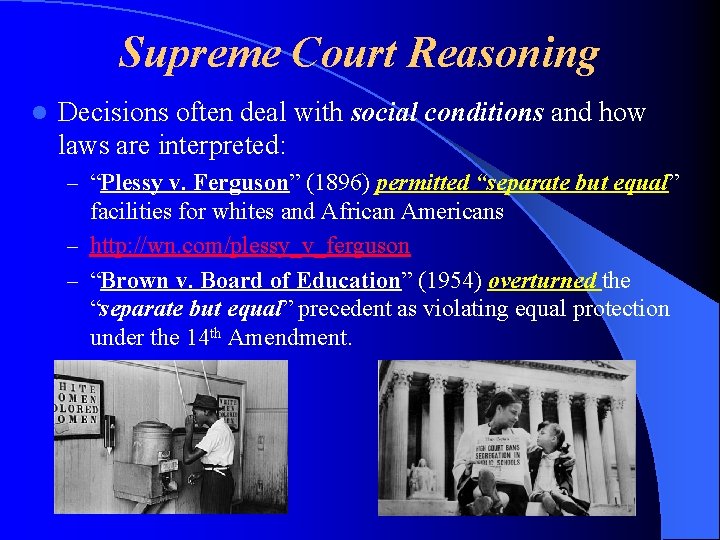
Supreme Court Reasoning l Decisions often deal with social conditions and how laws are interpreted: – “Plessy v. Ferguson” (1896) permitted “separate but equal” facilities for whites and African Americans – http: //wn. com/plessy_v_ferguson – “Brown v. Board of Education” (1954) overturned the “separate but equal” precedent as violating equal protection under the 14 th Amendment.
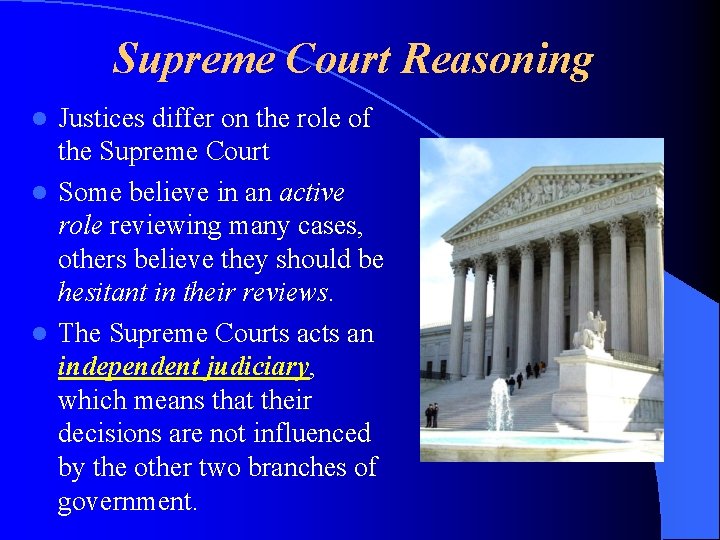
Supreme Court Reasoning Justices differ on the role of the Supreme Court l Some believe in an active role reviewing many cases, others believe they should be hesitant in their reviews. l The Supreme Courts acts an independent judiciary, which means that their decisions are not influenced by the other two branches of government. l
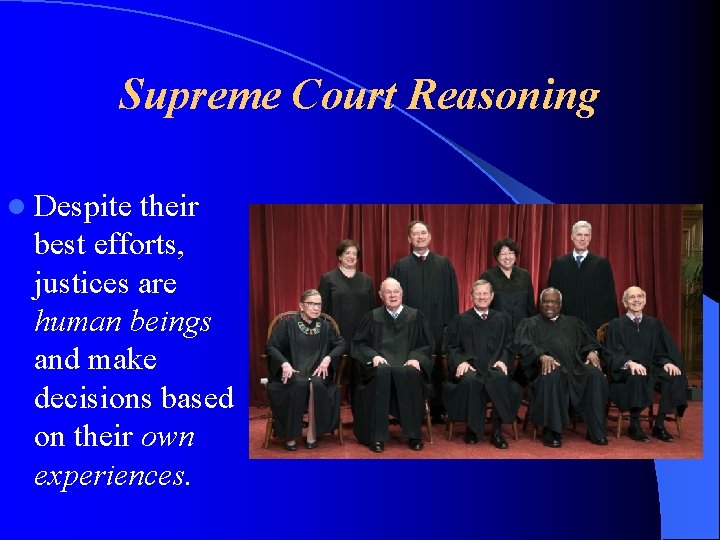
Supreme Court Reasoning l Despite their best efforts, justices are human beings and make decisions based on their own experiences.
- Slides: 45