
Chapter 9 The Central Nervous System The Brain
Chapter 9 The Central Nervous System: The Brain and Spinal Cord J. F. Thompson, Ph. D. & J. R. Schiller, Ph. D. & G. Pitts, Ph. D. .
The Brain n General n 100 billion neurons n about 1. 6 kg in males/1. 45 kg in females n proportional to body size n divided into hemispheres and lobes n its size is not representative of intelligence n complexity dictates processing power
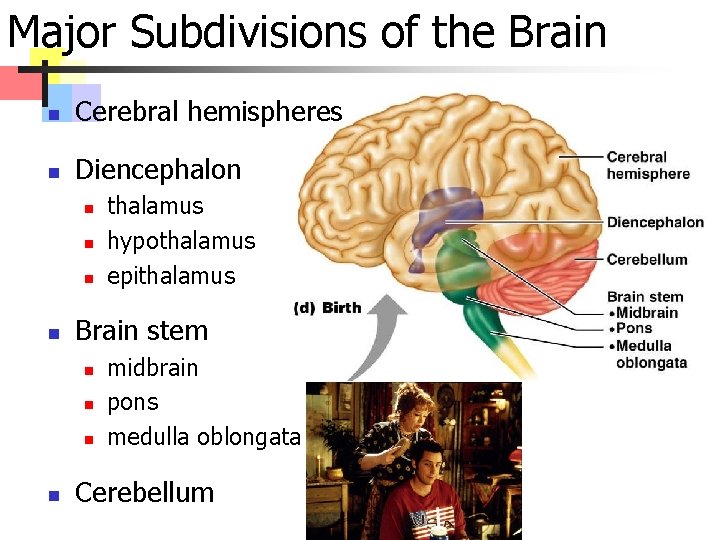
Major Subdivisions of the Brain n Cerebral hemispheres n Diencephalon n n Brain stem n n thalamus hypothalamus epithalamus midbrain pons medulla oblongata Cerebellum
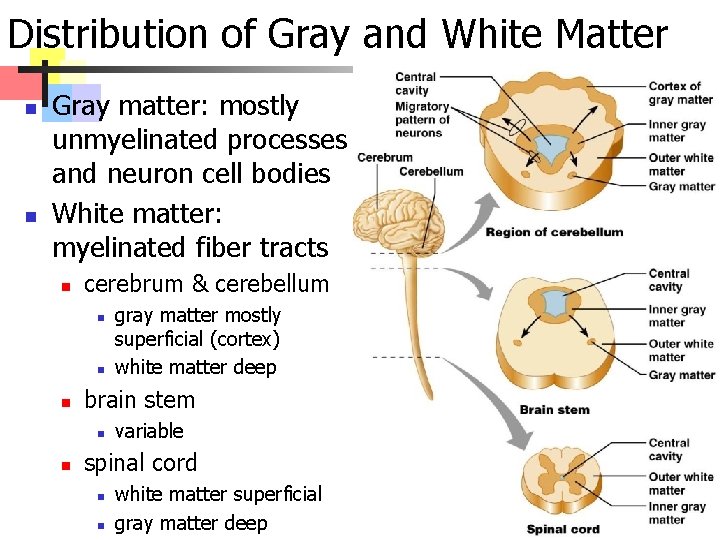
Distribution of Gray and White Matter n n Gray matter: mostly unmyelinated processes and neuron cell bodies White matter: myelinated fiber tracts n cerebrum & cerebellum n n n brain stem n n gray matter mostly superficial (cortex) white matter deep variable spinal cord n n white matter superficial gray matter deep
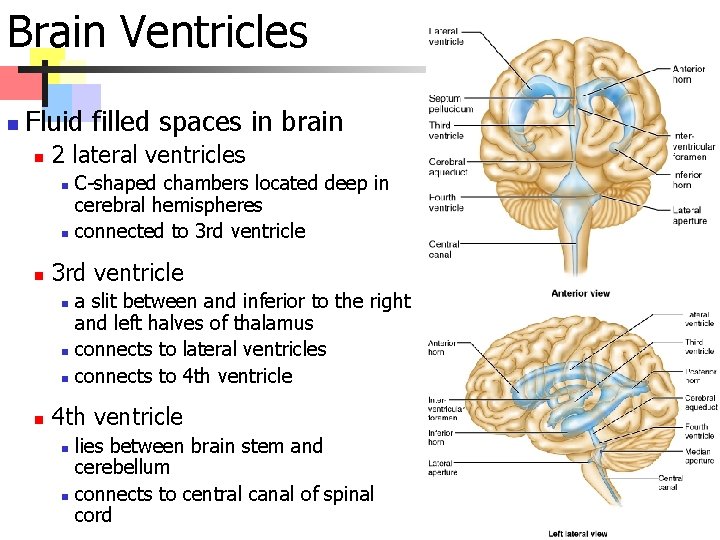
Brain Ventricles n Fluid filled spaces in brain n 2 lateral ventricles n n n 3 rd ventricle n n C-shaped chambers located deep in cerebral hemispheres connected to 3 rd ventricle a slit between and inferior to the right and left halves of thalamus connects to lateral ventricles connects to 4 th ventricle n n lies between brain stem and cerebellum connects to central canal of spinal cord
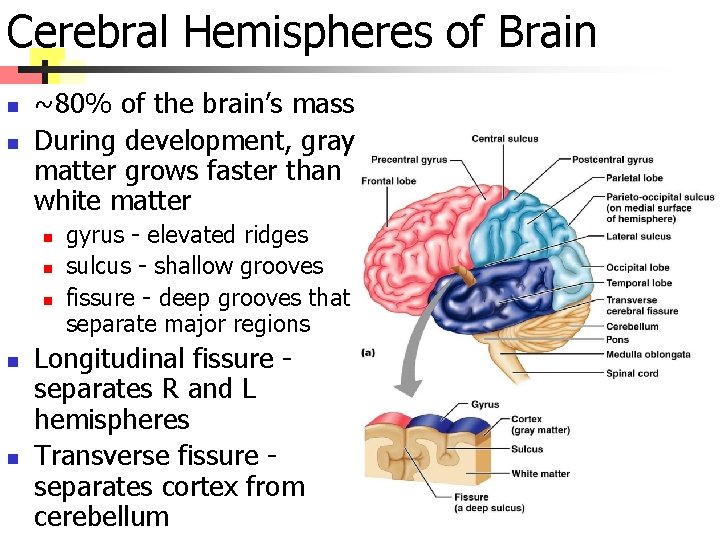
Cerebral Hemispheres of Brain n n ~80% of the brain’s mass During development, gray matter grows faster than white matter n n n gyrus - elevated ridges sulcus - shallow grooves fissure - deep grooves that separate major regions Longitudinal fissure separates R and L hemispheres Transverse fissure separates cortex from cerebellum
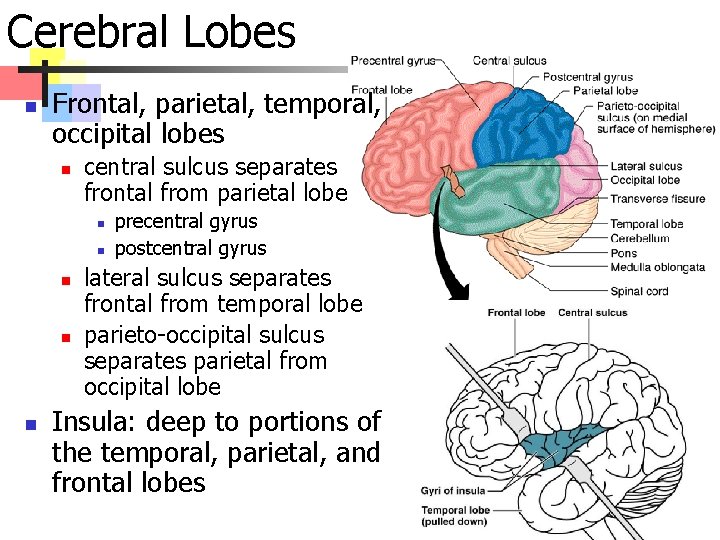
Cerebral Lobes n Frontal, parietal, temporal, occipital lobes n central sulcus separates frontal from parietal lobe n n n precentral gyrus postcentral gyrus lateral sulcus separates frontal from temporal lobe parieto-occipital sulcus separates parietal from occipital lobe Insula: deep to portions of the temporal, parietal, and frontal lobes
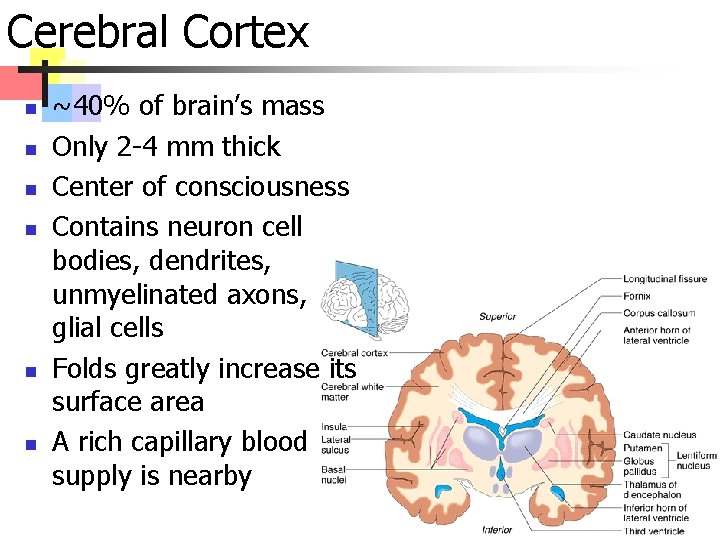
Cerebral Cortex n n n ~40% of brain’s mass Only 2 -4 mm thick Center of consciousness Contains neuron cell bodies, dendrites, unmyelinated axons, glial cells Folds greatly increase its surface area A rich capillary blood supply is nearby
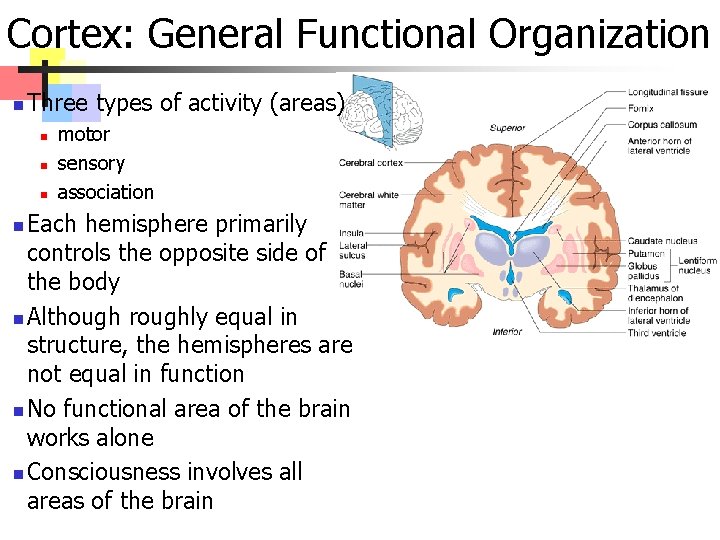
Cortex: General Functional Organization n Three types of activity (areas) n n n motor sensory association Each hemisphere primarily controls the opposite side of the body n Although roughly equal in structure, the hemispheres are not equal in function n No functional area of the brain works alone n Consciousness involves all areas of the brain n
![Motor Areas of the Cerebral Cortex n Primary motor cortex (4*) [* Brodmann areas]](http://slidetodoc.com/presentation_image_h2/71f25932372689ad088fc6ba21a65f45/image-10.jpg "Motor Areas of the Cerebral Cortex n Primary motor cortex (4*) [* Brodmann areas]")
Motor Areas of the Cerebral Cortex n Primary motor cortex (4*) [* Brodmann areas] precentral gyrus of frontal lobe n primarily involved in voluntary motor control with more area devoted to skilled muscles (e. g. , controls fingers, face) n
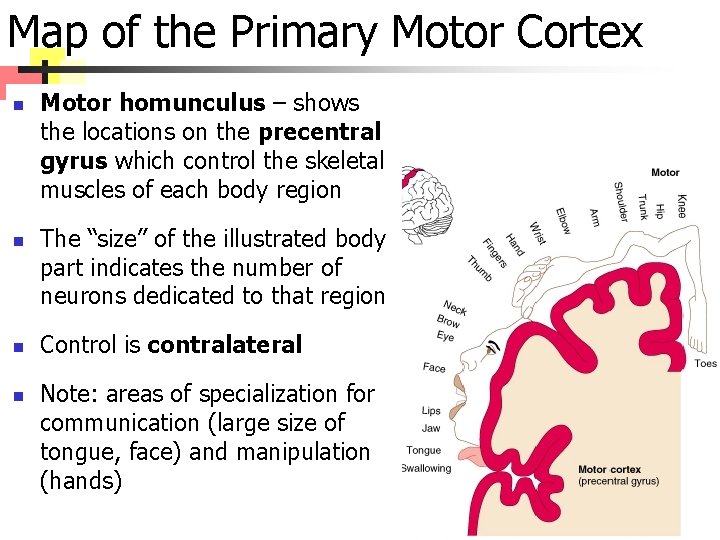
Map of the Primary Motor Cortex n n Motor homunculus – shows the locations on the precentral gyrus which control the skeletal muscles of each body region The “size” of the illustrated body part indicates the number of neurons dedicated to that region Control is contralateral Note: areas of specialization for communication (large size of tongue, face) and manipulation (hands)
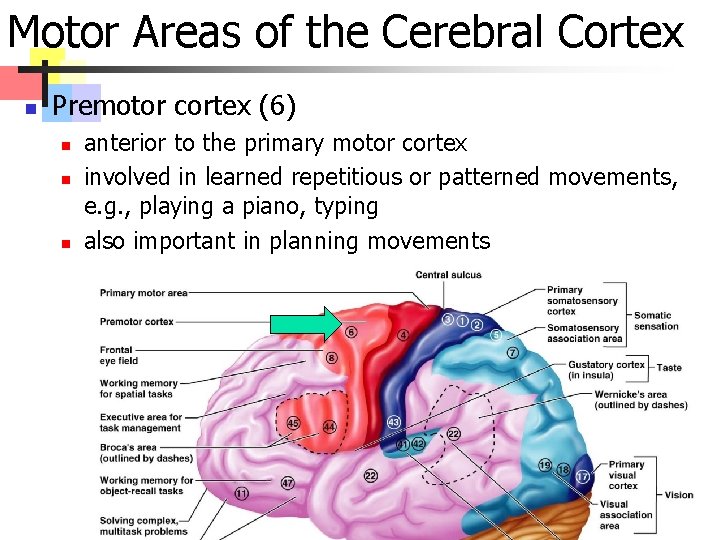
Motor Areas of the Cerebral Cortex n Premotor cortex (6) n n n anterior to the primary motor cortex involved in learned repetitious or patterned movements, e. g. , playing a piano, typing also important in planning movements
Homeostatic Imbalance of Motor Cortex n Damage to the primary motor cortex effects the opposite side of body, e. g. , stroke, trauma n n n only voluntary control of skeletal muscle is lost reflexes remain -- controlled by the spinal cord Damage to the premotor cortex n n loss of programmed motor skills muscle strength and the ability to perform tasks remain n one can still make finger movements to type, etc. not automatic need to re-learn fine motor control
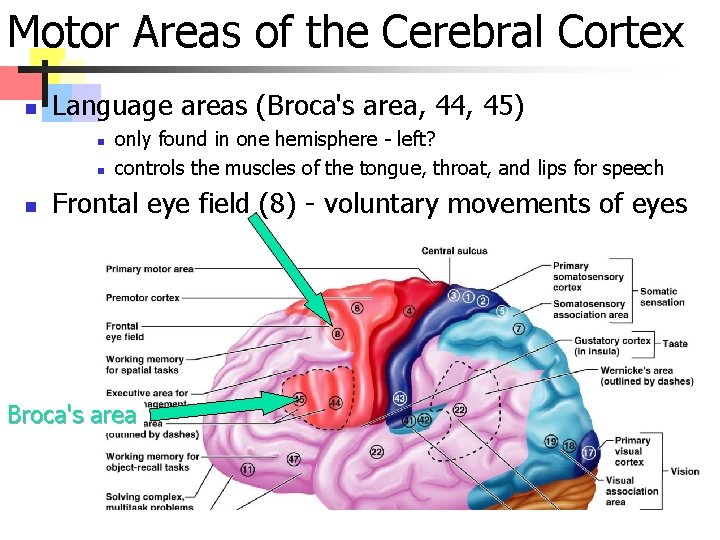
Motor Areas of the Cerebral Cortex n Language areas (Broca's area, 44, 45) n n n only found in one hemisphere - left? controls the muscles of the tongue, throat, and lips for speech Frontal eye field (8) - voluntary movements of eyes Broca's area
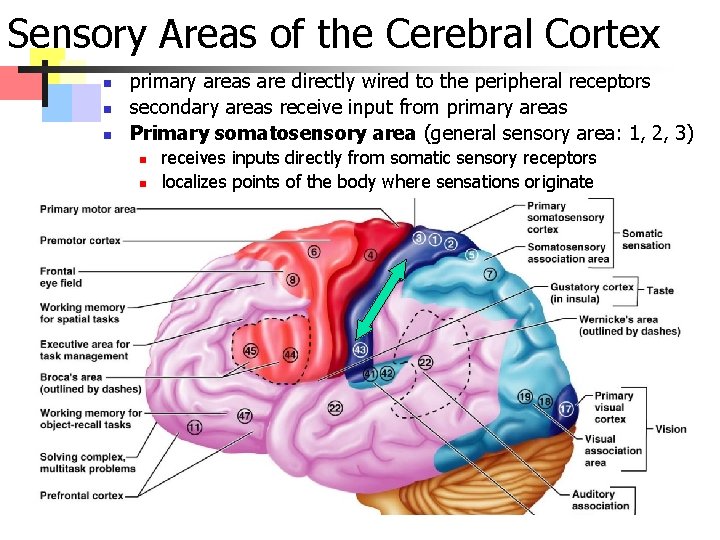
Sensory Areas of the Cerebral Cortex n n n primary areas are directly wired to the peripheral receptors secondary areas receive input from primary areas Primary somatosensory area (general sensory area: 1, 2, 3) n n receives inputs directly from somatic sensory receptors localizes points of the body where sensations originate
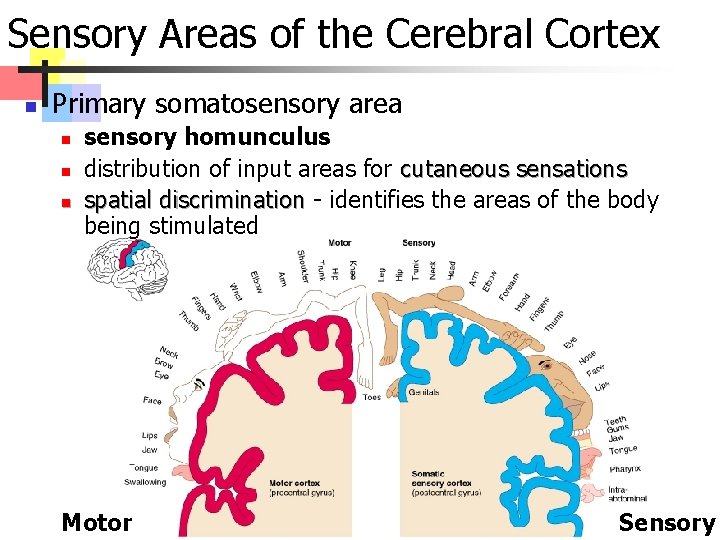
Sensory Areas of the Cerebral Cortex n Primary somatosensory area n n n sensory homunculus distribution of input areas for cutaneous sensations spatial discrimination - identifies the areas of the body being stimulated Motor Sensory
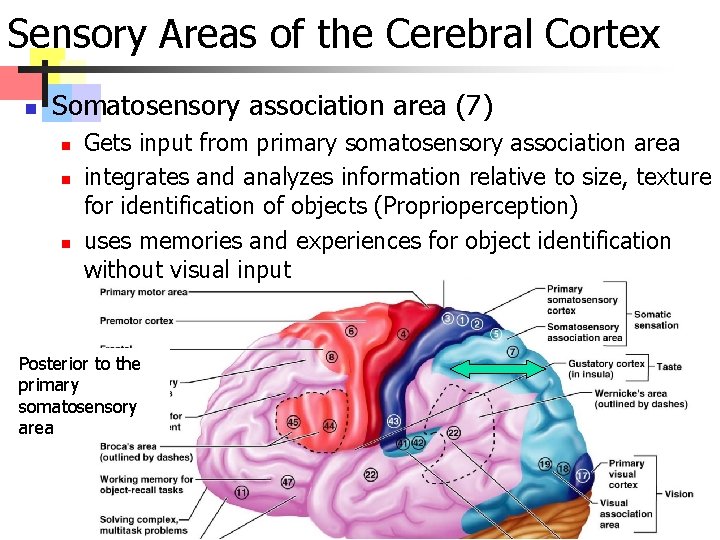
Sensory Areas of the Cerebral Cortex n Somatosensory association area (7) n n n Gets input from primary somatosensory association area integrates and analyzes information relative to size, texture for identification of objects (Proprioperception) uses memories and experiences for object identification without visual input Posterior to the primary somatosensory area
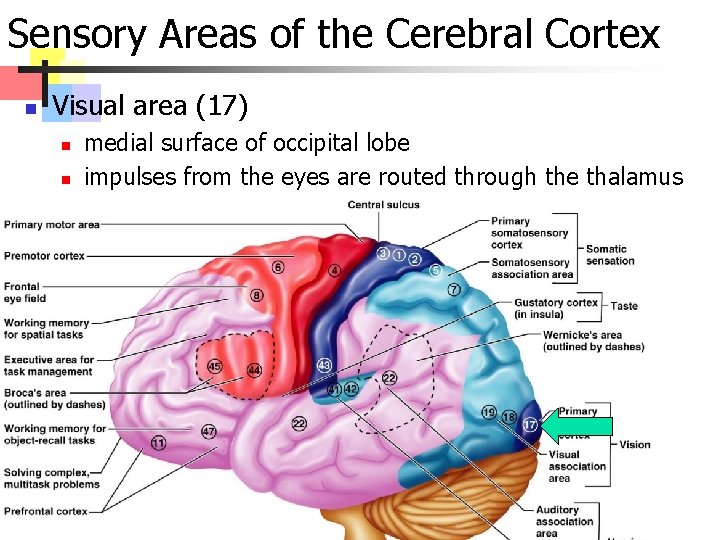
Sensory Areas of the Cerebral Cortex n Visual area (17) n n medial surface of occipital lobe impulses from the eyes are routed through the thalamus
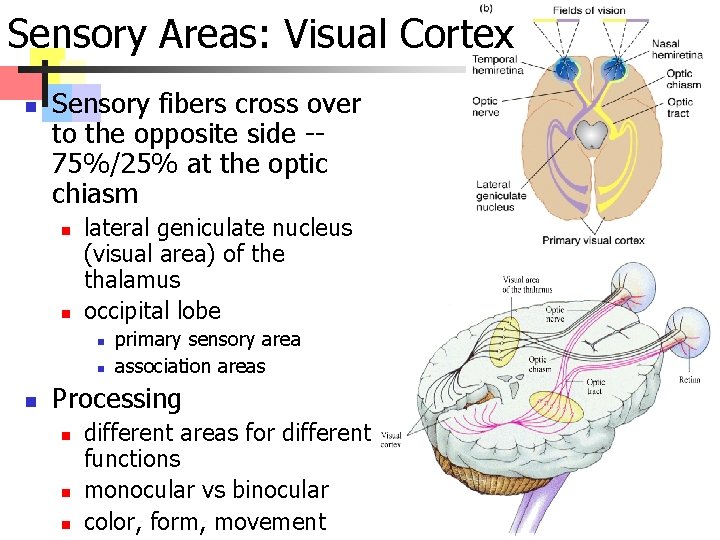
Sensory Areas: Visual Cortex n Sensory fibers cross over to the opposite side -75%/25% at the optic chiasm n n lateral geniculate nucleus (visual area) of the thalamus occipital lobe n n n primary sensory area association areas Processing n n n different areas for different functions monocular vs binocular color, form, movement
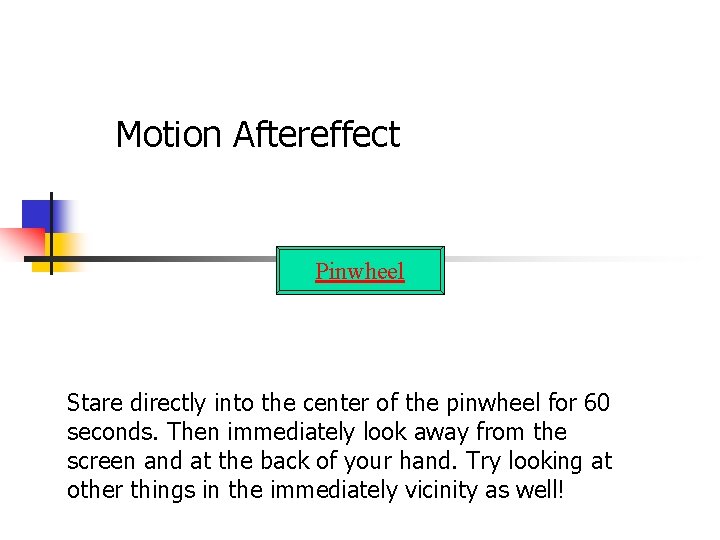
Motion Aftereffect Pinwheel Stare directly into the center of the pinwheel for 60 seconds. Then immediately look away from the screen and at the back of your hand. Try looking at other things in the immediately vicinity as well!
Color Afterimage Stare directly at the center of the next screen for 60 seconds.
What did you see? Let’s repeat it.
green red + yellow blue
Reviews of Neural Processing n Different levels n Neuron to neuron communication n Specific hardwired pathways route information in predictable directions to specific locations Association areas permit integration and interpretation of different types of sensory information Motor areas issue appropriate commands to effector organs
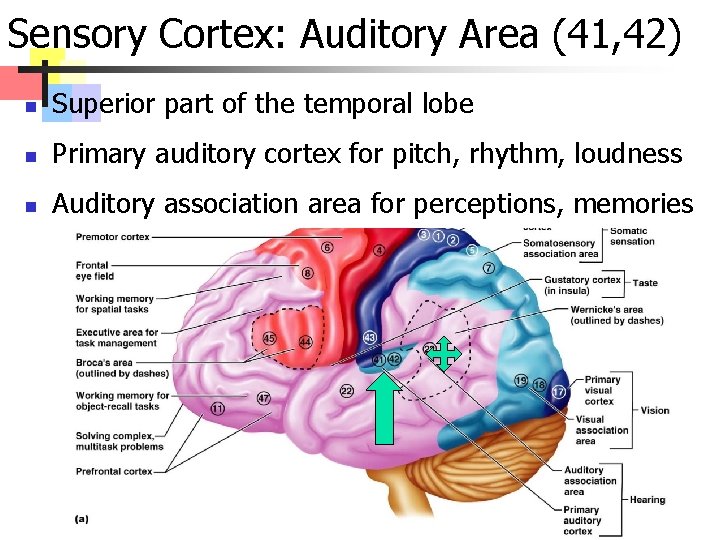
Sensory Cortex: Auditory Area (41, 42) n Superior part of the temporal lobe n Primary auditory cortex for pitch, rhythm, loudness n Auditory association area for perceptions, memories
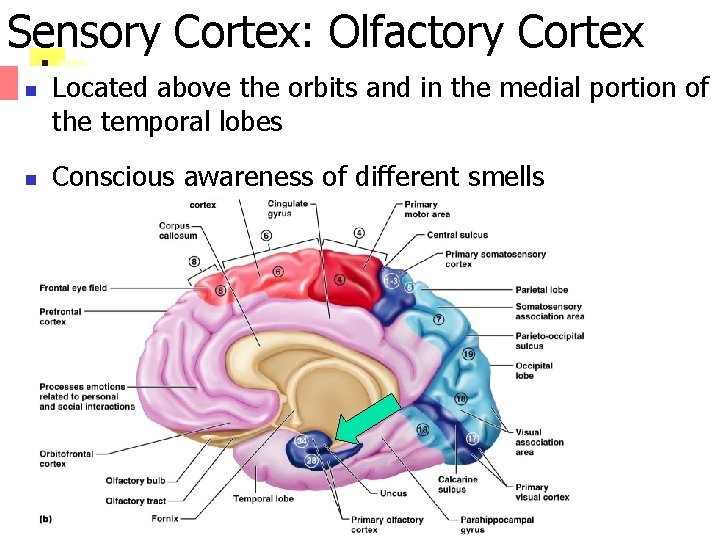
Sensory Cortex: Olfactory Cortex n n Located above the orbits and in the medial portion of the temporal lobes Conscious awareness of different smells
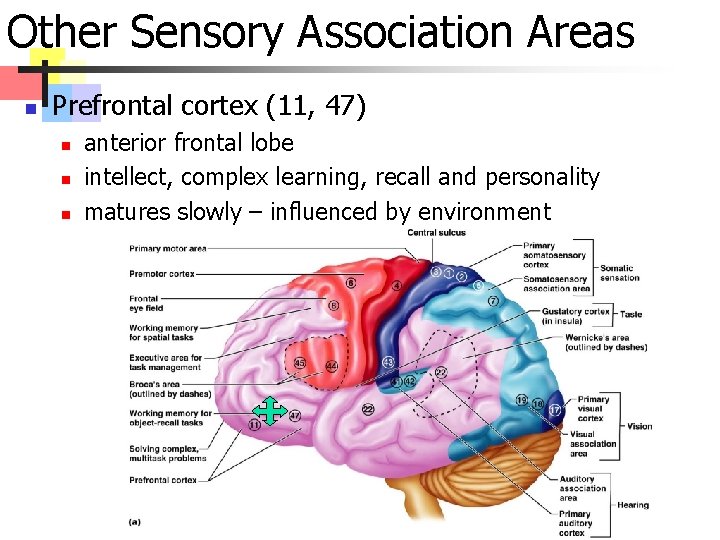
Other Sensory Association Areas n Prefrontal cortex (11, 47) n n n anterior frontal lobe intellect, complex learning, recall and personality matures slowly – influenced by environment
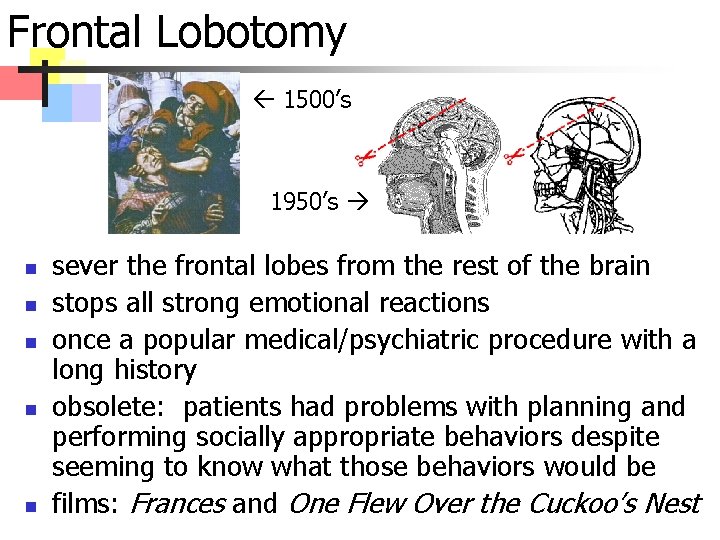
Frontal Lobotomy 1500’s 1950’s n n n sever the frontal lobes from the rest of the brain stops all strong emotional reactions once a popular medical/psychiatric procedure with a long history obsolete: patients had problems with planning and performing socially appropriate behaviors despite seeming to know what those behaviors would be films: Frances and One Flew Over the Cuckoo’s Nest
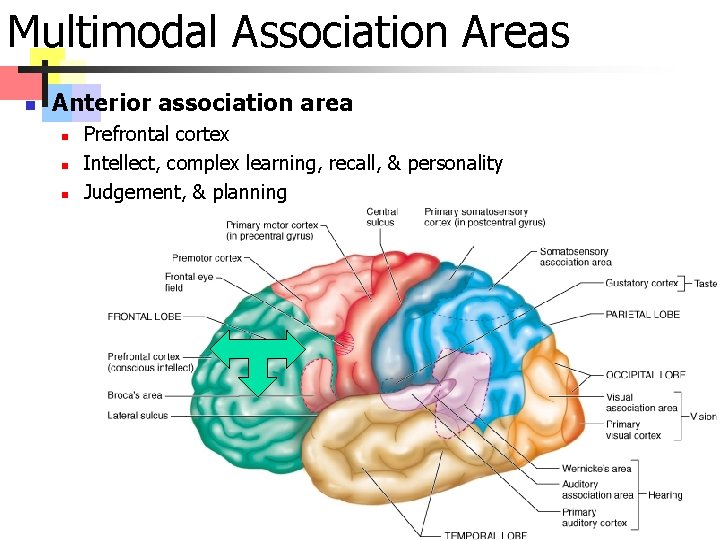
Multimodal Association Areas n Anterior association area n n n Prefrontal cortex Intellect, complex learning, recall, & personality Judgement, & planning
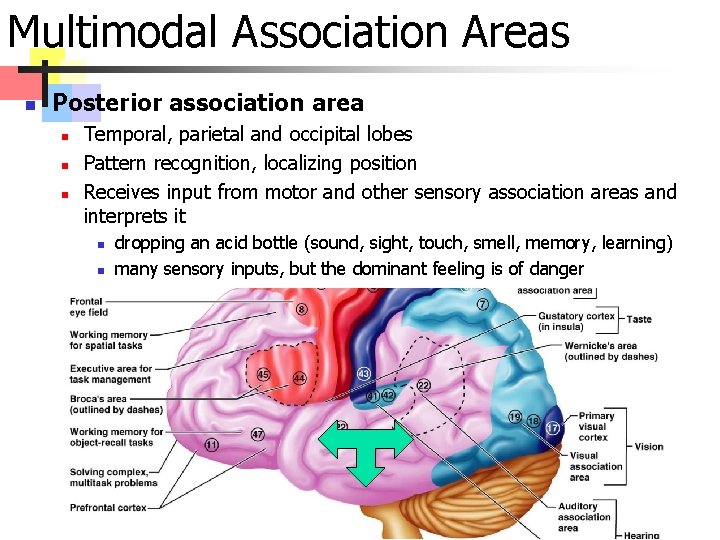
Multimodal Association Areas n Posterior association area n n n Temporal, parietal and occipital lobes Pattern recognition, localizing position Receives input from motor and other sensory association areas and interprets it n n dropping an acid bottle (sound, sight, touch, smell, memory, learning) many sensory inputs, but the dominant feeling is of danger
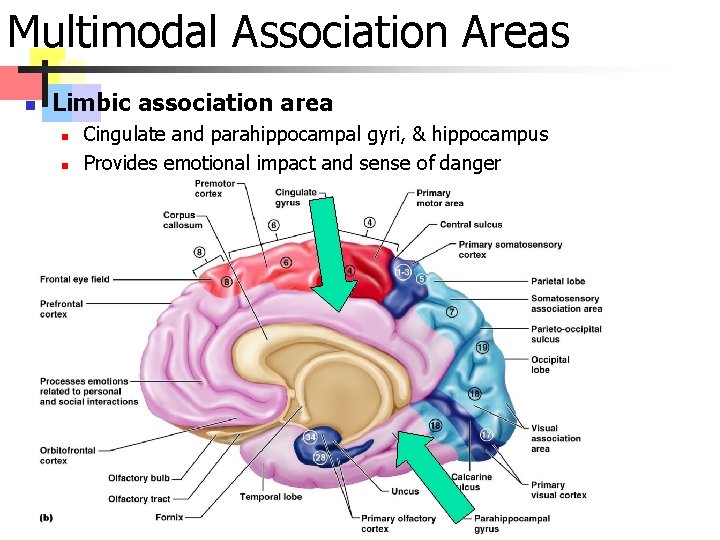
Multimodal Association Areas n Limbic association area n n Cingulate and parahippocampal gyri, & hippocampus Provides emotional impact and sense of danger
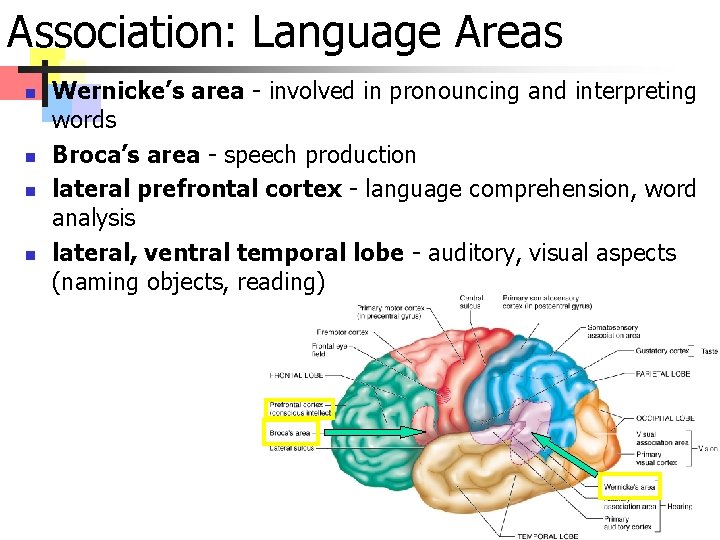
Association: Language Areas n n Wernicke’s area - involved in pronouncing and interpreting words Broca’s area - speech production lateral prefrontal cortex - language comprehension, word analysis lateral, ventral temporal lobe - auditory, visual aspects (naming objects, reading)
Brain Lateralization n both hemispheres participate in every activity, but one hemisphere is dominant for most activities n e. g. : the left hemisphere is dominant for language skills in most people (90%) n the left is also dominant for math abilities and logic n the right hemisphere is usually dominant for “creative” skills: n n n visual-spatial skills intuition emotion appreciation of art and music most left-hemisphere-dominant people are righthanded and visa versa.
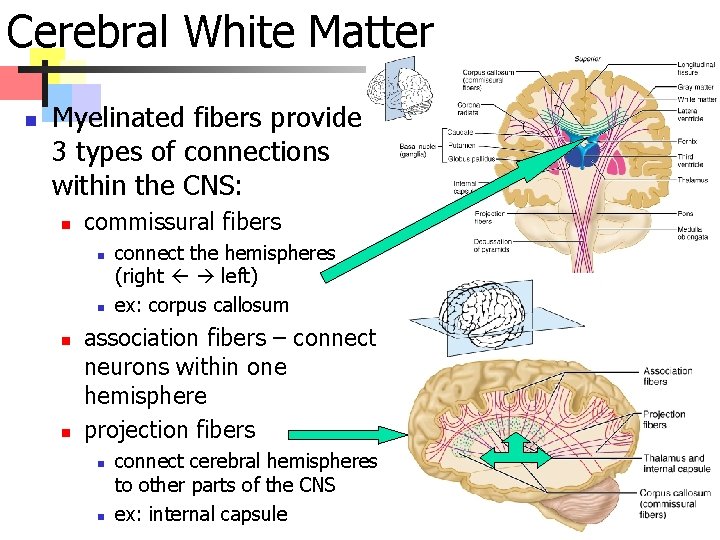
Cerebral White Matter n Myelinated fibers provide 3 types of connections within the CNS: n commissural fibers n n connect the hemispheres (right left) ex: corpus callosum association fibers – connect neurons within one hemisphere projection fibers n n connect cerebral hemispheres to other parts of the CNS ex: internal capsule
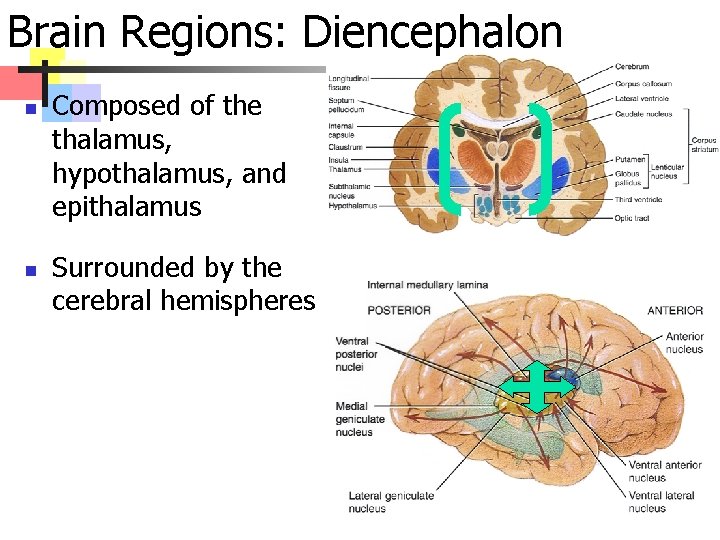
Brain Regions: Diencephalon n n Composed of the thalamus, hypothalamus, and epithalamus Surrounded by the cerebral hemispheres
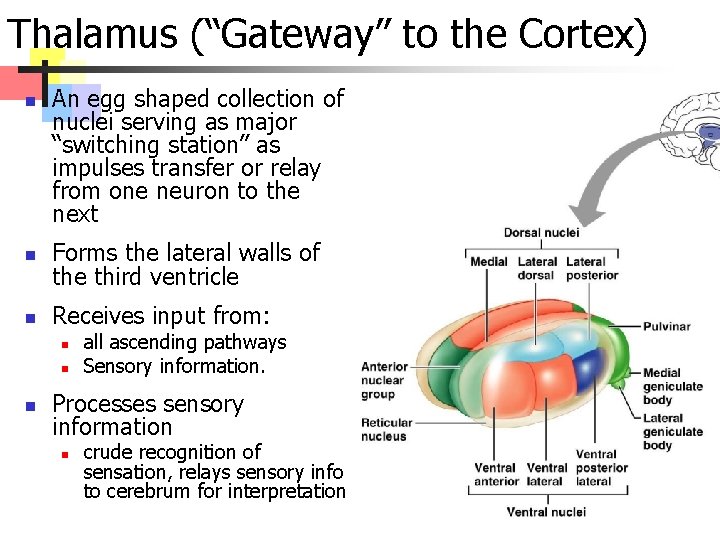
Thalamus (“Gateway” to the Cortex) n An egg shaped collection of nuclei serving as major “switching station” as impulses transfer or relay from one neuron to the next n Forms the lateral walls of the third ventricle n Receives input from: n n n all ascending pathways Sensory information. Processes sensory information n crude recognition of sensation, relays sensory info to cerebrum for interpretation.
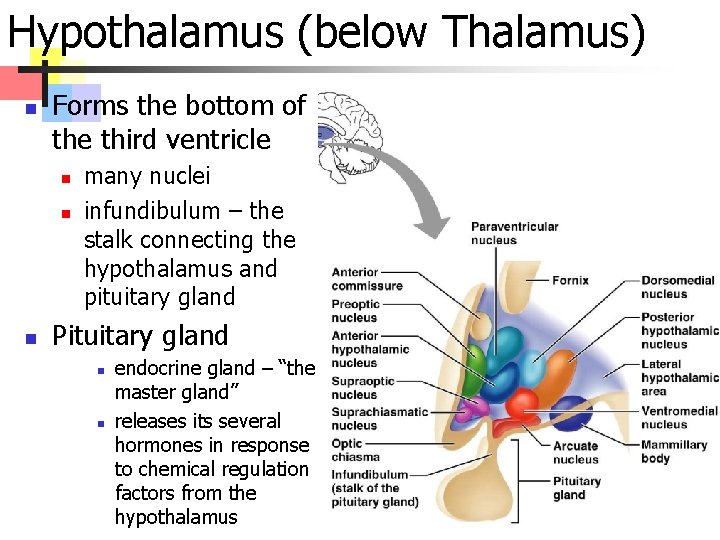
Hypothalamus (below Thalamus) n Forms the bottom of the third ventricle n n n many nuclei infundibulum – the stalk connecting the hypothalamus and pituitary gland Pituitary gland n n endocrine gland – “the master gland” releases its several hormones in response to chemical regulation factors from the hypothalamus
Functions of the Hypothalamus n n n n Autonomic Nervous System (visceral) control center – important in homeostasis a center for emotional responses and behaviors body temperature regulation of food intake regulation of water balance and thirst regulation of sleep-wake cycles controls many endocrine system functions n neuroendocrine feedback control
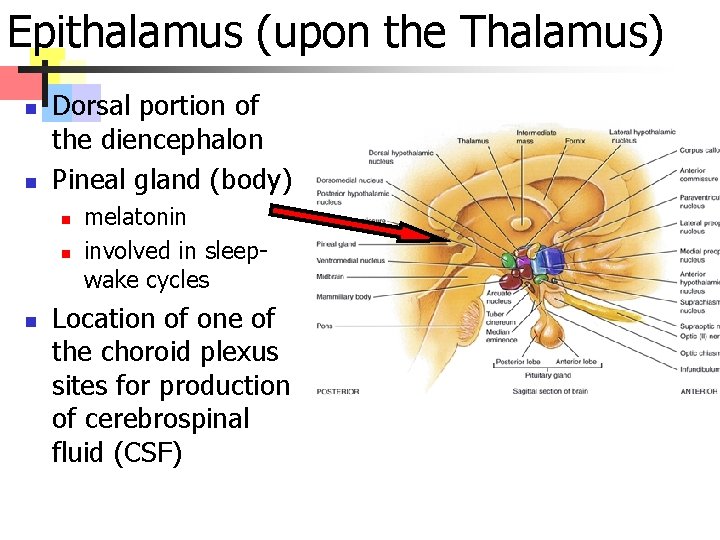
Epithalamus (upon the Thalamus) n n Dorsal portion of the diencephalon Pineal gland (body) n n n melatonin involved in sleepwake cycles Location of one of the choroid plexus sites for production of cerebrospinal fluid (CSF)
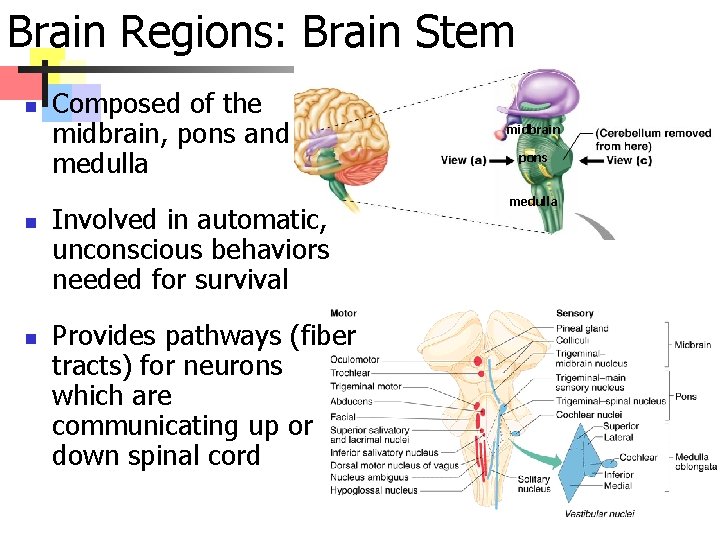
Brain Regions: Brain Stem n n n Composed of the midbrain, pons and medulla Involved in automatic, unconscious behaviors needed for survival Provides pathways (fiber tracts) for neurons which are communicating up or down spinal cord midbrain pons medulla
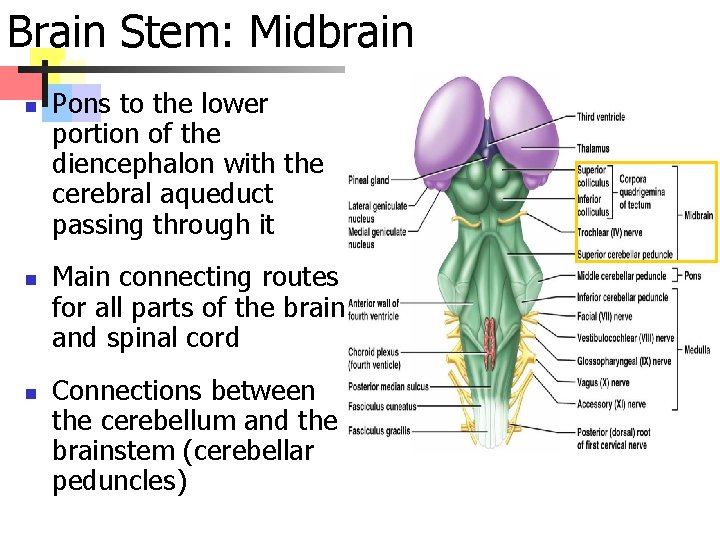
Brain Stem: Midbrain n Pons to the lower portion of the diencephalon with the cerebral aqueduct passing through it Main connecting routes for all parts of the brain and spinal cord Connections between the cerebellum and the brainstem (cerebellar peduncles)
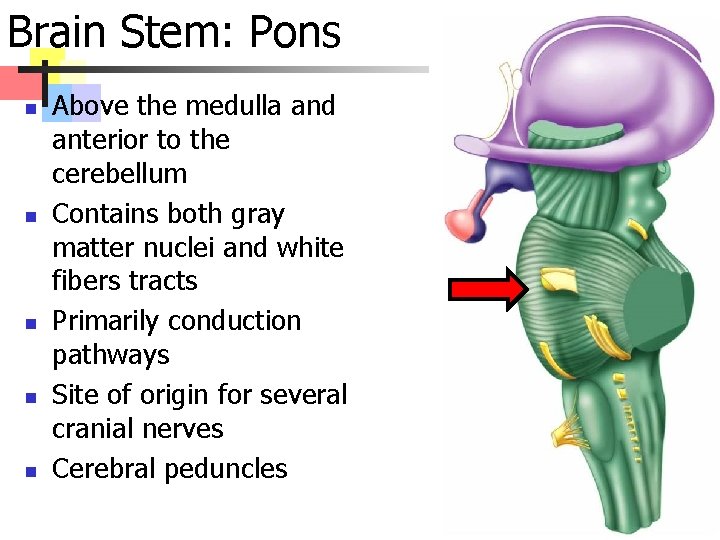
Brain Stem: Pons n n n Above the medulla and anterior to the cerebellum Contains both gray matter nuclei and white fibers tracts Primarily conduction pathways Site of origin for several cranial nerves Cerebral peduncles
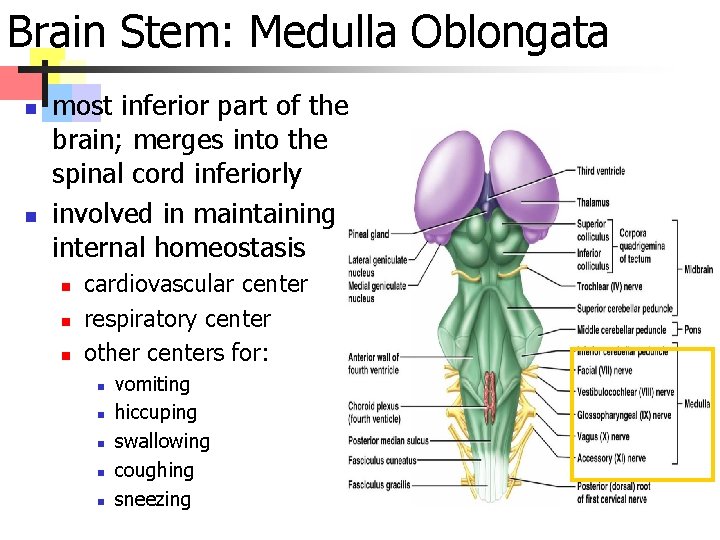
Brain Stem: Medulla Oblongata n n most inferior part of the brain; merges into the spinal cord inferiorly involved in maintaining internal homeostasis n n n cardiovascular center respiratory center other centers for: n n n vomiting hiccuping swallowing coughing sneezing
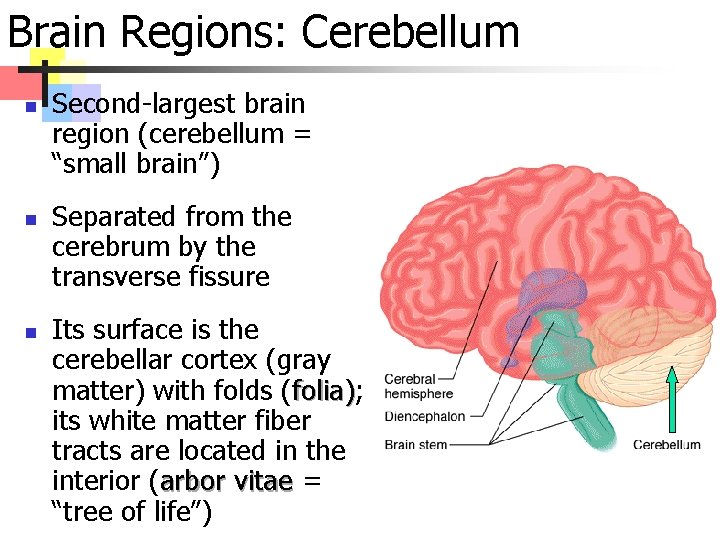
Brain Regions: Cerebellum n n n Second-largest brain region (cerebellum = “small brain”) Separated from the cerebrum by the transverse fissure Its surface is the cerebellar cortex (gray matter) with folds (folia); folia) its white matter fiber tracts are located in the interior (arbor vitae = “tree of life”)
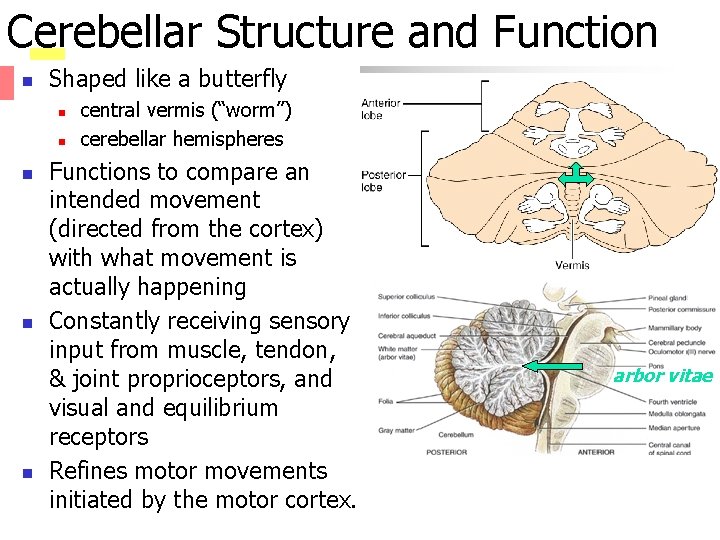
Cerebellar Structure and Function n Shaped like a butterfly n n n central vermis (“worm”) cerebellar hemispheres Functions to compare an intended movement (directed from the cortex) with what movement is actually happening Constantly receiving sensory input from muscle, tendon, & joint proprioceptors, and visual and equilibrium receptors Refines motor movements initiated by the motor cortex. arbor vitae
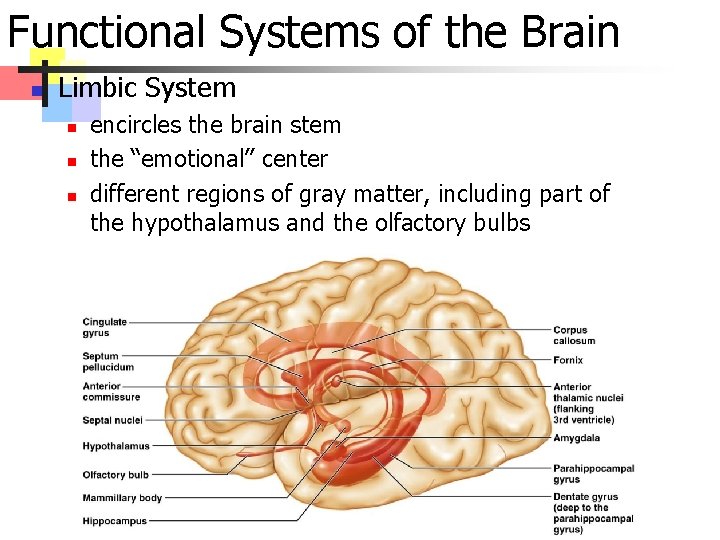
Functional Systems of the Brain n Limbic System n n n encircles the brain stem the “emotional” center different regions of gray matter, including part of the hypothalamus and the olfactory bulbs
Limbic System (cont. ) n n Functions in emotional aspects of behavior related to survival Also functions with the cerebrum in memory n n olfactory centers are near the limbic system individuals, objects and experiences which initiate strong emotional responses or are associated with smells are committed to memory more easily Memory impairment results from damage to the limbic system Also associated with pleasure and pain n n electrical stimulation elicits different responses includes defensive posturing (rage); others inspire timidity
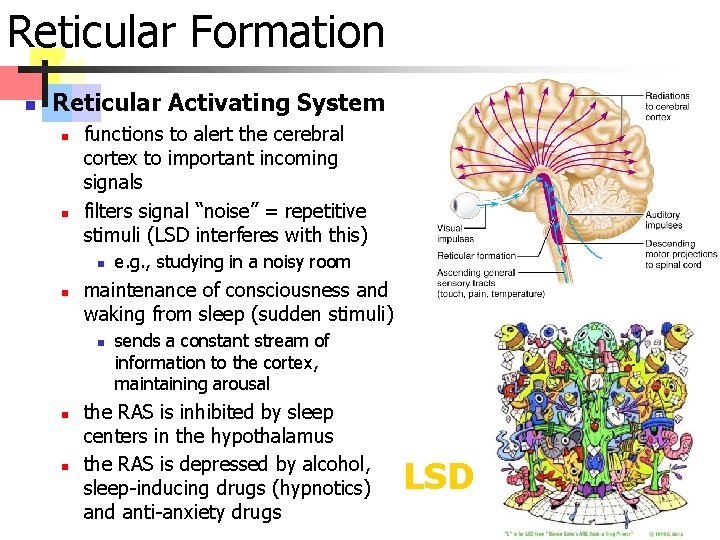
Reticular Formation n Reticular Activating System n n functions to alert the cerebral cortex to important incoming signals filters signal “noise” = repetitive stimuli (LSD interferes with this) n n maintenance of consciousness and waking from sleep (sudden stimuli) n n n e. g. , studying in a noisy room sends a constant stream of information to the cortex, maintaining arousal the RAS is inhibited by sleep centers in the hypothalamus the RAS is depressed by alcohol, sleep-inducing drugs (hypnotics) and anti-anxiety drugs LSD
Protection of the Brain n n Soft tissue which needs to be protected Several different protective mechanisms n n n scalp hair to prevent sunstroke? bones – the cranium (“brain case”) of the skull meninges n n cerebrospinal fluid (CSF) n n three connective tissue membranes wrapping the CNS a fluid “shock absorber” which cushions and nourishes the brain blood-brain barrier n the physical and physiological separation of the CNS from the bloodstream
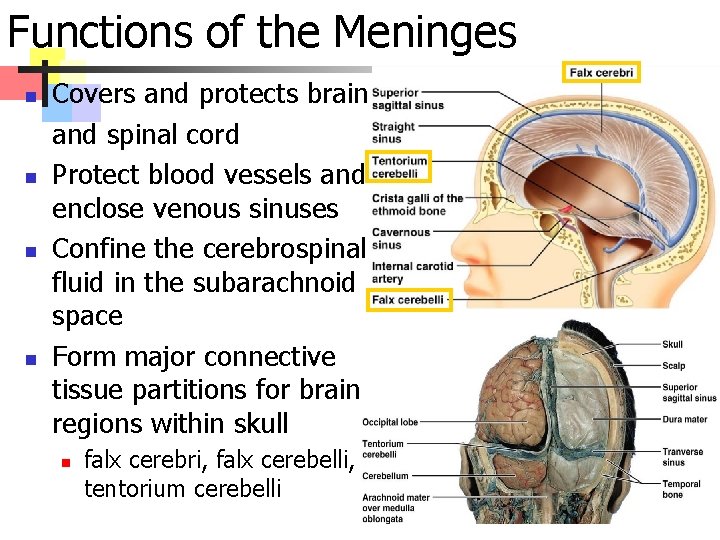
Functions of the Meninges n n Covers and protects brain and spinal cord Protect blood vessels and enclose venous sinuses Confine the cerebrospinal fluid in the subarachnoid space Form major connective tissue partitions for brain regions within skull n falx cerebri, falx cerebelli, tentorium cerebelli
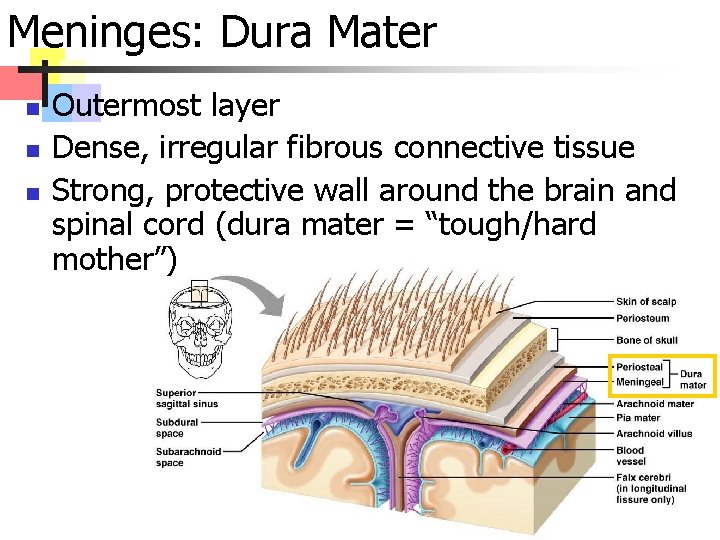
Meninges: Dura Mater n n n Outermost layer Dense, irregular fibrous connective tissue Strong, protective wall around the brain and spinal cord (dura mater = “tough/hard mother”)
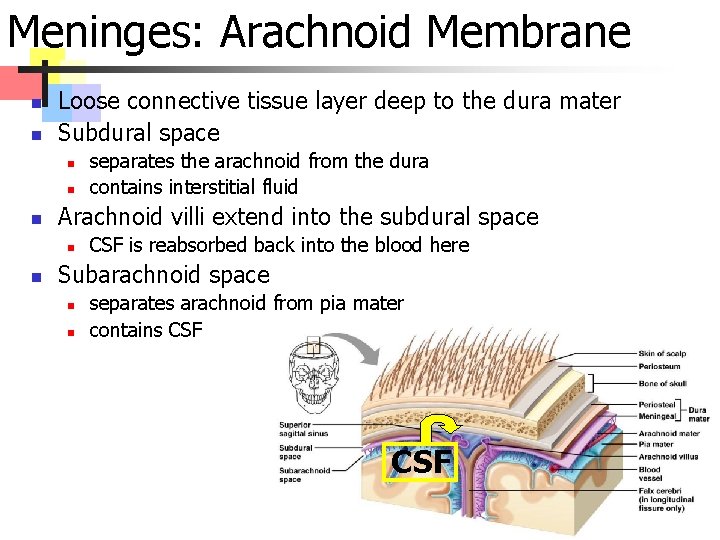
Meninges: Arachnoid Membrane n n Loose connective tissue layer deep to the dura mater Subdural space n n n Arachnoid villi extend into the subdural space n n separates the arachnoid from the dura contains interstitial fluid CSF is reabsorbed back into the blood here Subarachnoid space n n separates arachnoid from pia mater contains CSF
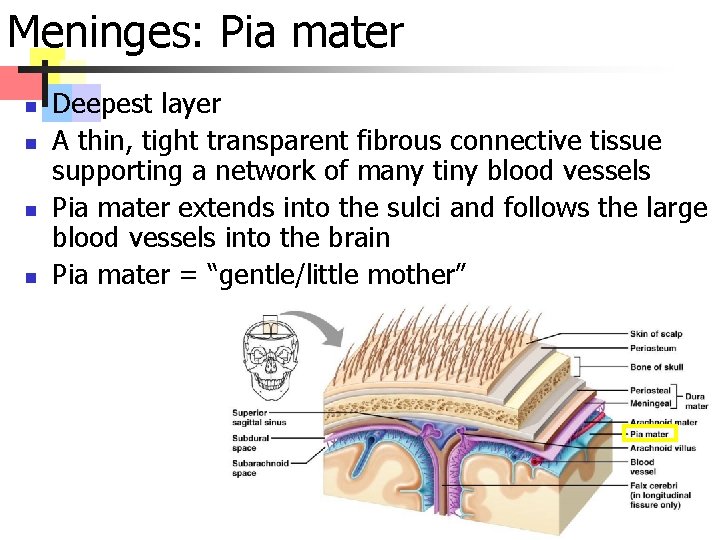
Meninges: Pia mater n n Deepest layer A thin, tight transparent fibrous connective tissue supporting a network of many tiny blood vessels Pia mater extends into the sulci and follows the large blood vessels into the brain Pia mater = “gentle/little mother”
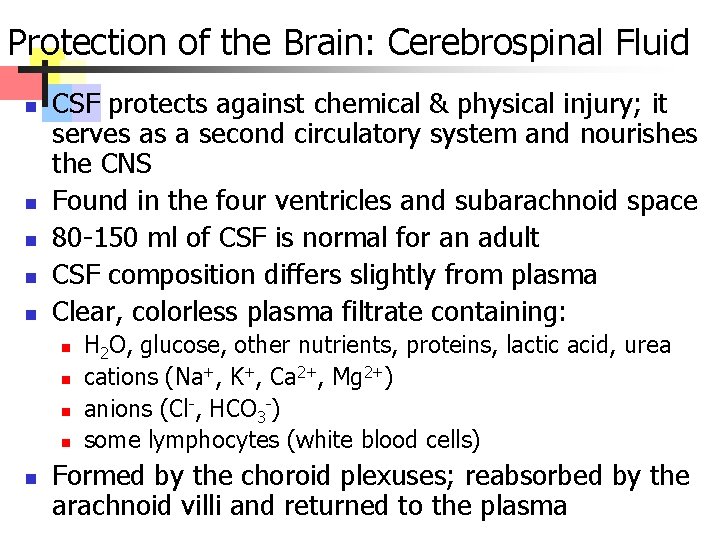
Protection of the Brain: Cerebrospinal Fluid n n n CSF protects against chemical & physical injury; it serves as a second circulatory system and nourishes the CNS Found in the four ventricles and subarachnoid space 80 -150 ml of CSF is normal for an adult CSF composition differs slightly from plasma Clear, colorless plasma filtrate containing: n n n H 2 O, glucose, other nutrients, proteins, lactic acid, urea cations (Na+, K+, Ca 2+, Mg 2+) anions (Cl-, HCO 3 -) some lymphocytes (white blood cells) Formed by the choroid plexuses; reabsorbed by the arachnoid villi and returned to the plasma
Functions of Cerebrospinal Fluid n Mechanical protection n Chemical protection n n shock absorbing fluid the brain “floats” in this fluid provides a constant chemical environment the p. H of the CSF is important in the control of breathing CSF composition is important for regulating cerebral blood flow Circulation for the exchange of nutrients and waste products between the blood and nervous tissue
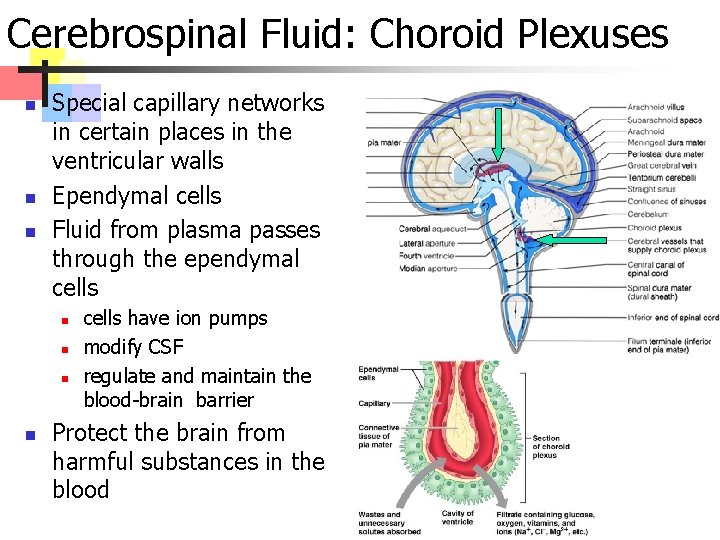
Cerebrospinal Fluid: Choroid Plexuses n n n Special capillary networks in certain places in the ventricular walls Ependymal cells Fluid from plasma passes through the ependymal cells n n cells have ion pumps modify CSF regulate and maintain the blood-brain barrier Protect the brain from harmful substances in the blood
Blood-Brain Barrier n Penetration of molecules from the blood into the brain is regulated by: n n tight junctions between capillary cells thick basal lamina (connective tissue layer) astrocytes pressed against capillaries The barrier is a selective membrane n n n some substances, particularly if lipid-soluble, pass easily from blood to the brain (water, glucose, O 2, CO 2, alcohol, caffeine, nicotine, heroin, most anesthetics) most charged ions do not pass easily proteins and most antibiotics do not pass at all
Blood-Brain Barrier n Permeability is variable depending on the site n n n choroid plexus – CSF production vomiting center in brain stem - monitors the blood for toxic molecules and poisons hypothalamus n n has no blood-brain barrier monitors blood composition for water balance, temperature, p. H, osmolarity and many other homeostatic metabolic functions
Homeostatic Imbalances of the Brain n Traumatic Brain Injuries n concussion n a blow to head n n n possibly, there is no visible external damage a variety of cognitive problems follow contusion n the skull stops, but the brain keeps moving the brain bounces off the inside of the skull breaks in small vessels, some bleeding, visible bruising effect depends on the location laceration n n tearing of the brain knife and gunshot wounds, other major traumas
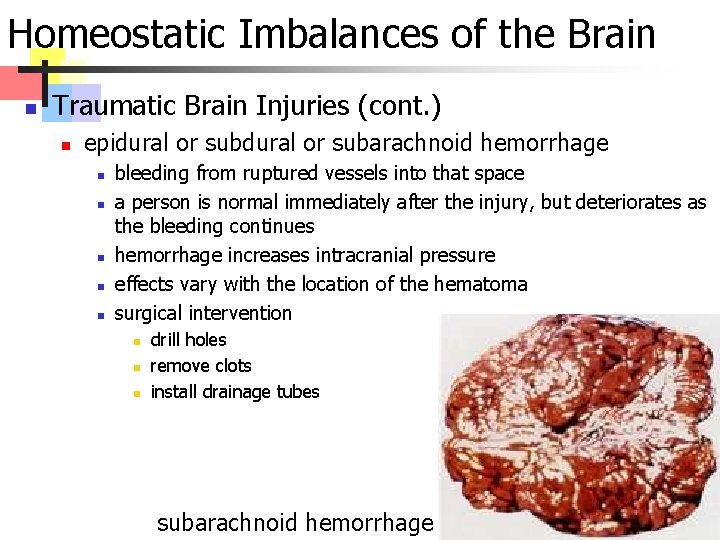
Homeostatic Imbalances of the Brain n Traumatic Brain Injuries (cont. ) n epidural or subarachnoid hemorrhage n n n bleeding from ruptured vessels into that space a person is normal immediately after the injury, but deteriorates as the bleeding continues hemorrhage increases intracranial pressure effects vary with the location of the hematoma surgical intervention n drill holes remove clots install drainage tubes subarachnoid hemorrhage
Homeostatic Imbalances of the Brain n Cerebrovascular Accidents (CVA’s) n Stroke n n n third leading cause of death in the United States ischemia anemia caused by reduced or blocked blood flow) hemorrhages and blood clots increase intracranial pressure brain tissue dies (infarct) risk factors: high blood pressure, high cholesterol, heart disease, narrowed carotid arteries, diabetes, smoking, obesity, excessive alcohol intake Transient ischemic attack (TIA/ministroke) n n n may last minutes flow is reduced and brain tissue suffers temporarily blood flow is re-established
Homeostatic Imbalances of the Brain n Degenerative brain diseases n Alzheimer’s disease n n about 11% of population over age 65, 4 million people suffer, 100, 000 die annually; hereditary component widespread cognitive deficits - (short term) memory loss, shortened attention span and disorientation, loss of language skills death from secondary causes, e. g. , due to being bedridden diagnosis is difficult since there is no definitive test; only after death can it be confirmed by autopsy: n n significant loss of neurons in specific regions abnormal proteins are deposited in brain tissue tangled nerve masses generally, the damage is limited to the cerebral cortex
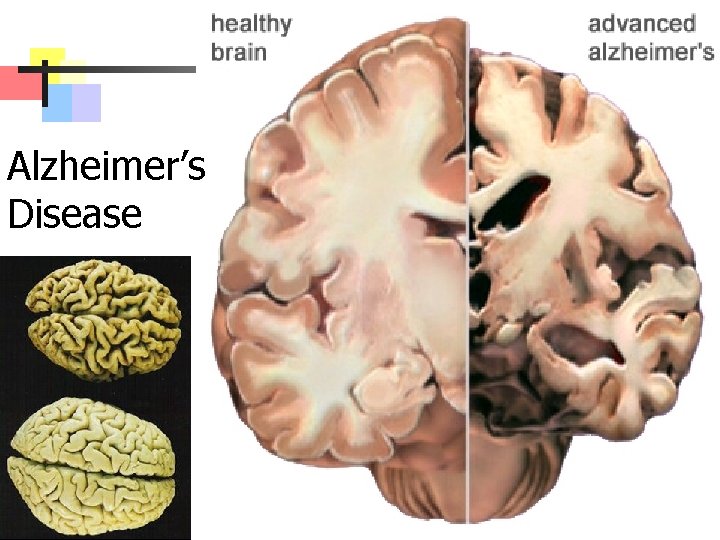
Alzheimer’s Disease
Homeostatic Imbalances of Brain n Degenerative brain diseases (cont. ) n Parkinson’s disease n n n progressive disorder of the CNS which typically affects victims at age 60 or so cause(s) unknown; hereditary component sometimes characterized by degeneration of dopamine-releasing neurons characterized by tremor (shaking) and rigidity (continuous contraction) motor performance impaired by bradykinesia (slow motion) and hypokinesia (reduced range of motion) treatments try to increase dopamine and decrease ACh with therapeutic drugs or by experimental implantation of fetal brain cells
Homeostatic Imbalances of Brain n Traumatic brain diseases n Cerebral Palsy n n n damage to motor areas of brain during fetal life, at birth, or during infancy, usually transient O 2 deprivation poor control and coordination of voluntary muscle activities but usually little impact on intellect irreversible, but not progressive 70% of victims appear to be mentally retarded n n n often due to their inability to hear or speak well generally, they are more aware and understanding of their situation and surroundings than they appear Concussion, Contusion, Sudural or Subarachnoid Hemorrhage, Cerebral Edema, CVAs
Not Everybody is an Einstein!
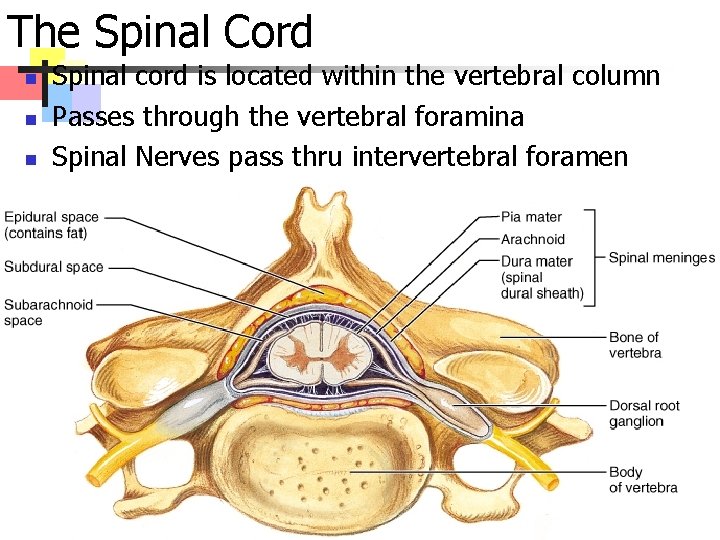
The Spinal Cord n n n Spinal cord is located within the vertebral column Passes through the vertebral foramina Spinal Nerves pass thru intervertebral foramen
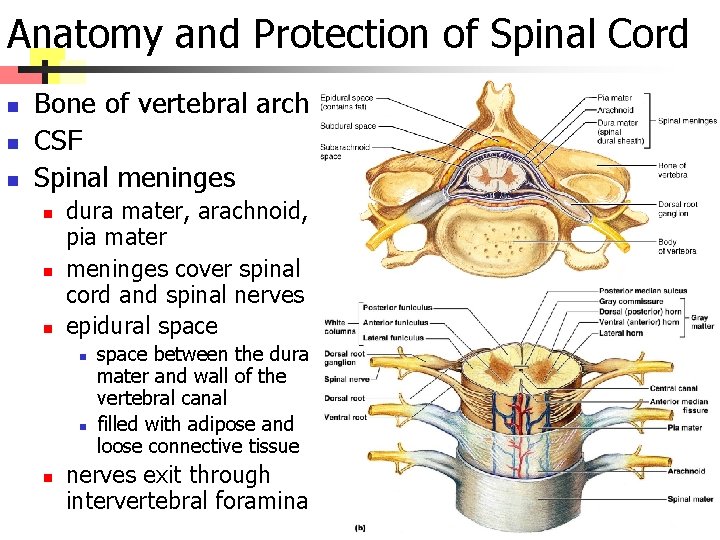
Anatomy and Protection of Spinal Cord n n n Bone of vertebral arch CSF Spinal meninges n n n dura mater, arachnoid, pia mater meninges cover spinal cord and spinal nerves epidural space n n n space between the dura mater and wall of the vertebral canal filled with adipose and loose connective tissue nerves exit through intervertebral foramina
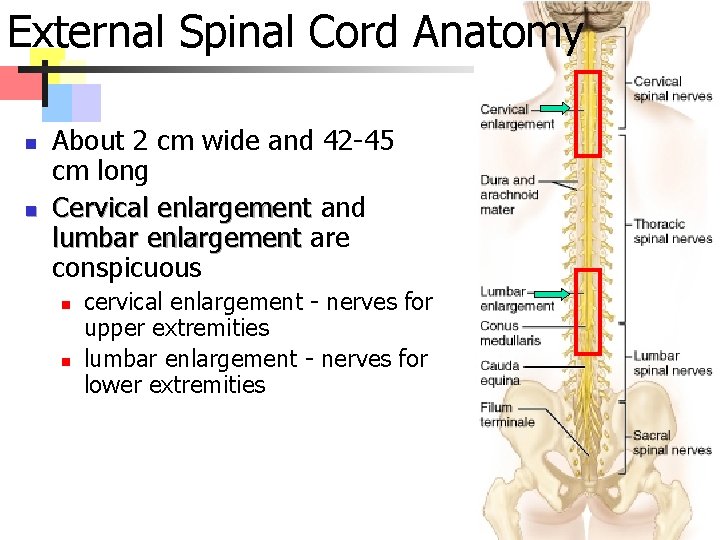
External Spinal Cord Anatomy n n About 2 cm wide and 42 -45 cm long Cervical enlargement and lumbar enlargement are conspicuous n n cervical enlargement - nerves for upper extremities lumbar enlargement - nerves for lower extremities
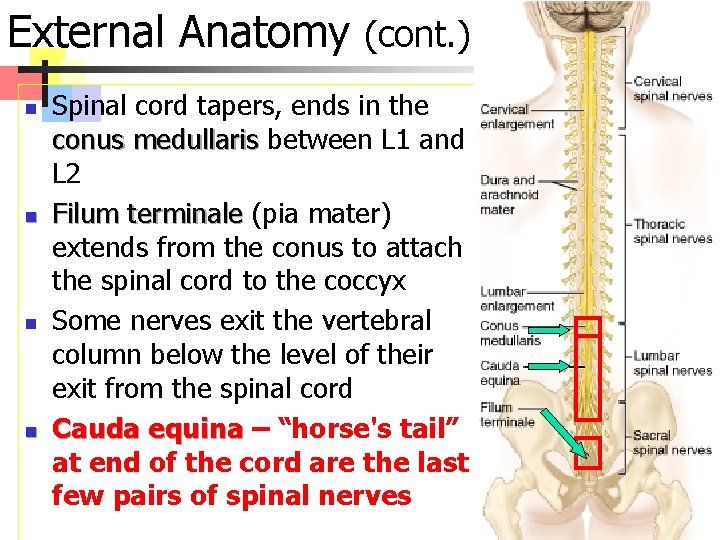
External Anatomy (cont. ) n n Spinal cord tapers, ends in the conus medullaris between L 1 and L 2 Filum terminale (pia mater) extends from the conus to attach the spinal cord to the coccyx Some nerves exit the vertebral column below the level of their exit from the spinal cord Cauda equina – “horse's tail” at end of the cord are the last few pairs of spinal nerves
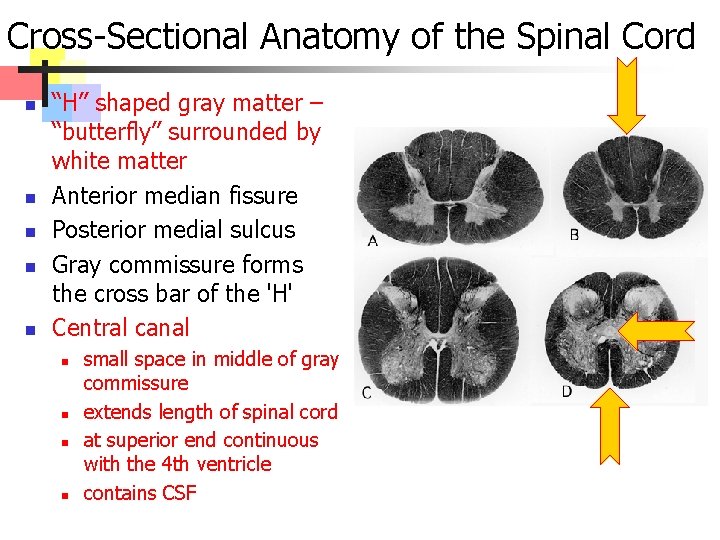
Cross-Sectional Anatomy of the Spinal Cord n n n “H” shaped gray matter – “butterfly” surrounded by white matter Anterior median fissure Posterior medial sulcus Gray commissure forms the cross bar of the 'H' Central canal n n small space in middle of gray commissure extends length of spinal cord at superior end continuous with the 4 th ventricle contains CSF
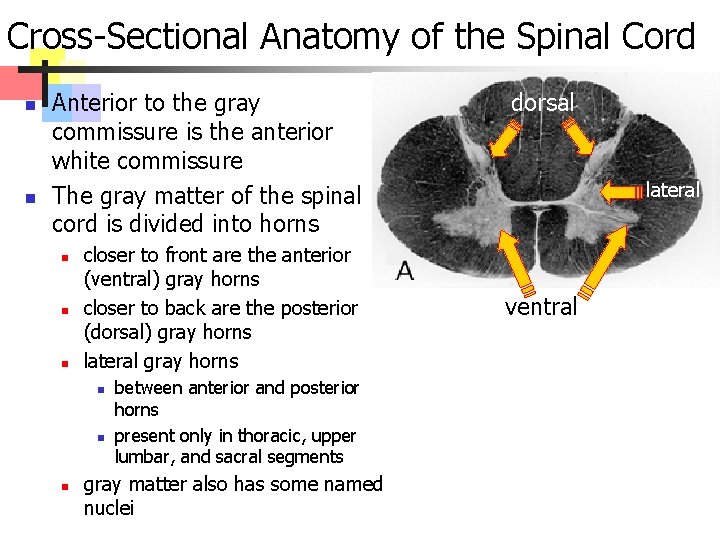
Cross-Sectional Anatomy of the Spinal Cord n n Anterior to the gray commissure is the anterior white commissure The gray matter of the spinal cord is divided into horns n n n closer to front are the anterior (ventral) gray horns closer to back are the posterior (dorsal) gray horns lateral gray horns n n n between anterior and posterior horns present only in thoracic, upper lumbar, and sacral segments gray matter also has some named nuclei dorsal lateral ventral
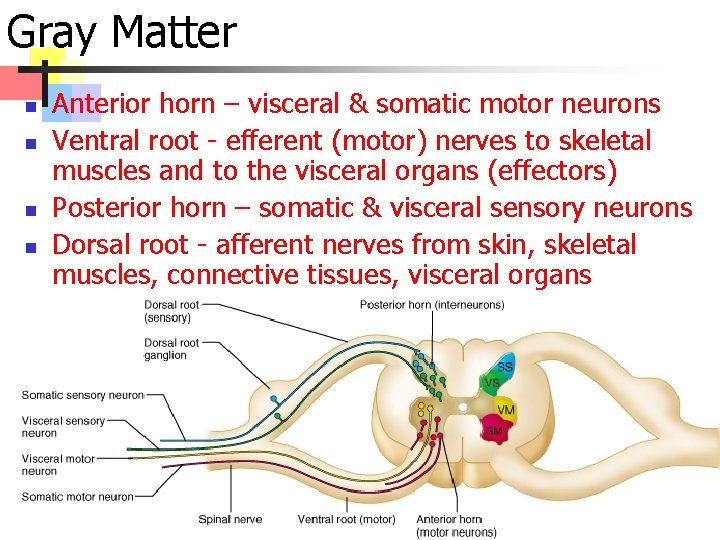
Gray Matter n n Anterior horn – visceral & somatic motor neurons Ventral root - efferent (motor) nerves to skeletal muscles and to the visceral organs (effectors) Posterior horn – somatic & visceral sensory neurons Dorsal root - afferent nerves from skin, skeletal muscles, connective tissues, visceral organs
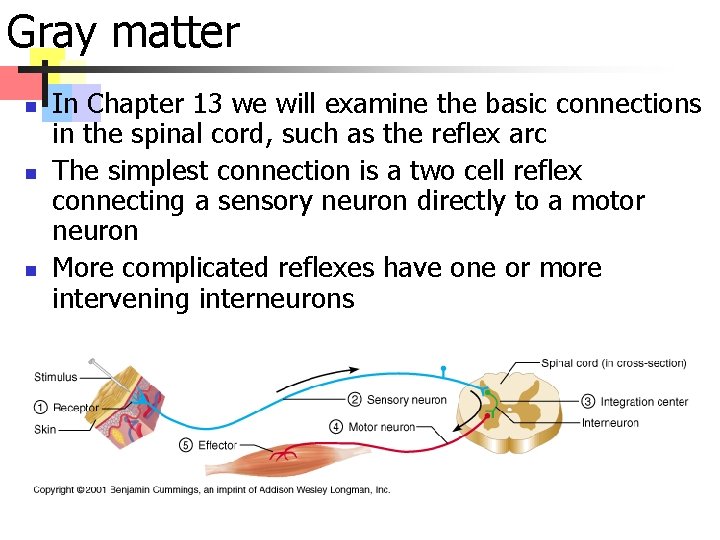
Gray matter n n n In Chapter 13 we will examine the basic connections in the spinal cord, such as the reflex arc The simplest connection is a two cell reflex connecting a sensory neuron directly to a motor neuron More complicated reflexes have one or more intervening interneurons
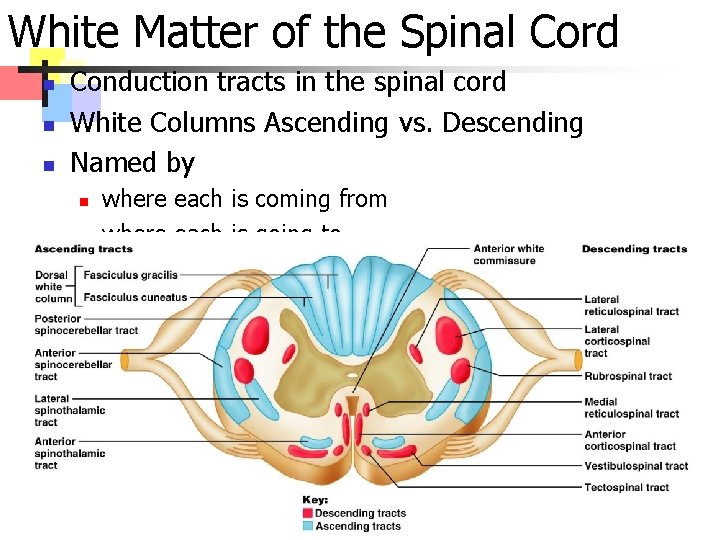
White Matter of the Spinal Cord n n n Conduction tracts in the spinal cord White Columns Ascending vs. Descending Named by n n where each is coming from where each is going to
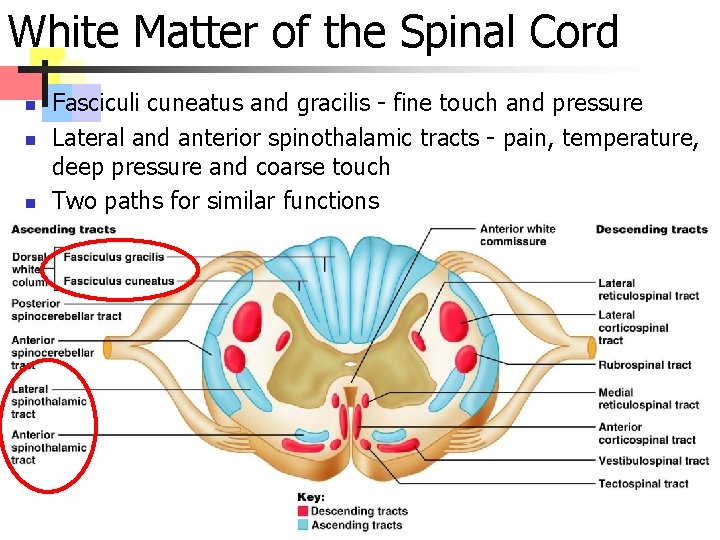
White Matter of the Spinal Cord n n n Fasciculi cuneatus and gracilis - fine touch and pressure Lateral and anterior spinothalamic tracts - pain, temperature, deep pressure and coarse touch Two paths for similar functions
- Slides: 79