
Chapter 9 Structuring System Data Requirements 2006 ITT


- Slides: 56
• Chapter 9 • Structuring System Data Requirements © 2006 ITT Educational Services Inc. SE 350 System Analysis for Software Engineers: Unit 8 Slide 1
Learning Objectives 11. Explain the role of conceptual data modeling in the overall analysis and design of information systems. Ø Ø Define each of the following key data modeling terms concisely: entity type, attribute, multivalued attribute, relationship, degree, cardinality, business rule, associative entity, trigger, supertype, subtype, object, state, behavior, object class, class diagram, operation, encapsulation, association role, abstract class, polymorphism, aggregation, and composition. Draw an entity-relationship (E-R) diagram or a class diagram to represent common business situations. © 2006 ITT Educational Services Inc. SE 350 System Analysis for Software Engineers: Unit 8 Slide 2
Learning Objectives Ø Ø Ø Distinguish between unary, binary, ternary relationships and give an example of each. Define four basic types of business rules in a conceptual data model. Explain the unique capabilities of class diagrams compared with E-R diagrams for modeling data. © 2006 ITT Educational Services Inc. SE 350 System Analysis for Software Engineers: Unit 8 Slide 3
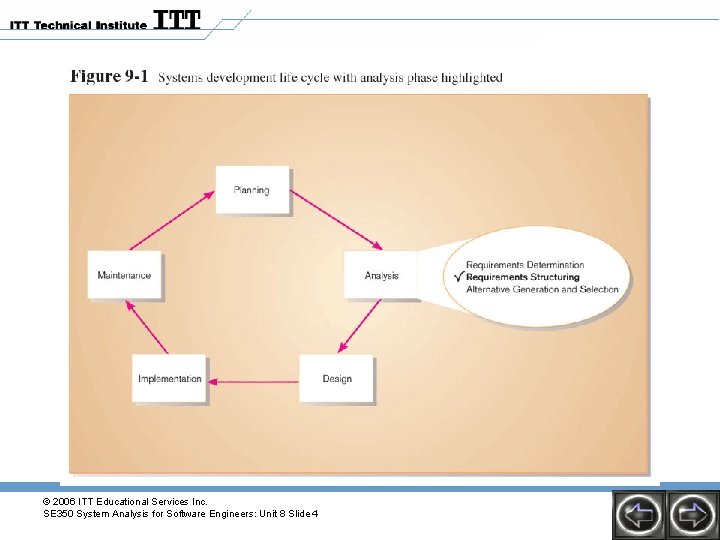
© 2006 ITT Educational Services Inc. SE 350 System Analysis for Software Engineers: Unit 8 Slide 4
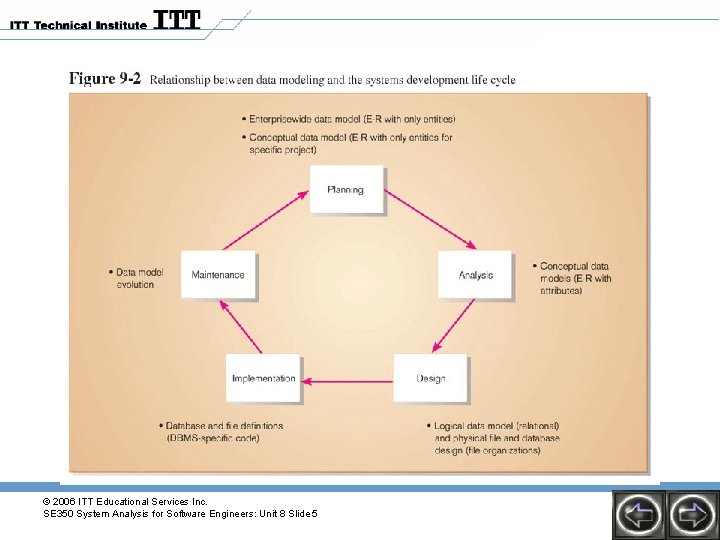
© 2006 ITT Educational Services Inc. SE 350 System Analysis for Software Engineers: Unit 8 Slide 5
Conceptual Data Modeling • A detailed model that captures the overall structure of data in an organization. • Independent of any database management system (DBMS) or other implementation considerations. © 2006 ITT Educational Services Inc. SE 350 System Analysis for Software Engineers: Unit 8 Slide 6
Process of Conceptual Data Modeling • Develop a data model for the current system. • Develop a new conceptual data model that includes all requirements of the new system. • In the design stage, the conceptual data model is translated into a physical design. • Project repository links all design and data modeling steps performed during SDLC. © 2006 ITT Educational Services Inc. SE 350 System Analysis for Software Engineers: Unit 8 Slide 7
Deliverables and Outcome • Primary deliverable is an entity-relationship (E-R) diagram or class diagram. • As many as 4 E-R or class diagrams are produced analyzed. Ø Ø E-R diagram that covers data needed in the project’s application. E-R diagram for the application being replaced. E-R diagram for the whole database from which the new application’s data are extracted. E-R diagram for the whole database from which data for the application system being replaced is drawn. © 2006 ITT Educational Services Inc. SE 350 System Analysis for Software Engineers: Unit 8 Slide 8
Deliverables and Outcome (cont. ) • Second deliverable is a set of entries about data objects to be stored in repository or project dictionary. Ø Ø Ø Repository links data, process, and logic models of an information system. Data elements included in the DFD must appear in the data model and vice versa. Each data store in a process model must relate to business objects represented in the data model. © 2006 ITT Educational Services Inc. SE 350 System Analysis for Software Engineers: Unit 8 Slide 9
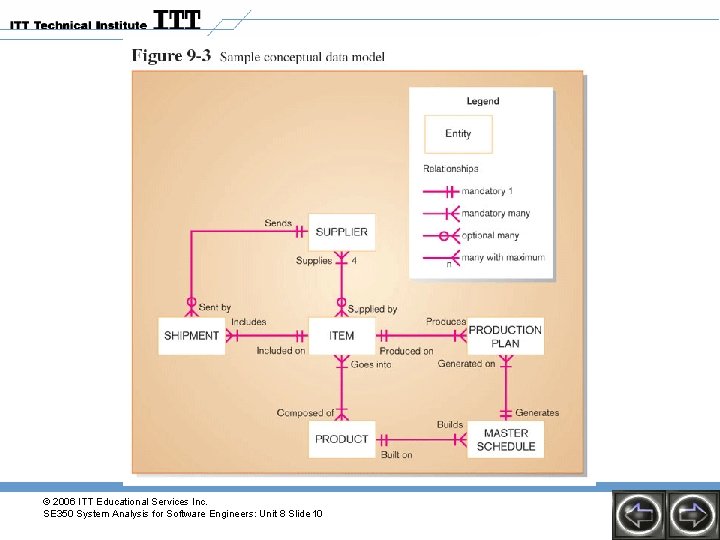
© 2006 ITT Educational Services Inc. SE 350 System Analysis for Software Engineers: Unit 8 Slide 10
Gathering Information for Conceptual Data Modeling • Two perspectives Ø Top-down • Data model is derived from an intimate understanding of the business. Ø Bottom-up • Data model is derived by reviewing specifications and business documents. © 2006 ITT Educational Services Inc. SE 350 System Analysis for Software Engineers: Unit 8 Slide 11
Requirements Determination Questions for Data Modeling • What are subjects/objects of the business? è Data entities and descriptions. • What unique characteristics distinguish between subjects/objects of the same type? è Primary keys. • What characteristics describe each subject/object? è Attributes and secondary keys. • How do you use the data? è Security controls and user access privileges. © 2006 ITT Educational Services Inc. SE 350 System Analysis for Software Engineers: Unit 8 Slide 12
Requirements Determination Questions for Data Modeling (cont. ) • Over what period of time are you interested in the data? è Cardinality and time dimensions. • Are all instances of each object the same? è Supertypes, subtypes, and aggregations. • What events occur that imply associations between objects? è Relationships and cardinalities. • Are there special circumstances that affect the way events are handled? è Integrity rules, cardinalities, time dimensions. © 2006 ITT Educational Services Inc. SE 350 System Analysis for Software Engineers: Unit 8 Slide 13
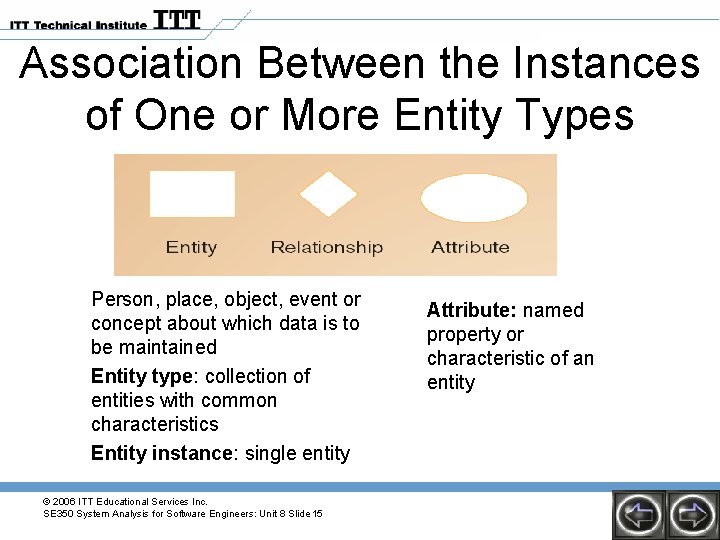
Introduction to Entity-Relationship (E-R) Modeling • Entity-Relationship (E-R) Diagram. Ø A detailed, logical representation of the entities, associations and data elements for an organization or business. • Notation uses three main constructs. Ø Ø Ø Data entities Relationships Attributes © 2006 ITT Educational Services Inc. SE 350 System Analysis for Software Engineers: Unit 8 Slide 14
Association Between the Instances of One or More Entity Types Person, place, object, event or concept about which data is to be maintained Entity type: collection of entities with common characteristics Entity instance: single entity © 2006 ITT Educational Services Inc. SE 350 System Analysis for Software Engineers: Unit 8 Slide 15 Attribute: named property or characteristic of an entity
Identifier Attributes • Candidate key Ø Attribute (or combination of attributes) that uniquely identifies each instance of an entity type. • Identifier Ø A candidate key that has been selected as the unique identifying characteristic for an entity type. © 2006 ITT Educational Services Inc. SE 350 System Analysis for Software Engineers: Unit 8 Slide 16
Identifier Attributes (cont. ) Selection rules for an identifier 1. Choose a candidate key that will not change its value. 2. Choose a candidate key that will never be null. 3. Avoid using intelligent keys. 4. Consider substituting single value surrogate keys for large composite keys. © 2006 ITT Educational Services Inc. SE 350 System Analysis for Software Engineers: Unit 8 Slide 17
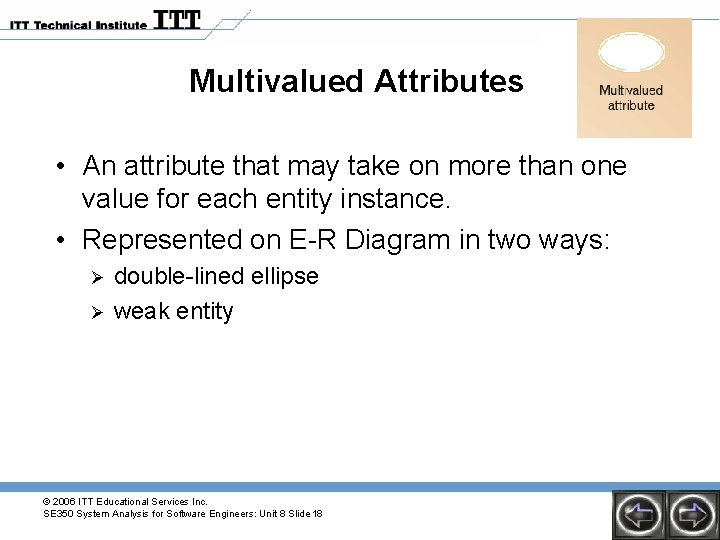
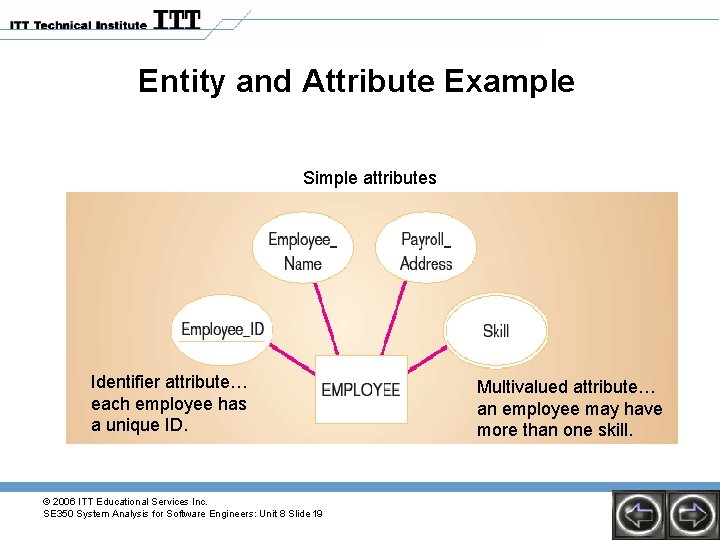
Multivalued Attributes • An attribute that may take on more than one value for each entity instance. • Represented on E-R Diagram in two ways: Ø Ø double-lined ellipse weak entity © 2006 ITT Educational Services Inc. SE 350 System Analysis for Software Engineers: Unit 8 Slide 18
Entity and Attribute Example Simple attributes Identifier attribute… each employee has a unique ID. © 2006 ITT Educational Services Inc. SE 350 System Analysis for Software Engineers: Unit 8 Slide 19 Multivalued attribute… an employee may have more than one skill.
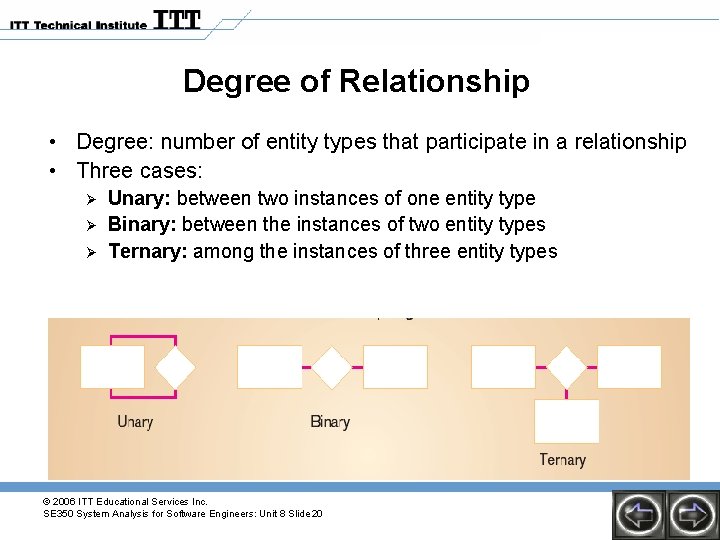
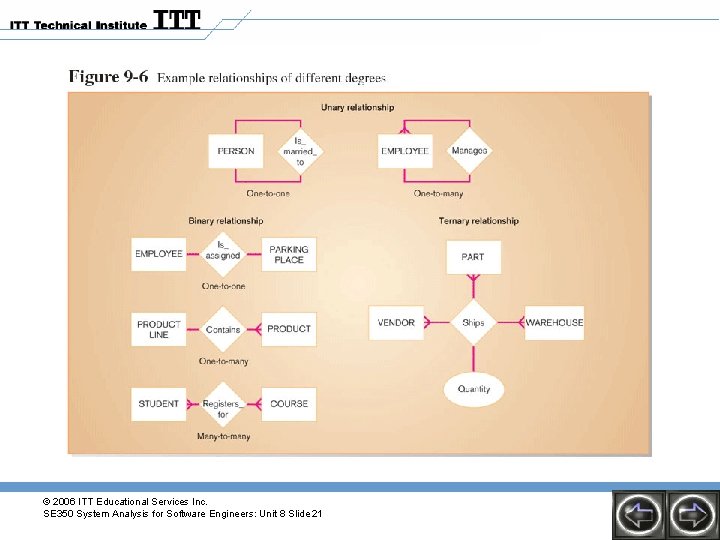
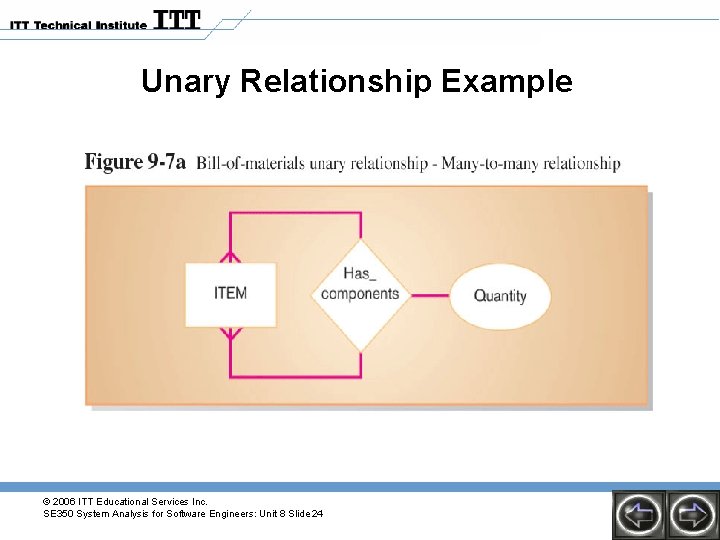
Degree of Relationship • Degree: number of entity types that participate in a relationship • Three cases: Ø Ø Ø Unary: between two instances of one entity type Binary: between the instances of two entity types Ternary: among the instances of three entity types © 2006 ITT Educational Services Inc. SE 350 System Analysis for Software Engineers: Unit 8 Slide 20
© 2006 ITT Educational Services Inc. SE 350 System Analysis for Software Engineers: Unit 8 Slide 21
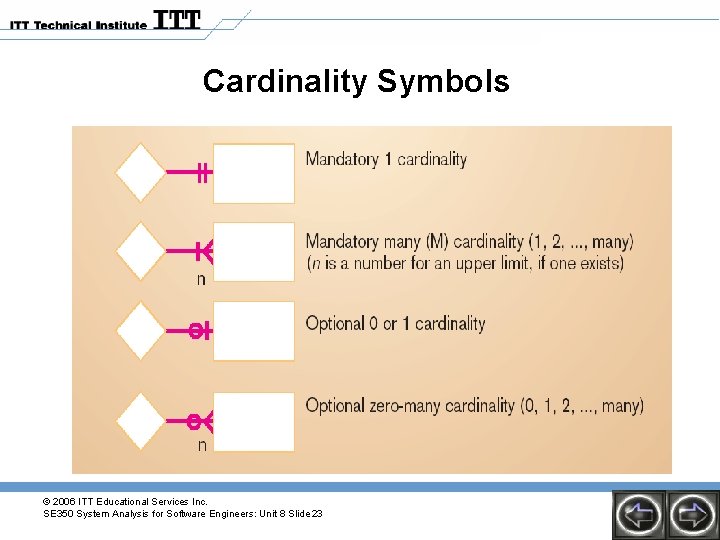
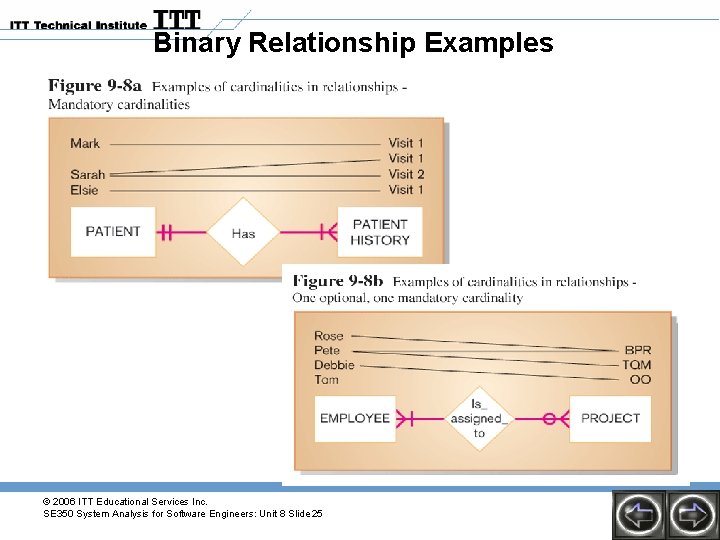
Cardinality • The number of instances of entity B that can or must be associated with each instance of entity A. • Minimum Cardinality Ø The minimum number of instances of entity B that may be associated with each instance of entity A. • Maximum Cardinality Ø The maximum number of instances of entity B that may be associated with each instance of entity A. • Mandatory vs. Optional Cardinalities Ø Specifies whether an instance must exist or can be absent in the relationship. © 2006 ITT Educational Services Inc. SE 350 System Analysis for Software Engineers: Unit 8 Slide 22
Cardinality Symbols © 2006 ITT Educational Services Inc. SE 350 System Analysis for Software Engineers: Unit 8 Slide 23
Unary Relationship Example © 2006 ITT Educational Services Inc. SE 350 System Analysis for Software Engineers: Unit 8 Slide 24
Binary Relationship Examples © 2006 ITT Educational Services Inc. SE 350 System Analysis for Software Engineers: Unit 8 Slide 25
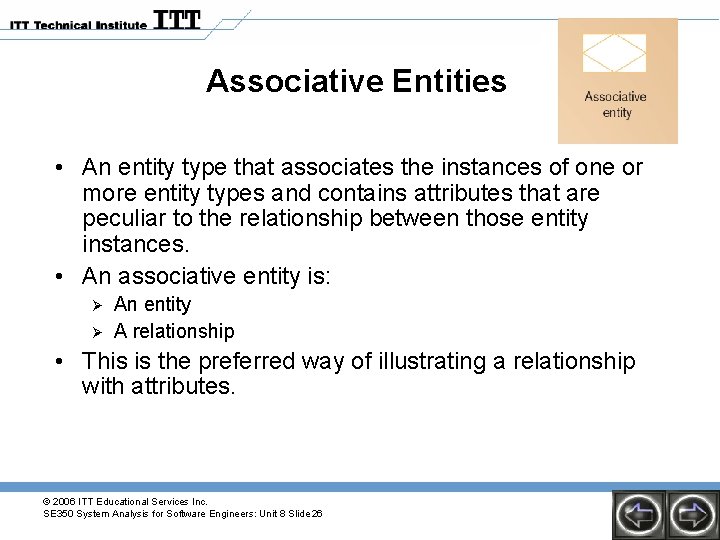
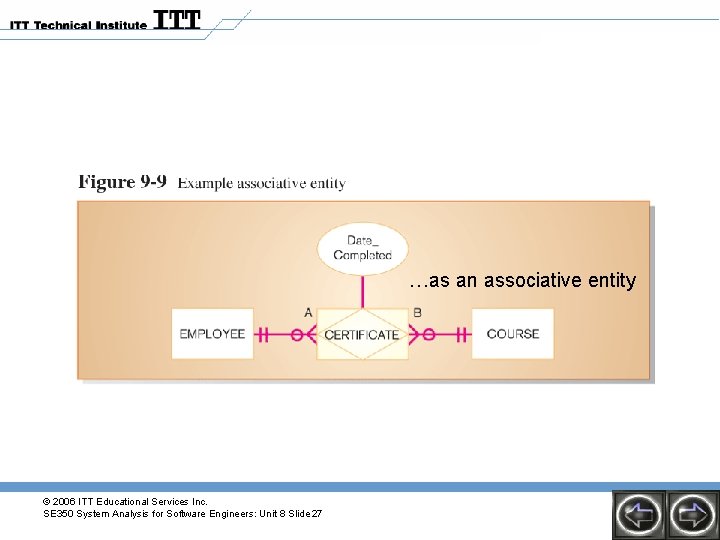
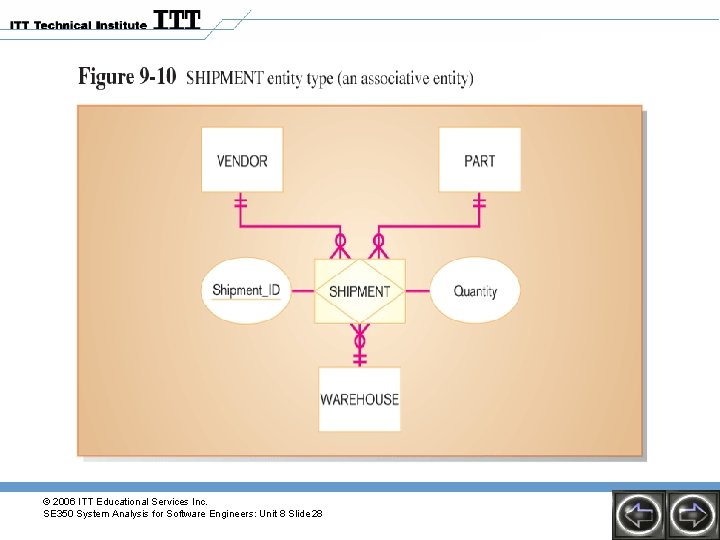
Associative Entities • An entity type that associates the instances of one or more entity types and contains attributes that are peculiar to the relationship between those entity instances. • An associative entity is: Ø Ø An entity A relationship • This is the preferred way of illustrating a relationship with attributes. © 2006 ITT Educational Services Inc. SE 350 System Analysis for Software Engineers: Unit 8 Slide 26
…as an associative entity © 2006 ITT Educational Services Inc. SE 350 System Analysis for Software Engineers: Unit 8 Slide 27
© 2006 ITT Educational Services Inc. SE 350 System Analysis for Software Engineers: Unit 8 Slide 28
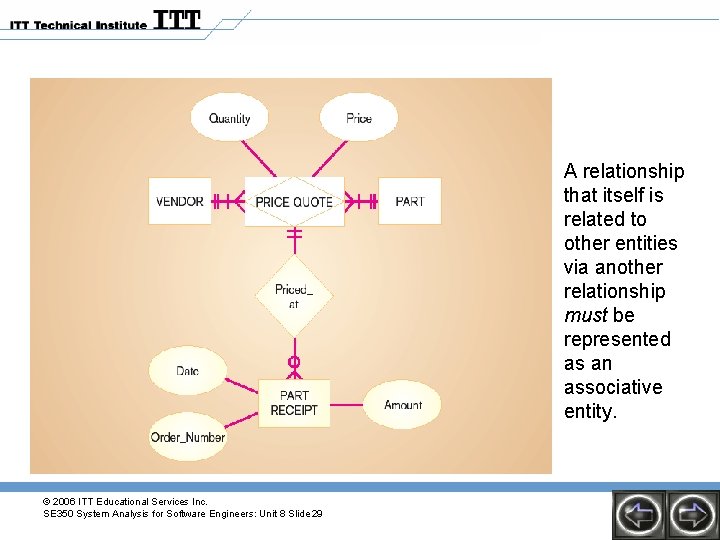
A relationship that itself is related to other entities via another relationship must be represented as an associative entity. © 2006 ITT Educational Services Inc. SE 350 System Analysis for Software Engineers: Unit 8 Slide 29
Supertypes and Subtypes • Subtype: a subrouping of the entities in an entity type that shares common attributes or relationships distinct from other subtypes. • Supertype: a generic entity type that has a relationship with one or more subtype. © 2006 ITT Educational Services Inc. SE 350 System Analysis for Software Engineers: Unit 8 Slide 30
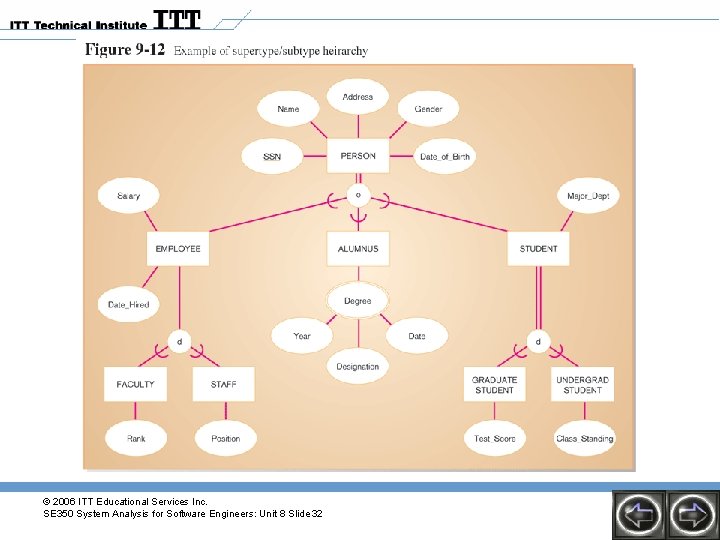
Rules for Supertype/Subtypes Relationships • Total specialization: an entity instance of the supertype must be an instance of one of the subtypes. • Partial specialization: an entity instance of the supertype may or may not be an instance of one of the subtypes. • Disjoint: an entity instance of the supertype can be an instance of only one subtype. • Overlap: an entity instance of the supertype may be an instance of multiple subtypes. © 2006 ITT Educational Services Inc. SE 350 System Analysis for Software Engineers: Unit 8 Slide 31
© 2006 ITT Educational Services Inc. SE 350 System Analysis for Software Engineers: Unit 8 Slide 32
Business Rules • Specifications that preserve the integrity of the logical data model. • Four types Ø Ø Entity integrity: unique, non-null identifiers. Referential integrity constraints: rules governing relationships. Domains: valid values for attributes. Triggering operations: other business rules regarding attribute values. © 2006 ITT Educational Services Inc. SE 350 System Analysis for Software Engineers: Unit 8 Slide 33
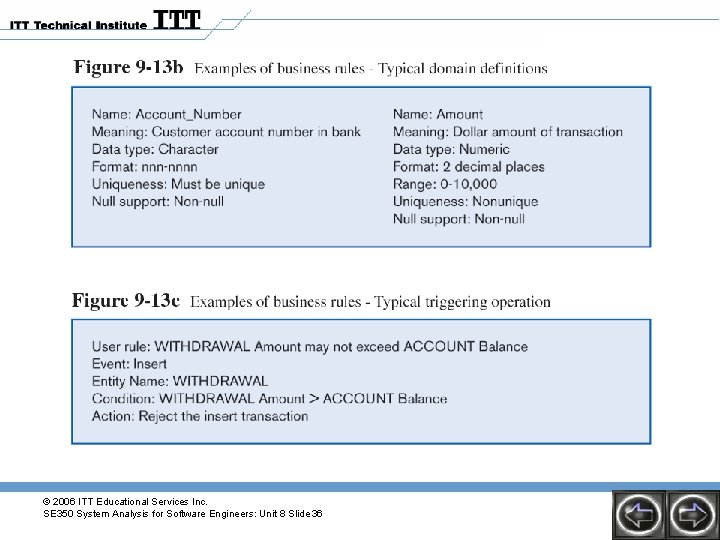
Domains are the set of all data types and ranges of values that an attribute can assume. Advantages: 1. Verify that the values for an attribute are valid. 2. Ensure that various data manipulation operations are logical. 3. Help conserve effort in describing attribute characteristics. © 2006 ITT Educational Services Inc. SE 350 System Analysis for Software Engineers: Unit 8 Slide 34
Triggering Operations • An assertion or rule that governs the validity of data manipulation operations such as insert, update and delete. • Components: Ø Ø Ø User rule: statement of the business rule to be enforced by the trigger. Event: data manipulation operation that initiates the operation. Entity Name: name of entity being accessed or modified. Condition: condition that causes the operation to be triggered. Action: action taken when the operation is triggered. © 2006 ITT Educational Services Inc. SE 350 System Analysis for Software Engineers: Unit 8 Slide 35
© 2006 ITT Educational Services Inc. SE 350 System Analysis for Software Engineers: Unit 8 Slide 36
Packaged Data Models • Generic data models that can be applied and modified for an organization. • Two categories: Ø Ø Universal Industry-specific • Benefits: Ø Ø Reduced implementation time and cost High-quality modeling © 2006 ITT Educational Services Inc. SE 350 System Analysis for Software Engineers: Unit 8 Slide 37
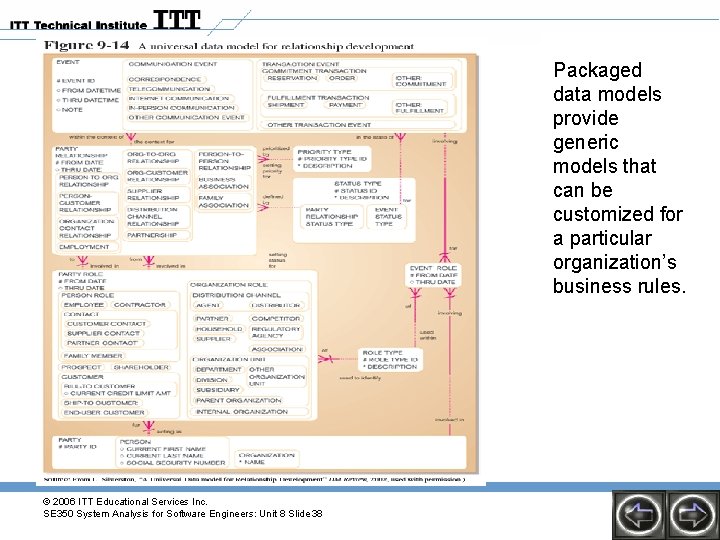
Packaged data models provide generic models that can be customized for a particular organization’s business rules. © 2006 ITT Educational Services Inc. SE 350 System Analysis for Software Engineers: Unit 8 Slide 38
Object Modeling Using Class Diagrams • Object-oriented approach • Based on Unified Modeling Language (UML) • Features: Ø Ø Objects and classes Encapsulation of attributes and operations Polymorphism Inheritance © 2006 ITT Educational Services Inc. SE 350 System Analysis for Software Engineers: Unit 8 Slide 39
Objects • Object: an entity with a well-defined role in an application. • Each object has: Ø Ø Ø State: encompasses the attributes, their values, and relationships of an object. Behavior: represents how an object acts and reacts. Identity: uniqueness, no two objects are the same. © 2006 ITT Educational Services Inc. SE 350 System Analysis for Software Engineers: Unit 8 Slide 40
Classes • Class: a logical grouping of objects with similar attributes and behaviors. • Operation: a function or service provided by all instances of a class. • Encapsulation: the technique of hiding internal implementation details of an object from external view. © 2006 ITT Educational Services Inc. SE 350 System Analysis for Software Engineers: Unit 8 Slide 41
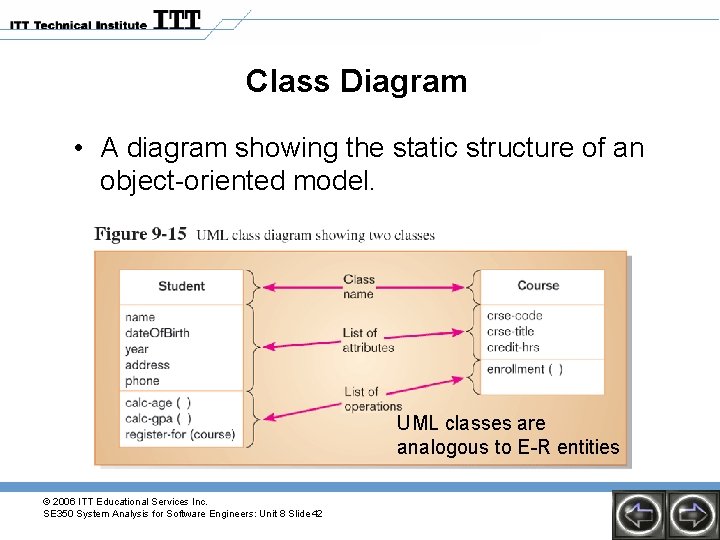
Class Diagram • A diagram showing the static structure of an object-oriented model. UML classes are analogous to E-R entities © 2006 ITT Educational Services Inc. SE 350 System Analysis for Software Engineers: Unit 8 Slide 42
Types of Operations • Constructor Ø Creates a new instance of a class. • Query Ø Accesses the state of an object. • Update Ø Alters the state of an object. • Scope Ø Applies to a full class rather than an individual instance. © 2006 ITT Educational Services Inc. SE 350 System Analysis for Software Engineers: Unit 8 Slide 43
Representing Associations • Association: a relationship among instances of object classes. • Association role: the end of an association where it connects to a class. • Multiplicity: indicates how many objects participate in a give relationship. © 2006 ITT Educational Services Inc. SE 350 System Analysis for Software Engineers: Unit 8 Slide 44
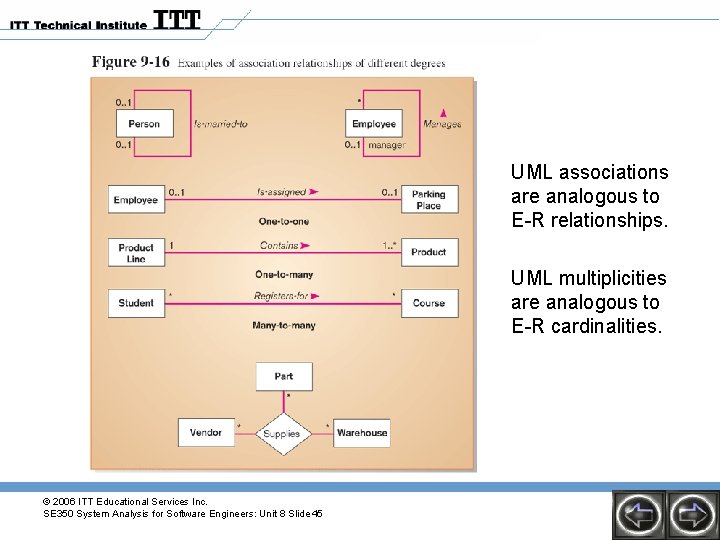
UML associations are analogous to E-R relationships. UML multiplicities are analogous to E-R cardinalities. © 2006 ITT Educational Services Inc. SE 350 System Analysis for Software Engineers: Unit 8 Slide 45
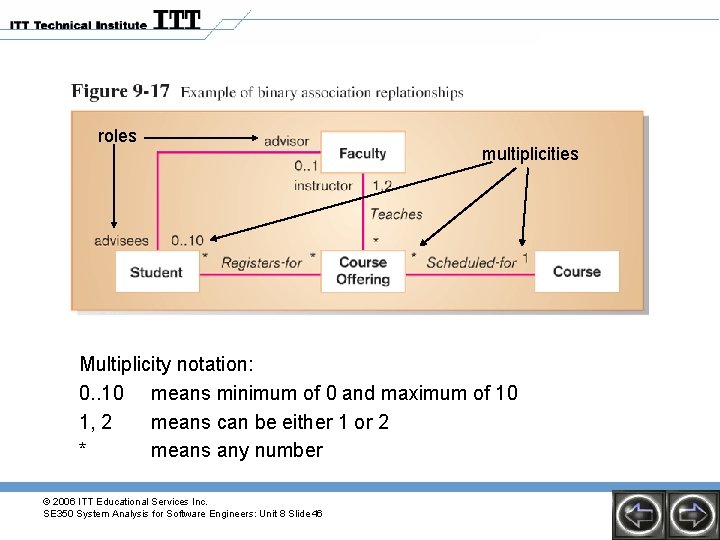
roles multiplicities Multiplicity notation: 0. . 10 means minimum of 0 and maximum of 10 1, 2 means can be either 1 or 2 * means any number © 2006 ITT Educational Services Inc. SE 350 System Analysis for Software Engineers: Unit 8 Slide 46
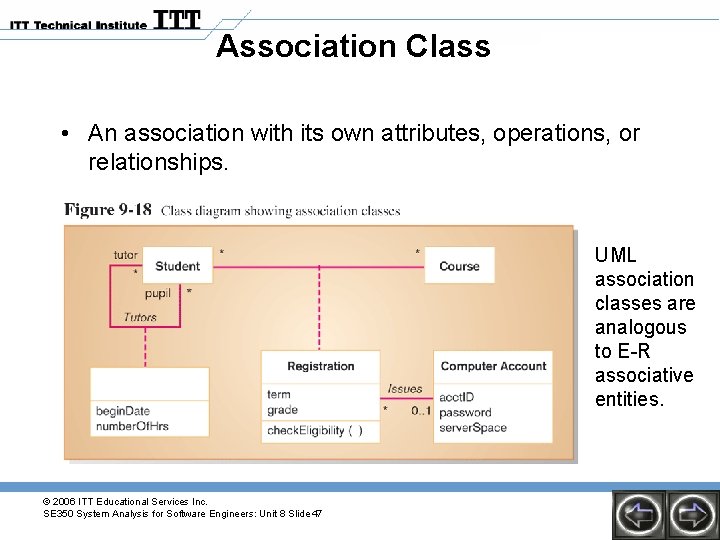
Association Class • An association with its own attributes, operations, or relationships. UML association classes are analogous to E-R associative entities. © 2006 ITT Educational Services Inc. SE 350 System Analysis for Software Engineers: Unit 8 Slide 47
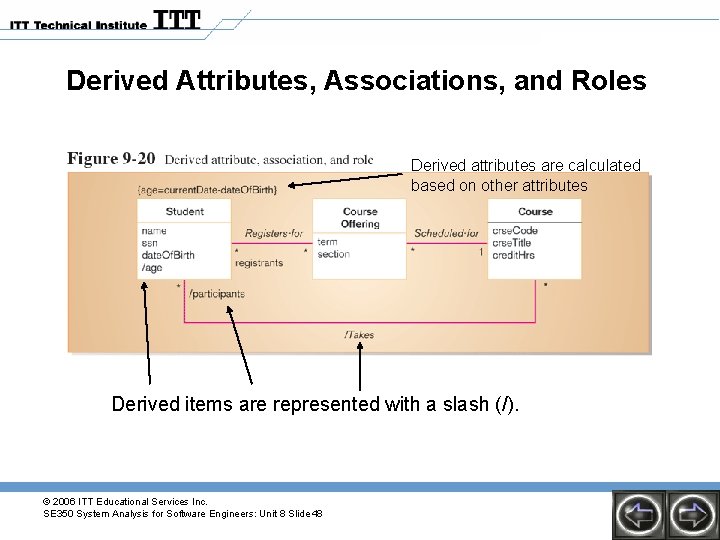
Derived Attributes, Associations, and Roles Derived attributes are calculated based on other attributes Derived items are represented with a slash (/). © 2006 ITT Educational Services Inc. SE 350 System Analysis for Software Engineers: Unit 8 Slide 48
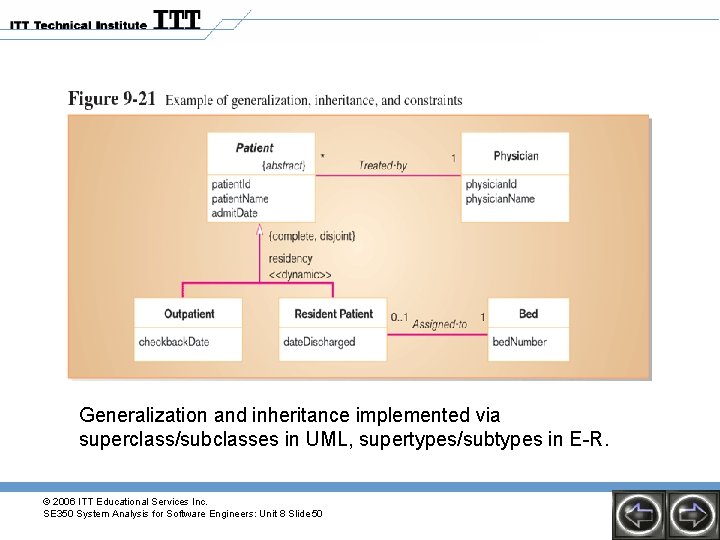
Generalization • Superclass-subclass relationships. • Subclass inherits attributes, operations, and associations of the superclass. • Types of superclasses: Ø Ø Abstract: cannot have any direct instances. Concrete: can have direct instances. © 2006 ITT Educational Services Inc. SE 350 System Analysis for Software Engineers: Unit 8 Slide 49
Generalization and inheritance implemented via superclass/subclasses in UML, supertypes/subtypes in E-R. © 2006 ITT Educational Services Inc. SE 350 System Analysis for Software Engineers: Unit 8 Slide 50
Polymorphic Operations • The same operation may apply to two or more classes in different ways. • Abstract operations: Ø Ø defined in abstract classes. defined the protocol, but not the implementation of an operation. • Methods: Ø the implementation of an operation. © 2006 ITT Educational Services Inc. SE 350 System Analysis for Software Engineers: Unit 8 Slide 51
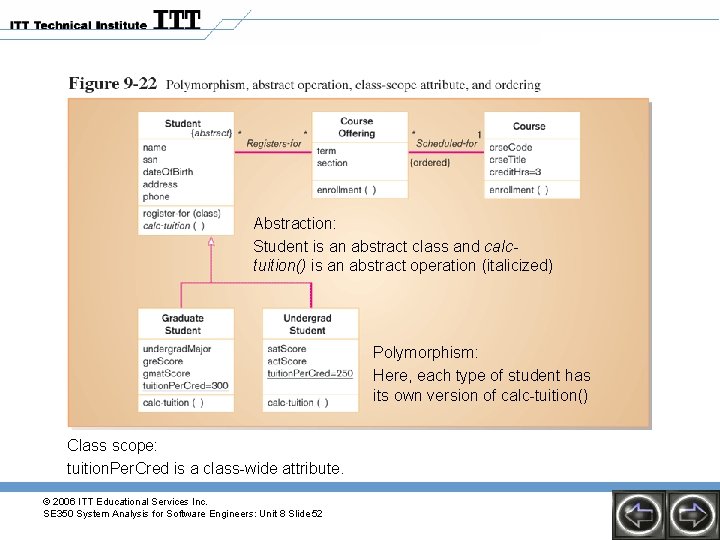
Abstraction: Student is an abstract class and calctuition() is an abstract operation (italicized) Polymorphism: Here, each type of student has its own version of calc-tuition() Class scope: tuition. Per. Cred is a class-wide attribute. © 2006 ITT Educational Services Inc. SE 350 System Analysis for Software Engineers: Unit 8 Slide 52
Aggregation and Composition • Aggregation Ø A part-of relationship between a component and an aggregate object. • Composition Ø An aggregation in which the part object belongs to only one aggregate object and lives and dies with the aggregate object. © 2006 ITT Educational Services Inc. SE 350 System Analysis for Software Engineers: Unit 8 Slide 53
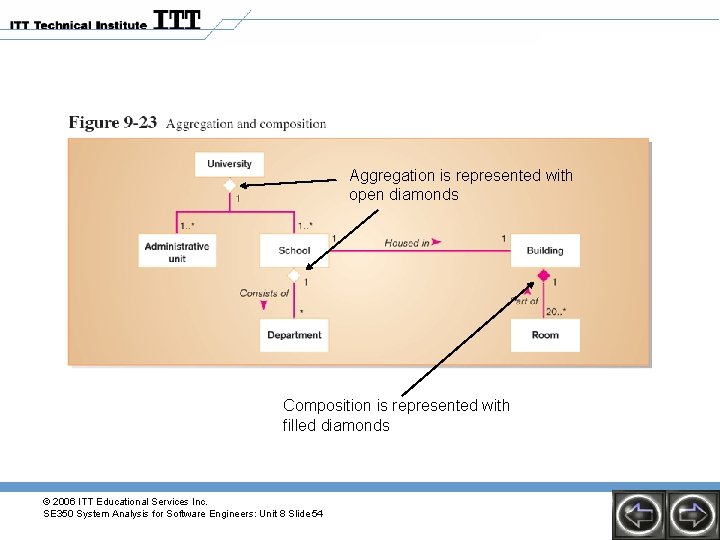
Aggregation is represented with open diamonds Composition is represented with filled diamonds © 2006 ITT Educational Services Inc. SE 350 System Analysis for Software Engineers: Unit 8 Slide 54
Summary In this chapter you learned how to: 11. Explain the role of conceptual data modeling in the overall analysis and design of information systems. Ø Define each of the following key data modeling terms concisely: entity type, attribute, multivalued attribute, relationship, degree, cardinality, business rule, associative entity, trigger, supertype, subtype, object, state, behavior, object class, class diagram, operation, encapsulation, association role, abstract class, polymorphism, aggregation, and composition. Ø Draw an entity-relationship (E-R) diagram or a class diagram to represent common business situations. © 2006 ITT Educational Services Inc. SE 350 System Analysis for Software Engineers: Unit 8 Slide 55
Summary Ø Ø Ø Distinguish between unary, binary, ternary relationships and give an example of each. Define four basic types of business rules in a conceptual data model. Explain the unique capabilities of class diagrams compared with E-R diagrams for modeling data. © 2006 ITT Educational Services Inc. SE 350 System Analysis for Software Engineers: Unit 8 Slide 56