
Chapter 9 Storage Retaining Information Storage Retaining Information
- Slides: 7
Chapter 9 Storage: Retaining Information
Storage: Retaining Information § Iconic Memory § a momentary sensory memory of visual stimuli § a photographic or picture image memory lasting no more that a few tenths of a second § Echoic Memory § momentary sensory memory of auditory stimuli
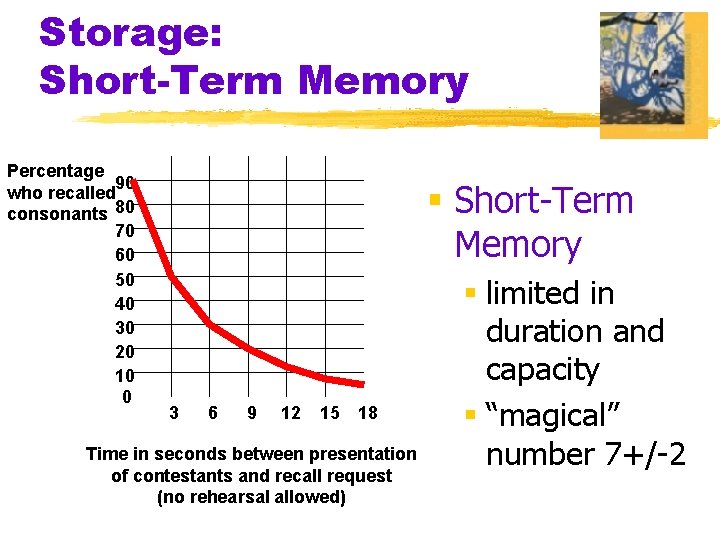
Storage: Short-Term Memory Percentage 90 who recalled consonants 80 70 60 50 40 30 20 10 0 § Short-Term Memory 3 6 9 12 15 18 Time in seconds between presentation of contestants and recall request (no rehearsal allowed) § limited in duration and capacity § “magical” number 7+/-2
Storage: Long-Term Memory § How does storage work? § Karl Lashley (1950) § rats learn maze § lesion cortex § test memory § Synaptic changes § Long-term Potentiation § increase in synapse’s firing potential after brief, rapid stimulation § Strong emotions make for stronger memories § some stress hormones boost learning and retention
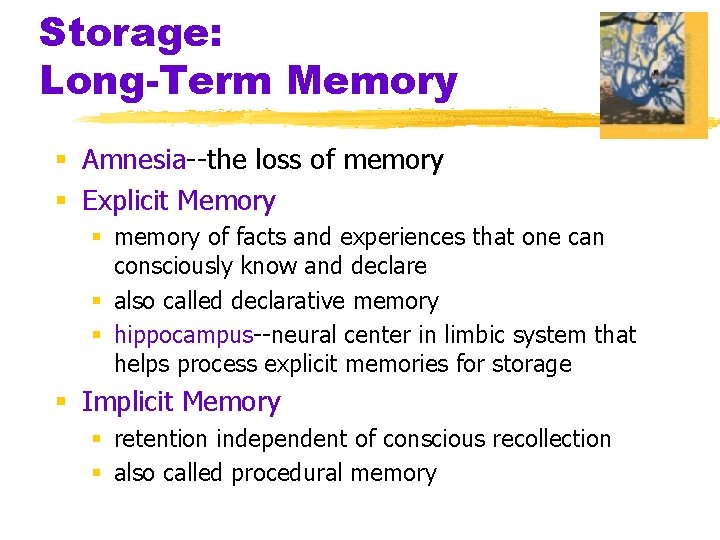
Storage: Long-Term Memory § Amnesia--the loss of memory § Explicit Memory § memory of facts and experiences that one can consciously know and declare § also called declarative memory § hippocampus--neural center in limbic system that helps process explicit memories for storage § Implicit Memory § retention independent of conscious recollection § also called procedural memory
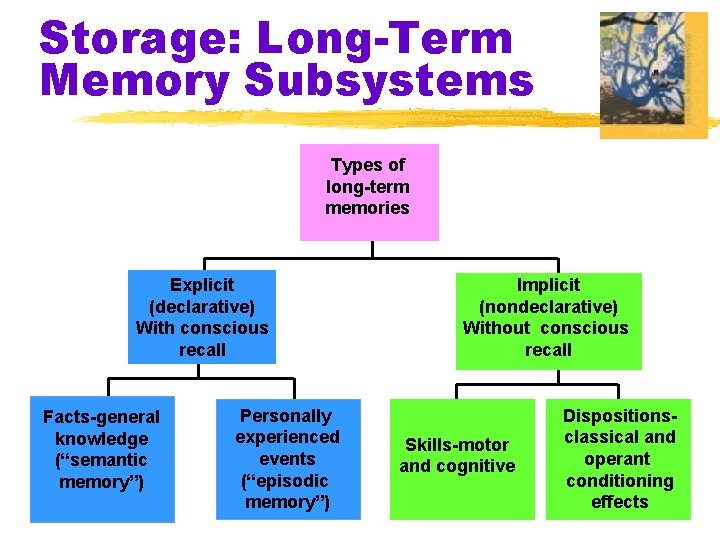
Storage: Long-Term Memory Subsystems Types of long-term memories Explicit (declarative) With conscious recall Facts-general knowledge (“semantic memory”) Personally experienced events (“episodic memory”) Implicit (nondeclarative) Without conscious recall Skills-motor and cognitive Dispositionsclassical and operant conditioning effects
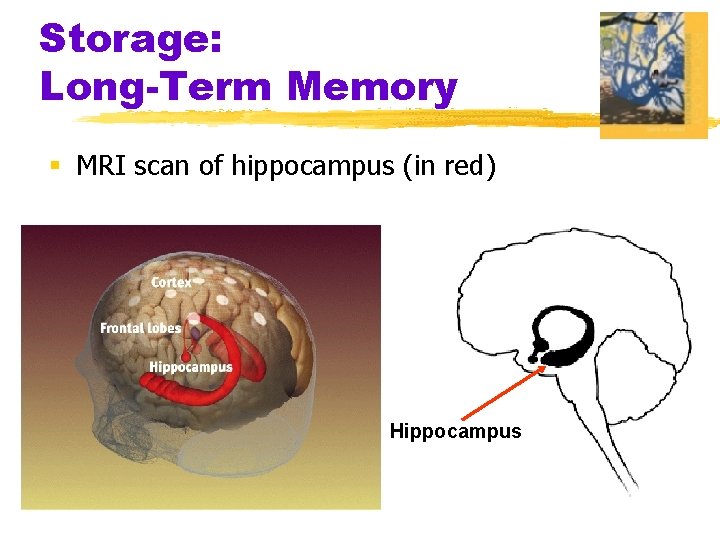
Storage: Long-Term Memory § MRI scan of hippocampus (in red) Hippocampus