
Chapter 9 Stoichiometry 9 1 Intro to Stoichiometry


- Slides: 13
Chapter 9 Stoichiometry 9. 1 Intro to Stoichiometry
Balanced Chemical Equations -Help us to calculate how much reactant is needed or how much product will be formed in a reaction. -Stoichiometry – Branch of chemistry involving the calculations of quantities in chemical reactions
Cayla is using a recipe to make chocolate chip cookies. She wants to double the number of cookies that the recipe will make. The original recipe calls for 2 cups of chocolate chips. How many cups of chips should Cayla use for a double recipe? A. 2 cups C. 1 cup B. 4 cups D. 8 cups
Cayla is using a recipe to make chocolate chip cookies. She wants to double the number of cookies that the recipe will make. The original recipe calls for 2 cups of chocolate chips. How many cups of chips should Cayla use for a double recipe? A. 2 cups C. 1 cup B. 4 cups D. 8 cups
Stoichiometry is the cooking of Chemistry! Copyright © Pearson Education, Inc. , or its affiliates. All Rights Reserved.
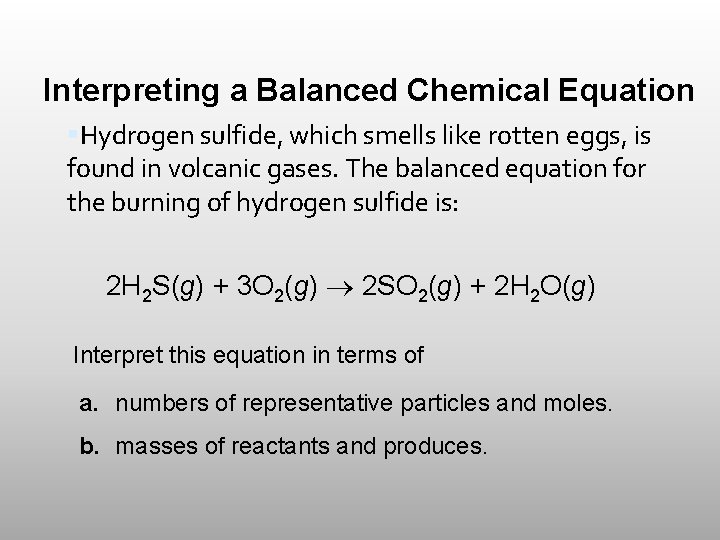
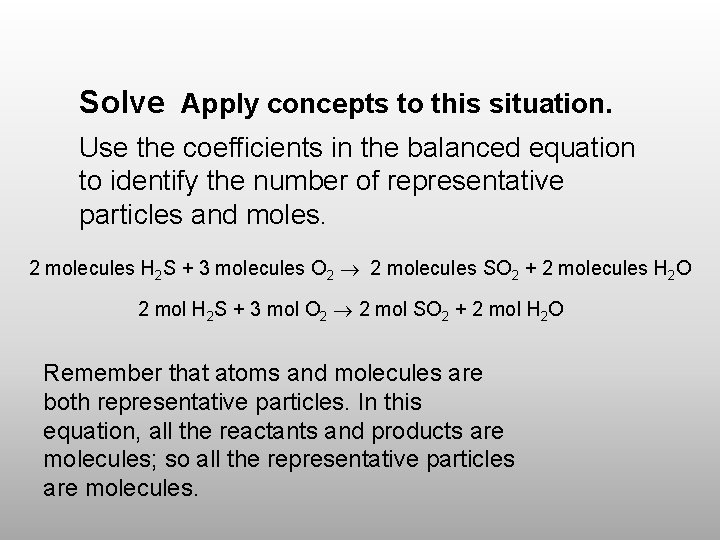
Interpreting a Balanced Chemical Equation Hydrogen sulfide, which smells like rotten eggs, is found in volcanic gases. The balanced equation for the burning of hydrogen sulfide is: 2 H 2 S(g) + 3 O 2(g) 2 SO 2(g) + 2 H 2 O(g) Interpret this equation in terms of a. numbers of representative particles and moles. b. masses of reactants and produces.
Solve Apply concepts to this situation. Use the coefficients in the balanced equation to identify the number of representative particles and moles. 2 molecules H 2 S + 3 molecules O 2 2 molecules SO 2 + 2 molecules H 2 O 2 mol H 2 S + 3 mol O 2 2 mol SO 2 + 2 mol H 2 O Remember that atoms and molecules are both representative particles. In this equation, all the reactants and products are molecules; so all the representative particles are molecules.
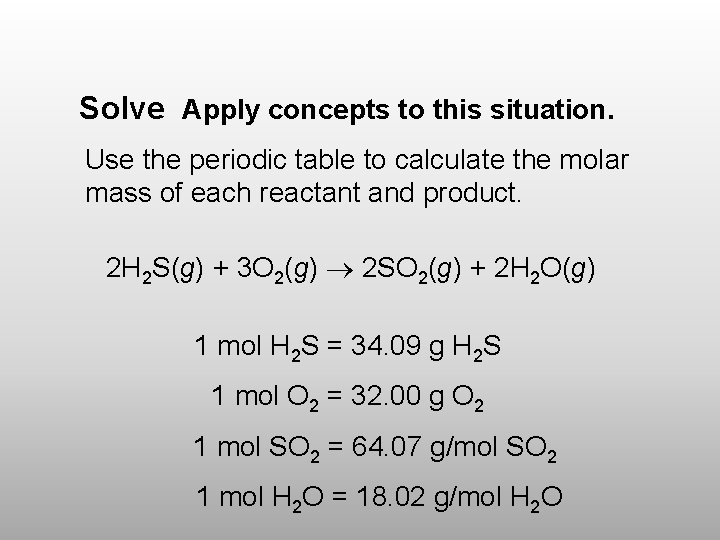
Solve Apply concepts to this situation. Use the periodic table to calculate the molar mass of each reactant and product. 2 H 2 S(g) + 3 O 2(g) 2 SO 2(g) + 2 H 2 O(g) 1 mol H 2 S = 34. 09 g H 2 S 1 mol O 2 = 32. 00 g O 2 1 mol SO 2 = 64. 07 g/mol SO 2 1 mol H 2 O = 18. 02 g/mol H 2 O
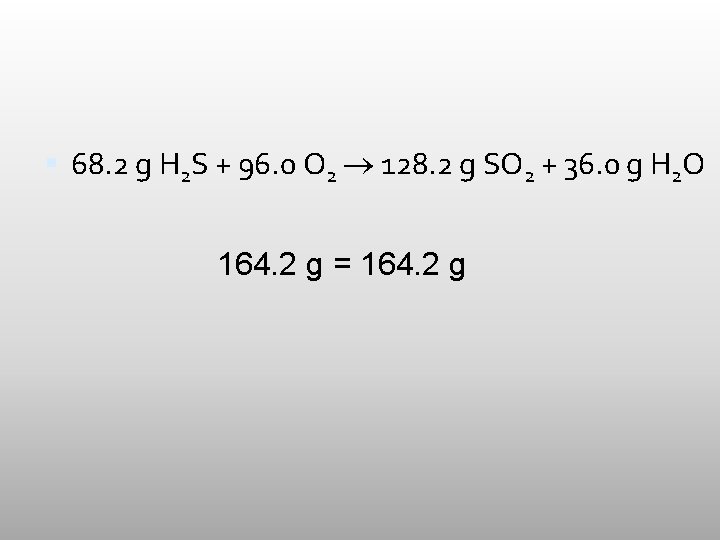
68. 2 g H 2 S + 96. 0 O 2 128. 2 g SO 2 + 36. 0 g H 2 O 164. 2 g = 164. 2 g
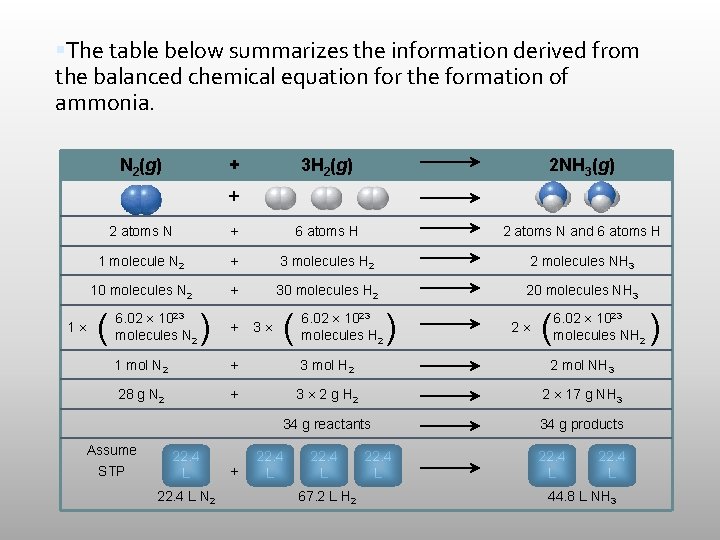
The table below summarizes the information derived from the balanced chemical equation for the formation of ammonia. N 2(g) + 3 H 2(g) 2 NH 3(g) + 1 2 atoms N + 6 atoms H 2 atoms N and 6 atoms H 1 molecule N 2 + 3 molecules H 2 2 molecules NH 3 10 molecules N 2 + 30 molecules H 2 20 molecules NH 3 ( 6. 02 1023 molecules N 2 ) + 3 ( 6. 02 1023 molecules H 2 ) 2 ( 6. 02 1023 molecules NH 2 1 mol N 2 + 3 mol H 2 2 mol NH 3 28 g N 2 + 3 2 g H 2 2 17 g NH 3 34 g reactants 34 g products Assume STP 22. 4 L N 2 + 22. 4 L 67. 2 L H 2 22. 4 L 44. 8 L NH 3 )
Mass and atoms are conserved in every chemical reaction.
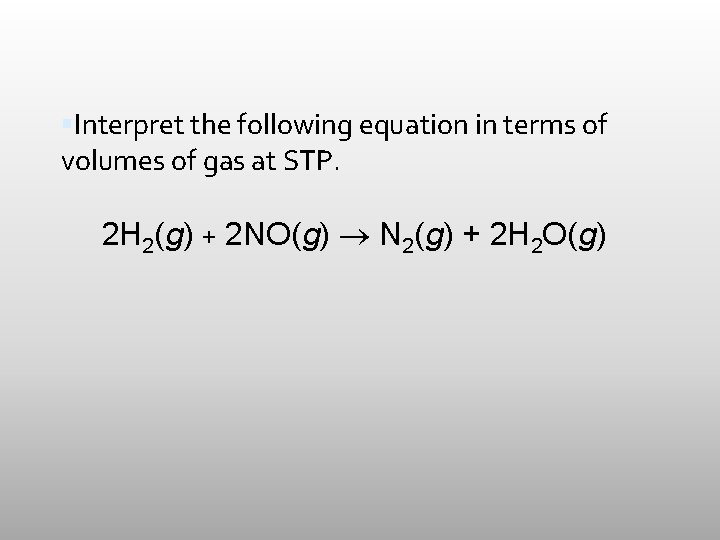
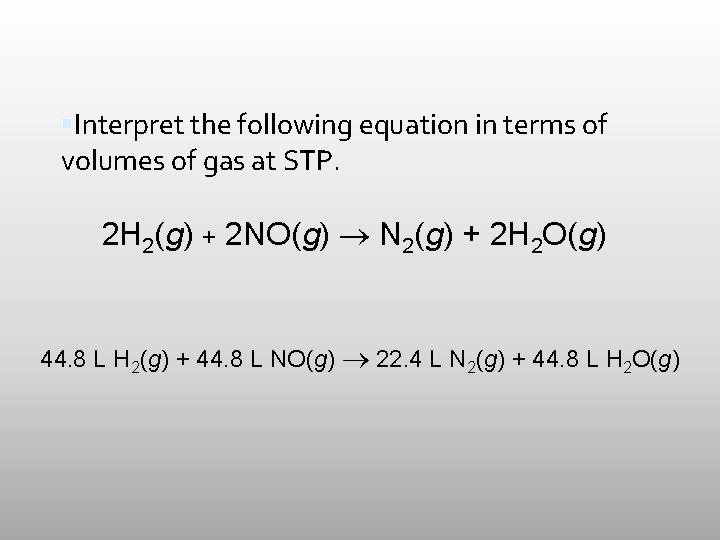
Interpret the following equation in terms of volumes of gas at STP. 2 H 2(g) + 2 NO(g) N 2(g) + 2 H 2 O(g)
Interpret the following equation in terms of volumes of gas at STP. 2 H 2(g) + 2 NO(g) N 2(g) + 2 H 2 O(g) 44. 8 L H 2(g) + 44. 8 L NO(g) 22. 4 L N 2(g) + 44. 8 L H 2 O(g)