
Chapter 9 Staffing Training and Compensation for Global

Chapter 9: Staffing, Training, and Compensation for Global Operations 9 -1 Copyright © 2017 Pearson Education, Inc. Ninth Edition
Chapter Learning Goals 1. To understand the strategic importance to the firm of the IHRM function and its various responsibilities 2. To learn about the major staffing options for global operations and the factors involved in those choices 9 -2 Copyright © 2017 Pearson Education, Inc.
Chapter Learning Goals 3. To emphasize the need for managing the performance of expatriates through careful selection, training, and compensation 4. To discuss the role of host country managers and the need for their training and appropriate compensation packages 9 -3 Copyright © 2017 Pearson Education, Inc.
Opening Profile: Staffing Company Operations in Emerging Markets BRIC Countries 9 -4 Copyright © 2017 Pearson Education, Inc. Many are simply not at the skill level required by foreign companie s BRIC Need for up to 75000 business leaders, but 3000– 5000 may be available BRIC Have outpaced the supply of mid and upper -level managem ent
Chapter Learning Goals To understand the strategic importance to the firm of the IHRM function and its various responsibilities 9 -5 Copyright © 2017 Pearson Education, Inc.

9 -6 Copyright © 2017 Pearson Education, Inc. Deficit starting at the middle level. Also, dealing with the “brain drain” China Deficit at all managem ent levels India Deficit at upperlevel managem ent Russia Brazil Opening Profile: BRIC—The Shortage of Mid/Upper-Level Managers Severe deficit at all levels of managem ent
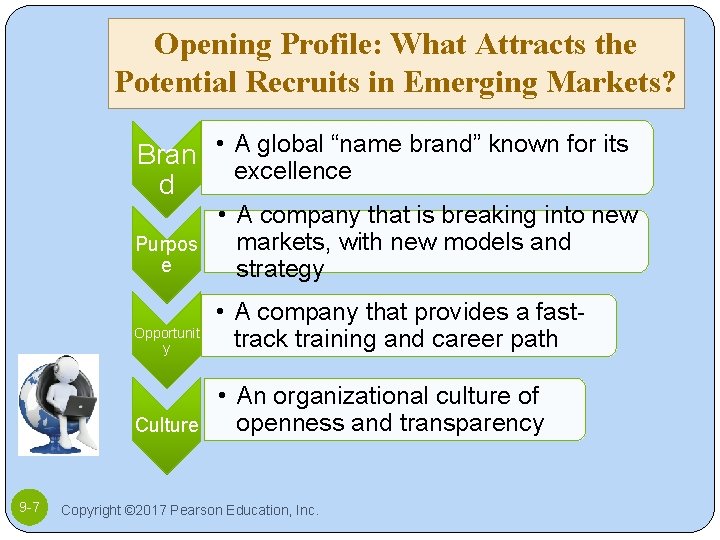
Opening Profile: What Attracts the Potential Recruits in Emerging Markets? Bran • A global “name brand” known for its excellence d 9 -7 Purpos e • A company that is breaking into new markets, with new models and strategy Opportunit y • A company that provides a fasttrack training and career path Culture • An organizational culture of openness and transparency Copyright © 2017 Pearson Education, Inc.
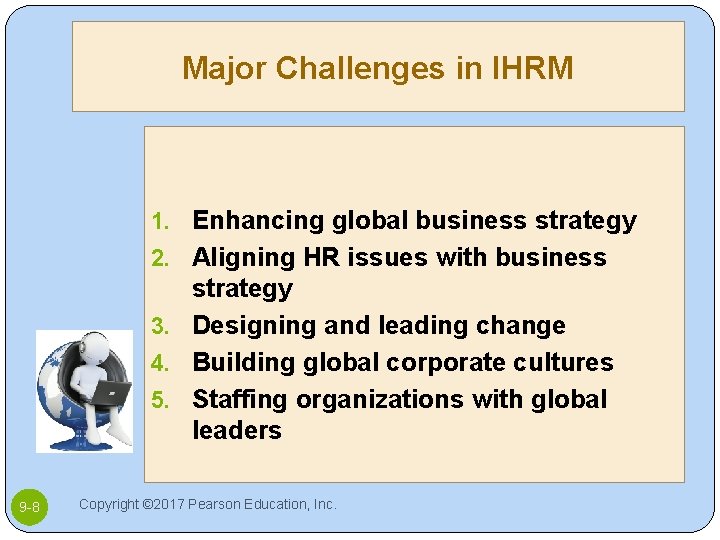
Major Challenges in IHRM 1. Enhancing global business strategy 2. Aligning HR issues with business strategy 3. Designing and leading change 4. Building global corporate cultures 5. Staffing organizations with global leaders 9 -8 Copyright © 2017 Pearson Education, Inc.
Chapter Learning Goals To learn about the major staffing options for global operations and the factors involved in those choices 9 -9 Copyright © 2017 Pearson Education, Inc.

Staffing for Global Operations Ethnocentric Approach Used at Polycentric Approach Often used with internationalization multinational stage of strategic strategy expansion, with Host-country centralized structure nationals (HCNs) Parent-country nationals (PCNs) 9 -10 Copyright © 2017 Pearson Education, Inc.
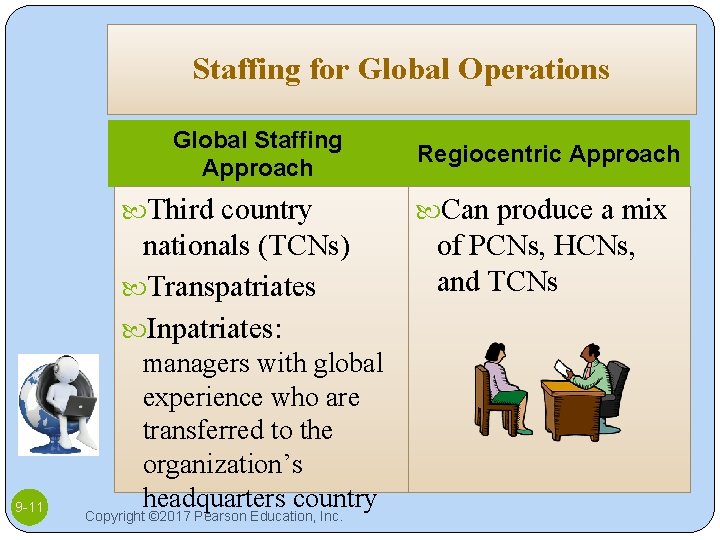
Staffing for Global Operations Global Staffing Approach Third country nationals (TCNs) Transpatriates Inpatriates: 9 -11 managers with global experience who are transferred to the organization’s headquarters country Copyright © 2017 Pearson Education, Inc. Regiocentric Approach Can produce a mix of PCNs, HCNs, and TCNs

Maintaining a Globalization Momentum 9 -12 Copyright © 2017 Pearson Education, Inc.

Strategic Mode, Organizational Variables, and Staffing Orientation Aspect of enterprise Ethnocentric Strategic orientation International Expatriates Perpetuation used for key positions Evaluation and control Rewards 9 -10 Home standards applied Polycentric Global Multidomestic Regional Transnational Locals used for key positions locally Regional people used regionally Best people used anywhere Determined locally Determined regionally Globally integrated Based on contribution to regional objectives Based on contribution to local and worldwide objectives High at home; Wide low in variation subsidiaries Copyright © 2017 Pearson Education, Inc. Regiocentric

MNC Staffing Most MNCs start from their own pool of managers polycentric or regiocentric policy: Increasing pressure from local governments to hire locals The greater cost of expatriate staffing Improvement in managerial and technical competence “All things being equal, a local national who speaks the language, understands the culture and the political system, and is often a member of the local elite should be more effective than an expatriate alien” 9 -14 Copyright © 2017 Pearson Education, Inc.

Global Mind-set Attributes for Successful Expatriates Intellectual capital Psychological capital Social capital 9 -15 Copyright © 2017 Pearson Education, Inc.
Chapter Learning Goals To emphasize the need for managing the performance of expatriates through careful selection, training, and compensation 9 -16 Copyright © 2017 Pearson Education, Inc.
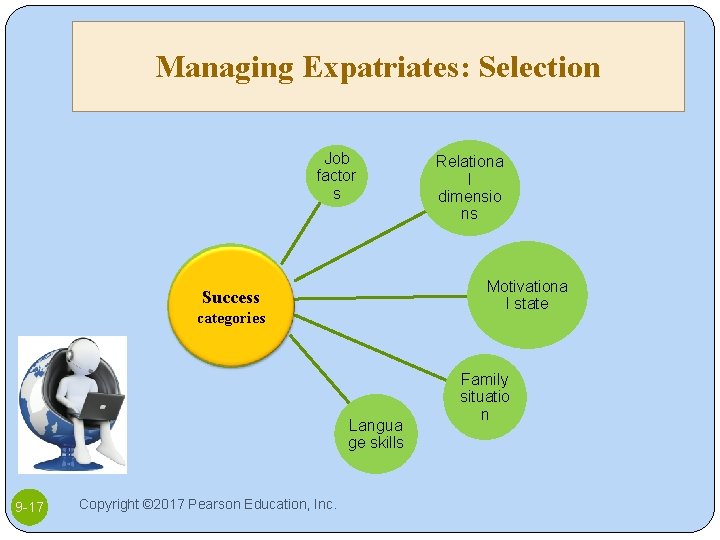
Managing Expatriates: Selection Job factor s Motivationa l state Success categories Langua ge skills 9 -17 Copyright © 2017 Pearson Education, Inc. Relationa l dimensio ns Family situatio n
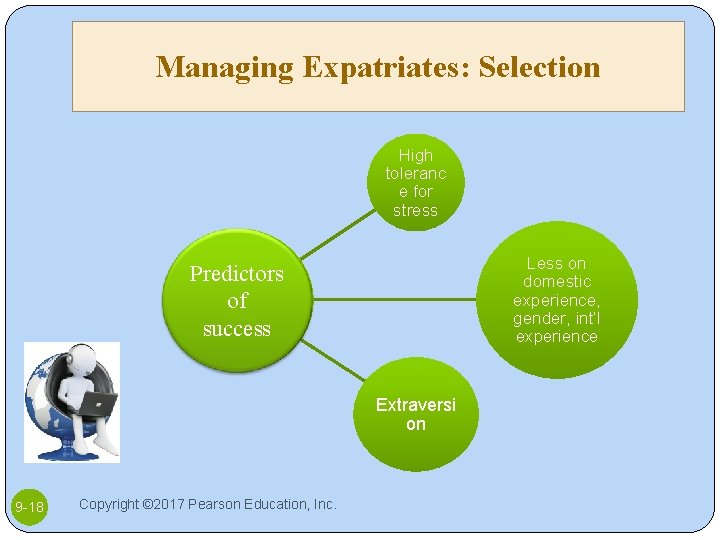
Managing Expatriates: Selection High toleranc e for stress Less on domestic experience, gender, int’l experience Predictors of success Extraversi on 9 -18 Copyright © 2017 Pearson Education, Inc.
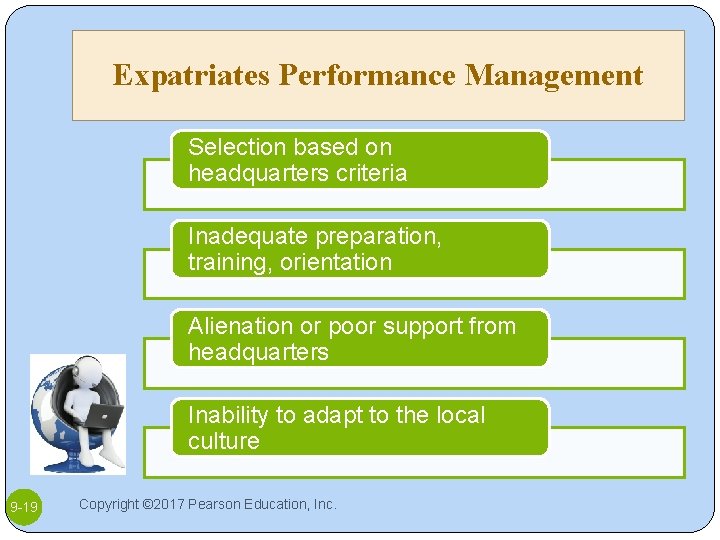
Expatriates Performance Management Selection based on headquarters criteria Inadequate preparation, training, orientation Alienation or poor support from headquarters Inability to adapt to the local culture 9 -19 Copyright © 2017 Pearson Education, Inc.
Expatriates Performance Management Problems with spouse and children Insufficient compensation and financial support Poor programs for career support and repatriation 9 -20 Copyright © 2017 Pearson Education, Inc.
Comparative Management in Focus: Expatriate Performance Management Practices: Samples from Five Countries 1. Goal setting 2. Performance Appraisal 3. Training and Development 4. Performance-related Pay 9 -21 Copyright © 2017 Pearson Education, Inc.
Global Team Performance Management 1. Expatriate performance on a team, based on decisions made with team members in various countries, cultures, and time zones 2. Discussions conducted through teleconferencing, Skyping, and social media 3. Careful selection and training of team members for insight, local knowledge, and group creativity 9 -22 Copyright © 2017 Pearson Education, Inc.
Expatriate Training and Development • Eating duck tongue and pigeon Chin head a Braz • Home phones don’t work il • Pervasive poverty India Indones ia • Rent paid 2– 3 years in advance Japa • Doctors reveal little to patients n 9 -23 Copyright © 2017 Pearson Education, Inc.
Expatriate Training and Development Japanese Expatriate Planning 9 -24 Copyright © 2017 Pearson Education, Inc. • Selection based on long-term knowledge of executives and their families • Use of longer assignments (e. g. , 5 years) • Extensive headquarters support
Culture Shock 1. Honeymoon 2. Irritation and hostility 3. Gradual adjustment 4. Biculturalism 9 -25 Copyright © 2017 Pearson Education, Inc.
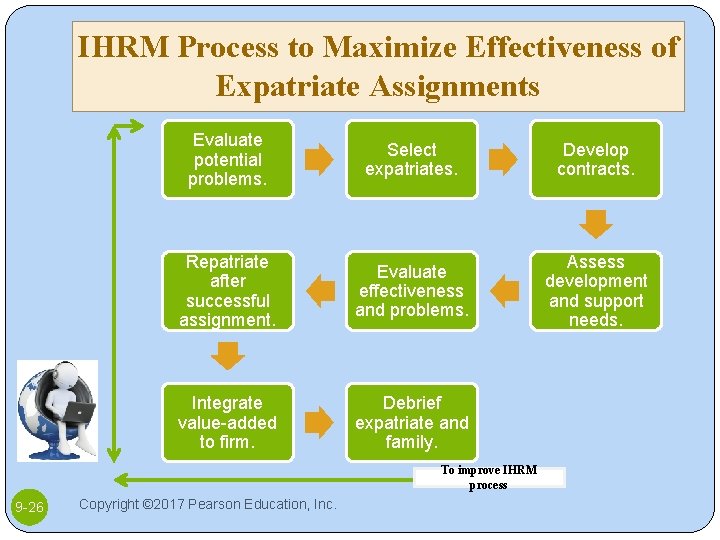
IHRM Process to Maximize Effectiveness of Expatriate Assignments Evaluate potential problems. Select expatriates. Develop contracts. Repatriate after successful assignment. Evaluate effectiveness and problems. Assess development and support needs. Integrate value-added to firm. Debrief expatriate and family. To improve IHRM process 9 -26 Copyright © 2017 Pearson Education, Inc.
Cross-Cultural Training 9 -27 Culture Shock • A state of disorientation and anxiety about not knowing how to behave in an unfamiliar culture • The goal of training is to ease the adjustment to the new environment Subcultu re Shock • When a manager is transferred to another part of the country, where there are cultural differences • The “shock” comes from feeling like an “immigrant” in one’s own country Copyright © 2017 Pearson Education, Inc.
Corporate Programs to Develop Global Managers ABB rotates managers to different countries to develop transpatriots Pepsi. Co has an orientation program foreign managers British Telecom uses informal mentoring techniques Honda offers Japanese language and culture preparation General Electric wants managers to have a global perspective 9 -28 Copyright © 2017 Pearson Education, Inc.
Integrating Training with Global Orientation Export Stage Training need: low to moderate Content: interpersonal skills, culture, customer values, business behavior HCNs: train to understand parent-country products and policies 9 -29 Copyright © 2017 Pearson Education, Inc. Multi-domestic Stage Training need: moderate to high Content: interpersonal skills, culture, technology transfer, business practices and laws HCNs: familiarize with production and service procedures
Integrating Training with Global Orientation Multinational Stage Training need: high moderate to high Training need: high Content: global corporate operations, corporate culture skills, two-way technology transfer, corporate value transfer, customers, transfer, strategy, stress global competitors, management, culture, strategy business practices HCNs: training in proficiency in HCNs: training in technical areas, products production and services, corporate efficiency systems, culture corporate culture, Copyright © 2017 Pearson Education, Inc. business systems, Content: interpersonal 9 -30 Global Stage
Chapter Learning Goals To discuss the role of host country managers and the need for their training and appropriate compensation package. 9 -31 Copyright © 2017 Pearson Education, Inc.
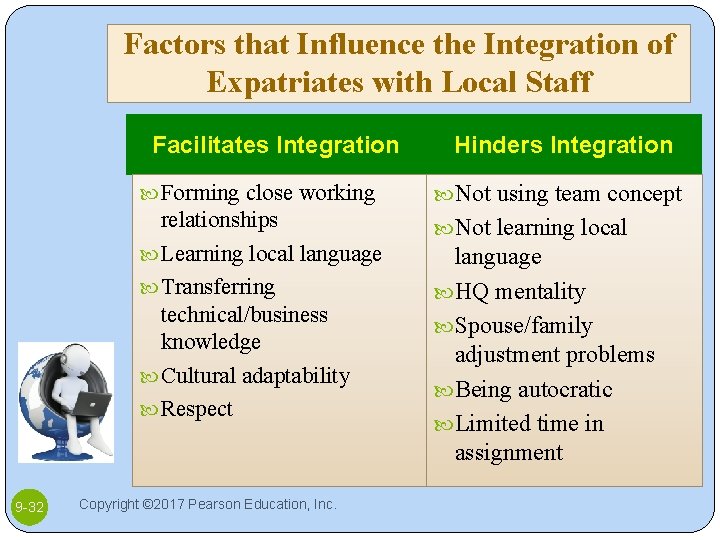
Factors that Influence the Integration of Expatriates with Local Staff Facilitates Integration 9 -32 Hinders Integration Forming close working Not using team concept relationships Learning local language Transferring technical/business knowledge Cultural adaptability Respect Not learning local Copyright © 2017 Pearson Education, Inc. language HQ mentality Spouse/family adjustment problems Being autocratic Limited time in assignment
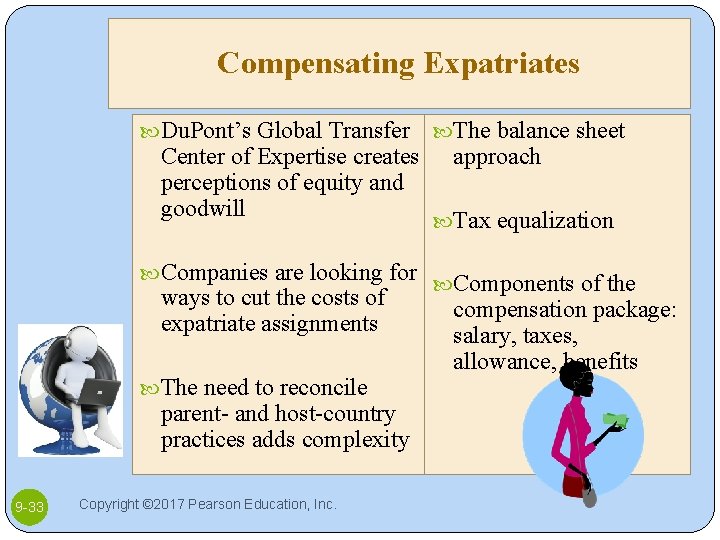
Compensating Expatriates Du. Pont’s Global Transfer The balance sheet Center of Expertise creates approach perceptions of equity and goodwill Tax equalization Companies are looking for ways to cut the costs of expatriate assignments The need to reconcile parent- and host-country practices adds complexity 9 -33 Copyright © 2017 Pearson Education, Inc. Components of the compensation package: salary, taxes, allowance, benefits
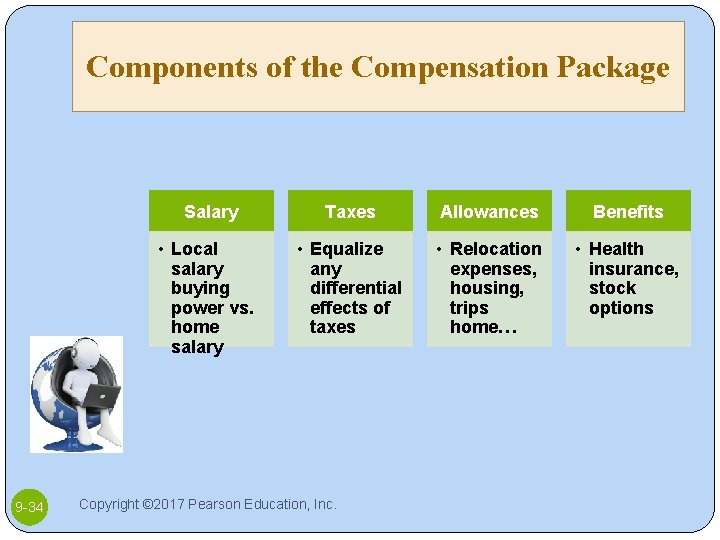
Components of the Compensation Package 9 -34 Salary Taxes Allowances Benefits • Local salary buying power vs. home salary • Equalize any differential effects of taxes • Relocation expenses, housing, trips home… • Health insurance, stock options Copyright © 2017 Pearson Education, Inc.
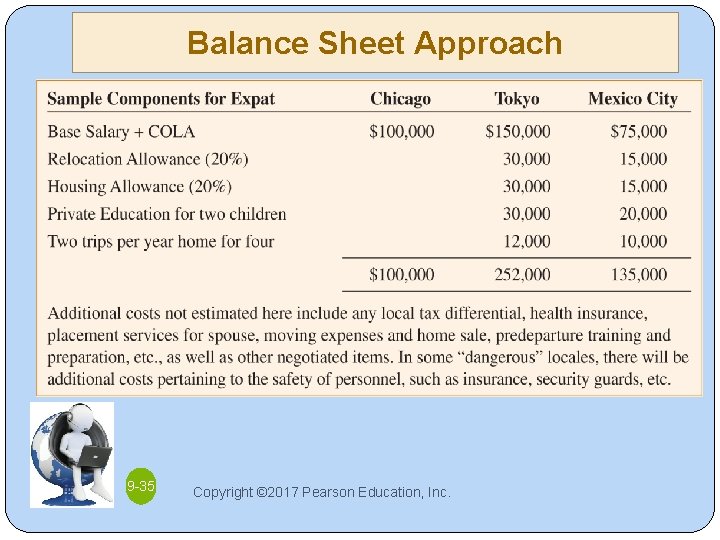
Balance Sheet Approach 9 -35 Copyright © 2017 Pearson Education, Inc.
Training Host Country Nationals Facilitates indigenization Links successful corporate culture and local culture Facilitates e-business adoption 9 -36 Copyright © 2017 Pearson Education, Inc.
Management in Action: Success! Starbucks’ Java Style Helps to Recruit, Train, and Retain Local Managers in Beijing Challenges: recruiting, motivating, and retaining Beijing managers Chinese recruits want training and advancement opportunities more than money Recruits need trust and participation in an environment where local nationals do not exercise initiative or authority 9 -37 Copyright © 2017 Pearson Education, Inc.
Management in Action: Success! Starbucks’ Java Style Helps to Recruit, Train, and Retain Local Managers in Beijing Recruits are trained in management and in Starbucks’ culture Three months in Seattle Make coffees in a real store Casual atmosphere Training, and resulting trust and participation, also serve as motivators 9 -38 Copyright © 2017 Pearson Education, Inc.
Compensating Host Country Nationals Eastern Europeans require more cash than Americans. Compensation in Japan is becoming more Westernized. In Latin America an employee’s pay and title are associated with the type of car received. 9 -39 Copyright © 2017 Pearson Education, Inc.
Conclusion Global HR management = vital component of global strategy Strategies = ethnocentric, polycentric, regiocentric, and global Many causes of ex-pat failure: inadequate preparation, inability to adapt, lack of HQ support for repatriation, etc Cultural training, language instruction, familiarity with everyday matters training is needed Compensation must be carefully designed 9 -40 Copyright © 2017 Pearson Education, Inc.

All rights reserved. No part of this publication may be reproduced, stored in a retrieval system, or transmitted, in any form or by any means, electronic, mechanical, photocopying, recording, or otherwise, without the prior written permission of the publisher. Printed in the United States of America. Copyright © 2017 Pearson Education, Inc. 41
- Slides: 41