
Chapter 9 Spin Total angular momentum Let us
- Slides: 30
Chapter 9 Spin
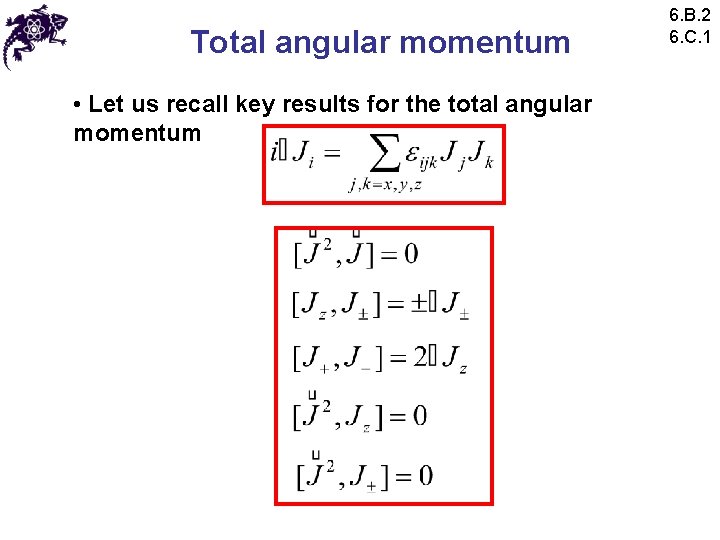
Total angular momentum • Let us recall key results for the total angular momentum 6. B. 2 6. C. 1
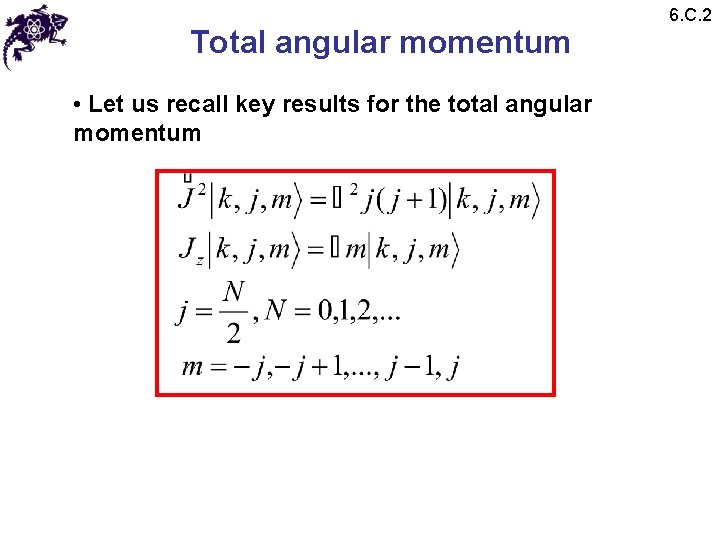
Total angular momentum • Let us recall key results for the total angular momentum 6. C. 2
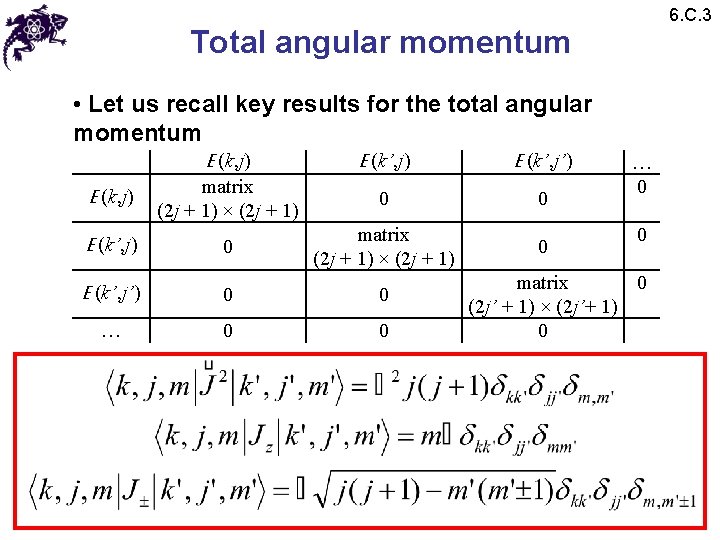
6. C. 3 Total angular momentum • Let us recall key results for the total angular momentum E (k, j) E (k’, j’) E (k, j) matrix (2 j + 1) × (2 j + 1) 0 0 E (k’, j) 0 matrix (2 j + 1) × (2 j + 1) 0 E (k’, j’) 0 0 … 0 0 matrix 0 (2 j’ + 1) × (2 j’+ 1) 0
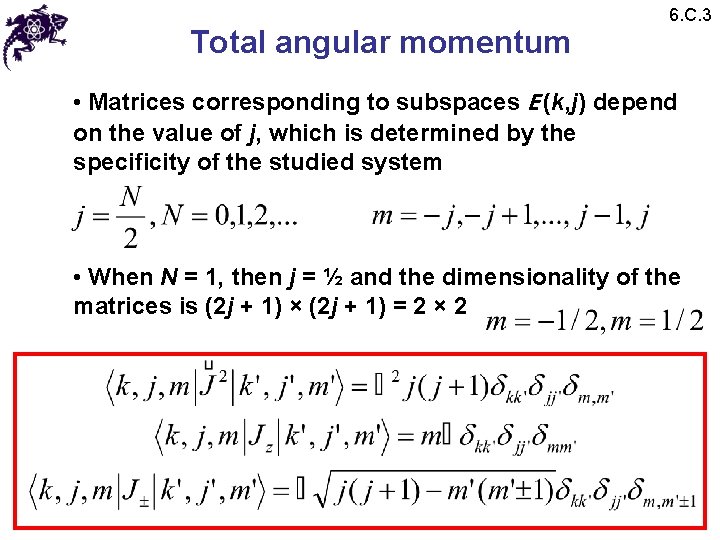
Total angular momentum 6. C. 3 • Matrices corresponding to subspaces E (k, j) depend on the value of j, which is determined by the specificity of the studied system • When N = 1, then j = ½ and the dimensionality of the matrices is (2 j + 1) × (2 j + 1) = 2 × 2
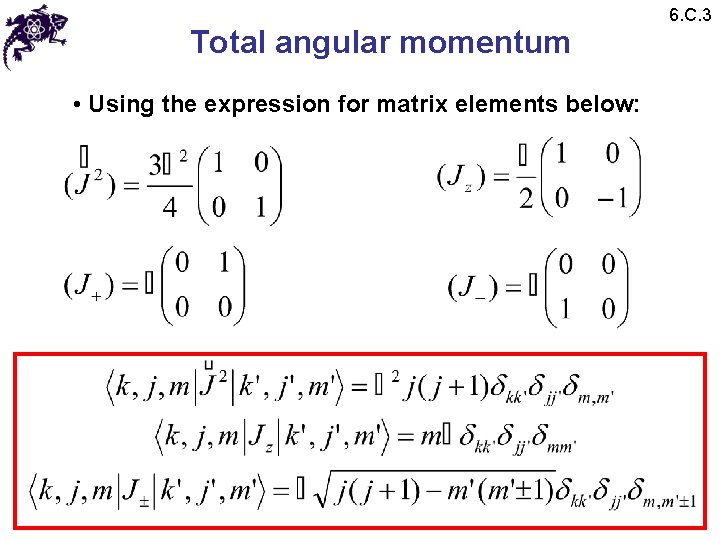
Total angular momentum • Using the expression for matrix elements below: 6. C. 3
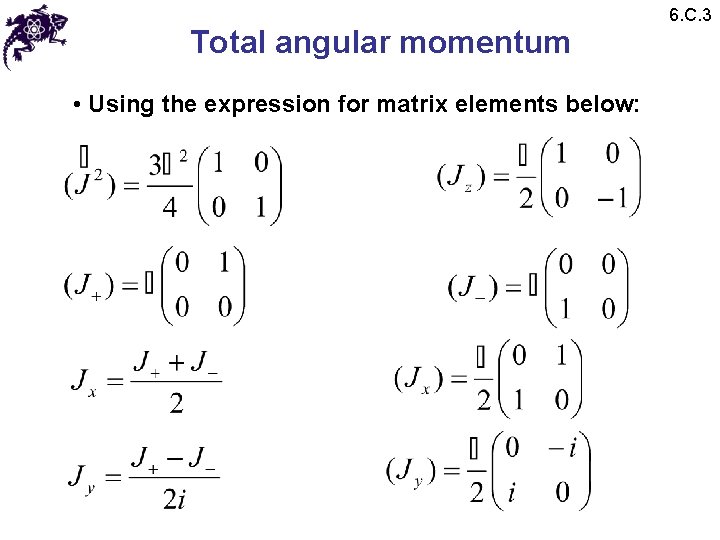
Total angular momentum • Using the expression for matrix elements below: 6. C. 3
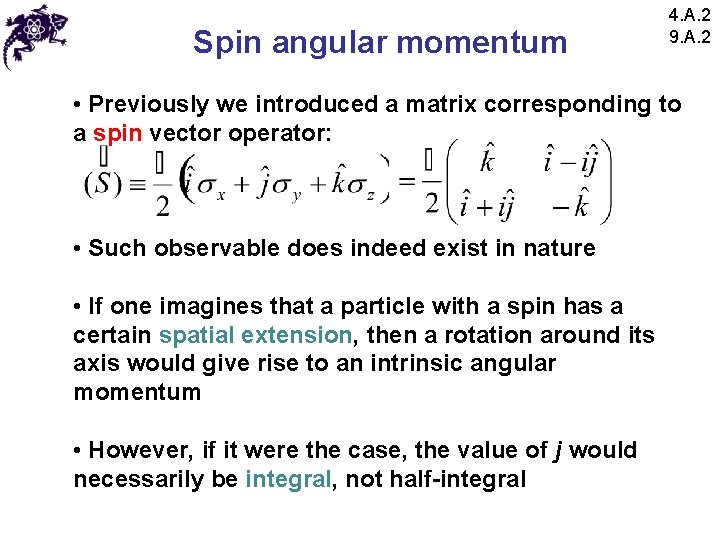
Spin angular momentum 4. A. 2 9. A. 2 • Previously we introduced a matrix corresponding to a spin vector operator: • Such observable does indeed exist in nature • If one imagines that a particle with a spin has a certain spatial extension, then a rotation around its axis would give rise to an intrinsic angular momentum • However, if it were the case, the value of j would necessarily be integral, not half-integral
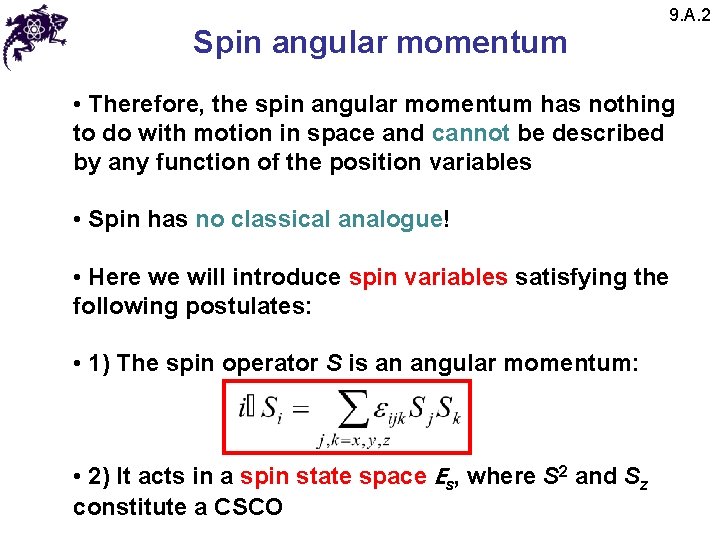
Spin angular momentum 9. A. 2 • Therefore, the spin angular momentum has nothing to do with motion in space and cannot be described by any function of the position variables • Spin has no classical analogue! • Here we will introduce spin variables satisfying the following postulates: • 1) The spin operator S is an angular momentum: • 2) It acts in a spin state space Es, where S 2 and Sz constitute a CSCO
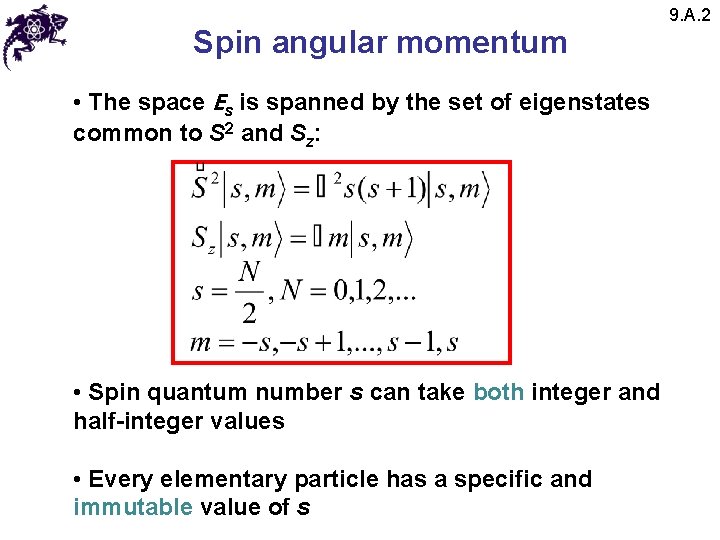
Spin angular momentum • The space Es is spanned by the set of eigenstates common to S 2 and Sz: • Spin quantum number s can take both integer and half-integer values • Every elementary particle has a specific and immutable value of s 9. A. 2
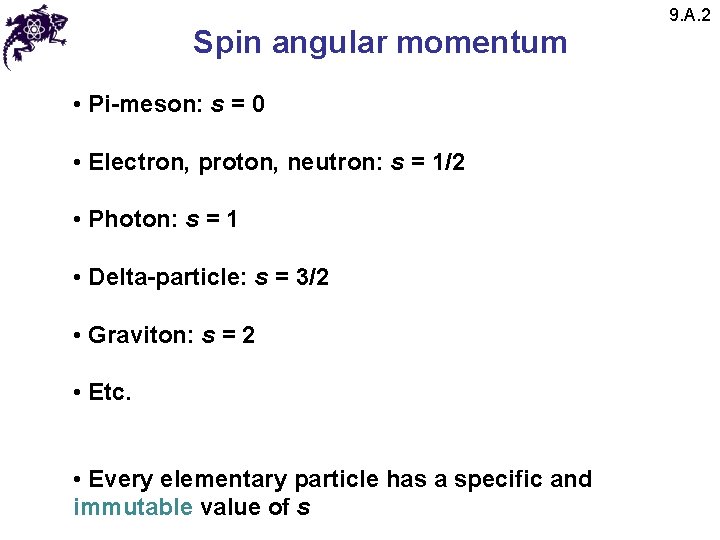
Spin angular momentum • Pi-meson: s = 0 • Electron, proton, neutron: s = 1/2 • Photon: s = 1 • Delta-particle: s = 3/2 • Graviton: s = 2 • Etc. • Every elementary particle has a specific and immutable value of s 9. A. 2
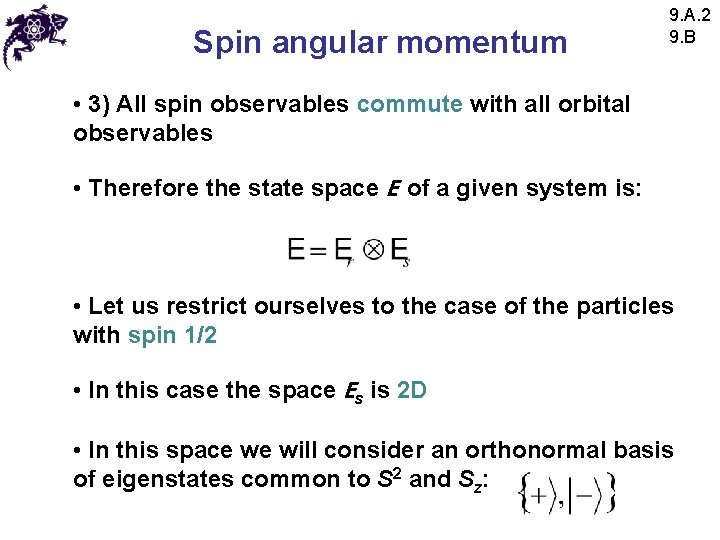
Spin angular momentum 9. A. 2 9. B • 3) All spin observables commute with all orbital observables • Therefore the state space E of a given system is: • Let us restrict ourselves to the case of the particles with spin 1/2 • In this case the space Es is 2 D • In this space we will consider an orthonormal basis of eigenstates common to S 2 and Sz:
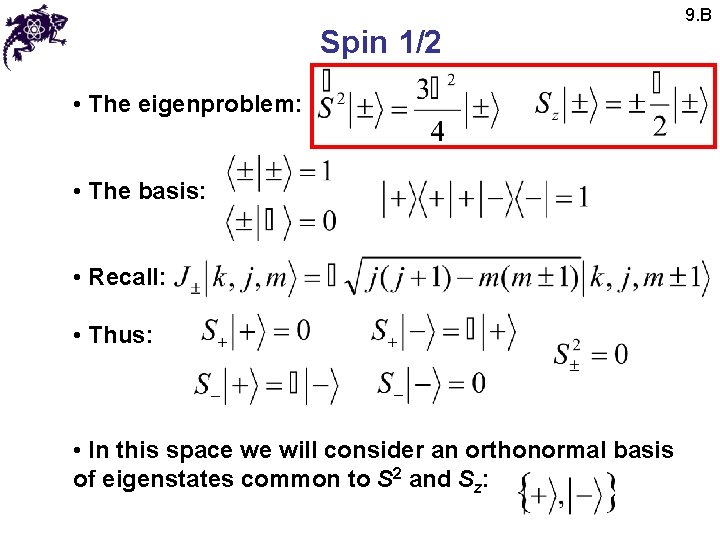
Spin 1/2 • The eigenproblem: • The basis: • Recall: • Thus: • In this space we will consider an orthonormal basis of eigenstates common to S 2 and Sz: 9. B
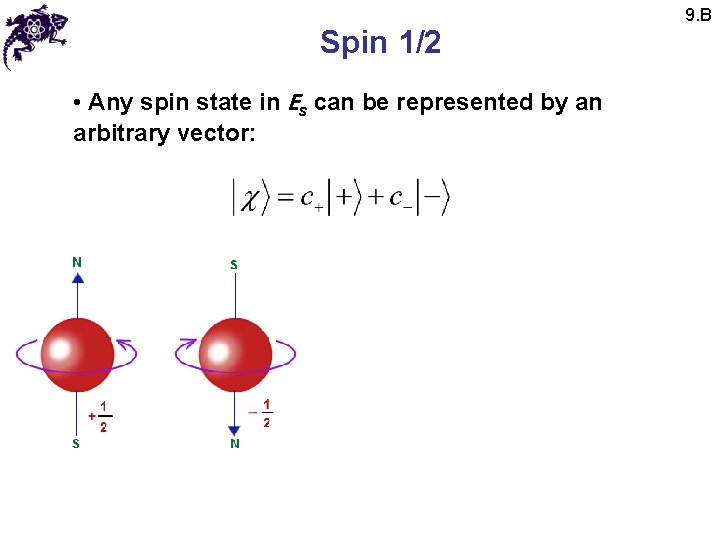
Spin 1/2 • Any spin state in Es can be represented by an arbitrary vector: 9. B
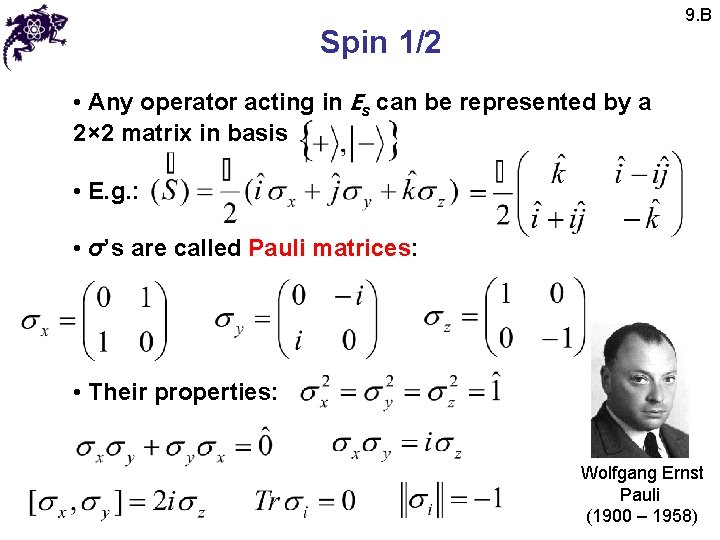
9. B Spin 1/2 • Any operator acting in Es can be represented by a 2× 2 matrix in basis • E. g. : • σ’s are called Pauli matrices: • Their properties: Wolfgang Ernst Pauli (1900 – 1958)
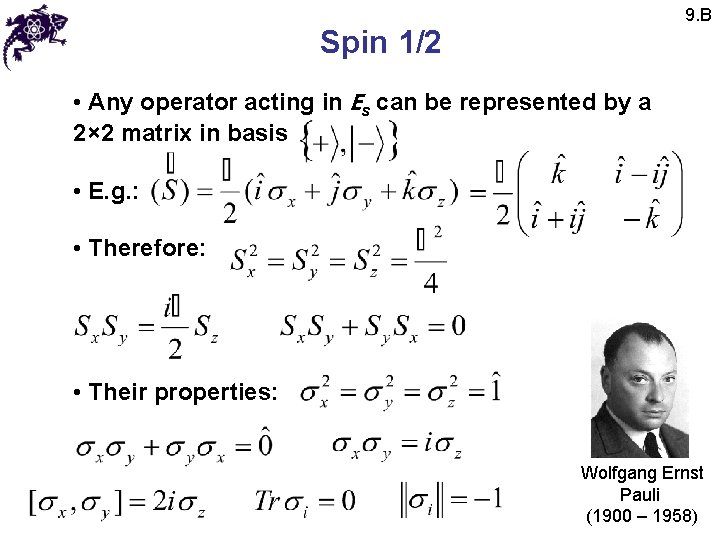
9. B Spin 1/2 • Any operator acting in Es can be represented by a 2× 2 matrix in basis • E. g. : • Therefore: • Their properties: Wolfgang Ernst Pauli (1900 – 1958)
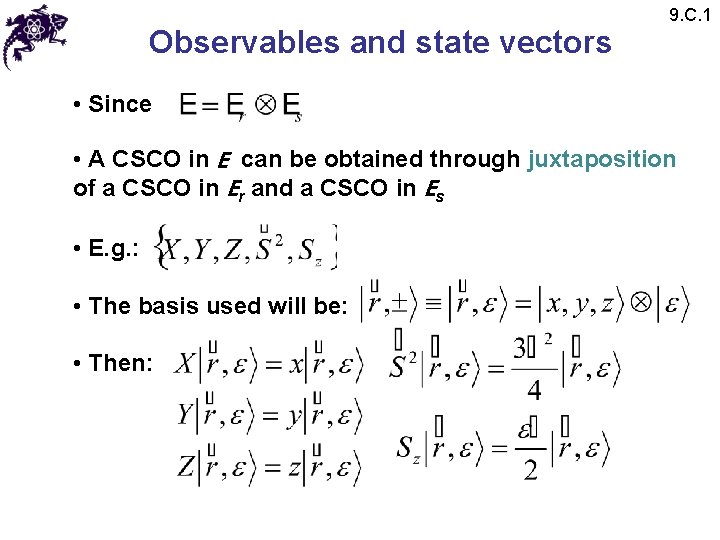
Observables and state vectors 9. C. 1 • Since • A CSCO in E can be obtained through juxtaposition of a CSCO in Er and a CSCO in Es • E. g. : • The basis used will be: • Then:
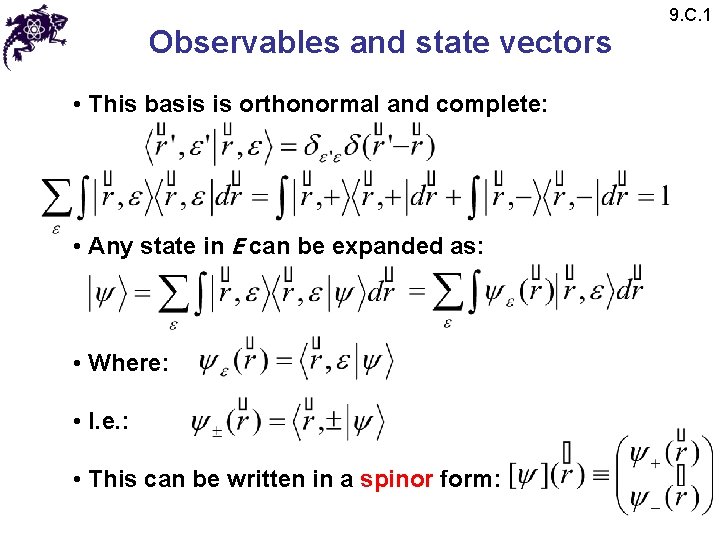
Observables and state vectors • This basis is orthonormal and complete: • Any state in E can be expanded as: • Where: • I. e. : • This can be written in a spinor form: 9. C. 1
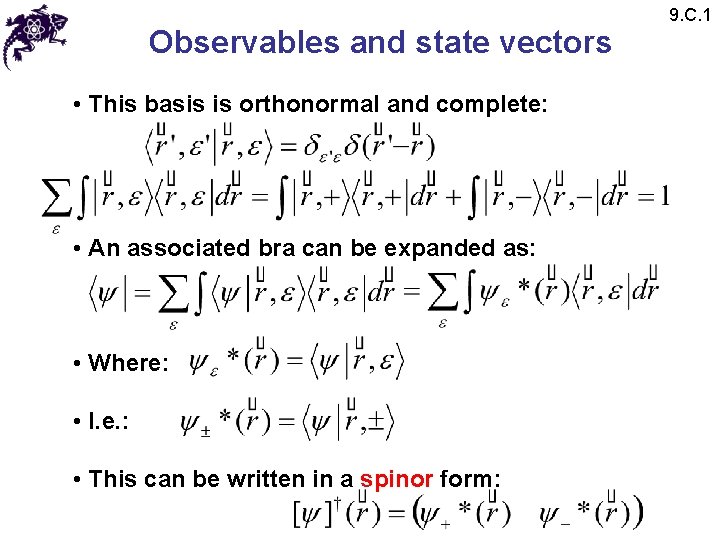
Observables and state vectors • This basis is orthonormal and complete: • An associated bra can be expanded as: • Where: • I. e. : • This can be written in a spinor form: 9. C. 1
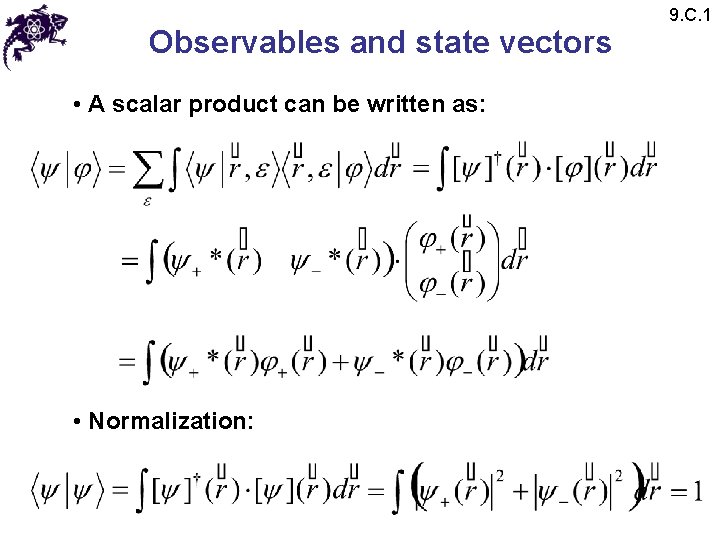
Observables and state vectors • A scalar product can be written as: • Normalization: 9. C. 1
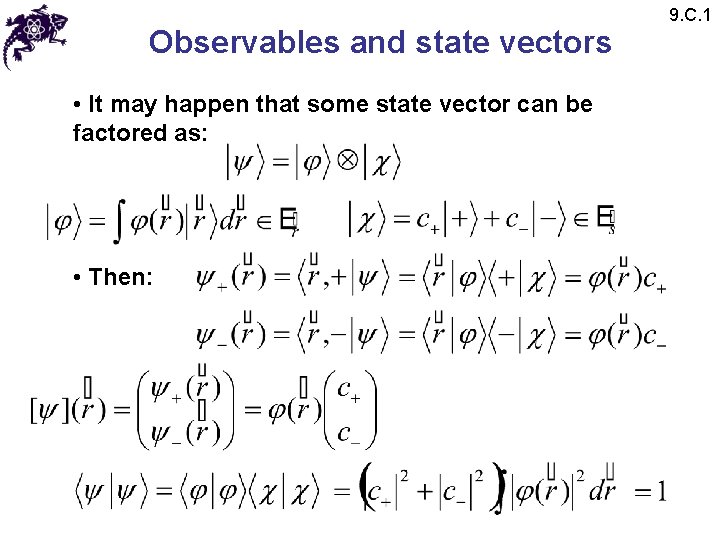
Observables and state vectors • It may happen that some state vector can be factored as: • Then: 9. C. 1
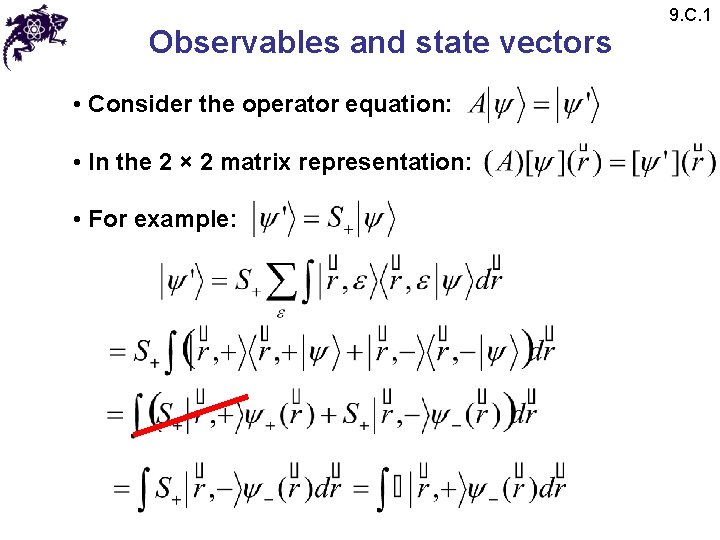
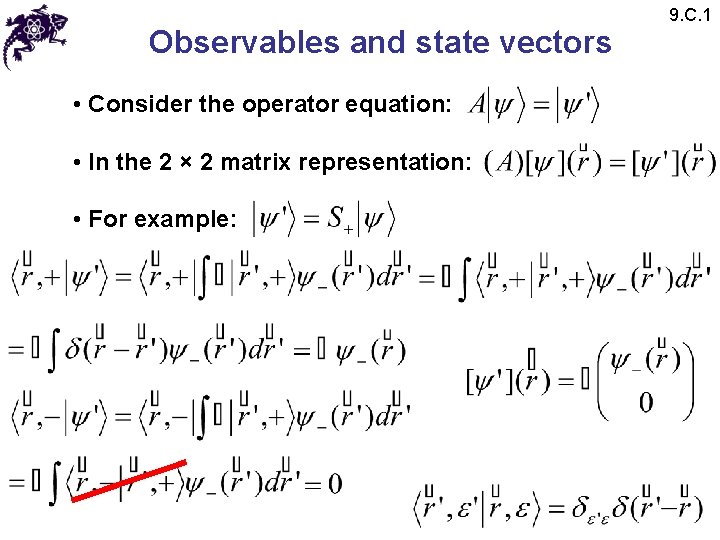
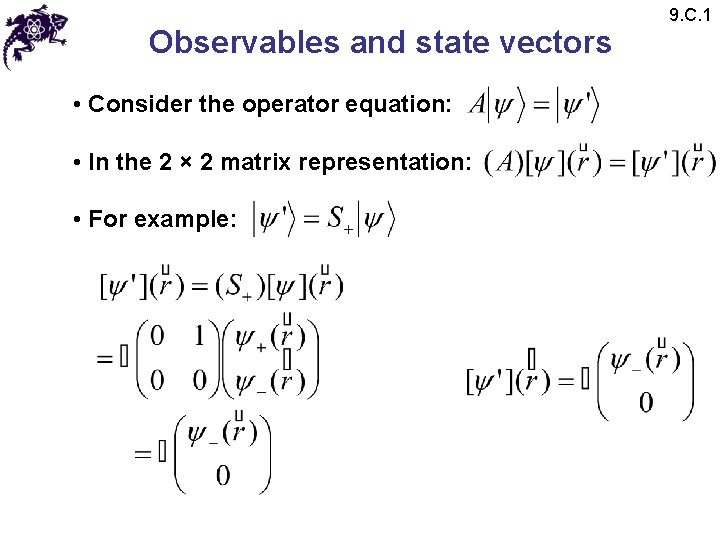
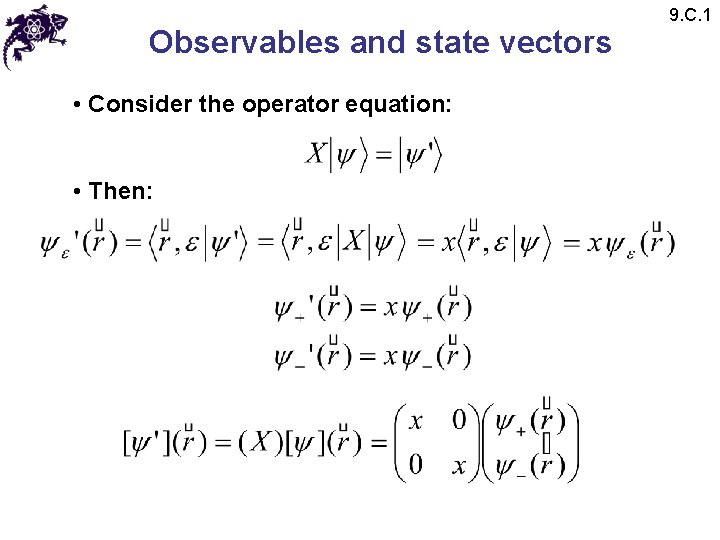
Observables and state vectors • Consider the operator equation: • In the 2 × 2 matrix representation: • For example: 9. C. 1
Observables and state vectors • Consider the operator equation: • In the 2 × 2 matrix representation: • For example: 9. C. 1
Observables and state vectors • Consider the operator equation: • In the 2 × 2 matrix representation: • For example: 9. C. 1
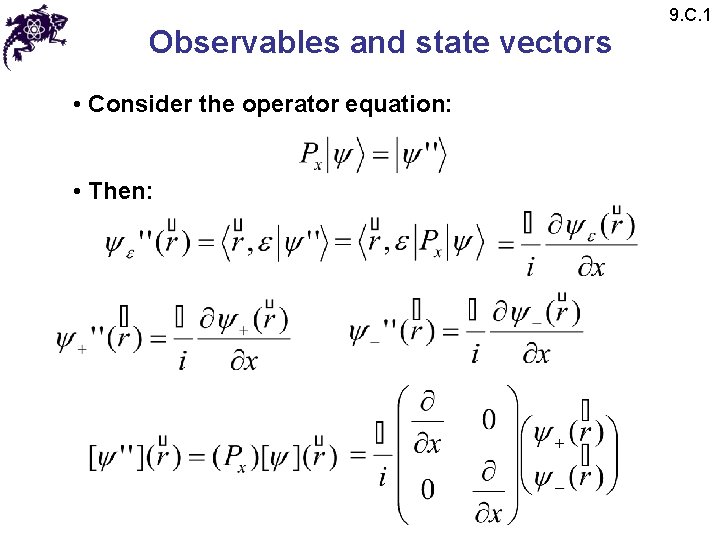
Observables and state vectors • Consider the operator equation: • Then: 9. C. 1
Observables and state vectors • Consider the operator equation: • Then: 9. C. 1
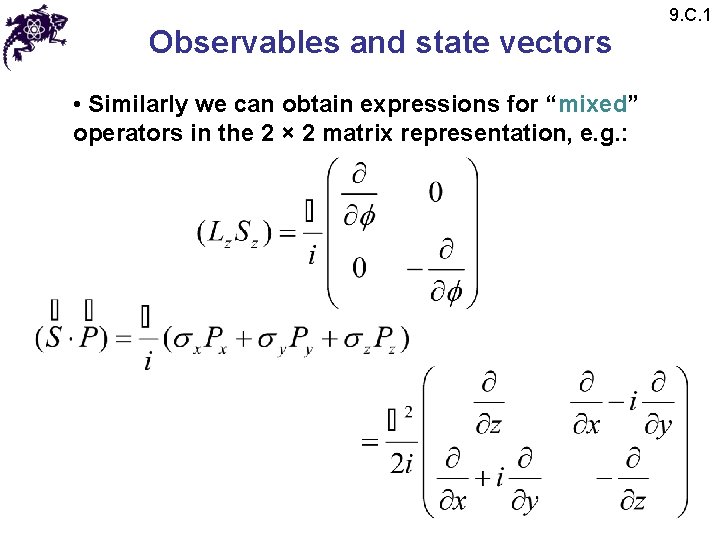
Observables and state vectors • Similarly we can obtain expressions for “mixed” operators in the 2 × 2 matrix representation, e. g. : 9. C. 1
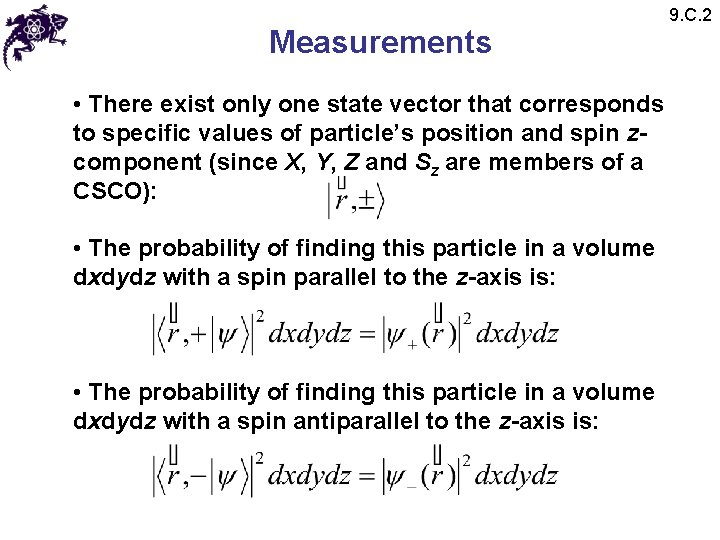
Measurements • There exist only one state vector that corresponds to specific values of particle’s position and spin zcomponent (since X, Y, Z and Sz are members of a CSCO): • The probability of finding this particle in a volume dxdydz with a spin parallel to the z-axis is: • The probability of finding this particle in a volume dxdydz with a spin antiparallel to the z-axis is: 9. C. 2
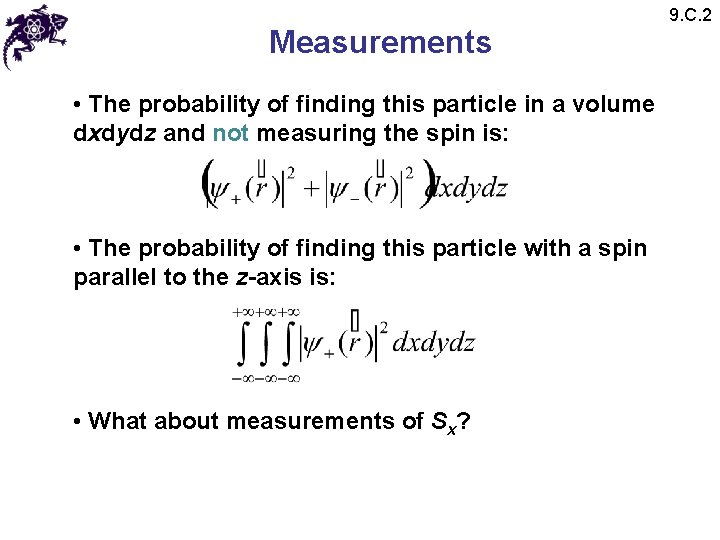
Measurements • The probability of finding this particle in a volume dxdydz and not measuring the spin is: • The probability of finding this particle with a spin parallel to the z-axis is: • What about measurements of Sx? 9. C. 2
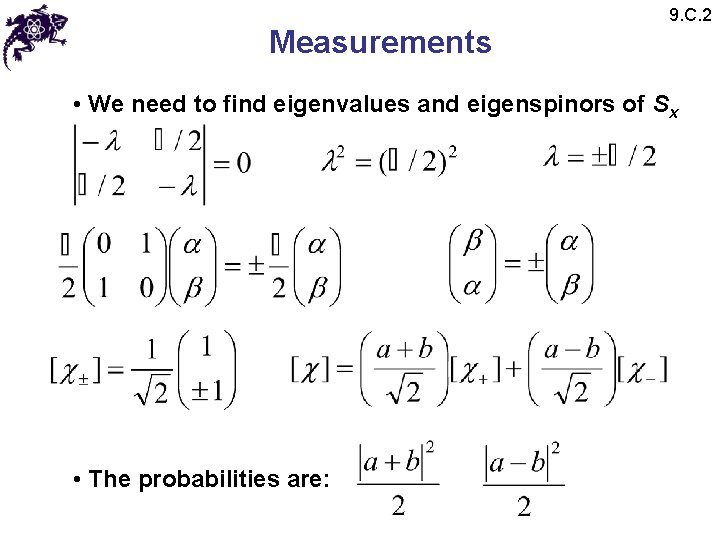
Measurements 9. C. 2 • We need to find eigenvalues and eigenspinors of Sx • The probabilities are: