
Chapter 9 Special Types of Intravenous Calculations Copyright

- Slides: 19
Chapter 9: Special Types of Intravenous Calculations Copyright © 2010 Wolters Kluwer Health | Lippincott Williams & Wilkins
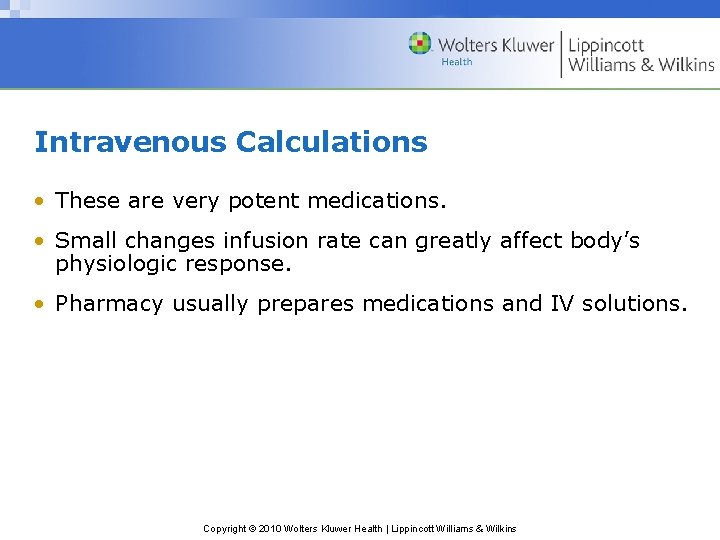
Intravenous Calculations • These are very potent medications. • Small changes infusion rate can greatly affect body’s physiologic response. • Pharmacy usually prepares medications and IV solutions. Copyright © 2010 Wolters Kluwer Health | Lippincott Williams & Wilkins
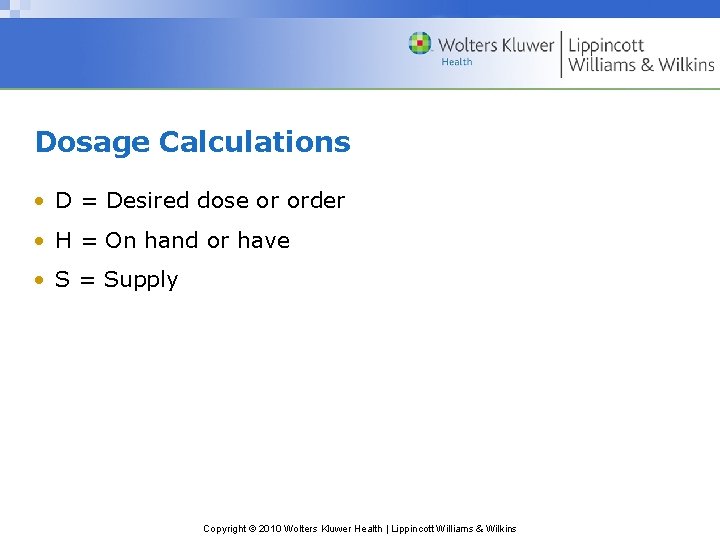
Dosage Calculations • D = Desired dose or order • H = On hand or have • S = Supply Copyright © 2010 Wolters Kluwer Health | Lippincott Williams & Wilkins
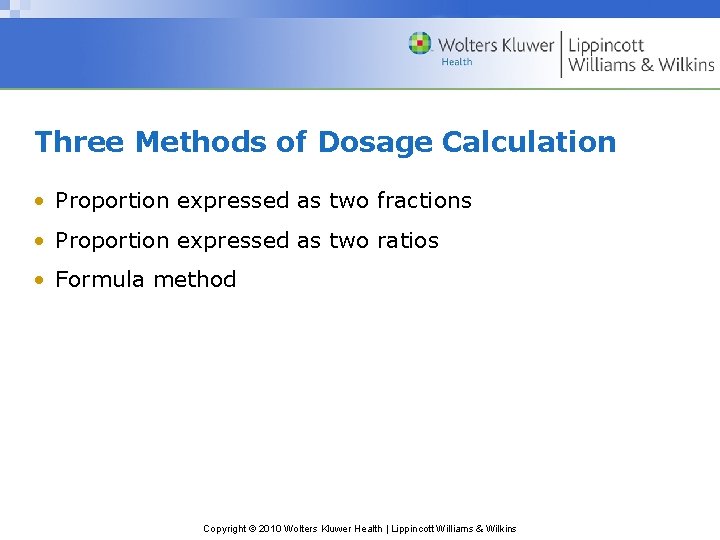
Three Methods of Dosage Calculation • Proportion expressed as two fractions • Proportion expressed as two ratios • Formula method Copyright © 2010 Wolters Kluwer Health | Lippincott Williams & Wilkins
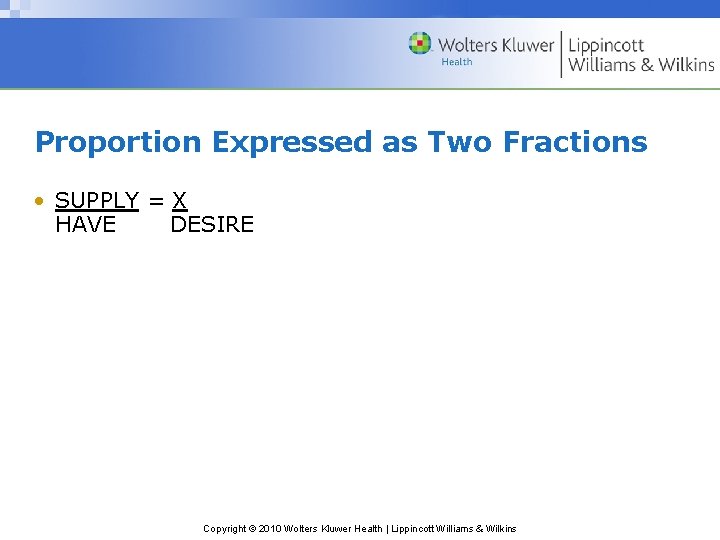
Proportion Expressed as Two Fractions • SUPPLY = X HAVE DESIRE Copyright © 2010 Wolters Kluwer Health | Lippincott Williams & Wilkins
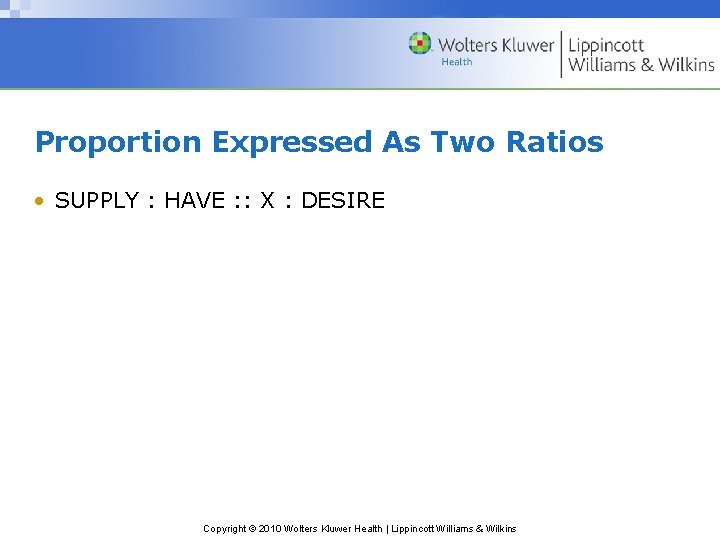
Proportion Expressed As Two Ratios • SUPPLY : HAVE : : X : DESIRE Copyright © 2010 Wolters Kluwer Health | Lippincott Williams & Wilkins
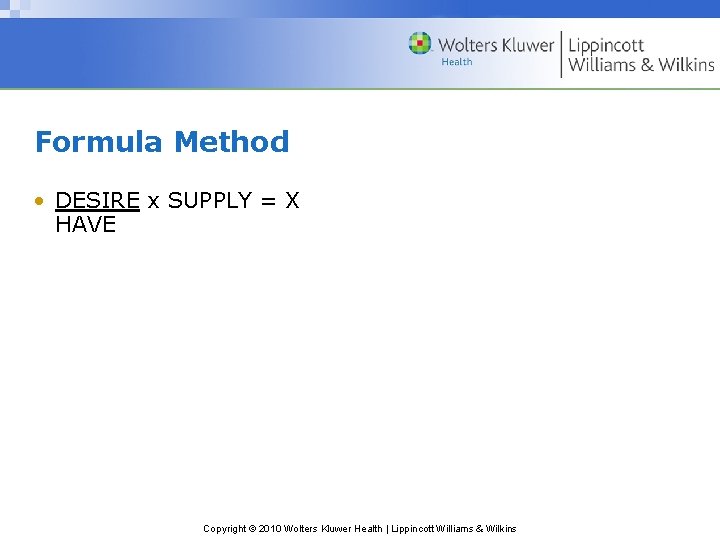
Formula Method • DESIRE x SUPPLY = X HAVE Copyright © 2010 Wolters Kluwer Health | Lippincott Williams & Wilkins
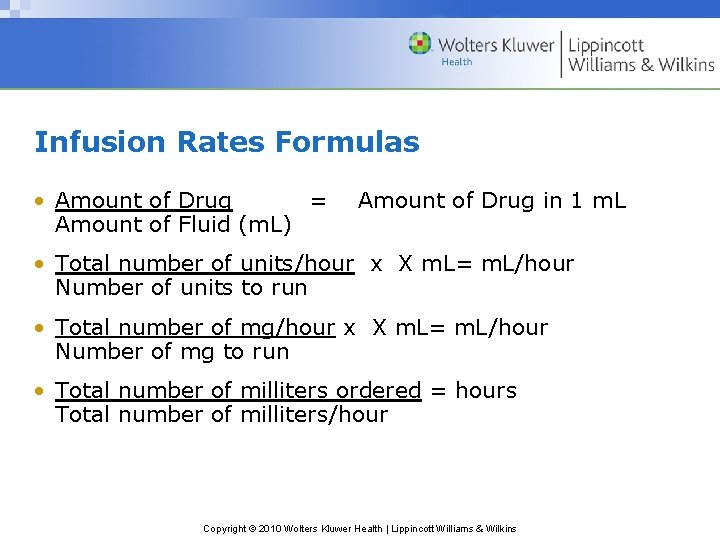
Infusion Rates Formulas • Amount of Drug = Amount of Fluid (m. L) Amount of Drug in 1 m. L • Total number of units/hour x X m. L= m. L/hour Number of units to run • Total number of mg/hour x X m. L= m. L/hour Number of mg to run • Total number of milliters ordered = hours Total number of milliters/hour Copyright © 2010 Wolters Kluwer Health | Lippincott Williams & Wilkins
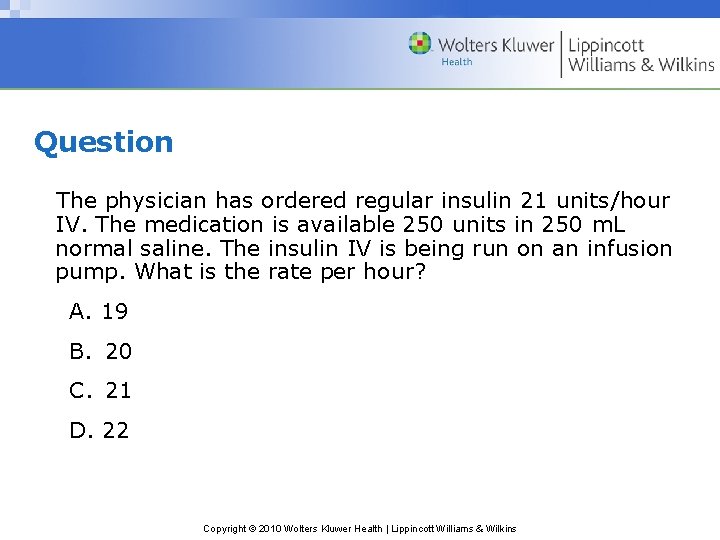
Question The physician has ordered regular insulin 21 units/hour IV. The medication is available 250 units in 250 m. L normal saline. The insulin IV is being run on an infusion pump. What is the rate per hour? A. 19 B. 20 C. 21 D. 22 Copyright © 2010 Wolters Kluwer Health | Lippincott Williams & Wilkins
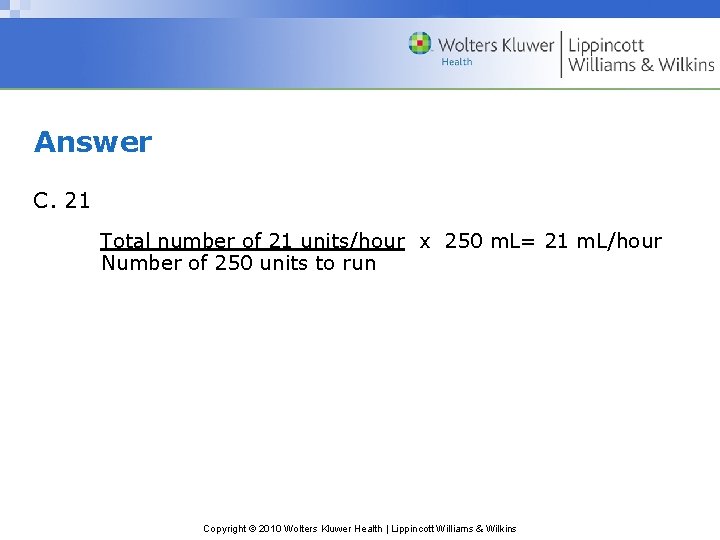
Answer C. 21 Total number of 21 units/hour x 250 m. L= 21 m. L/hour Number of 250 units to run Copyright © 2010 Wolters Kluwer Health | Lippincott Williams & Wilkins
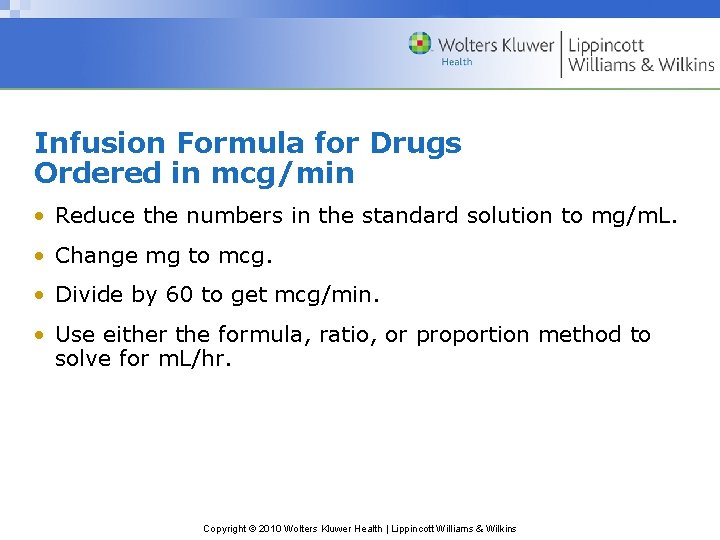
Infusion Formula for Drugs Ordered in mcg/min • Reduce the numbers in the standard solution to mg/m. L. • Change mg to mcg. • Divide by 60 to get mcg/min. • Use either the formula, ratio, or proportion method to solve for m. L/hr. Copyright © 2010 Wolters Kluwer Health | Lippincott Williams & Wilkins
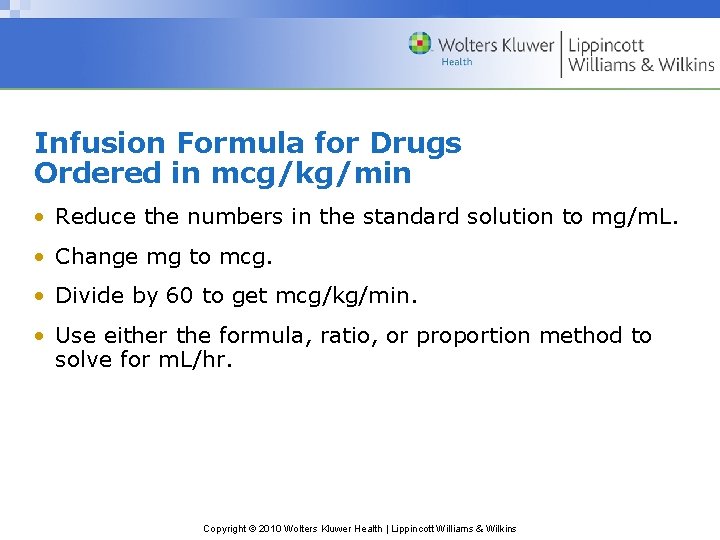
Infusion Formula for Drugs Ordered in mcg/kg/min • Reduce the numbers in the standard solution to mg/m. L. • Change mg to mcg. • Divide by 60 to get mcg/kg/min. • Use either the formula, ratio, or proportion method to solve for m. L/hr. Copyright © 2010 Wolters Kluwer Health | Lippincott Williams & Wilkins
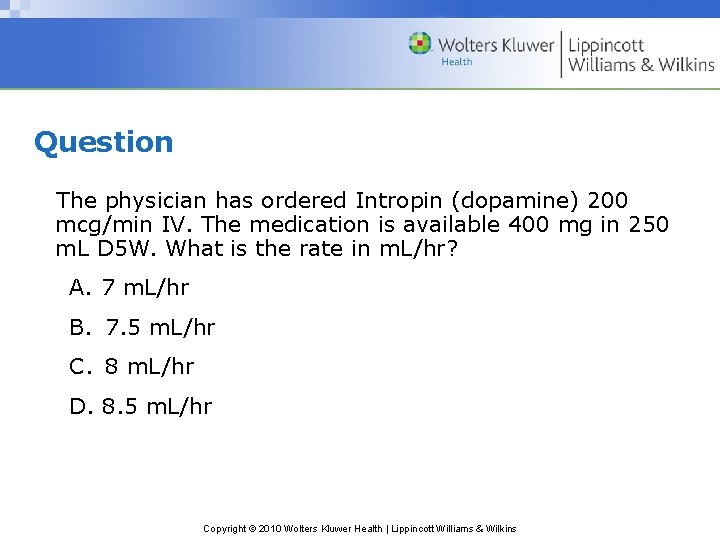
Question The physician has ordered Intropin (dopamine) 200 mcg/min IV. The medication is available 400 mg in 250 m. L D 5 W. What is the rate in m. L/hr? A. 7 m. L/hr B. 7. 5 m. L/hr C. 8 m. L/hr D. 8. 5 m. L/hr Copyright © 2010 Wolters Kluwer Health | Lippincott Williams & Wilkins
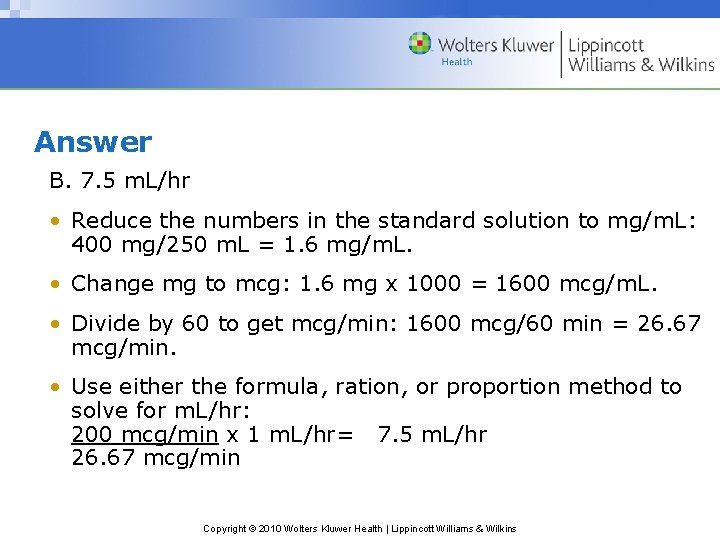
Answer B. 7. 5 m. L/hr • Reduce the numbers in the standard solution to mg/m. L: 400 mg/250 m. L = 1. 6 mg/m. L. • Change mg to mcg: 1. 6 mg x 1000 = 1600 mcg/m. L. • Divide by 60 to get mcg/min: 1600 mcg/60 min = 26. 67 mcg/min. • Use either the formula, ration, or proportion method to solve for m. L/hr: 200 mcg/min x 1 m. L/hr= 7. 5 m. L/hr 26. 67 mcg/min Copyright © 2010 Wolters Kluwer Health | Lippincott Williams & Wilkins
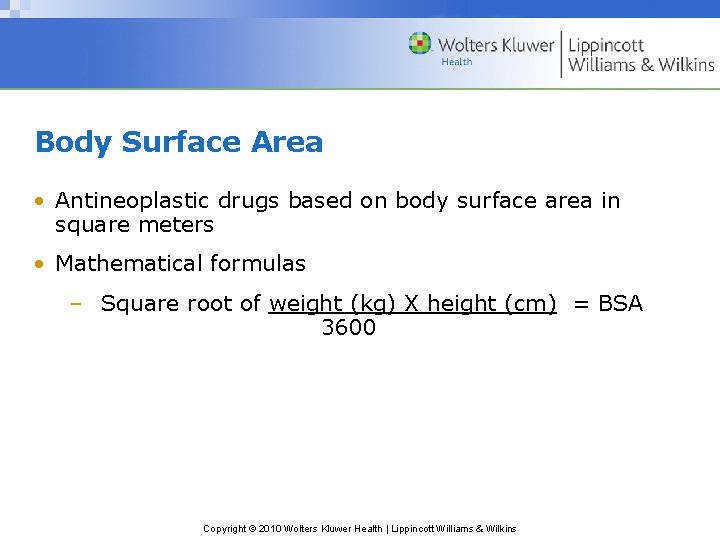
Body Surface Area • Antineoplastic drugs based on body surface area in square meters • Mathematical formulas – Square root of weight (kg) X height (cm) = BSA 3600 Copyright © 2010 Wolters Kluwer Health | Lippincott Williams & Wilkins
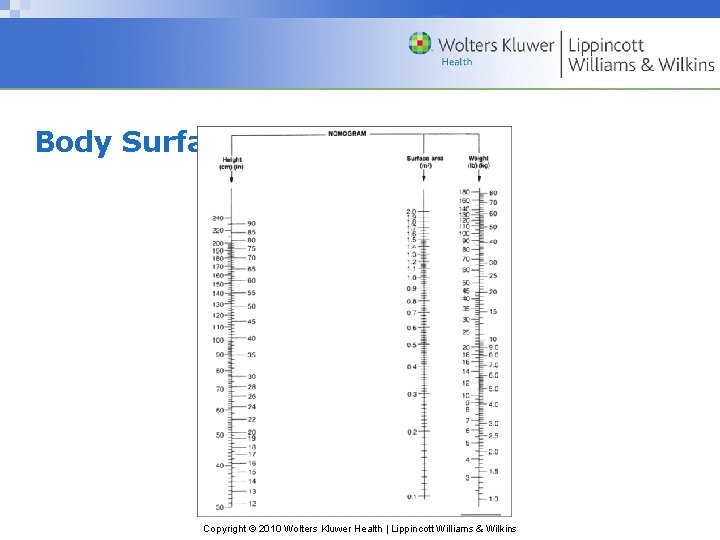
Body Surface Nomogram • Mark the client’s height in first column. • Mark the client’s weight in the third column. • Draw a line between these two marks. • Point at which the line intersects in the middle column indicates estimated body surface in meters squared. Copyright © 2010 Wolters Kluwer Health | Lippincott Williams & Wilkins
Body Surface Nomogram Copyright © 2010 Wolters Kluwer Health | Lippincott Williams & Wilkins
Patient Controlled Analgesia • Basal rate: amount of medication infused continuously every hour • PCA dose: amount of medication infused when the client activates the button control • Lockout time or delay: interval during which patient cannot initiate another dose after giving a self dose; prevents overdosage • Total hourly dose: maximum amount of medication the client can receive an hour Copyright © 2010 Wolters Kluwer Health | Lippincott Williams & Wilkins
Heparin and Insulin Protocols • Protocols are based on a parameter, usually a lab test ordered by healthcare provider • After receiving the lab test results, the nurse uses the protocol to determine the change in the dosage amount. Copyright © 2010 Wolters Kluwer Health | Lippincott Williams & Wilkins