
Chapter 9 Spatial reasoning and uncertainty Worboys and
Chapter 9 Spatial reasoning and uncertainty © Worboys and Duckham (2004) GIS: A Computing Perspective, Second Edition, CRC Press
What you will learn What is spatial reasoning? Summary Spatial reasoning Uncertainty Qualitative Quantitative Applications Why is spatial information imperfect? What are the different types of imperfection in spatial information? How can we reason about spatial information under uncertainty? What qualitative and quantitative approaches to uncertainty are there? What sorts of applications exist for reasoning under uncertainty? © Worboys and Duckham (2004) GIS: A Computing Perspective, Second Edition, CRC Press
Section 9. 1 Formal aspects of spatial reasoning © Worboys and Duckham (2004) GIS: A Computing Perspective, Second Edition, CRC Press
Spatial reasoning has aspects that are: Cognitive Summary Spatial reasoning Uncertainty Qualitative Quantitative Applications Computational Formal aspects are derived from logic Key logical distinction is between Syntax (see chapter 7) Semantics (meaning) E. g. , “Paris is in France” © Worboys and Duckham (2004) GIS: A Computing Perspective, Second Edition, CRC Press
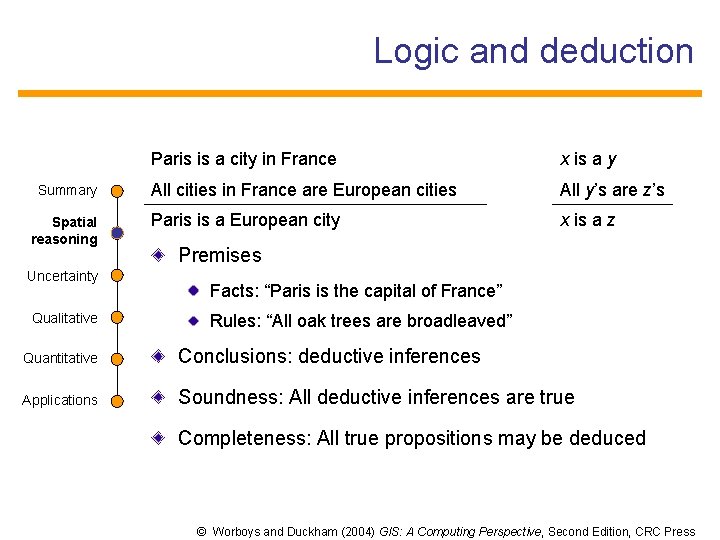
Logic and deduction Summary Spatial reasoning Uncertainty Qualitative Paris is a city in France x is a y All cities in France are European cities All y’s are z’s Paris is a European city x is a z Premises Facts: “Paris is the capital of France” Rules: “All oak trees are broadleaved” Quantitative Conclusions: deductive inferences Applications Soundness: All deductive inferences are true Completeness: All true propositions may be deduced © Worboys and Duckham (2004) GIS: A Computing Perspective, Second Edition, CRC Press
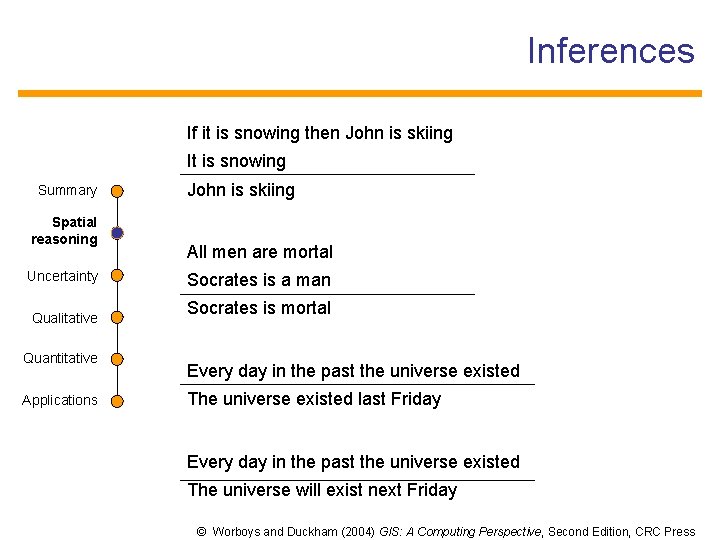
Inferences If it is snowing then John is skiing It is snowing Summary Spatial reasoning Uncertainty Qualitative Quantitative Applications John is skiing All men are mortal Socrates is a man Socrates is mortal Every day in the past the universe existed The universe existed last Friday Every day in the past the universe existed The universe will exist next Friday © Worboys and Duckham (2004) GIS: A Computing Perspective, Second Edition, CRC Press
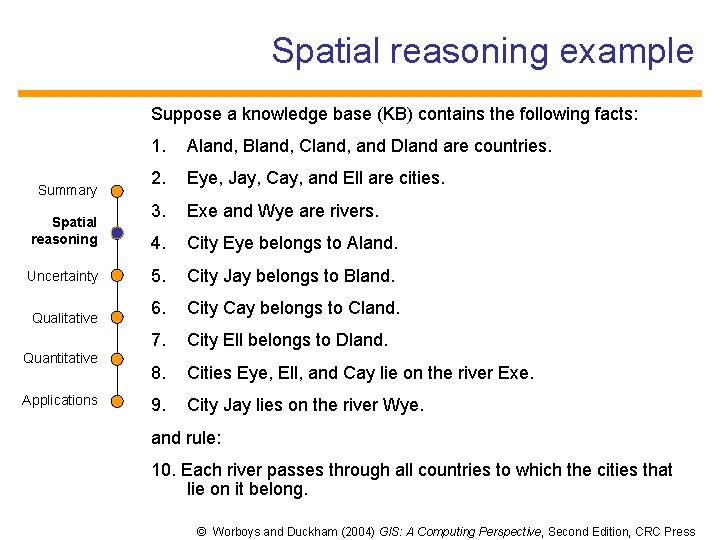
Spatial reasoning example Suppose a knowledge base (KB) contains the following facts: Summary Spatial reasoning Uncertainty Qualitative Quantitative Applications 1. Aland, Bland, Cland, and Dland are countries. 2. Eye, Jay, Cay, and Ell are cities. 3. Exe and Wye are rivers. 4. City Eye belongs to Aland. 5. City Jay belongs to Bland. 6. City Cay belongs to Cland. 7. City Ell belongs to Dland. 8. Cities Eye, Ell, and Cay lie on the river Exe. 9. City Jay lies on the river Wye. and rule: 10. Each river passes through all countries to which the cities that lie on it belong. © Worboys and Duckham (2004) GIS: A Computing Perspective, Second Edition, CRC Press
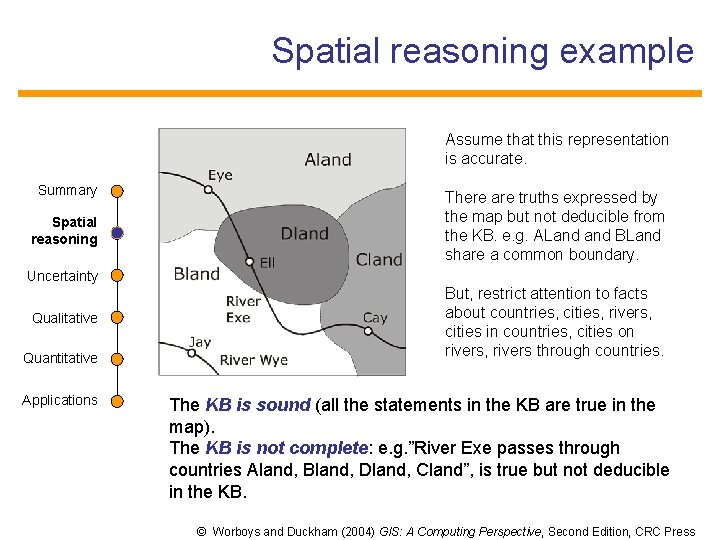
Spatial reasoning example Assume that this representation is accurate. Summary Spatial reasoning There are truths expressed by the map but not deducible from the KB. e. g. ALand BLand share a common boundary. Uncertainty Qualitative Quantitative Applications But, restrict attention to facts about countries, cities, rivers, cities in countries, cities on rivers, rivers through countries. The KB is sound (all the statements in the KB are true in the map). The KB is not complete: e. g. ”River Exe passes through countries Aland, Bland, Dland, Cland”, is true but not deducible in the KB. © Worboys and Duckham (2004) GIS: A Computing Perspective, Second Edition, CRC Press
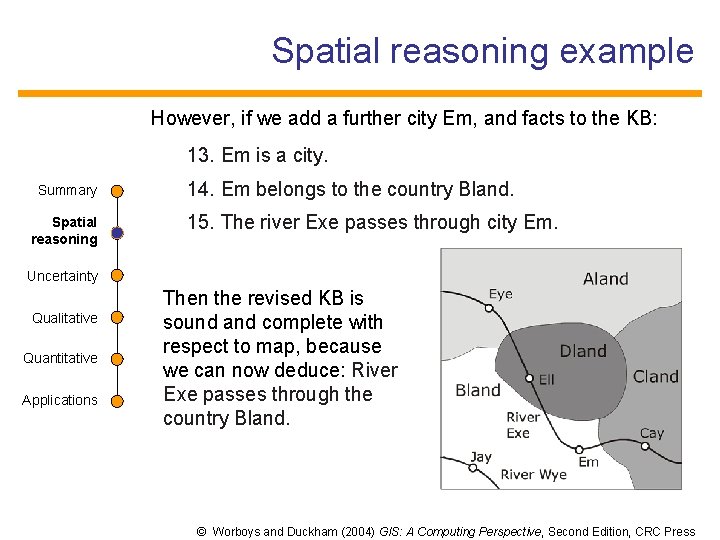
Spatial reasoning example However, if we add a further city Em, and facts to the KB: 13. Em is a city. Summary Spatial reasoning 14. Em belongs to the country Bland. 15. The river Exe passes through city Em. Uncertainty Qualitative Quantitative Applications Then the revised KB is sound and complete with respect to map, because we can now deduce: River Exe passes through the country Bland. © Worboys and Duckham (2004) GIS: A Computing Perspective, Second Edition, CRC Press
Section 9. 2 Information and uncertainty © Worboys and Duckham (2004) GIS: A Computing Perspective, Second Edition, CRC Press
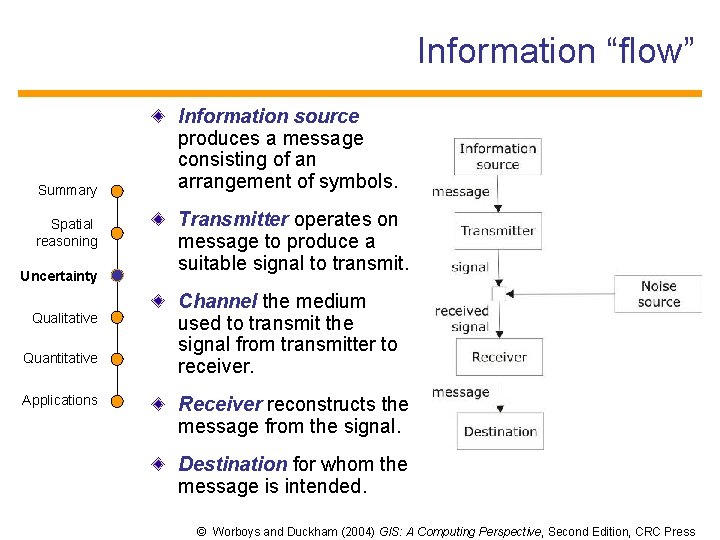
Information “flow” Summary Spatial reasoning Uncertainty Qualitative Quantitative Applications Information source produces a message consisting of an arrangement of symbols. Transmitter operates on message to produce a suitable signal to transmit. Channel the medium used to transmit the signal from transmitter to receiver. Receiver reconstructs the message from the signal. Destination for whom the message is intended. © Worboys and Duckham (2004) GIS: A Computing Perspective, Second Edition, CRC Press
Uncertainty Summary Spatial reasoning Uncertainty Qualitative Quantitative Applications May refer to state of mind: “I am unsure where the meeting will take place” May be applied directly to data or information about the world: “The depth of the sea at a particular location is uncertain” Uncertainty is an unavoidable property of the world, information about the world, and our cognition of the world © Worboys and Duckham (2004) GIS: A Computing Perspective, Second Edition, CRC Press
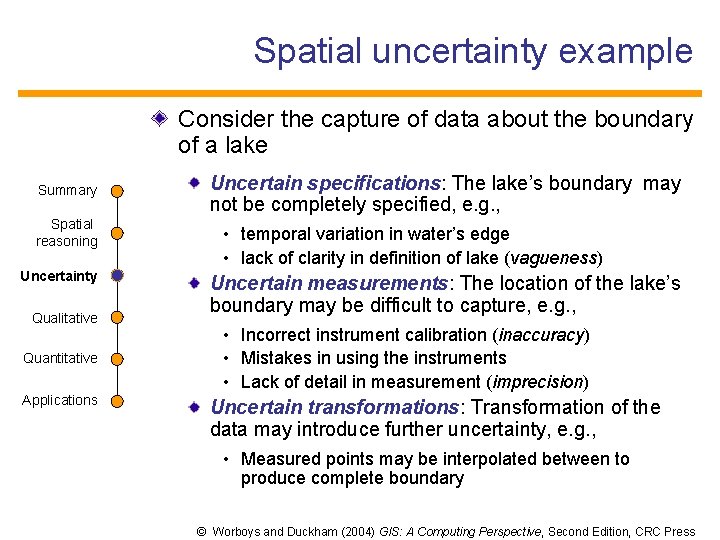
Spatial uncertainty example Consider the capture of data about the boundary of a lake Summary Spatial reasoning Uncertainty Qualitative Quantitative Applications Uncertain specifications: The lake’s boundary may not be completely specified, e. g. , • temporal variation in water’s edge • lack of clarity in definition of lake (vagueness) Uncertain measurements: The location of the lake’s boundary may be difficult to capture, e. g. , • Incorrect instrument calibration (inaccuracy) • Mistakes in using the instruments • Lack of detail in measurement (imprecision) Uncertain transformations: Transformation of the data may introduce further uncertainty, e. g. , • Measured points may be interpolated between to produce complete boundary © Worboys and Duckham (2004) GIS: A Computing Perspective, Second Edition, CRC Press
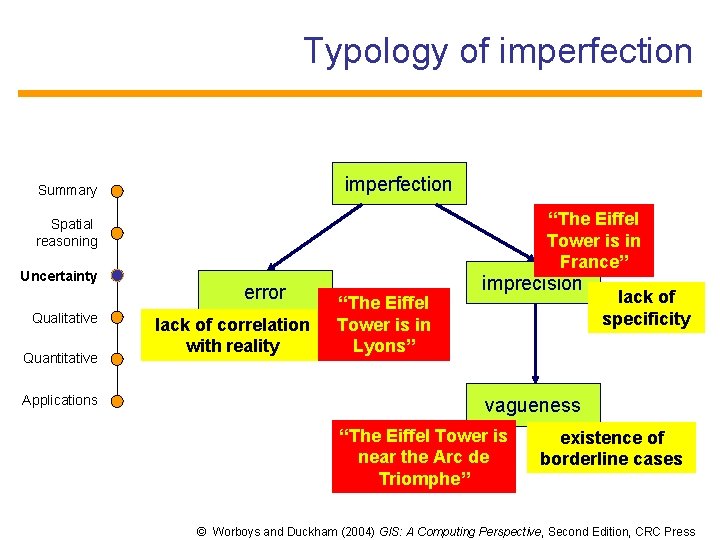
Typology of imperfection Summary “The Eiffel Tower is in France” Spatial reasoning Uncertainty Qualitative Quantitative Applications error lack of correlation with reality “The Eiffel Tower is in Lyons” imprecision lack of specificity vagueness “The Eiffel Tower is near the Arc de Triomphe” existence of borderline cases © Worboys and Duckham (2004) GIS: A Computing Perspective, Second Edition, CRC Press
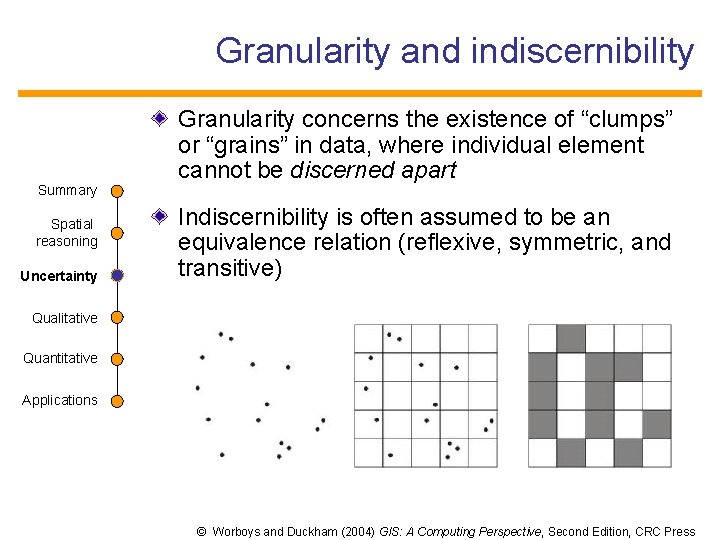
Granularity and indiscernibility Summary Spatial reasoning Uncertainty Granularity concerns the existence of “clumps” or “grains” in data, where individual element cannot be discerned apart Indiscernibility is often assumed to be an equivalence relation (reflexive, symmetric, and transitive) Qualitative Quantitative Applications © Worboys and Duckham (2004) GIS: A Computing Perspective, Second Edition, CRC Press
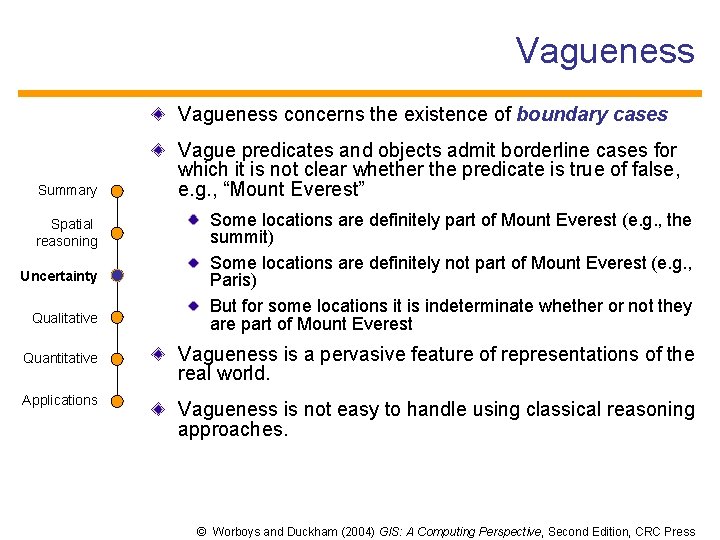
Vagueness concerns the existence of boundary cases Summary Spatial reasoning Uncertainty Qualitative Quantitative Applications Vague predicates and objects admit borderline cases for which it is not clear whether the predicate is true of false, e. g. , “Mount Everest” Some locations are definitely part of Mount Everest (e. g. , the summit) Some locations are definitely not part of Mount Everest (e. g. , Paris) But for some locations it is indeterminate whether or not they are part of Mount Everest Vagueness is a pervasive feature of representations of the real world. Vagueness is not easy to handle using classical reasoning approaches. © Worboys and Duckham (2004) GIS: A Computing Perspective, Second Edition, CRC Press
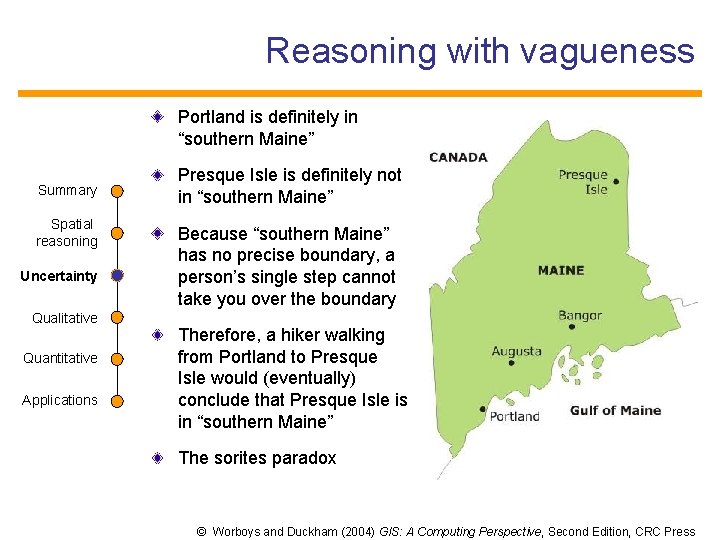
Reasoning with vagueness Portland is definitely in “southern Maine” Summary Spatial reasoning Uncertainty Qualitative Quantitative Applications Presque Isle is definitely not in “southern Maine” Because “southern Maine” has no precise boundary, a person’s single step cannot take you over the boundary Therefore, a hiker walking from Portland to Presque Isle would (eventually) conclude that Presque Isle is in “southern Maine” The sorites paradox © Worboys and Duckham (2004) GIS: A Computing Perspective, Second Edition, CRC Press
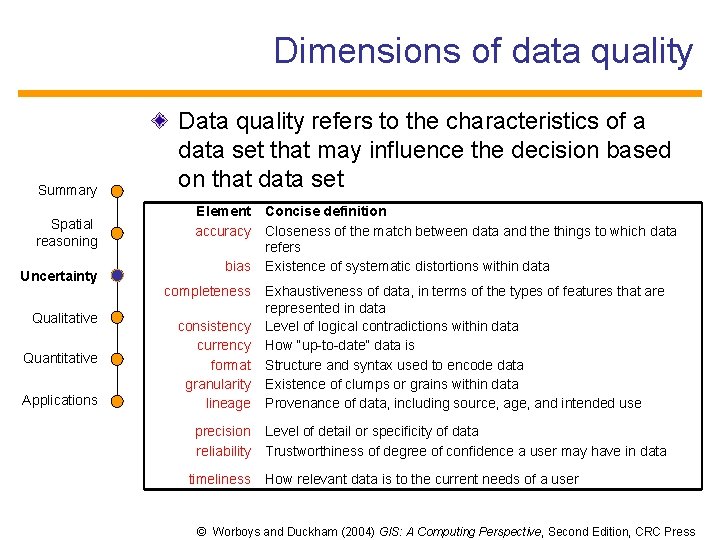
Dimensions of data quality Summary Spatial reasoning Uncertainty Qualitative Quantitative Applications Data quality refers to the characteristics of a data set that may influence the decision based on that data set Element accuracy bias completeness Concise definition Closeness of the match between data and the things to which data refers Existence of systematic distortions within data consistency currency format granularity lineage Exhaustiveness of data, in terms of the types of features that are represented in data Level of logical contradictions within data How “up-to-date” data is Structure and syntax used to encode data Existence of clumps or grains within data Provenance of data, including source, age, and intended use precision reliability Level of detail or specificity of data Trustworthiness of degree of confidence a user may have in data timeliness How relevant data is to the current needs of a user © Worboys and Duckham (2004) GIS: A Computing Perspective, Second Edition, CRC Press
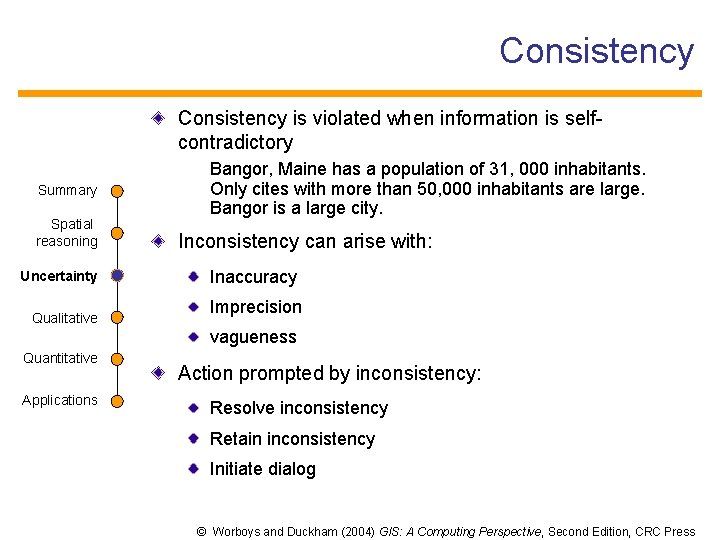
Consistency is violated when information is selfcontradictory Summary Spatial reasoning Uncertainty Qualitative Bangor, Maine has a population of 31, 000 inhabitants. Only cites with more than 50, 000 inhabitants are large. Bangor is a large city. Inconsistency can arise with: Inaccuracy Imprecision vagueness Quantitative Applications Action prompted by inconsistency: Resolve inconsistency Retain inconsistency Initiate dialog © Worboys and Duckham (2004) GIS: A Computing Perspective, Second Edition, CRC Press
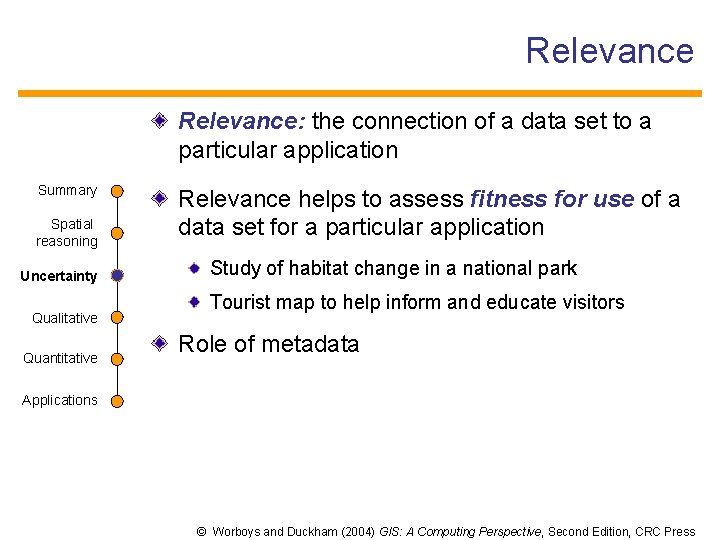
Relevance: the connection of a data set to a particular application Summary Spatial reasoning Uncertainty Qualitative Quantitative Relevance helps to assess fitness for use of a data set for a particular application Study of habitat change in a national park Tourist map to help inform and educate visitors Role of metadata Applications © Worboys and Duckham (2004) GIS: A Computing Perspective, Second Edition, CRC Press
Section 9. 3 Qualitative approaches to uncertainty © Worboys and Duckham (2004) GIS: A Computing Perspective, Second Edition, CRC Press
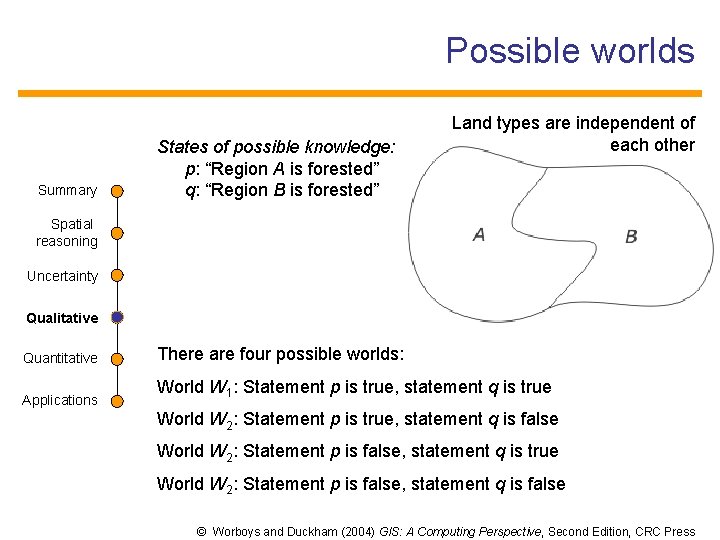
Possible worlds Summary States of possible knowledge: p: “Region A is forested” q: “Region B is forested” Land types are independent of each other Spatial reasoning Uncertainty Qualitative Quantitative Applications There are four possible worlds: World W 1: Statement p is true, statement q is true World W 2: Statement p is true, statement q is false World W 2: Statement p is false, statement q is true World W 2: Statement p is false, statement q is false © Worboys and Duckham (2004) GIS: A Computing Perspective, Second Edition, CRC Press
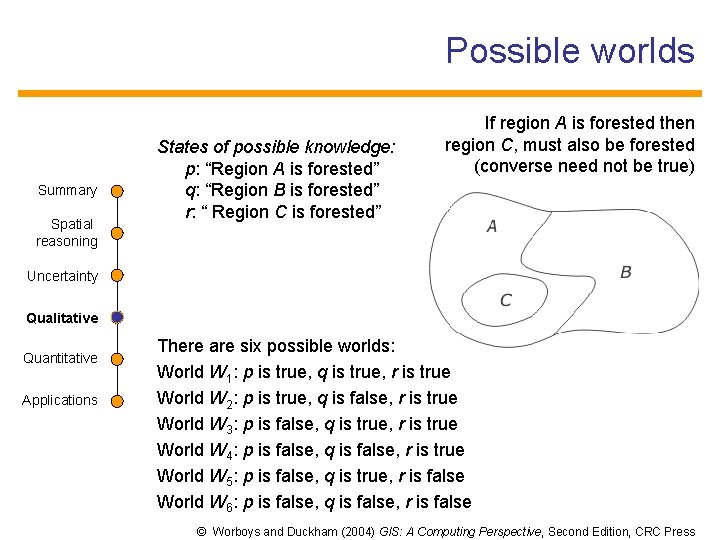
Possible worlds Summary Spatial reasoning States of possible knowledge: p: “Region A is forested” q: “Region B is forested” r: “ Region C is forested” If region A is forested then region C, must also be forested (converse need not be true) Uncertainty Qualitative Quantitative Applications There are six possible worlds: World W 1: p is true, q is true, r is true World W 2: p is true, q is false, r is true World W 3: p is false, q is true, r is true World W 4: p is false, q is false, r is true World W 5: p is false, q is true, r is false World W 6: p is false, q is false, r is false © Worboys and Duckham (2004) GIS: A Computing Perspective, Second Edition, CRC Press
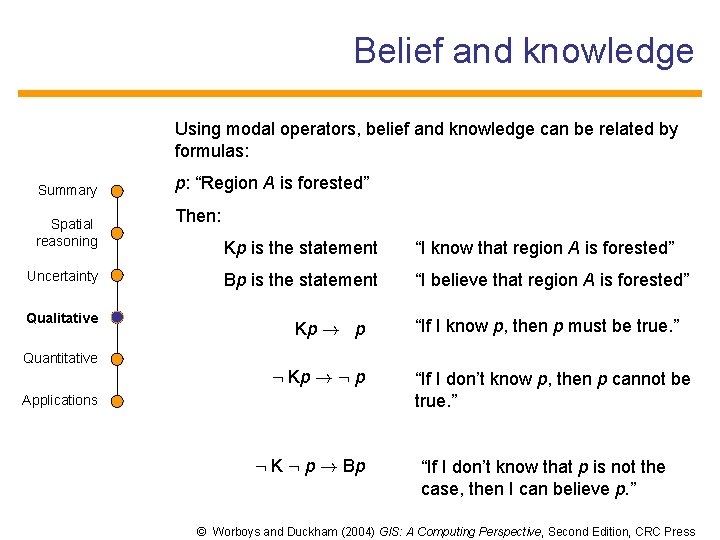
Belief and knowledge Using modal operators, belief and knowledge can be related by formulas: Summary Spatial reasoning Uncertainty Qualitative p: “Region A is forested” Then: Kp is the statement “I know that region A is forested” Bp is the statement “I believe that region A is forested” Kp ! p “If I know p, then p must be true. ” Quantitative : Kp ! : p Applications : K : p ! Bp “If I don’t know p, then p cannot be true. ” “If I don’t know that p is not the case, then I can believe p. ” © Worboys and Duckham (2004) GIS: A Computing Perspective, Second Edition, CRC Press
Belief revision Summary Spatial reasoning Uncertainty Qualitative Quantitative Belief revision: If new information arises that contradicts our current beliefs, we may want to review, revise or retract our old beliefs so as to make way for the new information Beliefs are often founded on other beliefs, the effects of removing one belief may cascade through the knowledge base, in a way that is difficult to predict Applications © Worboys and Duckham (2004) GIS: A Computing Perspective, Second Edition, CRC Press
Example Summary Spatial reasoning Uncertainty Qualitative Quantitative Applications The bird caught in the trap is a swan. The bird caught in the trap comes from Sweden is part of Europe. All European swans are white. We receive new information: “The bird caught in the trap is black. ” Which beliefs do we retract in order to regain consistency? Preference relation Principle of minimal change Nearness principle © Worboys and Duckham (2004) GIS: A Computing Perspective, Second Edition, CRC Press
Default Reasoning Summary Spatial reasoning Uncertainty Qualitative The bird caught in the trap is a swan. The bird caught in the trap comes from Sweden is part of Europe. All European swans are white. The fourth statement is difficult or impossible to verify Maybe we want to say: Quantitative Applications All European swans are white (except if we have definite evidence to the contrary in the case of a particular swan) Default reasoning allows the possibility that some counterexamples may exist © Worboys and Duckham (2004) GIS: A Computing Perspective, Second Edition, CRC Press
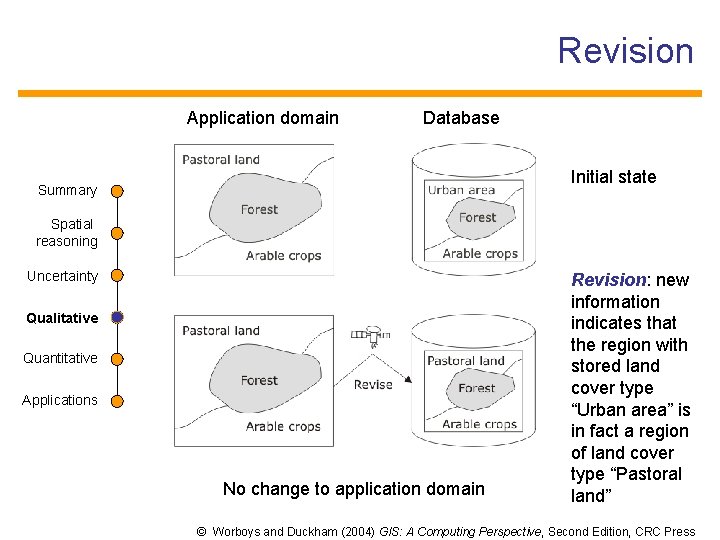
Revision Application domain Database Initial state Summary Spatial reasoning Uncertainty Qualitative Quantitative Applications No change to application domain Revision: new information indicates that the region with stored land cover type “Urban area” is in fact a region of land cover type “Pastoral land” © Worboys and Duckham (2004) GIS: A Computing Perspective, Second Edition, CRC Press
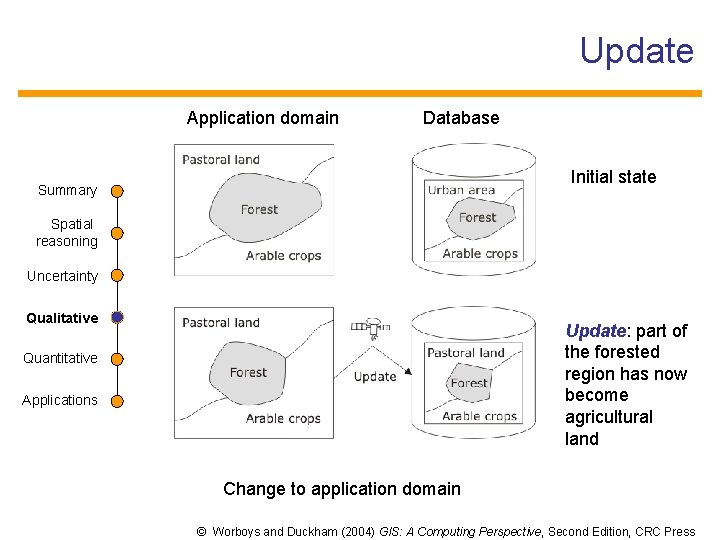
Update Application domain Database Initial state Summary Spatial reasoning Uncertainty Qualitative Update: part of the forested region has now become agricultural land Quantitative Applications Change to application domain © Worboys and Duckham (2004) GIS: A Computing Perspective, Second Edition, CRC Press
Three-valued logic Three truth values > (True) Summary Spatial reasoning Uncertainty Qualitative Quantitative Applications (False) ? (Undetermined) Depending on the interpretation of “? ”, we can arrive at different truth tables Kleene logic Uncertainty is interpreted as a limitation on reasoning or computing resources © Worboys and Duckham (2004) GIS: A Computing Perspective, Second Edition, CRC Press
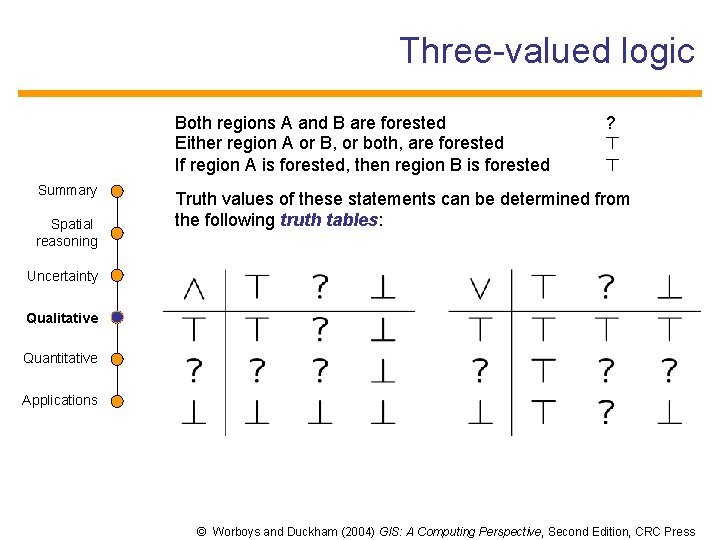
Three-valued logic Both regions A and B are forested Either region A or B, or both, are forested If region A is forested, then region B is forested Summary Spatial reasoning ? > > Truth values of these statements can be determined from the following truth tables: Uncertainty Qualitative Quantitative Applications © Worboys and Duckham (2004) GIS: A Computing Perspective, Second Edition, CRC Press
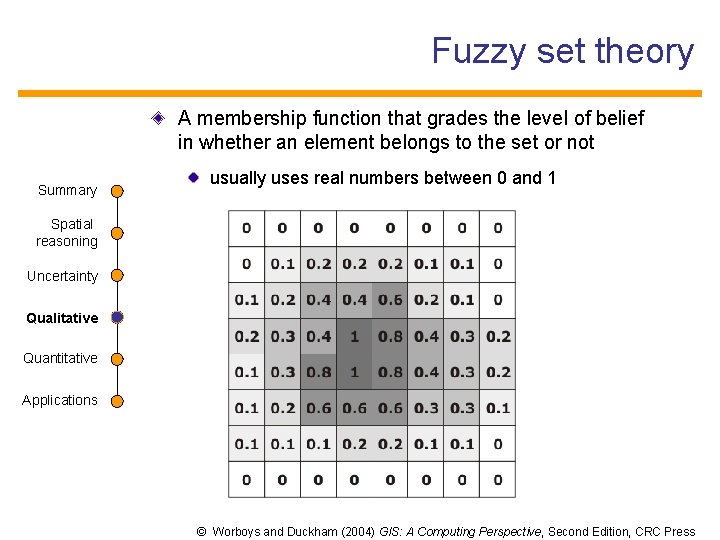
Fuzzy set theory A membership function that grades the level of belief in whether an element belongs to the set or not Summary usually uses real numbers between 0 and 1 Spatial reasoning Uncertainty Qualitative Quantitative Applications © Worboys and Duckham (2004) GIS: A Computing Perspective, Second Edition, CRC Press
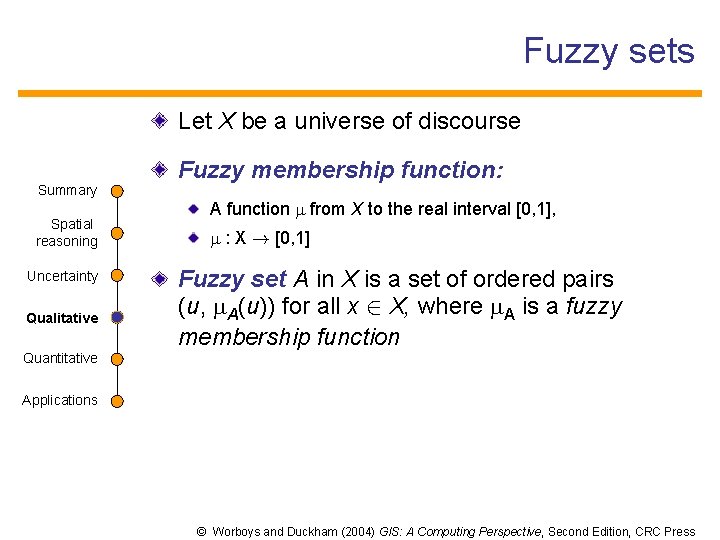
Fuzzy sets Let X be a universe of discourse Summary Spatial reasoning Uncertainty Qualitative Fuzzy membership function: A function from X to the real interval [0, 1], : X ! [0, 1] Fuzzy set A in X is a set of ordered pairs (u, A(u)) for all x 2 X, where A is a fuzzy membership function Quantitative Applications © Worboys and Duckham (2004) GIS: A Computing Perspective, Second Edition, CRC Press
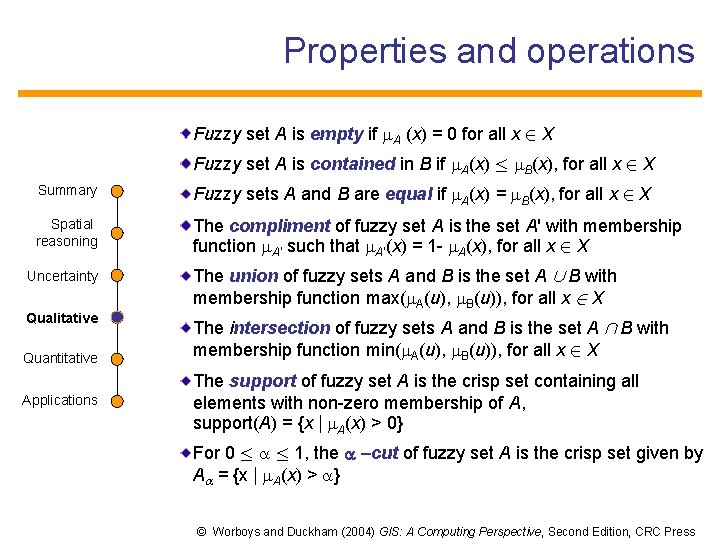
Properties and operations Fuzzy set A is empty if A (x) = 0 for all x 2 X Fuzzy set A is contained in B if A(x) · B(x), for all x 2 X Summary Fuzzy sets A and B are equal if A(x) = B(x), for all x 2 X Spatial reasoning The compliment of fuzzy set A is the set A' with membership function A' such that A'(x) = 1 - A(x), for all x 2 X Uncertainty Qualitative Quantitative Applications The union of fuzzy sets A and B is the set A [ B with membership function max( A(u), B(u)), for all x 2 X The intersection of fuzzy sets A and B is the set A Å B with membership function min( A(u), B(u)), for all x 2 X The support of fuzzy set A is the crisp set containing all elements with non-zero membership of A, support(A) = {x j A(x) > 0} For 0 · · 1, the –cut of fuzzy set A is the crisp set given by A = {x j A(x) > } © Worboys and Duckham (2004) GIS: A Computing Perspective, Second Edition, CRC Press
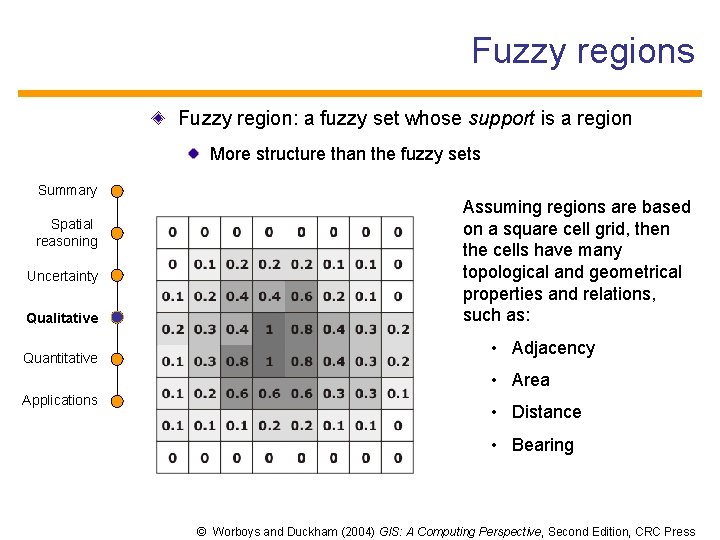
Fuzzy regions Fuzzy region: a fuzzy set whose support is a region More structure than the fuzzy sets Summary Spatial reasoning Uncertainty Qualitative Quantitative Assuming regions are based on a square cell grid, then the cells have many topological and geometrical properties and relations, such as: • Adjacency • Area Applications • Distance • Bearing © Worboys and Duckham (2004) GIS: A Computing Perspective, Second Edition, CRC Press
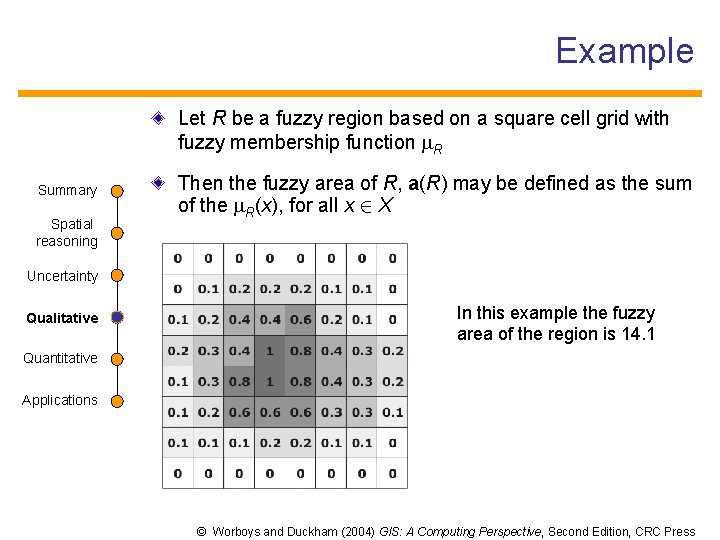
Example Let R be a fuzzy region based on a square cell grid with fuzzy membership function R Summary Spatial reasoning Then the fuzzy area of R, a(R) may be defined as the sum of the R(x), for all x 2 X Uncertainty Qualitative In this example the fuzzy area of the region is 14. 1 Quantitative Applications © Worboys and Duckham (2004) GIS: A Computing Perspective, Second Edition, CRC Press
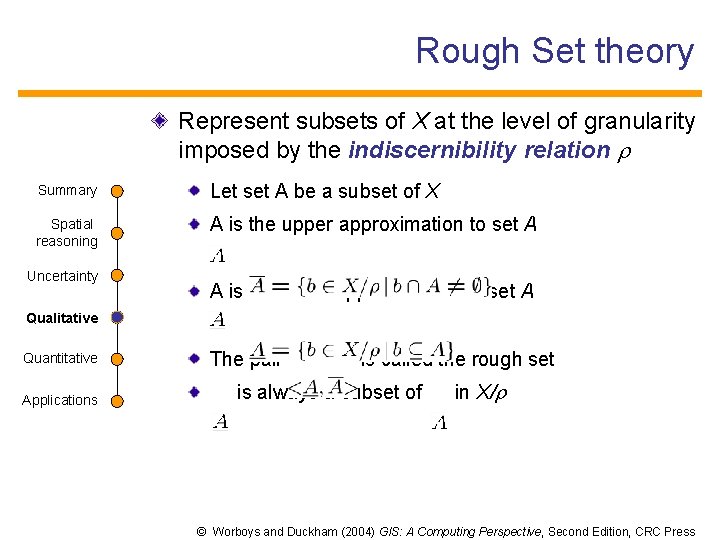
Rough Set theory Represent subsets of X at the level of granularity imposed by the indiscernibility relation Summary Let set A be a subset of X Spatial reasoning A is the upper approximation to set A Uncertainty A is the lower approximation to set A Qualitative Quantitative Applications The pair is called the rough set is always a subset of in X/ © Worboys and Duckham (2004) GIS: A Computing Perspective, Second Edition, CRC Press
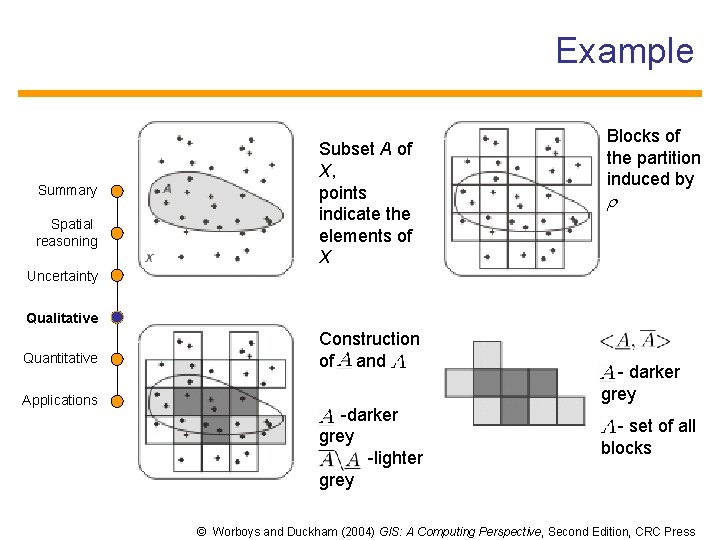
Example Summary Spatial reasoning Subset A of X, points indicate the elements of X Blocks of the partition induced by Uncertainty Qualitative Quantitative Applications Construction of A and A A -darker grey AA -lighter grey A - darker grey A - set of all blocks © Worboys and Duckham (2004) GIS: A Computing Perspective, Second Edition, CRC Press
Section 9. 4 Quantitative approaches to uncertainty © Worboys and Duckham (2004) GIS: A Computing Perspective, Second Edition, CRC Press
Probability Random experiments Summary Spatial reasoning Uncertainty Qualitative Quantitative Applications If X denotes the set of possible outcomes, we can specify a chance function ch : X ! [0, 1] ch(x) gives the proportion of times that a particular outcome x 2 X might occur • Frequency analysis • The nature of the experiment ch should satisfy the constraint that the sum of chances of all possible outcomes is 1 For a subset S µ X, ch(S) is the chance of an outcome from set S © Worboys and Duckham (2004) GIS: A Computing Perspective, Second Edition, CRC Press
Rules ch(; ) = 0 Summary Spatial reasoning Uncertainty Qualitative Quantitative ch(X) = 1 If A Å B = ; , then ch(A [ B) = ch(A) = ch(B) Also, given n independent trials of a random experiment, the chance of the compound outcome chn (x 1, …, xn) is given by: chn(x 1, …, xn) = ch(x 1)*…*ch(xn) Applications © Worboys and Duckham (2004) GIS: A Computing Perspective, Second Edition, CRC Press
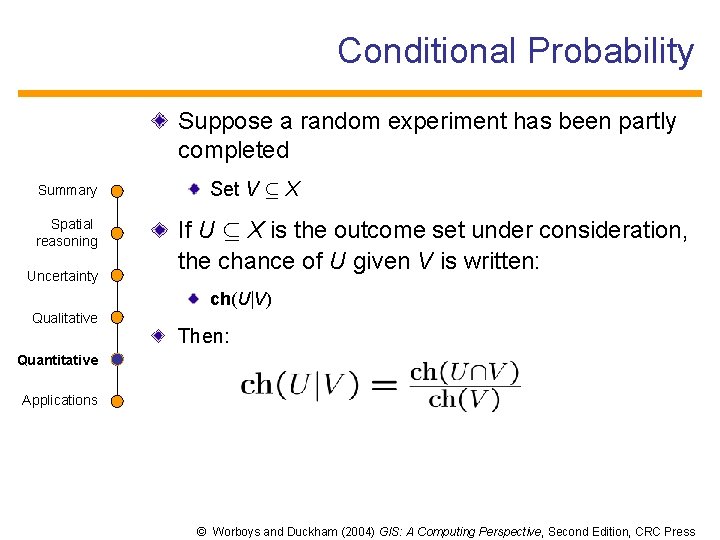
Conditional Probability Suppose a random experiment has been partly completed Summary Spatial reasoning Uncertainty Set V µ X If U µ X is the outcome set under consideration, the chance of U given V is written: ch(Uj. V) Qualitative Then: Quantitative Applications © Worboys and Duckham (2004) GIS: A Computing Perspective, Second Edition, CRC Press
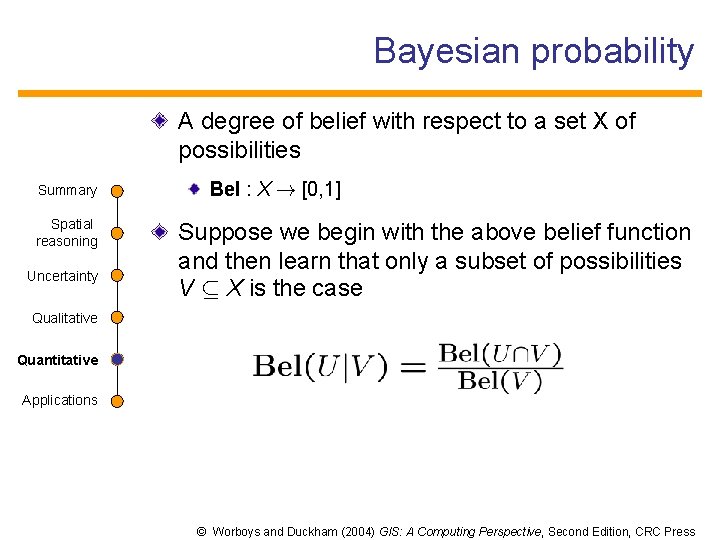
Bayesian probability A degree of belief with respect to a set X of possibilities Summary Spatial reasoning Uncertainty Bel : X ! [0, 1] Suppose we begin with the above belief function and then learn that only a subset of possibilities V µ X is the case Qualitative Quantitative Applications © Worboys and Duckham (2004) GIS: A Computing Perspective, Second Edition, CRC Press
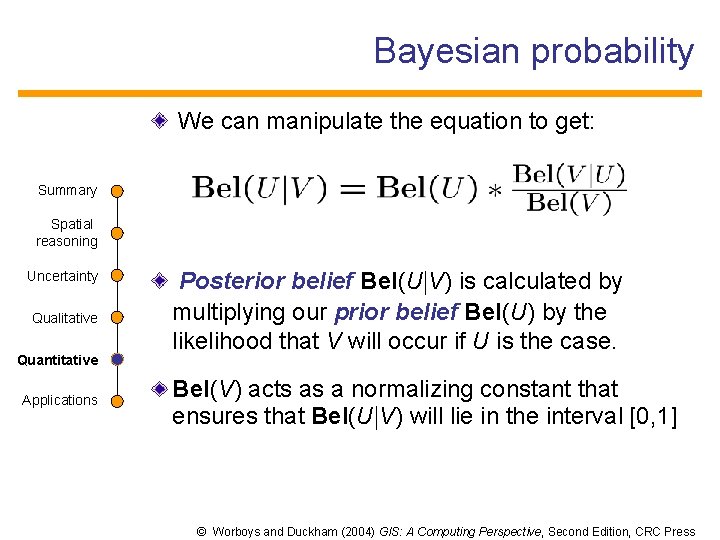
Bayesian probability We can manipulate the equation to get: Summary Spatial reasoning Uncertainty Qualitative Quantitative Applications Posterior belief Bel(Uj. V) is calculated by multiplying our prior belief Bel(U) by the likelihood that V will occur if U is the case. Bel(V) acts as a normalizing constant that ensures that Bel(Uj. V) will lie in the interval [0, 1] © Worboys and Duckham (2004) GIS: A Computing Perspective, Second Edition, CRC Press
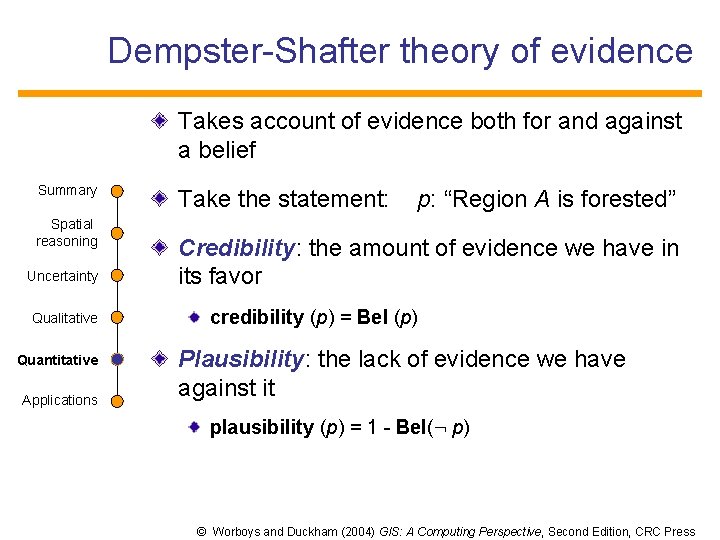
Dempster-Shafter theory of evidence Takes account of evidence both for and against a belief Summary Spatial reasoning Uncertainty Qualitative Quantitative Applications Take the statement: p: “Region A is forested” Credibility: the amount of evidence we have in its favor credibility (p) = Bel (p) Plausibility: the lack of evidence we have against it plausibility (p) = 1 - Bel(: p) © Worboys and Duckham (2004) GIS: A Computing Perspective, Second Edition, CRC Press
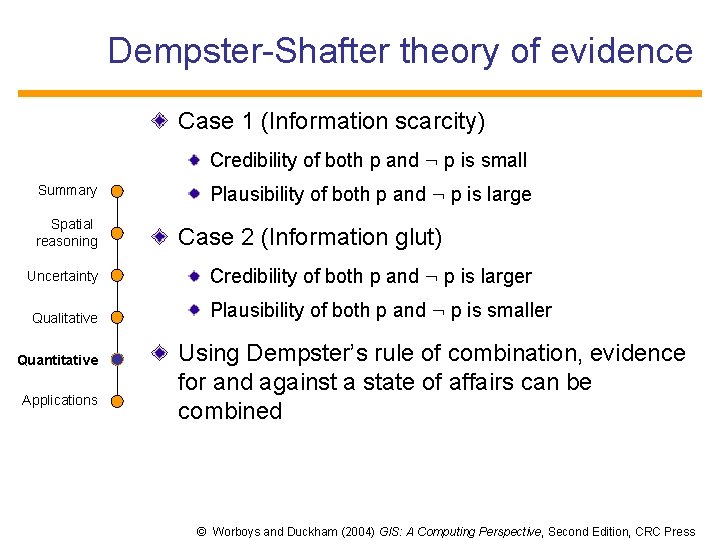
Dempster-Shafter theory of evidence Case 1 (Information scarcity) Credibility of both p and : p is small Summary Spatial reasoning Uncertainty Qualitative Quantitative Applications Plausibility of both p and : p is large Case 2 (Information glut) Credibility of both p and : p is larger Plausibility of both p and : p is smaller Using Dempster’s rule of combination, evidence for and against a state of affairs can be combined © Worboys and Duckham (2004) GIS: A Computing Perspective, Second Edition, CRC Press
Section 9. 5 Applications of uncertainty in GIS © Worboys and Duckham (2004) GIS: A Computing Perspective, Second Edition, CRC Press
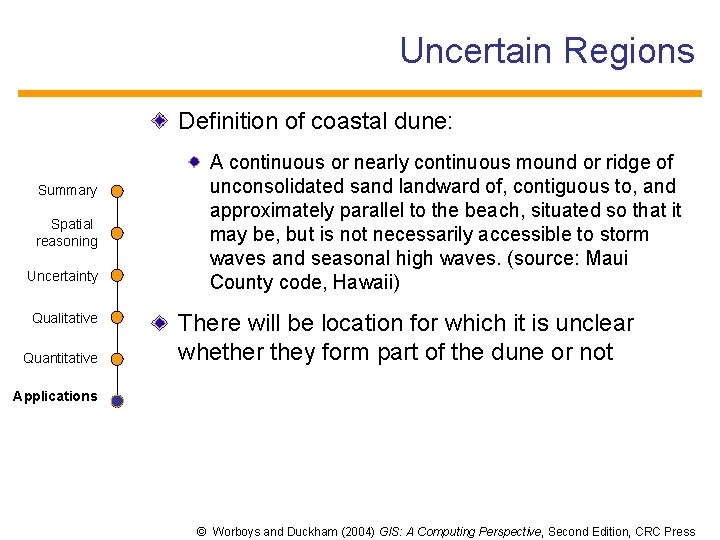
Uncertain Regions Definition of coastal dune: Summary Spatial reasoning Uncertainty Qualitative Quantitative A continuous or nearly continuous mound or ridge of unconsolidated sand landward of, contiguous to, and approximately parallel to the beach, situated so that it may be, but is not necessarily accessible to storm waves and seasonal high waves. (source: Maui County code, Hawaii) There will be location for which it is unclear whether they form part of the dune or not Applications © Worboys and Duckham (2004) GIS: A Computing Perspective, Second Edition, CRC Press
Fuzzy set theory How do we assign membership functions? Dunes Summary Spatial reasoning Uncertainty Qualitative Quantitative Applications Elevation with respect to the beach Forest The existence and density of various tree species Problem: Applying the fuzzy intersection operator to construct an new region which is both forest and wetland New region is not equivalent to a region derived from indicators of “wetland forest” © Worboys and Duckham (2004) GIS: A Computing Perspective, Second Edition, CRC Press
Rough sets Let R be an uncertain region Summary R consists of locations that can be said with certainty to be in the region R Spatial reasoning R excludes all locations that can be said with certainty not be in the region R Uncertainty Qualitative Quantitative Applications Principled account of indeterminacy arising from change of granularity If assignment of upper and lower approximations depends on level of belief, they are open to the same criticism as fuzzy sets © Worboys and Duckham (2004) GIS: A Computing Perspective, Second Edition, CRC Press
Uncertain viewsheds Viewshed: a region of terrain visible from a point or set of points Summary Spatial reasoning Uncertainty Probable viewshed: Uncertainty arising through imprecision and inaccuracy in measurements of the elevation Boundary will be crisp but its position uncertain Qualitative Quantitative Applications Fuzzy viewshed: Uncertainty arising from atmospheric conditions, light refraction, and seasonal and vegetation effects Boundary is broad and graded Fuzzy regions are often used © Worboys and Duckham (2004) GIS: A Computing Perspective, Second Edition, CRC Press
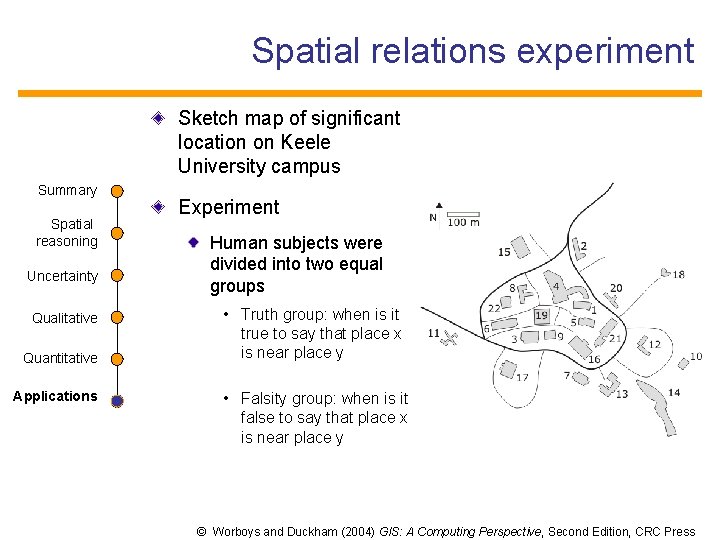
Spatial relations experiment Sketch map of significant location on Keele University campus Summary Spatial reasoning Uncertainty Qualitative Quantitative Applications Experiment Human subjects were divided into two equal groups • Truth group: when is it true to say that place x is near place y • Falsity group: when is it false to say that place x is near place y © Worboys and Duckham (2004) GIS: A Computing Perspective, Second Edition, CRC Press
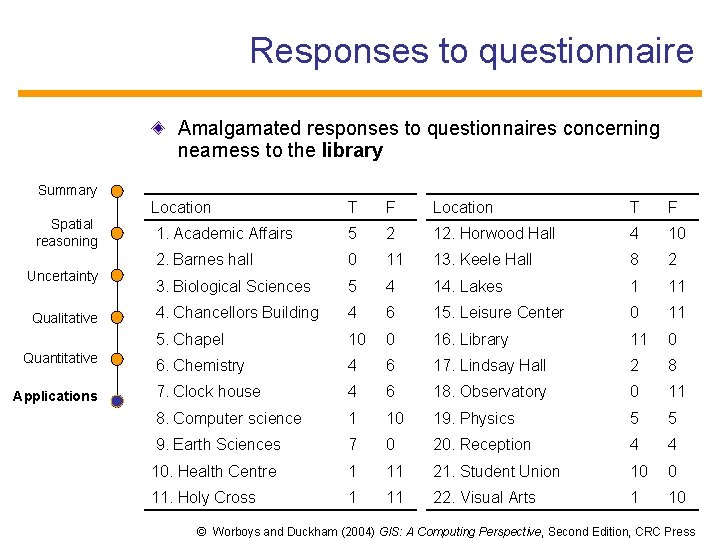
Responses to questionnaire Amalgamated responses to questionnaires concerning nearness to the library Summary Spatial reasoning Uncertainty Qualitative Quantitative Applications Location T F 1. Academic Affairs 5 2 12. Horwood Hall 4 10 2. Barnes hall 0 11 13. Keele Hall 8 2 3. Biological Sciences 5 4 14. Lakes 1 11 4. Chancellors Building 4 6 15. Leisure Center 0 11 5. Chapel 10 0 16. Library 11 0 6. Chemistry 4 6 17. Lindsay Hall 2 8 7. Clock house 4 6 18. Observatory 0 11 8. Computer science 1 10 19. Physics 5 5 9. Earth Sciences 7 0 20. Reception 4 4 10. Health Centre 1 11 21. Student Union 10 0 11. Holy Cross 1 11 22. Visual Arts 1 10 © Worboys and Duckham (2004) GIS: A Computing Perspective, Second Edition, CRC Press
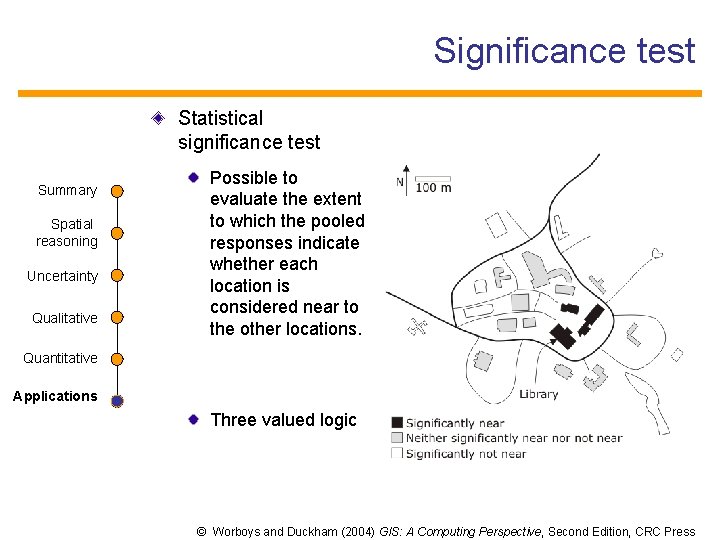
Significance test Statistical significance test Summary Spatial reasoning Uncertainty Qualitative Possible to evaluate the extent to which the pooled responses indicate whether each location is considered near to the other locations. Quantitative Applications Three valued logic © Worboys and Duckham (2004) GIS: A Computing Perspective, Second Edition, CRC Press
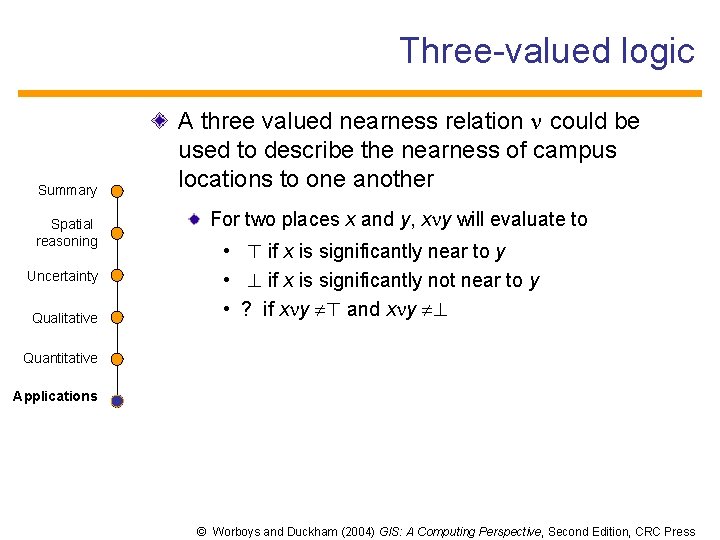
Three-valued logic Summary Spatial reasoning Uncertainty Qualitative A three valued nearness relation could be used to describe the nearness of campus locations to one another For two places x and y, x y will evaluate to • > if x is significantly near to y • ? if x is significantly not near to y • ? if x y > and x y ? Quantitative Applications © Worboys and Duckham (2004) GIS: A Computing Perspective, Second Edition, CRC Press
- Slides: 55