
Chapter 9 Solids and fluids Ying Yi Ph


- Slides: 57
Chapter 9 Solids and fluids Ying Yi Ph. D 1 PHYS I @ HCC
Outline �States of Matter �Density and Pressure �Deformation of Solid �Buoyant Forces and Archimedes’ Principle 2 PHYS I @ HCC
ØStates of Matter 3 PHYS I @ HCC
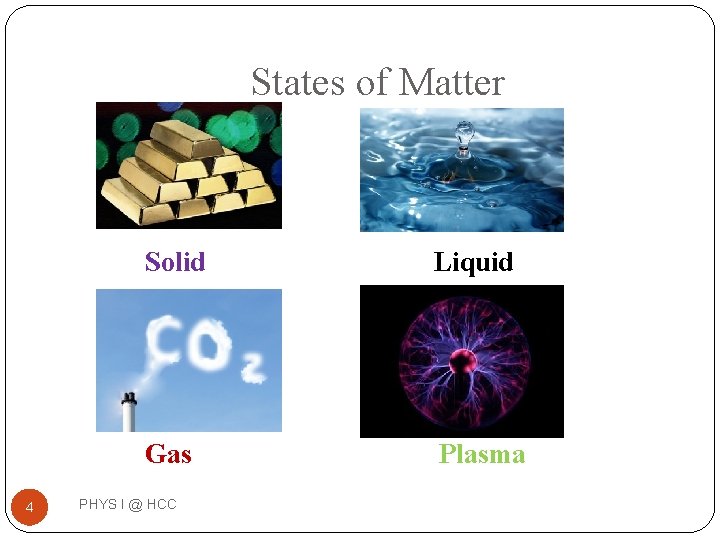
States of Matter 4 Solid Liquid Gas Plasma PHYS I @ HCC
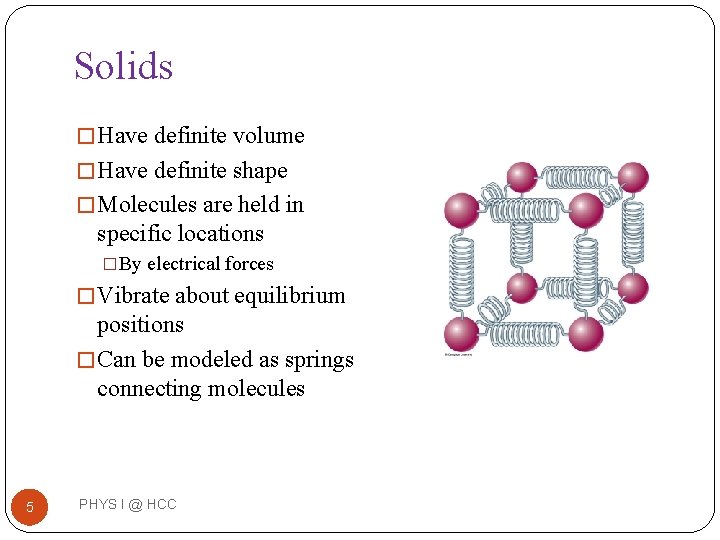
Solids � Have definite volume � Have definite shape � Molecules are held in specific locations �By electrical forces � Vibrate about equilibrium positions � Can be modeled as springs connecting molecules 5 PHYS I @ HCC
More About Solids �External forces can be applied to the solid and compress the material �In the model, the springs would be compressed �When the force is removed, the solid returns to its original shape and size �This property is called elasticity 6 PHYS I @ HCC
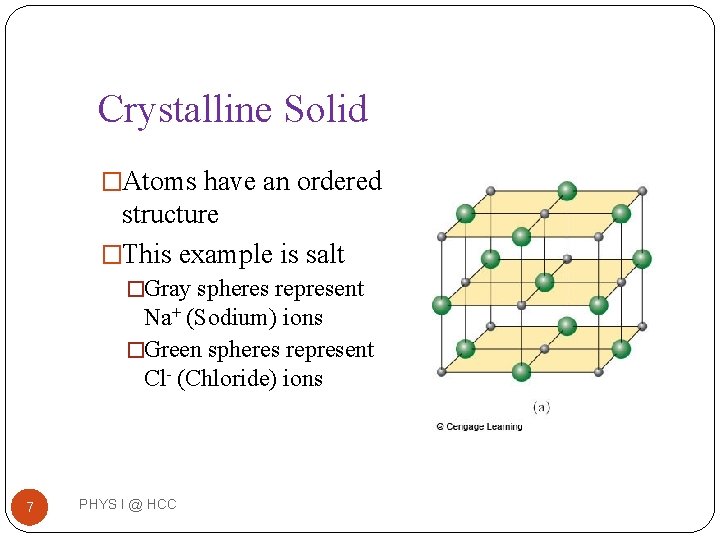
Crystalline Solid �Atoms have an ordered structure �This example is salt �Gray spheres represent Na+ (Sodium) ions �Green spheres represent Cl- (Chloride) ions 7 PHYS I @ HCC
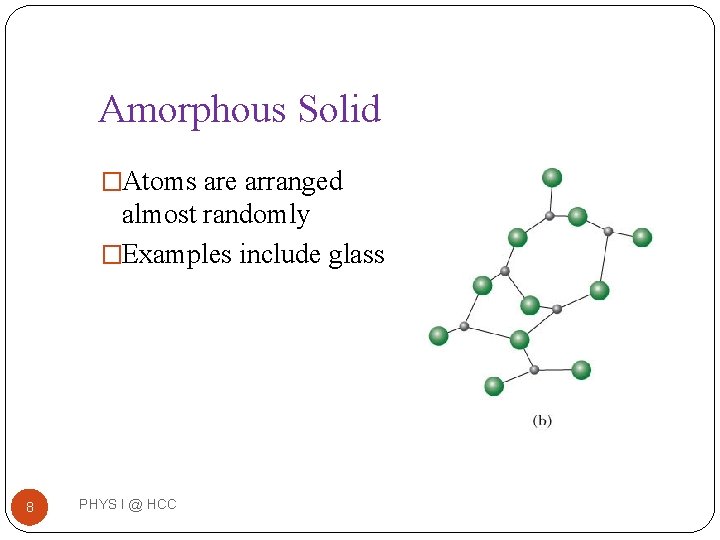
Amorphous Solid �Atoms are arranged almost randomly �Examples include glass 8 PHYS I @ HCC
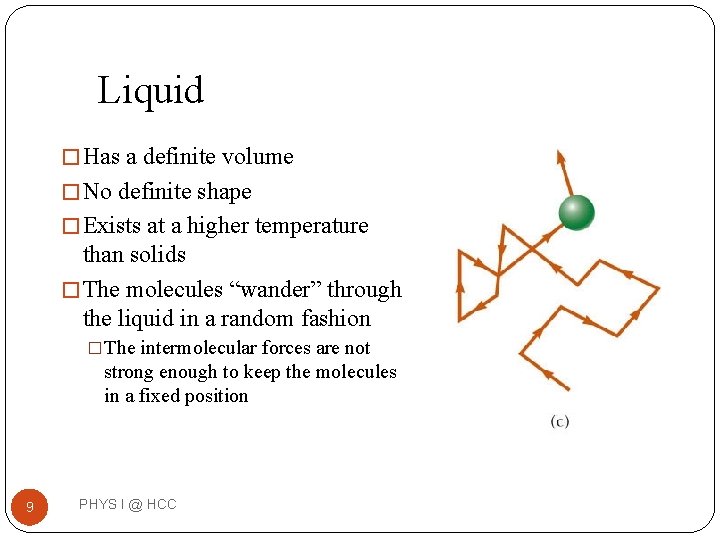
Liquid � Has a definite volume � No definite shape � Exists at a higher temperature than solids � The molecules “wander” through the liquid in a random fashion �The intermolecular forces are not strong enough to keep the molecules in a fixed position 9 PHYS I @ HCC
Gas �Has no definite volume �Has no definite shape �Molecules are in constant random motion �The molecules exert only weak forces on each other �Average distance between molecules is large compared to the size of the molecules 10 PHYS I @ HCC
Plasma �Gas heated to a very high temperature �Many of the electrons are freed from the nucleus �Result is a collection of free, electrically charged ions �Plasmas exist inside stars 11 PHYS I @ HCC
ØDensity and Pressure 12 PHYS I @ HCC
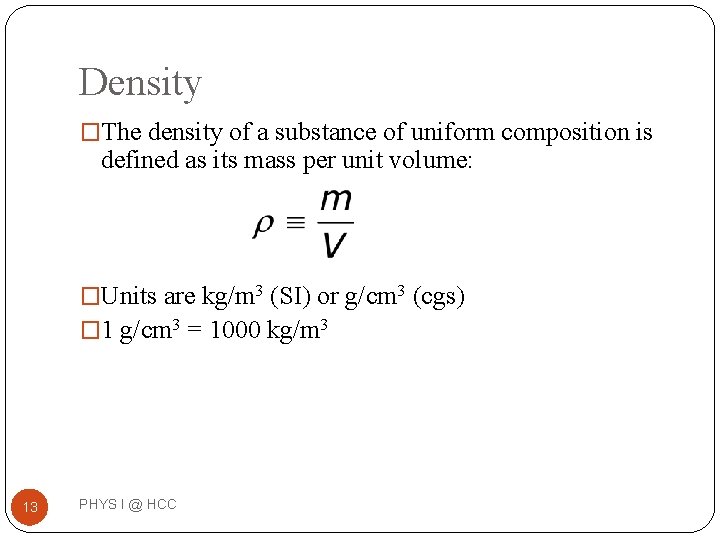
Density �The density of a substance of uniform composition is defined as its mass per unit volume: �Units are kg/m 3 (SI) or g/cm 3 (cgs) � 1 g/cm 3 = 1000 kg/m 3 13 PHYS I @ HCC
Density, cont. �The densities of most liquids and solids vary slightly with changes in temperature and pressure �Densities of gases vary greatly with changes in temperature and pressure �The higher normal densities of solids and liquids compared to gases implies that the average spacing between molecules in a gas is about 10 times greater than the solid or liquid 14 PHYS I @ HCC
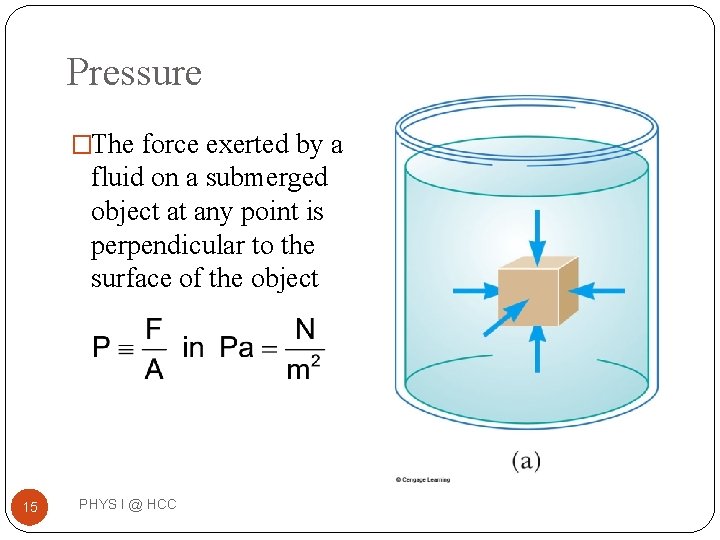
Pressure �The force exerted by a fluid on a submerged object at any point is perpendicular to the surface of the object 15 PHYS I @ HCC
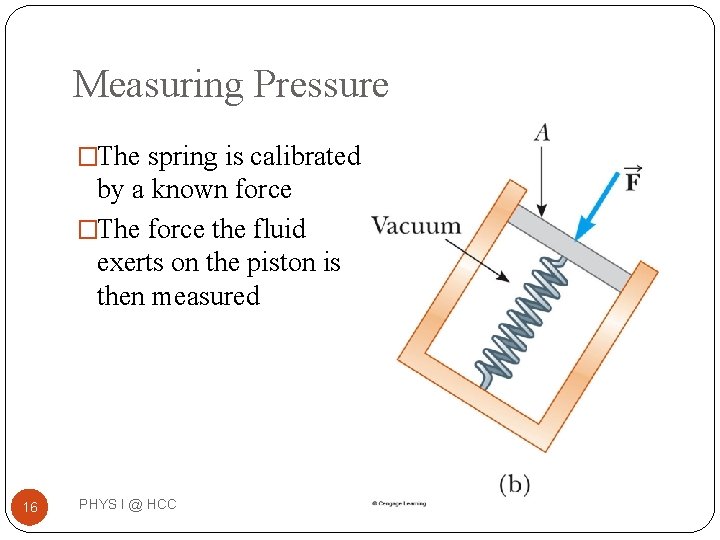
Measuring Pressure �The spring is calibrated by a known force �The force the fluid exerts on the piston is then measured 16 PHYS I @ HCC
Notes on Atmospheric Pressure �Temperature: 20º �Altitude: Sea level �air density = 1. 225 kg/m³ �Relative humidity: 20% �Standard atmospheric Pressure: 1. 01 × 105 Pa 17 PHYS I @ HCC
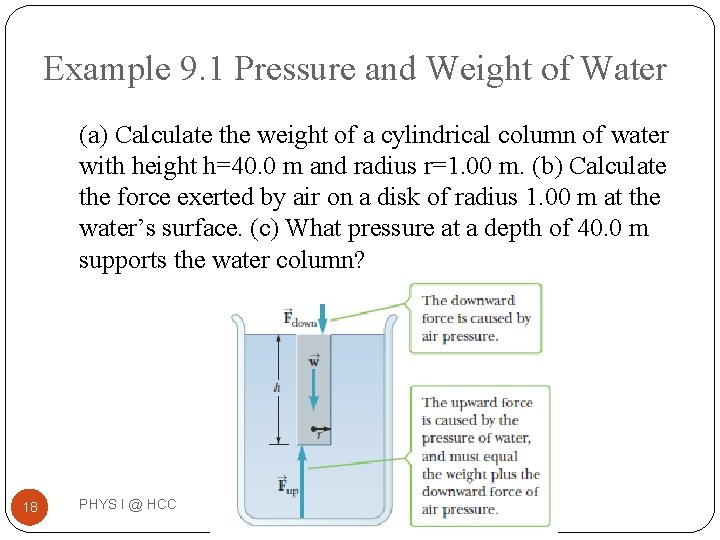
Example 9. 1 Pressure and Weight of Water (a) Calculate the weight of a cylindrical column of water with height h=40. 0 m and radius r=1. 00 m. (b) Calculate the force exerted by air on a disk of radius 1. 00 m at the water’s surface. (c) What pressure at a depth of 40. 0 m supports the water column? 18 PHYS I @ HCC
Deformation of Solids �All objects are deformable �It is possible to change the shape or size (or both) of an object through the application of external forces �When the forces are removed, the object tends to its original shape �An object undergoing this type of deformation exhibits elastic behavior 19 PHYS I @ HCC
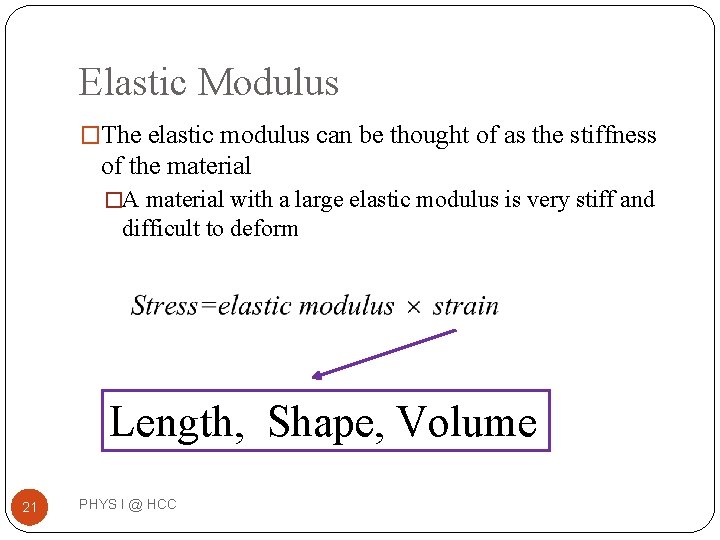
Elastic Properties �Stress is the force per unit area causing the deformation �Strain is a measure of the amount of deformation �The elastic modulus is the constant of proportionality between stress and strain �For sufficiently small stresses, the stress is directly proportional to the strain �The constant of proportionality depends on the material being deformed and the nature of the deformation 20 PHYS I @ HCC
Elastic Modulus �The elastic modulus can be thought of as the stiffness of the material �A material with a large elastic modulus is very stiff and difficult to deform Length, Shape, Volume 21 PHYS I @ HCC
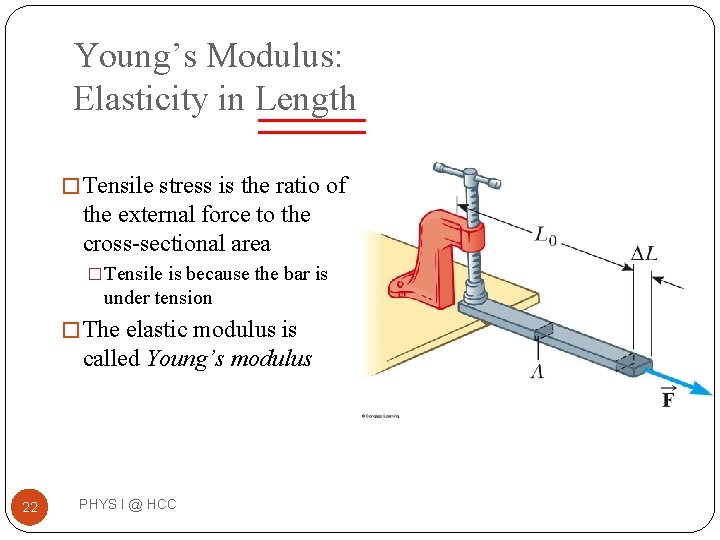
Young’s Modulus: Elasticity in Length � Tensile stress is the ratio of the external force to the cross-sectional area �Tensile is because the bar is under tension � The elastic modulus is called Young’s modulus 22 PHYS I @ HCC
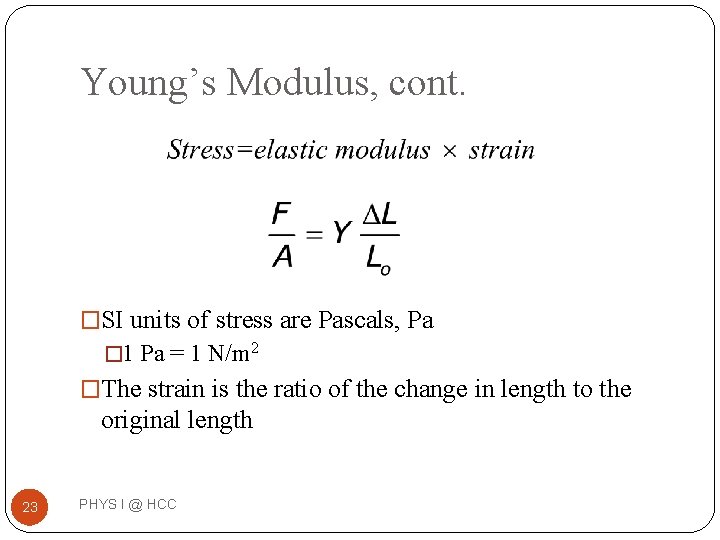
Young’s Modulus, cont. �SI units of stress are Pascals, Pa � 1 Pa = 1 N/m 2 �The strain is the ratio of the change in length to the original length 23 PHYS I @ HCC
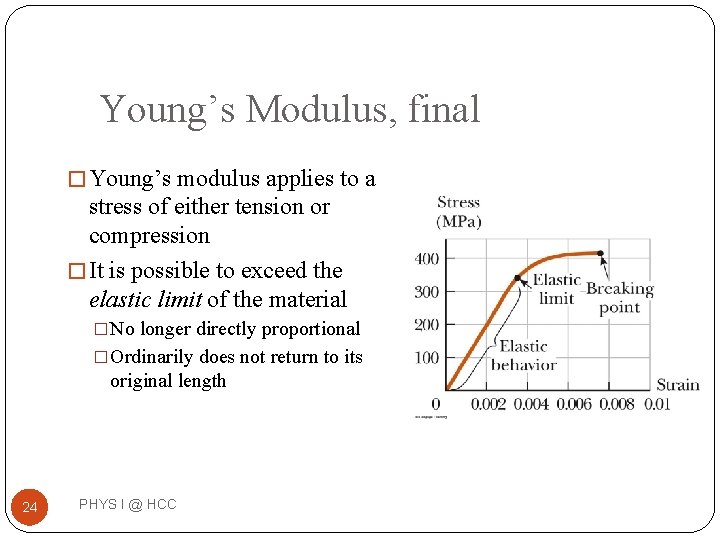
Young’s Modulus, final � Young’s modulus applies to a stress of either tension or compression � It is possible to exceed the elastic limit of the material �No longer directly proportional �Ordinarily does not return to its original length 24 PHYS I @ HCC
Breaking �If stress continues, it surpasses its ultimate strength �The ultimate strength is the greatest stress the object can withstand without breaking �The breaking point �For a brittle material, the breaking point is just beyond its ultimate strength �For a ductile material, after passing the ultimate strength the material thins and stretches at a lower stress level before breaking 25 PHYS I @ HCC
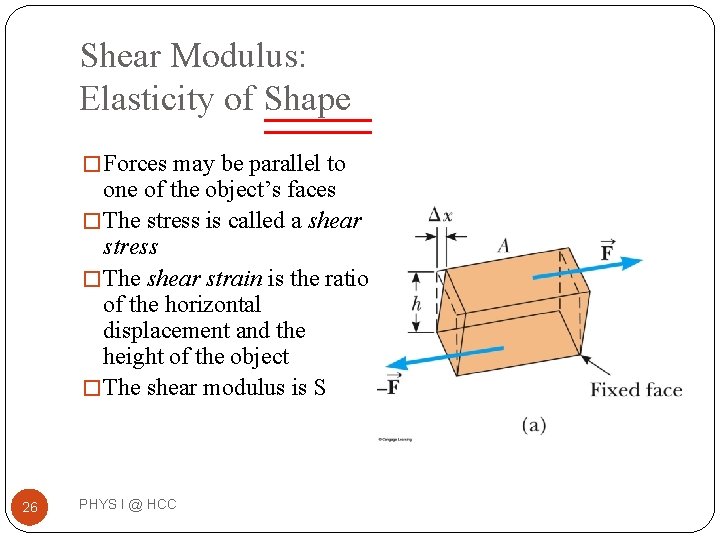
Shear Modulus: Elasticity of Shape � Forces may be parallel to one of the object’s faces � The stress is called a shear stress � The shear strain is the ratio of the horizontal displacement and the height of the object � The shear modulus is S 26 PHYS I @ HCC
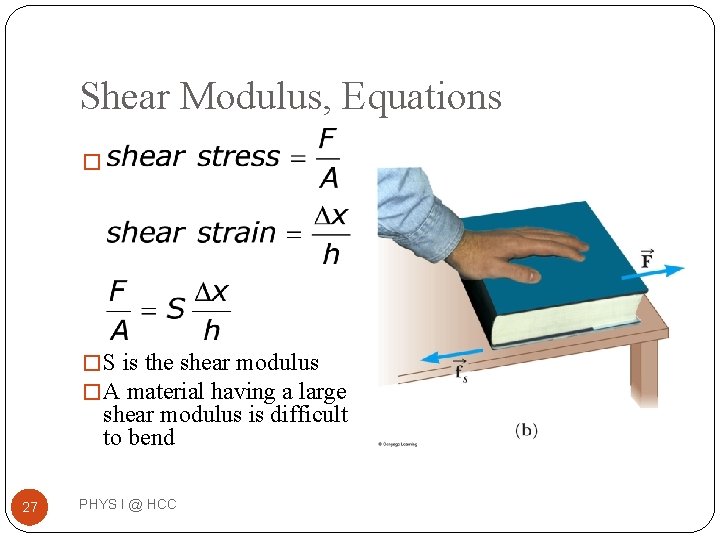
Shear Modulus, Equations � � S is the shear modulus � A material having a large shear modulus is difficult to bend 27 PHYS I @ HCC
Shear Modulus, final �There is no volume change in this type of deformation �In tensile stress, the force is perpendicular to the cross- sectional area 28 PHYS I @ HCC
Example 9. 2 Young’s modulus A vertical steel beam in a building supports a load of 6. 0 × 104 N. (a) If the length of the beam is 4. 0 m and its cross-sectional area is 8. 0 × 10 -3 m 2, find the distance the beam is compressed along its length. (b) What maximum load in newtons could the steel beam support before failing? 29 PHYS I @ HCC
Bulk Modulus: Volume Elasticity �Bulk modulus characterizes the response of an object to uniform squeezing �Suppose the forces are perpendicular to, and act on, all the surfaces �Example: when an object is immersed in a fluid �The object undergoes a change in volume without a change in shape 30 PHYS I @ HCC
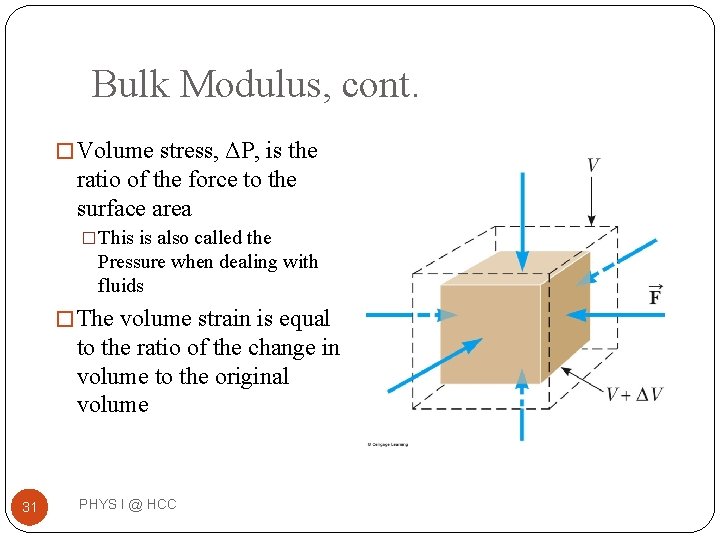
Bulk Modulus, cont. � Volume stress, ΔP, is the ratio of the force to the surface area �This is also called the Pressure when dealing with fluids � The volume strain is equal to the ratio of the change in volume to the original volume 31 PHYS I @ HCC
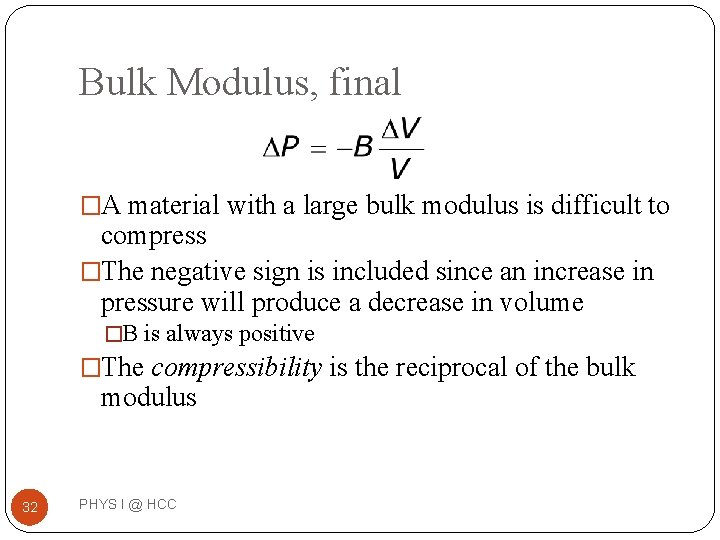
Bulk Modulus, final �A material with a large bulk modulus is difficult to compress �The negative sign is included since an increase in pressure will produce a decrease in volume �B is always positive �The compressibility is the reciprocal of the bulk modulus 32 PHYS I @ HCC
Group Problem: Bulk modulus Ships and sailing vessels often carry lead ballast in various forms, such as bricks, to keep the ship properly oriented and upright in the water. Suppose a ship takes on cargo and the crew jettisons a total of 0. 500 m 3 of lead ballast into water 2. 00 km deep. Calculate (a) the change in the pressure at that depth and (b) the change in volume of the lead upon reaching the bottom. Take the density of sea water to be 1. 025 × 103 kg/m 3, and take the bulk modulus of lead to be 4. 2 × 10¹⁰ Pa 33 PHYS I @ HCC
Notes on Moduli �Solids have Young’s, Bulk, and Shear moduli �Liquids have only bulk moduli, they will not undergo a shearing or tensile stress �The liquid would flow instead 34 PHYS I @ HCC
Ultimate Strength of Materials �The ultimate strength of a material is the maximum force per unit area the material can withstand before it breaks or factures �Some materials are stronger in compression than in tension 35 PHYS I @ HCC
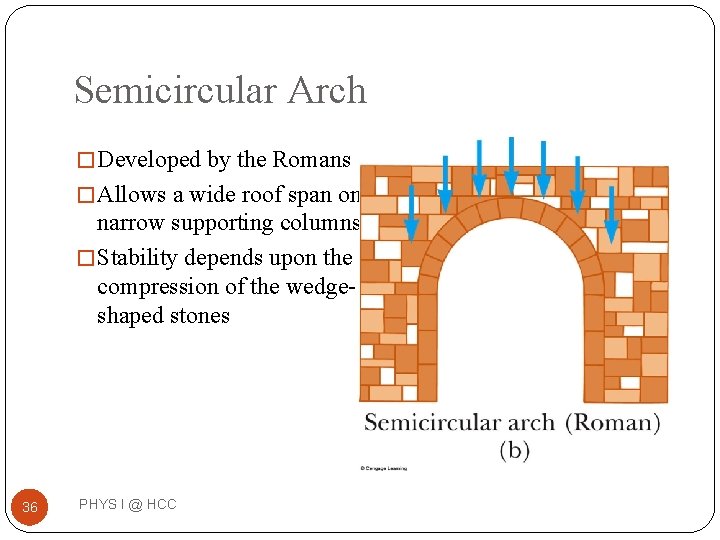
Semicircular Arch � Developed by the Romans � Allows a wide roof span on narrow supporting columns � Stability depends upon the compression of the wedgeshaped stones 36 PHYS I @ HCC
ØBuoyant Force and Archimedes’ Principle 37 PHYS I @ HCC
Variation of Pressure with Depth �If a fluid is at rest in a container, all portions of the fluid must be in static equilibrium �All points at the same depth must be at the same pressure �Otherwise, the fluid would not be in equilibrium �The fluid would flow from the higher pressure region to the lower pressure region 38 PHYS I @ HCC
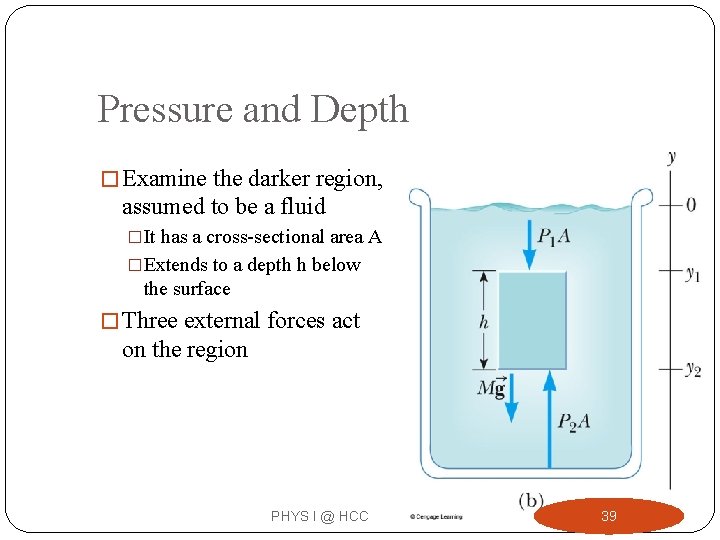
Pressure and Depth � Examine the darker region, assumed to be a fluid �It has a cross-sectional area A �Extends to a depth h below the surface � Three external forces act on the region PHYS I @ HCC 39
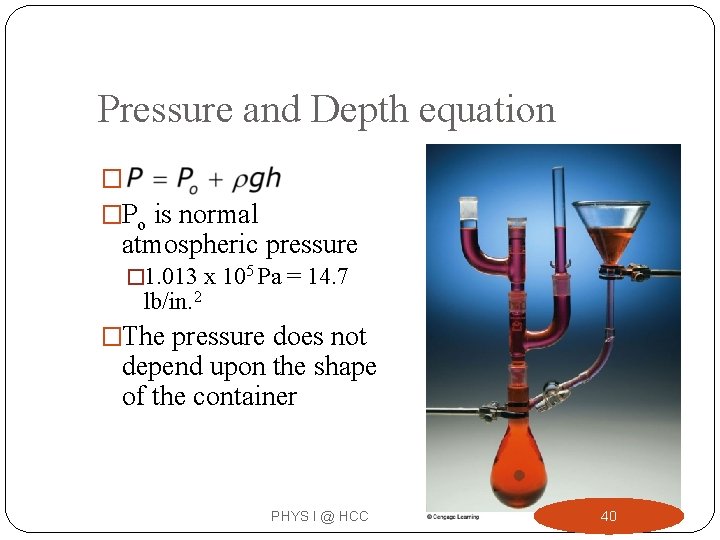
Pressure and Depth equation � �Po is normal atmospheric pressure � 1. 013 x 105 Pa = 14. 7 lb/in. 2 �The pressure does not depend upon the shape of the container PHYS I @ HCC 40
Pascal’s Principle �A change in pressure applied to an enclosed fluid is transmitted undimished to every point of the fluid and to the walls of the container. �First recognized by Blaise Pascal, a French scientist (1623 – 1662) 41 PHYS I @ HCC
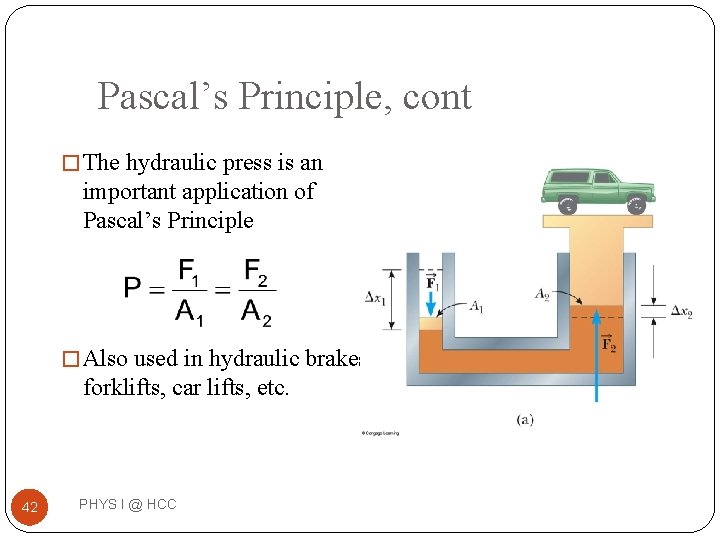
Pascal’s Principle, cont � The hydraulic press is an important application of Pascal’s Principle � Also used in hydraulic brakes, forklifts, car lifts, etc. 42 PHYS I @ HCC
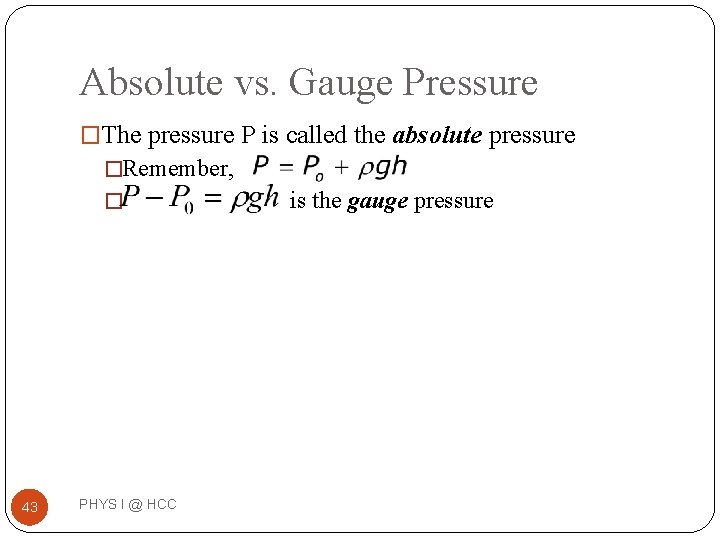
Absolute vs. Gauge Pressure �The pressure P is called the absolute pressure �Remember, � 43 PHYS I @ HCC is the gauge pressure
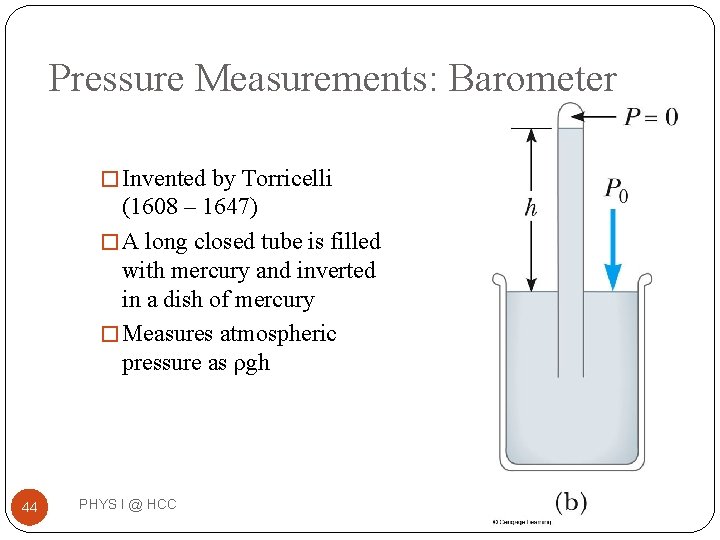
Pressure Measurements: Barometer � Invented by Torricelli (1608 – 1647) � A long closed tube is filled with mercury and inverted in a dish of mercury � Measures atmospheric pressure as ρgh 44 PHYS I @ HCC
Pressure Values in Various Units �One atmosphere of pressure is defined as the pressure equivalent to a column of mercury exactly 0. 76 m tall at 0 o C where g = 9. 806 65 m/s 2 �One atmosphere (1 atm) = � 76. 0 cm of mercury � 1. 013 x 105 Pa � 14. 7 lb/in 2 45 PHYS I @ HCC
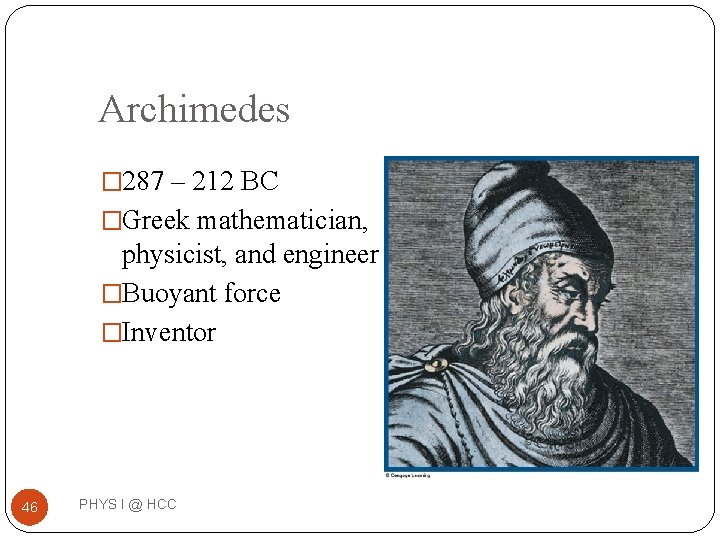
Archimedes � 287 – 212 BC �Greek mathematician, physicist, and engineer �Buoyant force �Inventor 46 PHYS I @ HCC
Archimedes' Principle �Any object completely or partially submerged in a fluid is buoyed up by a force whose magnitude is equal to the weight of the fluid displaced by the object 47 PHYS I @ HCC
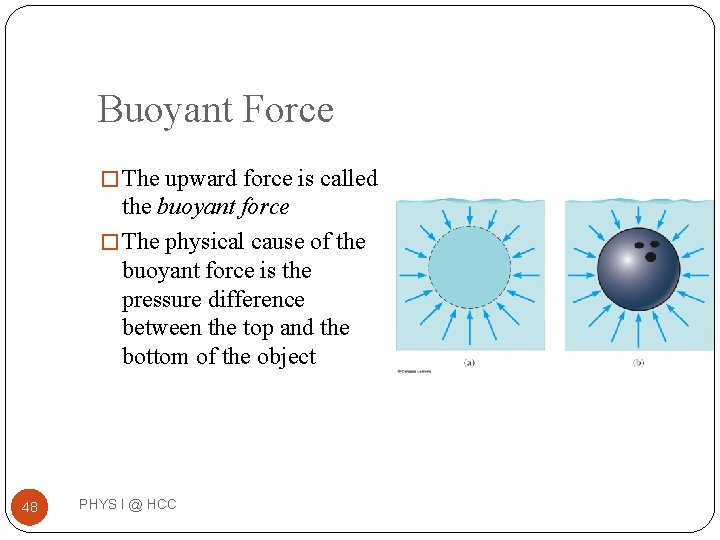
Buoyant Force � The upward force is called the buoyant force � The physical cause of the buoyant force is the pressure difference between the top and the bottom of the object 48 PHYS I @ HCC
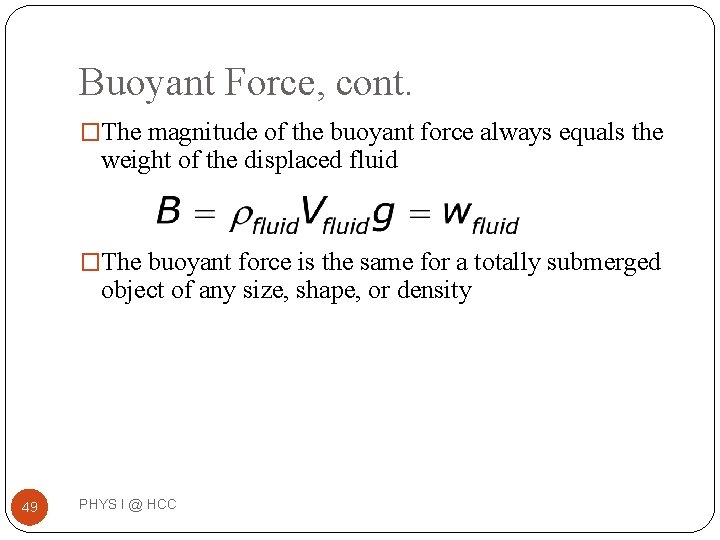
Buoyant Force, cont. �The magnitude of the buoyant force always equals the weight of the displaced fluid �The buoyant force is the same for a totally submerged object of any size, shape, or density 49 PHYS I @ HCC
Buoyant Force, final �The buoyant force is exerted by the fluid �Whether an object sinks or floats depends on the relationship between the buoyant force and the weight 50 PHYS I @ HCC
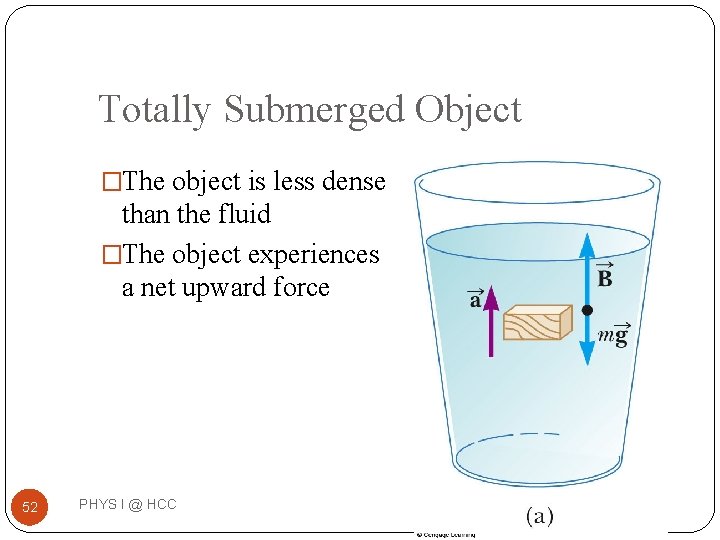
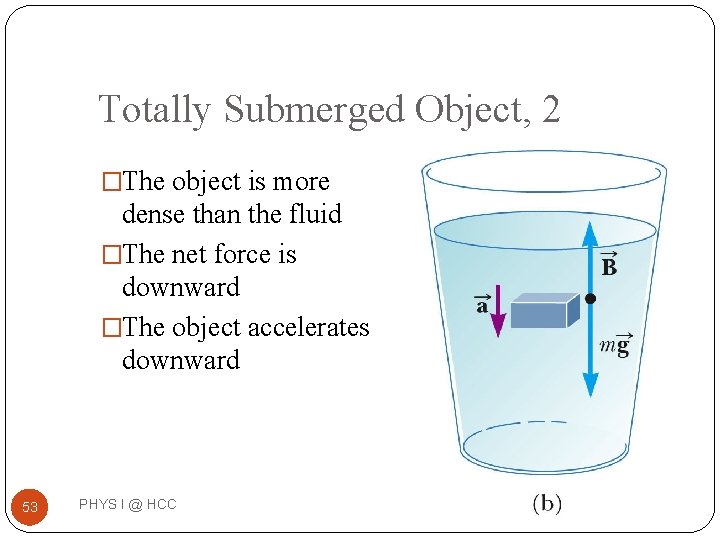
Archimedes’ Principle: Totally Submerged Object �The upward buoyant force is B=ρfluidg. Vobj �The downward gravitational force is w=mg=ρobjg. Vobj �The net force is B-w=(ρfluid-ρobj)g. Vobj 51 PHYS I @ HCC
Totally Submerged Object �The object is less dense than the fluid �The object experiences a net upward force 52 PHYS I @ HCC
Totally Submerged Object, 2 �The object is more dense than the fluid �The net force is downward �The object accelerates downward 53 PHYS I @ HCC
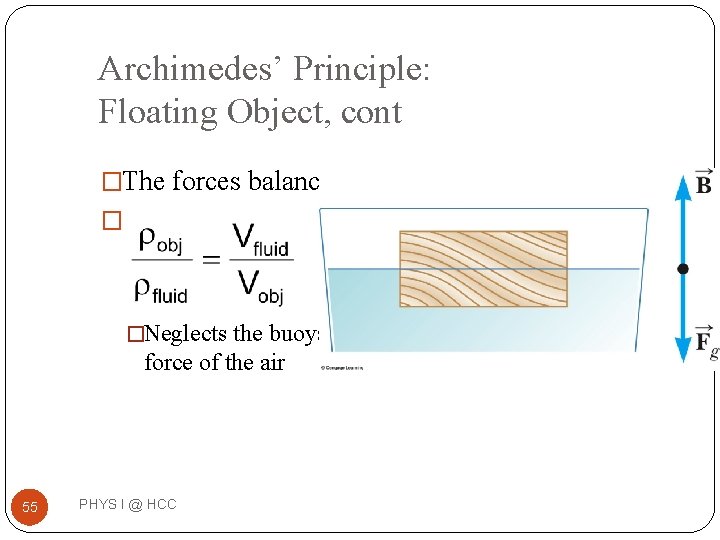
Archimedes’ Principle: Floating Object �The object is in static equilibrium �The upward buoyant force is balanced by the downward force of gravity �Volume of the fluid displaced corresponds to the volume of the object beneath the fluid level 54 PHYS I @ HCC
Archimedes’ Principle: Floating Object, cont �The forces balance � �Neglects the buoyant force of the air 55 PHYS I @ HCC
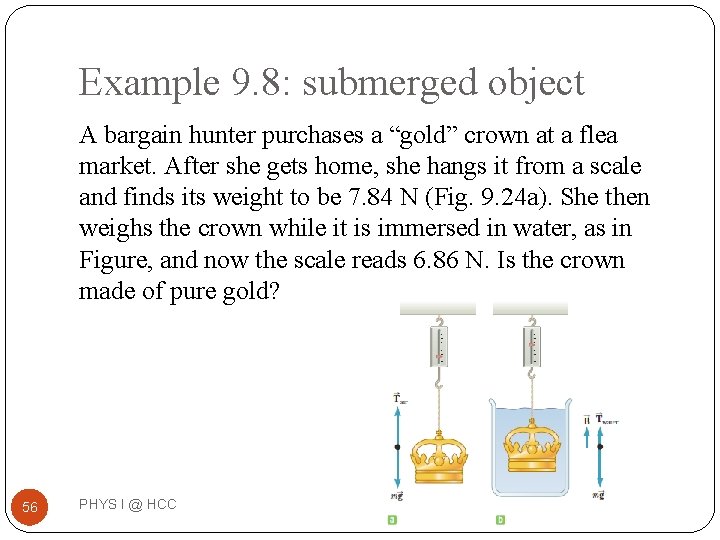
Example 9. 8: submerged object A bargain hunter purchases a “gold” crown at a flea market. After she gets home, she hangs it from a scale and finds its weight to be 7. 84 N (Fig. 9. 24 a). She then weighs the crown while it is immersed in water, as in Figure, and now the scale reads 6. 86 N. Is the crown made of pure gold? 56 PHYS I @ HCC
Homework 3, 6, 12, 13, 21, 29, 31, 35, 38, 41 57 PHYS I @ HCC