
Chapter 9 Social Cognitive Theory Created by Leslie
Chapter 9: Social Cognitive Theory Created by: Leslie De la Fuente
What is the Social Cognitive Theory? • Albert Bandura -is considered to be the driving force behind the social cognitive theory. • His main goal is to explain how learning results form interaction among three factors: – Personal characteristics – Behavioral patterns – Social environment
Triadic Reciprocal Causation • “Ones internal processes, behavior, and social environment can affect one another to produce learning” • Personal Characteristics- include mental and emotional factors, metacognitive knowledge, and self-efficacy. • Behavioral patterns- self observation, self evaluation, creating productive study environments • Environmental factors-refers to an individual’s social and physical environment.

Triadic Reciprocal Causation Model: Personal Characteristics Behavior Environment
Personal Agency • Self-control: (self-discipline) is the ability to controls one’s actions in absence of external reinforcement or punishment. Ex. A student who has been taught to begin a new task after finishing seatwork. • Self-regulation: consistent and appropriate application of self-control skills to new situations. Ex. A teacher who modifies her lesson plan to focus on students interest in stories, monitors reaction, compares her performance and her students and rewards herself if the standard has been met.
Cont. Personal Agency • Self-efficacy: how capable one feels to handle particular kinds of tasks. Ex. A student with a high self-efficacy in math may have a different level of self-efficacy for literature. • Self-efficacy beliefs occupy a central role in the social cognitive theory.
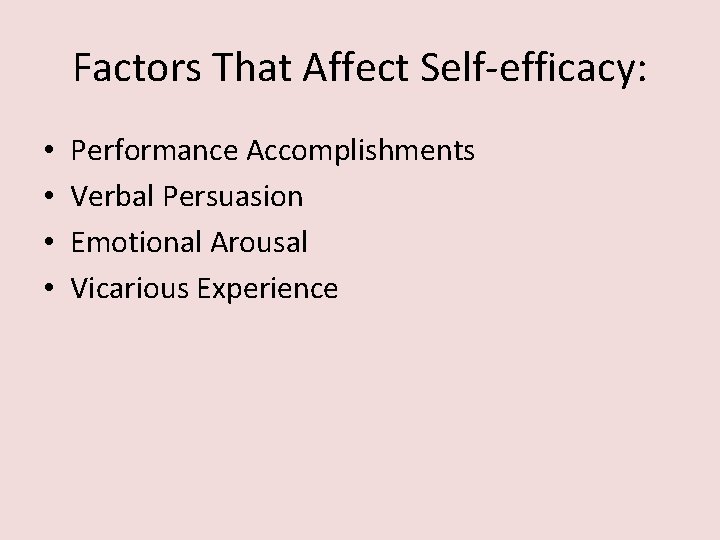
Factors That Affect Self-efficacy: • • Performance Accomplishments Verbal Persuasion Emotional Arousal Vicarious Experience
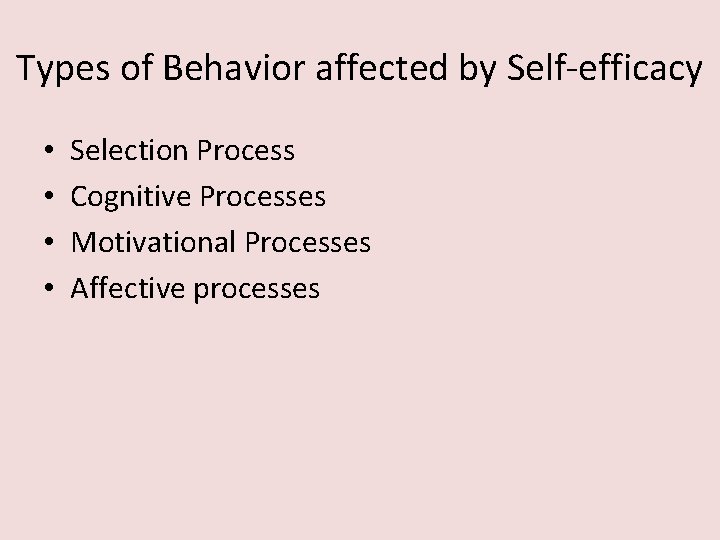
Types of Behavior affected by Self-efficacy • • Selection Process Cognitive Processes Motivational Processes Affective processes
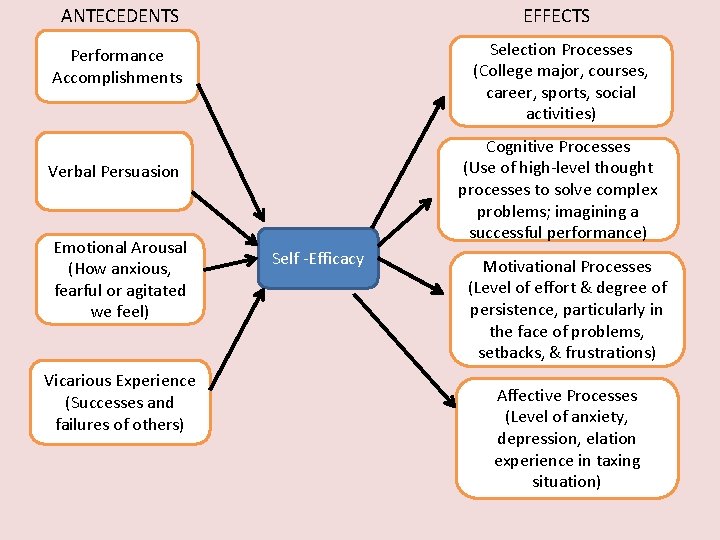
ANTECEDENTS EFFECTS Performance Accomplishments Selection Processes (College major, courses, career, sports, social activities) Cognitive Processes (Use of high-level thought processes to solve complex problems; imagining a successful performance) Verbal Persuasion Emotional Arousal (How anxious, fearful or agitated we feel) Vicarious Experience (Successes and failures of others) Self -Efficacy Motivational Processes (Level of effort & degree of persistence, particularly in the face of problems, setbacks, & frustrations) Affective Processes (Level of anxiety, depression, elation experience in taxing situation)
The Components of a Self-Regulatory System • Forethought Phase: is subdivided into to categories of task analysis. * Self-regulated learners set goals, create plans to achieve those goals • Performance Phase: Contains several selfregulatory processes , self-control category & the self-observation category. * Self-regulated learners focus on task, process information meaningfully, self-monitor
The Components of a Self-Regulatory System Cont’d • Self-Reflection Phase: is self-judgment and self -reaction. * Self-regulated learners evaluate their performance, make appropriate attributions for success and failure, reinforce themselves.
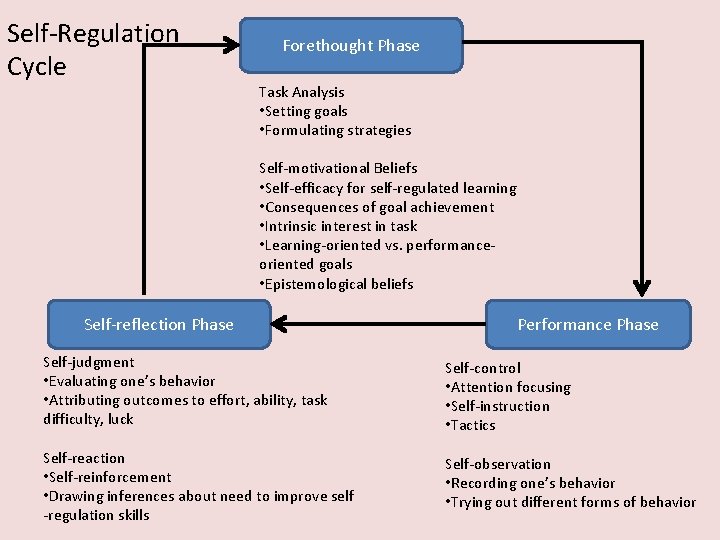
Self-Regulation Cycle Forethought Phase Task Analysis • Setting goals • Formulating strategies Self-motivational Beliefs • Self-efficacy for self-regulated learning • Consequences of goal achievement • Intrinsic interest in task • Learning-oriented vs. performanceoriented goals • Epistemological beliefs Self-reflection Phase Performance Phase Self-judgment • Evaluating one’s behavior • Attributing outcomes to effort, ability, task difficulty, luck Self-control • Attention focusing • Self-instruction • Tactics Self-reaction • Self-reinforcement • Drawing inferences about need to improve self -regulation skills Self-observation • Recording one’s behavior • Trying out different forms of behavior
Nature of Learning Tactics and Strategies • A learning strategy is a general plan that a learner formulates for achieving a somewhat distant academic goal. Ex. Getting an “A” on the next exam • A learning tactic is a specific technique that a learner uses to accomplish an immediate objective. Ex. to be able to understand concepts in a textbook chapter
Types of Tactics: • Memory-directed – rehearsal – Mnemonic devices • Comprehension-directed – Self- and peer questioning – Note taking – Concept mapping
Memory Directed Tactics • Rehearsal- simplest form is rote rehearsal used at early childhood age. * Rote rehearsal not a very effective memory tactic • Mnemonic Devices- such as acronym, acrostic, loci method, & keyword method. * Mnemonic devices meaning fully organize information, provide retrieval cues.
Comprehension-Directed Tactics • Self- and Peer Questioning- improves comprehension, and knowledge integration • Note Taking- taking notes and reviewing notes aid retention and comprehension • Concept Mapping- is a technique that helps students identify, visually organize, and represent the relationships among a set of ideas.
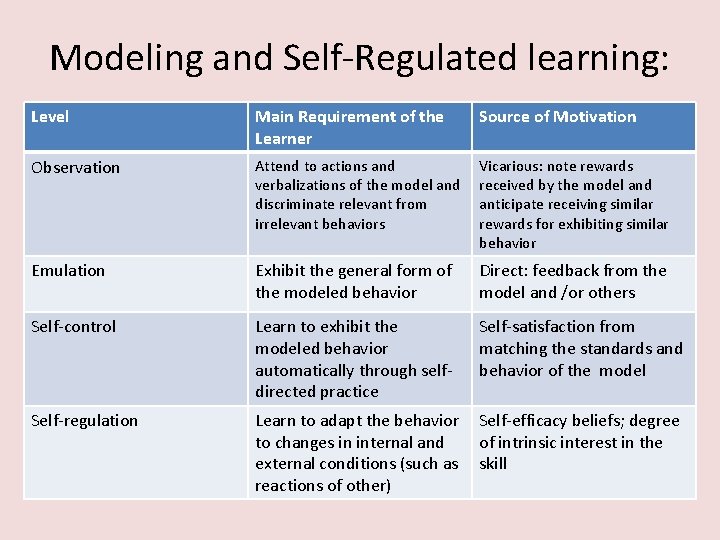
Modeling and Self-Regulated learning: Level Main Requirement of the Learner Source of Motivation Observation Attend to actions and verbalizations of the model and discriminate relevant from irrelevant behaviors Vicarious: note rewards received by the model and anticipate receiving similar rewards for exhibiting similar behavior Emulation Exhibit the general form of the modeled behavior Direct: feedback from the model and /or others Self-control Learn to exhibit the modeled behavior automatically through selfdirected practice Self-satisfaction from matching the standards and behavior of the model Self-regulation Learn to adapt the behavior to changes in internal and external conditions (such as reactions of other) Self-efficacy beliefs; degree of intrinsic interest in the skill
Research on Social Cognitive Theory • Improving students’ mathematical problem solving skills – Peer models – Self-modeling • Improving Students’ writing skills – Modeling for strategy development – Observing weak and strong models – Modeling versus practice
Using Technology to promote Self. Regulated Learning • Modeling-computer based video model • Cognitive and Metacognitive Feedbackcomputers have filled this missing space to provided precise feedback • Scaffolded Instruction (Vygotsky’ theory)computer based instructional aid
- Slides: 19